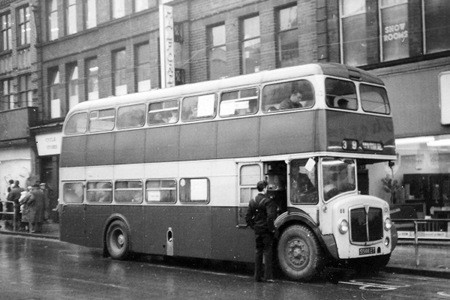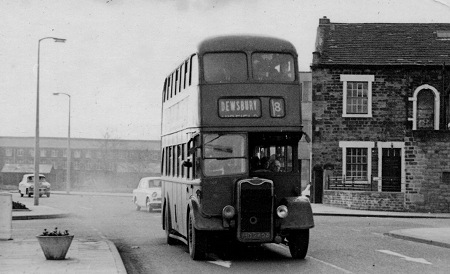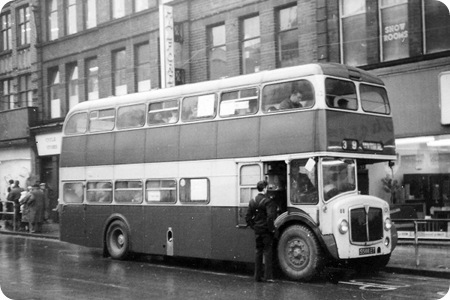
Rotherham Corporation
1964
AEC Renown 3B3RA
Roe H39/31F
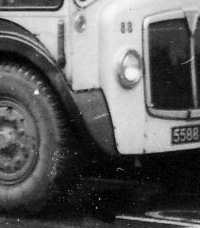
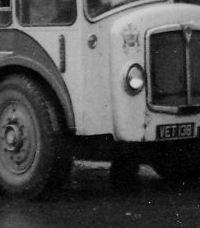
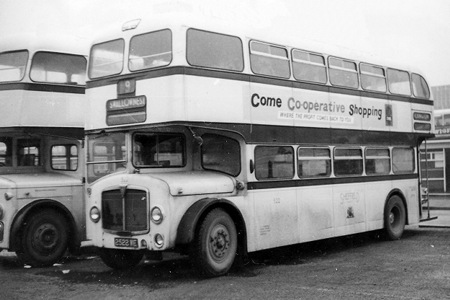
There has also been a 1961 Rotherham Corporation Bridgemaster on site (link here) and the easy way to tell them apart was the front off side mudguard. It is easier to show than describe so the close up on the left is the Renown and the one on the right is the Bridgemaster.
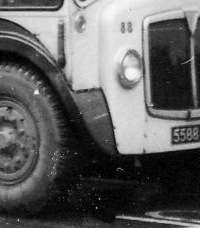
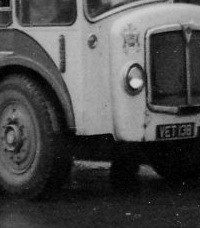
As you can see the Renown’s mudguard follows through the body where as the Bridgemaster’s body goes over the mudguard and this was always the case with these two buses.
This Renown has the AEC code of 3B3RA which meant it had an AEC 9.6 litre six cylinder engine with a 4 speed synchromesh gearbox and air brakes. There was only one alternative the 3B2RA and the only difference was it had the Monocontrol direct selection gearbox. One thing I have noticed which I find strange is that this Renown’s drivers cab door slides backwards on the outside of the body to open it normally the door slid forwards inside the cab.
A full list of Renown codes can be seen here.
———
If you look at the position of the cab door opening in relation to the front wheel it is obvious why the sliding door is external. If it was internal the wheel arch leaves nowhere for it to go, unless the door were made unreasonably shallow to pass over the top of the mudguard. For the same reason Lodekkas and other low-height buses always had hinged cab doors. The only exception seems to be the Albion Lowlander, as bodied by NCME and Alexander, where the coachbuilders raised the cab ceiling above the level of the main upper saloon floor (and raised the foremost seats to perch on top of the cab). That gave sufficient headroom to allow an internally-sliding cab door of conventional style.
David Jones
———
I’m not absolutely certain but weren’t these the only Renowns bodied by Roe? (although obviously to a Park Royal design)
Ian Wild
———
Yes, Ian. As was common in the sixties and seventies, whenever Park Royal was hard pressed, they subcontracted to their (smaller) Yorkshire partner. Geoff Lumb’s excellent book on C H Roe records in words and pictures that the Rotherham Renowns were built at Crossgates.
David Oldfield
———
11/09/12 – 06:43
I think I have a photo somewhere in my possession that show an EYMS Renown at Roes too, or am I dreaming there?
Graham
Quick links to the - Comments Page - Contact Page - Home Page
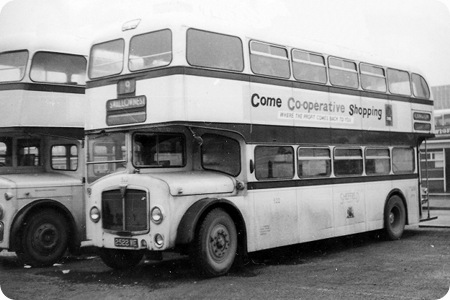
Sheffield Corporation
1959
AEC Bridgemaster
Park Royal H45/31R
Here we have a shot of one of Sheffield Corporations rear entrance AEC Bridgemaster. There was a shot of a Sheffield front entrance earlier this year (link here) and we had 2 comments disputing information, so I have done a bit of research and come up with the following.
There was six rear entrance Bridgemasters fleet no 519 – 524, 519 was delivered January 1959 and the remaining 5 were delivered in February 1959. Incidentally there was only two other production chassis built before the Sheffield six one for each Walsall no 825 and Belfast no 550, there was five other chassis but they were for AEC themselves demonstrators and test vehicles I suspect. The chassis numbers for the six were 007 – 012, it is not until April 1961 and chassis number 104 that the one and only front entrance Bridgemaster for Sheffield was built making seven in total.
So I hope that this sorts out the query into the number of Sheffield Bridgemasters, (unless you know different), my thanks to Bus lists on the Web (see credits) for most of the information.
———
“519-524 were rear entrance with a row of five rear facing seats, Lodekka style, at the front of the saloon. This covered the gearbox/differential housing – which can be seen at the front of the saloon of all traditional half-cabs. On Bridgemasters, this was extra large – hence the reason on the front entrance version for the doors to be set further back and the strange small window.”
David Oldfield
———
04/05/11 – 07:02
519 was a Commercial Motor Show exhibit in November 1958 prior to delivery. It was something of a tradition for Sheffield to have a new vehicle exhibited at what was then a bi-annual show. These were Sheffield’s first 30ft long double deckers and initially operated for a number of years on the 101 and 102 services to Gleadless and Herdings. They were later moved to the Dinnington services 6 and 19 where their low height enabled them to operate under the low railway bridge at South Anston. They had air suspension on the rear axle which I recall gave quite a bouncy motion as passengers boarded and alighted.
Ian Wild
———
05/05/11 – 06:53
…..and they hissed audibly.
David Oldfield
———
I would like to mention that the AEC Bridgemaster No.519 was a show model at Earls Court in September 1958. In early December it arrived at Queens Road and one lunchtime I rushed to the Works to catch a sight of it. My reward was to see the Rolling Stock Engineer, Ted Bale, climb into the cab, saying he was taking it to Leadmill Road. Unfortunately, I was not invited aboard. Taking a 101 route AEC Regent III to city, I alighted near to the depot, arriving there to hear Ted tell the Regulator, "Do a changeover and put it straight into service" on the 101 or 102 Gleadless route. The date was around 10th-12th December 1958.
Keith Beeden
Quick links to the - Comments Page - Contact Page - Home Page
Photograph by ‘unknown’ if you took this photo please go to the copyright page.
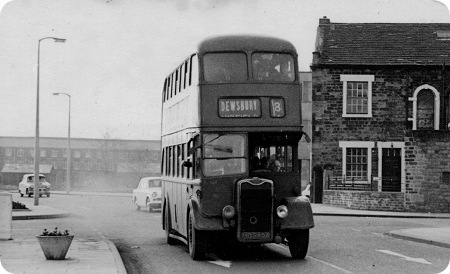
Yorkshire Woollen District
1943
Guy Arab II 6LW
Roe H56R
Here is a a good shot of a Guy Arab II going about it’s business in the Yorkshire mill town area of Dewsbury. The 6LW after the make and model means that this bus had a Gardner 8.4 litre 6 cylinder diesel engine there was only one alternative at the time a Gardner 5LW 7.0 litre 5 cylinder diesel engine. This bus had a straight forward four speed crash gearbox and a vacuum assisted hydraulic braking system, the original body on this bus would have been of a utility style, all very basic but then it was built during wartime. It was rebodied around 1953 there is more on that subject and an excellent comment for the reason why here.
———
12/08/12 – 07:29
Please could anyone tell me what year Central Works Savile town closed as I worked their from 1973 to 1978
Ray
———
22/10/12 – 16:56
In answer to Ray’s question, when did YWD Central Works Dewsbury close, the time was August 1983 when the entire operation, including staff was transferred to Belle Isle at Wakefield. The function was then combined with the West Riding central works. A new machine shop and fuel injection-"pump" shop was then established as previously all fuel injection work was carried out at the Dewsbury site. I too worked at YWD, and started work there as an apprentice fitter in July 1963
David Howram
Quick links to the - Comments Page - Contact Page - Home Page