Old Bus Photos

Yorkshire Traction – Leyland Titan PD2 – VHE 193 – 1193
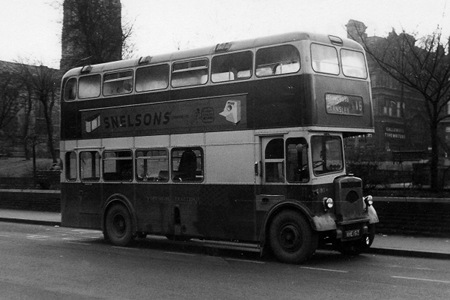
Yorkshire Traction - Leyland Titan PD2 - VHE 193 - 1193

Yorkshire Traction
1961
Leyland Titan PD2 
Roe H35/28F

Here we are in Huddersfield again on the road where all the non Corporation buses had there terminus, although the odd one did sneak in now and then. I think it was Lord Street and the building on the left is the Parish Church, this is where I think all the buses to surrounding towns i.e. Wakefield, Dewsbury and Barnsley for example started there journey.
Anyway this is a very interesting bus, I have titled it as a Leyland Titan PD2 as it was listed in my ‘British Bus Fleets’ book but actually it was a re-bodied Leyland Tiger PS2/1.
I found in the Roe body list on the ‘Bus Lists on the web’ website that the original Leyland Tiger registration was EVH 211, knowing that VH was an Huddersfield registration I thought I would try to find out who owned it originally. I ruled out the corporation as they were more into AEC single deckers, no way would it be ex Hanson they would have re-bodied it for themselves several times. Then I remembered that Yorkshire Traction were part owners of the Huddersfield based County Motors, so onto the ‘Huddersfield PTG’ website and sure enough there it is EVH 211 fleet no 83 a 1949 Tiger PS2/1 with a Roe B34F body. If you would like to see what it looked like originally there is a link here you will have to scroll half way down the page to find it.


Tracky rebuilt and refurbished many PS1 and PS2 Tigers – so much that they merited new registration numbers. They were always referred to as Tigers, not Titans, after their rebuild and re-registration.

David Oldfield


YTC indeed did rebuild a significant number of obsolete half cab single decks, not all of which were for themselves – for example Stratford Blue had a similar bus to the one shown.
The chassis were, more accurately, built using PD2 chassis rails with running gear and other components salvaged from the donor vehicle.
YTC had an honourable tradition of rebuilding/re-bodying, as an example look no further than the preserved Tiger number 492 with its’ post-war body.
The last vehicles to be rebuilt were the three Leopards in NBC days – Numbers 153/4 and 386.
The first two were, in principle the same format as the PS2s i.e. the donor vehicles (ex Yorkshire Woollen in this case) were simply donors of components as the vehicles had updated chassis rails to PSU3E spec. They received Plaxton Supreme bodies with new registrations. Interestingly they had YTC chassis numbers. The 3rd vehicle in the exercise was very heavily rebuilt utilising the original chassis and body frame with updated running gear, it also gained a new registration.

Andrew


I worked for YTC when 153/4 were in for rebuild. The original chassis rails were retained, also no change to the O600 engine and keeping the original 4 speed gearbox made the outcome very predictable. There was no consideration given as to what type of service these buses would be used on. End result, underpowered and lack of top speed.

Trackyman


29/08/12 – 12:17

If ever there was a box on wheels then this was it It must be amongst the top three ugliest buses ever So bad were these that YTC adopted a modified livery for them to improve their looks but to no avail.
Similar conversion with NCME bodies were very attractive in contrast.

Chris Hough


29/08/12 – 14:55

I agree, Chris, but what are your other two? They certainly did Roe’s reputation no good at all. [People would see the name Roe, not realising it was a PRV design.]

David Oldfield


29/08/12 – 16:38

David my other personal two are Northern Counties Nottingham style bodies supplied to A1 Lytham and Stratford Blue and the ECW bodies supplied to South Yorks PTE complete with peaks fore and aft. I think Colchester also bought some like the Roe rebuilds how could they sink so low.

Chris Hough


29/08/12 – 18:56

I think the ECWs were, essentially, a SYPTE "design" improvement which (sorry, here I go again) ruined the balance and symmetry of the original. They also resulted in some atrocious blind spots which were cured by cutting holes in the pillars to provide better vision. Why on earth Colchester then bought them, goodness only knows. Did anyone else?

David Oldfield


13/05/15 – 06:50

I worked in the body shop at Yorkshire Traction for nearly 50 years from 1956. I had a hand in lifting the old single deck bodies off before the mechanics took over and did a full strip down. The Leyland PS1s were sent to Charles Roe and were fitted with light weight double deck bodies. They were fine for the first few years , but when the metalastic bearer end brackets became tired they creaked and groaned like an old sailing ship when cornering.The PD2s were sent to Northern Counties and the last batch went to Charles Roe, but were built to a design by Park Royal. They certainly looked a little strange. In later years on having passed my PSV all types driving test I had the pleasure of driving on service most of the Leyland conversions.I think of all the various types of buses I drove at Yorkshire Traction my favourite without doubt was the PD2.

Barrie Micklethwaite


18/06/15 – 16:45

To confirm the location, it is Lord Street, Huddersfield where most (all?) the Tracky and County routes terminated.

Tim Jackson


30/05/20 – 06:50

The comments about these re-bodied buses have made interesting reading, I drove these many times in the late 60`s and early 70`s, the crews called them "Banana Boxes", among other things, and you certainly needed to be aware of what type of bus you were driving when it came to these, the body was very light, and when fully loaded they rolled alarmingly on bends, the Vacuum braking system needed thought too, nothing seemed to happen for ages when you pressed the brake, so stopping accurately needed advance planning to allow for they delay, like all the PD2s and PD3s, being half cab they were warm in winter, during the summer it was nice to ride about with the sliding cab door open, and the full window clipped back over the bonnet to get plenty of air, If memory serves me the PD1s had hinged doors and had to stay closed, but you could still open the window.

busman25


Quick links to the  -  Comments Page  -  Contact Page  -  Home Page
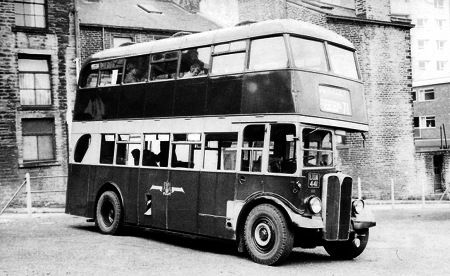


Leeds City Transport – AEC Regent III – LUA 441 – 441

Leeds City Transport AEC Regent III
Photograph by ‘unknown’ if you took this photo please go to the copyright page.

Leeds City Transport
1948
AEC Regent III
Roe H31/25R

This bus was one of quite a few Leeds City buses sold to or on loan to Halifax Corporation in 1964, they were never painted in the Halifax livery obviously not destined to stay long, in fact they were withdrawn one year later. I am not quite sure why they were at Halifax maybe they were short of buses as 20 Leyland Titan PD2s were delivered in 1965 if there is another reason let me know. I have headed this bus as Leeds and not Halifax as it actually kept its Leeds crest, I think only the fleet number and the destination blind changed.

———

In 1964 Halifax acquired a small number of recently withdrawn AEC/Roe Regent IIIs from Leeds City Transport. This was to cover a delay in new chassis deliveries due to difficulties at the body builders Weymann who had a protracted strike at that time.

Chris Hough

———

08/09/11 – 14:15

Hi Chris,
Did they call your dad Tommy, if so he had me as a trainee conductor in 1960, was his drivers name Burdett? I spent six years at Bramley as a conductor than driver. I became a ticket Inspector in 1968 and a depot inspector in 1969, spending my last 10 years as a depot inspector at Torre Road.
Happy days.

Ian Powell

———

10/09/11 – 08:18

Hi Ian
My dad was called Tommy and he did spend many years working with a driver called Burdett whose first name was Arthur. Later he worked with Johnnie Calvert who was a character and drove the first one man double decker in 1969 His final driver was Dick Clough who was one of the last tram drivers. My dad retired in 1984 but sadly passed away in 1985 I still have his LCT cap badges and PSV conductors badge. Sadly as an outsider I feel that much of the fun enjoyed by bus people in my dad’s day no longer occurs.

Chris Hough

———

04/11/11 – 07:12

Does anyone know where I can see or buy photos of Leeds City Transport Department buses in the BLUE livery which lasted certainly until about 1950, and possibly until the disappearance of the trams in the late 1950s? I particularly want a picture of a No 41 Colton bus. I live in Colton 1949-1951, and can still ‘smell’ the interior of these buses. I’ve sought these pictures in vain on all the websites I can find.

Harry Cockerham

———

05/11/11 – 07:00

try the sales stalls at Dewsbury bus museum on 13.11.11

Ken Wragg

———

05/11/11 – 07:01

The last buses delivered to LCT in the blue livery were twenty five Roe bodied AEC Regents numbered 601-625 NUB601 etc
Coloured pictures of Leeds buses in blue are not often seen There is a 1949 AEC Regent under restoration at Keighley bus museum which will carry blue livery Also there is a Roe PS1 in postwar blue and two pre-war AEC Regents in pre-war blue There are pictures of all these vehicles on www.sct61.org.uk

Chris Hough

———

05/11/11 – 07:02

Chris Hough – after Arthur Burdett became an OMO driver he was also one of the first on the 49 route from Old Farnley to Hyde Park – and if I remember rightly he was also a TGWU official.

Chris Youhill

———

10/11/11 – 17:05

Chris Hough – A thousand thanks for your response. I just can’t say how grateful I am, having found two photos of No. 41 Leeds buses in Colton on the website you gave details of. Will try to contact the copyright holders. Thank you again.

Harry Cockerham

———

12/11/11 – 06:08

Glad to be of help Harry. The shot of the Leeds CVG6 in the snow at Colton was taken by me please feel free to use it for personnal use.

Chris Hough

———

12/11/11 – 14:50

Ditto, Harry you can also use mine of VUG 547 in Colton for personal use.

Paul Haywood

———

16/03/12 – 15:46

Leeds 441 is on a June 1965 tour, a few days before it was withdrawn from Leeds service. This tour took the bus and its enthusiast passengers to Bradford, then Halifax where it joined former Leeds 440 and a couple of others, in Halifax service as a stop-gap due to late delivery of new Halifax buses.
Photo I think is behind the railway arches at Stanningley Bottoms, parked just of Richardshaw Lane. I have similar photos in colour and black and white a spot of blind-twiddling was indulged in and quite a few tour participants had a go at photographing the bus here.
441 never became a Halifax bus; it was sold for scrap. Pity really. It and its sisters weren’t in bad shape considering their age-several years of life left in them for sure.

A. D. Young

———

17/03/12 – 06:16

An interesting photo and if I may try to be helpful, certainly not critical, I can’t recognise the surroundings as being anywhere familiar near those railway arches. Top right of the view shows some multi storey flats nearby and I can’t think which they could be.

Chris Youhill

———

17/03/12 – 07:07

The picture of 441 was taken on the spare parking ground at the top of the old Crossfield Bus Station in Halifax.

Philip Carlton


Quick links to the  -  Comments Page  -  Contact Page  -  Home Page
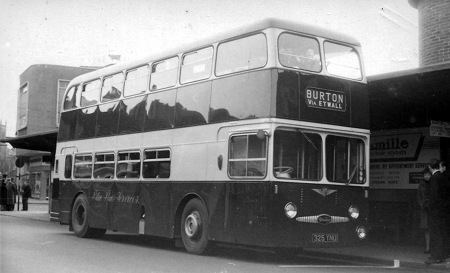


Blue Bus Services – Daimler Fleetline – 325 YNU

Blue Bus Services Daimler Fleetline
Photograph by ‘unknown’ if you took this photo please go to the copyright page.

Blue Bus Services
1962
Daimler Fleetline CRG6LX
Northern Counties H40/33F

Blue Bus Services was the operating name of Tailby & George who were located at Willington in Derbyshire.
This bus was the 54th Fleetline chassis built its sister vehicle registration 324 YNU was the first production Fleetline chassis built numbered 60003 the three chassis before were all owned by Daimler and were number 60000 a demonstrator registration 7000 HP, 60001 an experimental chassis and 60002 a demonstration chassis. Blue Bus Services actually purchased the demonstrator 7000 HP after it had done its rounds but unfortunately it and many other buses were destroyed when the Willington bus depot burnt down in 1976. 

———

07/03/11 – 09:22

Yes a great loss, I have a rare ring binder bound book on Blue Bus by a small long gone concern known as Morley’s Bible and Book shop, Nottingham Rd, Ilkeston. from about 1978.

Roger Broughton

———

07/03/11 – 16:09

Yes, I remember visiting the shop and knew the proprietor – John Moorley (spelt that way if I remember rightly).

Stephen Ford

———

18/03/11 – 07:55

I worked for Blue Bus for 4 years as an apprentice engineer and left to go to Nottingham City Transport in 1971. It was a fantastic, varied fleet that always looked smart in the hand painted argyle blue and cream livery. Buses were properly cleaned and mopped almost daily, a standard that was probably higher than many current operators achieve nowadays.
If I can help anyone who wants to know anything about the company or their buses I will, just ask, as I was proud to work there, and it set the scene for the vehicle standards I have worked to achieve ever since as an Engineering Director.
Incidentally, my last role was the accountability for engineering and maintenance for a 70,000 bus and coach fleet in the USA and Canada, including the ubiquitous Greyhound fleet. Not bad for a Blue Bus lad from the wilds of Willington!

John Ashmore

———

18/03/11 – 09:16

Big trees from little (blue) acorns grow! Perhaps you could write a potted history for the ARTICLES section – I’m sure we’d all be interested, especially in any amusing incidents.

Chris Hebbron

———

19/03/11 – 07:59

I think that 325 YNU was one of 10 pre production chassis, another of which was PMT L899 which had a virtually identical low height Northern Counties body and was delivered in 1962. L899 had chassis number 60027 which seems a bit high for a pre production chassis but that was what I was told whilst at PMT.

Ian Wild

———

07/05/11 – 18:43

Moorleys shop is certainly long gone but the company survives as a Print and Publishing company. I have retired but still take an interest in the business. Visit //www.moorleys.co.uk for both company history and current titles published.

John Moorley

———

28/01/12 – 08:46

Hi, I wonder if someone could help me. In this thread you mention a bus with the registration 7000 HP. I have found a photo of this bus and my Mum and I believe it could be my Dad driving it. (really exiting if it is as I only have one photo of my Dad)
The bus is in a Street in Sunderland, it is the number 23, destination Roker.
I am just trying to find out what year’s this bus was on the road, and if possibly find out when it was in Sunderland, then we can see if we can match it to the years my Dad was a driver.
I hope someone can help me a little with this.
Many thanks in advance

Lorna

———

28/01/12 – 17:35

Hi Lorna – well, 7000 HP was a Daimler "demonstrator" – ie one loaned to any interested operator to see if they would like to order some after a short trial. If your picture is in Sunderland it is likely to have been on loan to the Corporation for a very short spell – it was new in 1960 and was sold by Daimler in 1966 so the Sunderland loan must have been sometime in that very wide window.

Can anyone narrow it down to a closer date?

Chris Youhill

———

29/01/12 – 16:46

Just to add to Chris’s comment, indeed this vehicle was a demonstrator and went to many operators and spent a considerable time with Birmingham City Transport. The picture here: //www.flickr.com/  and date in text may help further.

Nigel Edwards

———

29/01/12 – 20:21

Lorna, Chris: As 7000 HP was a demonstration vehicle, and the first of Sunderland’s own Fleetlines arrived towards the end of 1962, I would suggest the photo could have been taken in 1961 or 1962.

Bob Gell

———

20/02/12 – 08:54

Hi Lorna
I also have a photo of 7000 HP in Sunderland on route 23 (Thorney Close). It’s in it’s demonstration livery similar to Birmingham Corporation’s, but has Sunderland Corporation showing on the top of the near side windscreen. Unfortunately it is not dated but looks to be 1961 or 1962 as suggested. The engine bonnet cover does not look to be the extended one fitted when a wider Cummins engine was installed as a mobile test bed, so I do not think it was 1965/6, at least.

John Ashmore

———

325 YNU_lr Vehicle reminder shot for this posting

———

24/04/12 – 06:42

There is mention several times in these files of Geoff Hilditch. A former boss of mine (in Southampton City Council) once told me a story regarding the advent of the Dennis Dominator. My boss and Mr Hilditch had both worked for the same Council at one time and appear to have still been in contact when the Dominator entered the arena.
I’d have put this entry under the Dennis Dominator, but it doesn’t seem to appear in the menu on the right, so I’ll file it under Daimler instead.
Any readers who want something approaching the truth about how we came to have the Dominator, can find a suitable story on the "Encyclopaedia" website. There are some detail differences between what appears there and what my boss told me, but you’d expect that! Suffice to say that the Dominator was virtually a clone of the Fleetline.
Leyland, for their own reasons, didn’t want to sell Fleetlines to Mr Hilditch in the numbers he wanted to buy, and over the number of years he wanted to buy them. Leyland’s arrogance has been mentioned in these files, and it isn’t just relating to their bus production.

Pete Davies

———

24/04/12 – 09:07

…..but the sad thing is that we all use Leyland as a short hand for British Leyland Motor Corporation who made the proud and historic marque a toxic name and a laughing stock. Even through the bleak years, really good vehicles were produced AN68s, Leopards and Reliances to name but three. Any problems with these were mainly as a result of BLMC ownership which starved Leyland Bus of money for R & D – and possibly quality control. [Tigers, Titans and Olympians were all delayed years because of this starvation.] We can only gasp in astonishment at the arrogance and ignorance that forced the Leyland National Mark 1 on an unsuspecting market and public – and at the expense of the Bristol RE!

David Oldfield

———

24/04/12 – 16:29

Mention of the Dennis Dominator brings to mind the Dennis test bed for this model which was a former Leeds Daimler CVGLX/30 517 7517 UA Dating from 1959 and carrying a Roe body the bus was finished in a red livery and toured operators prior to production commencing.
In its new guise it was re engined and given Voith transmission and a Loline rear axle. It was eventually bought by Leicester for spares.
A fake Dominator visited 10 Downing Street as a publicity event. It was fake because it was actually an East Lancs bodied Atlantean of Brighton with a Dennis nameplate on the front! Of course South Yorks PTE had the largest fleet of Dominators in the UK with 349 buses and the solitary Dennis trolleybus which survives at Sandtoft Museum

Chris Hough


Quick links to the  -  Comments Page  -  Contact Page  -  Home Page


All rights to the design and layout of this website are reserved     

Old Bus Photos from Saturday 25th April 2009 to Thursday 4th January 2024