Foden Works – Foden PVRF6 – OLG 855
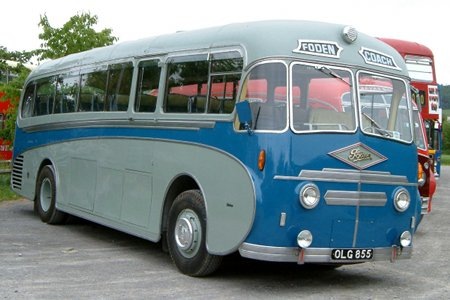
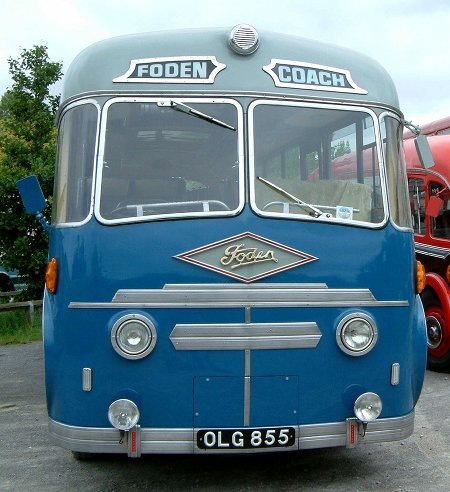
Foden Works
1951
Foden PVRF6
Plaxton C??C
These excellent shots were contributed by Andrew Charles who took them in 2005 the vehicle was restored by its present owner Nick Helliker. This particular vehicle was built for the Foden Works Brass Band who used it to travel to all their concerts until 1979 when it was replaced by another Foden vehicle. It was then laid up at the Foden factory until it was bought by an enthusiast who stored it under cover until the present owner bought it and did a full restoration to the standard you see above.
Fodens rear engine layout was way ahead of its time in 1951 as most other manufactories had just nicely switched over to underfloor engines and would stay that way for quite awhile to come. In fact Andrews comment that accompanied the shots read:-
“With it’s rear mounted two stroke engine this configuration when viewed now from sixty years on has become the norm – indeed Volvo have just delivered the last underfloor engined coach – a B12B – to Pulhams of Bourton on the Water, all future production will be rear engined.” (09/10)
The engine fitted to the above was Fodens own 4·0 litre two stroke diesel engine although there was the option to have a 8·4 litre Gardner 6LW in which case the model code would be PVRG6. I think there would have been a noticeable difference in performance as the Gardner is twice the size of the Foden engine, unless being a two stroke made a difference in which case why did it never catch on with other engine manufactories. The body for the above was built in Scarborough by Plaxton and was based around their Venturer model. I am rather curious to know what the circular grill in the roof above ‘Foden Coach’ is, a large air horn perhaps.
Oh does anyone know what the seating capacity is?
Photograph contributed by Andrew Charles
Lovely pictures of a fine vehicle. Direct comparison of the engine capacities (4.1-litre Foden versus 8.4-litre Gardner) is, as Andrew suggests, complicated by the fact that in the two-stroke engine each cylinder delivers power at every revolution—not every other revolution as in the four-stroke—and so should develop double the torque. You would therefore reasonably expect that with air delivered to the cylinders at atmospheric pressure a 4.1-litre 2-stroke would develop torque equivalent to that of an 8.2-litre 4-stroke, but in practice inlet air pressure has to be well above atmospheric in order to scavenge the exhaust AND fill the cylinder with a clean charge of new air all in one go, so a blower has to be provided. Whether this blower is seen as a mere scavenger or as a supercharger depends on the amount of excess air it provides.
On p98 of the 1953 edition of Commercial Motor’s "The British Commercial Vehicle Industry" the Gardner 6LW as fitted to Foden passenger vehicles is shown as developing 358 lb/ft torque at 1,300 rpm and the Foden 2-stroke engine as giving 350 lb/ft at 1,500rpm.
Gardner maximum power is 112 bhp at 1,700rpm against the Foden’s 126 bhp at 2,000 rpm. Not much difference in on-paper torque, then, but in real life you had to keep the Foden engine spinning, as low-speed torque fell off alarmingly. Hence the need for the 12-speed gearboxes used for example in those wonderful howling Hoveringham gravel lorries. I’ve never driven a Foden of any kind, but I had a day in a 3-cylinder 2-stroke Commer coach belonging to Spiers of Henley-on-Thames which really NEEDED its 2-speed axle to allow you to keep the engine whirring within it optimum range. My guess is that the Foden 2-stroke didn’t catch on with PSV operators because of a) exhaust noise, b) reasonable but not wonderful fuel consumption, c) maintenance costs and d) inability to lug at low revs.
Incidentally, Foden later added a turbocharger and planned a 7-cylinder version. Does anyone know what became of it?
Ian Thompson
Memories, memories: this site is therapy. Do I remember that the Foden engine sounded like one of those old dumpers? Presumably the idea was to keep the weight down at the back.
I’d say that the grille at the front was a vent- there don’t seem to be many others: it probably pushed the tubas ciggie smoke along a bit….
Lovely looking coach for its time, though.
Joe
My late father had the opportunity to drive a wide selection of vehicles during his war service with the army and always maintained that the very best lorries were the Fodens. They certainly seemed to uphold this reputation right up to the end – including the small foray into buses – producing vehicles of a very high quality. Surprising then that they did not make bigger inroads into buses than they did – but their niche market of specialist trucks was probably more profitable and time consuming.
The Plaxton Centenary book simply describes the grille as an air intake. For engine, passenger or tuba player it does not say.
David Oldfield
I think the reason Foden didn’t make greater inroads into the bus market was the same as for the ill-fated Daimler CD650 – Fodens were rather complicated and probably rather expensive. Most transport managers of those days were pragmatic and conservative, preferring something familiar that was known to be good enough rather than something unknown that might just possibly be better.
As for the two-stroke engine, Ian has explained it perfectly. The reason that torque fell off alarmingly at low revs was that the blower couldn’t keep up, and so alternate firing strokes would become weakened as the engine tended towards a four-stroke cycle. I owned the ex Samuel Ledgard two-stroke Foden coach ONW 2 (front-engined) for a short while. My impression was that it was smooth, powerful and effective as a coach, but would have been hopeless for bus work. It also tended to stall when manoeuvring, as the torque would suddenly be halved by the four-stroke effect if the revs got too low. More recently I have travelled in the back of Roger Burdett’s rear-engined two-stroke, and noticed a distinct chugging sensation as it pulled out of roundabouts for the same reason, since with a wide-ratio gearbox it isn’t easy to keep the revs up.
Peter Williamson
Peter I never drove ONW 2 as I was at Otley and Ilkley Depots, but I have the most vivid memories of the stretch of the A64 dual carriageway at Whitwell. The road has a high summit and a deep trough at both ends, and many’s the time ONW 2 could be seen in the offside lane overtaking virtually everything in sight. Once in full flight that fine machine could really swallow up the miles but, as I’m of limited technical knowledge, I’ve found your explanations of the two stroke limitations most fascinating.
Chris Youhill
The above Foden was purchased by Ken Batsford from Fodens and was kept safe until purchased by present owner. I have driven many Foden trucks and with regards the Gardner vs the stroker scenario, leaving Millwall with 21 ton of timber on board me in a s36/Gardner my mate in a s36mk7 stroker on Archway Rd climbing north towards Mill Hill/M1 he would be 2 gears lower than me but pulling away from me. Once on the M1 he would leave me for dead his top speed about 65/70 mine about 50/55. When I drove a 2 stroke you had to wind it up in every gear and note the speed you shifted gears at because that’s the speed you changed down at to keep the thing pulling hard, lose the revs and you were knackered. Driving the 12 speed you started off in 2 low range up to 4 low, up to 2 direct and then 2 overdrive 3 direct and so on. Fodens were cold and noisy or hot and noisy depending on the weather but good trucks, 2 strokes suffered with cooling problems and often scrapped cylinder heads (separate head per cylinder)
Chainmaker
Ah the 2 stroke Foden. My short stint as a driver for Transglobe (B’ham) brings back the memory of one of my nosier ‘steeds’ – and having to take it to the Foden works (Sandbach) for diesel pump adjustments. I think it had a Duple body.
Nigel Edwards
Engine aside, perhaps a major reason the Foden PVR was unsuccessful was that it was fitted with Lockheed continuous flow hydraulic servo braking. Other manufacturers also tried this (Daimler, Dennis) and would be buyers stayed away in droves. It was not that brakes were particularly poor (though in the case of the earlier Fodens, if the engine stalls than braking is reduced to practically nil) but sheer complication of the system and potential maintenance problems were enough to keep people away. The only bus that really saw success with a system like this was the Routemaster which took the might of London Transport’s engineering development to take the bugs out of the design.
I am, incidentally, the current owner of another Foden PVR coach, VRF 372, currently in restoration.
Nick Webster
Chris Youhill’s comments about ONW 2 overtaking nearly everything in sight reminded me of a report from a Commercial Motor correspondent, Alfred Woolf, who hitched a ride on Salopia’s HUJ 996, one of their rear engined Observation coaches, on its way to the Nice Coach Rally. Covering 800 miles in three days on roads of dubious quality, the coach ‘left most other public service vehicles behind, even those with more powerful motors’ and ‘provided that the engine speed is kept up, few vehicles can climb as well as the Foden’. On some stretches of prime Belgian pave, flat in nature, speeds of 60 m.p.h. were seen – and maintained for many a mile. The coach took the Grand Prix du Confort et de l’Elegance award – Whitson’s fifth such award! Another rear-engined Foden, OLG 968, was taken by Fodens on an Alpine Tour to test its suitability for Continental touring. Admittedly driven hard, to assess its capabilities, the coach averaged 30.2 m.p.h. and 10.8 m.p.g. over a total distance of 2,850 miles. This included scaling no fewer than five high Alpine passes, most of which were loose surface roads! I have heard an apocryphal tale that the coach was clocked by one German driver in excess of 80 m.p.h. – downhill and out of gear! Average speeds on the German autobahns were over 50 m.p.h. and even the long run from Strasbourg to Paris (302 miles) on standard main roads was completed at an average speed of 36.4 m.p.h. Yes, the two-stroke engined coaches were fliers, but you had to keep the revs up to get the best out of them.
Peter Tulloch
13/05/11 – 06:36
I think that must be a pic of the great Fodens bus that my father talked a lot about. He has fond memories of his days at Fodens Works at Sandbach. He was there for six years in the sixties then came home to run the family business of eight wheel Fodens. I have heard many a funny story involving that machine. Does Billy Harrison ring a bell to anyone?
Lee Harrison
21/01/16 – 15:33
I think that as well as a higher purchase price and the complication of the braking system, another problem with Foden PSVs particularly in the coach application is that of resale value, here the two stroke was particularly likely to depreciate heavily, at least you could take a 6LW out and use it in about 60% of other heavyweight buses and coaches of the same era.
Stephen Allcroft
30/08/19 – 10:01
I have really enjoyed being educated again at the age of 66, on the principles of two stoke engines. In 1961 when at school I can vividly remember the heavy bulk sugar lorries of Tate and Lyle in dark blue livery heaving and struggling to re-start from traffic lights on the old A11 London to Cambridge road. The exhaust note was unbelievable and with high revs and just poured out hot shimmering heat onto my bare legs, as I only wore shorts then for school. It always surprised me that the hot exhaust gases were even directed by design towards pedestrians on the nearside pavements! – such memories
Paul Tanner
01/09/19 – 06:09
Always interesting to comment on Fodens. I have travelled around 1500 miles in mine this year so it was great to look back over the comments and think how it had performed. Mine will do 60mph (twice the 1951 speed limit for coaches) but is really comfortable bowling along at around 50mph. Fuel consumption has been between 10 and 11 mpg as compared to 14mpg for my Gardners. The brakes whilst competent do not have accumulators so engine stopping means no brakes at all-can be scary. It is a pig to drive with the gearbox being transverse behind the rear axle meaning timing is really critical to clean changes. Anyone who has ridden with me this year will have seen one trip all clean next trip hit and miss. PW back in the dialogue talks about chugging coming out of roundabouts and he is totally correct. First being a crawler is not much use and wide gaps mean I have been caught out in the wrong gear more than once. Ironically it is better to be slower in roundabouts and use second rather than third. My style tends to be I clatter through roundabouts so it does require me to alter driving style. Switching from Gardner to Foden 2 stroke say a week apart means a totally different driving style. I understand the 12 speed box is essentially the same as mine just with a 3 way splitter.Having said that I love it but need a couple of extra hours sleep afterwards. It is running at Delaine Running Day Sept 28 and then resting until 2021.
Roger Burdett
13/10/21 – 03:30
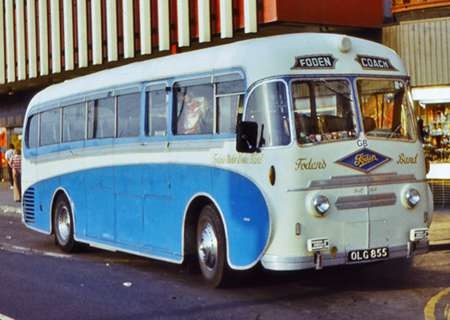
While having an hour of browsing reminiscence, I came across this photo of the Foden Works Band’s coach. I took it on a damp day at Blackpool on August 22, 1976. The livery has been reversed in the top photo of 2005 and the fog lights changed. The GB sticker and row of city stickers along the bottom of the windscreen look like trophies of a continental concert tour.
Geoff Pullin
13/06/22 – 06:25
The Mark 7 Six cylinder engine was the last model built. It had higher pressure fuel injectors compared to the earlier Mark 6 with blue caps instead of black in order to distinguish them. I worked at Foden’s in Elworth in the late ‘Sixties and spent some time building the engines. At that time, Gardner LW’s and LX’s were being rebuilt there. The crankshaft bearings on the LW’s had to be scraped in and, as an apprentice, you only touched the face of the bearings once with your fingers. A blow at the side of the head from the fitter put paid to further attempts. Apprentices learnt quickly in those days. In the experimental department, one test run they used was up Shap Fell, the apprentice logging the figures from the multitude of analogue gauges which, as I recall, were built into a board. Regarding Billy Harrison (Lee Harrison) I don’t recall Billy but I do remember a Paul Harrison. He would have been in his late teens in 1969.
Daniel Preston
14/06/22 – 06:12
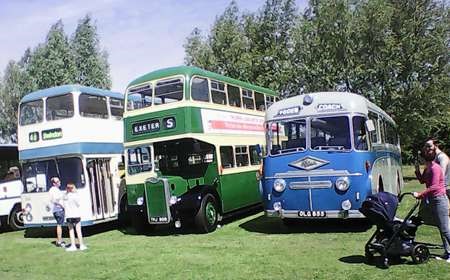
Thought you might like to see a recent photo including this coach when it appeared at the Didcot Transport Rally.
John Lomas
Quick links to the - Comments Page - Contact Page - Home Page