Old Bus Photos

Bradford Corporation – Daimler CVG6 – EAK 232D – 232
Bradford Corporation - Daimler CVG6 - EAK 232D - 232
Copyright Brendan Smith

Bradford Corporation
1966
Daimler CVG6LX/30
East Lancashire (Neepsend) H40/30F

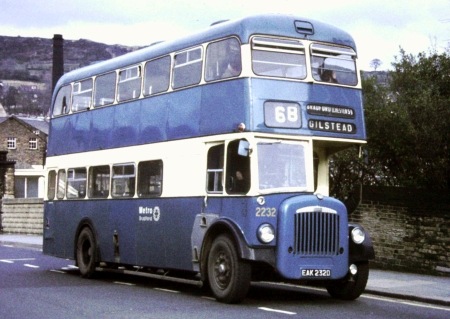
Captured here waiting on Park Road, Bingley is Bradford CT 232, one of a batch of fifteen Daimler CVG6LX/30s supplied to the undertaking in the latter part of 1966. It is seen still wearing BCT’s attractive blue and cream livery, but has had its classic Bradford City Transport fleet name and coat of arms replaced by West Yorkshire PTE’s ‘Metro Bradford’ fleet name and PTE logo. (A ‘2’ prefix has also been added to the fleet number, denoting former Bradford ownership). They were very comfortable buses to ride in, and most handsome buses to look at, bearing a strong resemblance – particularly at the rear – to BCT’s forward-entrance re-bodied trolleybuses delivered a few years previously. Saltaire depot had an allocation of these fine machines, and they could often be seen on the 68 service from Bradford to Edwick/Dick Hudson’s, operated jointly with West Yorkshire Road Car. The Gardner 6LX engines fitted to the Daimlers would have been well-suited to the steady climb up to Gilstead and Eldwick.

Photograph and Copy contributed by Brendan Smith

———

17/09/12 – 07:18

All of this batch went new to Saltaire depot, but 234-40 were passed on to Ludlam Street when Saltaire received new Fleetlines 271-85, which was of course only a matter of months later. These latter, and the remaining CVG6s 226-33 constituted the principal complement of Saltaire’s vehicle allocation for several years, although I was surprised when, around 1970, there was also an East Lancs-bodied Regent III based there. While trolleybuses were still operative on service 40 to City via Thackley there were, I think, two trolleys also kept there overnight, outstationed from Thornbury depot. Does anyone know what effect the trolleybus abandonment had for Saltaire’s vehicle allocation?
The CVG6s were standard fare (pun intended) on route 68, indeed while they were around I don’t recall seeing anything else on BCT’s share of the service. Of course Eldwick didn’t need eight buses, so they also appeared on Manningham Lane services, although heavily outnumbered by Fleetlines. Thornbury depot also had a small presence on these routes, using Regent Vs.
In the early 1970s 234-40 moved on from Ludlam Street depot to Horton Bank Top, where they replaced Regent IIIs.

I can’t vouch for when these actually arrived, but I think only two had entered service by the end of 1966, the rest doing so early in 1967.

I’ve just had a look at my copy of the Stanley King book, and he quotes entries into service of between August and November 1966 – a bit at variance with my recollection, and the vehicles he quotes as the first two in service are not quite the same two I would have said. Still, I’ll stand corrected on this point if necessary.

David Call

———

17/09/12 – 07:19

I think, Brendan, that these 15 buses were "la creme de la creme" with regard to Bradford`s later fleet, and I travelled on them quite regularly when they were quite new. I also travelled (more often) on the 15 contemporary PD3s with identical bodies, which appeared on my "80" route.
The Daimlers, in particular, just oozed quality, and the sound of the Gardner engine, after so many screaming Regent Vs was a pure delight.
I do remember though, that some Bradford staff were not too happy with the Neepsend bodies, which did not seem as structurally sound as the Blackburn East Lancs version. They looked a lot better though, with the full original Bradford insignia!

John Whitaker

———

17/09/12 – 07:20

This batch of buses only 8 years old at the formation of the PTE never received PTE livery and remained blue and cream all their lives When quite new they were often seen on the former Ledgard Leeds-Pudsey-Bradford route and were a really nice bus to ride on.

Chris Hough

———

These vehicles were superb. 226-33 were allocated to Saltaire Depot from new and I remember them appearing on the service to Eldwick in the autumn of 1966. I travelled on them regularly to school. Later when I worked in the Traffic Office of BCT in Forster Square we worked alternate Saturdays and I’d travel on the 07:35 hours journey from Eldwick, which was a BCT Daimler CVG working.
Later still I was a member of a small group of staff that on Monday nights used to frequent the BCT Social Club in Sunbridge Road. The bus stops outside the Club were for services 15 and 16 – West Bowling and Allerton. The bus to Eldwick stopped some distance away in John Street. The last bus from Bradford (Chester Street) to Eldwick left at 10.20pm and I used to ring the Chief Inspector’s Office at Forster Square at about 10.10pm to say that I was "ready for home". I’d make my way the best I could to the stop for the Allerton service just outside the Club and I’d then be joined by one of the Duty Inspectors. When the Daimler CVG came round the corner from Godwin Street into Sunbridge Road the Inspector would step purposefully into the road and stop the bus for me so that I could get on it. He’d then tell the conductor: "Make sure that he gets off at Eldwick Post Office."
Ah, happy days, or should that be daze?

Kevin Hey

———

18/09/12 – 07:25

Huddersfield had a contemporary batch of sixteen CVG6LX-30s, 457-472 (HVH 457-472D). Half were bodied by East Lancs at Blackburn the other half by Neepsend. They became due for initial recertification shortly after I arrived at Huddersfield. I don’t recall that the Neepsend bodies were any worse at that stage than the Blackburn built examples. I do recall that one body type all suffered from body framing fractures above the entrance doors (Neepsend I think) whilst the other all had frame fractures on the staircase side. Some of this batch were particularly hard worked being 2 way radio fitted and hence allocated to the longest duties. Yes, the dulcet tones of these Daimlers were a vast improvement on the raucous cacophony from the eight forward entrance Regent Vs which were disliked by the crews.

Ian Wild

———

19/09/12 – 07:16

Huddersfield also had an earlier batch, 435-440, CCX 435-440B. There were detail differences in this earlier batch, from memory, mainly colour and layout of the staircase/luggage area.

Eric Bawden


Quick links to the  -  Comments Page  -  Contact Page  -  Home Page


Guernsey Railways – Albion Nimbus – 14626 – 72

14626
Copyright Pete Davies

Guernsey Railways Co Ltd
1964
Albion Nimbus NS3AN
Reading B35F

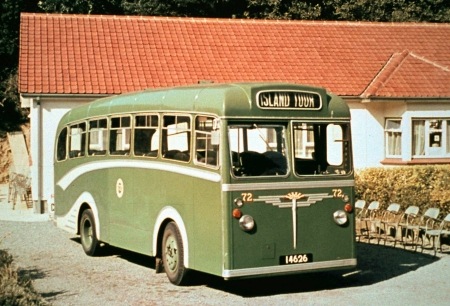
Here is a view of an Albion Nimbus, registration 14626. She is in the green and cream livery of the Guernsey Railways fleet and has a Reading body, with fleet number 72. The Guernsey Motors vehicles were a dark red (quite near the Northern General or Ribble "cherry") while Guernsey Railways vehicles were in this green and cream. She’s at Le Gouffre during a refreshment stop on a morning drive. At least, my ticket was for a morning drive, but the blind is set at Island Tour. Given the size of the island, I’ve never discovered the difference! Did the afternoon drive have a different route? The date is 15 September 1972.

Photograph and Copy contributed by Pete Davies

———

15/09/12 – 07:26

EBW 112B_lr

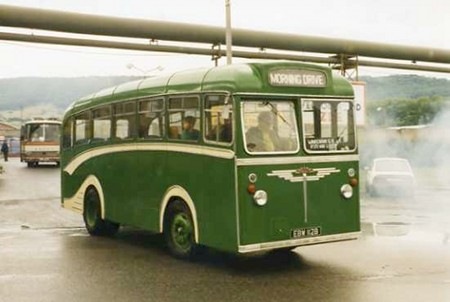
Here is its twin number 173 (14651) at the centenary rally in Usti-nad-Labem on 19/06/1999.
It had travelled from Wareham to the Czech Republic under its own power.
It was even blinded for the "Morning Drive".
What a superb event it was, we attended on ex North Western Road Car 413 (JMA 413L) a Bristol RE/ECW.

Dave Farrier

———

15/09/12 – 08:43

Am I being unrealistically demanding in thinking I’d have expected something a little more fancy than a stage carriage Albion Numbus for a scenic trip?

Roy Burke

———

16/09/12 – 07:19

No Roy. I would have baulked at the regular use, by Ribble, NWRRC (and friends) of service buses on their X2/X60 type services. I had a very enjoyable ride around the Isle of Wight last month on a B10M coach – and also later on open-topped Olympians! SUT, Yorkshire Services and the local indies always gave us coaches in Sheffield.

David Oldfield

———

16/09/12 – 07:20

So, MORNING DRIVE did exist on the blind, then? I suppose setting it for ISLAND TOUR covered most eventualities!!! I see that Dave’s note was posted 40 years to the day since I captured the scene.
Yes, Roy, most folk would expect something a little more grand for a tour, but I don’t recall seeing anything like that. This, after all, is somewhat more upmarket than the Albion CX or Bedford types elsewhere in the Guernsey fleets at that time.

Pete Davies

———

17/09/12 – 07:08

Until the advent of second hand Bristol SUs and LH in the eighties these were the last passenger chassis bought by Guernsey most of the Bedfords being based on lorry derived chassis The older Albion CXs had high backed coach type seats

Chris Hough

———

17/09/12 – 07:09

In response to Roy and David’s comments: Guernsey is quite small and distances short; and traffic very thin – I assume that economics dictated, and geography allowed, the use of buses on tour duties. Could Guernsey Railways/Motors have justified the purchase of special narrow-bodied coaches – and wasn’t the Guernsey width limit 7’4"? – which would have "laid up" out of season?. Its quite a different proposition to the use of buses for coaches on the mainland. Anyway, perhaps this was the Nimbus’s finest moment: tootling around impossibly narrow lanes, providing a "big bus" service where only truck-derived Bedfords followed . . . (until the Trafalger years).

Philip Rushworth


15/02/13 – 05:59

Not sure why people are referring to Albion ‘CX’ vehicles when they never operated on Guernsey. If they are referring to Victors (FT and earlier PH models), from 1950 the bodywork they carried (which was developed by Heaver and Guernsey Railways), was effective classed as ‘Service Coach’ standard, to be used on both stage carriage and island tours, etc. We would today classify this as Dual Purpose.
The Abion Victors (the chassis of which was also sold as the FT3 truck range) were followed by the Nimbus model, the style of body being adapted by Readings of Portsmouth), which was an underfloor engined Albion Claymore lorry chassis marketed under a different name for PSV use.
Guernsey’s final ‘standard’ vehicle to use this style of curved waistrail ‘Service Coach’ bodywork was the J4EZ1 model, which was derived from the Bedford truck range but popular for PSV and coach use between the OB going out of production and the VAS being developed.
Guernsey’s buses were no less inferior for their use of HGV derived chassis, nor were the many hundreds of Bedford J2 coaches used throughout the UK in the 60’s and 70’s. Of course the VAS chassis, designed for bus and coach use also ended up carrying truck bodies such as mobile library’s, etc. From an engineering point of view rural bus chassis and truck chassis were all but identical from the turn of the 20th century right up to the end of the 60’s, essentially being the same 3, 4 or 5 ton models, marketed under different names.

John


28/05/13 – 17:07

Contrary to misconception, all of Guernsey’s Albion Victors, Nimbus and Bedford J4 vehicles (delivered between 1950 and 1972), carried Service Coach bodywork for dual-purpose (stage carriage and tours) operation.
Their seating was identical throughout the classes being of the double-arched semi-high backed variety, well upholstered, though the moquette was updated over the years.
As far as the chassis were concerned, as John has pointed out above, the Albion Victor was derived from the FT3 truck series, the Nimbus was evolved from the Claymore underfloor-engined lorry and the J4EZ1 was Bedford’s long wheelbase 5-ton bonneted truck converted to forward control at the coach-builders under supervision from the local Bedford Agents.
In essence vehicle manufacturers frequently used engines, gearboxes, axles, cross members, braking and control systems, etc in common across their PSV and HGV ranges, only the chassis side frames for the former were specifically designed to ease the fitting of passenger bodywork, often being cranked over the axles to reduce step-heights. However, in terms of ride quality, comfort or reliability there was absolutely no appreciable difference between PSV or HGV chassis.
The width restrictions in Guernsey necessitated some diverse thinking with regards to chassis supply, often it was the axles that were over-width so it was more convenient, expedient and commercially acceptable to receive off-the-peg width-conforming 5-ton chassis rather than have a full blown PSV types converted to suit, which would have been a costly and often time-consuming exercise, where large volume manufacturers would need to take standard chassis off-line and effect bespoke modifications.
In pre-war days the maximum lawful vehicle width was restricted to 6′-6", this was changed to 7′-0" in 1945, then relaxed to 7′-4" after the last J4EZ5 / Pennine vehicles arrived in 1974. Due to restricted model availability, this was further relaxed to 7′-6" (for certain routes only)in 1979.
The 7′-4" vehicles that remained in the fleet after 1979 had their fleet numbers amended with an ‘A’ indicating they could serve ‘A’nywhere on the island’s route network.
The 7′-0" wide vehicles also received the ‘A’ suffix at the same time.

J Edward Rose


18/05/15 – 06:54

I have the privilege of owning Guernsey Railways 77 and have in the past owned several FT39 Albion Victors.
As has been previously mentioned the vehicle chassis is in principal Albion Chieftain FT37. On one occasion I purchased a life expired Chieftain for spares, the only difference I came across (to my cost) was that the truck road springs are shorter than the PSV springs, I assume to give the passengers a softer ride.
77 has now been in preservation for 35 years her operational life was just 23 years! whilst in preservation 77 has been "On the road" for at least 30 of the 35 years.
A good testament to Readings the body builder, Albion and her post Guernsey Railways owners.

Peter Davies


19/05/15 – 06:05

Well said, Peter, in your comments about Readings, Albion and 77’s owners in preservation. It makes one wonder how many Enviro 400s will still be around in 35 years time.
Incidentally, where I used to work, there were five of us named Peter Davies or Davis. We identified ourselves by using the Welsh system of ‘Davies the . . .’ The silly thing was that the one with the English spelling (no E for the uninitiated) was Welsh [Davis the Welfare, as he was in Social Services] and the four with the Welsh spelling were English, at least by birth although my grandfather WAS a Welshman! We were continually receiving each others post, and used to meet several times a week to exchange papers. No such troubles in your workplace, I hope!

Pete Davies


25/04/16 – 06:39

Guernsey Nimbus 75 16216, now carrying a UK reg JNP 590C, is also preserved and was out yesterday on the Cheshire Run, part of Drive it Day 2016.
Photo can be seen at www.oldclassiccar.co.uk/

John Lomas


30/04/17 – 07:50

And 175 will be out on the Cheshire Run again today.

Tim Smith


Quick links to the  -  Comments Page  -  Contact Page  -  Home Page


Sheffield Corporation – Leyland Titan PD2 – NWE 561 – 361

Sheffield Corporation - Leyland Titan PD2 - NWE 561 - 361
From the Tom Robinson Collection

Sheffield Corporation
1952
Leyland Titan PD2/12
Mann Egerton H30/26R

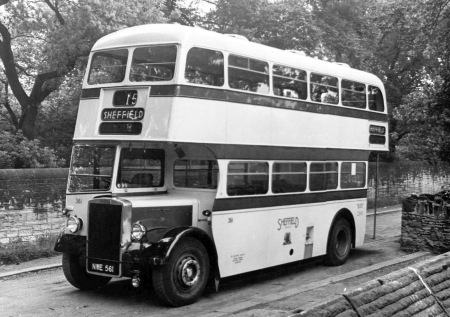
There have been many previous references to Sheffield PD2s including those bodied by Leyland, Weymann/MCW, Roe and ECW but as far as I know, the small but rare order for two buses from Mann Egerton hasn’t been mentioned. These buses enjoyed the usual thirteen year life with Sheffield prior to selling on. Tom Robinson of the Sheffield Transport Study Group comments and I quote "362 went via a Barnsley scrapman to Paton’s of Renfrew. Paton was so pleased with the bus he immediately tried to buy 361 which was at the same scrapyard. Alas it was in the course of being scrapped. In time ex 362 was cut down to single deck. The result of a fire, I think, and used as a tow wagon. They really were impressive and heavy vehicles. The saloon woodwork was especially opulent."
Keith Beeden advises that although the original contract called for H30/26R, steps were taken shortly after delivery to change this to H32/26R possibly because Roe were seating H33/25R on their deliveries at the time

Photograph and Copy contributed by John Darwent

A full list of Titan codes can be seen here.


The Roe PD2s were the first of many bodies from the Crossgate works. They were NWE 586-594 but were delivered earlier, in 1951. I suspect the reason for both bodies being higher seating capacity was that they were (Sheffield’s) earliest vehicles to 27′ rather 26′ length.
Despite many comments to the contrary, even by eminent experts, there was a standard – but not standardised – Sheffield bus. [During most of the ‘fifties it was either a Regent or Titan with either a Weymann or Roe body.] It changed with time and the demise of certain companies but a lot of the post war interest was with the "distress purchases" when, especially Weymann, could not meet demand. Occasionally the distress purchases turned out to be gems – true of these two Mann Egertons. There are two magnificent green London Transport Ts on the Rally Circuit (9.6 powered Regal III – a single deck RT) which attest to the beauty and quality of Mann Egerton’s work.
Mann Egerton were better known as the Norwich Austin dealer and they bodied many early post war Austins as small coaches, but the London Transport work did no harm to their reputation and their balance sheet.

David Oldfield


13/09/12 – 07:05

Here is a picture of 362 with Patons: www.flickr.com

Stephen Bloomfield


13/09/12 – 08:33

Very handsome vehicle, especially in that fine livery. Had no idea that Mann Egerton had ever built d/deckers. Sad that 361 was broken up after such a short life: if they were heavy then they must have been pretty robust too.

Ian Thompson


14/09/12 – 06:29

Ian, they are supposed to be the only deckers they ever built. They did get as far as building underfloor coaches as well – including a pair of AEC Regal IVs for Creamline of Bordon Hants.

Stephen. Can’t find 362 on flickr.

David Oldfield


14/09/12 – 06:32

They were certainly unusual looking, and stood out, especially with that slightly recessed panel at the front where the destination boxes were, which was unique in the fleet. But to my mind, they weren’t nearly as handsome as the OWB-registered PD2/10’s (656-667) alongside which they ran regularly on the 69 service joint with Rotherham Corporation. I seem to recall the two Mann Egerton’s sat down at the back end quite noticeably, especially when they had a good load on, but perhaps that was just a perception.
Ironically, one of the PD2/10’s, 666, was cut down to a gritter/towing vehicle by STD, just like Paton’s ended up doing with the former 362, and in its sheared off form, G56, as it became, was kept busy for many years, considerably longer than the fourteen years it served as a bus, towing all kinds of disgraced rear-engined machines back to Central Works from wherever they’d decided to expire. And it always looked quite happy doing it!

Dave Careless


14/09/12 – 06:34

A smart bus, indeed – but does anyone know why these had the sunken destination screen box? I know some pre-war and early post-war Sheffield buses had this feature, but it was by no means universal. It would be interesting to speculate that, had Mann Egerton ever tried to sell d/d’s to LT following on from their successful PS1s, then this large screen box area would be almost the same proportions as that used for the roof-box RT!

Paul Haywood


14/09/12 – 06:35

A quicker link to the ex- 362 picture Stephen.
Debateable whether the Patons livery does the bus any favours though. www.flickr.com/

John Darwent


14/09/12 – 06:37

Is it just me, or can anyone else see a distinct resemblance to Roberts bodywork (also very heavy!) sct61.org.uk/da86  ?

Peter Williamson


14/09/12 – 06:14

Apparently Glasgow Corporation FYS 494 fleet number D66 was a Daimler CVD6 with a Mann Egerton H30/26R body, new in 1951, scrapped 1960 and rebodied with an Alexander body from FYS 488 fleet number D60 which was a Daimler CD650, (10.6 litre with power steering) but chassis scrapped, not a very popular bus that one.

Spencer


14/09/12 – 06:39

Glasgow Corporation received a Mann Egerton bodied Daimler CVD6 double-decker in 1951 – D66 (FYS 494).

David Call


15/09/12 – 07:08

You’ll be hard pressed to find many of today’s featherweight Eurobuses fit to be preserved in future years and yet in the fifties the professionals were complaining about buses being too heavy. [Please compare fuel mpg of a fifties half-cab with a Euro 5 diesel.]
Why do people eulogise the Mann Egertons and their contemporary Roberts Regent IIIs – let alone their mainstream Weymann and Roe cousins? They were beautifully made, well made and looked good. The lightweight Orion and similar PRV/Roe offerings were the reaction to these heavy bodies. I ask you, what would you prefer?

The recessed destination display was, indeed, a pre-war Sheffield feature. There are echoes in the 1949/50 Cravens/Regent IIIs – featured on this site earlier this year. The most interesting manifestation was on the immediate pre-war all Leyland TD5cs, which had to have non-standard small upper deck screens to accommodate it. It was also a feature of the 1936 Cravens/TD4cs and "broke" the blue line under the upper deck windows. Weymanns managed to get the display in without either recessing the display or breaking the line.
Some post-war bodies managed to "avoid the line" in the Weymann manner but most encroached into the line surrounding the number display without breaking it. Significantly, the 1953/4 PD2/Weymanns avoided the line, like their predecessors, but the subsequent 1954 Regent III/Weymanns "encroached" in the normal post war fashion. Hours of scrutinising photographs has not yielded a satisfactory answer to the question, Why?

Dave. Couldn’t agree more. 656-667 were my favourite PD2s.

David Oldfield


15/09/12 – 07:09

In Classic Bus 110 I asked if Sheffield was the only order for M.E doubledeckers. The reply, and a follow-up in Classic Bus 112 will probably interest those who have responded above.

Les Dickinson


15/09/12 – 07:11

The reason that Sheffield ordered the two Mann Egerton bodies is quite interesting.
In November 1949 a tender was advertised for 30 double deck buses, complete chassis and bodies or chassis only or bodies only.
At the time, all the STD PD2/1’s delivered since 1947, carried Leyland bodywork. The Leyland management advised the transport committee to "look elsewhere for bodywork"
In consequence, an intended order for 30 buses to the forthcoming new regulations of 27′ x 7’6" was varied. The result was that an order for 10 NCB, 2 Roe and 2 Mann Egerton bodies were contracted.
Surprisingly, Leyland offered to supply 16 complete vehicles to the existing 26’x 7’6" PD2/1 standard. Unfortunately, NCB ceased trading, and Roe were awarded another seven bodies. The balance of the outstanding 11 (9 Roe 2 Mann Egerton) were built on the PD2/12 27’x 8′ chassis, authorised in 1950. This batch of 11 replaced 13 trams for the City to Fulwood tramway abandonment. Therefore the original 30 require was reduced to 27. Quite a complicated situation!

Keith Beeden


15/09/12 – 07:13

I understood that Newcastle Corporation also had some Daimler CW’s rebodied by Mann Egerton

Stephen Bloomfield


16/09/12 – 06:50

So, Keith, Leyland were anticipating pulling out of coach-building that early and at the same time were already showing signs of their later take it or leave it attitude. Thanks for the insight.

David Oldfield


16/09/12 – 06:52

Stephen
You may or may not remember me from our time together at BCT, but that’s another story.

Newcastle Corporation had a batch of 5 Daimler CWA6 vehicles delivered between 1945-47 that received new Mann Egerton bodies in October 1950. They had been delivered new with second-hand bodies transferred from 1931 vehicles.

Kevin Hey


14/12/12 – 16:17

It is true that Newcastle had Mann Egerton Deckers , there were I believe three on Daimler chassis, possibly rebodies of chassis that had originally been fitted with pre war Metro Cammel bodies taken from scrapped earlier chassis, and also Glasgow had one Mann Egerton bodied Daimler, D66 I believe

Mr Anon


05/07/14 – 17:34

Mr Anon, Newcastle had 5 Mann Egerton bodied Daimlers, they were fleet numbers 1 to 5, JVK 421 to 425.

Peter Stobart


Quick links to the  -  Comments Page  -  Contact Page  -  Home Page


All rights to the design and layout of this website are reserved     

Old Bus Photos from Saturday 25th April 2009 to Wednesday 3rd January 2024