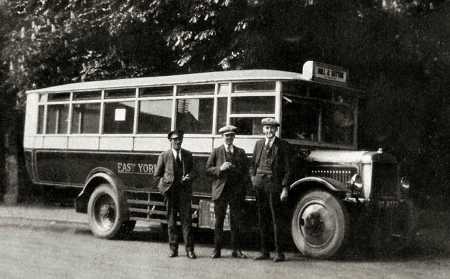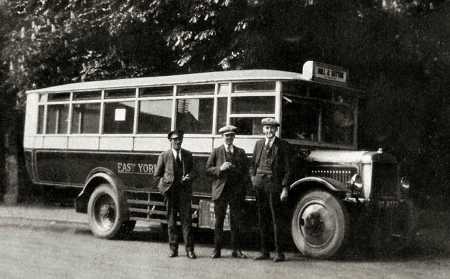
East Yorkshire Motor Services
1923
Leyland A13
Leyland B26
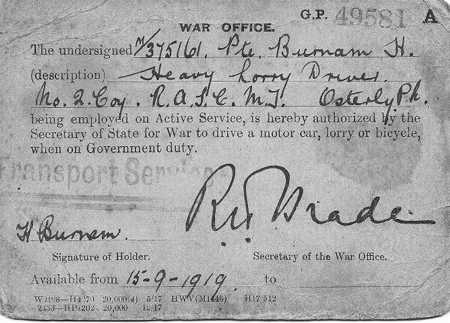
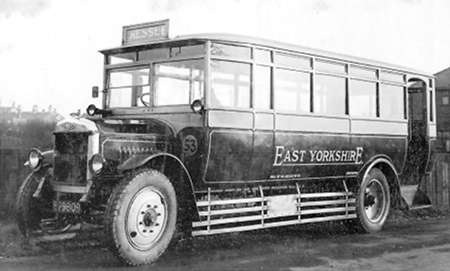
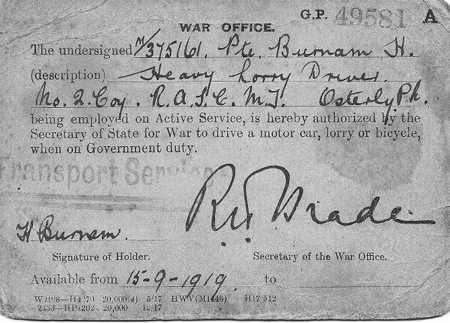
As photography is my hobby I have been busy restoring the old family photographs and I came across the above shot of my father and the bus he drove, he is the tallest person in the photo, I hope the photo maybe of interest to you. During the First World War my father was trained as a Heavy Lorry Driver and below is his War Office Warrant Card. He was always thankful for the Army as it had taught him a trade.
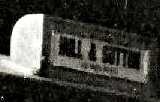
In the 1920’s a Bus Driver had to have a good mechanical knowledge in case the bus broke down, if it did he had to repair it himself, there was no AA in those days to get you going again. The route was Hull & Sutton.
Photographs and Copy contributed by Malcolm Burnard
09/12/12 – 15:49
Now! You do not see many shots of these on the internet, especially one of such good quality. You obviously take your hobby very seriously. Thank you for posting it.
Trevor Knowles

09/12/12 – 16:43
A super high quality photo, for which many thanks.
Can any of the EYMS chaps identify the vehicle as I cannot make out the reg. That very narrow rear side window suggests it is not a Leyland bodied A13.
John Whitaker
09/12/12 – 17:39
On the excellent EYMS website which I’ve mentioned before there is reference to a BT 8773, a 1926 Dennis bodied Dennis 50cwt, acquired with the business of Hull & District Motor Services. Could this be the vehicle depicted? I’m afraid that I’ve personally no knowledge of vehicles from that time, I wouldn’t be able to tell a Leyland from a Dennis or any other make.
David Call
09/12/12 – 17:40
The original poster says EYMS 64 Reg BT 8777. Keith Jenkinson’s book on EYMS states that D W Burn of Withernsea took delivery of a new 26 seater Leyland A13 in September 1925 followed by another of the same type in March 1926.He also purchased a Leyland C9 with 26 seats in 1926 and sold all three Leylands to EYMS in October 1926. It may well be that the bus in question is one of the A13’s bought from Burn.
John Darwent
To be fair to Malcolm I did the heading to the posting as it looked like BT 8?77 and working from Kieth Eastons fleet list on site I came up with a Leyland A13 originally owned by Noel Tompson of Sutton.
Peter
10/12/12 – 07:13
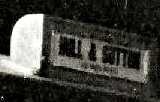
I would certainly support Peter’s identification as BT 8777. The fact that the bus is being used on the Hull-Sutton route is at least consistent, although one would have to know more about EY operating practice to be positive. Looking at the inset photo, there is no doubt that the first and last digits are 8 and 7 respectively, but the other two are less defined. Without the benefit of the EY fleet list, I would have guessed at 8177, possibly 8277. The third character might be a 3, although it would depend on whether local practice used a flat-top or rounded version.
From my less-than-expert point of view, I would also say that the radiator looks like a Leyland type for the period.
Alan Murray-Rust
10/12/12 – 07:14
Sorry, I hadn’t looked properly at the close-up of the registration – the final ‘7’ looks pretty definite and I haven’t been able to find a better match. It probably helps that the bus is shown operating between Hull and Sutton, although all respect to John Whittaker’s assertion that the vehicle shown is not a Leyland-bodied A13, of course.
David Call
10/12/12 – 08:56
Could well be a Leyland body David, as there were many variations. It just does not shout "Leyland" to me, body wise, but I am easily fooled!
John Whitaker
10/12/12 – 09:26
If you look in the top left rear window and use the ‘Ctrl +’ trick you can see the registration, as far as I can make out it is the BT and the last two numbers which look like the down strokes of a seven. I can not make out the first two numbers due to the woodwork. Can you do a blow up of the area.
Trevor Knowles
Don’t forget the ‘Ctrl 0’ to return to normal.
10/12/12 – 11:01
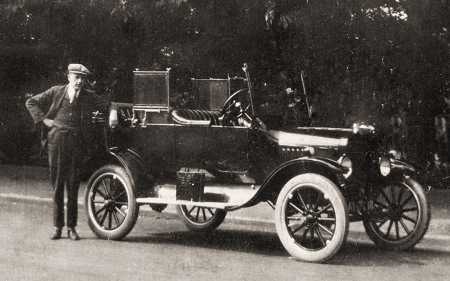
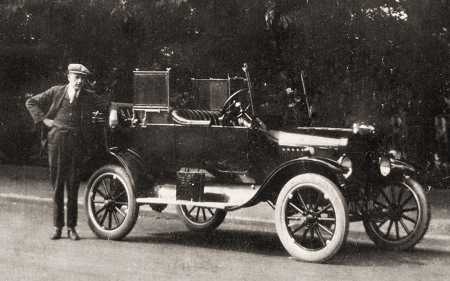
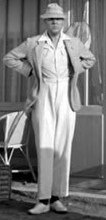
I thought you maybe interested in a shot of my father and his Model T Ford it appears to be taken at the same time and location. It’s a bit grainy but the original photo was very small.
Malcolm Burnard
11/12/12 – 07:16
Interesting that the bus had pneumatic tyres, by no means common at this time.
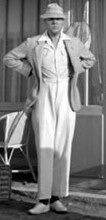
Slightly off-piste, but I just love the pose of your father, Malcolm, by his Model ‘T’ Ford. It reminds me of Jacques Tati’s ‘Monsieur Hulot’ and even me, I suspect, showing off my corporal’s stripes HERE:
Chris Hebbron
11/12/12 – 07:17
Firstly, apologies, my list is wrong in that BT 8777, was in fact numbered 54 not 64 by East Yorkshire.
The Chassis is definitely a Leyland, and the bodywork has a very striking resemblance to other early Leyland bodies. The destination reading "HULL & SUTTON" would indicate that it did pass to EY from Noel Thompson who was situated in the village of Sutton-on-Hull, it was at that time outside the city of Hull. My information on former owners is not at hand at the moment so I cannot comment on any former ownership of the vehicle. Finally it is good to see such a clear photo of such an early vehicle, well done.
Keith Easton
11/12/12 – 10:05
Well that was a bit of a struggle chaps, but it seems a consensus has been reached!
John Darwent
11/12/12 – 10:09
One small correction, Malcolm. Both the RAC and AA were providing roadside assistance from their inception (1897 and 1905 respectively) and the RAC campaigned successfully for the abolition of the man with the red flag walking in front of the car. Of course, how many patrols and where they were was another matter. It would certainly be practical for bus staff to be able to carry out minor repairs/adjustments/punctures where needed.
Chris Hebbron
11/12/12 – 11:32
Been looking at my dad’s Fleet list. He has 54 as BT 8981 Leyland A13 and 55 as BT 8777 Leyland A13, B26, New 7-23, ex Noel Thompson of Sutton. I am wondering if he has transposed these numbers by accident from another list. Luckily of course he has complete lists of the AT, BT and WF registration cards for the bus and carriers vehicles so it was easy to look in the BT list to see BT 8777 is chassis number 35638 later disposed to Peacock in Hull.[?] Handwritten notes, fun is! Curiously in some of the earlier photos Dad has there are several with staff and buses together, if I have time I will look to see if he is in any of them!
Apologies for another off piste swerve but I also love the Model T Ford, looks like a post 1915 Trafford Park built T. Clue is the black painted radiator. Great cars, electric lights, electric starter. I owned a later Tudor from 1926, not much different to this, no indicators, no brake lights, no speedo, no front wheel brakes! Happy motoring
Matt Gibbs
12/12/12 – 07:05
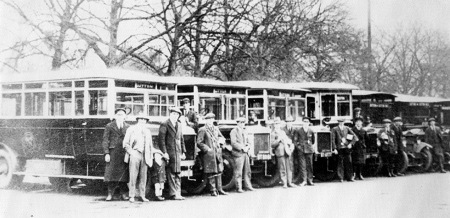
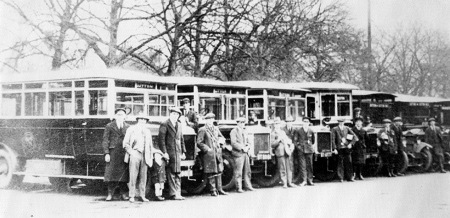
Please find attached a photo of Noel Thompson’s fleet prior to take over by East Yorkshire, buses are left to right: BT 9809, Dennis 2 1/2 ton 29 seats, (EY 53); BT 8981 Leyland A13, Leyland 26 seats (EY 55); BT 8777, Leyland A13, 26 seats (EY 54); the other three are unidentified, but appear to be a Vulcan (possibly BT 7852 EY 52?), and a Ford (possibly BT 8549) plus another totally unidentified.
I would be pleased if anyone could provide positive id’s for these. With regard to Matt’s comment: I took the numbers for 54 and 55 (BT 8981 & BT 8777 respectively) from the PSV Circle publication PB17 (page 7). If Matt has positive confirmation of the transposition, I would be pleased to amend my records.
Keith Easton
12/12/12 – 17:18
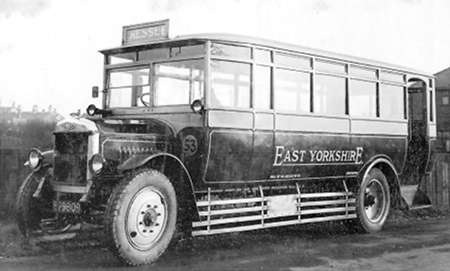
The fleet numbers of BT 8777 & BT 8981 seem to be causing some confusion, my copy of PB17 show 54 as BT 8777, 55 is BT 8981 & 53 is BT 9809, but one thing I have noticed from all this is that EY must have fitted the ex Thompson vehicles with roof destination boxes as the original photo of 54 shows and I have sent a photo of 53 now fitted with a roof box.
Hope Ian is getting better and I am looking forward to the Bridlington book.
Mike Davies
13/12/12 – 06:27
Yes Mike, My copy agrees with that also. With regard to the fleet numbers 49 to 52 which are on my list, none of these numbers have been officially confirmed, and I have a short essay detailing how I arrived at the conclusions I came to. If anyone is interested I can supply a scanned copy of it.
Also may I add my wishes for Ian’s speedy recovery, I was sorry to learn of his illness on the site. (Not to mention his work on the Bridlington book, for all us Bridophiles).
According to Ians book on EY, my photo shows BT 9808, BT 8981, BT 8777, BT 7853, BT 4718, AT 6517 and BT 8549. I hope this is of interest.
Keith Easton
13/12/12 – 16:28
Malcolm Burnard’s comment that, in the 1920s, bus drivers had to have a good mechanical knowledge reminded me that, a few years ago, I came across an extract from the Drivers’ Rule Book issued in 1929 by Ribble Motor Services. In the hope that these may be of general interest, here are those referring to mechanical aspects.
Rule 4. Immediately after reporting for duty, drivers MUST obtain wheel-changing equipment (jack, bar and brace).
Rule 21. Drivers must, when coasting, listen for chassis and body noises; these can best be heard when the engine is running slowly.
Rule 22. Ask your conductor to inform you of such items as loose and noisy windows, squeaking pillars, loose and drumming panels, loose floor traps, etc.
Rule 23. Tighten up any bolts etc found to be loose.
Rule 40. Drivers must not, in any circumstances, interfere with or alter the adjustment of the carburettor or magneto, the only exception to this rule being if a bus has completely broken down a considerable distance from any of our garages and one of these two units is suspected. In this case the driver must do what he thinks necessary to get home.
Rule 41. If it becomes necessary to adjust your brakes on the road, make as little adjustment as possible, care being taken to see that the near and offside are adjusted evenly, and after this from time to time all brake drums are to be felt for undue heating. To enable him to fulfil these tasks, the driver was issued with a tool kit, which he was required to have with him whenever on duty. The kit comprised:- bag (1 no), hammer (1 no), punch (1 no), tube spanners (3 no), tommy bar (1 no), pliers (1 no), chisel (1 no), screwdriver (1 no), double ended spanners (3 no), piece of rubber tubing (1 no), 6" King Dick spanner (1 no).
David Williamson
14/12/12 – 07:10
David, I’m intrigued about this 6" King Dick spanner, what would it be used for?
Andrew
14/12/12 – 10:46
Thx, David, for the 1929 Rule Book extract, bound to bring a smile to our faces in this day and age. It’s a wonder that any bus ran to time in those days. I’ll bet they didn’t provide bath/shower facilities on return from duty.
The 6" King Dick spanner might have been used to beat the conductor with for reporting, endlessly, various rattles and squeaks! Other uses are best left to the imagination! Seriously, I have a couple of their spanners from when my father died, in 1947. KD are a very old company and I was surprised to find it still exists today, although I’ve never seen mention of them.
Chris Hebbron
14/12/12 – 16:24
I’m afraid I have no idea of the intended use of the KD spanner, or any of the other tools for that matter. I can’t imagine what a chisel would be used for, for example.
The same Rule Book had some ‘dress code’ rules, which seem rather quaint by today’s standards.
Rule 3. Drivers when on duty must be clean and neat in appearance, courteous in demeanour and language, not lounge about, nor read newspapers.
Rule 9. The wearing of clogs by drivers when on duty is forbidden.
The following items of uniform were supplied:- winter coat (1 no), summer coat (2 no), cap (1 no), cap cover (1 no), brass buttons (15 no). Note that shirts, ties and trousers were not provided by the company. Presumably the brass buttons were attached to the jackets, and the company wanted the same number returned when employment ended, hence they were itemised separately.
David Williamson
15/12/12 – 07:43
The brass buttons were quite likely of the type attached by inserting the loop on the back of the button through a small buttonhole and fastening the button with a spring peg through the loop. This meant that the buttons could be removed and polished without the polish being applied to the material of the garment, and also the garment could be washed without putting the buttons through the wash. 15 seems a large number for a single garment, so there may have been enough for both summer and winter coats.
Alan Murray-Rust
15/12/12 – 07:43
The rule forbidding the wearing of clogs by drivers persisted in some municipalities until quite late. Halifax Passenger Transport Department had a similar embargo in the mid 1960s, on road safety grounds. Anyone familiar with the traditional wooden soled clog will know that, whatever its qualities may be, proper control of accelerator, brake and clutch is not numbered amongst them.
Roger Cox
15/12/12 – 07:44
The mention of a tool kit for a bus reminded me that London Transport provided in the cab of the RT a saw presumably to saw through the life guard. I can not recall any other operator doing this.
Philip Carlton
15/12/12 – 11:57
In contrast to Halifax Passenger Transport, neighbouring Todmorden J.O.C. apparently allowed the wearing of clogs (or else turned a blind eye) and it continued with a small number of staff certainly through into the Yorkshire Rider era.
John Stringer
29/03/13 – 17:13
When I conducted for West Yorkshire in the early 1960s, "clogging it" was the term for driving a bus at maximum speed, e.g. on the last trip of the day back to town. I remember having difficulty trying to count my change while sat on the rear seat of the bottom deck as the driver clogged a 1937/8 rebodied K5G over potholes and cobbles, of which there were many in Keighley.
Martin S
30/03/13 – 07:30
Martin, I too have heard West Yorkshire staff use the term "cloggin’ it", as well as "trammin’ on", "goin’ full pelt", and "goin’ full belt" which similarly related to driving at top speed. The only time I was actually frightened whilst travelling on a bus, was as a thirteen year old on board a WY KSW. I was returning home to Harrogate from school in Bradford, and having a ‘Bradford – Harrogate’ bus pass, decided to break my journey in Otley to look around the bus station and nearby Sammie Ledgard depot. As the KSW was about to turn into Otley bus station, I was descending the stairs, unaware that the driver had suddenly decided to "clog it" around through the middle entrance ready for the return journey to Bradford. The centrifugal force was hair-raising, and I honestly thought I would literally be thrown off the bus. All I can say is that I was glad of the solidity of the handrail and its mountings, and my hitherto undiscovered vicelike grip on same! To add to my predicament, in those days I didn’t even know any decent swear words to use to let the conductor know of my concern!
Brendan Smith
07/09/14 – 08:00
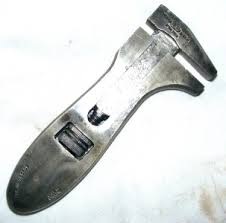
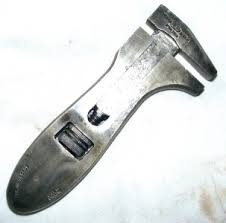
The 6" King Dick spanner referred to in the list of tools is an adjustable one, as shown in the attached picture. They were used for bolt sizes not catered for by the 3 ordinary spanners provided, or if two of the same size were required, one to hold a bolt while the other tightened the nut.
Lloyd Penfold
08/09/14 – 06:30
Interesting tale, Brendan: whilst many drivers from various companies would clog on a bit on an open road (except Tracky as I suspect the buses wouldn’t) my jaundiced views on Tilling/West Yorkshire (see elsewhere) are coloured, too, by experience of some of their drivers who never seemed to want to be seen by other motorists as Knights of The Road.
Joe
17/10/14 – 05:14
I’ve just found Keith Easton’s photo of Noel Thompson’s fleet and recognise it as a different angle to one I have of the same occasion. My view shows vehicles to the right of BT 8777 to be Vulcan BT -983, Atlases BT 5226 – AT 6517 – BT —- and Ford BT 8549.
Steve Thompson
17/10/14 – 10:51
Hello Steve. Any chance we can have a look at your photo of Thompsons line up ?
Mike Davies
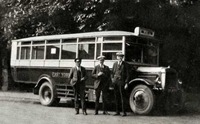 Vehicle reminder shot for this posting
28/04/16 – 06:49
I’m sat with my Dad looking at the photo in question and will try to send you a copy. However Dad has the following info. Dad thinks Vulcan is BT7093 and belonged to W. Cyril Dixon and the destination is shown as Preston which is where Dixon came from, he was a partner with Noel Thompson. Dad thinks their idea being if they sold out to EY and had more buses/routes they may have got more money from the sale! Dixon owned another bus and possibly there is another photo in the old EY files possibly of this vehicle. Sadly littke is known of the elusive Dixon! Dad seems to remember seeing a photo (prob too expensive sine he didn’t buy it! ) of a ramshackle bus side view and that Dixon is in the photo. This photo of the Thompson fleet was seen on a stall at the Pudsey postcard fair in a large wooden frame for sale? Several years ago. Dad has an excellent scan copy of it but can’t remember who from. Apologies if it was you Keith but I have no access to his files at present.
Matt Gibbs
P.S. he’s thinking of working on a history of the Hessle operators!