Douglas Corporation – AEC Regent I – DMN 650 – 50
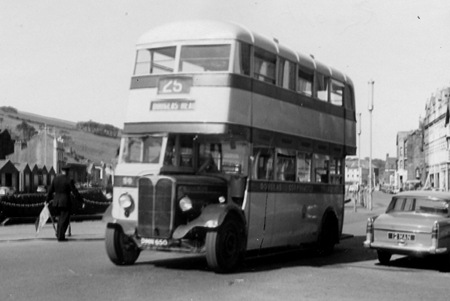
Photo by M Standeven
Douglas Corporation
1939
AEC Regent I
Northern Counties H27/25R
The AEC Regent I first appeared at the 1929 Olympia show it was more or less a cut down version of the six wheeled AEC Renown. AEC coded the early Regents chassis 661 has it had a 6 cylinder 6.1 litre petrol engine, it was 1935 when the code changed to 0661 the ‘O’ stood for oil because it was then when a 7.7 litre oil (diesel) engine became available.
The chassis number for the above bus is O6615965 and it was withdrawn from service with Douglas Corporation in 1967 that is 28 years of service not many buses can boast that.
Douglas Corporation had four Regent 1 buses delivered between 1937-39 numbered 47-50 only no 50 had the diesel engine the others were petrol, not sure if any were later re-engined with a diesel units.
And another thing, about no 50 lasting 28 years, about 60% of Douglas Corporation buses were laid up apart for the tourist season when they were needed, so it stands to reason they would last longer.
Spencer
18/10/11 – 05:40
You can hardly call the Regent I a "cut-down Renown", since it preceded the Renown as model 661, the Renown being the 663. J.G. Rackham, the designer, never made any secret of the fact that he thought six-wheel buses were an archaic idea, and he only produced the Renown to keep London General happy.
Incidentally, the main argument in favour of the six-wheel bus was originally that it provided room for another set of brake drums, in the period when mechanical brakes on a steering axle were still beyond the chassis designers and stopping power with rear-wheel brakes only on a two axle bus was marginal to say the least! LGOC Renowns, with 60 seats, offered no more capacity than the STL, some of which were also built as 60-seaters.
David Jones
23/10/11 – 11:40
Sorry for delay in answering your comment David. As I was not around in 1929 (although there’s time when I feel as if I could have been) I must have found the information from either the web or in a book well it was one of my books ‘Buses and Trolleybuses 1919 – 1945’ by David Kaye.
I quote the opening paragraph for the AEC Regent entry.
"Thirty-nine years is a long time for a model to keep going, but that is the time gap between the appearance of the Regent Mark I at the 1929 Olympia Show and the continued production of the Regent Mark V in 1968. Needless to say there is little in common between the two extremes, but it has been a long tale of evolution. This 4 wheeled double-deck chassis was originally called the 661 model and had a wheelbase of 15ft 6½ins., its engine was new 6 cylinder AEC 6·1 litre unit, and in most respects it was really a smaller form of the Renown 6 wheeler."
And here the first line for the Renown entry.
“In 1929 AEC introduced the 6 wheeled Renown model 663”
Both new 1929 eh, so was the Regent a cut down Renown or was the Renown an extended Regent?
Peter
02/12/12 – 10:55
This is from a book about Manx buses as I wasn’t around for much bar the last few years of the following buses lives.
‘Douglas Corporations pre-war AEC Regents were 41-50. 41-44 were type 661 and kept their petrol engines, 45-49 were also 661s but received 7.7 diesels from ex London Transport STLs in the mid-1950s. 50 and all subsequent Douglas buses had diesel engines except for some post-war Bedford OWBs.’
Paul Mason
03/12/12 – 14:08
I’m sure Douglas 50 was preserved when withdrawn and came to England and was registered something like SMU 222F. It was kept in Huddersfield for a while but I don’t know its whereabouts now.
Eric Bawden
03/12/12 – 16:30
The late Brian Crowther, proprietor of Black Prince Coaches, Morley, bought No. 50 in 1968 reputedly for £30 and shipping to Liverpool was £100. It was registered SWU 222F and rallied for a while before sale to Roy Marshall.
According to the PSV Circle Preserved Buses 2006, it was then back at Douglas with ‘Jennings’ as owner and recorded as being DMN 650 again. If anyone has the 2012 edition, perhaps they can confirm whether it has moved on again.
John Darwent
04/12/12 – 07:10
As to which came first, the 661 or the 663, Alan Townsin’s book “Blue Triangle” gives the date of completion of the prototype Regent as 13th February 1929. The second prototype Regent was delivered to the National Omnibus and Transport Company in Colchester on 12th April 1929. However, the very first Renown 663 to be supplied to the LGOC was licensed in August 1929. G.J.Rackham was not a devotee of the six wheeled bus concept, and it is probable that his initial ideas were focused upon the two axle Regent, though the emergence of the Renown at a date so closely behind that of the Regent means that the two designs must have progressed more or less simultaneously. Also, the chassis of the Renown was not quite an extended Regent. Whilst being virtually identical with the Regent at the front end, the Renown chassis widened out more at the rear to accept the fitment of single tyres on the bogie.
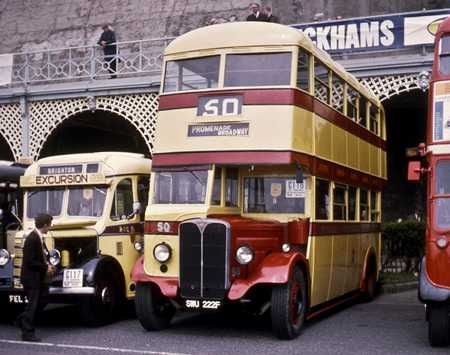
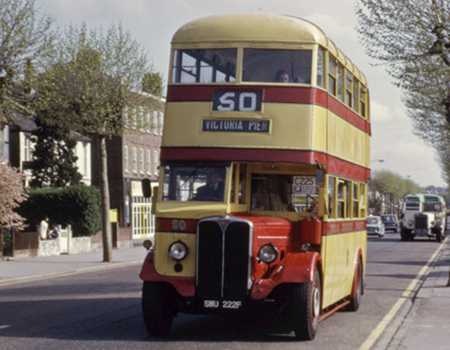
Back on the subject of the Douglas Regents, here are two shots of No.50 taken on London – Brighton HCVC Rallies. The first picture was taken at Marine Parade, Brighton in May 1969, and the second shows it at South Croydon en route to Brighton in May 1972.
Roger Cox
04/12/12 – 11:44
I wasn’t far out with my SMU rather than SWU.
On the subject of three axle buses, in general were both rear axles driven or just one? I seem to think Huddersfields BUT trolleys had both axles driven.
Eric Bawden
04/12/12 – 16:54
Preserved buses can be found on the Classic Manx Buses website. No. 50 appears under year 1939 www.skylineaviation.co.uk/
John Darwent
05/12/12 – 07:33
It was usual for both rear axles to be driven on three axle buses and trolleybuses. The driven axles incorporated a ‘third’ differential (incorporated in the leading differential) to balance the drive between the two driven axles and to alleviate the stresses that led to broken half shafts etc.(Karrier, didn’t initially incorporate the ‘third’ differential with the resultant failures of half shafts).
Leyland built a number of three axle Tigers pre 1940, some of which had both rear axles driven and some of which had the third axle not driven – described as trailing. This was reflected in the designations such as Tiger TS7D (for both axles driven) and Tiger TS7T (for a trailing third axle).
As a boy I was fascinated by watching the rear axles of Nottingham’s BUT 9641T trolleybuses turning at the tight service 43 turning circle at Trent Bridge. The nearside wheel on the third axle was almost at at standstill during the turn – the third differential doing its ‘stuff’.
Michael Elliott
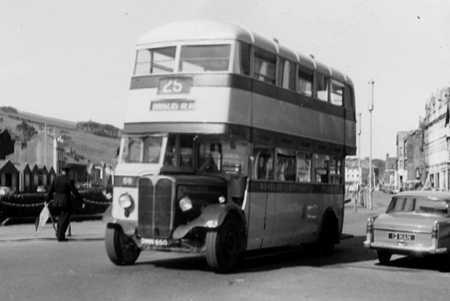 Vehicle reminder shot for this posting
16/11/15 – 10:10
Despite the ‘O’ on its chassis number, DCT 50, like its 9 predecessors entered service with a petrol engine. I can vouch for this, having travelled on it in the in the 1940’s. It would appear that its chassis had been around for some time before Douglas acquired it, as its chassis number is lower than that of number 49 delivered a year earlier. DCT did not operate diesels until the arrival of Daimler CWA Utilities 51-53 in 1945 (just after I had started school). Number 50 was re-equipped with a secondhand diesel engine in the 1950’s along with numbers 46-49.
It is now back in the Isle of Man awaiting restoration. Full details were recorded by the late Mike Goodwyn in ‘Manx Transport Review’, whose research at source corrected this and several other several misconceptions.
M Jones