Old Bus Photos

Yorkshire Woollen District – Leyland Titan – HD 8553 – 699
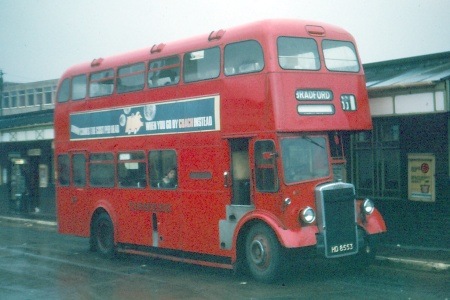
Yorkshire Woollen District - Leyland Titan PD2 - HD 8553 - 699

Yorkshire Woollen District Transport
1963
Leyland Titan PD2
Roe H63R

Now this gets interesting according to my book this is a 1950 Leyland Titan PD2/3 with a Roe H56R body. Well it is defiantly not a rear entrance that’s plain to see and the registration of just two letters I think came well before 1950. I think its time to get Googleing
Here is a result found on the SCT ’61 website the link takes you to a better photo of the same bus, the info found does make sense to me it is as follows.
“Yorkshire Woollen rebuilt a number of Leyland Tiger PS single deckers as double deck vehicles in the 1950s and 1960s. One such is HD8553, a PS2/5 given a Roe front entrance body in 1962 and numbered 699 – later renumbered 502 by YWD.
This bus and its brethren survived long enough to receive NBC livery.”


I think your history is wrong.
A large number of PS1s were rebodied. I saw one of the first which was painted "Poppy Red" in Frost Hill depot parked in the middle of the depot It looked terrible then. The new bodies were MCW Orion.
They weighed less after re-bodying than when original.
They were very noisy and cold as the new bodies were single skinned.
The photograph is one of a small batch of PS2s which were rebuilt much later. the chassis were rebuilt by YWD with new chassis sides, they originally had a bolt on chassis extension as the rules changed when they were originally built. I think there were only 8 rebuilt. A like number were sold to Yorkshire Traction for rebuilding the only difference was that the Yorkshire Traction rebuilds were reregistered. I never found out why.

E. Malone


I will investigate this further find my own information and get back, check with the ’Latest Comments’ page for any update.
Here are the details of a batch of six Leyland Tiger PS2/5 chassis that were re-bodied by Roe to H35/28F in 1963 Reg no HD 8551-4 and HD 8562-3 they went into service with fleet nos 697-700 and 708-9 respectively.
The above photograph is one of this batch and this information backs up the original article.
An extra piece of information I found is that the original Tigers were probable bodied by Willowbrook with a B38F body and were first built in 1950.
The PS1 chassis you mention were a batch of 24 originally built in 1948 the registrations are a bit haphazard but are late HD 7800s and very early 7900s the fleet nos are a bit the same but they all fall between 562-631. These were re-bodied by Metro-Cammell with H56R ‘Orion’ bodies in 1954-5.

Peter


Richard Malone is wrong about the colour. Poppy red only came in with NBC.  The closest to the original colour was Post Office red. I know this from a YWD Fleetline I owned at one time.
There were 75 Brush bodied Leyland Tigers PS1s, fleet numbers 558-632 registration HD7841-7915. In 1954 12 of these were rebodied as double deckers with fleet numbers (562/75/7/97/8/9/603/11/3/4/6/20) with a weight of 6.8.1 tons. A further 12 were rebodied in 1955 as fleet numbers (570/4/83/7/8/96/618/24/7/8/30/1) with a weight of 6.7.0 tons. It is interesting to note that they weighed 6.9.1 tons as Tiger single deckers.
I own the only survivor of the original batch of Brush bodied Tiger PS1s fleet no 622 registration HD 7905 which can be seen here.
The Willowbrook/PS2s, 697-725, HD8551-79 (and OPD2s, 728-733, HD8710-5) were built in 1949. They were originally 27’6" long with B32F bodies these were then lengthened to 30′ B38F by Willowbrook between June 1954 and June 1955. Six were rebodied by Roe as H63F (697-700/8/9) for YWD a further nine went to YTC (701/4/6/7/10/1/2/4/6) in 1962, rebodied by Northern Counties as front entrance double deckers. (One of these still exists.)

Gordon Brooke


The subject of re registrations of bus rebuilds is an interesting one. I was always curios about the batch of Leyland PS2s that were rebodied as double deckers by both Yorkshire Traction and Yorkshire Woollen. The Y W D ones kept their old 2 letter HD marks yet the YTC ones were allocated new YHE marks of the time. Another example of these double standards concerns County Motors of Lepton owned by YTC, YWD and West Riding. In 1955 they had two elderly single deckers rebodied as double deckers. They wanted to give them new registrations but Huddersfield CBC would not allow this so they were transferred to Barnsley where they were given new marks of the time.

Philip Carlton


Difficult to tell from the photo if the width of this vehicle, was a PS2/5 7ft 6in or 8ft wide? The original batch of re-bodies, from PS1 chassis were certainly 7ft 6in Orions. When Birch Bros had some PD1’s re-bodied with Orions by MCW a year or so later, they were virtually identical even down to the destination display. Maybe the same drawings were used!

Chris Barker


01/01/14 – 09:14

I drove these buses in 1965 at this time I lived in Heckmondwyke and worked at Becklane Depot I remember the P duties they worked Mirfield Bradford 65 service they seemed to be sluggish pullers..

Jack


03/01/14 – 10:00

I would like to comment on the "Hales Cake" vehicle shown in Colin Shears yard. It is a Leyland TS7 and was East Midland Motor Services No10 BAL 610. In the 1950s I worked at EMMS Chesterfield workshops at this time after I left school and remember this vehicle well it was one of eighteen rebodied by Willowbrook in 1948 it looked far better in EMMS livery of biscuit cream and brown picture shown in Mikes afterlifes.

Jack


26/10/16 – 06:41

I remember the forward entrance versions of these rebodies on B and C services from Ossett to Fir Cottage in YWD red and cream and then NBC poppy red not bad for a bus built as a single decker in the late 1940s and still in service in the 1970s we cannot say that today, by the way I liked them as much as AEC Regent Vs.

David Parkin


27/10/16 – 08:17

To answer Chris Barker’s question from way back, the PS2/5 was 8 feet wide.

Peter Williamson


28/10/16 – 07:37

Peter W, thanks for your answer, I’m certain that these vehicles reverted to their original length of 27ft 6ins. upon rebuilding as double deckers, the seating capacity of 63 seems to support this. However, when they ran as single deckers, presumably they had drop frame extensions to enable the provision of luggage boots and then they were extended to 30ft length, still with drop frame rears, so was the chassis itself extended? When they became double deckers, a drop frame extension would have been of no use on a front entrance d/d but if it was simply removed, the rear overhang would have needed supporting somehow, I imagine new chassis frames were the only answer. Perhaps it might have been easier to rebody them as 30ft double deckers!

Chris Barker


31/03/17 – 15:37

The registration of just two letters I think came well before 1950.
Dewsbury didn’t reach HD 9999 until November 1953 – while it took until April 1960 for Bootle to reach EM 9999 and August 1960 for Rutland to reach FP 9999.
And nine Scottish counties didn’t reach 9999 with two letters before the year suffix system was introduced in 1964/5 – Buteshire famously only getting as far as SJ 2860.

Des Elmes


06/09/17 – 06:44

Chris Barker, I think you will find that NONE of the PS1 or 2’s owned by YWD had luggage boots. The emergency door was in the middle at the back on both those models.

Ron Lake


Quick links to the  -  Comments Page  -  Contact Page  -  Home Page
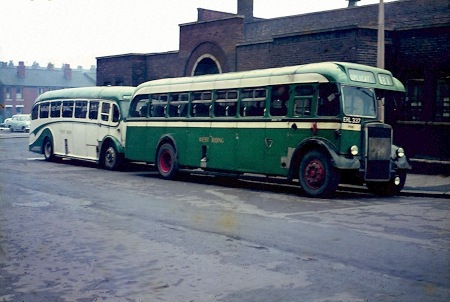


West Riding – Leyland Tiger PS 2/12 – EHL 337 – 726

West Riding - Leyland Tiger PS 2/12 - EHL 337 - 726

West Riding Automobile
1952
Leyland Tiger PS2/12
Roe B39F

According to my Ian Allan book which I have now found West Riding was the second largest Independent operator in the UK not sure who the first one was LUT perhaps. The book British Bus Fleets no 9 Yorkshire (company operators) was published March 1962 and cost 2s/6d by the way.  I have come across a YouTube Video of a preserved Leyland Tiger from the same batch as above you can see it here the first Minute is bit the same but it gets better when the camera goes outside the bus.


24/07/11 – 10:46

I think the largest independent was Barton

Stan


24/07/11 – 17:08

I seem to remember reading an article on Venture Transport of Consett, Co. Durham in a Buses Annual of about 1968/9 and it stated Venture was the third largest independent in the country. Perhaps by this time though, West Riding belonged to BET or NBC thus taking them out of the equation, so that would leave LUT and Barton to "fight it out" for first and second place.

Eric


25/07/11 – 08:47

Well as a starter regarding the LUT/Barton question, I have a copy of BBF 17 (North Western Area) for March 1964 which lists LUT as having 416 vehicles!

Dave Towers


25/07/11 – 08:59

I seem to remember from somewhere that LUT was the largest independent and Barton the second.

Stephen Ford


25/07/11 – 09:01

BBF17 Second Edition, undated but apparently 1965, says that LUT was the largest. BBF5, Second Edition 1965, says that Barton was the third largest.

Peter Williamson


23/11/17 – 07:18

What appears to be missing from the West Riding memories is any picture of the AEC Regent with the central entrance. They were bought to replace the trams, were painted red, and used mainly on the former tram routes. Kettlethorpe to Leeds via Wakefield (route 10) and Wakefield to Ossett (route 20)

Geoff Bragg


24/11/17 – 07:19

I would have thought Midland Red would have been the largest independent.

Roger Burdett


25/11/17 – 08:02

Midland Red was surely BET?
There is a debate over West Riding being independent but LUT was bigger than WR with Barton next?

Stuart Emmett


26/11/17 – 06:15

There is even doubt about LUT being independent (especially since Neville Mercer excluded it from his book on Lancashire Independents), but I haven’t been able to find out anything about its ownership.

Peter Williamson


28/11/17 – 07:39

Ian Allan’s ‘The Little Red Book’ 1965/66 has West Riding’s rolling stock as 433 buses and coaches (336 d/deck; 56 s/deck; 41 coaches). Lancashire United is given as having 400 buses and coaches (301 d/deck; 63 s/deck; 36 coaches), whilst sadly Barton’s entry simply states 323 s/deck and d/deck buses. (As Chad might have said: "Wot! No coaches!"). Venture Transport is shown as having 52 s/deck buses; 32 semi-coaches; 7 coaches – which I total up to be 91 vehicles. Maybe the fleets concerned varied slightly in size over the decades – contracting or expanding as various social changes took place – which could account for a certain amount of ‘jostling for 1st, 2nd and 3rd position’ – he suggests tactfully!

Brendan Smith


29/11/17 – 08:20

Brendan,
There was always friendly rivalry between Lancashire United and West Riding as to who was the largest company in pre- grouping days, both having about 400 vehicles.
In early days they in fact shared the same director (Harry England) who was West Riding’s first MD and close friend of LUT’s MD (Ned Edwards) The garter symbol on the rear of both companies’ buses was an indication of their early association developing from their tramway systems in the 1920s.

David A


30/11/17 – 08:11

Thank you for that fascinating information David. It’s much appreciated. It’s always interesting to hear about friendly rivalries that develop between bus operators. West Yorkshire Road Car and United Automobile are two others that spring to mind, although they were obviously both ‘Tilling’ companies rather than independent concerns. I’m sure that some of our OBP Team will be along soon to furnish us with details of a few more operators who ‘rubbed along nicely’ in ‘friendly rivalry’ all those years ago.

Brendan Smith


Quick links to the  -  Comments Page  -  Contact Page  -  Home Page
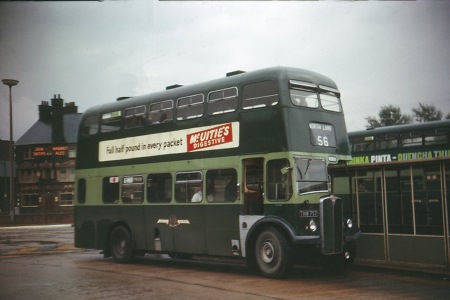


Leeds City Transport – AEC Regent III – TNW 757 – 757

Leeds City Transport AEC Regent III

Leeds City Transport
1954
AEC Regent III
MCW H33/25R

Photo taken Leeds city bus station information from my now found official fleet lists my Leeds one is dated May 1964.


“TNW 757 entered service 1st December 1954. It was withdrawn 29th October 1970.
The batch 755- 759 were all then sold to Telefilm Transport Ltd in November 1970 but immediately passed on to Pickersgill & Lavery at Barnsley for scrap”

Terry Malloy


TNW 759 of this batch of five buses (755 – 759) was fitted with an experimental “self locking” fluid flywheel – a vicious device which made it very difficult to give a decent ride even for those of us who could be bothered to try – many couldn’t. This mechanical pest earned 759 the nickname of “Leaping Lena” – a title which was confirmed by a very prominent piece of “BIRO GRAFFITI” above the windscreen.

Chris Youhill


Bring back the old two shades of green livery.

Anonymous


Here here Anonymous – I couldn’t agree more strongly – AND some windows which can be seen through instead of passengers having to look at the back of zany and largely ineffective advertising !! The last time that passengers were obliged to tolerate "horse box" gloom like this was in the London Blitz of WW2 when London Transport were obliged to board up shattered windows to keep the vehicles in service.

Chris Youhill


You can have your two shades of green if we can have our various applications of blue and cream in Sheffield and Rotherham – and proper green in my current neck of Surrey!

David Oldfield


Its a deal David !!   There was no more handsome sight in Leeds Bus station than the Sheffield vehicles in cream and blue on service 67, especially sometimes the rare ECW bodied examples. As far as lovely leafy Surrey is concerned I just have to say "Bring back the immortal Godstone STLs." Quite irrelevant I admit, but my first ever car was a 1934 Standard 9 – £25 "0n the road" – which was registered in Surrey – BPE 405 and affectionately nicknamed "Beepy" for obvious reasons.
I shall now be missing for a few days as I’m having my right eye cataract removed tomorrow, and if its as excellent as the left one in February I shall be grateful and delighted.

Chris Youhill


The first Orions I ever saw were on Aldershot & District’s 1954 Dennis Lances, and at the time I thought they looked cheap and homemade, with only the nice two-tone green livery to redeem them. The Leeds Regent IIIs again prove that two greens (though very different from A&D’s) can bring a metal box to life.
SUK 3, the ex-Wolverhampton Guy Arab IV at Wythall, proves again what a fine livery can do for an Orion, which I think looks its worst in BET overall red.
For a design whose hideous incompetence shines triumphantly through any livery, I’ll go for those front-entrance Park Royal Southampton and Swindon deckers of the 1960s.
Apparently the A&D Orions were about a ton lighter than their handsome East Lancs brethren, something for which the pre-war Gardner 5LWs they inherited must have been very grateful, and Tim Stubbs tells me that the Orion batch had to be sent back to Dennises to have the springs softened to cope with the unexpected lightness!

Ian Thompson


29/10/14 – 17:24

Hi after looking through your Pages of old AEC Buses! with great memories. Can you tell me any information about the bus that I used to travel home from school on in the early 1950s in Leeds, it was on the no 42 route traveling from Harehills to Lower Wortley traveling past Harehills County Secondary School. The bus had fleet no 700, the seats on this bus were not straight backed, each seat seat bent in the middle.

David Hill


30/10/14 – 07:11

Ian Thompson makes his always informed comment about this characteristic in respect of the 1954 Dennis Lance K4s of Aldershot & District, the first 20 of which carried sturdy East Lancs bodies, but the final 12 had Weymann Orion ‘tin cans'(though these were better finished than the norm). Dennis had to reset the springing to improve the ride. I doubt that many operators went to that trouble.

Roger Cox


30/10/14 – 07:12

David, if you look at the comments on Sheffield Leyland PD2 fleet number 391 on these pages you will find references to cranked seats and Leeds 700.

Ian Wild


30/10/14 – 07:12

MCW body with Roe staircase, by the look of it.

Ian T


31/10/14 – 16:27

David 700 was a one off AEC Regent II exhibited at the 1950 Earls Court Show. As Ian mentions its seats were an effort to give greater comfort to the traveling public it remained unique in the Leeds fleet.

Chris Hough


18/01/18 – 09:05

Lovely trip down memory lane on an LCT bus. In the 60’s I was a school kid living in Halton. The trudge up Halton Hill was always a struggle, especially if the bus was full when it became a first gear thrash that used to take forever. Would these double-deckers with rear landings have been Leyland Titans and AEC Regents?

Chris Bradley


Quick links to the  -  Comments Page  -  Contact Page  -  Home Page



All rights to the design and layout of this website are reserved     

Old Bus Photos from Saturday 25th April 2009 to Thursday 4th January 2024