Old Bus Photos

Liverpool City Transport – AEC Regent III – JKF 933 – A690
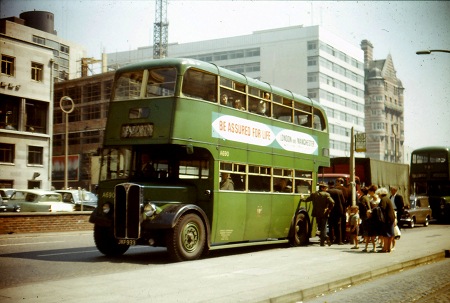
Liverpool Corporation - AEC Regent III - JKF 933 - A690

Liverpool City Transport
1950
AEC Regent III
Weymann H??R

This bus is pre 1951 because all buses in the Liverpool fleet after that date were 8ft wide and had two side by side destination boards with route numbers above a quick link here to view an example. The bodies were supplied from Weymann as frame only they were then finished by Liverpool Corporation in their own body shops.


When new, this bus DID have 2 cream bands, one below the upper windows and the other above the lower windows – most were repainted in the early 60s as above.

Anonymous


I remember these as being quite fast and manoeuvrable, with their pre-selector gearboxes and distinctive sound. Two particular memories – one, hearing and seeing them thundering along the Strand and Goree on the heavily trafficked 1 route between Dingle and Seaforth (the bus route which effectively replaced the overhead railway) and two, being upstairs on the peak workings of the 71 between Penny Lane and I think South Castle Street, upper deck thick with tobacco fug and not a seat to spare. On full return journeys buses were able to avoid the congested city centre and skirt up the hill past the cathedral non-stop,

Anonymous


04/05/12 – 08:52

I remember driving one on a road that was VERY BENDY and went through Woolton Golf course and it was far easier than the usual AEC MK Vs we usually used. It took the bend’s beautifully.

Dave


10/10/13 – 15:51

I worked at Walton garage as a conductor and driver and I have fond memories of the number 1 route Seaforth to Dingle with a full bus of Dockers on board going to work at various docks along the Liverpool waterfront

Billy


17/04/15 – 07:04

One thing I never could understand was how the pre-selector gearbox worked…can anyone post a simple, not too technical explanation?

Mr Anon (lpl)


18/04/15 – 07:30

Here is a link to a detailed explanation.

Peter


19/04/15 – 07:31

Not many folk realise that something that many of were familiar with, when we were young, was an epicyclic gearbox; namely the Sturmey-Archer bicycle rear wheel hub, a compact gem of genius, IMHO.

Chris Hebbron


19/04/15 – 07:31

One thing that needs to be added to the article in Peter’s link is that on postwar AECs the change speed pedal operated by compressed air rather than a spring.

Peter Williamson


19/04/15 – 11:52

Guy also offered the Arab III with an air operated preselector gearbox.

Roger Cox


20/04/15 – 07:13

As usual I’m late to the party, but I thought I might as well jump on the (pre-selector) bus anyway. In previous threads contributors have written about the Daimler quadrant pre-selector selector. I’ve been puzzled as to how that worked, as opposed to a conventional selector gate, but never thought to ask . . . anybody out there care to enlighten me?
Sturmey-Archer gears = Raleigh Chopper! Pennant on the back? Tassels from the handlebars?? Playing card clothes-pegged to the rear fork to give that "motorcycle" sound??? Not me! – too sophisticated (me, not the Chopper kids) – 15sp Derailleur for me (even if I only ever used about five). But I remember the arguments in the playground as to whether one should pedal/stop pedalling/back-pedal when changing Sturmey-Archers . . . did it matter?

Philip Rushworth


21/04/15 – 06:27

To the best of my memory, the quadrant went RN1234, from nearest the driver outwards. At least LT’s CWA/CWD’s did.

Chris Hebbron


21/04/2015 06:28:26

Philip, the quadrant selector simply moved in a continuous arc as may be seen in this picture:- www.flickr.com/photos/superkevs/
One had to be careful to set the lever accurately in preselecting the next gear, or the pedal would spring back with some vehemence. The gate type selector used by AEC on the Regent III was much more positive. Earlier AEC and some Guy preselectors used a selector that looked like a conventional gear lever. Take a look at this page:- www.flickr.com/photos/preselector
Sturmey Archer bicycle gears – yes, you should stop pedalling when changing gear. The engagement of each epicycle gear is made by means of a rod (equivalent to the band brake on a bus gearbox) that locks each gear through the spindle. Keep pedalling, and you will chew it up and burr the matching gear internals to bits.

Roger Cox


21/04/15 – 09:44

Did the position of the Daimler gear-change vary even on the same model? My memory of the Portsmouth Daimler CWA6’s was of the gear select on the left side. The first link supplied by Roger shows it at the right side. As delivered, both the Portsmouth ones, and the Douglas one in the link would have been "identical", of the CWA6 variant, and with Duple bodies. (The Portsmouth ones were rebodied in 1955 by Crossley, and appear elsewhere on this site). Perhaps my memory is incorrect, any comments welcome.

Michael Hampton


22/04/15 – 07:30

Roger, thanks for the informative post – exploring the links has filled up time why my class completed a mock examination.

Philip Rushworth


22/04/15 – 07:30

On Portsmouth’s rebuilt-bodied CWA6’s, the quadrant was definitely on the R/H side, Michael H. Never looked inside the cab of them in their original form.

Chris Hebbron


22/04/15 – 07:31

Wonderful picture Roger, (& Kev) of the cab of a Daimler CV/CW! I don’t think the CV was any less primitive. Would suit someone with strong arms and small feet. Good through-flow ventilation, too. Daimler (and others) never felt the need to promote their vehicles once sold- the fluted (often painted) radiator and a couple of D bosses on the front wheels (possibly?) were the only indicators. Leyland seemed to encourage you to put your own badge on the radiator, too. That all changed with the bustle buses with huge flutes, Atlas et al, although Leyland had rarely anything to put on the front of an Atlantean, unlike the St Helens front. Enough rambling: I think the quadrant was on the right on a CV?

Joe


23/04/15 – 07:02

Thanks Chris H for confirming the quadrant position. Clearly my memory is playing tricks! I only remember these in their rebodied form, even though I lived in the area when they were in original condition.

Michael Hampton


23/04/15 – 07:03

Manchester’s and Derby’s CAVs were certainly on the right Hand side. I have never driven nor seen one with it on the left.
Because the settings used to wear, the gear was never where the mark was on the quadrant, so Drivers used to put pencil marks on it. There were that many marks on them, you still never knew where it was.
You then used to put your own Mark on adding to the confusion.
I loved driving pre-select buses, they also made you read the road, having the correct gear selected was important to keep up steady and speedy progress.
BUT watch out for the pedal kicking back, it did hurt, OUCH.

Stephen Howarth


23/04/15 – 08:32

Roger wrote :-
"One had to be careful to set the lever accurately in preselecting the next gear, or the pedal would spring back with some vehemence."
Roger, that’s definitely the finest and most eloquent description of the dangerous fault exhibited by the spring operated gearboxes that I’ve ever heard. the problem was, of course, even worse as not only did the pedal spring back with the vehemence mentioned but also came considerably further out than was the norm, which is how the pain and often injury occurred.
Incidentally it was also necessary to raise a button to allow the quadrant lever to travel beyond neutral to select reverse. A further pitfall for fresh or inattentive drivers was to set off with gusto in first gear and to fail to preselect second gear – then a little later when correctly allowing the engine revs to die down before letting the pedal out you were likely to find the passengers and conductor trying to join you in the cab – the violent braking effect thus achieved would have given a very favourable reading on the Tapley Meter brake tests !!

Chris Youhill


24/04/15 – 06:25

Chris Y, we have obviously both suffered the less than tender mercies of the spring operated preselector when not treated precisely in accordance with ‘the book’. One could always pick out the casualties by their progress round the depot in their accurate impressions of Laurence Olivier in the role of Richard III. The pedal would come back twice as far as normal with the force of all the springs in the box (or so it seemed) generally thrusting one’s left knee into violent contact with the steering column. I wonder how modern companies would get on with such a gearbox in this age of compensation culture and ambulance chasing litigators. Your vivid description of the outcome of a lapse of memory in not preselecting the next upward gear is something that I must put my hand up to having enacted occasionally. The ensuing ‘g’ forces restored one’s concentration at lightening speed, so that one shoved and held the gear pedal down instantly. Ah, happy, joyous days. The modern crop of bus steering wheel attendants don’t know what a gearbox is.

Roger Cox


24/04/15 – 06:26

You have conjured up a wonderful image of said passengers and conductor crammed into the cab with the driver Chris! Very descriptive, and it made me chuckle. I’m sure I read somewhere in the distant past, that the height of the gearchange pedal on some buses with spring-operated preselector gearboxes varied, dependent on which gear the vehicle was in. Is this correct, or is it, to quote Hylda Baker "a figleaf of my imagination?"

Brendan Smith


24/04/15 – 08:47

Brendan Smith you are correct in thinking that the ‘Change speed pedal’ (sometimes referred to as ‘The Tripper pedal’), was at different heights depending on which gear it was in. Lowest being neutral, and highest being top, in normal driving.
Not only was your knee jammed under the steering wheel but your heel was stuck under the seat frame. This along with your foot held on the pedal, made it virtually impossible to apply any pressure to push the pedal down against the 5 springs. Hence the need of outside assistance in returning it to the normal settings.
At Derby we had a Driver called ‘Tripper Wood’ so named because he had been kicked by the pedal so many times, he used to slide his foot off quickly to avoid such occurrences.
He gave a very rough ride, but had a regular mate, who, I guess was used to his driving style.

Stephen Howarth


25/04/15 – 09:23

There was just one ray of hope in the spring operated "kick back" scandal. If you were lucky enough to survive without injury to the ankle, and your foot was not trapped, it was usually possible to apply both feet to the extended pedal while heaving the shoulders against the cab rear window area – first of course making sure to positively select neutral. This usually worked, although Goodness knows what the passengers must have thought to the performance !!

Chris Youhill


26/04/15 – 07:48

For completeness I should add that later CVGs had a gear selector gate on the left, very similar to the one on the Regent III. Later still, when air brakes were offered, the gearbox could be either Daimatic (like the Fleetline) or air-operated preselect like the Regent III. But the spring-operated type continued to the end on vacuum-braked chassis.

Peter Williamson


28/04/15 – 06:59

Thanks for confirmation of the gearchange pedal positioning Stephen, and your reference to "tripper pedal" which I have not heard before, but is a very descriptive phrase. I had read that drivers’ knees were prone to a severe blow if the pedal kicked back, and Roger and Chris Y have also mentioned this, but how many of us realised that a driver could end up trapped with his knee under the steering wheel and heel under the seat frame? It sounds absolutely scandalous that such events could be deemed acceptable by manufacturers and operators alike, and must have led to severe bruising, and in extreme cases to fractures and torn ligaments/tendons, which are no laughing matter. On a lighter note however, Roger’s comment about injured drivers doing impressions of Richard III raised a chuckle. Presumably they would have preferred the RT’s air-operated system, but its only a hunch…..

Brendan Smith


23/01/17 – 07:33

As a child I recognised these AEC Regents which dominated route 1 from 1957 to 1967.
Route 1 was the last route to employ 7ft 6 ins wide buses full time. The 1 allocation was drawn from the ranks of 9.6 litre preselector buses A325-349, later A525 etc, and A657-756. When route 1 started the roads in the south docks were unsuitable for buses and it was not until autumn 1958 that the council paved the Dingle area roads. The route north of the Pier Head had similar problems but a parallel route was adopted for the 1 which was not too far from the docks.Buses replacing the Overhead Railway had three problems, paving being one but the others were the need for the buses to climb Dingle Mount whereas the LOR burrowed through the cliffs, which meant the powerful 9612Es were essential for the task. The other obstacle was Stanley Dock Bridge which, 7′ 6" wide buses could pass each other but not wider buses. This was not resolved till the 1990s and so when the narrower buses were withdrawn during 1967/68 buses had to take turns to cross the bridge. The 1 route, under Merseyside PTE a shadow of its former self as a frequent route vanished on deregulation in 1986. Some extracts of this sourced from Liverpool Transport Vol. 4 1939-57 by Messrs Horne & Maund.

Paul Mason


Quick links to the  -  Comments Page  -  Contact Page  -  Home Page
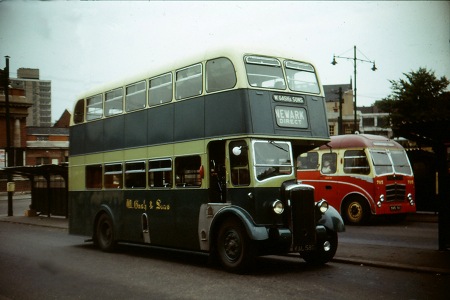


W Gash & Sons – Daimler CVD6 – KAL 580 – DD3

W Gash & Sons - Daimler CVD6 - KAL 580 - DD3

W Gash & Sons
1948
Daimler CVD6
Strachans but possible rebodied by Massey 1962

I have cobbled together this info from too many to mention web sites if you know more let me know. Also I can’t remember for the life in me where I was when I took the photo possible Nottingham as the bus behind is a Barton Transport fleet no 703.

A full list of Daimler codes can be seen here.


The location is undoubtedly Nottingham Huntingdon Street bus station – long since disused.

It may be of interest that Huntingdon Street bus station was host to no less than ten different operators in the 1950s – Trent (about 12 routes or groups of routes), Barton (4), East Midland (3 joint with Trent), Midland General (3), Mansfield District (2), South Notts (2), Lincolnshire (1 joint with Trent), Skills (1 joint with Trent), W Gash (2) and Nottingham City Transport (1) – a mish-mash of AECs, Leylands, Daimlers, Bristols and the occasional Guy, in various shades of blue, green, red, purple and brown.

Stephen Ford


This is the bus I went to school on and it is DD3

JB


In addition the other bus companies were
East Midland who operated services to Doncaster & Retford via Farnsfield Bilsthorpe Edwinstowe and Ollerton
United Counties operated a London service via Northampton
Black & White Coachways to Cheltenham
Taylor Bros & Hall Bros services to Newcastle
Royal Blue operated from Maidenhead on Saturdays
Skills Scenicruisers services to Bridlington on Saturdays
Midland Red to Ashby de la Zouch/Birmingham
East Yorkshire to Scarborough on Saturdays
Lincolnshire road car to Ingoldmells Mablethorpe and I think possibly Skegness
Yorkshire Traction to Leeds via Sheffield, Barnsley and Wakefield… later as part of what was combined by United Counties/Yorkshire Traction to form the first Leeds – London service changing at Huntingdon street.

Huntingdon street bus station long before the national express routes we know today was a major hub/interchange link for all of the above operators there were a few others as I remember but at this moment in time cannot remember their details hoping this adds a little more info to your entry.

Mickey Summers (New York)


Hi Mickey, you are quite right about the other operators. I only listed the regular local and interurban bus routes, as opposed to longer distance coach services, though some of the local operators (Trent and Barton in particular) also ran coach services, mainly to the east coast resorts. By the early 1950s (the earliest I can remember) Midland Red’s X99 Birmingham service had been transferred to Mount Street bus station, where it shared platform 6 with selected Trent routes. Actually Mount Street only had 3 platforms, numbered 4 (Midland General/Notts & Derby), 5 (Barton) and 6. Not sure why there was no 1,2 or 3! I think the idea of Mount Street was to hive off all the routes that left the city in a north westerly direction via Canning Circus, so that they didn’t have to fight their way through increasing traffic around Huntingdon Street.

Stephen Ford


Well now, there’s another operator that I had forgotten at Huntingdon Street. North Western were equal partners with Trent on route X2 to Manchester, via Ilkeston, Ripley, Matlock, Buxton and Stockport. It was "limited stop" rather than a true express service, and also had a strict "no setting-down" restriction until after Ripley (to protect Midland General’s B2).

Stephen Ford


This area was a hive of activity in those days, across from the bus station were the Central Markets, opposite was the Palais-de-Danse, there was also a short cut for bus passengers wishing to get to Victoria Railway Station. Strange how the focal point of a city can be altered over the years, I suppose construction of the two shopping centres led to that. I was often taken on shopping trips to Nottingham by my parents and we usually concluded the shopping down the Huntingdon Street end, I always enjoyed a visit to Notts but the one thing I hated was the long trek back to Mount Street to get our (Midland General) bus home! Today, Huntingdon Street is quite a dead area, apart from passing traffic, and so too, for that matter is Mount Street!

Chris Barker


11/03/11 – 09:30

Is the saloon next to the Gash decker a Barton’s own built MK2 Veiwmaster?

Roger Broughton


11/03/11 – 16:05

Roger – in a word yes! And lovely vehicles they were to travel in too. Comfortable coach type seats, and orange Perspex panels in the roof which could make even a dismal wet November day seem sunny – until you alighted of course! I have spent many a happy half hour travelling from Long Eaton to Nottingham in one of these on routes 3/3C, 10 and 11 in the mid 1950s.

Stephen Ford


11/03/11 – 16:10

Re Mickey Summers comment above: I can think of two more operators not mentioned as yet, West Yorkshire Road Car Co (whose coaches were in daily use on the Yorkshire Services pool), and Ribble Motor Services who contributed to the X2/X60 connection to Blackpool – more often than not a through vehicle in the summer months with everything from all-Leyland Royal Tiger coaches to BET Federation 36 ft service buses in drab all-over red appearing in Huntingdon Street.
Does anybody know why Nottingham corporation route 25 terminated there, or to put it another way why just the 25?
Fond memories. The iconic tram-shed is still in place and currently being advertised as luxury apartments. A great shame – it would have made a superb bus museum for the area and with the vehicles known to be in preservation a passable good recreation of Huntingdon Street in its heyday could have been held on a regular basis. If I ever win the jackpot on the Lottery those flats are being ripped back out again!

Neville Mercer


12/03/11 – 07:05

In answer to Neville, the 25 was the last of three NCT routes that originally started/terminated at Huntingdon Street. It was a circular to Mapperly Westdale Lane – out via Carlton, in via Sherwood (25A in the opposite direction). In the 1930s it was virtually an out of town service, going to the limits of where housing development was just starting. The other two were to Hucknall via Basford and Bulwell (route 22 at the time) – later discontinued as Trent served that area; and route 19 to Lenton Abbey, near the University campus. Geoff Atkins’ photos show AEC Reliances in Huntingdon Street on routes 22 and 25, and a 1935 Regent/Northern Counties with its blind set to "19, Huntingdon St Bus Stn via Derby Road and Wollaton Street."

Stephen Ford


29/08/11 – 16:16

Re operators of Daimler buses with Massey bodywork – Peter Gould lists in SHMD Fleet List four Daimler buses owned by SHMD with Massey bodywork. They are HMA 12 (Daimler CWG6) and HMA 155,156 and 157 (all CWA6’s). Info of any interest?

Peter Crossley


25/12/11 – 18:49

Just been reading through the site on Huntingdon Street bus station Nottingham.
I was a conductor with Trent Motor Traction from 1968 to 1983 then driver from 1983 to 1991, I have conducted on the Manchester service X2 and the Great Yarmouth service, and local services, great remembering the old bus station

Stephen Morrell


26/12/11 – 10:49

Stephen, just reading your comment above made me think you may be able to help me with some research I am undertaking re. the end of crew operation around the UK. I don’t have a final date for Trent; you mention you were still a conductor in 1983 which I imagine must be close to the date when Trent became 100% o-p-o. Any idea when the final date may have been, please?

Dave Towers


02/01/12 – 12:57

In reply to Dave Towers, I passed my bus test 10/10/1983 and I was one of the last conductors to go driving at the Nottingham depot there could well have been some after me at the Derby depot. So I would think by end of October 1983 it would have been 100% o.m.o, hope this helps, (might be able to find out exactly still know one or two at Nottingham) who might be able to help me.

Stephen Morrell


08/02/12 – 15:37

Regarding the comments on Strachans, I have been trying to ascertain their history without much success. I do have a photograph of the interior of their works in West Acton in 1935 with a line of Austin Taxi’s all bodied by Strachans. I live in France and have discovered a 1935 Austin taxi with a body by Strachans which I am renovating. I am missing the small brass plaque which says "Body by Strachans" and their address, if anybody has such an item I would be delighted to purchase it.

Peter London


13/02/12 – 15:56

Strachans at Hamble did indeed start in London. The ‘history’ is not ‘straightforward’, and may well get put into a book in due course ! (A not particularly accurate article did appear in an ‘Annual’ some years ago).
The origins of the firm were with W E Brown, who began as a coachbuilder in Shepherds Bush in the 1890s. He went into partnership with S A Hughes – and – as Brown & Hughes – they bodied many of the earliest motor buses (including the initial Milnes Daimlers at Eastbourne) – in fact they later claimed to build the first double deck motor bus ever made. In 1907 B & H were joined by J M Strachan, and the firm was renamed Brown, Hughes & Strachan – a company registered in December 1908. J M Strachan was also proprietor of Aberdonia Cars – also with a factory in Shepherds Bush (he came from near Aberdeen), and BH & S bodied these. They moved to new premises at the (then new) industrial estate of Park Royal in 1912, and in early WW1 work included ambulances. However, Messrs Brown and Strachan were removed as directors in April 1915, and in June that year there was a disastrous fire. Meanwhile, Messrs Brown and Strachan set up a new firm – trading from July 1915 from premises in Kensington where BH & S had been previously — the firm being a partnership under the title Strachan and Brown (ie not a ‘registered company’). They built – amongst other things – aircraft during WW1, and from 1920 or so got back to ‘what they knew best’ – ie motor vehicle bodies. Several patents were granted for special springing, opening windows, opening roof etc. They often built bodies for chassis builders who had quoted for ‘complete vehicles’, (AEC and W&G for example) as well as supplying bodies ‘direct’. S&B moved to a new, purpose built factory (designed by J M Strachan) in 1923 at Wales Farm Road, Acton.
However, there was a ‘disagreement’ between Brown and Strachan, such that in November 1928 the Commercial Motor announced the partnership had been dissolved. (There were related court hearings). At this point, W E Brown became a director and principal of Duples (where 2 of his sons also held senior positions). It is at this point that Duple’s coachbody sales ‘accelerated’.
The firm at Acton then became just ‘Stachans’. However, J M Strachan died in June 1929 – and the firm never quite had the same flair having lost both of its founders. From October 1929, the company became Strachans (Acton) Ltd. A further name change came in August 1934, when the name Strachans Successors Ltd is adopted – and the firm continues under this title until well after WW2. A holding company – Giltspur – then acquired the business, and they subsequently moved production to Hamble, Hampshire, on part of the airfield there, ‘A’ and ‘G’ Hangars were leased to Strachans by April 1960 (possibly earlier). Later this became part of a specialist vehicle building group called Glover Webb (who made armoured land rover type vehicles), but the airfield was sold in 1984 for housing, by which time Strachans as such had ceased to exist.

Peter Delaney


14/02/12 – 07:39

Further to Peter Delaneys helpful info, a web search reveals that a meeting took place on March 30th 1976 at which it was agreed to wind up Strachans Coachbuilders Limited and Strachans Engineering Limited. This ties up with the reported move of Glover Webb to Hamble around that time. Any suggestions for the last Strachans bus body to be built?

Nigel Turner


14/02/12 – 07:42

Thx Peter, for this concise history of a company with a complicated past! I’ve read titbits over the years and they’ve conflicted, unsurprisingly.
Despite finishing up in Hamble, Strachans were not really supported by its neighbouring bus operators. Only Provincial gave them an order for nine single-deck Seddon/Strachans in 1968, which might well have been a unique combination.

Chris Hebbron


14/02/12 – 07:43

Thanks for that, Peter. Looks like another case of a great might have been (such as I have mentioned before – Metalcraft, Sentinel and Foden). In that period of "get what you can, when you can" in the immediate post war period, Sheffield’s only PS2 Tigers (most were PS1) had Strachans bodies. A long way to go for emergency provisions!

David Oldfield


14/02/12 – 11:23

I think Chris you have overlooked the 6 AEC Swifts Numbers 1-6 taken by Southampton Corporation in 1967/68.

Pat Jennings


14/02/12 – 16:34

Ah, Yes, Pat, I stand corrected on them!

Chris Hebbron


06/04/12 – 15:39

I was one of the last conductors at W Gash I was the only one in April 1986 until October 1986 when the rms came, conductors stayed until the last day of Gash existence

Anthony Townsend


16/11/12 – 07:38

Regarding Strachans bodies, I understand that some of those built in the 60s included faults that limited their life. Those purchased by Wolverhampton on Guy Arab V chassis in 1967, were scrapped after only 7 years and most of the chassis were sold to Hong Kong.

Tony Martin

20/05/13 – 16:46

With reference to Lincolnshire Road Car running from Huntingdon Street to the Lincs East Coast. This was Express service A and started from the Skills booking office on Alfreton Road (Peveril Terrace) and proceeded to Huntingdon Street. It then ran via Newark and Lincoln (same route as Trent) but branched off in Wragby to Mablethorpe via Louth. From Mablethorpe it travelled down the A52, through Sutton on Sea, and diverting off the main road calling at Anderby Creek and Chapel St. Leonards before continuing to Ingoldmells. The service terminated at Butlins. I have fond memories of making this journey with my parents regularly to Chapel St. Leonards, as we had a caravan there from 1949 onwards. Bristol L types were the mode of transport of my childhood, painted in the "coach" style of predominantly cream with Tilling green lining – a reverse of the stage carriage livery on these vehicles.

Brian Binns


01/05/18 – 06:05

A bit more miscellaneous info for Peter Delaney. I am not sure of the date but following a fairly lengthy strike, we were all brought into the office at 1000 on a Friday morning and told that the company was closing and we had to be out by 1200. Probably late 72 or early 73. A very sad time as some of the old hands had even built their toolboxes into the walls. They brought a few people back on a six week contract to clean up and sort out the drawings etc. ready for the take over. There were only a few of the Ford Transit chassis/cowls remaining as Fords had removed most of their stock before the strike started. I quickly lost contact with the drawing office staff although I did hear that Neil Moore who was the Chief Draftsman with Strachans did stay on with the new owners. In the latter days we were looking at building dedicated school buses similar to the North American style as they also used the truss panel construction methods. We also spent time working on the drawings for how to ship buses out in CKD and SKD for overseas assembly but the end came first.

Dick Henshall


15/02/21 – 06:18

X2 (Trent and North Western joint service to Manchester) ran direct to Ripley, via Eastwood, I think, not Ilkeston. The Barton service to Blackpool ran via Ilkeston.

John Bremner


15/02/21 – 15:16

Just been checking my 1953 Trent timetable, and the X2 definitely ran via Ilkeston, not Eastwood. (Actually it is mentioned in Neville Mercer’s excellent 3-part article on Huntingdon Street bus station on this site). It took only 21 minutes to Ilkeston, compared with the Midland General all stops B2 schedule of 27 minutes for the shorter run from Mount Street.The X2 was, of course, limited stop and only had 21 stops between Nottingham to Buxton. From Nottingham to Heanor they were Radford Boulevard, Wollaton (Doctor’s Corner), Trowell Church, Ilkeston Market Place, Ilkeston Rutland Arms, Shipley ‘Brick and Tile’.

Stephen Ford


16/02/21 – 05:56

It would make sense to run the limited stop service via Ilkeston rather than Eastwood. Although approx. half a mile longer, there were substantial sections of open countryside between Wollaton and Trowell and between Ilkeston and Heanor, whereas the route via Eastwood was even then essentially continuously built up, with probably very little derestricted road. A check on Google shows that even today, following the old routes, it’s about 5 minutes quicker via Ilkeston than via Eastwood. (You wouldn’t normally do it that way today, as the Kimberley/Eastwood bypass has eliminated much of the congested section of route.)

Alan Murray-Rust


17/02/21 – 07:09

The Barton (formerly Robin Hood) Nottingham-Blackpool service (X61) travelled via Kimberley, Eastwood, Heanor etc rather than Ilkeston.
Robin Hood timetable Winter 1959-1960:
//www.ipernity.com/doc/davidslater-spoddendale/37286302
Barton X61 timetable Summer 1968:
//www.ipernity.com/doc/davidslater-spoddendale/37286308

David Slater


18/02/21 – 07:14

I notice that the last picking up point going north and first setting down point going south was Stockport but there’s no mention of any restrictions from the Nottingham end. Does anyone know if local passengers were carried on the section Ripley, Matlock, Bakewell and Buxton?

Chris Barker


18/02/21 – 14:44

The Summer 1970 Express Coach Guide (first ABC successor) shows fares between Ripley and all stops to its west. There are no local fares shown between Matlock and Buxton. It’s an indicator of circumstances but not 100% reliable and a check of the actual licence records would provide the best confirmation.
Regarding the Bolton stop annotations these restrictions did not apply to the daily journeys – just the Friday and Sunday evening extras.
Given North Western and Trent’s presence on the corridor, all operating rights would be hard fought for.

Mike Grant


18/02/21 – 14:45

I cannot be sure. In the aforementioned 1953 timetable the X2 was described as limited stop – not express. In those days limited stop seemed to mean that it would only call at specified stops. I do believe that Midland General would have been "protected" on the Nottingham – Ripley section, though the X2’s four journeys per day wouldn’t abstract a lot of traffic. MGO ran their own limited stop service taking 41 minutes Nottm – Ripley (route A4 – did they pinch that monika from the railway?!) The X2 took 43 minutes – but for the longer run from Huntingdon Street. My impression was that "beyond Ripley) was regarded as the first setting down point. The notes in the timetable do say that after Buxton the X2 would stop "at any official stopping place" through to Manchester. (We’re getting a long way from Gash’s CVD6 aren’t we!)

Stephen Ford


KAL 580_lr Vehicle reminder shot for this posting


29/09/21 – 04:37

With regard to the X2 service, Trent timetables state that the first setting down point on journeys from Nottingham and the last picking up point on journeys to Nottingham is at Bull Bridge. This is about 3 miles beyond Ripley and so would give protection to MGO/NDT services A1/B1/B2/C6/E7 etc between these points.

Philip Backhurst


Quick links to the  -  Comments Page  -  Contact Page  -  Home Page


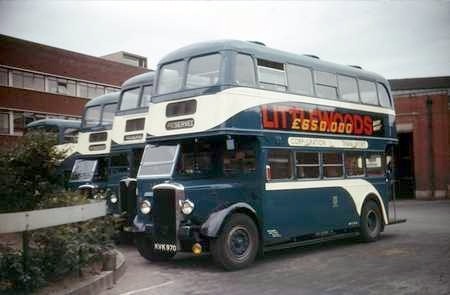
Hull Corporation – Daimler CV6G – KVK 970 – 128

Hull Corporation - Daimler CV6G - KVK 970 - 128

Kingston upon Hull Corporation Transport
1948
Daimler CV6G
Metro Cammell Weymann H55R

My thanks to Paul Morfitt an expert on K.H.C.T. for information regarding this bus.

“this bus entered service on the 10th June 1961 and was withdrawn in December 1966. It came from Newcastle to cover parts of the trolleybus conversions”

Does anyone have any information of this bus whilst it was at Newcastle?


These ex Newcastle Daimlers were notable for their Birmingham style bodies. Compare this photo with any HOV ### registered Birmingham City Transport Daimler. I think Edinburgh also had some like this.

Simon Avery

To see a Birmingham Daimler registration HOV 845 click here


I think that "timeless elegance" describes this classic style of body – with just a quiet air of superiority. I loved to see them in Hull, where they fitted in perfectly with the Corporation Transport Department’s image. What a magical combination arose from the KHCT and EYMS fleets in those days, and many thanks to the RAF for sending me to Patrington (Spurn Point) for my two years National Service – I couldn’t have asked for anything better.

Chris Youhill


All the second hand Regents, and Daimlers too, were bought for two reasons, firstly, as Paul said, was to facilitate trolleybus replacement, although memory seems to tell me that the Coronation trolleybuses on the 63 (Beverley Road) service were replaced directly by the early Atlanteans.  Secondly, as already noted Hull lost 2/3rds of the fleet due to air raids on 7/8th May, 1941; consequently there were large batches of Regents acquired in the post war period, as replacements. Thus in the 1960’s a large number of Regents were nearing the end of their lives, and KHCT was in the process of introducing OMO to its fleet, having a planned purchasing plan for a large number of Atlanteans which was spread over a period of some 10 years. The various batches of second hand buses were basically stop-gaps until the end of the OMO conversion. Incidentally KHCT was the first Municipal operator to achieve 100% OMO operation on both saloons and ‘deckers. This was achieved in 1972.

Keith Easton


Further to my previous comment, the losses due to Luftwaffe exploits over Hull only 1/3rd of the fleet was lost (actually 35% – 44 vehicles).

Keith Easton


03/08/11 – 16:04

These old Newcastle Daimler were great buses – had preselector gearboxes as well – they were painted dark blue and often had a blue light on next to the destination board!
Travelled a lot in them in the early 1940ties!
My favourites were FVK 198 through to FVK 201!

Stui Beveridge


04/08/11 – 07:18

What was the purpose of the blue light, Stui?

Chris Hebbron


02/10/11 – 14:05

When the Daimlers first appeared local enthusiasts thought them old fashioned mainly due to the curious windscreen arrangement (130 with a Roe body was an honourable exception) – they did not compare with the contemporary Hull Regent IIIs or the EYMS PD1s.
Authority to buy was obtained in May 1961 with a bid limit of £205 per vehicle. There is no mention in the report specifically regarding trolleybus replacement although. My own view is that they were to cover the bodywork problems on the Regent IIIs which were such that the department couldn’t cope and many went to Roe for attention. No buses were withdrawn as a result of their arrival.
Mr Pulfrey had said in May 1960 that he expected the Chanterlands Avenue route to be replaced in 1960 using spare standard 58 seat buses. The 1961 timetable did not mention services 61/65 but included replacements 13/23 but not until July 1962 did that conversion take place.

Malcolm Wells


15/03/12 – 09:30

Hi Chris, sorry for the delay as we are out and about in retirement living mainly in Düsseldorf but in winter on Gran Canaria!
Strangely – the purpose of the blue light next to the front destination board was to show at night they were so called " Blue buses " and not the new fangled bright yellow trolley buses.
Just loved travelling on these buses – favourite routes were 1 and 2 – Denton Burn / Cochrane Park / Scrogg Road etc and yes – they were quite advanced as they had pre-selector gearboxes which made life easier for the drivers.
It was wartime and the buses were very often completely packed in the rush hours or when it was pouring with rain – even upstairs – as the unions at that time had no influence on passengers carried!
Upstairs was then a disaster as the passengers were all soaking wet and damp and it was full of smokers and their gaspers! Players Please or Senior Service were favourites and poor dock workers building warships like George V or so sufficed with a cheap 5 fag paper pack of Woodbines!
Has anyone relatives or friends with any decent old Newcastle street scenes showing all these marvellous blue and yellow buses and the dark maroon trams?
Lets have your comments here please?

Stui Beveridge


16/03/12 – 08:38

Thx for the ‘blue light’ v yellow trolleybus explanation, Stui. I assume that there was an extraordinarily large part of the local populace who were colour-blind and/or deaf, not being able to detect the different noise level between the two! Seriously, it’s not commonly known that London trams had three small lights above the destination screen, so that combinations could indicate which route they were on, for the illiterate. Other systems had this, too, with some having different coloured liveries for different routes. Not a lot of use for those like me who were colour-blind!

Chris Hebbron


16/03/12 – 09:55

As many custom car enthusiasts have found to their cost, apart from emergency and specifically exempt vehicles, under current legislation it is illegal to show a blue light that is visible on any part of the to the exterior of the vehicle ‘including the underside’

Ronnie Hoye


16/03/12 – 12:40

Wigan Corporation always had two green lights either side of the destination so that locals caught "their" bus as opposed either Ribble or LUT both of whom used red as a colour as did Wigan. This arrangement lasted until the last buses delivered to Wigan in 1972.

Chris Hough


17/03/12 – 06:18

Regarding the Hull Coronations what a crying shame that none were preserved.

Philip Carlton


23/04/13 – 07:54

I am sure there was an Atlantean at Maspalomas Gran Canaria. Is it still there?

box501


13/10/14 – 17:23

Special or even no lights? Please remember at that time these buses were originally in service between 1939 – 1945 we were in the middle of a deadly serious world war on several fronts simultaneously and had more or less total black out on the streets!
Danger of invasion was later not quite so imminent but it was still there! Life was not a pony farm and quite so funny as it is to-day under the EU and Co!
In occupied Europe life was horrific with daily trains leaving most main cities with cattle trucks packed with innocent men, women and children for the concentration camps mainly in the east!

Stuart Beveridge


14/10/14 – 06:29

I wonder if Hull Corporation would have purchased these vehicles if they had had Daimler engines?

Chris Barker


15/10/14 – 07:19

Hang on, Stuart, why the seeming rebuke? This is a site for those interested in buses, not a history one. That said, I’m sure that many of us who post are ‘of a certain age’ and fully aware of the war, maybe even lived through it, as I did. I lost an uncle in both wars and years of working a 6.5 day week, in munitions work, killed my father prematurely. Knowledge of the Holocaust would not be unfamiliar to us, either.

Chris Hebbron


Quick links to the  -  Comments Page  -  Contact Page  -  Home Page


All rights to the design and layout of this website are reserved     

Old Bus Photos from Saturday 25th April 2009 to Thursday 4th January 2024