Old Bus Photos

County Motors – Guy Arab II – CCX 801 – 70
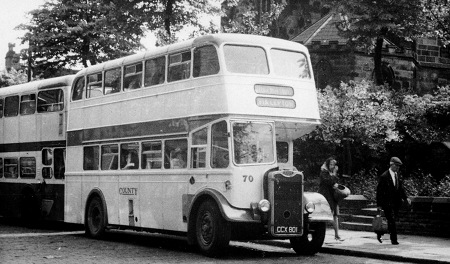
County Motors - Guy Arab II - CCX 801 - 70 
Photo by ‘unknown’ if you took this photo please go to the copyright page.

County Motors
1945
Guy Arab II
Roe L27/26R

This photo was taken at the Huddersfield terminus and the bus behind is a Guy Wulfrunian probable owned by West Riding. The Wulfrunian was said to be very advanced for the time, but I have read somewhere that the only advanced thing about it was the all round air suspension, lets face it the rather strange layout of the engine and stairs didn’t exactly catch on did it, if you disagree leave a comment.
But back to the County Motors Arab II this bus apparently has been preserved but at the moment I have not been able to come up with a link to a dedicated website, if you know, let me know.
It started life with a wartime utility body but was re-bodied in 1953 by C. H. Roe Leeds and ended up two seats less at the end of it.
Hard to tell which engine this bus had as all Arab IIs had the extended radiator to accept either the six cylinder Gardner (6LW) engine of 8.4 litre or the shorter five cylinder 7.0 litre Gardner (5LW) engine. Although knowing Huddersfield as I do then I think this bus would of handled the surrounding hills much better with the larger 6LW engine, either that or  the driver would have to be very good at changing gear, especially down.


“Anything—pictures or info—on Guy Arabs is fascinating. Greatly enjoyed pictures and comments.
In Reading we had utility Arab 5LWs and 6LWs until 1949-50, when they were sold on. No 27 seemed to be everyone’s favourite. How I wish one had been preserved…!”

Ian Thompson 


“I can confirm that County 70 has a 6LW engine. At the time of re-bodying in 1953 it was fitted with a transmission of contemporary (i.e. Arab IV) design, which makes it much easier to drive than the original twin-plate clutch and sliding-mesh gearbox of the Arab II. This bus is currently in the Dewsbury Bus Museum.”

Peter Williamson


10/02/21 – 07:13

County 70 is preserved and is now semi-restored at the Dewsbury Bus Museum awaiting a full repaint.
Can confirm it is a West Riding Guy Wulfrunian behind. The other advanced engineering on it was that Wulfrunians had disc brakes.

Graham Crawshaw


11/02/21 – 07:17

Graham’s post has drawn my attention to my earlier statement about 70’s transmission. Since writing that, I have discovered that the last Arab IIs to be built had the constant mesh gearbox from new, and so it may be that 70’s transmission is original. Sorry about that.

Peter Williamson


12/02/21 – 06:10

The transmission of the wartime Guy Arab consisted of a twin plate clutch and a four speed sliding mesh (crash) gearbox that dated from the 1920s, in which the gear selector operated from right to left for upward changes. During the summer of 1945 Guy began fitting the Arab with a single plate clutch coupled with its new all constant mesh gearbox, in which, unusually for the time, even first gear had constant mesh engagement. This gearbox, which selected gears in the by then conventional left to right sequence, was designed and developed during the conflict, but pressures of wartime delayed its appearance in service. This transmission proved to be immensely robust and reliable and remained an option right to the end of Arab production.

Roger Cox


12/02/21 – 12:12

I was for a time part-owner of Provincial 55 which has the reverse gearbox. The gear lever was fitted with a red knob rather than a black one to indicate this; I am not sure whether this was an original Guy feature, or fitted by Provincial, but I believe the former. I don’t recall the box as being tricky to master, other that having to remember where to put the stick!

Alan Murray-Rust


13/02/21 – 07:07

My Arab which also has a reverse gearbox has a black knob. Issue with the gearbox is that unlike Leylands or Bristols you have to place the gear lever the others allowing you to use the selector box sides for guidance.

Roger Burdett


13/02/21 – 07:08

The red gear lever knob was originally fitted to the later constant mesh box to indicate the correct left to right sequence. The old Guy gearbox had a black knob. No doubt things got swapped about in the course of time.

Roger Cox


13/02/21 – 07:09

I’ve not met any Guys with the reverse gearbox, but those with the constant-mesh box usually had maroon gear lever knobs. Even the Daimler CCG models, which had the same Guy gearbox, had maroon knobs.

Peter Williamson


14/02/21 – 07:00

London Transport lopped a couple of inches off their reverse gearbox Arabs., compared with the later ones.

Chris Hebbron


Quick links to the  -  Comments Page  -  Contact Page  -  Home Page
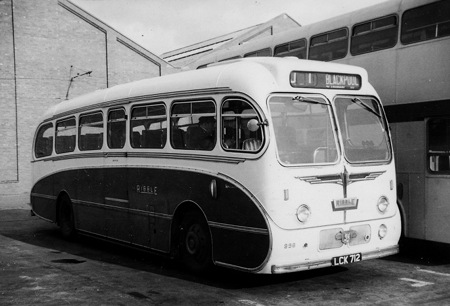


Ribble – Leyland Tiger Cub PSUC1/2 – LCK 712 – 998

Ribble Leyland Tiger Cub

Ribble Motor Services
1958
Leyland Tiger Cub
Burlingham ‘Seagull’ Mk 3 C41F

We are travelling in style today on a rather nice coach or as when I was a young lad I would always say “are we going on a chara” more than likely originates from charabanc. The Yorkshire dialect as a tendency to shorten words and does not use a new word if the old one will suffice. Did you have a word other than coach for coach, and whilst we are at it, have you a different word for a bus, I had a friend from Oldham Lancashire who called a bus a ‘buzz’, let me know along with your area, leave a comment.
Anyway that’s enough of that back to the Ribble, the ‘Seagull’ body was very popular for the period not surprising really they did look rather sleek at the time. Ribble also had the Mk 2 version of the ‘Seagull’ built 1953/4 but they had centre entrances. I have a photo of a 1957 Yorkshire Traction ‘Seagull’ I think it is a Mk 2.


An uncle of mine, a native of St Helens, always referred to a coach as a SALOON.

Pete Davies


Which was correct as the replacement for the charabanc was the Saloon – or all weather – Coach.

David Oldfield


The bodywork on this is actually of the Mk. 6 version of the Seagull, easily distinguished by the side glazing which is set in "window pans" after the fashion of Burlingham’s service bus body of the time. Very few of this design were built apart from the Ribble batch, but Harper Bros of Heath Hayes had some on Guy Arab LUF chassis. One of these at least is preserved. I have just written an article on the various breeds of Seagull which I will be sending to the website as soon as I can get round to typing it!

Neville Mercer


When working for Ribble at Carlisle depot in 1964 I was detailed to take over a Tiger Cub/Seagull identical to this one at Carlisle when it arrived from Manchester en route to Glasgow. With 4 speed (I think) gearbox and 2 speed axle they were lovely machines to drive even up the A 74 trunk road which was little better than a glorified country lane in those days. Although I remember well the large fleet of Austin 5 ton tippers belonging to a Carlisle scrap merchant hauling rock on the construction site when the section from Telford Bridge to Beattock Summit was being converted to dual lane.

Gerald Walker


29/01/12 – 07:25

Southdown buses and coaches were always referred to as cars for many years even into NBC days. I totally agree with Gerald Walker about the Tiger Cub with 4 speed box and 2 speed axle they had a lively performance and light controls and excellent brakes, the secret was to master the 2 speed axle and use it properly. Ours were fitted with Weymann Fanfare bodies which were solidly built and comfortable. I have to say light controls and brakes were not at that time a common trait with Leylands.

Diesel Dave


29/01/12 – 16:27

Saloons/Cars, as hangover’s from the past, bring to mind older conductors, even in the early 60’s, still saying, when the inside was full, "Plenty of room outside" from open-top days.

Chris Hebbron


29/06/13 – 15:20

I started my apprenticeship at Frenchwood body shop which we shared with the body builders in 1962 and worked on most bus numbers 1200s, 1300s, 1400s, 1500s, and 1600s with 1700s just about starting the overhaul on the bus bodys, one instance whist cleaning the boot of a seagull coach some one closed the doors, and with using cellulose thinners after 15 mins I was drunk as a lord, light headed and later, with a bad head, but I left in 1964 and went to Atkinson vehicles to finish my time, in the service department and was there for 12 years.

James Lynch


23/11/13 – 07:51

One of these worked out of Whiteleas for George Wimpey Contractor in the 60s and 70s, it was a former Ribble coach and had reg LCK ???

Frank Lowe


Quick links to the  -  Comments Page  -  Contact Page  -  Home Page
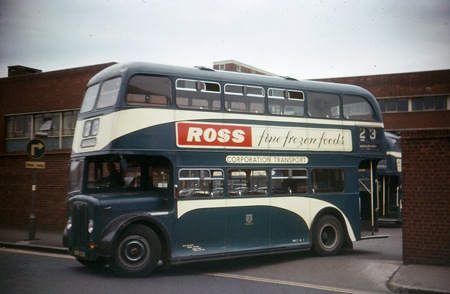


Hull Corporation – AEC Regent III – OKH 336 – 336

Hull Corporation AEC Regent III

Kingston upon Hull Corporation Transport
1953
AEC Regent III
Weymann "Auroa" H32/26R

Regent III I hear you shout, yes I thought it was a Daimler as well, until Paul Morfitt a K.H.C.T. expert pointed it out to me. K.H.C.T. bought 6 of these Regent IIIs with the Birmingham style tin front, they were apparently the last front engine/open platform buses bought brand new by them. Fleet number 337 is now fully preserved and should be out on the rally circuit next summer (2010) so keep your eye out for it. There is also a restored Bradford City Transport Regent III with a similar tin front it can be seen here.


04/04/13 – 06:28

The Weymann Aurora body is something of an enigma. The first one – also co-incidentally on an AEC Regent III with tin front – was built for Devon General and exhibited on the MCW stand at Earls Court in 1952 alongside the prototype Orion. An MCW sales brochure was produced, which was still being distributed two years later, but no more bodies of that type were ever built. In the meantime Weymann had been building this much more elegant design, which most people agree bears no resemblance to the prototype described in the brochure, and which could instead be traced back much more clearly to earlier Weymann bodies. It is almost as though Weymann simply thumbed its nose at the MCW design team and just carried on with their own design evolution as if nothing had happened.
To confuse matters still further, a brief article in a recent edition of Classic Bus magazine, describing the prototype (which is now preserved) as unique, it was answered by not one but two letters referring to production Auroras as "virtually identical" to the prototype – one of them referring to these Hull vehicles and the other I think to some Bristols for Maidstone and District. It seems that resemblance, like beauty, is in the eye of the beholder!

Peter Williamson


04/04/13 – 08:29

The Aurora is certainly an enigma – and a trap for those who only know half the story. I too have been puzzled by the lack of similarity between to prototype and production versions but the Weymann Story (in two volumes Senior/Venture) is very clear. The Aurora name was used for these modernised versions of the classic Weymann design (produced from 1953 to 1959). The MCCW Orion design was produced at Addlestone from about 1953 (the first being re-bodies of war time Guys for Maidstone & District). Interestingly, Addlestone were also building Aurora bodies on war time Bristols for M & D. What most people didn’t realise – me included – is that the Aurora name was then resurrected as the official and proper name for the forward entrance version on the Orion.

David Oldfield


04/04/13 – 11:03

Just remembered the Bournemouth trolleys which had the Aurora as late as 1962.

David Oldfield


04/04/13 – 11:04

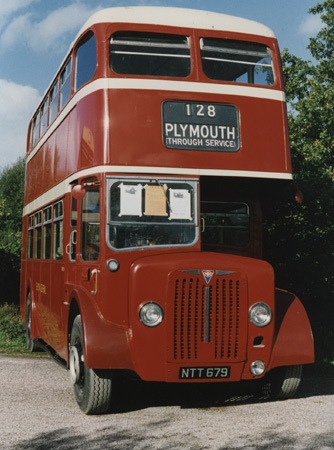
NTT 679

Here is a photo of the preserved one-off 1952 Aurora, Devon General NTT 679, taken at the Devon General Running Day at Newton Abbott in 1993.

John Stringer


04/04/13 – 15:49

The main difference between the prototype Aurora and the production model seems to be the move from pan window fixing to rubber mounting.
birkenhead titan

Here is an example of the production version as supplied to Birkenhead Corporation in 1954. Apart from being on an exposed radiator chassis, it differs from the Hull version in having a 5-bay body. The traditional Weymann drooping saloon window is much in evidence. Birkenhead dabbled with Weymann as a body supplier. The batch of 10 Auroras was not the whole of the CBG intake, the remaining 5 of the batch having locally-built Ashcroft bodies. The 1955 intake of 17 vehicles (10 PD2 and 7 Arab IV) saw half the PD2s bodied with the Orion style, and finally in 1964 came the one-off batch of 10 Fleetlines, again with Orion style, one of which appears on the left of the picture. (Originally delivered with the cream relief as window surrounds only, the appearance of the Fleetlines was much improved with the application of the standard livery on repaint, as seen here.)

Alan Murray-Rust


05/04/13 – 05:51

To me there are more differences than similarities. On the prototype, the dimensions of the windows – deep lower, shallow upper – are more like a production Orion than any other Aurora (and the deep lower deck windows were made much of in the sales brochure). On the production version, as Alan says, the traditional Weymann drooping bulkhead window is much in evidence, whereas on the prototype the top rail is straight and only the bottom curved, again just like most highbridge Weymann Orions. In fact the only similarities I can find (using other images) are in the front and rear domes and the rear emergency window.

Peter Williamson


23/04/13 – 07:50

My favourite bus, thin steering wheel and a smooth seat which you could slide off on exit from a roundabout and if it was a hot day and your cab door was open it could be interesting. A lot of drivers didn’t like them because you couldn’t see the pavement from the cab. I thought they were great, the exhaust would roar when you put your foot down.

box501


03/06/14 – 12:52

The Daimler and Guy Utilities of Maidstone and District were rebodied with a later form of five bay Weymann body derived from the pre and early post war design but with deeper windows upstairs. Only some Utility Bristol K6As had four bay ‘Aurora’ or five bay ‘Orion’ bodies. The only Orion bodied Guys which Maidstone and District had, were the Guy Arab IVs acquired or ordered by Chatham and District which were based on new post war chasses.

Gordon Mackley


Quick links to the  -  Comments Page  -  Contact Page  -  Home Page


All rights to the design and layout of this website are reserved     

Old Bus Photos from Saturday 25th April 2009 to Thursday 4th January 2024