Photo by ‘unknown’ if you took this photo please go to the copyright page.
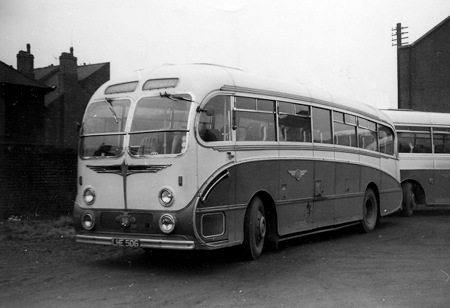
Yorkshire Traction
1957
Leyland Tiger Cub PSUC1/2
Burlingham ‘Seagull’ C41F
If you go back to a previous posting at this link you will be able to compare the difference between this ‘Yorkshire Traction Seagull’ bodywork and the ‘Ribble Seagull’ . The main difference that strikes me is the Horizontal split windscreen and slightly different lighting arrangement. Is this a Mk 2 or Mk 3? Maybe they are both Mk 3s and in the one year age gap improvements to the screen were made. If you know, let me know, leave a comment.
06/03/13 – 16:46
This Seagull is a Mark V. This was available with either front or central entrance and replaced the central entrance Mark III and forward entrance Mark IV. The distinguishing feature of the Mark V from the models it replaced was the single piece rear windscreen with rear quarter lights. The Mark V was produced for the 1957 and 1958 seasons. The windscreen arrangement was optional on the Mark IV, V and VI, either single piece flat screens or horizontally split. For example, Ribble had Mark IV and Mark VI Seagulls with flat screens, whilst North Western, Trent, Wallace Arnold and Yelloway (at least) had Mark V Seagulls with flat screens.
David Williamson
Quick links to the - Comments Page - Contact Page - Home Page
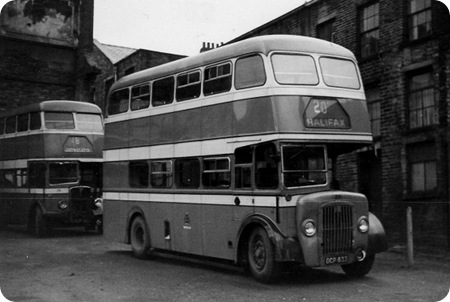
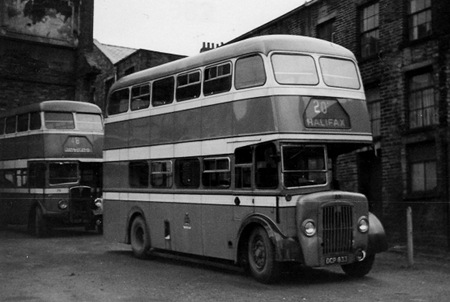
Halifax Corporation Transport and Joint Omnibus Committee
1954
Daimler CVG6
Roe H33/25R
This bus is a ‘CV series Daimler the ‘V’ stands for Victory meaning the chassis was built after World War II whereas the preceding series ‘CW’ was for chassis built during the War when the ‘W’ stood for war.
As this bus is a ‘CV’ series it had what was called a ‘Birmingham Tin Front’, similar to the previous K.H.C.T. AEC Regent III. If it had been a CS/CC series built 1955 onwards the radiator would of been different, and would then of been called a ‘Manchester Front’. Is there a Tin/Fibre Glass front expert out there that can sort out this radiator business once and for all. When does a ‘Birmingham’ become a ‘Manchester’.
There is a link to a video of a preserved Halifax Daimler ‘CV’, all be it two years younger than this bus here please note the difference in the destination boxes from the bus in this photo and the one in the video, more on that at a later date.
A full list of Daimler codes can be seen here.
———
The Manchester front is the one with the headlamp mounted on the wing, the bonnet itself being narrower than the Birmingham version. It took a Mancunian to realise that short drivers couldn’t see the nearside wing on a Birmingham front so they were forever bashing things!
The Birmingham front was also fitted to Crossleys, Guy Arabs and AEC Regent IIIs, whereas the Manchester type only ever appeared on Daimlers. There are two versions of the Manchester front, as CVG6s had a tapering front chassis frame with a 7′ 6" front axle. CVG6-30s, CCGs & CSGs and the last few CVG6s all had straight frames and 8ft axles, hence a wider front.
David A Jones
———
29/05/11 – 07:51
Sadly these buses weighed a ton more than the mark III Regent and had 112bhp engines in lieu of 125bhp of the mark III as a result they had a lot of trouble, many were fitted with Leyland O.600 units and later 95 had a 6LXB Gardner whilst 93 had a turbo charged Daimler. So 95 became CVG6LX, 93 CVD6, most of the others CVL6 some retained the 6LW mainly the 116 etc group used on the flatter shorter corporation services.
Christopher
Quick links to the - Comments Page - Contact Page - Home Page
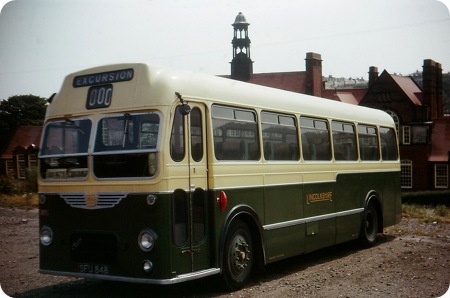
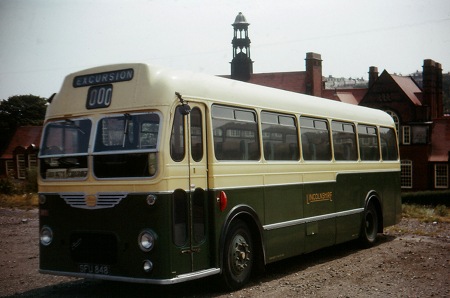
Lincolnshire Road Car Company
1958
Bristol MW5G
ECW DP41F
Another photo taken in Scarborough coach park of a Bristol ‘MW’ series single decker but this time in the fleet of the Lincolnshire Road Car Company Ltd. This vehicle was classed as ‘dual purpose’ meaning it was a bus with ‘nearly but not quite’ a coach standard of interior. I do like the paint work on this bus the step in the cream ¾s way down the side makes a big difference.
The ‘5G’ after the ‘MW’ in the ‘MW’ series letters above means that this bus had a Gardner 5HLW engine which was a 5 cylinder 7.0 litre horizontal diesel engine. If the ‘MW’ had been followed by ‘6G’ it would of had a Gardner 6HLW engine which was a 6 cylinder 8.4 litre horizontal diesel engine. As far as I know only these two engines were available with the ‘MW’ series, meaning no Bristol engine, if you know different let me know.
———
Although as you rightly state, the Bristol MW was only available with the Gardner 5HLW or 6HLW engine, one was fitted experimentally with a Bristol engine, but never operated in service as such. This was an early MW chassis bodied by ECW with a bus shell, and it was returned to Bristol Commercial Vehicles as a test-bed vehicle. The engine was in itself experimental – being a horizontal version of the BVW 8.9 litre unit and known as the BHW. In 1963, the MW6B (as it would have been known) was re-engined with a Gardner 6HLW unit. Its body was then completed to 45-seat bus layout, and it entered service with Red & White as their U1563 (228JAX). Another BHW-engined Bristol test-bed vehicle appeared in 1963 in the shape of a prototype RELH chassis fitted with an ECW coach shell. Whether this was fitted with the engine from the MW I do not know, as apparently Bristol had built several BHWs for experimental use. The engine in the RELH6B test vehicle also had a turbocharger fitted to increase power. However, the BHW engine never entered production, and later the vehicle (chassis number REX003) was given a Gardner 6HLX engine and its body fitted out to full 47-seat coach specification. It then entered service with West Yorkshire as its CRG1 (OWT241E) in 1967.
Brendan Smith
Quick links to the - Comments Page - Contact Page - Home Page