Halifax Corporation – Leyland Leopard – OCP 231 – 231
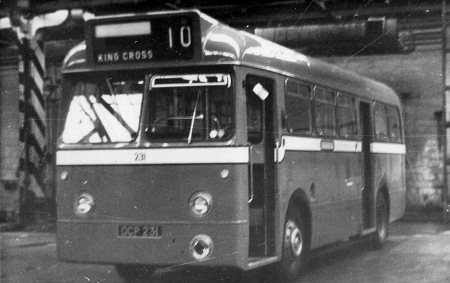
Photograph by ‘unknown’ if you took this photo please go to the copyright page.
Halifax Corporation Transport and Joint Omnibus Committee
1961
Leyland Leopard L1
Weymann B34D
I thought that this bus was a one off being a dual entrance vehicle with Halifax Corporation, but on research I find that they had half a dozen Karrier WL6 with Harris & Hassall duel entrance bodies in 1928. The above bus was only a duel entrance for three years before being modified to to a front only entrance and seating 42, it was then re-seated the following year to a B44F.
As a matter of interest the 1928 Karriers were all withdrawn by 1932 they were not even re-bodied, duel entrance did not seam to work for Halifax. I think duel entrance buses were more useful in cities rather than towns mainly for the speed of on and off loading of the passengers.
With reference to the Karriers, many vehicles built prior to the late twenties weren’t expected to have lives of much more than five or six years anyway -timber-framed bodies, stiff springing, solid or narrow-section tyres and granite setts didn’t make for longevity.
Karriers were probably the worst motorbus ever perpetrated on the industry, even at a time when there were a lot of poor quality specimens on offer -rebodying these atrocious machines wouldn’t have made sense to anybody however many doors they had!
David A Jones
Earlier comments about these Karriers are well-founded! Another problem was that it was not realised then that if you had two driving rear axles, you needed a third crown wheel and pinion BETWEEN the axles. Thus, many half-shafts needed replacing regularly! And to compound the problem, Karrier never bothered to keep spares much beyond the time when a model had been replaced! Apart from getting extra length with 6-wheelers, one bonus was having braking on all four rear wheels. At that time, effective front wheel braking was not easy to achieve in the late ’20’s.
This was told to me by an old boy who’d worked for Portsmouth Corporation who had made the mistake of buying half a dozen Karriers, they also didn’t last beyond about 1932!
Chris Hebbron
This was actually the prototype Leopard, to spec L1, it had a unique badge different to all other leopards and was built 2 years before any others, in essence a Tiger Cub chassis with a Worldmaster engine and synchromesh gearbox, clearly Mr Lefevre decided to experiment at this time.
Christopher
27/11/11 – 08:06
I remember driving this bus during my time at Halifax, by which time it had lost its centre door. When one took it straight out from the garage, with cold engine and gearbox, it was virtually impossible to change gear with the thing, so stiff was the linkage (and, presumably, the gearbox internals). Even when warmed up, it was a serious challenge. All Leyland buses of that era had very heavy controls, but this bus, No. 231, was in a class of its own.
Roger Cox
27/11/11 – 09:16
Roger, you’ve brought back vivid memories to me of the earliest batches of 36 foot Leopards which were operated by Wallace Arnold. They were hard work with a vengeance – cold or warm. The clutches were far too heavy and the brakes were poor to the point of inadequacy, especially when needed frequently at speed or on gradients. The four speed gearbox was ludicrous, and these luxurious vehicles were unable to ascend certain hills on some of the most arduous tours, or at least were prohibited from doing so "just in case." A further constant irritation was the enormous steering wheel, mounted by the bodybuilders far too close to the dash assembly. To be fair the 30 foot Leopards were far more acceptable in general, being less cumbersome and far more spritely. The comparison between the large Leopards and the big Reliances from AEC was incredible – the latter being swift (small "S" and no pun intended) ideally geared, and a joy to handle all day – and capable of speeds which, after all these years, I’d be reluctant to mention in print !!
Chris Youhill
28/11/11 – 10:28
I well remember as a child looking out of out the bedroom window of our house at Stump Cross early one Saturday morning – it would be 1961 – and catching my first fleeting glimpse of 231 as it flashed by at great speed towards Hipperholme. It was most likely travelling empty to Brighouse to operate the local Stoney Lane-Brighouse-Field Lane 51 route, to which it had already been banished apparently. I had never heard of a bus having two doors, let alone seen one – it looked very strange. I saw it again a week or two later travelling in the opposite direction, then that was that. Though its appearance was very similar to the earlier Worldmasters, it made a different sound – louder and with much more rasping exhaust.
The following year another sixteen similar buses arrived – nine for the Corporation (31-39) and seven for the Joint Omnibus Committee (232-238). The Corporation ones immediately replaced the preselector Regent III’s on the Northowram route – my daily bus to school. The badge on the front announced that they were Leopards – 231 did not have such a badge at the time and looked a bit blank. The front number plate was attached slightly higher, above the dividing strip between the upper and lower panels, whereas 231’s was in the lower panel. Inside, the interiors were all painted metal – typical MCW of the period – with dark green lower panels and pale green window surrounds, but the inside of the doors was all over dark green, whereas 231’s were divided half and half like the rest of the interior. Trivial differences, but features that made them instantly identifiable from one another. The seats were upholstered in an uncomfortable, slippery green vynide, unlike the moquette-covered ones on the Regents. They were also incredibly noisy inside. The route continued to be crew-operated for quite a while, and the older drivers did appear to struggle with them at times, and it was clear many did not approve.
The next time I saw 231 it was a conventional single door bus just like the others. I did not subscribe to ‘Buses Illustrated’ at the time, and knew no other enthusiasts – indeed I believed I was probably the only person in the world who was interested in buses. I eventually concluded that the two doors had been all in my imagination, and it was to be a few more years before the truth was verified, and a lot longer before I was able to obtain a photograph.
I had always a soft spot for these buses, due to my childhood school bus associations, but years later when I was to drive them in service, that spot was burst for ever ! They were utterly unsuited to Halifax’s hilly local routes, frequently stopping and starting and negotiating awkward turns – the driver constantly grappling with the heavy, stiff gear change linkage and hard pedals. The accelerator was frustrating, the revs taking their time to build up and die down. The steering was relatively light, but like all Leylands of the time the wheel was enormous in order to achieve that. Many would jump out of gear when climbing long hills. Frequent bashing of the steering wheel rim by omo drivers’ heavy metal Ultimate ticket machine boxes had chipped the covering, leaving patches of cold bare metal, and jagged plastic sticking out to cut the fingers. The driving position was very low – it was like you were sitting on the floor with the passengers towering above. The destination winders behind a flap above the windscreen were awkward to access, the door operating lever was a long reach forward. The change dispenser mounted above and behind the driver’s left shoulder was literally a pain – though this feature was common to all HPT buses. The demisters were totally ineffective, so the windscreens would quickly mist over, especially with a full load of standing passengers, so a goodly supply of paper towels was always called for. In winter they were always freezing cold, and the windscreens would often freeze over on the inside, requiring frequent stopping to scrape a clear patch.
In fairness, once up through the gears and on the go they would motor on nicely. They could eventually achieve a fair speed, and their road holding was excellent, but it was not often you got them on a long run. Occasionally one would find its way onto the Rochdale route as a changeover for a newer type, and they would usually romp noisily up from Littleborough to Blackstone Edge and over the moors in fine style with good sound effects from the exhaust. The engineers would probably have argued that they were more reliable and durable than the subsequent AEC Reliances, but as a driver I certainly know which I preferred !
John Stringer
28/10/15 – 07:08
The early Leopard L1 had a basically Tiger Cub chassis with a Worldmaster engine, not that this mattered it was a Leyland so Le Fevre would buy it, Halifax later choose Reliances because of the spare wheel carrier, would you believe that Leyland refused to move this and thus Halifax went AEC and as you have noticed the AEC had nicer steering, easier clutch, good brakes and was a more pleasant vehicle to one man, those with 505 engines could go, I recall coming back from London on one of 273/4 running at 85 miles/hour only overtaken by an EYMS Leopard with 2 speed axle. Once the L series was discontinued in favour of the PSU3 type (11 metre) or PSU4 (10 metre) then Halifax switched back to Leylands.
231 had a special Leyland front badge that was slightly different to others that came later, I cannot say how it was different but it was.
Christopher
Quick links to the - Comments Page - Contact Page - Home Page