West Bridgford – Daimler CWA6 – GNN 410 – 25
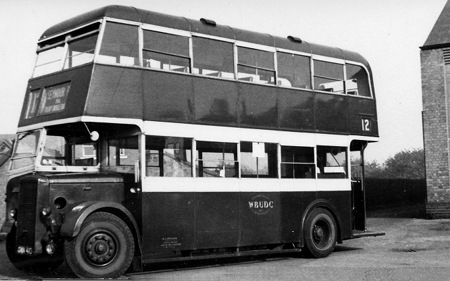
Photo by ‘unknown’ if you took this photo please go to the copyright page.
West Bridgford Urban District Council
1945
Daimler CWA6
Brush H30/26R
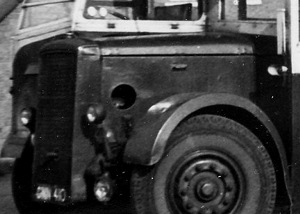
Here is a fine example of a utility body built just at the end of the war all very square and flat with little if any panel beating due to using unskilled labour to build it. You can also see just how small the headlights were and a painted radiator rather than polished alloy or chrome, not that it had anything to do with the war but you can also see the pop out trafficators (top right of photo below).
 The CW series (‘W’ stood for “war”) started production in 1943 with the CWG5 which had a Gardner 7.0 litre 5 cylinder engine in total 100 were built before being superseded in the same year by the CWA6. The CWA6 had an AEC 7.7 litre six cylinder engine over 800 were built until in 1945 when Daimler introduced its own 8.6 litre six cylinder engine which was called the CWD6. Production of the CWD ceased in 1946 but due to waiting for bodies some did not get on the road until 1947 the CV series (‘V’ stood for “victory”) followed with production starting in 1946. All CWs regardless of engine had the Daimler fluid flywheel four speed preselective gearbox and vacuum assisted brakes.
The above bus entered service in April 1945 and was withdrawn from service in 1967 according to a fleet list I have dated 2nd April 1965 courtesy of WBUDC it states that this bus still had its Brush body so I do not think it had a rebuild but I bet it had a fair bit of touching up.
Bus tickets issued by this operator can be viewed here.
At the St Helens road transport museum there was a Daimler similar to the West Bridgford one here, the engine did not have a cylinder head on so I could see it was a 6 cylinder engine. But no 2 pot was only 2" in diameter while the rest were about 4"-5" any clues? was it a start help cylinder or balance help issue. What engine was it, the fuel injector pump had 6 outlets but no 2 was slightly different. The Vacuum pump was in front of the injector pump.
I remember the West Bridgford buses very well, they always looked a bit more posh than my fathers Nottingham City Transport, dad was commercial manager for many years, which meant I spent many a happy hour in the depot.
Ken Johnson
07/03/11 – 09:27
WBUDC was taken over by NCT in the late 60’s
Roger Broughton
11/06/13 – 12:31
A very belated answer to Ken Johnson’s question about the mysterious tiny piston visible in the temporarily headless AEC 7.7 engine of EWM 358, the ex-Southport Corporation Daimler CWA6 awaiting restoration at the St Helens Transport Museum, which I revisited with great pleasure last Saturday.
One of the pistons is at top dead centre, and with an overlay of dust covering both block and piston the actual bore diameter is obscured. Clearly visible is the toroidal combustion chamber in the piston head, looking for all the world like a baby piston in its own right. To add the the confusion, the other piston that would have been at TDC is missing, so that ALL bores except for the mystery one appear empty. The only inline sixes where only one piston at a time is at TDC are two-strokes, which this engine most definitely isn’t!
The whole vehicle is a major restoration project, so thanks, congratulations and best wishes to the Museum for their achievements up to now and in the future.
Ian Thompson
11/01/16 – 16:00
EWM 358 It was acquired by Blundell’s coaches in March 1957 – I took my double decker test on it. Wilf Blundell who was the British Stock Car champion was a friend of Mrs Topham of Aintree and the Daimler was frequently to be seen in use as a mobile grandstand. It suffered problems with its timber body and I think that is what led to its arrival at St Helens.
EAO
23/09/16 – 06:54
As a further insight to this vehicle I have just become a member of the NWTM and have the job of rebuilding the replacement engine for this vehicle, The original engine had thrown a leg out of bed (smashed the block on both sides due to con rod failure) The heads where removed for inspection.
I will update this agenda as work proceeds.
John P
23/09/16 – 11:01
All utility bodies built of wood suffered from timber problems within 6-8 years, EAO, as green (unseasoned) timber was used in their construction. London Transport started overhauling their Daimler CWA6’s around 1949 and gave up about halfway through the 281 they had. They found that much of the wooden frames had completely disappeared into dust and that correcting the work was far too time-consuming and therefore expensive! They didn’t like the 12 or so CWD’s they were allocated and replaced them fairly quickly with 7.7 AEC engines recovered from scrapped STL’s. One problem with the Daimler engine was that the exhaust manifold was next to the driver and made the cab very hot at times. Also the timing chain was at the rear of the engine and difficult to access. Isn’t the subject of utility buses fascinating???
Chris Hebbron
24/09/16 – 07:44
Gardner engines also had the exhaust on the right hand side, and that certainly didn’t influence their acceptability. I understand, also, that the Daimler CD6 engine had timing gears rather than a timing chain. Both the CD6 and the contemporary Crossley HOE7 copied exactly the bore and stroke dimensions of the pre-war Leyland 8.6 litre unit, but neither came remotely near that fine engine in terms of performance and dependability. The location of the timing train at the rear of an engine permits more accurate timing and allows the entire engine unit to be more compact. The rear location of the timing gears does reduce accessibility, but this only becomes an issue if the engine is of dubious reliability. Dennis adopted rear timing gears in the mid 1930s, and reliability was never an issue with Guildford power plants, unlike those of Daimler and Meadows. Daimler’s engines were of exceedingly variable quality, ranging from appalling to excellent, and London Transport quickly gave up on them. Daimler soon limited the fitment of its own CD6 diesel to single deck versions of the CVD6, where the unit was subject to rather less stress. The Freeline underfloor engined model used the larger 10.6 litre CD650.
Roger Cox
03/10/16 – 06:33
EWM 358 update; The engine has now been rebuilt and should be test run this week, prior to cleaning and refurbing the engine bay. The bearings in the fluid flywheel are at present trying to be sourced as they are the original Hoffman type 325/340 and have so I believe been obsolete for some years, There are however possible alternatives.
The intention being is to refit the engine so the vehicle can be moved under its own power to facilitate restoration.
John P
18/11/16 – 07:08
EWM 358 update. The replacement engine has now been test run and is in good working order, the engine bay is currently being refurbed in preparation for the engine fitting hopefully before Christmas.
A question for all you bus people out there,The Original engine does NOT appear to have a dynamo fitting anywhere on the block. I maybe clutching at straws here but were these fitted with Dynostart units, as all the main battery leads are on the starter side only.
The replacement engine is from a AEC Matador Ex service vehicle and was fitted with the Dynamo unit on the LHS Driven off the vacuum pump, which we are having trouble sourcing as we need the star drive and shaft with it.
More updates to follow
John P
19/11/16 – 08:07
The dynamo on postwar Daimlers was driven by belts from the input to the gearbox, which was mounted half-way down the bus, so there would be no dynamo on the engine. I can only assume that wartime Daimlers were the same.
David Beilby
20/11/16 – 05:46
Thanks for your info David, I will put the boiler suit on and have look.
As usual I will keep you posted and will put some pictures on soon.
John P
20/11/16 – 14:28
The subject of early timber framing deterioration in utility bodies is indeed true in the large majority of cases, but there were certain very commendable exceptions. Samuel Ledgard was very fortunate in this respect and seemed to have reasonably minimum trouble with theirs, new or second hand, whether built by Duple, Roe, Park Royal or Brush. One minor manufacturer though really did "let the side down" – Pickerings, and the two that the Ministry "treated" Ledgard’s to were so ugly and they looked like falling apart very early on. The Duple and Roe ones mostly gave approaching twenty years top line service with little attention other than the "in vogue" fitting of sliding windows to replace the half drop originals. Even the "Sutton depot" ex London Park Royals appeared to escape major timber rot. As with many other folks I find the subject of the utilities to be endlessly fascinating and I greatly enjoyed conducting and driving them.
Chris Youhill
21/11/16 – 07:48
To be fair, Chris Y. most of LTE’s 1946 Park Royal CWA6’s that Samuel Ledgard acquired in 1954 were overhauled in both 1949 and 1952, so most of the green wood was probably replaced by the time of sale! I’d say that SL got a bargain with them. Those of this batch which went to Belfast Corporation were re-bodied immediately by Harkness, which seems a little unnecessary at that point in time. Since Morden accommodated both Sutton and Merton vehicles, it’s certain that some of these buses had both you and me travelling on them at some point in time, Chris Y! The Guys Arab I’s might well have more robust chassis, but the Daimlers were more sophisticated: a classier act, IMHO. My joy was when they were used on the Morden to Epsom Raceday specials. I used to save up much of my pocket money and bunk off school for these rides. The conductors would often not take my fares, bless ’em! It is right to say that the CWD-engined ones performed better, but, if memory serves, there were only 12 of them!.
Chris Hebbron
24/11/16 – 07:26
EWM 358 update, I have now found the dynamo located underneath the bus as advised by David, While I was under there I was amazed at the condition of the lower timber floors and the body out riggers, certainly they are black, but they appear in general rot free, it is intended when the engine is soon to be installed, to remove some of the side panels for inspection, but if the ones that cant be seen are in the same condition as the lower ones the restoration maybe a lot less involved.
John P
29/11/16 – 08:46
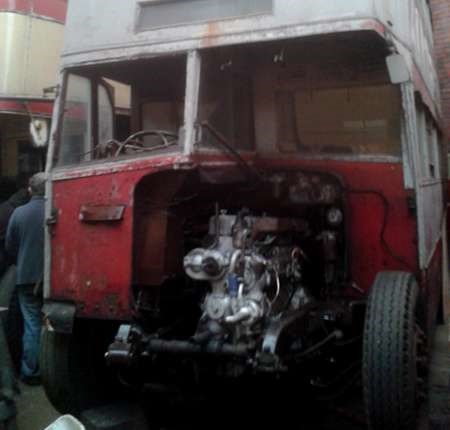
EWM 358 update, The engine is now fitted back in the bus, However nothing is yet connected to it so it has not yet warmed the exhaust. Its nice to see it in its rightful place after all the years.
John P
30/11/16 – 07:01
This is all very interesting, John P. Do keep us informed of progress. Glad that the body condition seems to be positive.
Chris Hebbron
02/12/16 – 07:11
As a member of the above museum, I have been helping John with some of the engine replacement in the bus, as he says we ran the engine on a ‘dolly’ outside the museum a couple of weeks ago and it ran ok.
Will be nice to see it move under it’s own power after over 30 years as a static – albeit – somewhat derelict exhibit!
Cannot wait to see it move under it’s own power in the future!
Norman Johnstone
12/01/17 – 06:42
As promised update on EWM358, after changing the oil and conneecting the fuel system, Batterys were connected and after a few seconds on the starter the engine fired for the first time in the bus.
It smoked a bit then settled to a nice tickover.
However we do have a leak problem with the radiator it appears to have rusted some of the tubes out, but we will see what can be done.
OK now for the I need help bit. I know that this bus was supplied new to Southport in 27/02/1945 Fleet No 62 and was in service with them till 1953/4 and then sold to Wilf Blundell Circa 1957, it then went to Aintree race course as a mobile grandstand where presumably it threw the con rod through the block,it was later bought by a soliciter which is how it came to be in our museum. Can anyone fill in the gaps with the history, or even have photos especially when it was at Aintree.
More updates will follow.
John P
01/02/17 – 17:15
Belfast were aware of the issues with the utility bodies so having refurbished the chassis and fitted a new body these vehicles were a lesser cost route for a brand new vehicle effectively. They weren’t rebodied immediately – they were acquired in 1953 and rebodying did not commence until 1955/6. All gave 15 year lives so BCT got good value out of their vehicles. One example 476 (GYE 98) former LT D93 is preserved.
Bill Headley
Quick links to the - Comments Page - Contact Page - Home Page