Old Bus Photos

Harper Bros – AEC Regal III – TRE 251 – 42
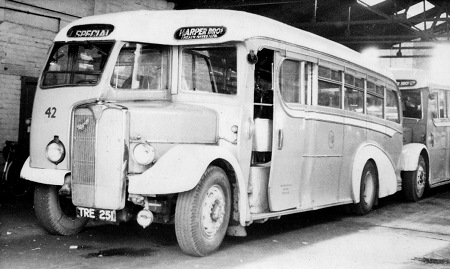
Harper Bros - AEC Regal III - TRE 251 - 42
Photograph by ‘unknown’ if you took this photo please go to the copyright page.

Harper Bros (Heath Hayes) Ltd
1950
AEC Regal III
Burlingham C33F

I do not have much information on Harper Bros but Heath Hayes is approximately 3kms east of Cannock, Staffordshire. If you have any information and would like to share it please leave a comment. From what I have come up with they were taken over by Midland Red Omnibus Company Limited (MROC) in September 1974, the depot at Heath Hayes was closed and the buses were moved to a new Midland Red depot at Cannock.
I am not sure who built the body for the above coach but if I had to guess Duple would be fairly high on the list. This style of body was called an half canopy as there was no roof over the bonnet and nearside mudguard as apposed to an half cab which did. The Harper Bros livery was a light grey green with white mudguards and in the case of this coach a white roof not sure if the white roof was standard for all the fleet.
Is there anybody who can explain the difference if there is one between Birmingham and Midland Motor Omnibus Company Limited (BMMO) and Midland Red Omnibus Company Limited (MROC). If you know please leave a comment.


You are spot on, TRE 251 has a Burlingham C33F body as had sister vehicle TRE 241. Both new in 1950. TRE 251 was scrapped in Nov 1968, TRE241 not traced. Harper Bros had 9 AEC double deck buses & 6 AEC coaches from 1930 to the mid 1960s. If anyone requires information on Harper Bros I will gladly try to answer any queries.

Mick Bullock


The Birmingham & Midland Motor Omnibus Co Ltd (BMMO) was established on 26 November 1904. BMMO was commonly known as Midland Red & used the fleet name Midland on its distinctive red buses. After losing Birmingham services to the new West Midlands Passenger Transport Executive (WMPTE) BMMO was renamed to the Midland Red Omnibus Co Ltd (MRO) on 29 March 1974. MRO lasted until 6 September 1981 when it was divided into six independent companies: Midland Red (North) etc. Enthusiasts can learn all this & much more at Adam Harber’s excellent www.midlandred.net website.

Peter Walford


24/03/11 – 08:38

Hi I am seeking fleet list of Harpers from there start to BMMO sell out. Any costs will be met.

John Hellewell


07/07/11 – 06:38

I now live in Cheshire and have done since 1960, I was born in Walsall Wood during the war. I remember Harpers bus service very well and used it till it was taken over, sad day. It was in my mind the best bus service I have ever known, I wish I had kept some of the early tickets which were about 3 inches by 2, all different colours and individual. The half fare for me was tuppence from Streets corner to Aldridge, If I came out of the house late and did not get to the bus stop they would pick me up, I remember in 1965 getting the bus to Aldridge and my girl friend getting on in Aldridge and she was late, John Morson the driver would shout don’t get off Jim we will wait for her. I know this is not much but you may draw something from it.

Jimmie Charles


07/07/11 – 08:09

What a lovely romantic story, Jimmie – the driver knew what romance was all about! Were that service was like that today!

Chris Hebbron


08/07/11 – 06:19

Thanks Chris, I have very little to offer but one thing stays in my mind, they had a double decker that was different to the others, when you went upstairs the aisle did not go down the centre with twin seats either side but went down the off side of the upper deck with seats on the left which seated 4. does that make sense. If I can think of any more useless info I will let you know.

Jimmie Charles


09/07/11 – 07:05

Hi Jimmie the double decker you refer to is what was classed as a Low Bridge Decker by having the aisle along the offside meant the roofline could be lower, the normal height would be 14’6 a low bridge if I remember correctly was around 13’6. I stand corrected but I think the fleet number was 3, if you remember you had to step up from the aisle into the seats and downstairs you had to mind your head if you sat by the offside window. I used to work for Harpers for a few years from 1964 both part time and full time conducting and driving (happy days) so if their is anything that you want to know and I can give you the answer I will

Phil Burton


09/12/11 – 08:33

Jimmie you have brought back a lot of memories. I to was born in Walsall Wood and remember Harper Bros with affection both for Bus services… Cannock through Brownhills to Kingstanding; Saturday Football Coaches to Villa, WBA and Wolves, and Saturday Holiday Coaches to North Wales resorts, New Brighton, Southport and Blackpool. In school holidays worked at their Aldridge Garage taking Holiday and Day Trip bookings. Most reliable and considerate firm out, our annual trip to Colwyn Bay would never have been the same, especially as coach hardly made the big hills at times, or had to pull in and wait to cool off. Still have a model Guy Arab in their colours, prized possession.

Ken Paskin


01/04/12 – 08:36

Has John Hellewell managed to acquire a Harper Bros fleet list yet, as I could supply him with one if required.

Mick Bullock


15/04/12 – 07:35

I think Jimmie’s referring to KRE 849, Harper’s fleet no. 24, a Burlingham lowbridge bodied Guy.
Mick – any chance of a copy of your fleet list, please?

Graeme Fisher


04/07/12 – 05:14

I remember Harpers with great fondness as a young lad from the 1960’s when a bus conductor called Jack used to let me ring the bell on journeys between Hednesford and Aldridge. I am always on the look out for photos from this period and as someone has mentioned I also would love a fleet list. If anyone can.

Keith Harley


17/07/12 – 07:11

Phil and Jimmie
The lowbridge double decker was fleet number 24, KRE 849 with Burlingham bodywork.

Graeme Fisher


21/07/12 – 07:43

Graeme
Thanks for the confirmation, I wasn’t sure of the fleet number as I was only a child when I used to ride on it from Cannock to Kingstanding on Saturday afternoons with my dad who used to conduct it as well as other buses in the fleet, happy memories. When I worked for Harpers it was long gone.

Phil Burton


23/07/12 – 07:53

I would also be interested in a Harpers fleet list.

Alan Nicholls


22/09/12 – 06:57

The depot at Heath Hayes wasn’t closed when Harpers were taken over, I think Midland Red used it for 3/4 years before opening the new depot at Cannock.
When Midland Red lost a significant proportion of its operating area (and depots) to WMPTE, it found itself short of depot capacity and therefore reopened a depot at Cradley Heath which had closed some time earlier. When the Cannock depot was opened, both Heath Hayes and Cradley Heath depots closed. (Yes, I know Cradley Heath is nowhere near Cannock, there must have been a bit of a swap about of routes). I believe that some of the staff from Cradley Heath actually transferred to Cannock, which must have been something of a hike for them.
Incidentally, after the loss of routes to WMPTE Midland Red publicly stated that it was on the acquisition trail – so it wasn’t too much of a surprise when, before too long, it had bought not only Harpers but also Green Bus of Rugeley.

David Call


02/10/12 – 15:22

I remember the Cannock garage, My uncle drove for Harpers and lived in the house next to the garage. I’m no sure if the house an garage are still there. Does anyone have any photos of Harpers Garage in Cannock?

Merv


27/10/12 – 05:57

Harper’s garage at Heath Hayes was demolished some time ago and replaced by housing. Their small garage at Aldridge survives as a carpet shop. As others have said, they were a special operator in their day and sold out because Albert Harper wished to retire and no other family member was interested.

Tony Martin


07/02/13 – 06:42

I have very fond memories of Harpers of Heath Hayes as my father, the late Joe Martin was a driver for them during my childhood in the 1950’s and 60’s. I can remember a couple of other drivers, Jack Slater, Ernie ??? We lived in the village too, so I was always going on trips during school holidays with the Labour Club, The Cons Club etc. I have a photo of my dad pictured at a reunion of drivers and staff some years ago, which I will dig out and place here. I also have some black and white photos of a couple of trips with all the children, mothers and even Nurse Girdlestone assembled (a local Heath Hayes character from the 50’s and 60’s!) They show just how many people were transported to lovely places for the day by several drivers on the same day. It was like a coach convoy!
My friend’s late mother also worked in the office at the Harpers garage on the Stafford Road in Cannock, her name was Vera Sherratt and we still often talk about this great local company, who served this area of the Midlands very well. My parents originally met on my dad’s bus too on the route to Chapel Ash. In later years he gave up his job as a driver for Harpers before Midland Red took over, to work in my mothers grocery shop in Mill Street, Cannock – he always said he felt like his driving wings had been clipped!
Sorry that my account is not too bus related, but this lovely company was always held in high regard by everyone that travelled with them.

Carol Jones


20/02/13 – 16:55

Hi Carol, I remember your late father both as a child, when my late father Cyril Burton worked different shifts with him as his conductor & some Saturdays I would have a ride to Kingstanding have a cup of tea in the billiard hall with Joe & my dad then ride back, also when your father would be the driver of an excursion to the seaside we would be going on, no motorways then. Also when I started part time with Harpers as a conductor I worked with him a few times but he did mainly excursions & private hire work then. Other drivers who would have worked for this iconic company at the time Joe was there & he would probably bring up in conversation would be George Brown, Jack Poiser, Joe Scott, Norman Mills, Eric Thacker, Les King, Ray Wilce, Tommy Owen, George & Bill Elsmore to name but a few. The people who were served by Harpers Buses & crews had no idea what a great reliable service they had until 1974 when they lost it, I bet they wish they had Harpers now.

Phil Burton


09/06/13 – 11:38

I remember Harpers well through my childhood and youth. They had a garage and small booking office at the corner of New Penkridge Road Cannock with Dartmouth Avenue. One of their renowned drivers was named Jim Brown and he lived nearby in New Penkridge Road and I was at school with his son Emlyn.
My Aunt at Wedges Mills used to organise coach trips with Harpers through many summers late 40s early 50s – Rhyl, Blackpool, New Brighton, Evesham at blossom and fruit times and London all being popular Sunday destinations leaving happy memories. My Aunt was a nervous passenger and was always more nervous when Jim drove the coach as she considered him a "speed mad driver" and she often used to say " He will kill us all" – in truth he was a good driver and she was just suffering from nervousness.
Also recall that on Saturdays when Wolves were playing at home at 2pm a single deck and a double deck Harpers would pass through packed with supporters to the game.
In the late 50s my method of transport to my first job was via Harpers single decker from Cannock (Rosas Cafe) to Brewood via Hatherton, Calf Heath and Four Ashes a life line for those places at that time..

Tony Bibb


10/03/14 – 14:53

I too used to travel on Harpers buses 1948-1964
I lived in Hatherton Village, Cannock.
Yes the bus drivers used to know every ones ‘habits’ and would wait for any of their usual passengers if they were late. Conductors helped you on and off the bus with any luggage.
I remember going to school one very deep snowy morning in Brewood, and the bus got stuck in a drift on Somerford corner, so the driver Harry, locked up the bus and actually marched us all round to our school in a line. Then went back to sort his bus out.
Nothing was too much trouble for any of the drivers or conductors.
One of the drivers I remember by name was Levi, and the guy that wore the brown overall, was he the Inspector Mr Cardman or something close to that name.
Oh what memorable, pleasant happy days.
Service with a smile always. It was a grand company.

Carole Mears


19/03/14 – 07:33

Hi Carole I think the names you are thinking about are possibly Levi Humphries and Athy Carden. Like you say pleasant happy days.

Phil Burton


11/08/14 – 09:54

It’s been a couple of years since I have been on this site, I am amazed how much has been added since then, I found the picture of the tickets interesting & remember them, however before those tickets which rolled out of a small machine when the handle was turned, the conductor & I do remember Jack if it’s the same man had a kind of wooden clip board which he took the individual tickets out & punched a hole in them, does anyone remember those wonderful different coloured tickets? Why didn’t I keep some. Also, after reading your articles I felt a warmth which you don’t get these days, also, I remember the day trips to Wales, a real treat for ordinary kids who had very little & there were plenty of us. How lucky we were.

Jimmie Charles


11/06/16 – 05:31

As a lad of 13 during the late 60s l went on many day trips with Harpers during the school holidays. My late mother and father would book the tickets for us from a little office in Park Road Sutton Coldfield,close to where we lived. We would meet the coach at a place called Harman Road and the adventure would start. We had no car and limited amounts of money, but Harpers helped to create some of the happiest memory’s of my life, l will never forget them and their ‘family ‘of friendly drivers.

John Starkey


19/06/16 – 05:55

I worked for Harper Bros in their Heath Hayes office from 1962-1974,then Midland Red 1974-1978. I did a short period of working at the ‘Gloria De Luxe Office in Sutton Coldfield, before moving to Head Office. Best time of my working life.

Pam Harris (Nee Dodd)


08/11/17 – 06:24

I remember Harpers Buses fondly from my early days. We lived in Stonnall and my Nan lived in Commonside Brownhills so we either got a bus to Streets Corner or the Brownhills bus to Freezeland Lane.
We then moved to Aldridge and continued to use Harpers buses.
Even our Bruce dog used them – he was a pretty savvy Corgi-Collie cross. He’d always gone on the buses with Mom and Dad and knew enough to hop on a bus at the corner of Leighswood Ave and Northgate, get under the seat and then get off at Streets Corner and go to my Great Grandad’s house and then, having found no one in, trot off round to Nan’s. He did a similar trick but went back to our old house in Main St Stonnall before going down to my Gran’s in Cartersfield Lane. He got away with this because the conductor, Levy who many will remember, knew him.

Chris Smith
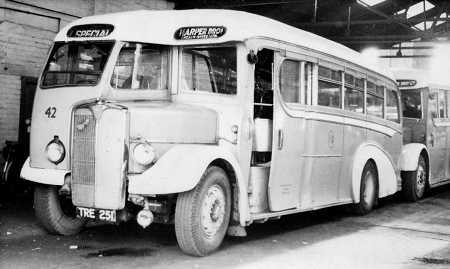

TRE 251_lr Vehicle reminder shot for this posting


07/03/20 – 07:25

As a lad of 17 I lived in Clacton-on-Sea and often took one of Suttons Coaches to London to visit my Grandfather.
I very clearly recall the delivery in 1947 of New Leyland Tigers and AEC Regal III’s. A couple of times I travelled on the inaugural trip of one of these vehicles.
While I am almost 90 I still recall those trips very clearly. I have trawled the web looking for pictures of these and my only find was A Tiger LVX 679 and LVX 680. I have found info on AEC Regal OTW 50 but no pictures. Do you have any ideas about places to look.

David Hawksworth


09/03/20 – 06:39

David if you use the search facility on the "Bus lists on the web" site it will bring up results from the "flickr" photo sharing site of OTW 50.

Stephen Howarth


09/03/20 – 06:40

A gentleman called David Troughton wrote a book on Suttons of Clacton a few years ago. I have a copy but can’t find a supplier on the internet.

Nigel Turner


Quick links to the  -  Comments Page  -  Contact Page  -  Home Page
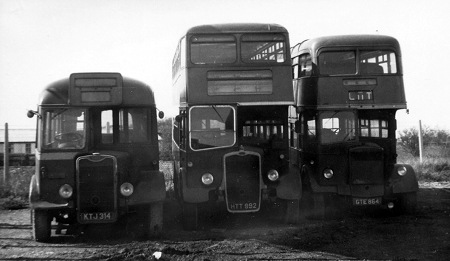


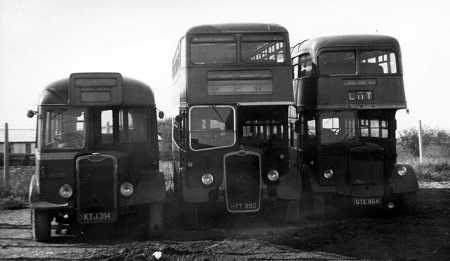
LUT – Guy Arab III – KTJ 314 – 408

LUT Guy Arab III and Dennis Lance with Wetern National Bristol K5G
Photograph by ‘unknown’ if you took this photo please go to the copyright page.

Lancashire United Transport
1949
Guy Arab III
Roe B32F

Thanks to Spencer who I think should really be called Sherlock these three have been identified and are here from the ‘Do You Know’ page.
The one on the left is as the above specification. L.U.T. was the largest independent operator in the UK and operated in the South Lancashire area. They were quite diverse with there makes of buses including Atkinson, Foden and Dennis but they did like there Guys. I think but I stand to be corrected they bought the last Guys ever built. If I am wrong let me know, leave a comment.
The bus in the centre was a Western National Omnibus registration 356 HTT fleet no 992 which was a Bristol K5G with an ECW L27/28R built in 1946. I wish I knew more about the Bristol K series so I could write more, can anybody help on that score if so please get in touch.
The bus on the right which I thought was a Leyland Titan is according to Spencer, and I’m not going to argue with him, an L.U.T. Dennis Lance K2 registration GTE 864 fleet no 196 built in 1947 with a Weymann L27/26R body. On further research I have found out that the Dennis Lance K2 had a Gardner 6LW engine which was a 8.4 litre six cylinder diesel.
Just in case you want to know the Dennis Lance K3 had a Dennis 8.0 litre six cylinder diesel and the Lance K4 had a Gardner 5LW 7.0 litre five cylinder diesel. The K4 also had a concealed radiator a touch like the well known Birmingham style, the K 2 and 3 had exposed radiators.


“The last Guy Arabs delivered to a British operator actually went to Chester City and were 1969/70 H registered, LUT bought their last Guy in 1967.

Chris Hough


“Chris is right the last three Guy Arab Vs delivered to Chester Corporation had Northern Counties H41/32F bodies, registrations DFM 345-7H, fleet numbers 45-47.

Spencer


I thought that LUT had either one or two Guy Wufrunians which they didn’t like and sold them on to West Riding Auto?

Geoff

———

They only had one Geoff.

137 were built in total delivered as follows

126         West Riding
    2         County Motors
    2         Wolverhampton Corporation
    2         Accrington Corporation
    1         West Wales
    1         Bury Corporation
    1         Lancashire United

Spencer

———

The Bristol K series and the closely associated ECW bodies – a most complex and fascinating subject concerning two absolutely top class and rightly successful manufacturers.
The vehicle shown is one of the very first post-war standard models bought widely by the Tilling Group. It is to the standard dimensions of the time, 26 feet x 7 feet 6 inches. "K5G" denotes the popular 5 cylinder Gardner 7.0 litre engine. The "lowbridge" low height body is of the type with all the upper saloon seats on the nearside, and a sunken offside gangway sadly causing pain and injury to the offside lower deck passengers, especially those who hadn’t seen the little notice "Lower your head when leaving your seat" – a high but necessary price to pay for the often essential reduction in overall height, until the invention of the highly ingenious "Lodekka."  A fair few of the early post-war vehicles of this type suffered the indignity of being diverted on loan to London Transport when brand new – this must have gone down very badly with the purchasing operators and their staff – I’ve always held the opinion that it was abominably unfair, and that older vehicles should have been sent to assist with the shortage in the Capital.

Chris Youhill


I agree with Chris’s comments re-London getting other operators’ new buses. But think of the poetic justice – London Transport drivers having to do proper gear-changing!

Stephen Ford


I hadn’t really thought of that Stephen but of course you’re right, although we tend to forget after all these years that legions of manual gearbox STs and LTs etc had "only just gone" in the late 1940s.  The strange quantity, seventy six, of the new all Leyland PD1s (STD 101 – 176) had also just arrived and would be "sorting the men from the boys" too.

Chris Youhill


It’s a bit off-subject, but I have often suspected that the reason why Nottingham broke with the long AEC tradition, and went for Daimlers as their first orders after the war was the strong preference for pre-selector. I gather AEC could only offer crash-gearbox Regent IIs initially. By 1949 NCT was again taking pre-selector Regent IIIs in large volumes, and the 31 CVD6s of 1948 remained an anomaly.

Stephen Ford


31/01/11

I lived in Clifton, between Swinton and Kearsley until 1948, I know!!!, and remember that LUT had a number of Guy double deckers, which were painted matt grey, had squared-off roof corners and wooden slat seats. At the end of the war one was painted white and had ‘fairy lights’ all round. Just a passing comment.

Jim Moyse


31/01/11 – 20:28

Words/phrases like ‘abominably’ and ‘poetic justice’ are surely a bit strong! Central Division London Transport had barely digested its independents with their multiplicity of makes by 1939. It had updated Green Line and then ordered some 350-odd RT’s which were cut back to 150, and was due to replace much of its fleet by 1942. It lost many vehicles in the Blitz/V bomb attacks (22 complete Tilling STL’s alone at the bombed Croydon Garage, with others damaged) and used up its body float on patched up chassis. It lent out a considerable number of vehicles for most of the latter part of the war, mainly petrol Tilling ST’s, many of which, on return, were condemned (the last didn’t return until 1947). Buses were failing faster than they could be replaced, despite many vehicles being renovated to an excellent standard and other bodies strapped up and maybe even held together by string! What didn’t help was RT production being delayed by a year so that the bodies could be jig-built. Craven-bodied RT’s and SRT’s helped fill gaps. Passengers rocketed, with the maximum number reached in 1949. And it was borrowing a lot of vehicles (mainly coaches) from outsiders. By 1949, nationalised, it was probably a good decision by BTC to quickly allocate new buses, than have a lot of near-scrap vehicles cascaded over a period of months.
It says something for Chiswick that buses designed for a 10 year lifespan lasted over twice that in some cases, even without a rebuild. Some LT ‘scooters’ lasted over 21 years!
And there were still plenty of manual gear change buses in 1949, all 435 Guys, Bristols, (austerity STD’s (they WERE a challenge!), many T’s, pre and post-war, TD’s and some country STL’s on loan.
Many of the drivers would originally have come from independents and be familiar with manual ‘boxes. If any men were sorted out from the boys, I’d say it was the tram drivers who had to convert over to buses!!

Chris Hebbron


01/02/11 – 05:44

Hi Chris – all a harmless bit of banter! On the same subject, I recall a Meccano Magazine cartoon at the time of the vehicle loans to London. It featured a number of buses from various cities, which were sweeping round Trafalgar Square in brilliant sunshine – all except for a Manchester Corporation vehicle which was driving along under its own permanent rain cloud.

Stephen Ford


01/02/11 – 05:44

Many very valid and respected points there Chris H and I must confess that I’d never really studied the "diverted new vehicles" question to such a depth. So I can now see the matter in a more informed way and amend my "abominably unfair" criticism somewhat – but I do still feel though that the intended recipients, both engineering and operating, of the shiny new steeds may well have felt somewhat maligned and I think that I would too. I agree about the tram drivers’ dilemma and I think it nothing short of miraculous that they were able to make the conversion in such large numbers, and those changing to trolleybuses didn’t have a very much easier alternative either !!

Chris Youhill


01/02/11 – 18:52

My comment was light-hearted, too, but I thought a bit a background info would be interesting. I also forgot to mention that the government of the day put a restriction on the number of PSV deliveries, which, in 1948, meant a shortfall of 748 in RT deliveries, which must have been devastating. Although this restriction applied nationally, too, the misery would have been spread out more and the effect less per operator.
It is on record that the diversion of the new Bristol/ECW steeds caused a lot of resentment to intended recipients. As for London Transport, the ever-difficult Met. Police put in their two penn’orth by banning lowbridge buses with their so-called slower dwell-times at bus stops, relenting eventually by restricting them from certain routes!
This meant that, at times, the Bristol K5G’s were put on hilly routes they were unsuitable for. And there were problems with hinged doors and garage capacity! In some ways, welcome though they were, they must have been a mixed blessing to LTE.
If anyone has an interest in reading more, Ken Glazier’s book ‘Routes to Recovery’ is the one to buy.
As for tram drivers in London, when LPTB was formed in 1933, the LCC was the dominant tram operator and there was resentment that local authority staff, some admin, who just happened to be there at that point of their career, were trapped in PSV-land from then on. However, there was no retirement age for such staff and many tram drivers went on for years after the LPTB retirement age! But enough, I’m digressing!

Chris Hebbron


02/02/11 – 06:23

This further information is extremely interesting to me and tells me much that I never knew, even though I was a frequent visitor to Streatham SW16 throughout the War and until around 1995. I well remember the K5Gs on route 137, and I believe that they were not confined to parts of the service but undertook the full very long journey from Highgate Archway Tavern to Crystal Palace. Based no doubt at Victoria (Gillingham Street GM) they probably posed few problems to the drivers there as the Leyland PD1s STD 101 – 176 (or a number of them) were already there. I can imagine the frustration though at having to stop half way up Central Hill at Norwood when already half an hour late at busy times. Happy days for dedicated busmen.

Chris Youhill


02/02/11 – 21:03

Would the Tilling companies concerned have been consulted about the arrangement beforehand or was it a done deal by a higher authority? When the Bristols eventually reached their rightful owners, effectively as second hand vehicles, was there any compensation or had the companies simply been obliged to lend a hand without question?

Chris Barker


07/03/11 – 09:21

After LUT were taken over by GMT, Barton of Chilwell became the largest independent operator who too had a very diverse fleet just like LUT.

Roger Broughton


07/03/11 – 16:03

Chris B – It was a done deal! The Tilling Group had voluntarily sold out to the BTC in September 1948 and almost immediately were told to divert 25% of their new deliveries to LTE, some 200, later reduced to 190 (45 lowbridge). The order annoyed the operators, who felt that LTE had brought the shortage on itself by delaying new vehicle production by insisting the RT family bodies be jig-built.
The first Bristols came in December 1948 and the last went in June 1950.
Most other non-Tilling buses which helped out were single-deckers, although my posting about the Thorneycroft Daring mentioned it was one exception. Others were three new Daimler/Brush CVG6’s from Maidstone Corporation and, from Leeds Corporation, 17 pre-war AEC Regents/Roe (with one Weymann) with pre-selective gearboxes (Leeds STL’s)!
Unlike the other surplus austerity buses, which went all over the place, but were banned from going to a BET company, when the 29 austerity Bristols were then ready to leave LTE, the word was put out to BTC in advance, so that the ex-Tilling companies could prepare for their transfer.

Chris Hebbron


10/03/11 – 07:41

Referring to the comment by Jim Moyse, I suspect the grey Guy’s were wartime deliveries with utility specification bodies. A trip to most local libraries in South Lancashire should yield a copy of British Bus And Trolleybus Systems number 7, Lancashire United/SLT, which details the whole story.
With regard to the Guy Arab IV’s and V’s of the fifties/sixties, a friend of mine drove these, working out of Swinton depot. He subsequently purchased number 134, 6218 TF, the penultimate open rear platform model, later disposed of, current owner/location unknown.
A peculiarity of the gearbox is that depressing the clutch pedal to it’s full stroke before selecting first gear results in the the box locking, preventing any attempt to upshift. I can’t remember whether double-declutching released it, or whether it was necessary to stop the vehicle. Apparently something around 75% of pedal travel is all that is required for normal operation.

Phil Meadows


15/03/11 – 16:43

It’s taken me a while to puzzle out Phil’s gearbox lock-up. Pressing the clutch pedal all the way down activates a device called a clutch-stop, which is a transmission brake on the shaft connecting the clutch to the gearbox. This may be useful in counteracting clutch-spin when engaging a gear at rest, but more importantly it can be used to speed up gear-changing. The clutch-stop on Guys was more gentle than on Bristols and Leylands, producing a comfortably fast change rather than a rapid one. But I’ve never heard of a clutch stop locking a gearbox before.
I finally realised that trying to move out of gear with a transmission brake on is exactly like trying to do so with the clutch engaged and the engine stopped. The gearbox input shaft needs to be free to rotate, so you need to lift the clutch pedal slightly to free it off.

Peter Williamson


18/06/11 – 18:31

Just a small point in the original note to this picture. The Dennis Lance K3 certainly had a Dennis power plant, but it was the O6 of 7.58 litres capacity, a four valve per cylinder engine of excellent quality. The 8 litre variant of this engine didn’t appear until the later 1950s. Dennis was the only British manufacturer to design and produce diesel engines with four valve heads, in 5 litre, 5.5 litre, 7.58 litre and 8 litre sizes. The Crossley HOE7 was initially designed as a "four valver" using Saurer concepts, but, when Saurer asked for a royalty payment, the Crossley engine was rapidly redesigned as a "two valver", with disastrous consequences, becoming notorious for its poor performance and unreliability.
Turning to the "London Transport question", a great many London buses were certainly rebuilt in their lifetimes, particularly when Aldenham was up and going. Even some of the older types were given major body overhauls. Many of the six wheeled LT single deck "scooters", which I am old enough to be able to recall having travelled on, on routes 213 and 234, were given major body overhauls by Marshalls of Cambridge around 1949. From the RT type onwards, London buses were designed to be taken apart every five years or so, with chassis and body being sent on separate tracks through Aldenham Works. Each chassis emerging at the far end then took the first available rebuilt body, not the one it went in with. No other operator in the land followed this costly procedure, and the supposed long life of London bus types needs to be balanced against the regular visits to Aldenham. The much vaunted RM only survived for so long in London service because of this rebuilding procedure. The Northern General RMs, which had to rely on standard overhaul methods, were withdrawn around 1980 after a life of some 15 years.

Roger Cox


01/09/11 – 10:55

In Relation to Lancashire United’s Sole Guy Wulfrunian, they actually ordered 3 to be fleet numbers 58-60 in the Post 1959 fleet, but only 58 (802 RTC) was delivered it being unpopular, there is a picture of it shown close to Atherton depot on service 82 on flickr. The remaining order for 2 was changed and materialised as the trusted Guy Arab fleet number 59 and 60.
The Last numbered Guy Arab in the LUT fleet was 290 delivered in 1967 (265-290) In the post 1959 fleet LUT Guy Arabs were
18-27 with Northern counties body
40-49 with Metro Cammell Weymann bodies (40 was rebuilt in 1966 to a front door layout following serious accident on the East Lancs road at Ellenbrook)
50-57 NCME
59 and 60, then 61-80, 103-135 all rear loaders with NCME 136 (6220TF) was the first build front loader NCME
159-170, 186-195, 218-240, 265-290 all NCME
Many an enjoyable day riding on, conducting and driving these buses I worked at LUT Atherton from being 18 in 1977 until it closed on 7th Feb 1998. I still work for First now some 34 years.

Chris Stott


02/09/11 – 11:23

With regard to the loaned Provincial Bristols to L.T.E. if you watch the film starring Jack Warner The Blue Lamp one passes by in the dark in one scene.

Philip Carlton


26/11/12 – 08:39

In the list of Guy Wulfrunian chassis above the total of 137 is correct but missing from the list underneath are the two demonstrators, 7800 DA and 8072 DA. I believe that they were both ultimately sold to West Riding for spares. Sold to West Riding for service were the LUT, West Wales, and two County examples – one of the ex-County ones is now preserved. Despite their illogical layout, both the Accrington ones saw further service. I have read that they initially went to Ronsway of Hemel Hempstead, but one finished up with Byley Garage in Cheshire – and they did use it, as I saw it on the road on one occasion. The Bury one was sold on to a succession of Welsh independents before ending up with Berresford’s at Cheddleton – I’m not sure whether or not it was actually used there. Later it was placed in storage behind GMT’s Hyde Road depot as a prelude to a proposed preservation, but for reasons which now escape me, this ultimately didn’t come to pass.
The two Wolverhampton examples failed to sell to any subsequent operator.
Until I read Chris’s post above I had quite forgotten that LUT 59 & 60 had been intended to be Wulfrunians. The order was presumably altered before even No.58 had been constructed.

David Call


26/11/12 – 10:28

Talking of Wulfrunians, coincidentally I have just been re-reading David Harvey’s fascinating book ‘The Forgotten Double Deckers’, in which he states that Rotherham and Belfast had ordered three and one Wulfrunians respectively but cancelled their orders very quickly when they began to hear bad news about the model. The two cancelled LUT buses would have been rear entrance types like Accrington’s pair, as would even more incredibly a pair provisionally ordered by Todmorden J.O.C – a staunch and very traditional Leyland customer. The mind just boggles at the thought of Todmorden Wulfrunians climbing up to Mankinholes!

John Stringer


27/11/12 – 07:32

I recall that West Riding ordered a batch of single deck Wulfrunians but changed the order in favour of double deckers. What would they have looked like? I was interested in the information about potential customers who suddenly got cold feet.

Philip Carlton


29/11/12 – 07:32

I imagine that a single-deck Wulfrunian would have worked a lot better than the double-deck ones did, owing to the reduction in weight. As to what it would have looked like, I think that would depend on whether Roe were allowed to design it themselves or had more nonsense imposed on them by Park Royal. It’s a fascinating thought, as there were no low-floor single deckers around at all at that point.

Peter Williamson


29/11/12 – 11:05

Wasn’t the Guy Victory export chassis to some extent a version of a single deck Wulfrunian? I believe it had a front mounted engine, semi-automatic transmission, disc brakes and optional air suspension.

John Stringer


03/11/14 – 06:24

I can see that this thread is almost two years old … but regarding LUT Wulfrunians. I always thought that nos 58 AND 59 left the bodyworker en-route to Atherton BUT No 59 was written off in a road traffic accident before arriving in Howe Bridge?

Iain H


07/11/14 – 15:43

Iain H, Please refer to Bus lists on the web and can you see any NCME body numbers for 58 & 59 if they were built as Wulfrinians?
No, they were built as standard 30 rear entrance Arab IV’s

Mike N


KTJ 314_lr Vehicle reminder shot for this posting


07/09/20 – 06:11

Regarding the Accrington Wulfrunians they were in sense Guy Arabs having manual gearboxes instead of a semi automatic one.
Why Accrington specified rear entrance is probably due to the council committee at the time (look at 14,15 and 16) these came as rear entrances

F. Atkinson


08/09/20 – 06:21

Re Accrington’s rear entrance Wulfrunians, see my article Days out with Martin Hannett on this site.

Phil Blinkhorn


Quick links to the  -  Comments Page  -  Contact Page  -  Home Page


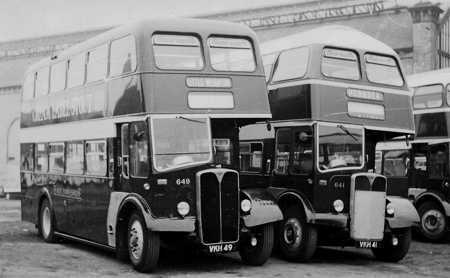
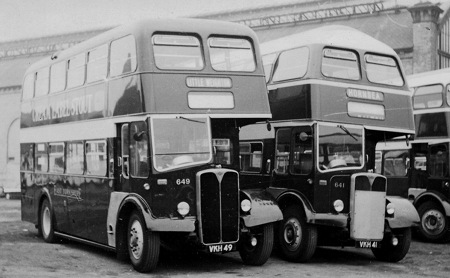
East Yorkshire – AEC Regent V – VKH 47 – 649

East Yorkshire AEC Regent V
Photo by ‘unknown’ if you took this photo please go to the copyright page.

East Yorkshire Motor Services
1957
AEC Regent V
Willowbrook L31/28RD

Now we have two Regent Vs from a batch of 19 delivered to East Yorkshire in 1956/7 they were fleet numbered 634 – 652.
634 to 648 were 27ft in length had AEC 7.68 litre six cylinder engines a four speed synchromesh gearbox and a Willowbrook highbridge ‘Beverly Bar’ style roof bodies seating 56 as per the bus on the right above. 
649 and 650 had the same engine and gearbox but had Willowbrook lowbridge bodies seating 59 as per the bus on the left above.
651 and 652 were 30ft in length with AEC 9.6 litre six cylinder engines a four speed synchromesh gearbox but with Roe highbridge Beverly Bar style roof bodies seating 66. Another difference that 651 and 652 had was that they both had the more well known concealed radiator associated with the Regent V to see a shot of one of them click here.
With regards the above shot the bus on the right must have a cold running engine, that is a rather large radiator blanking panel. Getting a photo that shows the shape of the ‘Beverly Bar’ style roof is not easy as it was painted white and when shot in black and white the roof merged into the sky.
I wonder why East Yorkshire ordered nineteen of these Regent Vs and not twenty seems a strange number to order to me

A full list of Regent V codes can be seen here.


With regard to EYMS Regent V’s, there were two (or three) separate batches involved in the 19 vehicles referred to. The first batch was for 15 MD3RV;s 634 to 648, the highbridge ones, plus two lowbridge ones 649 and 650 (all were registered VKH 634-650) delivered November, 1956; plus two LD3RA’s 651 and 652 (registered WAT 651/2) delivered April, 1957. The numbering of these last two completed the gap between the first batch(es) and the first ex Everingham vehicle, which carried fleet number 653 (the whole series for Everingham vehicles was 653 to 664 plus 46!) These were acquired, of course, in November 1953.

Keith Easton


For many years the "Beverley Bar" VKHs were to be seen on the Leeds – Bridlington service (joint with WYRCC). I was a frequent traveller on them, having relatives then in Bridlington, and often went all the way smoking merrily with others in the lower saloon. EYMS were possibly the last operator in the Country to allow smoking anywhere in the vehicle ?? The Willowbrooks, fine in most ways, did though have possibly the worst sliding windows for incessant rattling. I wish we could still ride on them today when I travel in the present rattling thudding horrors that manufacturers are so proud of !!

Chris Youhill


Looks like the coach drop off point Bridlington coach station around the mid 60s

Mickey Summers


Sorry, Mickey – I think this is the main Hull bus park outside the railway station (in the background). This was the location where countless EYMS and KHCT buses would park off-peak, and was always a good place to take photos.

Paul Haywood


Yes, It is definitely the bus park now gone under ST Stephens shopping centre and Interchange. What a crime!

Keith Easton


I remember taking dozens of box camera shots on this site at Hull in the very early 1950s. There were rebodied Guys, TD4 and TD5s, some ECW rebodied, and some lowbridge all Leyland PD2s, as well as the usual BB Roe PD1s and PD2s, plus several single deck types inc the ECW PS1s, Burlingham coaches, and the usual "Federation" types. Fascinating fleet it was too. I particularly remember the oval rear windows of the pre war single deck stock (a bit of an out-dated feature) and the original 3 window upper fronts of the pre war Titans.
We used the Bridlington to Hull service many times, via Barmston, Beeford, Ulrome and Skipsea, and it always seemed to be on a Roe PD1, which I remember as quite lively.
An interesting fleet….perhaps it was the livery which held it apart from other BET fleets.
Does anyone remember the slogan on the sides of several Brush PS1s…. "This is not a nationalised bus" ?

John Whitaker


09/08/13 – 07:54

My great grandfather designed and built the first Beverley Bar bus, his name was William Bundy. He lived in Sproatley till his death at 99 in a house he built himself.

Bernice Brumby


09/08/13 – 09:30

Yes John, I do remember the slogan and there was another version on the cove panels of single deckers – it boldly and unashamedly proclaimed
"UN-NATIONALISED, UNIMPAIRED."

Chris Youhill


10/08/13 – 05:52

Wasn’t that the point of the white band around the roof? . . . to make the roof blend into the sky and look like a normal low-bridge roof? (In which case why not paint the whole lot white, rather than just a band around the roof . . . suggestions on a post-card).

Philip Rushworth


11/08/13 – 06:50

I’m surprised that no-one else has picked up on this. The title to this page gives the registration of EYMS 649 as VKH 47, Keith Easton gives it as VKH 649, while the photo clearly shows it as VKH 49. In fact, all of 634-50 were VKH 34, etc. While I’m on this subject of EYMS Regent Vs, could anyone tell me why EYMS suddenly bought two lowbridge double-deckers? Did they have a true lowbridge route, or were the two Regent Vs someone else’s cancelled order?
Also, how did Willowbrook come to build double-deckers to the ‘Beverley Bar’ outline? I thought the idea had emanated from a collaboration between EYMS and Roe, and had assumed that Roe had gone on to construct all the examples. (I don’t regard the Bridgemasters and Renowns as true ‘Beverley Bar’, they’re more like ‘pretend’).

David Call


11/08/13 – 09:29

Before the Second World War Brush built twenty-six Beverley Bar bodies and ECW twenty-one. Brush built more during the war (the PSV history and some published sources disagree as to whether all Brush bodies on the first Arabs were Bar buses) and ECW rebodied some Titans after the war whilst Roe rebodied the Arabs.
The Willowbrook bodies were a shock and are not regarded by many as handsome a design as the Roe bodies on various Titans (the full fronted ones excepted)
The bus park was useful to photographers, including myself, but for anyone wanting decent photos showing EYMS (or KHCT) at work in Hull it was a menace since many visitors rarely ventured outside this and the coach station.
The best "Bar" bus portraits ( they’re too good to be called photographs) were taken by G F H Atkins in Scarborough on his holidays, mostly at Northway.

Malcolm J Wells


11/08/13 – 09:29

David, I’m pretty sure but without looking deeply that East Yorkshire did need lowbridge buses somewhere in the outer west of Hull – possibly Elloughton ??

Chris Youhill


15/08/13 – 07:03

It would seem that East Yorkshire’s Elloughton garage was the main home of the company’s lowbridge buses.
The March 1962 and June 1965 editions of the Ian Allan ‘British Bus Fleets – Yorkshire Company Operators’ both show East Yorkshire as operating the following lowbridge double deckers:
584-589 (MKH 402-407) Leyland PD2/12/Leyland L53R 632-633 (SRH 632-633) Leyland PD2/12/Roe L56R 649-650 (VKH 49-50) AEC Regent V/Willowbrook L59R
(The 1965 edition shows the split of upper deck and lower deck seating capacities with 632-633 being L28/28R and 649-650 being L31/28RD. I had never personally noticed any lowbridge deckers with a capacity of more than 53 before).
I am not sure though that the 1962 book is totally correct as in some R H G Simpson photographs I have there were also (at least) 505/506 (JRH 978/979) which look like Leyland lowbridge bodies but the book lists these two as Roe HBB54R (the ‘HBB code used to identify Beverley Bar buses with highbridge layout seating).
In an EYMS allocation list dated 1 March 1962 584/585/586/588/633/649/650 were allocated to Elloughton and 587/589/632 were allocated to Hornsea.
The allocation list dated 1 October 1962 shows 584/585/586/588/589/649/650 allocated to Elloughton, 632/633 allocated to Hornsea and 587 allocated to Withersea.
The list dated 1 November 1963 shows 584/585/586/587/589/649/650 allocated to Elloughton and 588/632/633 to Hull (Anlaby Road).
The list dated 1 January 1964 shows 584/585/586/589/649/650 allocated to Elloughton and 587/588/632/633 to Hull (Anlaby Road).
Lists dated 1 April and 1 May 19 both show 585/586/589/649/650 allocated to Elloughton and 584/587/588/632/633 to Hull (Anlaby Road).
In the same allocation lists the Willowbrook Beverley Bar bodied AEC Regent V buses 634-648 (VKH 34-48), which I always really liked and frequently saw in Scarborough. These were mainly allocated to Driffield Garage – I suspect for service 12 between Hull and Scarborough. The exceptions being in March 1962 635/636/644 were allocated to Bridlington; in October 1962 635/636 were allocated to Bridlington; in November 1963 and January 1964 were 634/635/636 allocated to Hull (Anlaby Road); in April and May 1965 634/635/636/637/638 were allocated to Hull (Anlaby Road) and 648 allocated to Bridlington.

David Slater


15/08/13 – 11:58

Interesting information David. Given that the nearest railway line and station to Elloughton today is Brough, a line which doesn’t have any low bridges, I wonder if the offending structures were on the old Hull and Barnsley line around the North Cave/South Cave area?

Chris Barker


17/08/13 – 11:54

I knew I had seen something in print somewhere about where the low bridges were on the EYMS routes and I can quote the following from page 6 of the Venture Publications Prestige Series book on EYMS which reads: ‘The standard lowbridge types were in the fleet because of only two low bridges, one at Hornsea Mere station and the other near Selby’.
As an aside, the Prestige book also helped towards clarifying the point of the correctness of the 1962 Ian Allan British Bus Fleets book. The BBF book has grouped together in one block 50 Roe bodied Leyland Titan PD1A buses built between 1947-1950 and shows them all as ‘HBB54R’ – the code used to indicate a highbridge bus with Beverley Bar roof profile. These 50 buses are listed as: 447-453 (JAT 415-421); 471-498 (JAT439-466) and 505-519 (JRH 978-992).
However, as I mentioned before, I had photographs of 505 (JRH 978) and 506 (JRH 979) which I could clearly see were both lowbridge buses. The Prestige book shows a picture of 505 and confirms it was Roe bodied and not, as I had assumed, Leyland bodied – although the styling was very similar. So maybe these, the first two of the JRH batch were the only lowbridge bodies on that order and the list overlooked that fact. There is also a picture of 509 (JRH 982) which is a highbridge model.

David Slater


17/08/13 – 16:29

One has to be careful about sources
The OS/PSV history of 1980 shows the following
420-425 PD1 with Roe H52R bodies (later H56R)
426-427 PDI with Roe L51R bodies
433-453 PD1 with Roe H52R bodies (later H56R)
471-498 PD1A with Roe H54R bodies
505-507 PD1A with Roe L51R bodies
508-519 PD1A with Roe H54R bodies
The EYMS enthusiasts page says PD1, not PD1A
Which version is correct? I have no idea. The early Ian Allan books could be very inaccurate as shown in the first Yorkshire Municipal book’s entries for Hull’s 190-9/204-39 which contained no references to those rebodied with pre-war Massey and Weymann bodies from Regents and Daimlers, despite the fact that these had taken place 7-9 years previously.
The low bridge "near Selby" was, I think, at North Cave with the ex-Hull and Barnsley Railway Bridge although there may have been a problem at Willerby.

Malcolm J Wells


18/08/13 – 06:29

Malcolm, I had no idea that so many of the magnificent PD1s had been upseated from 52 to 56. Presumably a double seat was inserted each side in the upper saloons ??

Chris Youhill


18/08/13 – 12:00

As far as I am aware – yes. H30/26R instead of H26/26R, but I was a lad at the time and more interested in trolleybuses in Hull.

Malcolm J Wells


04/11/13 – 07:12

As a youngster I often travelled from Anlaby Common to Hessle to visit my Nana. The buses were always on service 3 Goole or service 4 Selby and if they were double-deckers they would be what we called "flat tops"- ie lowbridge. If for a change we walked through to Boothferry road to get a service 5 going to South Cave it was usually a "flat topper" too. For many years (1962 to 1969) I travelled to Beverley Grammar School from the Red Lion at Anlaby. For most of the time this was on the PD1A "JATs" and they went through Willerby without a problem so that bridge just short of Willerby Square mustn’t have been too low. Later we had the MKH full fronted PDs and latterly we had Bridgemasters or Renowns.
It is always good to see photographs of "the muck" behind Ferensway Coach Station – where I spent many happy hours noting numbers, collecting tickets and when the crew allowed setting the blinds for the next duty.

David Cornwall


04/11/13 – 16:50

Whilst the bus park alongside the coach station was very good for seeing lots of EYMS and KHCT buses many enthusiasts went no further so that photos of buses at work are in short supply. Photographs of EYMS elsewhere in the city in the 1950s and 1960s are rare – most pics show Scarborough, Bridlington and Beverley with hardly any in the suburbs for EYMS and very few KHCT ones outside the city centre.
Trolleybus enthusiasts tended to ride to and take pics at the outer termini as well as the city centre.
Until the KHCT head office was built in 1962/3 KHCT buses could also be found on what was bombed damaged land alongside the front of the garage in Lombard Street.

Malcolm Wells


VKH 49_lr Vehicle reminder shot for this posting


06/12/13 – 17:51

In common with several others who have posted EYMS comments, I too was – quote, unquote, a Grammar School git, who commuted between Willerby and Bev between 1963 and 1969. I must express particular gratitude to David Cornwall above, as he once lent me his 1964 copies of "Buses Illustrated" – I had only started buying it in 1965. I am delighted to see David remains interested in buses: my own enjoyment has never waned. Not being any good at maths, physics, Latin, games, woodwork – in fact not being very good at almost anything they tried to teach us at school – my nostalgia for those days is limited, but I would love to stop the clock and travel once again on the EYMS fleet of the mid-1960s. Our school run required about six buses each day, and almost anything from the fleet might turn up, even coaches on occasion. I was able to underline just about everything in the East Yorkshire section of my Ian Allen British Bus Fleets: Yorkshire Company Operators. My least favourite at the time were the JAT PD1s – Skidby Hill was always a challenge for them, but the AEC AV590-engined Bridgemasters and Renowns took it by storm, the Renowns being memorably melodious. I had a particular affection for the VKH Regents: ugly as sin, but what sounds they emitted, sweet AV470 melodies from the front, but a very rude raspberry of an exhaust.

Mark Evans


Quick links to the  -  Comments Page  -  Contact Page  -  Home Page


All rights to the design and layout of this website are reserved     

Old Bus Photos from Saturday 25th April 2009 to Thursday 4th January 2024