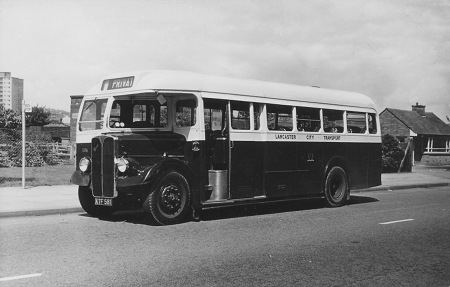
Lancaster City Transport – AEC Regal III – KTF 581 – 581
Photograph by ‘unknown’ if you took this photo please go to the copyright page.
Lancaster City Transport
1949
AEC Regal III
Strachans B36F
This in my mind is what an half cab single deck bus should look like, mind you the 50-50 split livery of this Lancaster Corporation does help. I’m not all that knowledgeable about Strachans bodybuilders I think I went on a Ford demonstrator which had a Strachans body once when it was on loan to Halifax Corporation.
This bus was originally delivered new to Morecambe & Heysham Corporation along with its sister vehicle KTF 582, I’m not sure what fleet numbers they had when at Morecambe & Heysham, if you know please leave a comment. They were both transferred, sold or exchanged to nearby Lancaster in 1953, I think there was a close working relationship between the two corporations, I read somewhere that Lancaster actually took over Morecambe & Heysham bus fleet in the early seventies.
Lancaster had a very strange way when it came to fleet numbering they used the registration number which meant out of there fleet of 37 buses in 1965 the lowest fleet number was 70 and the highest was 965, now that was different.
In 1974, local authorities were reorganised – the most dramatic being the invention of Metropolitan Counties such as Greater Manchester and Merseyside. The City of Lancaster borders were extended to include the boroughs of Morecambe and Heysham. As a result, Morecambe and Heysham buses came under common ownership with Lancaster – hence the take over.
David Oldfield
KTF 581/2 were new to Morecambe and Heysham in January 1950 and allocated fleet numbers 52/3. When new they were 35 seaters. They were withdrawn in 1951 and after a period in store were sold to Lancaster City Transport in October 1952. They entered service with their new owner in January 1953, being withdrawn in July 1967 and May 1968 respectively.
Just as a note, the Regent III double deckers delivered concurrently, 54-65 (KTF 583-594) had a much longer life in the resort, withdrawals taking place between 1974 and 1979, some of them converted to open-top.
Dave Towers
———
Just to add to the above, the Regals were converted for o-m-o in January and February 1957, Lancaster commencing such operations later that year, (a process completed in 1982). Of course one-manning of half cabs was not ideal with the driver having to swivel around to face passengers and take fares, but with a fairly small capacity would be manageable!
Dave Towers
The Lancaster and Morecambe & Heysham fleets were merged on April 1st 1974 when local government was reorganised and an enlarged City of Lancaster created from five separate councils, these being the existing Lancaster City Council plus Lancaster Rural District Council, Lunesdale District Council, Carnforth Urban District Council and Morecambe & Heysham Borough Council. Although only two of these councils operated buses it was decided that blue & white was to be used for all council vehicles as none of the constituent councils had used these colours on their vehicles (dustcarts, etc). There were a couple of experimental liveries tried before the decision on the blue and white livery was decreed, though I’m not sure if any saw the light of day.
Ian Simpson
21/01/12 – 17:22
You say you know little of Strachans bodies… I worked at Strachans Coachbuilders in the 1960’s at Hamble in Hants. They were originally in London and I believe linked with Duple before they moved to Hamble, but I must say that was passed on by word of mouth, how true that is would need confirmation. However I distinctly remember working on half cab deckers for Wolverhampton, (I wonder if any survived, I think they were Bristol chassis). and single deck pacemakers and pacesavers, and some rather nice looking coaches for Rickards which had a polished stainless steel hand made grill, which I, as an apprentice had to polish on the buffing wheel! I can still smell that buffing soap!! Sorry if I’ve ambled on a bit, call it a senior moment!
Pete Hatcher
22/01/12 – 06:43
Strachans are an enigma, and I would like to know more about them, Pete – so (H)amble on.
As far as I am aware, the best Merlin/Swifts of London Transport were those early ones bodied by Strachans. Apparently they benefited from a type pf mounting which did not break the back of the bus – as the others were apt to do. If they could outdo the likes of Park Royal, Met-Camm and Marshall, why were they not better known and why did they not survive? Indeed, they seemed to fizzle out with no ceremony. [They also seemed to be a favourite of Aldershot and District for a time.]
David Oldfield
22/01/12 – 16:39
I’m glad its not only me who is a bit vague about Strachans. Unlike most body builders I don’t think there has ever been a book published about them even though they did have some high profile customers.
Nigel Turner
23/01/12 – 07:37
Apart from our common interest, it’s always nice to find that there are certain subjects which interest us particularly, I think Strachans must be one of them. I’ve always thought of them as something of an enigma because like Nigel says, they had some high profile customers and they had some nice designs too, like the vehicle above but they seemed to have more than their fair share of disasters, yet they were favoured with regular orders throughout the 1950 and 60’s. The post-war double deckers seemed to have been particularly bad, South Yorkshire’s Albions and West Riding’s Daimlers had to be heavily rebuilt and some operators found that re-bodying was the only answer. The worst of all were surely the Leyland PD1’s of Western SMT which lasted only three years before disintegrating! The Lancaster vehicle looks like a nicely balanced and well constructed bus but it known why they lasted a year at Morecambe? The fact that the pair went on to achieve eighteen and nineteen years service suggests that these were very durable vehicles.
Chris Barker
23/01/12 – 07:38
Re David’s comment about London Transport Merlins, I have heard exactly the same about Sunderland’s Leyland Panthers. Metro-Cammell bodied them conventionally and the rear of the bodies became distorted with the flexing of the chassis. Strachans mounted the rear body overhang on a cantilevered subframe separate from the chassis, and this was said to be much more successful.
Peter Williamson
23/01/12 – 07:39
Peter the Wolverhampton double deckers were locally built Guy Arabs used for trolley bus replacement duties.
Chris Hough
23/01/12 – 07:40
The Wolverhampton double deckers that Pete Hatcher worked on would be Guy Arab Vs, and the Rickards coaches were a unique batch on Dodge chassis.
Peter Williamson
23/01/12 – 10:09
Strachans also built quite a few coach/ambulances on Bedford 4.9 litre petrol engined chassis for the Ministry of Defence, I worked on them whilst with the REME in our LAD at Chilwell Depot (38 Central Workshops) in the 70’s
Roger Broughton
24/01/12 – 05:54
With regard to Chris Barker’s question about the short life of KTF 581/2 in Morecambe, there is an explanation in the new "Morecambe and Lancaster" book from Venture. I’ve actually loaned the book to a friend at the moment so I can’t be totally precise, but I believe Morecambe purchased them for a specific new service, which never actually got off the ground, and so they weren’t required in the resort.
Dave Towers
02/10/12 – 14:50
Message for Pete Hatcher (above).
You may be interested to know that ex. Southampton City Transport No.1 Reg. No. JOW 499E a Strachans Pacemaster (Body No.40214) 1967 AEC Swift built at Hamble, has just been restored and put back on the road after 20 years dormant.
You can get more information by going on the SADTHT website. SADTHT stands for the SOUTHAMPTON & DISTRICT TRANSPORT HERITAGE TRUST.
Terry Knappett
03/10/12 – 05:56
Didn’t someone (Alan Townsin perhaps) write a comprehensive history some years ago of Strachans & Brown/Strachans/Strachans Successors in one of the enthusiasts’ magazines (possibly Classic Bus in its superior days under Gavin Booth). I remember reading this series of articles, but I no longer have my old Classic Bus copies to confirm.
Roger Cox
03/10/12 – 05:57
I was once told (this would be the mid-1960s) that the two Morecambe & Heysham Regal IIIs were withdrawn and subsequently sold to Lancaster because the steps had proved too steep for the borough’s elderly residents. This came from an M & H conductor who seemed to speak with confidence, as if to suggest that he had been in the employ of M & H at the relevant time. I agree that this explanation does seem a little odd, bearing in mind that there would be elderly people in Lancaster as well – but no doubt not nearly as many.
David Call
29/10/12 – 07:09
Further to my post of January, I’ve now come across the reference to KTF 581/2 in Harry Postlethwaite’s book. He says that these vehicles were purchased for a service to Middleton Tower Holiday Camp which did not materialise (the service, not the camp!), as the camp decided to provide its own transport.
Dave Towers
12/11/12 – 10:51
For Pete Hatcher.
The two top designers at Hamble were Colin Holt and Dave Hoy and Colin did all the design work for the first AEC London Transport "Red Arrow’s". I was a drafting office apprentice from 1964 to 1970 and then returned later just prior to Strachans closing. It was a great place to work as we handled everything from single and double deck buses, military bus/ambulance conversions, semi-luxury coaches, Ford Transit vans and conversions, Military truck bodies on Bedford R series 4×4 chassis right through to special ‘one offs’ like the railcar for the Sadler Rail company. Mention has been made of the coaches for Rickards and these were unique as if memory serves me right, they failed the tilt test with the overhead parcel racks installed. They were re-tested with the parcel racks tied to the tops of the seats and the racks were installed when the coaches were shipped over to the continent. I was there when the first AEC Merlin bare chassis was delivered with a somewhat white faced driver. With the rear engine, the front wheels lifted off the road under acceleration, all subsequent chassis deliveries had boxes of engine blocks strapped on to keep the front wheels on the road. When Strachans closed I believe that both Colin Holt and Dave Hoy went to Duple and it would be interesting to contact them if they are still in the Blackpool area.
Dick Henshall
13/11/12 – 06:52
What a fascinating couple of tales, Dick; the sort of insider stories that help to make the bus subject so interesting.
Chris Hebbron
19/05/14 – 18:30
I worked on Lancaster corporation buses in the early 60s. Passed my test on a Crossley with a dodgy gearbox. Double decker’s in those days, were Guys, Crossley’s, and Leyland’s. Had to prime the Guy’s and start them with a rope on the starting handle. Single deckers, 2 Daimlers, one with only 14 seats.
G Seaman
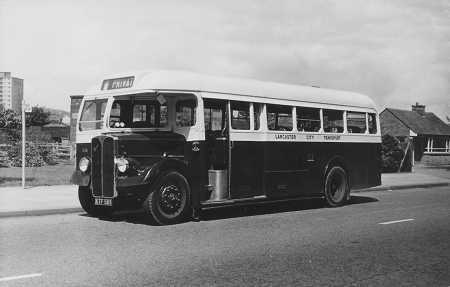 Vehicle reminder shot for this posting
20/06/16 – 06:35
The thing that puzzles me is why did M&H go to Strachans for these Regal’s bodies when at the same period they bought several batches of Regent with Park Royal bodies.
Keith Wardle
20/06/16 – 09:08
I can only think that, somehow, Strachans offered a better price!
Pete Davies
Quick links to the - Comments Page - Contact Page - Home Page