Old Bus Photos

Rossie Motors – Daimler CVD6-30 – 220 AWY
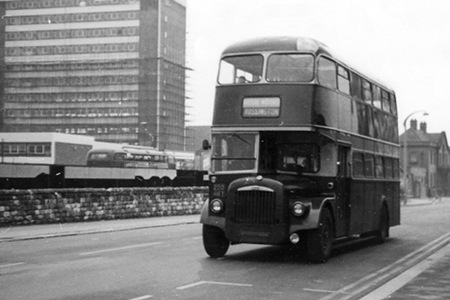
Rossie Motors - Daimler CVD6-30 - 220 AWY

Rossie Motors (Rossington) Ltd
1962
Daimler CVD6-30
Roe H41/29F

Yet another independent from the Doncaster area it would be interesting to know just how many there were in the heyday of bus transport. Rossie Motors mainly ran a regular service between Rossington and Doncaster jointly with Doncaster Corporation, Blue Ensign and East Midland must of been a busy route to make it worth while for four operators. The bus above was a thirty foot version of the Daimler CV series hence the 30 suffix code. From what I have come up with, when the 27 ft version of the CVD or G were built to the 30 foot length the code changed to CVD/G6-30 which makes sense. This vehicle is rather rare as the majority of Daimler CVs built around the time this one was were CVGs that is having the Gardner engine.
In 1980 this bus transferred to the South Yorkshire PTE (SYPTE) and was numbered 1160 in their fleet.
There are also references to the Daimler coding ending with ‘DD’ which I presume stands for double decker, so that would make the above bus a Daimler CVD6-30DD.

A full list of Daimler codes can be seen here.


19/10/11 – 06:30

I worked for Rossie Motors in mid/late 60’s. Loved this bus. Very strong & powerful engine. Good ol’ 220. A fav’ with all the crews at that time.

Andy


28/02/12 – 07:58

I believe 220 AWY still survives in the hands of Isle Coaches of Owston Ferry. There is a recent picture here //www.flickr.com/  
Sadly, it appears to be deteriorating.

John Darwent


28/02/12 – 12:13

…..next to a Thurgood Commer, John?

David Oldfield


28/02/12 – 12:13

According to Bus Lists on the Web, this was the last Daimler engined CV series bus supplied to home operators. Another Doncaster area Independent, Leon of Finningley, took delivery of 432 KAL which had a Roe H41/32F body in July 1961, and this bus was described as CVD650-30DD, which indicates that it was powered by the larger 10.6 litre engine. By inference, this suggests that the Rossie Motors bus, like the few CVDs delivered after the heyday of the Daimler engine finished in the mid 1950s – Swindon (3), Coventry, Glasgow and Potteries (1 each)- had the 8.6 litre CD6 engine. This powerplant was never noted for performance in its naturally aspirated form, so Andy’s comment from personal experience about the "very strong and powerful engine" is interesting. Was this engine turbocharged, or did the bus have the larger CD650 motor? Geoff Hilditch always maintained that Daimler gave up too early on its diesel engine manufacturing, and further development would have yielded dividends. My own experience of the Daimler engine is limited to the turbocharged version fitted to one of the Halifax Daimler CVs, and that bus went up hills like a mountain goat with its posterior on fire, so GGH might well have been right.

Roger Cox


28/02/12 – 17:29

The PSV Circle Fleet History for Potteries states that Potteries H8900 originally had an ‘exhaust driven turbocharger’ fitted to its Daimler engine. It was fitted with a Leyland 0.600 engine in 1964 – making it unique as a CVL6-30?? It ran in this mode in a quite satisfactory manner, mainly on the 12/13 Hanley to Bentilee services whilst I was at the Company in the late 60s. Except that some crews disliked the inability for conversations between driver and conductor as they could on an Atlantean. Some wanted the glass in the small window between the cab and platform…..whilst others wanted it out!! Oh dear!

Ian Wild


28/02/12 – 18:06

The suspiciously Dennis Lancet-looking front hub of GWN 432 (next to the Daimler d/d in the flickr photo) caught my eye, and a quick google reveals that it is a Lancet. Wonderful chassis; pity about the styleless body. Is it a replacement?

Ian Thompson


29/02/12 – 07:13

If you go back to the owner’s photostream there’s a detailed history of both vehicles in a caption. Here is a quick link to view it. 

David Beilby


29/02/12 – 07:17

Yes Ian, the body is apparently a Thurgood replacement as David spotted and it is a Dennis Lancet.

John Darwent


29/02/12 – 07:19

Yes, I think it was rebodied in the late fifties.
I’m sure there was an article on it in Bus & Coach Preservation Magazine a year or two back.

Eric


29/02/12 – 07:20

Ian, the body on Dennis Lancet J3 GWN 432 is a Thurgood FC37F, and, as you indicate, it is a replacement, though what the original body was is difficult to establish. Gleaning info from the internet, it seems that the vehicle was originally owned by Super of Tottenham in 1950, and then later came into the ownership of Jenkins of Skewen who had it rebodied and re-registered, hence the Swansea reg plate. Like you, I find some of the full fronted bodies on vertical engined chassis decidedly uninspiring. The O6 engined Lancet was a masterpiece, and rebodying this one to look like a Bedford is the ultimate indignity.There is another picture of this coach at:- //www.flickr.com/

Roger Cox


29/02/12 – 07:24

Re Ian’s question regarding the Dennis, I see that the original flikr picture has a full description. Click on the large blue "Photo" word and the picture shrinks. It is a 1950 Dennis Lancet with a 1960 Thurgood body having originally been a half cab built by Yeates.

Richard Leaman


29/02/12 – 07:23

Its always most interesting to read the varied views of those in the know about the features of individual vehicle models. My experience of the Daimler standard engine fitted to the CWD6 and CVD6 examples was most favourable – at Samuel Ledgard’s we had two utilities with Duple bodies, and four heavier Brush models from Exeter, and of course the famous (or notorious) entire class of ten Brush ones from Leeds City Transport – the premature sale of the latter to be operated on the same roads by the independent rival caused a rumpus in the Council Chamber like Guy Fawkes would have loved to launch successfully at Westminster – an immediate resolution was passed that no such embarrassing situation should ever be allowed again !! I also drove several of the former Wallace Arnold coaches rebodied by Roe as double deckers. I always found them to be powerful and fast, and their only disadvantage was that the exhaust manifold was next to the cab and uncomfortably hot in good weather – but there again pleasantly warm in Winter – "you can’t have it all ways" as they say.

Chris Youhill


01/03/12 – 07:54

I’m sure GGH was right about the Daimler engine from an engineering point of view, but commercially there probably wouldn’t have been much point in further development. Interest in Daimler engines all but disappeared around 1950 as soon as Gardner were once again able to satisfy demand. I strongly suspect that Daimler would not have started updating the CD6 and experimenting with turbochargers if it hadn’t been for the secrecy surrounding Gardner’s development of the 6LX at the time the maximum length of double deckers was increased to 30ft. After the 6LX came on stream, the only way Daimler would have sold engines in any numbers would have been to withdraw the Gardner option. That of course is exactly what Albion did immediately after the war (with the exception of special orders) – and look what happened to them!

Peter Williamson


01/03/12 – 09:20

London Transport’s ‘D’ class contained around 10 CWD’s among a sea of CWA’s. They lasted about 4 years and, in this case, it was less to do with being non-standard and more of being more difficult to service, with the timing mechanism being at the rear of the engine. I have a feeling that the exhaust manifold was nearest the driving cab and ‘cooked’ the drivers in hot weather.
However, one of these had a chalk notice above the windscreen ‘D???, the fastest ‘D’ of all’! Anyway, with AEC engines coming spare from scrapped STL’s, out they came.

Chris Hebbron


02/03/12 – 07:23

The pioneer, at least in Britain, of employing timing gears at the back of the engine was Dennis, who also went a bit further by employing four valves per cylinder. Oil engined Dennis Lancets were very popular with independent operators, who did not have the sophisticated engineering facilities of the larger companies and municipalities, yet the quite complex O4 and O6 engines earned an excellent reputation for quality and reliability. The location of timing gears only became an issue if other aspects of the engine fell short of acceptable reliability standards, when the removal of the entire power unit became necessary for rectification. Daimler, and later Meadows also used rear mounted timing gears, but, in both cases, the quality of design and manufacture failed to achieve the necessary degree of dependability. Albion, like Gardner, used a front mounted timing chain in their 9.0 and 9.9 litre engines, but, unlike Gardner, the chain of the Albion had a propensity to stretch, so that repeated and very difficult adjustment was required to maintain performance. In the early post war period, Sidney Guy sought to compete more strongly with AEC and Leyland by offering the Arab with a larger engine than the 6LW, and he asked Albion if they would supply him with the 9.9 litre EN243. In the event this came to nothing, perhaps because of the Albion’s timing chain shortcomings, though it is possible that merger talks were already under way with Leyland. Guy then turned to the Meadows 10.35 litre 6DC630 (with rear mounted timing gears) which also proved to be a broken reed. Not until the advent of the superb 6LX did the smaller makers have access to a motor of suitable size and quality that was able to take on AEC and Leyland. Gardners also had a right hand exhaust manifold to keep drivers warm!

Roger Cox


02/03/12 – 07:26

I seem to remember that when Rossie received their first two Fleetlines, this vehicle and the other, the ‘ordinary’ CVG6/30, BYG 890B, were dispatched to Charles H Roe for refurbishing and re-painting. When they came back, they had the nice ROSSIE MOTORS fleetname in gold letters (which they hadn’t had before) to match the Fleetlines. This gave Rossie four very good high capacity double deckers for a service which only required a maximum of two vehicles from each operator!

Chris Barker


05/03/12 – 07:38

Thanks, Roger and Richard,for the Flickr link. I’d better put cards on the table, head above the parapet etc and confess that I don’t like droopy-swoopy coach bodies, or any kind of "streamlining" for that matter, on traditional halfcab chassis. I feel they work better on underfloors, where the droop at the back is partly balanced by a slightly drooping front, and the Burlingham Seagull got it dead right. (Thanks to Neville M for that fine article.) Curved-waistrail bodies, with their plethora of window and panel shapes and sizes must have been far more expensive to make, repair and carry replacements for.
Roger Cox’s words "…rebodying this one to look like a Bedford is the ultimate indignity" perfectly sums up my feelings about that Thurgood body and the attitude of mind that led to its being fitted. Those two recently-posted handsome Alexander Greyhound PS2s (MWA 761 and 761) exemplify to my mind how a halfcab single-decker should look, whether bus or coach.

Ian Thompson


06/03/12 – 08:24

I think everyone is being a bit harsh about the Dennis, possibly because the full story, which appeared in B&CP in September 2009, hasn’t been told here. The point is that by the time it came to be rebodied, it was already no longer a half-cab, but merely a chassis with the remains of a burned-out body sold to a dealer as an insurance write-off. At 10 years old, it is a tribute to the quality of the chassis that anyone wanted to do anything other than scrap it. Rebodying it as a halfcab in 1960 would have been ludicrous, and I’d hazard a guess that getting Thurgood to do the job, rather than a mainstream builder, made enough difference in the cost to make it worthwhile.

Peter Williamson


06/03/12 – 12:14

Very true Peter. I am a VW man and am very sniffy about people hacking (real Type 1) Beetles about. On the other hand, many of these HAVE been saved from the scrap yard and given a second life. That being the case, fine and dandy!

David Oldfield


06/03/12 – 12:15

I am sure that most of us would agree with Ian that the traditional half cab coach design was a classic in its own right, but Peter’s comments are valid. I believe that something of the order of 900 Lancet III chassis were produced, of which only a modest number survives, and, as with all half cab coaches and buses, many of these were disposed of prematurely with the advent of underfloor engines. That Jenkins of Skewen should have had sufficiently high a regard for this chassis to have it rebodied for further service in the then "modern" age is a testament to Dennis quality. Assuredly, had the operator not done so, this vehicle would almost certainly not be still with us today. In the context of its times, having regard to the dismal contemporary efforts of Duple, Plaxton and others on Bedford and Ford chassis, the Thurgood body is not too bad.

Roger Cox


09/03/12 – 17:30

Don’t get me wrong! I’m more than grateful that Lancet GWN 432 has been preserved and admire the present owners for the effort they put into its care.
It’s just that the body’s too redolent of my pet hate, the Duple Super Vega, a topic I’d better keep off…

Ian Thompson


21/05/13 – 12:03

220 AWY is indeed with Isle Coaches at Owston Ferry, along with GWN 432 as part of their heritage fleet. They also have PUJ 783, a Burlington Seagull/Leyland Tiger Cub.

Kenton Rose


28/06/13 – 14:26

GWN 432 is now at Hornsby Motors Ashby and is to be restored for their centenary next year.

Tony Harrison


29/06/13 – 07:19

Just spotted the discussion re Thurgood-bodied Dennis Lancet GWN 432. We ran the story in B&CP, as gratefully acknowledged above, in 2009, when the coach was owned by my good friend, the late Nigel Woodward of Gainsborough. I have extracted the relevant paragraphs and included them below.
As Peter Williamson has pointed out, at the time of the rebody, a ‘modern’ body was the only way forward. The work was carried out by Thurgood as it was ‘local’ to Horseshoe Coaches (Modern Super Coaches’ parent), which had bought the chassis, Thurgood having already carried out some rebodying in this style for companies in the Horseshoe Group. The similarity to a Duple Vega results from the inclusion of a number of standard Vega parts in the body, particularly at the rear. Behind the front dash, the original front dash from its half-cab days (below the driver’s windscreen) is still in situ, complete with circular aperture to accommodate the headlamp!

Philip Lamb


21/03/14 – 18:03

East Midlands took over the Rossington Doncaster service from Red Don,think in the very early 1960s.

Robert Durrant

220 AWY_lr Vehicle reminder shot for this posting


26/08/17 – 07:32

Born and bred in and resident of Rossington from 1940 to 1965 I have many fond memories of Rossie Motors and their dedication to Dainler. From 1951 to 1957 I was, along with other Rossoites, transported by Rossie Motors to Maltby Grammar School a round trip of some 20 miles, usually by a double decker but on rare and welcome occasions by a luxury (to us) single decker coach. I still recall one occasion when overnight snow lay hard packed on the steep road at the entrance to the school. After the passengers alighted the driver was unable to set off as the drive wheels spun on the hard packed snow. The problem was solved by the erstwhile passengers pushing at the back of the bus to get it going, a practice that in the present days health and safety concerns would raise more than a few eyebrows.

Fred Edgar


Quick links to the  -  Comments Page  -  Contact Page  -  Home Page
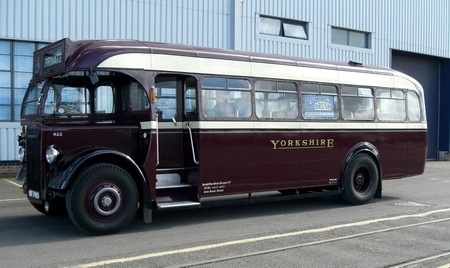


Yorkshire Woollen District – Leyland Tiger PS1 – HD 7905 – 622

Yorkshire Woollen District Leyland Tiger PS1
Photograph G. Brooke

Yorkshire Woollen District
1948
Leyland Tiger PS1
Brush B34F

This great shot of a superb bus arrived above due to a comment made on another YWD vehicle on this site. The person who made the comment said he owned the only survivor of a batch of 75 Brush bodied Leyland Tiger PS1s. This I had to pursue, the bus is owned by Dr Gordon Brooke who as a schoolboy went to school on these Tigers when they were new and then in his student days he was a conductor on the actual bus above.
Many of the Tigers from the original batch of 75 were re-bodied as double deckers in 1954/5 but 622 carried on until 1960 when she was withdrawn from regular service. Instead of being sold on to a dealer which was normal, 622 was used for other things. First she was used as a driver trainer by Yorkshire Woollen District and secondly as a tow-wagon/gritter by the engineering dept with the rear end cut away and most of the seats removed. In 1969 622 was sold to W. Norths (PV) Limited, Sherburn-in-Elmet (dealer).
Gordon acquired 622 in 1988 but did not start restoration until 1990, he then spent the next 12 years restoring her to an immaculate original condition as can be seen from the photograph above. To maintain originality 622 has been painted in the dark maroon livery of Yorkshire Woollen District instead of the later Post Office red, this would have been the livery when she was delivered new.
The above photograph was taken early 2006 and 622 is seen outside the shed where she was originally built in 1948 at the Brush bodyworks Loughborough, Leicestershire.

From a photograph and information contributed by Dr G. Brooke

For much more detailed information regarding YWD Tigers click here.


“Looks like a beautiful restoration.”

Many people are aware of the 1960’s standard BET body with curved screens at either end and some are aware of the earlier version on underfloor chassis. This is the earliest version on half-cabs.
Various contractors would build to BET’s standard design – the final type mainly by Marshall, Weymann and Willowbrook. In addition to Brush, Roe and Weymann built to this design but Yorkshire Traction also had examples built by Roberts and Northern Coachbuilders.
Brush sold out their coach building side to Willowbrook in the early ’50s and shortly afterwards Willowbrook sold out to Duple. The bulk of the Brush empire remained to do much railway work – especially building locomotives.

David Oldfield


I just had to make comment on the above vehicle. Could it be the vehicle in which I passed my PSV test? It was May 1966, the driving instructor was Clifford Allott.

Colin Wilson


This looks a superb restoration.
How lovely it would be to hear this vehicle running. These Leyland PS1 and PD1 buses were blessed with a fascinatingly musical sound, especially in intermediate gears. How I remember Southdown’s examples crooning and murmuring, with gulps and sobs when going on to the over-run! Vehicles of this era were far more characterful than in the last 30 years.

Tony Evans


What a wonderful surprise it was to see that someone had restored an “Old Friend” I served my apprenticeship in the Savile Town Central works and passed my PSV on this vehicle. I also drove its converted (to double deck) sisters on the Birstall to Thornhill route on many busy Saturday duties. Where is it kept? as I would love to see it!!!!

Chris Bligh


I agree completely with Tony Evans about the fabulous music emanating from the PS1s and PD1s. I passed my PSV test on Samuel Ledgard’s PD1 JUM 378 – it had just arrived, warm, from a peak hour duplicate and was tuned to perfection for the difficult course around West Leeds – I sailed around fervently hoping to pass with the toughest Ministry examiner whose fearsome reputation put terror into the hearts of even experienced lorry drivers, many of whom failed for the slightest tinkle of even one gear. As we descended a steep hill in third gear an exasperated voice wailed through the rear cab window "There are four gears on this vehicle" – Fortunately I didn’t fall for that one as I would have failed on the spot. We returned to Armley Headquarters, still showing "Kingsley Drive" on the destination blind, and I was handed the famous pink slip and there began some of the happiest times of my long career. I was allocated a late duty the following day on the Leeds – Guiseley -Ilkley service, and another fine vehicle rolled up – LAE 12, a PD1 ex Bristol with the fascinating combination of an ECW body. Quality design and construction to the last nut and bolt, and every bit as well behaved and delightful as her all Leyland "half sister" who had done so well for me the previous day on the PSV test.

Chris Youhill


Those ECW-bodied "Bristol Omnibus" Leylands were rather smart hybrids. Do you have a photo of them in Samuel Ledgard service, Chris?

Chris Hebbron


Plenty of such photographs Chris H, which I’ll send to Peter by E mail and perhaps some may appear on here. We had three ex Bristol PD1s with ECW bodies, KHW 631, KHY 395 and LAE 12. We also had a further three with BBW bodies, not handsome but full of character and soundly constructed, KHW 243, KHW 622 and LAE 2.

Chris Youhill


The preserved YWD Tiger is resident at the South Yorkshire Transport Museum in Rotherham.

Chris Hough


My father was employed as a coach painter/signwriter by Yorkshire Woollen during the 1950s. He painted these Brush bodied PS1s among others. 586/91 608/12/22 were painted in reverse livery and went on loan to Hebble at Halifax. Dad said these were painted in overtime.

Philip Carlton


Super picture of the YWD PS1 which stirs memories in Bradford`s Chester Street Bus Station. Trouble is, most were rebodied as double deckers in an all over drab red livery, with what I think were the first examples (or very early) of MCW Orion lightweight bodies.
The Federation design of single deck body dates well before WW2, going back to c. 1932, being built by Brush, ECW, Weymann, Roe et al. There was even a double deck version with front upper deck window in 3 divisions, but seen in much smaller numbers. YWD had some with centre entrance, and Thames Valley seems to be in my memory, but EYMS were the principle users.
Chris Ys remarks about ECW bodied Leylands (and BBW!!) also reminded me that the Tilling Group purchased these in the early post war years as they could not get the required number of Bristols. Pity West Yorkshire didn’t`t get any, but this always seemed to be a "flagship" fleet.

John Whitaker


Many thank for your reply Regarding the PS1 622 I wonder if any of your members know what happened to 773 (UTF 930) a Leyland Demo that ended up at Y W D T. As I said in my previous email I worked at YWDT as an Auto Electrical Engineer in the 50/60s and recall with very fond memories 773 this must have been the best of 56 seater conductor operated buses. It was a extremely reliable vehicle you sent it out on Monday morning and forgot about it until someone remembered it may need cleaning or the oil changing it just kept running. The drivers would fight to get it on there duty as it was a pleasure to drive and had vacuum brakes which where very progressive, so the Conductors loved it as well!! The brakes had the Leyland R P adjuster mechanism which worked extremely well and the only attention it required between relines was a liner check every 2 weeks (the other thing that sticks in my mind was the very unusual “Exhaust Note” which sounded like a Ferrari!!!) If this Super bus still exists I would very much like to see it (Distance NO object)
Also I would like to hear from any one who worked for Y W D T around the 50/60s as this was one of the best times of my life!!!

Chris Bligh


Chris, 773 was renumbered 54 in 1967 and withdrawn in 1970 going to Norths of Sherburn in Elmet in 1971 and then sold for scrap February 1971. I remember the bus well as I started work at Saville Town in 1969 and I am still employed by YWDs successors Arriva although at Belle Isle. The bus was frequently on Chickenley area services and would romp up Wakefield Cutting in third and as you say a very popular bus with drivers. Another thing I remember that was unique with 773 was the continuous push bell strip the only one of its kind in the YWD Double decker fleet until the arrival of the 1965 Fleetlines.
As regards people in the Engineering department when I started.
Depot Engineer at Saville Town was Eddie Beaumont.
A charge hand called Eric Daniels.
Central works foreman was Bennett (Jack I think)

John Blackburn


I have had a great shot of the YWD Titan 773 (UTF 930) sent to me by Bob Gell so it will be posted in its own right mid February.

Peter


With regard to YWDT staff I was apprenticed to Jack Bennett (mid 50s) who became charge hand at Dewsbury Central works (Repair Shop). Eddie Beaumont was Charge hand on the “Daily Dock” section. Eric Daniels was a Ganger on the Daily Dock, I believe he had returned to “The Works” after National Service.
I also believe Jack Bennett went on the be a Fleet Engineer or T A at West Riding at Belle Isle. His farther was a driver at Dewsbury and also played the drums in the YWDT Band, he was always known as “Drummer Bennett”. Also thanks Peter I will look forward to seeing the Photo in Feb!!

Chris Bligh


22/02/11 – 06:30

In response to looking for old YWD employees. May dad (Fred Sharpe) was with the company for many years. Started at Saville Town, went to Bradford (Hebble depot), back to Heckmodwike (Beck Lane) before being retired.
Fond memories of the kids bus trip to the seaside on a convoy of single deckers from Long Causeway each year, with our little ‘Paddington Bear’ type tags dangling from duffle coats (always seems to rain on those days!)
Dad used to take ‘specials’ at weekends in Bradford, often fishing trips, where the ladies would go on to the coast while the blokes did the angling. Sometimes we would get to go with them for the ride.
Used to live in Chickenley, cost us three-ha’pence to town on the L/M bus when I was first allowed to travel alone, to Sunday School. Pretty sure my dad passed his PSV on the Tiger as well. He’s still around (Feb 2011), in Mirfield. I live in Doncaster now.

Gordon Sharpe


Rather curious what L/M stands for when you say "three-ha’pence to town on the L/M bus"

Peter


That was the service ‘number’ – several YWD services ran as letters.

The ‘A’ buses went from Batley/Birstall through Dewsbury town centre to Thornhill. Later they did multi routes on the ‘A’, making them A1, A2, A3 and A4, to denote which direction they went round Thornhill – I remember those because I caught them to my Grandma’s and needed to know where I had to get off, depending which route it was running. They are now the 281/282/283 I think.

‘B’ and ‘C’ went from Ossett to Fir Cottage, which went past my other Grandma’s. ‘G’ was Cleckheaton. I can’t remember any others just now.

Service "L and M" was Dewsbury to Chickenley, The L went clockwise, the M was anti-clockwise through Chickenley itself (I think it was that way round). They are possibly absorbed into what is now the 126/127 which goes through to Ossett, but it’s donkeys years since I last rode on the bus up that way.
They were converted to numbers by the time we moved to Bradford. My dad went to the Hebble depot (YWD stored a couple of vehicles there) to pick up a YWD bus for the 66 route to Sheffield, long before the current X33. I could catch the 66 all the way from Bradford (Chester Street bus station) to Frank Lane (Rectory Park) at Thornhill, then a walk up the hill to my grandma’s.

Gordon


23/02/11 – 06:30

Just to note Chris Bligh’s comment about the Yorkshire Bus Company Band. My dad had a copy of the LP they released ‘National Tour’, which I have since digitised and added a CD to the music library of the hospital radio station in Doncaster & Bassetlaw, which I’m involved with.
Back to the bus itself – I must take a trip to Rotherham, never knew such a gem was down there! Would be such a surprise to my dad if I could get a picture standing next to it…!

Gordon Sharpe


07/03/11 – 09:27

The YWD F route was Birkenshaw to Batley. Some of the services went on the new Healy by-pass. It was not really a popular duty since there was no-where at Birkenshaw to get a pot of tea. There was a cafe in Batley but I think this was only open early morning.

Jim Broughton


16/03/11 – 17:30

Chris Bligh regarding 773 it was the Bus that Never rang in, I remember drivers bringing sweets for Ivor the Garage man just to have it.
I was also at the workshops in 1963 as Apprentice Auto Electrician and worked under you and Robin before been banished to Beck Lane to work with Herbert Smithson.
With regard to Fred Sharp he was most well known for throwing the running board across the garage every day when you cancelled any buses.
"Happy Days"

Brian Taylor


29/03/11 – 07:24

WOW!!!! What a brilliant web site. Not only do i find the bus I passed my PSV test on, but an old (sorry for the word) colleague Brian !! How the devil are you???? I remember you well!! (Just to clear up a point , when I was at YWDT I was known as Robin Bligh, but after a few years people started calling me Chris and it stuck!!) I have many happy memories of YWDT and the people who worked with us. I’d love hear from you but this site is properly not the place! If you would like to contact me Peter at the Old Bus Photos website has my email address. I would be delighted!!

Chris Bligh


31/03/11 – 15:23

I think the garage man you referred to was Fred Smith at Beck Lane.Can you remember another garage man George Richardson who when you rang a bus in his stock comment was Let it develop.His sister Dorothy was a clippie at Beck Lane together they must have had over 50 years service with the company.

Philip Carlton


04/04/11 – 07:26

Yes Philip, I remember George very well!! He was a great guy, always a smile on his face and I believe he had spent some time in Iceland (the country not the shop) and had wonderful stores to tell about his time there. Also garage men at Beck Lane where Tommy Latham and Norman Pickles all great characters!!. Also remembered are Harry Snowden (Charge hand fitter) Walt Jennings (Foreman) Fred Smith (SS Fitter) Gerald Kay (SS Fitter) and of course Mrs Rocket canteen lady (I use the word lady lightly).
I vividly remember Tommy Latham going out to Bradford to tow in a PD” Decker, with Gerald Kay with the old Tow Truck (Ridged Bar Tow) and arriving back in the depot on his own trailing the tow pole and wondering what had happened to Gerald. He was sent back to find him and did find him in the middle of Heckmondwike blocking all the traffic!!. It took him many (Long) years for him to “Live that one down” .

Chris Bligh


02/07/11 – 07:01

I learnt to drive in this bus in 1965, Clifford Allott was the driving instructor Tom Batty tested and passed me. They are great days to look back on I played football and cricket for the YWD for a few years 1960/1970 finally left the company in 1980. The photos are fine to look back on but they also bring back memories of cold winter mornings sat in cabs with newspaper around the windows to keep the draught out and most of them were an handful to drive I’m thinking mainly of the old Guys and the Salmon cans in particular. But it was an experience I wouldn’t have missed for the world.

John Ward


04/10/20 – 07:21

Great photo, my wife’s grandfather built this vehicle at brush. We have seen it a few times at bus days out.

Mark Dwyer


Quick links to the  -  Comments Page  -  Contact Page  -  Home Page
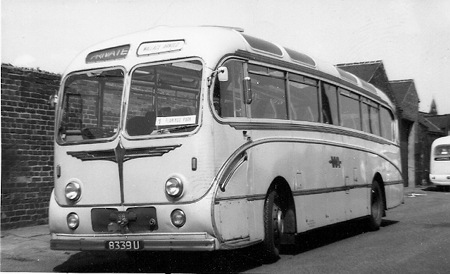


Wallace Arnold Tours – Leyland Tiger Cub PSUC1/2 – U 8339

Wallace Arnold Leyland Tiger Cub PSUC1/2   

Wallace Arnold Tours Leeds 
1958
Leyland Tiger Cub PSUC1/2
Burlingham Seagull C41F

I don’t claim to be more expert than anyone else but I am a huge fan of Burlingham and regard them as one the very best coachbuilders ever. Mark/Series numbers are a bit of a mystery since they were extremely small variations between certain types – and a new number for each.
This is putting 2 and 2 together and getting into the making 5 territory, but I think I can piece most of the Mark numbers together from what little evidence I have.

Mark I – The original centre entrance Seagull on heavyweight chassis such as an AEC Regal IV and Leyland Royal Tiger.

Mark II – Basically the same centre entrance body on a medium weight chassis such as an AEC Reliance and Leyland Tiger Cub. The earlier Ribble Motor Services 1953/4 Leyland Tiger Cub Seagulls Fleet numbers 926/945 FCK 426/440 & FRN 675/679 are certainly of this mark.

Mark ? – Forward entrance/lightweight chassis such as Bedford (SBG/SBO) and the Commer Avenger was this the Mark III

Mark IV – Front entrance body on medium weight chassis such as an AEC Reliance and Leyland Tiger Cub.

Mark ?

Mark VI – Front entrance interim style with radiused (bus?) window panes. The later Ribble Motor Services 1956/8 Leyland Tiger Cub Seagulls Fleet numbers 977/1018  LCK 889/732 I think are of this mark

Mark VII – Final full coach version (similar to Mark IV but with Duple rear end screens)

I believe new numbers were given for the slightest variation. That being said, what was the Mark III and could the missing Mark V have anything to do with the Ford 570E when it was finally introduced? If you know the differences between the Marks or if you can through a little light on any of the above please leave a comment.

Copy by David Oldfield photograph by Paul Haywood

———

The Mark numbers you refer to are the ones which were used for Seagull bodies on underfloor engined chassis. The Mk2 differed from the Mk1 in having a doubled chrome "tank shape" moulding beneath the window line. The Mk3 (introduced in 1953) reverted to a single chrome moulding and had a slightly restyled rear end. The Mk4 offered the alternative of a front entrance (all previous Seagulls had been centre entrance) and also had the option of a front dome destination blind box. The Mk5 replaced the Mk3 in 1955 and differed from it in offering a choice of front or centre entrance. It also featured flat one-piece glass panels in the front windscreen as opposed to the two-piece, slightly curved units previously fitted. The Mk6, as you correctly state, differed from the Mk5 in having its side windows fitted into radiused (and slightly recessed) window pans for ease of maintenance. The variant was built at the request of Ribble Motor Services and there were few other customers. The final "heavyweight" Seagull in this sequence was the Mk7, introduced in 1958 and featuring much longer side windows than previous models. This was in response to Plaxton’s introduction of the trendsetting Panorama design, but the Burlingham model proved less popular than they might have hoped. As a result it was replaced in 1960 by the Seagull 70 with its pseudo-American styling, and this was used by Scottish Omnibuses, East Midland, Trent, and other operators although only in penny numbers.
Lightweight chassis such as Bedford SBs were given a design of bodywork which mimicked the then current Seagull design, but as far as I know the body never had an official name although many (including some Burlingham employees) referred to it as "the Baby Seagull". The final, rather ugly version of this body made its appearance in 1959 and was the butt of so many unfavourable comments that it lasted just a single year. In 1960 it was replaced by the Seagull 60, similar in styling to the previously mentioned Seagull 70 for heavyweight chassis. It sold well, but operators soon discovered that the slightly raised "clerestory roof", made of see-through plexiglass, was prone to leakage. The design was relaunched the following year, with the leakage problem solved, as the Seagull 61 which featured far too much front-end chromework for most tastes. The last two new Burlingham-badged designs emerged in 1962. The Seagull 62 was barely distinguishable from its immediate predecessor, but coach operators were offered an alternative, the curiously named Burlingham Gannet which featured a restyled front end and more glasswork. Both models sold poorly and from 1963 onwards were replaced by the Duple (Northern) Firefly.

Neville Mercer

———

19/09/12 – 07:11

Ribble Motor Services FRN 679 mentioned in Mark II above was definitely a Royal Tiger rather than a cub.
I used to travel to school in it and always liked to sit at the front as the view was superb. Comfy seats too.
Any idea where it went?

David

———

29/09/12 – 12:35

The small batch of coaches featured in Paul’s photo, 8338 – 8343 U, were indeed splendid vehicles but with "minor" limitations of which the Company seemed blissfully unaware. I can speak from bitter experience, having operated the Yorkshire – Torquay/Paignton night service with them. The passengers all seemed to equip themselves with enough enormous luggage to suffice for emigration to the Southern Hemisphere – and it was the very devil to stow it all in the shallowish boot of the "Seagulls."
The return journey (non stop for we drivers) was scheduled at around thirty hours and, due to the lack of motorways/by-passes, we were always very late back into Leeds on Saturday nights – the Tiger Cubs and the top speed limit for coaches meant that there was no chance of achieving the timetable – it was not a pleasant assignment at all in those days. That’s in no way a criticism of the Tiger Cubs or of the Seagulls – simply wildly over optimistic and unrealistic scheduling by the Company.

Chris Youhill


Quick links to the  -  Comments Page  -  Contact Page  -  Home Page



All rights to the design and layout of this website are reserved     

Old Bus Photos from Saturday 25th April 2009 to Thursday 4th January 2024