Old Bus Photos

Hull Corporation – Leyland Atlantean – 7383 RH – 383
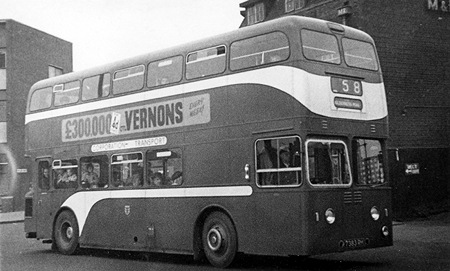
Hull Corporation Leyland Atlantean 383
Photograph by ‘unknown’ if you took this photo please go to the copyright page.

Kingston upon Hull Corporation Transport
1963
Leyland Atlantean PDR1/1 
Roe H44/31F

I could say here is a rather poor shot, not too bad at the front of the vehicle faded out and slightly grainy to the rear, or alternatively, I could say this photo was taken on a cold misty morning in March and what an atmospheric shot it is. I will let you decide which is true, I though have the advantage of seeing the original Black & White photograph.
By 1963 most operators were either switching over to rear engined vehicles or were seriously thinking about it.SGD 669_lr_cu
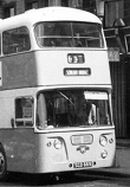
C H Roe were always known for a more rounded look to their bus bodies but this vehicle is somewhat strange for one of theirs. Very square front and a flat split windscreen, which is very boxy compared to the one to the right. An Alexander bodied vehicle of the same date, a much more rounded appearance a one piece wrap round windscreen and upper deck front window, I think are much more pleasing on the eye. Both of these Atlanteans being PDR1/1s would have had a flat lower deck floor until the rear axle when there would either be a slope or a step to get over it. The PDR1/2 which arrived on the seen in 1964 had a flat floor over and to the rear of the rear axle this was made possible by the use of the Albion Lowlander rear axle.


C H Roe were known for their high quality timber frame bodies and after their take over by Park Royal they did such work and Park Royal concentrated on metal framed designs. During the fifties there was more call for metal frames and Park Royal needed to send some of its work for Roe to do using Park Royal frames – famously the Yorkshire Traction Leyland Tiger rebuilds.
When the Leyland Atlantean was introduced, Park Royal designed a body for the whole group to produce – not unlike the front entrance Bridgemaster, but stretched up to full height. The Bridgemaster was Park Royal’s ugliest design to date, but the Atlantean body excelled in ugliness – looking totally unbalanced. Some wag called them glazed pantechnions!
Park Royal was so involved in mass Routemaster production that all bodies of this design were produced at Leeds. Luckily Park Royal/Roe went on to produce the classic design introduced in quantity in 1968 which essentially continued until the end of Atlantean production.
The Alexander body is actually of a later vintage, the contemporary (first) version being differently ugly. Sheffield had a Motor Show, and unique, example (369). Unsurprisingly Glasgow and Northern General were operators of numbers of these – as was Godfrey Abbott, then a North Cheshire independent, later to be swallowed up by SELNEC.

David Oldfield


Park Royal bodied Atlanteans are so ugly, that they are beautiful, or has time rewritten every line?

Keith Easton


I think in this case I’d rather say "The combination of boxy shape and streamlined livery is so insane that it’s beautiful."

Peter Williamson


Like a streamlined brick!

Stephen Ford


Try this, then: the first Atlanteans all looked like that: the appearance of the body was dictated by its function, as fitted the taste of the times. The bustle was practical because it gave fullest access: the body could easily be repaired: "streamlining" and flashy paintjobs (Hull) were rather vulgar and reminded you of Seagulls and those funny 50’s coaches with a rudder at the top back (who by?) and GM cars. Very unsixties.
Then came the Liverpool Atlanteans & every local Councillor wanted a fleet like that…..

Joe


The 50s rudder was, of course, the Harrington Dorsal Fin – which, at the risk of being lynched, I personally thought looked ridiculous.

David Oldfield


Useful for stability at speeds over 45mph. The Russians liked them… or at least I recall some lookalikes in Moscow in the 1980’s. Go well with a ZIL!

Joe


I worked on the Atlantean buses as a conductor and driver. They where good buses in their day. I worked on the bus at top of this page on many occasion. This service bus changed from a 58 to a 55 circular bus, on some of them I nearly had to stand up to drive the bus round tight corners.

Mr Wright


I agree wholeheartedly with Mr. Wright about heavy Atlantean steering. My experience of this extended to the first examples of 33 feet long Atlanteans with no power steering and 78 seats. We had a large batch of these at Leeds City Transport and, particularly when fully loaded which they often were, it was practically necessary to stand up on tight manoeuvres to turn them – and I am nearly six feet tall. They really were a health and safety risk from that point of view. Also I’m sad, as a devoted Daimler Fleetline lover, to have to admit that the non power assisted 33 foot examples of that make were similarly unacceptable. I once had the embarrassment during a morning peak period of failing to get one of the latter round a temporary hairpin bend in Hunslet – the bus was fully loaded with some ribaldly outspoken clients and their remarks as I literally stood up in the cab to heave it through multiple "shunts" ring in my ears to this day, forty years later.

Chris Youhill


I have to say I agree wholeheartedly with Chris Youhill that the Daimler Fleetline was a nicer bus to drive than the Atlantean. In addition to his comments about heavy steering, early ones were anything but smooth to move from rest with a full load. It wasn’t necessary for the conductor to ask standing passengers to move down inside; the transmission would make sure of that as the vehicle started to move! The appeal/functionality of the ‘bustle is a matter of opinion; the Fleetlines I knew didn’t have them, and, (admittedly for many other reasons), the engineers I worked with found them better vehicles to maintain.
As far as the bodywork is concerned, I recall early lowbridge Atlanteans at Maidstone & District had a semi-offset gangway upstairs; central until about the last three rows of seats and then to the side. I rather think they had Weymann bodies. The flat front was a major reason for M&D to decide on Atlanteans, since they were introduced originally as replacements for the trolley buses in Hastings.

Roy Burke


I hope I’m not going to start disagreeing with Chris Y – we seem to agree on everything else.
Well actually, I don’t disagree! Everything he and Roy have said is absolutely true. They were rubbish, especially when compared with the PD2 and PD3 and Leyland didn’t get it right until the AN68 – when they ended up with the best of the first generation rear-engined deckers. [Of course, the AN68 did benefit by having power-steering and the 0.680 as standard.]
As we’ve said before, Metro-Cammell (MCCW) and Weymann were separate companies with a common marketing company (MCW). Often there were hidden side effects to this, not generally known. One concerned early Atlanteans. MCCW were the bigger "half" and dealt with big runs. The smaller Weymann would deal with smaller runs and more specialist work – including coaches. All early highbridge Atlanteans had Met-Camm bodies and all semi-highbridge bodywork was by Weymann.
This was to get more muddied later on. [Weymann built at least two, small, batches of highbridge for Sheffield Transport in 1962/3.]

David Oldfield


Roy’s mention of Atlanteans replacing the Hastings trolleybuses takes me back to very happy teenage years as a frequent visitor to the resort. As if the modern trolleybuses weren’t magnificent enough the wonderfully evocative fleetname at the time was the icing on the cake – "Hastings Tramways Company." Also any pretentious ideas the Council may have had about their beautiful and impressive Promenade were chopped down to size by the trolleybus destination blinds, where the lovely bracing thoroughfare was referred to as "Front."

David, please never fear about disagreement on any topic at all, as the opinions and knowledge of qualified friends are always most welcome.

Chris Youhill


05/08/16 – 06:00

Split window Atlantean terrible bus, draughty loose front window, noisy air driven w/s wiper, cold demisters and heaters, great holes in the floor for pedal, h/b rubber wouldn’t stay down, rigid drivers seat bolted to the floor with minimum cushioning situated five feet in front of the wheels giving a springboard effect if you were on a rough road, plastic peeled off the steering wheel leaving an alloy surface (hell in winter). Front wheels slid away on a wet surface you had to put your foot on the console to get it round a sharp bend, with Insp. Chris Hudson spraying deicer on the INSIDE of the w/s as you pulled out of Ferensway station. I’m sure there’s more but it’s been 35 years since I left.
At least they didn’t suffer from fuel surges or power steering failure going round corners like Scania’s

Pip


05/08/16 – 13:58

Going back to David Oldfield’s first post, above, Glasgow only had the one square-bodied Atlantean/Alexander (LA1), and Godfrey Abbott only had secondhand Atlanteans and Fleetlines, since running double-deckers on predominantly schools services was very much a latter-day experience for them. The only square-bodied Atlantean/Alexander I have managed to connect with them is KCN182, new 1/60 to Gateshead & District. They may have had others.

David Call


05/08/16 – 13:58

How long did the "streamlining" livery last and was that to the end of Hull Corporation’s existence?

Chris Hebbron


07/08/16 – 07:07

Chris,
The ARH-K batch of Atlanteans were the first in the non-streamlined livery that lasted from 1972 to the Cleveland Transit buy-in (c.1989) and then in a version with Yellow relief added to the Stagecoach takeover in c. 1995.

Stephen Allcroft


07/08/16 – 07:07

The streamline livery started to disappear from 1972, when Atlantean 318 (DRH 318L) appeared on the Commercial Motor Show in 1972, with a new Blue and White livery and the fleetname Kingston upon Hull City Transport, this was previewing the local government reforms of 1974, when Corporations were abolished, new vehicles from 1972 appeared in the new livery (slightly different from 318)and old ones embarked on a repainting programme.

Keith Easton


08/08/16 – 06:56

Steve/Keith – Thx.

Chris Hebbron


09/08/16 – 06:14

Further to my earlier comment the repainting was largely complete by 1975 (which was when I really got interested in Hull buses); all vehicles except for the AEC Reliances and the early Atlanteans mainly the 346-95 batches. Consequently the streamline livery finally disappeared from the streets of Hull around 1980.

Keith Easton


10/08/16 – 05:54

Thx, Keith. This must have been the last operator to use the streamline livery principle by a country mile, I’d wager. In fact, how many operators used streamline livery? Being a Southerner, the only one which immediately comes to mind, apart from Hull, was Manchester, Sheffield, Rochdale and, after a fashion, Blackpool Corp’n, but there were others, I suspect.

Chris Hebbron


21/08/16 – 07:44

Hello Stephen, Sorry to have to correct you, but the DRH-L batch, delivered 12/72 were the first to be delivered in the new livery, with 318 in the prototype livery being repainted later to match the remainder of the batch. The earlier batch ARH298-317K were delivered across the new year 1971/2 and were the last to be delivered in the streamline livery, indeed I have photographs of 310 and 313 still in streamline livery in May 1975.

Keith Easton


Quick links to the  -  Comments Page  -  Contact Page  -  Home Page
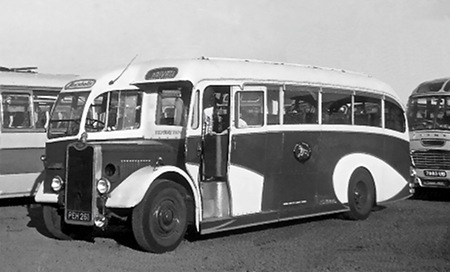


Marshalls – Guy Arab III – PEH 261

Marshalls - Guy Arab III - PEH 261 

Marshalls of Bradford
1951
Guy Arab III
Windover C33F

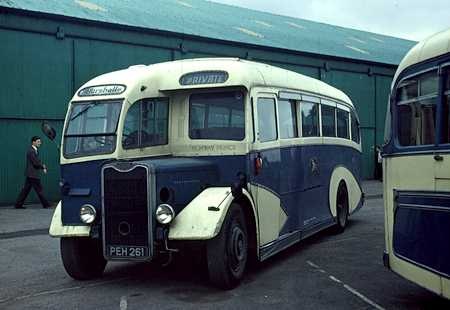
This coach first appeared on the do you know page and is from the Paul Haywood collection information supplied by John Kaye provided the history regarding this very nice half canopy Guy Arab III photographed at Blackpool in 1963. This coach was bought new by Scraggs of Cheadle which is halfway between Stoke-on-Trent and Uttoxeter, Staffordshire. They did not keep it very long as it was bought the following year 1952 by Ripponden & District Motors, Ripponden is a small village about five or six miles to the west of Halifax, Yorkshire. There main business was light haulage in the Yorkshire/Lancashire area they had two nick names from people who new them, ‘Rippi Dicks’ and ‘Rush and Dash’ but if you were to ask an employee where they worked the answer they would always come back with would be ‘down district’.
Hebble Motors of Halifax bought out Ripponden & District Motors coach excursions in 1957 and left them to concentrate wholly on there haulage business. Four years before being taken over they sold the Guy on to Marshalls of Bradford. PEH 261 closeup
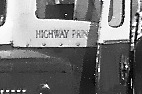
If you look carefully you can just see a name plate on the near side just below the saloon window it reads ‘Highway Princess’ did Marshalls name it or did it always have a name. If you know please leave a comment.


09/02/11 – 05:49

This picture brought back happy memories! A group of Students from Bradford Grammar School hired this coach from Marshalls in 1959 for a trip to Merseyside to see the first production Atlantean, and also take in Birkenhead Corporation buses. It certainly carried the Highway Princess name at that time.
As an aside, its was interesting to note that at the same time as Wallasey were commissioning the Atlantean, Birkenhead had just put a batch of PD2/40’s with exposed radiators into service. Examples of both types (FHF 451 from Wallasey and FBG 910 from Birkenhead) have made it into preservation.

David Bate


24/11/12 – 08:26

PEH 261_2_lr

I though you might like to attach this colour view of the Marshall’s Guy/Windover coach to the existing article. Compared with the Blackpool shot, it has acquired a rather less stylish pair of wing mirrors and lost its chieftain, but is otherwise unchanged.
The picture was taken on 25/8/68 by which time the vehicle was in the ownership of Kirby’s, the well known dealer at Anston (?or Dinnington) near Sheffield. I wonder whether it found a new owner, or was simply at a staging post on its way to Barnsley or similar.

Alan Murray-Rust


24/11/12 – 12:47

Rather a nice colour picture of it. It still appears to be sporting the Marshall fleetname on the side panel as seen in the B&W shot.

Eric Bawden


28/01/13 – 07:12

I well remember this vehicle whilst I was at school in the 60s as it regularly passed the bottom of our street. It normally seemed to live outside the owners home in Kensington Street Bradford, though as Marshalls owned 2 coaches, the other one must have lived elsewhere. Marshall’s acquired 3 vehicles when Ripponden & District stopped running coaches in 1957, these being a one and a half decker Commer with an SME registration, the AEC Regal IV with Whitson body which did not go to Hebble who took over R & Ds other vehicles and PEH 261. It may be that Marshalls were agents for R & D in Bradford as they had an office in Swaine Street, and that the vehicles were bought to continue in business, as these were the first vehicles owned as far as I am aware. The vehicles retained R & D colours though I seem to remember PEH at on time being all over cream with blue flash. The fleet name on the side is not actually the company’s name but a leaping tiger which was used on the side of R & Ds coaches and presumably was never painted over. Although not quite the same, it was similar to the tiger leaping through the hoop on Ellen Smiths coaches.

David Hudson


28/01/13 – 13:34

It’s pleasing to note that the original purchaser of this coach, Scraggs, is still very much in business, operating local bus services in the Stoke area.

Chris Barker


29/01/13 – 06:37

A blast from the past ! This thread started before I became aware of the OBP website and I missed this one. I well remember this vehicle and Marshalls who did quite a lot of work in my local area of Bradford. I was on the Bradford Grammar School trip mentioned by David Bate who I remember from School.
I also remember being on a male only party up into the Dales which used this vehicle. There certainly were the traditional crates of ale aboard – the only problem as I recall being that the coach had been booked the following day for a Mother’s Union outing from my local Church. Enough said.

Gordon Green


09/11/13 – 17:52

I’m only a year late in spotting Alan’s 24.11.12 post and mention of Kirkby’s (with two Ks). Kirkby’s were a coach dealership at North Anston on the north side of the A57 between Sheffield and Worksop – which is just south of Dinnington. They were also an operator in their own right with O licences for two operations – Kirkby’s of Harthill (near Anston) – with a rich blue livery (similar to Sammie’s) – and J O Andrew of Sheffield – with an attractive two tone green livery. History has made all of these strands into important players.
i) Kirkby’s was the first of several new owners (after the family) of Plaxtons. In yet another case of reverse take-over, they took on the more famous name (Plaxton) and the current Anston Plaxton site is indeed the original Kirkby site. [Remember that East Lancs/Darwen bought Optare in recent years but "reversed" to become known as Optare. Same sort of thing.] Kirkby’s, at the time, were also a major Vauhall/Bedford dealership in the Rotherham and Worksop areas.
ii) Kirkby’s decided to pull out of operating and the Andrew’s operation in Sheffield became a PSV driving school. On deregulation in the ’80s, Andrew’s came back into operating – but having been a classy coach operator they became one of the Sheffield pirate bus operators. They became the core of what became one of the biggest and most successful independents in competition with SYPTE and in their final incarnation were known as Yorkshire Terrier. This operation was in the latter days part of the Carter/Yorkshire Traction empire and, of course, in 2005 became part of the Stagecoach Bus UK. Stagecoach is now a major player in the City of Sheffield. iii) Kirkby’s became Plaxton, now owned by Alexander-Dennis who have Brian Souter as a major share-holder. Andrew’s became Yorkshire Terrier who eventually became a Stagecoach company. [So now they’re back together in common ownership?]

David Oldfield


10/11/13 – 07:58

Oooo – it’s doin’ me ‘ead in!

Stephen Ford


10/11/13 – 09:38

Sorry, Stephen….. [well I’m not really].

David Oldfield


11/07/14 – 16:26

Just came across this photo, the original owners also ran a fleet of lorries, my Dad drove for them in the early 60’s.
The company went out of business late 60’s and there is no connection with Scraggs of Bucknall, Stoke on Trent as reported on here!

Mr Anon


Quick links to the  -  Comments Page  -  Contact Page  -  Home Page


Leeds City Transport – AEC Regent V – ENW 980D – 980

Leeds City Transport AEC Regent V

Leeds City Transport
1966
AEC Regent V
Roe H39/31R

Perhaps this snippet about Leeds City Transports AEC Regent V fleet number 980 which has been preserved and is stored at the Keighley Bus Museum may be of interest. 980 spent most, if not all of its service life at the Headingley depot along with the remainder of the batch 974 – 983. I don’t know the technicalities but it was fitted with some kind of modified exhaust system which gave a totally different tone to the norm, especially when pulling hard. As it passed its home depot on the routes northwards out of Leeds it was instantly recognisable by the unique sound alone. The tone was uncannily like that made by a water craft when the exhaust dips below the surface and accordingly amongst enthusiast staff 980 enjoyed the nickname "The motor boat". Very happy days indeed.

Copy contributed by Chris Youhill

———

The exhaust sounds like an example of the famous AEC "straight through" exhaust – common on Regent IIIs, less common but not unknown on Regent Vs.

My passions are AECs and bodywork by Burlingham, Roe and Weymann. What an fine photograph of a beautiful bus. I am actually very concerned about the future of a similar bus ex Sheffield B fleet number 1330 registration number 6330 WJ which has been in the limbo of being half restored at Sheffield, South Yorkshire. An almost identical 2D3RA of 1960 vintage.

David Oldfield

———

I know the Mark IIIs wonderful barking "straight through" sound that you mean – this magnificent recital was fitted to most if not all of the Leeds City Transport "PUA" registration batch, of which 674 was undoubtedly the finest as it bellowed its way through the City Centre usually on services 42/66 from Harehills to Old Farnley/Leysholme Estate.

However the "motor boat" sound produced uniquely by 980 was quite different and was somewhat muffled and refined, perhaps best described as gentle "under water" bubbling. What priceless memories we are lucky to enjoy.

Chris Youhill

———

Work is well underway on the above vehicle…this site will be kept informed of developments in due course.

Mick Holian

———

Leeds City Transport always seemed to have a well turned out fleet of interesting vehicles, but seeing and hearing one of their many Regent Vs was to many of us the icing on the cake. Whether it was a handsome Roe-bodied example, or one of the plainer (but slightly more imposing?) MCW ones with exposed radiators, it didn’t matter. To the ear they were just the same – gorgeous! Perhaps best summed up as the mechanical sound effects of a Routemaster, coupled to the exhaust system of a decent sports car?! They were once a common sound booming their way up The Headrow past Lewis’s. If you were lucky enough, sometimes a skilled driver with a tuned ear would ‘hold’ a bus on its exhaust bark for quite a distance up the gentle incline. Bliss!….and a damned sight better than todays droning Volvo B7TLs!

Brendan Smith

———

Mention of the PUA registered 1952 AEC Regent IIIs brings to mind the Roe advert which adorned Leeds timetables for many years 669 was used until the nineteen sixties when it was replaced by a dual doored AEC Reliance in 1967 this was replaced by 131 the first of Leeds 33 foot Fleetlines the last Leeds bus to appear was a 1968 Daimler Fleetline with Roe dual door body. A small batch of these AECs carried very shapely Weymann bodywork.

Chris Hough

———

The six handsome Weymann "PUAs" were numbered 649 – 655 and they were a pleasure to behold from outside, and when on board you could enjoy some of the last Leeds buses to have the "warm" light beige window surrounds – I always thought that the subsequent silver ones were harsh and a retrograde step.

Chris Youhill

———

I have quite a collection of LCT photos click here to view. Some of them should bring back an odd memory or two!

David Beilby

———

25/09/11 – 07:18

Some of these AEC’s had a short spell with Tyne and Wear PTE (formerly Newcastle Transport) I believe they had been let down with a delivery of new vehicles and the AEC’s were brought in as a stop gap. They were used on the 18/19 Walker Circle route and were still in their LCT livery, but the panel around the radiator grill had been painted yellow.

Ronnie Hoye

———

25/09/11 – 09:00

I think that the L.C.T. buses that went to Tyne and Wear initially went to OK Motor Services but were not used by them. Tyne and Wear also painted the first panel on either side in their yellow livery.

Philip Carlton

———

25/09/11 – 09:03

They did look interesting in Newcastle didn’t they ?? The one in this picture though, 980, travelled even further north and served with A1 Services of Ardrossan in another fine green livery before being "repatriated" and is now approaching restoration to perfection standards at Keighley Bus Museum.

Chris Youhill

———

25/09/11 – 15:20

Further to my comments about LCT Buses in Newcastle, ironically, not long before the arrival of the LCT buses, Newcastle had decommissioned their own Park Royal bodied Mk V AEC’s, some were low bridge variants for the No 5 Ponteland/Darras Hall route, I also seem to remember some other foreigners from Edinburgh and Leicester were in Newcastle at the same time.

Ronnie Hoye

———

26/09/11 – 15:06

The PTE in Newcastle suffered a severe vehicle shortage and purchased a small number of ex Leeds AEC Regents and at least one Roe bodied PD3/5 all had PTE Yellow applied to their bonnets In addition the PTE loaned buses from Plymouth (MCW bodied Atlanteans) Lothian (Alexander bodied PD2s) Bournemouth (Atlanteans with Newcastle style MCW bodywork) Leicester (PD3s with East Lancs bodywork0 and Southend (Fleetlines with NCME bodywork)

Chris Hough

———

29/01/12 – 17:48

Yep about half a dozen Regent V"s and the PD3/5 along with all the other exotic birds were allocated to Byker depot and we had a trip out to photograph them. To add to the interest the restored Newcastle Leyland PD2 (in blue livery) and some ex Standerwick Bristol VRLL"s for the ferry services were also on shed. Newcastle was a very interesting place at that time. I am told that the Regents subsequently went to the magnificent OK motor services but not sure if they were ever used (possibly cannibalised for parts?)

Tony Greig


Quick links to the  -  Comments Page  -  Contact Page  -  Home Page


All rights to the design and layout of this website are reserved     

Old Bus Photos from Saturday 25th April 2009 to Thursday 4th January 2024