Old Bus Photos

A Mayne & Sons – AEC Regent V – CXJ 520C
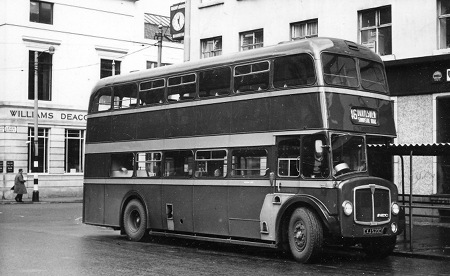
A Mayne & Sons - AEC Regent V - CXJ 520C

A. Mayne & Sons
1965
Regent V 2D3RA
Neepsend H41/32R

Another independent bus operator but this time from the other side of the Pennines, A. Mayne & Sons operated in the Manchester area. I must admit I know very little about A. Mayne & Sons but I have two photographs of AEC Regent Vs that are worth posting, so if anybody as any information about them please leave a comment and I will add it as an update.

This Regent had a body built by Neepsend formally Cravens of Sheffield South Yorkshire and the livery at the time if I remember correctly was a dark red body with three pale green bands, although I do stand to be corrected if you know better.

A full list of Regent V codes can be seen here.


Maroon with turquoise bands would be more accurate. In later years they adopted a red and cream livery which was much more modern-looking, but far less distinctive! Maynes sold their bus operation to Stagecoach four or five years ago, but the name is kept alive by the coaching operation based on Warrington, which is actually the former Barry Cooper business.
There is a nice story that back in the 1930’s Manchester Corporation offered to buy out the Maynes business. The reply was that this was an amazing coincidence, as Maynes were thinking of making a similar offer to MCTD!

David Jones


Another piece of interaction between Maynes and the Corporation may be worth recording. In the mid-1960s Maynes had a half-share in Manchester’s service 46 to Droylsden, as shown above, and also their own unnumbered service along the main road to Audenshaw, which ran in competition with Manchester’s trolleybuses. Since the trolleys operated under light rail legislation and were outside the Road Service Licensing system, this made Maynes the sole licensed operator of local (as opposed to limited stop) buses on the stretch of main road beyond the Droylsden turnoff. When the Corporation wanted to run motor buses on the trolley routes, they had to apply for a licence, to which Maynes objected on the grounds that it was their patch! This promised a real David and Goliath battle in the traffic court, but sense prevailed and a deal was struck instead. Maynes got the other half of the 46 (which they had always wanted) and both their objection and their Audenshaw service were withdrawn.

Peter Williamson


I’m not familiar with the "half share" referred to by Peter – but as far as I recall only Maynes operated the 46 from Stevenson Square to Droylsden [Sunnyside Road]. During the early Selnec years Maynes continued to operate the route which was renumbered 213.
The story I was told was that Maynes started the 46 route when Droylsden was still being built and the roads unfinished. When the roads were completed Manchester then wanted to operate the route as well.
Maynes are said to have objected and won their case with the only restriction being passenger pickup only between City centre and Ancoats – outbound and passenger drop off only from Ancoats to City Centre – inbound.

It is also interesting to note that up till the recent acquisition of Maynes local bus services by Stagecoach – Maynes original route 46 [subsequently 213] was their only local service which I think remained as such until the deregulation era. They then increased the number of routes between Manchester and the Ashton area. Of note is that ALL their routes went via DROYSLDEN, maintaining their original commitment to service this area.

Roy Oldham [Expat in London Ontario Canada]


According to "The Manchester Bus" by Eyre and Heaps, the 46 was jointly operated by Manchester and Maynes from its inauguration in 1958.  However, "half-share" wasn’t quite right, as I have found a table of joint services in 1962 which shows that the all-day service required 3 buses, of which 2 were Manchester’s and 1 Maynes. 
Maynes original route – started in 1926 – was from Newton Street to Kershaw Lane, Audenshaw, although inbound buses always showed "Dale Street" as that was where the alighting point was.

Peter Williamson


I cannot comment on what the "Official" arrangements were between Maynes and Manchester – all I know is that I travelled between Stevenson Sq and Pollard Street quite frequently in the late 50s to late 60s and if not using the 215/216 trolley bus would take the 46. Invariably the return trip would be on the 46 as the trolley buses didn’t return via Pollard Street. If Manchester was in fact operating two out of three vehicles the odds are that I would get one, whereas in reality it was always a Maynes bus that came.

Roy Oldham


What became of the 46 service started in 1933 as a shuttle service from Edge Lane to Manor Road which connected with the existing Audenshaw service. As that area of Droylsden developed the service was extended gradually until it reached Sunnyside Road. The inconvenience of changing buses at Edge Lane became an issue and in 1958 the service was extended into the City and was numbered 46 by Manchester Corporation who became a joint operator in the ratios previously described. Peak hour extras were additional and provided by MCT in summer and Mayne’s in the winter.
As Peter has already said above, the 46 became worked exclusively by Mayne’s following the abandonment of the Manchester trolleybus system.

David Beilby


Recently Buses Mag published an interview with Julian Peddle who at one time was Traffic Manager at Maynes, seemingly the financial arrangement with MCTD was that they paid Mayne’s a mileage rate who then paid MCT all their takings, an arrangement very beneficial to Mayne’s !

Andrew Critchlow


14/09/11 – 07:58

I was born and bred in Droylsden near the cemetery. I used the 2 Maynes services for many years until I went to London in 1959. When the Edge Lane to Sunnyside Road changed to no 46 Limited stop from Stevenson Sq I came home from work on it. I used the 215 216 to go to the City as the Maynes was usually full by the time it got to our bus stop. Sometimes I used it to go home until no 46 started as the walk from the stop on Manor Rd was shorter. When at school I used the 216 to Ashton and the Hurst or Smallshaw Circular or walked to school from Ashton market. My uncle Bill was a driver for Maynes and if I was on his no 46 going home he used to stop earlier than the bus stop so my walk was shorter. My Dad and Arthur Mayne were friends.

Alan Bevins


07/11/11 – 12:21

I use to use the Maynes bus in 1965 to get to work. I use to meet my father and we would go together on the bus from Sunnyside Road terminal to Stevenson Square and visa versa. Brilliant service and always full of people travelling in the early mornings and again at night.

Marie Mckenna


10/11/11 – 07:42

I now have a copy of the Maynes book by Venture Publications, and it gives a slightly different version from the Manchester book of the joint working arrangements on the 46, namely two Maynes buses and one Corporation rather than the other way round. Plus the peak hour extras referred to by David B.

Peter Williamson


12/03/13 – 14:05

In addition to the services listed above, Maynes also had a road service licence for the Droylsden to Audenshaw Grammar school bus which was operated as what would be known now as a commercial service. I travelled to school on one of the Regent V’s every day on this service in the 1960’s.
Later I found myself driving Fleetlines and VR’s for Maynes for a short while – very nostalgic with Ultimate ticket machines.

Bill Lear
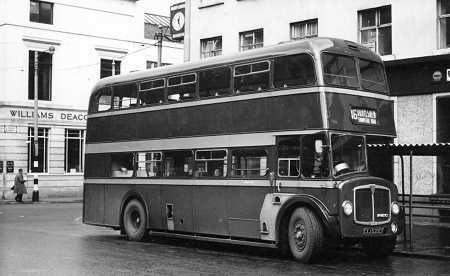

CXJ 520C_lr Vehicle reminder shot for this posting


12/05/13 – 06:53

In 1964 I co-organised a student- teacher PD1 Leyland decker trip to Moscow from Manchester and as I wanted to keep my PSV licence going, I drove part-time for Maynes Buses from 1965 until I left Manchester in 1978. At the time I was teaching first at Manor Road Primary and then at Bishop Greer Secondary in Gorton. I lived on Greenside Lane near the Clockhouse terminus.
My inauguration was on GUF 678 – a Leyland PD1 slow gear change, so I had no problems in satisfying the requirements. (the drivers used to say "You can light a fag in between gear changes")
Mr Palmer was the manager under Arthur Mayne Jnr. and Alex was the mechanic. I drove on the last Kershaw Lane route (Dec 31st 1965) when they changed the route from trolley buses and swopped it for the 46 Droylsden Route.
My first trip from Droylsden, Market Street to Mayne Road was a different story. I was given an AEC Regent II FT 571 with a quick crash box change and I could not find any of the gears. I got the timing wrong and could not stop with the vacuum brakes at Edge Lane Traffic lights. With the help of the passengers they directed me to Mayne Road. Phew! I thought my days of driving for Maynes were over, but they were just beginning.
Last journey was on a Bristol VR to Rochdale VJA 666S.
First new bus was on a Sunday morning in July 1965 Regent V CXJ 520C. It had air brakes and stopping was very fierce. I remember one man hitting the bulkhead as I braked for Market Street on route to Kershaw Lane, Audenshaw. Oh Dear !!
I could share many comments as I drove all the fleet of deckers. My favourite was Ex Oxford synchro 27ft 7194 H. The pre selectors were also good ECY 874.

John Brown


04/12/18 – 07:17

Just a very small correction to John Brown (above), 7194 H had, prior to Maynes, been an AEC demonstrator, but I believe it did carry City Of Oxford Motor Services livery at the time.

David Call


Quick links to the  -  Comments Page  -  Contact Page  -  Home Page
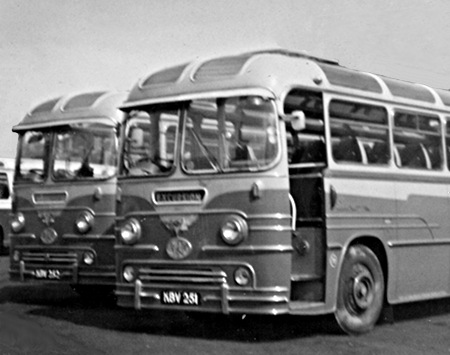


Ribblesdale – AEC Reliance – KBV 251

Ribblesdale AEC Reliance MU3RV

Ribblesdale
1958
AEC Reliance MU3RV 
Yeates C41F

Here is another photo taken with parents 127 Kodak at Scarborough coach station in the summer of 1965 I am afraid it is a little out of focus. Each of this pair of AEC Reliances according to what I can find out were owned by separate companies but garaged under the same roof I strongly suspect. KBV 251 was purchased new by Batty Holt, Blackburn Lancashire whilst KBV 252 was purchased by Ribblesdale, Blackburn Lancashire and apparently had a fleet number of 41 in their fleet. The company name of Batty Holt seems to have disappeared but Ribblesdale Coachways Ltd is still registered as a non trading company in Halifax Yorkshire.
These Yeates bodied coaches were probable top of the line in luxury coaches when new in 1958 and the amount of flashing if that is the correct word for it certainly makes them stand out in a coach park. The running gear on these two was either the AEC 6.75 or 7.7 litre diesel engine I would of thought the later with a coach body, through a five speed synchromesh gearbox and vacuum assisted braking.

A full list of Reliance codes can be seen here.


One of the best journeys of my life was an overnight on the Ribble Glasgow to Manchester service, as a student, in 1974. There was a duplicate on the 22:30 August departure – a Ribblesdale 4MU3RA Plaxton Panorama. I’m known for my preference for heavyweight, long Reliances but this was a beautiful, smooth and sprightly ride. Two other things stick in the memory. As a driver for an independent, he seemed friendlier than the regular service drivers but he didn’t know where he was going and hadn’t been briefed properly. We initially got lost in a large housing estate in the suburbs of Glasgow.
A superb coach, well driven, made up for it.

David Oldfield


04/02/11 – 06:57

Ribblesdale Batty Holt were indeed one and the same. The company was actually owned by O & C Holdsworth of Halifax, being part of their transport empire. One of the items common to all O & C companies was the use of Gothic script initials in stainless steel on the side of the coach, in this case BRH with a large R flanked by a small B and small H. The same applied to OCH, W & H (Walton and Hellewell) and WRS, (W Robinson and Sons, who are still owned by O & C). I would be pleased to hear from anyone with photos from any of these operators, particularly form the pre underfloor era.

David Hudson


05/02/11 – 05:44

I was never the greatest fan of Yeates bodies, but this model, which I’ve never seen before, is very attractive. despite the amount of what we could nowadays call ‘bling’!

Chris Hebbron


28/02/21 – 06:24

Batty Holt held the extended tours licences. It was sold to Shearings in 1971. The remaining business was operated by Ribblesdale until 1983 when the owners retired and sold to Robinsons. I don’t know where the idea that Ribblesdale belonged to Holdsworths came from. It was a family business owned by the Boltons until they retired – that’s when it became part of the Holdsworth empire. Robinsons was itself sold to Daish’s in 2020. Ribblesdale remains as a dormant company with Holdsworths.

David Verity


Quick links to the  -  Comments Page  -  Contact Page  -  Home Page
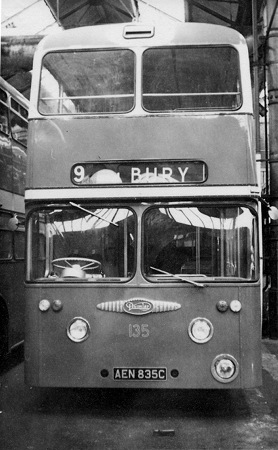


Bury Corporation – Daimler Fleetline – AEN 835C – 135

Bury Corporation - Daimler Fleetline - AEN 835C - 135

Bury Corporation
1965
Daimler Fleetline CRG6LX
East Lancs H43/31F

In 1965 when this shot was taken there was only two rear engined double deck vehicles the Daimler Fleetline and the Leyland Atlantean. The Fleetline had one big advantage over the early Atlanteans in that it had a flat central gangway downstairs and the step up from the ground to entrance floor level was only 1 foot. The advantage of the easy access and high seating capacity meant that the Fleetline became a very popular vehicle with municipal and company operators alike.
The first Fleetlines had the Daimler CD6 8.6 litre six cylinder engine but has soon as it went into serious production it was supplied with the Gardner 6LX 10.45 litre engine as standard with an option of the Gardner 6LW 8.4 litre both were six cylinder diesels.  The gearbox was of the four speed Daimatic direct selection epicyclic type and the braking system was air pressure. As with all Daimler vehicles the coding is fairly straight forward the ‘R’ stands for rear engine and the ‘G’ stands for the Gardner engine, I wish I knew what the ‘C’ stood for as it precedes most Daimler codes ‘CWG’ and ‘CVG’ for example my guess is ‘Chassis’ but if anybody knows better or has a good idea please please leave a comment.

A full list of Daimler codes can be seen here.


“I think the ‘C’ could stand for ‘Coventry’
It came from the dark recesses of my mind. What happened when the Fleetline moved from Coventry to Leyland? It ceased to be CRG/L and became FE. So unsubstantiated, but a reasonable guess – unless anyone else knows better.”
D Oldfield


“I think the ‘C’ could stand for ‘Commercial’
As the company at the time was called Daimler Commercial Vehicles and traded separate to the passenger car business.”

T J Haigh


The ‘C’ chassis prefix did stand for Commercial vehicle, as Daimler also made private cars. Sadly this tradition ended when Leyland in its infinite wisdom moved Daimler bus production to Leyland. These chassis were designated ‘FE’, in line with Leyland’s then practice of using the first and last letters of model names as chassis designations (eg: ON OlympiaN; TN TitaN; NL NationaL; LX LynX).

Brendan Smith


30/01/12 – 11:11

The debate goes on about how successful the RMF would have been had it gone into full scale production, but at Northern’s Percy Main depot we had both Atlanteans and Fleetlines, and for my money the Fleetline was a far superior vehicle, ‘perhaps that’s why it was killed off when Daimler became part of British Leyland’ All ours had the Gardner 6LW, the earlier ones were MCW bodied but my favourites were the later Alexander bodied vehicles, most of them were transferred to East Yorkshire when NBC came about.

Ronnie Hoye


28/09/12 – 07:49

This style of East Lancs body for rear engined double deckers only appeared on this batch for Bury and an almost contemporaneous batch of Fleetlines for Coventry.
They were well proportioned vehicles as can be seen here

Phil Blinkhorn


28/09/12 – 14:13

…..and three batches of PDR1/2s for Sheffield with Neepsend bodies…..

David Oldfield


28/09/12 – 14:15

Phil, Warrington also had Fleetlines with this style of East Lancs bodywork Atlanteans to the same design but built in Sheffield by Neepsend were bought by the corporation. Both the Fleetlines and Atlanteans dated from 1965-1966. An example of the Warrington Fleetlines appears at this link.

Chris Hough


28/09/12 – 18:02

David/Chris,
You are right about the Neepsend bodies for Sheffield and Warrington. I managed to eliminate part of my script after typing in the link to the Coventry photo and didn’t notice until I just read your replies.
If you go back to my original post, it would have continued:
"The photo shows Coventry 22 – but though the design is the same (in all but detail) the body is by Neepsend and is one of a batch where East Lancs produced 9 and Neepsend 13 and Coventry split delivery of chassis in a staggered way between the two plants (see Peter Gould’s list for Coventry 1966). Sheffield received vehicles of this design from Neepsend as well and, strangely, Warrington also received Neepsend produced vehicles. Is this a case of congestion at East Lancs or was this really designed to be built in Sheffield?"

Phil Blinkhorn


29/09/12 – 18:06

Can somebody clarify the relationship between East Lancs and Neepsend. Did East Lancs buy Neepsend to gain additional capacity? if so it seems to have been a bit of waste of time as – to my recollection – Neepsend didn’t last all that long as a body builder . . . which raises the question, what became of them? And what were Neepsend doing before they started assembling East Lancs bodies? – would general metalwork fabrication be a good guess?

Philip Rushworth


30/09/12 – 07:47

The entire share capital of East Lancashire Coachbuilders Ltd was bought by Cravens Railway Carriage and Wagon Company Ltd of Sheffield in 1964. Cravens itself was a subsidiary of the John Brown group of Clydebank, though the founder, John Brown, was himself born in Sheffield in 1816. Although it had made tentative forays into the bus building business between the wars, Cravens was by then primarily a constructor of railway rolling stock. Because the East Lancs premises in Blackburn were of constricted size, Cravens set up a subsidiary in the Neepsend area of Sheffield to increase the productive capacity of the bus bodybuilding side of the business. Neepsend built bodies to East Lancs designs from 1964 before closing completely in 1968.

Roger Cox


30/09/12 – 07:48

There is a deal of confusion on a great number of sites regarding just who were Neepsend and what they did.
It seems that the long established Sheffield firm of Cravens, which over the years produced trams, railway carriages and bus bodies bought East Lancs around 1960.
They set up Neepsend on Penistone Rd, away from their main site, at about the same time initially, as I understand it, as an overflow site (some local forums say that some BRS "Noddy" vans were built there but these were all supposed to have been built by Star Bodies, the BRS in house builder).
There are reports on some local Sheffield forums regarding a building collapse at the property damaging some vans in production.

Phil Blinkhorn


30/09/12 – 07:49

At the time both East Lancs and the former Craven plant in Sheffield were owned by John Brown engineering The company decided to use the Sheffield capacity to build bodies to East Lancs design.

Chris Hough


30/09/12 – 07:50

In 1964 the John Brown Engineering Group bought out the road vehicle body building part of Cravens – the railway part went to Metro-Cammell – and recommenced bus building in Sheffield at Neepsend as an overflow to their newly acquired East Lancs operation.
I was a regular visitor on business to the Blackburn operation up to and beyond the fire. The whole place was cramped and would have horrified a modern health and safety inspector.
If my memory is right there was an extension completed well before the fire which probably meant the demise of Neepsend, though the clutter remained.

Phil Blinkhorn


30/09/12 – 07:51

Further to my last comment Cravens actually bought a stake in East Lancs rather than the other way round in an effort to get back into bus building. This was achieved by a purchase of shares from the bank which was acting as executor of the will of one of the company founders. However the size of the factory and poor quality killed the project off by 1968.

Chris Hough


30/09/12 – 10:37

I have a hazy memory that the Neepsend factory was purpose built, because it had partly "glazed" doors on to Penistone Road through which the skeletons of buses could be seen. It always seemed a bit of a mystery why this was there, then.

Joe


18/01/18 – 05:25

I rode on LEN 101 ( Lenny ) many times when it was brand new at Bury, Ride like a bouncy castle , Drivers got sea sick & the cab was small & overheated being next to the engine, Plagued with mechanical faults, particularly the brakes, It was used sparingly & was on the Bury – Walmersley (37) run, so it wasn’t too far away when it broke down i’m told, A good ride downstairs, but not upstairs, We were told it was bought from the bus show, An untested prototype ?? Seems there were many variations of it,

Ian S


14/11/19 – 05:42

An ex Bury driver I used to know said that that Wulfrunian was the worst bus he ever drove in his 19 years on the buses, through Bury Corporation, Selnec and GMT.
Others he didn’t like were two 36 foot East Lancs bodied Leyland Leopards which had been new to Bolton and were transferred to Bury after Selnec took over, 6054/5.

David Pomfret


Quick links to the  -  Comments Page  -  Contact Page  -  Home Page



All rights to the design and layout of this website are reserved     

Old Bus Photos from Saturday 25th April 2009 to Thursday 4th January 2024