Hanson
1958
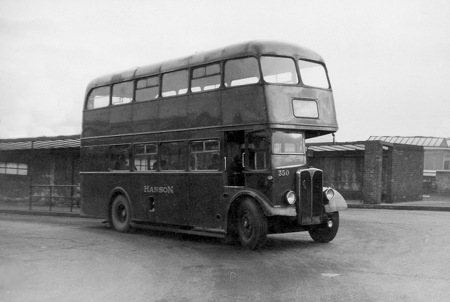
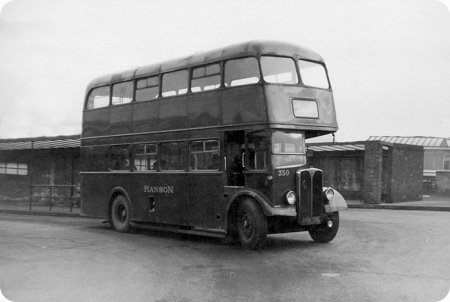
AEC/Hanson Regent
Roe H37/28R
Here we have yet another Hanson rebuild, they certainly got there moneys worth from their vehicles. My thanks to the HPTG websites Hanson section for the information regarding this bus. This vehicle was originally a 1948 AEC Regal 9621E321 with a Duple C32F half canopy body with the registration DVH 311 and a fleet number 243. In 1953 it was rebuilt by Plaxtons with a full fronted C33F body and was renumbered 322 in the fleet. The final rebuild to a double decker came about in 1958 with a Roe H37/28R body and renumbered again this time to 350, this bus transferred to Huddersfield Corporation on the 1st of October 1969 when they bought out Hansons bus operations. I am not sure if it actually went into service with Huddersfield and if it did for how long, if you know please leave a comment.
———
27/04/11 – 07:32
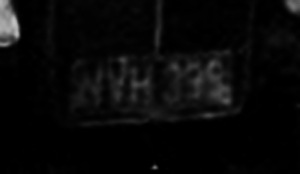
Just a note to point out that the registration of 350 was actually NVH 399 not 394. It is incorrectly listed as 394 on the HPTG site, so I’ll let you off this time! It ran for Huddersfield for a few weeks after the takeover
Eric
Thanks for that Eric it certainly looks like a nine to me I have corrected above.
Peter
29/04/11 – 06:45
350 was lucky to survive to Huddersfield Corporation days. In 1963 during a heavy snowfall it crashed through a wall in rural Helme into a field whilst working the Meltham-Huddersfield service. It ended up on it’s side straddling the wall. Considerable damage must have been caused and probably even more in the recovery proccess. However it was repaired and returned to service. There is a picture of it on it’s side on P43 of P. Cardno and S. Harling’s book Hanson of Huddersfield & Their Neighbours.
Eric
18/06/15 – 16:41
As a Huddersfield resident, these pictures bring back memories of an interesting local operator, who had a great capacity – in the manner often used in Yorkshire – of ‘cobbling together’ older chassis and rebodying them to get extra years of service from them. I rarely travelled on Hansons double deckers, but used to travel daily to school in the late 1960’s on their Regal rebuilds, to old ‘Tanks’. To be a passenger on one of them travelling up Lockwood Scar is an experience that was totally unforgettable. Just a shame that I have lost my photos of these wonderful vehicles in service.
It is also good to see a picture of the old Huddersfield bus station, which disappeared in the early 1970’s to make way for the town’s ring road, and has been replaced by a soulless monstrosity that exists till this day. Must admit that the old one had very little protection from the weather
Tim Jackson
Quick links to the - Comments Page - Contact Page - Home Page
Photograph by ‘unknown’ if you took this photo please go to the copyright page.
Bradford Corporation Transport
1950
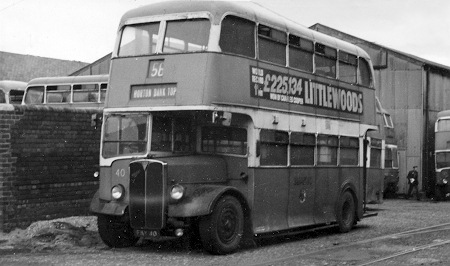
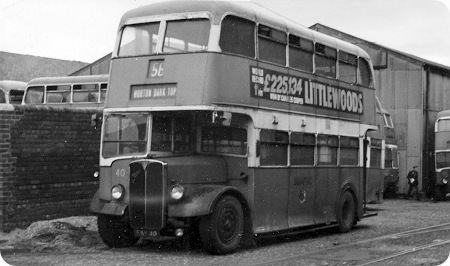
AEC Regent III 9612E
Weymann H30/26R
This was the last of a batch of forty AEC Regent IIIs with what Kev from Bradford calls the 8ft wide Weymann flared skirt body you can see why. I’m afraid it is looking a little tired in this shot taken about 1964 outside one of Bradfords bus depots. Four years latter this vehicle went to scrap, one year after that fleet number 33 was the last one of the batch of forty to go the same way.
In 1957 the seating capacity of the upper deck was increased by 3 to 33, a 10% increase, 2 extra seats I can understand easier than 3, unless the original rear seat was only for 2, if anyone has any clues on this please leave a comment.
A full list of Regent III codes can be seen here.
Bus tickets issued by this operator can be viewed here.
———
Your assumption about the rear upper seat is correct. All post-war Bradford buses prior to the HKW batch originally had 30 upstair-seats (15 x 2). Most (possibly all, apart from the ex-London RTs, in which there was no room for this) had in due course an additional 3-seat unit added to the nearside rear.
Julien Melville
———
The location appears to be the old Thornbury works yard which was attached to the operating depot. It was a common sight to see de-licensed trolleys and buses parked here in less than sparkling condition often with smashed windows etc. The whole complex at Thornbury still exists as a warehouse facility.
Until the end of its life under the PTE the sign over the works entrance read car works!
Chris Hough
Quick links to the - Comments Page - Contact Page - Home Page
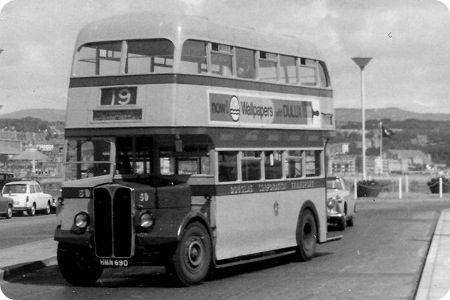
Photo by M Standeven
Douglas Corporation
1947
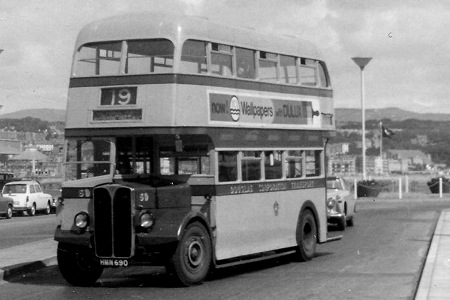
AEC Regent III O961/2
Northern Counties H30/26R
A nice shot of a very early AEC Regent III taken on the Isle of Man about 1964/5. The Northern Counties bodywork that Douglas Corporation seemed to favour is quite obvious by the front upper deck.
An interesting bit of information I came up with whilst researching Douglas Corporation was from Peter Goulds very informative website was that buses which operated within the borough boundary did not require road tax, if the route took it outside the boundary then it did. Needless to say they only had enough buses taxed to do the necessary routes and the letters ‘EA’ which stood for ‘Extended Area’ accompanied the fleet number. With a change of rules in 1964 no Douglas Corporation bus needed road tax to operate.
Now I know that the Isle of Man had and still have there own rules and regulations, but it got me thinking what the regulations were for the rest of the UK with regards road tax, MOTs and insurance. If you know please leave a comment
16/11/15 – 10:22
Something I have noticed but has not been commented on or explained is that DCT 56-59 (HMN 687-690) delivered in 1947, 60-63 (JMN 724-727) delivered in 1948 and 64-65 (KMN 835-836) delivered in 1949 had consecutive chassis and body numbers and were virtually identical, whereas the rest of the 1949 delivery, 66-71 (KMN 837-842) had much higher batches of chassis and body numbers, and were significantly different in outward appearance (gasket glazed indicators) and internal layout (one fewer seat on lower deck to create more luggage space). Was a batch of 10 chassis sent to Northern Counties in 1947, and when were the later deliveries bodied?
M Jones
Quick links to the - Comments Page - Contact Page - Home Page