Old Bus Photos

Morecambe & Heysham – AEC Regent III – MTE 638 – 76
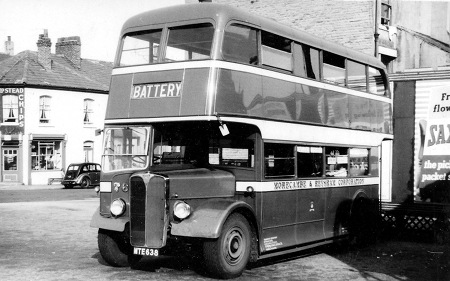
Morecambe & Heysham AEC Regent III
Photograph by ‘unknown’ if you took this photo please go to the copyright page.

Morecambe & Heysham Corporation
1951
AEC Regent III
Weymann H33/26R

This shot of a Morecambe & Heysham Regent III shows the older livery of green with three narrow cream bands, the newer livery which had an overall cream roof and a wider centre band can be seen here. This shot shows off very well the half drop windows which I should imagine were just the thing on a hot summers day whilst tootling up Morecambe promenade. Morecambe Corporation buses did not have route numbers just the destination and this bus is destined for ‘Battery which is more or less the centre point of the Morecambe promenade between Heysham harbour to the south and Morecambe golf club to the north.
When I say Battery ‘is’ I may mean ‘was’, when I researched this posting ‘Battery’ the place appears on Google maps along with the a little bed denoting ‘The Battery Hotel’ I am presuming that ‘The Battery ‘was an old military building. But on Google earth there is no mention of ‘Battery’ and all I can see is a car park I presume it is the map that is out of date. Does the place ‘Battery’ still exist or is it now just a car park if you know please leave a comment.


The Battery was a large public house situated very close to the Heysham Road Depot.
Buses running to the Battery would normally have started the journey at Happy Mount Park.

Terry Malloy


The Battery Hotel still exists. The Battery referred to on Morecambe buses was actually a bus park across the road from the pub it was also adjacent to the Morecambe depot. A recent visit to Morecambe revealed that the site is now a Drs surgery and retail pharmacy Stagecoach run the local services in the town. In the seventies Morecambe had a municipal depot as well as a Ribble one as did Lancaster. Part of Lancaster’s municipal depot is now converted into upmarket apartments called The Old Bus Depot!

Chris Hough


I believe that before Morecambe was developed as a holiday resort and expanded accordingly there was a firing range on the sands between Morecambe & Heysham with the Battery Hotel taking its name from an artillery battery which had been sited nearby. The bus park across the road took its name from the pub, which still gives its name to a timing point on the local bus network although a medical centre/pharmacy now stands on the site of the Battery Bus Park. The Battery is the boundary point between Morecambe & Heysham which were separate local authorities until 1928 when Heysham Urban District and Morecambe Borough Councils merged, the Morecambe & Heysham Corporation bus depot which was a couple of hundred yards south of The Battery was therefore in Heysham.

Ian Simpson


Morecambe were still running over 20 AEC Regent IIIs when they became part of the enlarged Lancaster fleet. Interestingly Morecambe were the last operator to run petrol engined double deckers they were certainly in use in the fifties. Also some of Morecambe’s pre-war double deckers had retractable canvass roofs for sunny weather a feature I would venture to suggest were unique unless anyone knows different .

Chris Hough


Actually the Battery was a field artillery station, when Morecambe was a training depot for the army in the late 1800s. The Battery hotel is named for this reason.

Andrew Wild


Yes Chris, the pre war Regents had roll back canvass roofs from the 1936 Park Royal batch up to the last pre war deliveries. These were panelled in during WW2. The relevant Park Royal bodies had an almost vertical rear dome to accommodate the roll up. I could never understand, as a youngster, why this was so different to the standard PR rear shape! There were some really unusual sounding destinations too, Bare, Happy Mount Park, Heysham Towers as well as "Battery" spring to mind.

John Whitaker


08/04/11 – 05:00

The canvas roofs were not unique to Morecambe double-deckers – in fact they were a short-lived fashion with coastal operators in the early/mid thirties, when they were of course very common on coaches. Southdown certainly had some Short-bodied TDs of this type, one of which I believe still survives.

David Jones


21/04/11 – 06:18

And not just coastal operators. Cheltenham & District had a couple of them for some inexplicable reason!

Chris Hebbron


21/04/11 – 06:31

Perhaps for the Cheltenham (Gold Cup) Festival?

David Oldfield


29/01/12 – 07:28

As youngster I travelled on these buses regularly in the 1950’s. They were always immaculate and looked very smart in their green livery. During the early 1980’s one restored bus, fleet no.69, LTF 254 ran on the promenade Happy Mount to the Battery service during the summer only. Does anyone know what happened to this bus? 20 JTE 546 and 35 KTF 594 were advertised for sale by Quantock Motor Services in Somerset back in Jan 2011 – where are they now?

James Welsh


29/01/12 – 16:34

Nothing really to do with buses but the mention of Bare reminds me that in the 1950s my grandparents and I always visited Morecambe for the Illuminations. We always came on a Yorkshire Woollen excursion and the coach always stopped for a refreshment stop at Ye Old Naked man at Settle. My Grandfather always cracked the same joke saying that the man lived at Bare. The premises are still at Settle but I don’t think that many coaches stop there these days.

Philip Carlton


17/04/12 – 07:03

At the risk of being accused of wandering ‘off topic’, there were (are they still there?) two establishments in the eastern part of Morecambe called the Bare Tennis Club and the Bare Women’s Institute, causing some merriment to visitors. I attended Morecambe Grammar School’s 6th form in the mid 1960’s, and several of my classmates hailed from the White Rose county. They called Morecambe "British West Bradford"!

Pete Davies


20/04/12 – 18:13

Re the diversion to the Bare district of Morecambe, I once read or heard that Morecambe Corp would run a fast duplicate service to that area, leaving the regular service for more local people. At the starting point, the conductress on the duplicate would apparently call out "Bare people only on this bus"! Whether that’s just someone’s made up story, or actually occurred, I know not.

Michael Hampton


21/04/12 – 08:20

…..but it’s worth the telling anyway. Couldn’t bear to miss it.

David Oldfield


21/04/12 – 08:21

Shades, Michael, of the "Loose Women’s Institute" in Maidstone !!

Chris Youhill


19/06/12 – 08:23

Morecambe’s petrol engined AEC Regents were still running until at least 1965 as open toppers. I worked on them then as a conductor during that summer after leaving school. As they were only 7′ 6" wide, collecting fares with standing passengers was a nightmare!

David Platt


19/06/12 – 09:16

The pre war Morecambe fleet was a classic collection of thoroughbred AEC Regents, with beautiful Park Royal or Weymann bodies, and they are engraved on my childhood memory. All were new with petrol engines, and the post 1936 Park Royal examples had sliding sun roofs, panelled in during WW2. a few survived as open toppers, as described by David above. There is a fleet list on this site to whet your appetite, which also covers Lancaster Corporation.
I just wish that I had taken photographs of these buses, as it was this fleet, during my early childhood, which cemented my interest in buses. I realised at an early age, that buses came in different, but subtle shapes, and that our home fleet in Bradford had some of identical pattern (Weymann).
If anyone knows of a photograph source for this pre war fleet, then I would love to know.
Another fascination was the haphazard, gap filling fleet numbering system, only just recently unwound in my mind thanks to the fleet list submitted by Dave Towers, for which , many thanks Memories!

John Whitaker


19/06/12 – 11:44

Well John, Sheffield were past masters at haphazard gap filling with the fleet numbers and with routes numbers. Possibly a bit biased, but I always preferred Sheffield to Manchester but I have to say the Manchester numbering system was always far better and more logical – 1000s and 3000s for Leyland, 2000s and 4000s for Daimler and blocks of route numbers for routes leaving the city down a particular common corridor.

David Oldfield


19/06/12 – 16:05

John If you can get hold of the Lancaster 75th anniversary brochure from 1978 you will find several shots of pre-war Morecambe buses including one overturned on the foreshore. The brochure can be obtained via Amazon. There is also a Super Prestige paperback album about Morecambe and Lancaster buses.

Chris Hough


20/06/12 – 08:08

Thanks Chris…I have both those publications, and also the "Morecambe Bay Buses" of c. 1978. The Super Prestige one is well worth having if you are a fan of either Lancaster and/or Morecambe. I just love the pre-war Lancaster "English Electric" flavour too! Bus shapes very similar to the Bradford Regen trolleys I was brought up with!

John Whitaker


21/06/12 – 06:57

Picking up David’s point, Manchester’s fleet numbering system was certainly a model of neatness, but its rationalisation of route numbers into corridor blocks was not without its critics. It has been suggested that it was far easier for passengers to remember the difference between 50, 64 and 161 than between the 41, 44 and 45 that replaced them.

Peter Williamson


10/10/12 – 09:34

Other than for a couple of brief breaks I lived in Morecambe from late 1958 up to 1982 and am therefore able to confirm/correct some of the above.
A bus coming along the promenade showing ‘Battery’ may indeed have come from Happy Mount Park, or it may have come from Central Pier. M & H were famous for sending spare crews out doing ‘promenades’, i.e. extras between the Battery and Central Pier – even when there was no earthly need for them! The turning arrangement at Central Pier was to back into a side street (Clarence Street I think it was called) – it would never be tolerated these days.
Buses also terminated at the Battery on the so-called ‘Circular’ service, i.e. Heysham Village – Battery – Promenade – Bare (Princes Crescent) – Torrisholme – Euston Road – Battery. After the arrival of the Leyland PD2s in 1960/62, they were the usual performers on the route.
I wouldn’t say that the Battery bus parking area was ‘adjacent’ to the depot – the depot being a full bus stop distance away. Don’t remember a firing range on the sands, but had there been one I probably wouldn’t have remembered it anyway.
I haven’t previously heard that the boundary between Morecambe and Heysham was at the Battery, or that the bus depot was in Heysham, but I’ve never been too sure where the boundary actually was so I’d better abdicate on this point.
I feel sure that the restored Regent III which ran on the promenade in the 1980s could only have been number 20 (JTE 546). Number 69 (KTF 254) was sold to the Mersey & Calder Bus Preservation Group in the late 1970s and is still, I believe, in preservation at present.
KTF 594 was fleet number 65 while with M & H.
I think that few people who have stopped for a break at Settle and parked in the car/coach park – even bus enthusiasts – will have realised that there is a bus depot located there. It certainly doesn’t stand out.
I think, Pete, that you have mentioned elsewhere that you attended Morecambe Grammar School in the 1960s. I did a full seven-year ‘stretch’ (1960-67) and I sincerely hope that your own experience of the place was significantly more positive than my own. This is perhaps a long shot, but did you happen to be a pal of one of the Mollitt twins? I wouldn’t be able to remember which one, but one thing I can remember is that they had forenames with the same initial letter – James and John I think.
Never known non-stop extras to Bare, I think that story’s apocryphal.
Morecambe’s last two pre-war Regents, 25 and 49, last ran, I think, in the summer of 1966, but they were diesel-engined by that time. I believe the conversion was quite late – possibly c1960 – by which time they were the only survivors. They were converted to open-top in time for the 1962 season, having been made surplus by the arrival of PD2As 90 and 91. When they were converted I believe the original gearboxes were retained, and as a diesel engine is much slower-revving than a petrol this made them hopelessly undergeared. I’ve heard that the drivers called them ‘two-gear’ buses – which would mean either second then top, or perhaps third then top.

David Call


24/06/13 – 11:40
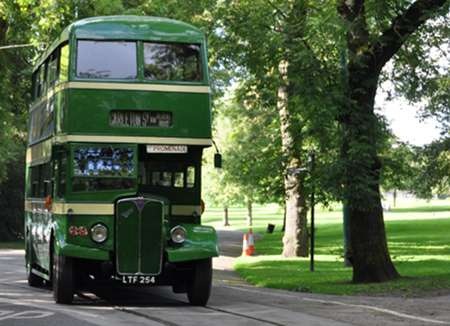
LTF 254

James Welsh (29/01/12) above asks whatever happened to LTF 254. Well it is preserved and was in service at the Ribble event in Morecambe this year – my picture was taken at Heaton Park on 4/9/2011

Ken Jones


24/03/14 – 13:46

Mention of petrol engined open-top Regents running until 1965 was a little off the mark. The last petrols (enclosed deckers) ran after the 1959 season, new Leylands replacing them the following winter. Two petrols had been converted to diesel after the war – these engines subsequently getting switched to ‘newer’ examples, and it was these which became open-topped from 1962 lasting till 1967 by when some Regent IIIs had been cut down. Open top 65 and enclosed 20 were sold by Quantock late in 2011 passing to Ukraine, 65 known to have been put into use at Sevastopol in red as "London Bus Cafe" (what else!).

Richard Allen
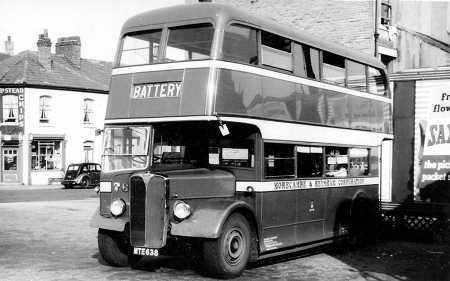


MTE 638_lr Vehicle reminder shot for this posting


16/09/16 – 06:17

Last November John Hewitt and Daren Hunt bought MTE 635 from Ken Wade. Hopefully back on the road in 2 years time.

John Hewitt


Quick links to the  -  Comments Page  -  Contact Page  -  Home Page
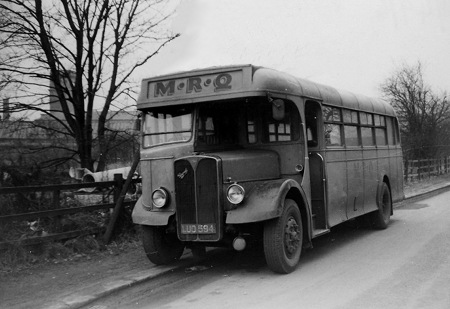


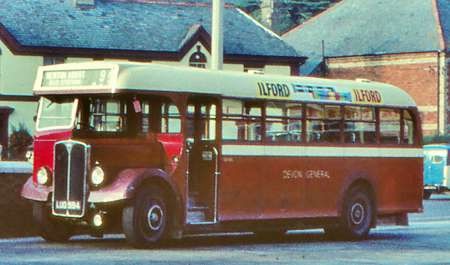
Devon General – AEC Regal III – LUO 594 – SR594

Devon General - AEC Regal III - LUO 594 - SR594
Photograph by ‘unknown’ if you took this photo please go to the copyright page.

Devon General
1950
AEC Regal III
Weymann B35F

It is amazing how many buses after serving their time as public service vehicles were bought by private companies as staff transport vehicles. I have quite a few and I will title them by their original owner but they will also be categorised under ‘Staff Transport’ as well, thus giving another individual section of vehicles on the website. If you have any shots of staff transport vehicles send them along, if you don’t know the history no problem it can go on the ‘Do You Know’ page first I am sure somebody will know.
One of the problems with staff vehicles is that they just served a purpose of transporting workers, and their appearance really didn’t matter, hence in this case the overall single colour which makes it look rather drab. But if you ignore that you can see the lower body panels giving the Weymann flared skirt body and the distance between the windscreen and the top of the radiator which makes it look older than it really was. You can also see that the passenger doors closed inside the body at the top of the stairs rather than the bottom flush with the body panels.
A sister vehicle to the one above was sold on to an independent bus operator, when I am reunited with my old copies of Buses Illustrated I will add the details, all I can remember at the moment is that it was in a small market town and seemed to be an all white livery.


27/02/12 – 13:53

Oh how this photo takes me back to 1964 when I was 10. I remember traveling on Devon General A E C Regents from Buckfastleigh to Newton Abbot. I spent almost 2 years in Hapstead House a home for sick children on the edge of Dartmoor, I still have that unique engine sound in my head of the A E C Regent, thank you for reminding me !

Frank Saint Clair


28/02/12 – 08:03

May I also share memories of seeing these operating in Dawlish during 1955 when my parents and I were staying in my Aunt’s house on Haldon Moor. We used to walk down from the Moor in the mornings but my Aunt refused to walk back so we caught the bus each evening.
In 1956 we bought a caravan in Shaldon, near Teignmouth and I clearly recall seeing several Devon General vehicles parked in a small square/stand. Sadly, being only 7/8 years old I didn’t have a camera and have never seen any pictures of the scene since. It’s a place on my list to return to.
Have any of these DG AEC’s survived into preservation please?

Richard Leaman


29/02/12 – 17:23

Yes Richard one of the Regals survives there was a recent (2011) picture in a recent issue of Buses magazine

Chris Hough


25/08/19 – 07:47

LUO 594

Browsing again, I came across a photo of this vehicle taken at Newton Abbot bus station in rather better paint condition on 23/9/1961. I had been on a day trip to Buckfast Abbey (by car). These vehicles always looked to be giving everyone a severe frown!

Geoff Pullin


26/08/19 – 07:00

Buckfast Abbey … memories not of Diesel smells but treacle tart!

Mr Anon


Quick links to the  -  Comments Page  -  Contact Page  -  Home Page


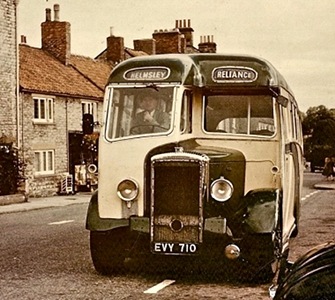
Reliance of York – Daimler CVD6 – EVY 710

Reliance of York - Daimler CVD6 - EVY 710

Reliance of York
1950
Daimler CVD6
Barnaby B35F

Reliance were a very small independent operator, who ran a service from York To Helmsley, along the B1363. The owner had a motor repair garage a few miles out of York on that road.
As far as I am aware, in the 1950’s, Reliance only had one vehicle – a 1950 Daimler half cab in green and cream livery; at some point, this was replaced with an underfloor Daimler in orange and cream. I remember the half cab Daimler being driven by an elderly gentleman – the proprietor – or a younger lady who I understand was his daughter.
Reliance’s terminus in York was Exhibition Square. The term ‘Square’ is slightly misleading, because the square is only a vacant space outside the York City Art Gallery on a short street connecting Museum Street and Bootham. It provided a car parking space for visitors to the art gallery or some York City offices which were situated along the street; the York Theatre Royal is on the other side. However, it did enable buses to turn without reversing, and thus was a practical terminus both for Reliance and for York Pullman Bus Co., whose service to Stamford Bridge also started and ended there. (the Old Bus Photos site has a great picture of a York Pullman AEC Regent V, taken at its terminus in Exhibition Square).
Exhibition Square was an important setting down and picking up point for local buses, (as well as a picking up point for a number of West Yorkshire longer distance services – e.g. Service 80 to Thirsk, 43 to Scarborough, 91 to Whitby), because it is close to York city centre. There was a line of bus stops on both sides of the road; Reliance’s stop was on the side opposite to the position of the York Pullman photo, closest to Bootham Bar.
The route to Helmsley was very rural, with only a few villages along the route. I don’t know the frequency of the service but the traffic volume would not have justified a great frequency. Reliance did, however, cater for a considerable volume of passengers who worked in York, and its early evening departure to Helmsley was always pretty full.
It was unique to see a lady driving a bus in those days. I remember an old West Yorkshire driver, (a chap called ‘Digger’ Ward, who operated the West Yorkshire city tour coach), telling me – whether this is true or not, I don’t know – that the gear change pedal used to work the Daimler pre-selector could occasionally kick back, and he would speculate on how the lady would cope with that without breaking her ankle. Happy days!

Copy contributed by Roy Burke with a photo by Paul Haywood


Thanks Roy for a fascinating insight into a company I never really knew. When I took this photo in Helmsley Market Place in 1959 (using a much valued colour exposure from my Dad’s camera), little did I realise that, 50 years later, it would be "exposed" to an audience then undreamed of.
It looks like the driver could be the proprietor?

Paul Haywood


“Digger" Ward was absolutely right about the gear change pedal on the pre-selector Daimlers – well, actually he wasn’t quite right enough as the pedal was likely to do far worse than to kick back – it would kick back twice as far as the normal stop often causing injury to hefty men, never mind to ladies. There were two chief causes. Firstly, if there was wear or poor adjustment in the linkages, the device in the gearbox which was intended to tension the appropriate band would fly through a gap between two with the painful result mentioned. Otherwise failure to either accurately select the required gear on the steering column quadrant, or to depress the gear change pedal fully to the floor, would have the same effect. Many drivers learnt the hard way that it was not a clutch pedal and was not to be treated gently and gradually, but fully and decisively.

Chris Youhill


Reliance was a bigger undertaking than you suggest. Edward Sheriff was the proprietor and his eldest daughter Joan took her PSV test in the early war years. She became Mrs Thornton on her marriage and was still involved with the business in the 1970s. By this date her younger sister Carol had taken on the business with her husband Richard Shelton.
In the 1950s the service to Helmsley ran every three hours and the fleet numbered nine buses, kept at Sutton on the Forest and at Helmsley.
Pullman buses to Stamford Bridge left from Merchantgate, and the Linton and Easingwold buses from Exhibition Square.
Reliance is still running today in the very capable hands of a new owner.

Anonymous


Naturally, I defer to ‘anonymous’s better information on Reliance; I really only came across them by way of seeing their Daimler in Exhibition Square and on car trips out of York. They are also quite right about York Pullman’s services – just age and cloudy memory on my part, I’m afraid. I was simply not thinking about their Linton service.
It also occurs to me that ‘anonymous’ must know more about Reliance than he or she has told. A three hour service between York and Helmsley certainly wouldn’t justify nine vehicles and two depots, so what else did they do?
I wonder if they could possibly be persuaded to tell more?

Roy Burke


Reliance still operate two routes from York to Easingwold, often with double deckers. I have a 1938 timetable which shows 7 return journeys from Helmsley to York, Monday to Friday, every two hours, 9 on Saturdays (hourly between Brandsby to York) and 5 on Sundays. There were late departures from York for theatre/cinema patrons. There was also a Friday market working from Nunningtom and Harome to Helmsley. The route was cut back to Brandsby in the 1960’s and later to Crayke. The through route to Helmsley was reinstated a few years ago but was obviously not successful and withdrawn shortly afterwards. The company currently have a green and cream livery and are based at Sutton on the Forest, north of York. In 1964 the company address was at St Peter’s Grove, York. Viewers of the soap “Emmerdale” will have seen a Reliance vehicle making an occasional appearance on the service to “Hotten”

Derek Vause


20/05/11 – 22:25

Reliance in the 1950’s was indeed a bigger operator as stated in one of the earlier posts. Apart from the regular service between Easingwold and York which would stop at individual homes/farms, official stops and not, along the York Road (B1363) as well as villages along the way, they provided a regular service for pickups and delivery of school children to Easingwold Grammar/Modern school from the surrounding villages like Sutton, Huby, East Moor, Stillington and further to the West and North. The original location was a petrol station and a substantial repair/depot on the York Road North of York South of Sutton on Forest which housed a number of vehicles, like the half cab style, all of them with manually sliding doors, a smaller type with the pushed forward bonnet, there were two of these as well as a number of newer types. All in the green and cream livery except one of the newer type which had automatic doors, this for some reason was orange and perhaps some cream trim.

John


23/07/11 – 08:41

Roy Burke asks why Reliance needed 9 vehicles to operate the service from York to Helmsley. Today services are much more frequent to meet the different travel habits of the population, but in the past this was different. There were key times when everyone wanted to travel, eg to York in the morning and out to the villages at teatime. Reliance regularly had three buses on some departures, one all the way to Helmsley and the others along part of the route. Even when I knew the company well in the 1970s they had two buses full out of York together at teatime. The present service is very high quality and has received national acclaim, a great credit to the owner.

Anonymous


16/09/11 – 09:24

Travelled in a Barnaby built coach in Devon at Greenaway. Agatha Christies place. The Driver told us there are only three Barnabys left in service/preservation. Can any one throw any light on this please.?

David Buttle


17/09/11 – 08:15

The only extant Barnaby-bodied coach I can think of is JVY 516, a preserved AEC Regal III ex York Pullman.

Peter Williamson


17/09/11 – 17:19

The "Classic Buses" website lists five half-cab single-deckers that have carried Barnaby bodies. One was re-bodied in 1962 and is now in Belgium and one is now a recovery vehicle. That leaves three. One is the York Pullman Regal, there is a York Pullman Dennis Lancet but that seems to be in very poor condition. The only other active one is the Bullock and Sons (Wakefield) PS1. That is likely to have been the one seen in Devon.

David Beilby


17/09/11 – 17:20

David the coach you refer to is AHL 394 – See it at this link you have to scroll down a fair way.

D Hick


20/09/11 – 14:50

There is a shot of AHL 694 taken a few years ago at www.sct61.org.uk in the West Riding pictures There is also a few shots of similar vehicles in service with West Riding.

Chris Hough


04/04/12 – 08:19

After reading about the early years of Reliance I must make a comment. We have an old friend who was brought up at Ampleforth and on a Friday and Saturday night if him and his friends went into York for a night out and there were more than enough passengers for the last bus back to Brandsby Ted Sheriff would follow on behind with his car with the extra passengers. I cannot see them doing that now.

Liz Greene


13/05/12 – 18:45

As well as the preserved AHL 694, West Riding Auto had a number of similar Barnaby bodied buses as Chris indicated. These were inherited from Bullock and Sons (Featherstone) in 1950. Bullocks had been customers of Barnabys since the 1930s having buses/coaches (including double deckers) rebodied by them in Hull during the 1940s.

David Allen


19/05/12 – 07:45

Re Barnaby’s Motor Bodies (Hull) Ltd there is a two-part history of the firm in Vintage Roadscene Vol 7 numbers 27 & 28 which contains an incomplete list of the Commercial non-psv bodies. I did submit a companion article on Barnaby’s Bus and Coach bodies to Messrs I Allan but they were not interested so it was returned to me and it has sat in my filing cabinet ever since. V Roadscene published a readers letter in VR no 29 picking out an error of mine about the final takeover of the firm so perhaps that put an end to it.
No praise for the research I had done from 1983-1989 tracing Barnaby’s history from 1872-1960.
Edward Sheriff started out with Mr Wilfred Mennell at Haxby with a 14 seat Ford T each, Bodied and painted by Barnabys at Hull in ‘Lake & Yellow’ 21st February 1923 the Fords began a York-Haxby service named "The Cosy Car Service". The later "Reliance" York to Helmsley service was the result of Mr Sheriff ‘going it alone’ after 1930.

Ian Gibbs


19/05/12 – 09:19

Don’t be put off by nit-pickers. We all make mistakes – I know I do – and I’ve been pulled up occasionally by people on this forum. (Quite rightly). If your research was sound and most of it accurate, perhaps you should revisit it and revise it with corrections. Histories of small but not insignificant companies are fascinating – and not very common.

David Oldfield


14/12/12 – 16:20

How many people know that Barnaby built one of only two Centre entrance Utility Double deckers, it was built on a 1933 AEC Regal chassis in 1943 and operated for Felix of Hatfield near Doncaster

Mr Anon


05/12/17 – 14:08

Whilst the present operations of Reliance are somewhat outside the timescale of the Old Buses website, the company now has a comprehensive website of its own and our members may wish to see the present day timetables and fleet news by way of continuity. There is also a company history section. https://reliancebuses.co.uk/

Mr Anon


28/06/18 – 06:37

I have just purchased AHL 694 the Leyland Barnaby PS1 and intend to start a sympathetic restoration & recommissioning.
Any history would be gratefully received, especially colours when new to Bullocks.

Aubrey Kirkham


29/06/18 – 06:25

I have just submitted a picture to Sct61 showing AHL694 with a representation of Bullock livery applied to tidy the vehicle up. It may be a few days before it appears on that site. Also Dewsbury Bus Museum may be interested in keeping in touch with you and may be able to assist with information from their archive.

Ken Aveyard


30/06/18 – 11:03

Good to see you have purchesed AHL. I have the only other preserved Barnaby JVY 516. My recollection is that AHL whilst a runner needs a lot of wood replacing under the panels but presume you know that as you are looking to restore. Any help I can give let me know.

Roger Burdett


31/03/19 – 07:20

I can’t contribute, anything technical, but all these posts bring back childhood memories.
When I was a boy, around 12yrs old, I caught the Reliance bus from Huby to York. I had five shillings every Saturday, which I earned from hard work. I would go to the Cinema in York, which offered a choice of five or six cinemas, have fish, chips and peas, bread and butter, and a pot of tea, 2/6d and catch the bus home. The last bus left the De Grey Rooms, Exhibition Square at 10pm, full to the gunwales, if you missed it, you walked the nine miles to Huby. Sherrif’s had a garage on Wiggington Road on the way from York to Sutton on Forest. I am now 89years old but I remember later when I lived at Brandsby, the service operated, thru Brandsby, Crayke, Sutton, York.

John Cox


Quick links to the  -  Comments Page  -  Contact Page  -  Home Page


All rights to the design and layout of this website are reserved     

Old Bus Photos from Saturday 25th April 2009 to Thursday 4th January 2024