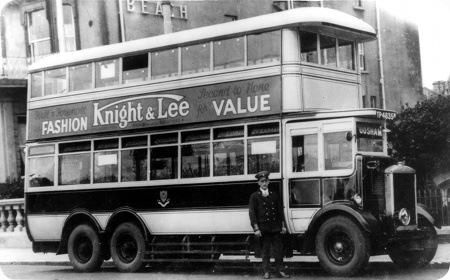
Photograph by ‘unknown’ if you took this photo please go to the copyright page.
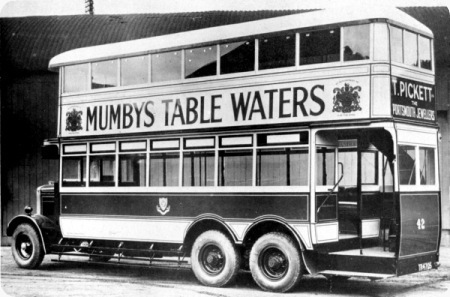
Copyright CPPTD
Portsmouth Corporation
1927
Karrier WL6/2
Brush H32/28R
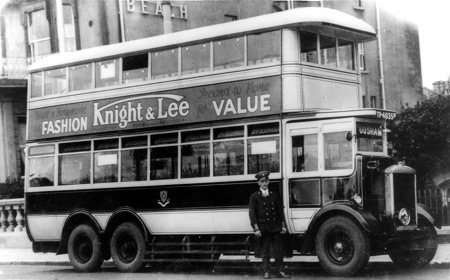
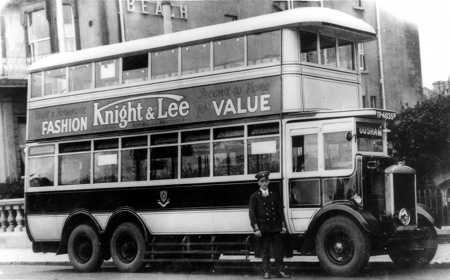
Portsmouth Corporation, primarily a tram operator at this time, having dabbled with some Thornycroft J’s, Guy J’s, Dennis 50 cwt’s, an LGOC B Class, Dennis E’s and a Karrier CL, then decided to go for some big boys, buying eight Karrier WL6/2’s registered in two batches, in 1927. Here is a photo of No. 46 (TP4835) with Brush H32/28R bodies. This was during a brief era when 6-wheel buses were ‘de rigeur’, with higher seating levels and, when front-wheel braking was uncommon, four wheels with brakes at the rear were better than two. However, Karrier was not the company to buy them from! Geoffrey Hilditch in his excellent book ‘A Look at Buses’ recalls that Karrier had not realised that it was necessary to have a crown wheel and pinion BETWEEN the two axles, which set up mechanical stress and continual breakdowns. On one occasion a lady with two children was walking along the downstairs bus aisle when a flailing drive shaft came through the floor, narrowly missing them. Karrier’s policy was not to bother to keep spares for its products for much longer than production ceased, adding to the users’ problems and, no doubt, prejudicing repeat orders for the company’s products, when Leyland/AEC were becoming the leading lights. Suffice to say, that when the Huddersfield company finally started to produce some quite capable models, such as the Chaser and Consort around 1930, sales had dropped right off and, with the Wall Street Crash causing a slump, never really recovered, leading to Rootes taking over the firm in 1934. As for those in Pompey, they were persevered with for one year longer, until 1935. The lining-out of the bus is extensive, yet surprisingly simple for the period, with no fiddly work at the corners which was often prevalent at that time, Portsmouth being no exception. In latter years, simple lining out became the order of the day again, as you can see from the Crossley DD42/7 I posted recently. I assume the colours were maroon/white, as the tram and later bus livery.
And the Knight & Lee store (“Still a Foremost for FASHION – Second to None for VALUE”), advertised on the side poster? Not exactly in the category as Binns of Newcastle, either in store size or bus advertising presence, it nevertheless still exists under the more famous ‘John Lewis’ name! More staying power than the bus!
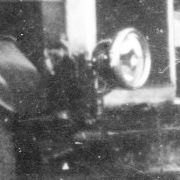
And a question – something is sticking out in front of the radiator. Is it a headlamp? At, say, 9” diameter and therefore the same depth, plus a bit more space, it would seem to be sticking out about 15” beyond the radiator front and, if not actually fouling the starting handle, making the use of the handle more difficult than otherwise would be the case. Blowing that part of the photo up to 400% does not, sadly, help provide an answer.
Photograph and Copy contributed by Chris Hebbron
Headlamp is clearly visible on the offside mudguard. As a suggestion, might it have been an audible warning device? After moving on from rubber bulb horns, it could have been some sort of patent mechanical klaxon. Or a fog light maybe?
Stephen Ford
It’s a headlamp!
The lamp on the offside wing is a sidelight, despite it size.
Buses as late as (if I remember correctly) 1967 didn’t have to have two headlamps, and if they did, they were not required to be of the same size or height from the ground. That’s why early pictures of Routemasters often show them with only one headlamp lit: they were on separate switches! Also, in the early post-war period you often saw buses (notably Manchester Corporation ones) with one original full-sized lamp and one tiny, former blackout lamp.
David Jones
13/02/11 – 06:38
I enlarged the picture & brightened it which then seemed to show that the headlamp was not in front of the radiator but mounted on the offside chassis dumb iron by a clumsy looking bracket.
Brian
13/02/11 – 18:34
Well done, Brian, that settles it. The headlamp is certainly formidable-looking!
Chris Hebbron
14/02/11 – 09:46
What a wonderful old vehicle this is!.
Did PCT have some with EE bodies as well?
The Brush version seen here is a FC version of the CX Guys supplied to Leicester. Forward control 6 wheel double deckers!
The fascination of buses from this era is their close tramcar ancestry, and the swift development in design between 1928/9, and 1932 is dramatic!
John Whitaker
Leicester`s CXs were, of course Normal control. My enthusiasm went ahead of my typing fingers!
15/02/11 – 06:24
Yes John, CPPTD took delivery of another six, 48-53. in 1928, with English Electric bodies, these lasting until 1934, with 52 being the very last of them all to be withdrawn, in 1936. You are so right in your mention of the huge leap in body design in that five years or so.
BTW – If anyone wonders about Portsmouth Corporation’s coat of arms, it is a star with a moon underneath, cupped upwards. The motto is: ‘Heavens Light – Our Guide’. And in English, too – no fancy Latin for Pompey!!
Chris Hebbron
18/06/12 – 11:57
Chris, you are obviously as fascinated as I am by this bus generation! I think it is because it is just past my recollection, as my earliest bus memories were during WW2, and anything of an earlier generation was just "out of reach" if you follow me!
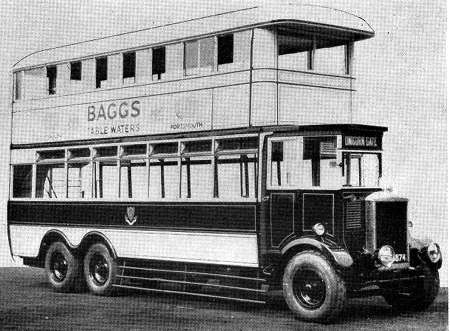
This rear view is particularly valuable, as such views were quite rare, and it gives me some indication as to what the rear end of a Leicester Guy CX would have looked like. A similar body although modified for fitment to a normal control 6 wheel chassis.
The English Electric version was quite similar, but I do have recollections of that family of buses, as I can (just) remember the Bradford English Electric "Paddlers" of 1929. See David Beilby`s galleries, where other, similar delights are to be found! Wonderful stuff!
John Whitaker
19/06/12 – 11:38
You’re right, John W, it was a period of fast change, which soon saw some early competitors off, especially with the Wall Street Crash of 1929. And with six-wheelers, Guy/Karrier got it wrong and AEC/Leyland got it right when it came to needing a diff between the twin axles. With the rear view of the bus, it clearly shows the tram influence, with the two side bulkheads aft of the saloon and the round-shaped winding staircase.
A rounded back, door between bulkheads, a controller and brake handle and it could pass for a tram end! And the internal view of the EE bodies for similar vehicles on David B’s excellent website, shows two enormous floor traps to gain access to those troublesome rear axles! Glad the photo was useful to you: it was to me, too.
I’d love to have ridden on them!
Chris Hebbron
03/11/12 – 17:15
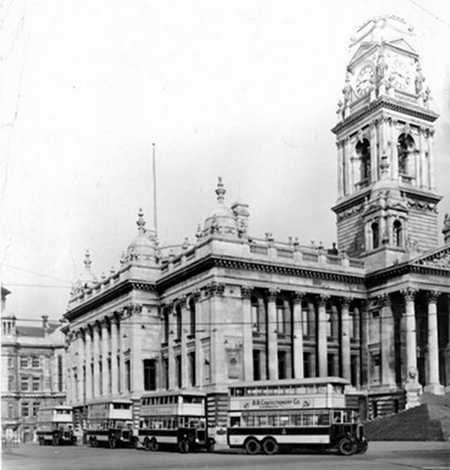
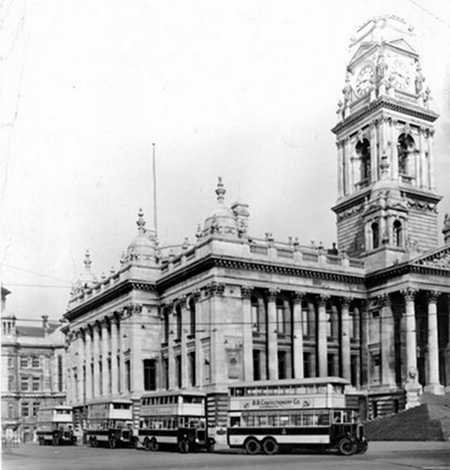
Here’s a rare and lovely photo of four Karrier WL6/2’s parked around the side of Portsmouth’s Guildhall, possible awaiting a concert crowd to take home.
If any Northerners think the building looks familiar, it’s an exact copy of Bolton Town Hall. However, it was gutted in the war and rebuilt many years after in a much more simplified style, losing much of its original glory.
Chris Hebbron
04/11/12 – 15:43
Chris, it was a delight to see your latest WL6 photo in Pompey, and it has served to re-ignite my fascination for this era. There seemed to be a "punctuation mark" in development stages, between this era, and the more rounded style post 1930/2. This "mark" was probably the TD1 Titan, and both sides of it are fascinating in a different way.
My nearest actual memory glimpses are the Bradford "Paddler" trolleybuses, which were direct relations of the English Electric bodied variant of the WL6 at Portsmouth. Similar bodies were built for Oldham on Guy FCX chassis, and, of course, good old Dodson reigned supreme in producing bodies to this classic style. A photo of the Portsmouth and Southampton (Thornycroft) 6 wheeler EE bodies would be of great interest, and, I am always amazed that the wonderful Wolverhampton fleet of the 1920s, in both petrol and electric format, does not generate more historical enthusiast interest. How fascinatingly different was a normal control 6 wheel motorbus!
The whole 1920s 6 wheel idea was a step too far, too quickly, in the drive for seats in the tram replacement climate, but when it comes to enthusiast content and memory, then unsuccessful they were NOT!!
Come on you OBP followers. Lets have more of the really old stuff! Or is it me getting longer in the tooth than anyone else? !!
John Whitaker
05/11/12 – 17:19
It really was a time of great change then, John, with petrol to diesel and open staircases giving way to enclosed platforms and open cabs to enclosed ones, especially in London. Boxy bodies giving way to more rounded, streamlined ones (now they’re boxy again). The second photo (rear of bus) has a bulge for the lower deck, which I’ve seen called ‘tumbledown’ in the past. Anyone know why – was it the type of staircase that necessitated the bulge or passenger risk, or what?
I really must try to trace a photo of the 1928 batch of Karriers, with EE bodies. they seem more elusive although there were 6 against 8 of the others, almost even.
Chris Hebbron
06/11/12 – 06:37
Hi Chris. These Brush bodies are very similar to the Leicester Guy CXs, which had a similar rear tumbleholme/tumbledown, but which does not commence its inward bend until first stair riser level, so I think it was purely a "fashion", and very common. The staircase was a half landing type, but Dodson bodies of this era had tramway style "half turn" or direct stairs to the tramway spiral style, and consequently , in plan view, the enclosed bodies had a much larger off side radius at the rear, compared with the near side. EEC bodies were very similar to the Brush design. I will try to gain access to the Brush Archive at Leicester Museums, to see if I can get access to photos of these Karriers, and others built by Brush. There were also batches of six wheel Maudslay Magnas for Coventry which were superb, magnificent machines!
Hall Lewis also built bodies for Karrier WL6, as did Roe, on Karrier and Guy, and also Short Bros.
Northampton had some Guy FCX with locally built Grose bodies too, but all in good time John…slow down a bit!
As an afterthought on the Karrier 6 wheel double deck motorbus theme, does anyone know the correct designation, as most photo captions refer to the double decker as "DD6", and the single decker as WL6/1 or 2. Also, was the maximum length for these buses, prior to 1931/2, 28ft, corresponding with the 25 ft for 4 wheelers? I never did know, but think the single deck could be built to 30ft,and the decker 28ft, this rising to 26ft and 30ft. in 1932 (viz ST to STL). Many trolleybuses were built to 30ft. length, as represented by AEC type 664T (663T for the shorter option), but were there any post 1932 30ft. 6 wheel motorbuses? I cannot think of any, but that means nothing!
It would seem that a resurgence of interest in "full size" motorbuses was about to materialise c.1939, with Leicester purchasing batches of "Renowns", and there was a Daimler COG6/60 chassis, due to be demonstrated to Leicester, destroyed at Daimlers works in the blitz. Please correct me if I say these were not 3o footers.
Also interesting is the fact that both EE and Brush, the first and second main supplier of tramcar bodies in the UK since 1900, were so prominent in the concept of "large capacity" motorbuses in the 1920s, and that both voluntarily abandoned this business during, or soon after WW2. The third supplier of tramcar bodies, Hurst Nelson of Motherwell, never really got into bus building at all.
I wonder if we could get together to make a list of all known pre-1932 6 wheel dd. motorbuses. An interesting read?
John Whitaker
26/07/13 – 17:42
I mentioned above a near-miss accident with one of these buses, but have found a news clipping about an horrific fatal accident with Wallasey Corporation Karrier DD6, a variant of the WL 6/1 & 6/2. Sadly, both Karrier and Wallasey Corp’n got away without being blamed. You’ve got to feel greatly for the husband. SEE: www.historyofwallasey.co.uk/wallasey/
Chris Hebbron
27/07/13 – 07:41
This horrific accident was mentioned in a history of Wallasey Corporation published c.1958 in Buses Illustrated. The author stated that as a result, all the Wallasey Karrier six-wheelers were withdrawn from service immediately. As I remember it, there was a hint that the cause was prop shaft failure, due to the stresses of the inadequate design of the twin rear axle, and that this accident also caused some other operators to get rid of this make of six-wheelers sooner rather than later.
Michael Hampton
27/07/13 – 09:08
Portsmouth, in its usual way, kept them going until 1935, probably the full span of their lives, for the time!
Chris Hebbron
28/07/13 – 07:34
I remember that article, Michael, and I also attended an illustrated talk in the mid 1960s given by my then boss, Geoff Hilditch at Halifax. He mentioned this tragic event, and later, writing as ‘Gortonian’, covered it in one of his Buses Illustrated articles. It was reprinted in his book ‘Looking at Buses’. These Karriers did not have a safety bridle on the shaft linking the engine to the gearbox, and when two of the three connecting bolts sheared off suddenly, the third held, causing the shaft to flail around and up through the floor with devastating results. Karriers never fully recovered their reputation after that accident.
Roger Cox
29/07/13 – 07:45
Doncaster received four AEC Renowns in 1935 and three Leyland Titanics in 1936 all with Roe H60R bodies.
Malcolm J Wells
29/07/13 – 14:46
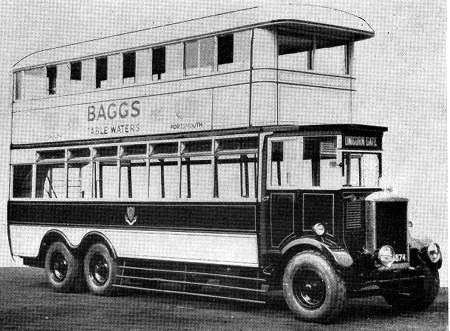
To show both body types on the same chassis, here is a rare photo of CPPTD’s Karrier WL6/2 No.50 (TP 6874), delivered 1928. These sported EE bodies very similar to the Brush ones, with the same seating capacity. The most obvious difference was the top deck’s far less neat side-sliding windows on this body. In this photo, the bus clearly has two headlamps Of the batch, 52 lasted the longest, until 1936. (Copyright: English Electric)
Chris Hebbron
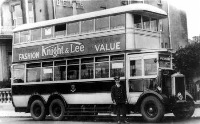 Vehicle reminder shot for this posting
16/11/13 – 10:50
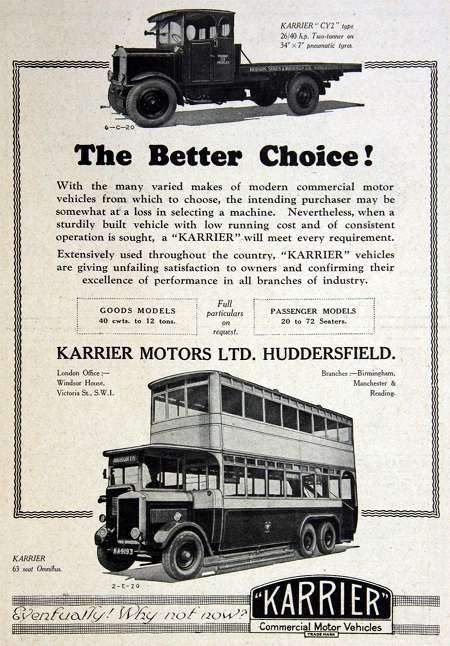
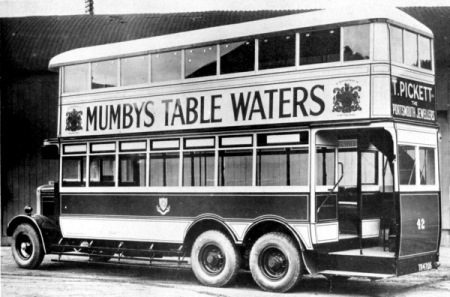
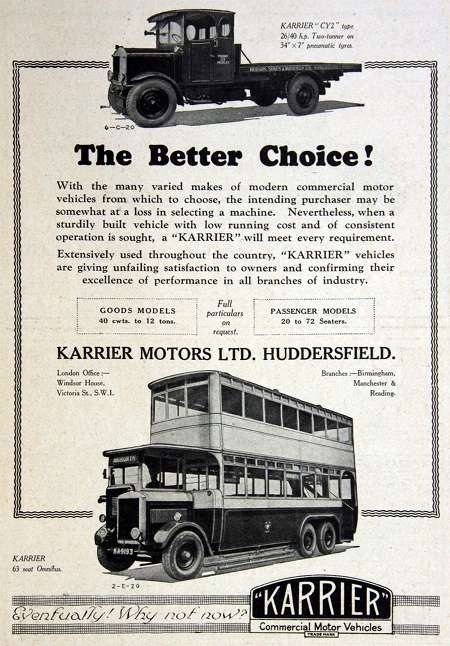
I’ve come across a 1928 advert, making great claims about their WL62 chassis.
I’ve no idea in whose livery the bus in the photo is (someone may know), but I am intrigued about the unusual non-cutaway section of platform on the rear of bus. I’ve never seen such an example before and it might be an added clue.
Chris Hebbron
07/08/16 – 06:55
Re: 1928 advert.
the livety is for Liverpool. they bought 6 two wheel chassis, and had the bodies built in the tram works.
Art
Vehicle reminder shot for this posting
11/07/17 – 06:53
This is in response to Chris Hebron’s message of 26/7/13 (!) with its link to an article about a passenger disappearing through the floor of a Karrier six wheeler and being killed by the machinery underneath. Over the weekend I was looking at the floor of the Bournemouth 6-wheel Karrier single decker LJ500. My usual experience of bus floors is ECW and Beadle products where the floors are 1" or 7/8" T&G boards. The lightweight Bristol SC, where everything was skinned down as much as possible to save weight has floorboards 5/8" thick. The Hall Lewis body on LJ500 has boards a smigen over 1/2" thick. The saving grace for the SC is that the distance between supports is a lot less than those on the Karrier – 18" or so compared with 3′ or more. I have to say that standing on the floor in LJ500 it didn’t feel all that safe and having now read Chris Hebron’s comments and the Wallasey article I understand why.
Peter Cook
12/07/17 – 07:24
On 6/11/12 (was it that long ago!), John Whitaker was interested in compiling a list of pre-1932 double deck buses manufactured. I’ve had a quick go and come up with the following, a couple of them are single deck ones.
AEC Renown (single and double), Bristol C (two chassis, only one of which bodied), Crossley Condor (one only), Guy CX & DD, Karrier DD, WL6 (both), Clipper (single) & Consort, Leyland Titanic (TS6T/TS7T single), Northern General SE6 (single), Sunbeam Sikh.
Chris Hebbron