Old Bus Photos

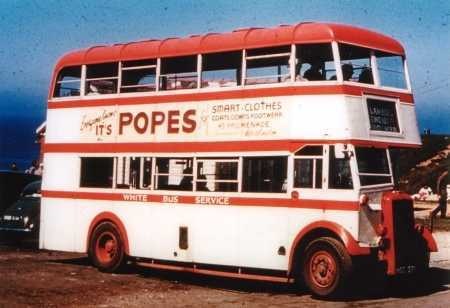
St Helens Corporation – AEC Regent V – GDJ 438 – H138
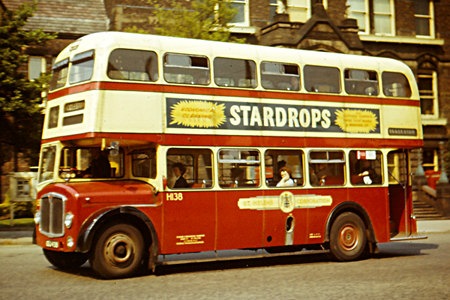
St Helens Corporation - AEC Regent V - GDJ 438 - H138

St Helens Corporation
1957
AEC Regent V MD3RV
Weymann H33/28R

The letter in front of the fleet number denotes the transport committees sanctions codes for new vehicles, I think I have seen this before with another operator but who just slips my mind at the time of writing. I am not quite sure as to why it is used unless it is a way of dating the vehicles. The strange thing is that it was only used on their double deckers mind you when this shot was taken in the summer of 64 St Helens corporation only had 4 single deck vehicles. Three AEC Reliance Marshall bodied buses and rather strange for a corporation fleet a Leyland Leopard L2 centre entrance Duple Britannia coach. Not quite sure what that was used for, school children to the swimming pool perhaps or for private hire, they would not of been the first municipality to go down that road.

A full list of Regent V codes can be seen here.


H or L often meant High or Low bridge? Some municipalities would have coaches to take civic parties on tours of inspection- eg the planning committee!

Joe


It’s been said before, and it’s still true. In the right livery, the Orion could be a handsome beast. This is an excellent example. [So is an STD Orion!]

David Oldfield


In this colour scheme, being light on the top half, the whole vehicle looks balanced and attractive. And the rear wheel spats give a touch of class!

Chris Hebbron


Sheffield had the (in)famous 9000 WB, a Reliance/Roe Dalesman C37C – for the use of the Transport Committee but available for Private Hire.
It was alleged that this was bought "because Leeds had one" – but I do not know whether this was true.
Salford had a late (1962) Weymann Fanfare/Reliance which became an airport coach after SELNEC took over. It replaced a Daimler CVD6/Burlingham – both originally committee coaches.
The St Helens Leopard was a 1962 Motor Show exhibit and is pictured in Doug Jack’s book "Leyland Bus".

David Oldfield


You’ve hit the nail squarely on the head David. In the right livery the Orion could indeed be a handsome beast. In this neck of the woods Samuel Ledgard operated four ex-South Wales AEC Regent Vs and an ex-Tyneside Leyland Titan PD2 with such bodies, and they looked a treat in Sammie’s blue and grey livery. The Regents were somewhat spartan inside mind you, but they had the most beautifully raucous exhaust note to compensate. Following Ledgard’s takeover by West Yorkshire in 1967, the AECs were numbered DAW1-4 and later allocated to Harrogate depot. My brother and I would deliberately walk from our usual stop in Bilton, to the one at the top of King Edward’s Drive, just for the sheer pleasure of catching one into town (and obviously back!!). They were generally to be found on the 1/2 Bachelor Gardens-Woodlands and the 9 New Park-Oatlands services, which suited us just fine. At the time I had a morning paper round, and so was also treated to the glorious sound of them barking their way up Bachelor Gardens or the Hill Tops just after seven each morning. Fabulous!

Brendan Smith


DAW 1 – 4 were indeed vehicles full of character Brendan. DAW 2, MCY 408, was the first Ledgard vehicle to be painted in West Yorkshire colours quite soon after the takeover. Along with all the AECs it was initially allocated to Otley and while working the last journey home at 22:35 from Cookridge Street it failed at the Gaumont Cinema (as was). It was taken to Roseville Road and treated to a mechanical wash with a vengeance – being 14’6" inches high it fouled the washing machine and suffered a damaged front roof dome, it was quickly repaired and became the first red "Sammy’s" double decker since G.F.Tate’s WN 4759 in 1943.

Chris Youhill


20/11/11 – 07:30

The Leyland Leopard L2 coach was number 200 (SDJ 162).
On October 9th 1965, I had booked to go, as a Liverpool fan, to Old Trafford to see Liverpool play Manchester United. My friends and I went by bus from Huyton down to Lime Street as we had booked on Crown Tours of Liverpool to get to Old Trafford.
I had a pleasant surprise to find that our coach was SDJ 162, on hire to Crown. However we lost 2-0 to goals from Best and Law, so the coach remained the highlight of the day.
It was later part exchanged against Bedford VAM 201 (KKU 77F) and was not traced after that.

Dave Farrier


20/11/11 – 13:35

David Oldfield mentions above the fact that Sheffield had a coach because Leeds had one. Leeds first coach was a 1965 AEC Reliance with a Roe body based on the Roe bodied AEC Reliance service buses bought at around the same time It was numbered 10 ANW 710C and was bought for private hire it went into preservation but its current whereabouts are unknown. Just before the PTE took over a trio of Plaxton bodied Leyland Leopards were also purchased numbered 21-23 MUG 21L etc

Chris Hough


20/11/11 – 14:44

Chris. How interesting – since the Sheffield one predated your Leeds one by about seven years. The story mangled the facts a bit, evidently.
As a matter of fact, I actually drove 10 when it was owned by Classic Coaches of High Wycombe on a private hire from Reading to Lord’s Cricket Ground, London, and back.
It was of Classics original fleet of four (including a West Riding Dalesman, a "Brown Bomber" Harrington and a Royal Blue MW/ECW). Mr Crowther then grew too quickly and went pop – after which I lost track of his vehicles. A lot of the interesting ones found further homes in preservation – it is to be hoped that the three Reliances above were among them.

David Oldfield


22/11/11 – 07:27

David This posting proves what a small world it is! I went to secondary school with David Crowther and later worked with his wife. Like many enthusiasts I think he let his heart rule his head despite training as an accountant

Chris Hough


22/11/11 – 09:16

Small world indeed. A very nice man – but not a successful operator – but I know a number of "professional" operators who would fit this bill as well. [I also know a number of the latter who run the ship with military precision but are thoroughly unpleasant people to work for!]
PS David had a cracking pair of Leyland engined REs as well!

David Oldfield


13/07/12 – 06:10

I went to school on this vehicle. If I remember I think the Letter in the fleet number was related to the registration number. A DDJ bus would be D### and K199 was a KDJ registration.

Geoff Atherton


14/07/12 – 18:09

To pick up a point raised in the original post, about "sanction codes" in front of fleet-numbers: the ten AEC Regent Vs delivered to Bradford Corporation Transport in November 1962 (126-135) carried the code "A" – they were the only vehicles so to do. These vehicles had been ordered in March 1961. John Wake, GM at St. Helen’s, had been appointed GM at Bradford in March 1961 . . . but left for Nottingham in July 1962. This innovation didn’t survive beyond his departure – although the St. Helens-style three piece destination layout did, and the earlier Regent Vs (106-125) were converted to this layout. I gather, from J S King’s excellent three-volume history of BCT, that John Wake didn’t stay long at BCT because his anti-trolleybus views put him in conflict with a good proportion of the Transport Committee . . . although that didn’t, during his short tenure, stop him pushing through the agreement in committee that led to the final decision to decommission the trolleybus operations.

Philip Rushworth


05/08/12 – 07:24

Re the comment from Geoff Atherton, St Helens K199, Reg No. KDJ 999 was an experimental Regent V front entrance bus bought in lieu of the fact that Leyland could not supply Atlanteans. She was unique to the Corporation and as far as I can remember had the nickname "Big Bertha". She ended up on the 309 service from Burtonwood to Southport, but had a habit of running out of diesel on route. Apparently, whilst on charter to Blackburn, she also dropped part of her engine on the nearside lane of the M6! As far as I am aware, she is still extant in the North West Transport Museum in St Helens.

Alan Blincow


22/08/12 – 14:58

St Helens Corporation had a kind of year letter system but it was only briefly used on double deckers. Some had the letter stencilled internally, others didn’t. Some had just the fleet number at the front of the bus, others didn’t.
It was only used between 1954 and 1966, the final six Leyland Titan PD2As and three AEC Regents (1967) were just 50-58.
Letters A-D were retrospectively applied, A being pre-1945, B were 1945-47, C 1948. The London specification AEC Regent RT types were given letter D. Sanction E was the first to be applied new, to Leyland Titan PD2s (1954/5), F (1955/6), G (1956). H, J and K were AEC Regent Vs of 1957-59 and the first "St Helens bonnet" Leyland PD2As of 1960. Letter L applied to AEC Regent Vs and Leyland PD2As built in 1961/62. L was used for the 1965 Leyland PD2As instead of M, but these had year-letter registrations and the corporation decided that with future new buses having year letter registrations the fleet number prefix was no longer necessary so it was dropped. However many of the L prefixed buses carried them internally until withdrawal in Merseyside PTE days in the late 1970s.

Paul Mason


25/05/13 – 08:34

Re Alan Blincows post…
K199 was used on the 309-319 services between Warrington and Southport extensively between 1963 and 1967 and most certainly didn’t run out of fuel on the ‘last Southport’!!!. The tank was more than ample for any duty that the Corporation ran.
I think you are referring to an article in Mervyn Ashtons otherwise excellent book on St Helens Transport…. Let’s just say that Mervyn was using a little ‘poetic licence’ at times!!!.
I bought Big Bertha from Tom Hollis at Queensferry in June 1978, and later sold her on to Ray Henton at the North West Transport Museum, where she still resides…

Roy Corless


24/08/14 – 10:39

Yesterday I did a wedding hire with ex St Helens AEC Regent V/MCW bus no 58. A warning in the cab says Unlaiden height 14ft 3 1/2in . So this must have been the standard for the corporation till the last half cabs were delivered

Geoff S


04/08/16 – 11:12

Does anybody know if St Helens K199 (Big Bertha) had any work done on it?

John M


01/12/16 – 06:54

In reply to your inquiry K199 has had a clutch slave cylinder replaced, But the master also needs work. This will be done sometime in 2017 to enable the bus to be moved around the museum more easily.
The sides of the bus are Bulging so work is required to the main body.

John P


27/05/17 – 07:33

Update on St.Helens K199 (KDJ 999) Big Bertha.
The clutch hydraulics have now been sorted and the engine started for the first time in 15yrs.
It still resides at the North West Transport Museum in St.Helens, there is going to be a show next year at the town hall square where it is hoped K199 will be on display.

John P


02/05/18 – 07:50

Does any one know if Big Bertha k199 is running yet?

John M

GDJ 138_lr Vehicle reminder shot for this posting


10/06/18 – 08:45

Yes it is running but unfortunately it cannot be extricated from the position it is in at the museum but the interior has been completely repainted on the lower deck to the standard of what it was when it was in service with St. Helens.

Norman Johnstone


Quick links to the  -  Comments Page  -  Contact Page  -  Home Page
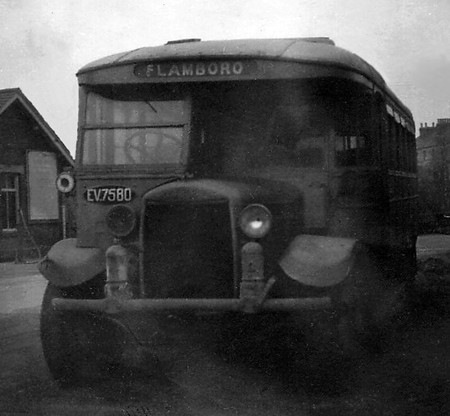


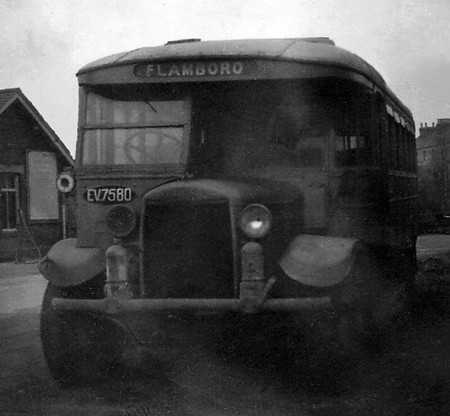
White Bus Service – Gilford 1680T – EV 7580

White Bus Service - Gilford 1680T - EV 7580 
Copyright Chris Youhill.

White Bus Service (Wilson and Hughes Ltd. Bridlington) 
1932
Gilford 1680T
Wycombe C32F

Here is one of my favourite pictures which I took as a teenager with my old roll film box camera. Obviously the standard is very poor, but it brings back lovely memories, for me, of happy times as a devotee of the several small operators in Bridlington in those days. The vehicle was new in 1932 to Hillman’s Saloon Coaches Limited of London, and in April 1934 passed to London Passenger Transport Board being immediately transferred to Eastern National (fleet number 3524). It came to Bridlington in May 1939, being withdrawn by White Bus in January 1950. Still in khaki livery, no doubt as a result of wartime camouflage for the sensitive coastal area of Bridlington, it is seen in the railway station yard where it languished inexplicably until it was taken away and scrapped in 1953. Of particular note is the endearing abbreviation of "Flamborough" to Flamboro. Where oh where have the last sixty years gone ??
The varied and wonderful fleets of the White Bus Service and of R. Williamson and Sons, both of whom managed to provide local bus services in the resort against the might of the equally commendable East Yorkshire Motor Services, were a joy to have experienced.

Photograph and Copy contributed by Chris Youhill


Oh Chris, what a wonderful evocative photo, where has the Brid of the 50’s gone as well? I well remember the station yard, when it was a station full of West Riding steam loco’s! It is good to see photos of some of the smaller operators in the area; is there any more where this came from. The black & white is wonderfully atmospheric, not to say the subject also. As you may be aware the EYMS website has photos of all of the White Bus fleet which was purchases by EYMS

Keith Easton


What a wonderfully evocative picture which captures the sadness of a loyal servant now discarded. The Gruss Air Springs really show up on this low-profile shot.
I think I only ever saw one Gilford, a Hera (their last model?), as a fairground vehicle on Wimbledon Common in pre-Womble days, around 1950. It really did look quite smart and I took a photo (with my box Brownie), sadly long lost. But your shot has made up for it, Chris!
The one outstanding ‘true’ coach that LT inherited was from Hillman, an AEC Renown with Harrington body. Withdrawn in 1939, unusually it was retained at Tilling’s former depot at Bull’s Yard, Peckham, where many unusual vehicles were stored for the ‘duration’. The yard was bombed in the Blitz and it was a casualty, along with many other gems.

Chris Hebbron


Being a Bradford lad, we had regular holidays in Brid, and later owned an old Bradford tram at Skipsea as a bungalow.
I vividly remember WBS and Williamsons, as well as Boddys, and can well remember WBS Bedford OWBs, and can still see the rear of an early 1930s single decker with oval window, which could well have been this Gilford. I also seem to remember a 6 wheel Guy double decker. of Williamsons ( ex Leicester?) and both Williamson and Boddys had ex YWD centre entrance TD2s, the latter on the Filey-Flamborough service. The later Halifax Regents, and London Daimlers of WBS come vividly to mind! Super days!! I was about 5 or 6 when these memories occurred, and I have similar nostalgia from Morecambe, where we also had holidays in the late war and early post war years.

John Whitaker


Wonderful memories of Bridlington John and thanks indeed for them. Sadly though the Williamson’s Guy six wheeler is only a happy dream – don’t we all have them eh ?? – but is actually very close to reality. The Firm operated two ex Doncaster giants – one was a Leyland Titanic and the other an AEC Renown. The financial incredibility of such "over equipment" (petrol engined especially) on two flat town services of a little over a mile each remains for ever completely fascinating.

Chris Youhill


Thanks Chris for following up on WBS, and clarifying my distorted 6 wheel memory!
Skipsea was a delight re. old buses… there were 2 more Doncaster 6 wheelers on the cliff top near us from about 1949.. I remember climbing into the cabs before they were "done up"! All sorts of other treasures too.
Do we have a fleet list for WBS by any chance? It will always remain one of my all time favourite fleets on the trip up to the "Lighthouse".
Great to share these memories.

John Whitaker


Chris Youhill mentions the Leyland Titanic (clever twist on Titan!) and AEC Renown in one sentence, which made me think of all the Renown competitors which had to bow down to AEC’s successful six-wheeler. Double-deck makes/models like the Guy FCX, LGOC’s CC and LS models, Crossley’s sole Condor and the wonderfully-named Sunbeam Sikh! There were also the single-deck Leyland TS6 and TS7 T’s and D’s. Although their stars had faded by the late 1930’s, they set the scene for the ascendancy of six-wheeler trolleybuses until about 1950.

Chris Hebbron


I do have a "sketchy" but relatively complete fleet summary for Williamson’s, and also one for White Bus Service, and will try to condense them some time soon when I have the chance.

Chris Youhill


Hi Chris (Y), would you please be so kind as to let me have a copy when available. Thanks a lot

Keith Easton


With reference to WBS fleet I believe the first vehicle for passenger work by user Alf Wilson was actually the boat shell of a fishing Coble put on wheels and pulled by horses. I’ve heard that Yorkshiremen are ‘tight’ in the purse area the phrase Cobbled-together takes on a new meaning up ‘ere in’t North. Reuben Williamson came a close second to this when in 1920 he fitted an ex-double deck Horse-bus body onto a Republic 2ton chassis.
At Easter 1912 their Horsebus plied the Bridlington Promenade and took £3 0s 6d in one day, this equals 726 one penny fares, hence the term coining it in?

Ian Gibbs


01/04/11 – 07:32

Three brief comments about the White Bus Service Gilford EV 7580 shown at the top of this site:
Firstly, Chris, the colour in which you saw it in the Station yard (which I recollect as nearer to dark grey than khaki) was definitely not a hangover from war camouflage, as my clear memory (which goes back to 1943) is of all the White Buses being in their normal livery of creamy white and red; the only buses I saw in wartime camouflage were those of United (with a few exceptions).
Secondly, WBS also had a second Gilford, WG 332 (ex-W.Alexander);
Thirdly, although both were withdrawn from service in 1950 (November and January respectively) they were then stored in the garage in the Old Town for some years, both appearing in the Station yard in about 1953, for what I recall as a short time only, they both seemed to be full of junk I remember.

Patrick Hooper


01/04/11 – 21:00

Thanks indeed Patrick for this extra information. You are no doubt right about the strange colour of EV 7580 whilst in the station yard – I wonder what on earth was the purpose behind this odd transformation. I also remember WG 332 very well from my very junior days, and in the same period I was not even aware of the locations of any premises for WBS – which is perhaps as well or poor old Dad would have been dragged even longer distances, and he was already commendably patient and tolerant about my avid interest in the buses in the Town Centre and in the West Riding here where we lived.

Chris Youhill


14/05/11 – 18:38

I just have to tell all you guys of my experience with the White Bus Company. In the early 50’s whilst at Huddersfield Technical College, the summer breaks was a time for earning some cash! My parents lived in Flamborough village so I had to find a local job. My stepfather, Gilbert Readhead, was senior driver for the WBSC and he got me the job of bus conductor from June to September. As a result my knowledge of the Company is quite considerable. Owned jointly by Jack Wilson and Billy Hughes they ran a one bus service during the winter between Flamborough and Brid and had a minimum of 5 buses in the Summer. I could go on for a long time so I would welcome questions from anyone interested in the activities of the White Bus Company, Queen St., Bridlington.

Tim Hepworth


24/05/11 – 07:49

A long-time friend of mine (Charlie Bullock, now aged 96) recently told of the time he took his PSV test in Scarborough during the 1930’s. All appeared to be going well as he took his steed – a Gilford – around the streets of the town. However, when the time came to carry out the hill start, Charlie said he was a little perplexed at one point, to say the least. His examiner asked him to pull up on Chain Hill, which he dutifully did. The examiner then alighted and briefly disappeared from view. On re-appearing he asked Charlie to set off when he was ready, but then remained outside the vehicle. Charlie set off, but had only driven a few yards before the examiner asked him to stop. He then disappeared again and returned holding a matchbox. Apparently he had placed this behind one of the Gilford’s front wheels in order to check that the vehicle had not rolled back at all during the hill start. Charlie was informed that as the matchbox was still in pristine condition, he could proceed with the rest of his test! Needless to say, Charlie passed that day with the Gilford, and went on to spend what he says were many happy years driving for United Automobile Services at their Scarborough depot.

Brendan Smith


11/01/12 – 13:31

Hi Tim H, my dad remembers your stepfather, Gilbert Redhead, but sadly not you he is ninety so maybe forgiven, White Bus Service finished in 1955, sold to East Yorkshire Motors, my grandad never talked about his life, so anything I read or hear from, means I can put together a life that until now, was a mystery. Thanks

John Hughes


18/02/12 – 16:31

Hi Tim H I have not looked at the white bus site for a while your offer for questions is generous can I mail one or two via either email to Peter or you by letter when I have time

Ian Gibbs


19/02/12 – 16:36

Hi Ian. I too, would be interested in anything "White Bus".
In fact, if we all got together, perhaps we could assemble an accurate fleet list for White Bus, and Williamson.
As well as the HS Lion Cub, there was a WBS post war "Regal" with a Lincolnshire mark, which is not in the PSV Circle list. Chris Y., well known in these columns, is pretty well versed in all things "Brid Independent" too, dare I say!

John Whitaker


20/02/12 – 10:39

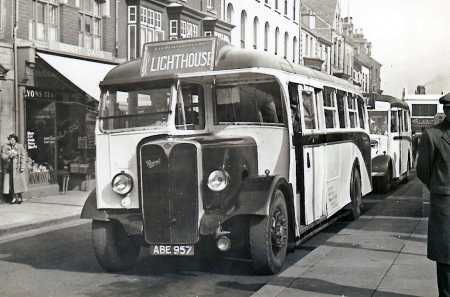
ABE 957_lr

I can answer John’s query about the Lincolnshire registered AEC Regal. It was ABE 957 and was ex Enterprise and Silver Dawn of Scunthorpe, and before joining WBS was with an operator from far away called, I believe, "Reliance." The picture was taken by the late Robert F. Mack.

Chris Youhill


21/02/12 – 07:11

Hi John W; off the top of my head the above WBS Regal is listed in PB17 in the list of vehcles acquired and taken over by EYMS. (But not used by them.) Count me in for any "BridBus" information, and I look forward to Ian’s book on the subject!

Keith Easton


21/02/12 – 16:40

Great stuff Keith!
I also look forward to Ian`s book.
Wonder why Enterprise and Silver Dawn sold this Regal so soon. Is ABE a pre-war mark..? I had assumed this was a Mk2 (post war) Regal, but the more I find out, the less I know!

John Whitaker


22/02/12 – 07:11

According to the Old Classic Car website, ABE was first used for Lincolnshire (Lindsey) from August 1937 to April 1939. (BBE registrations started in May 1939).

Stephen Ford


22/02/12 – 07:14

John W…ABE 957 was issued in Lindsay, Lincolnshire during late February/early March 1938. Does that help or hinder?!!

Richard Leaman


22/02/12 – 07:16

ABE was indeed a pre-war mark, issued in 1938. There was an article about Enterprise and Silver Dawn in Buses, Aug. 1965 which lists the fleet at takeover by Lincolnshire Road Car in 1950. Listed are ABE 951-956 and ABE 958/60/61. Missing are ABE 957 and ABE 959 with gaps in the fleet numbers. So, as John W asks, why would they have sold these two when they still had Regals dating from 1931/32 in the fleet in 1950! I wonder if Chris Y knows which "Reliance" company was involved in the story of ABE 957? The very nice looking bodywork was by Plaxton.

Chris Barker


22/02/12 – 07:18

Whilst still in "Bridlington Independent" mode, is there a kind gentleman out there who can fill in the previous owner and dates new/acquired detail for the following White Bus vehicles extant at the 1955 EYMS takeover?
HS 8306, CEL 223, ASD 149, EWW 149, and when ABE 957 was new and acquired.
I don`t suppose anyone has a photo of a London Daimler in WBS service ?

John Whitaker


22/02/12 – 15:22

I am happy to be able to provide all the answers which John W seeks today.
HS 8306 New 1935 – to WBS October 1951 from Graham of Paisley
CEL 223 New 1937 – to WBS June 1953 from Pulleyn, Dunninglen (spelling questionable)
ASD 149 New 1943 – to WBS May 1947 from Lennox, Whiting Bay
EWW 149 New 1944 – to WBS May 1952 from Robinson, Kippax
ABE 957 New 1938 – to WBS May 1949 from Enterprise (Mark 1 Regal of course)

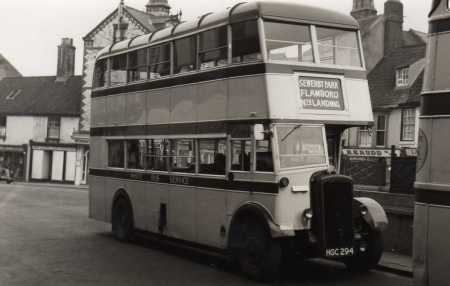
HGC 294_lr

HGC 279_lr

Pictures also attached (purchased long ago and sources unknown) of both of the Ex LT Daimlers in service – one in Queen Street, and the coloured one at Flamborough.

In answer to Chris B’s query about ABE 957, after disposal by EYMS it went to Reliance of Brightwalton, Berkshire.

Chris Youhill


22/02/12 – 17:55

Just to say how great it was to get answers so quickly for the wonderful White Bus Service, and also Williamsons, questions I have pondered for some time now. It all comes back as though I was 10 years old again, in vivid clarity, so thanks to all, and especially Chris. It is a great pleasure to discover that so many other enthusiasts share a love both for these fleets, and the era in general, and I trust we can revel in the enjoyment of this site for many years to come!

John Whitaker


25/02/12 – 07:35

WBS Brid UL5805 Gd

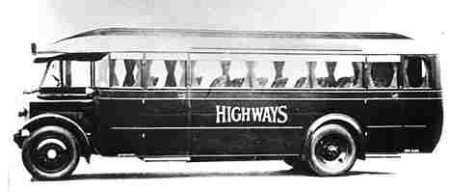
Hello all, Chris nice photos, in return I have found this WBS Gilford 1660T from D Okill when he was studying Gilfords I sent Dick extracts from tax records for his project in return he sent this photo I take the chance of sending it to OBP and hope no one will object, details New 2/29 Highways London No 8 London Lorries C30 to Clarke Bros Ripon 5/32 to WBS 7/33- any other owner?
Clarke Bros were Stage Carriage & Excursions they had a cracking fleet of mainly S/H coaches read like abc of makes, started 1914 with a Ryknield? Chara ferrying troops around locally I think then set up business has psv circle done a fleet? I calculated 37 but odd ones may be lorries from the Spud carrying work DWT 725 Leyland had Barnaby Coach Body

Ian Gibbs


25/02/12 – 14:26

Coaches of this era, to me, always had a sleek look even thought it wasn’t actually sleek, if you know what I mean! It must be the go-faster curtains! I love the stylish curved rear. Nice post,

Chris Hebbron


26/02/12 – 07:22

Re WBS Gilford picture posted above the Reg No was UL 5805 sorry I missed it out.

Ian Gibbs


07/04/12 – 07:14

According to PSVC book UL 5805 was with WBS until March 1938 after which there is no known history.

Andrew Stevens


07/11/12 – 06:46

Hi, chaps : rejoining the correspondence about White Bus Service buses etc., after a long absence! I was born (1938) and bred in Bridlington, so White Buses were very much part of the fabric of my childhood. Just 1 small amendment to make : CEL223 bore the name and address "Victor Pulleyn, York" when it arrived at WBS. ("Dunninglen" may be a misreading for "Dunnington", which is a small village a few miles to the east of York, but it didn’t appear on the actual vehicle.) I’m not aware that CEL223 was ever used in normal service; certainly it was never fitted with a destination blind, the destination indicator box glass being painted over with "Private" on it.
I’d be delighted to reminisce with anyone about WBS, Williamsons or any of the other buses in the East Yorkshire area; better to use e-mail, as I rarely have time to look at websites!

Patrick Hooper


21/01/13 – 05:55

One more comment, about the ex-Enterprise AEC Regal ABE 957 – it was indeed not operated by EYMS but sold by them to Reliance of Newbury, Berks.
Does anyone have a photograph of White Bus Commer AAD 140?

Patrick Hooper


21/01/13 – 05:58

Just to add that AAD 140 was a Gloucestershire registration.
The area abounded with folk who GAD about, were MAD, SAD, BAD, DAD and were bounders, sorry CAD’s, amongst others!

Chris Hebbron


21/01/13 – 15:59

*AD says Black & White Motorways – who were keen Gilford operators for a short while…..

David Oldfield


23/01/13 – 07:06

That would have just been a FAD… (Sorry David!)

Brendan Smith


23/01/13 – 07:07

CEL 223 was a Leyland Cub KPZ2, new in June 1936 with a Beadle C20F body to Hants and Dorset – originally in their version of the Royal Blue livery, for use on tours and excursions. In 1937, to avoid confusion with the coaches of the Royal Blue express services – by then owned by Southern/Western – H&D repainted their coaches into cream and green. It was withdrawn by H&D in August 1951. My notes say it went then to the dealers, North, in Leeds, and to G Bamborough, Chester-le-Street in the November. Subsequently, it was noted with an owner in Wakefield in February 1954 – possibly as a mobile caravan.

Peter Delaney


23/01/13 – 09:13

Nice one, Brendan.

David Oldfield


21/07/15 – 08:41

CEL 223 Passed to White Bus Service from Victor Pulleyn, Station Garage, Dunnington, he had operated it as a psv from 12/51 to 3/53. It came into service with White Bus Service in 6/53 and was still current when East Yorkshire took over, it was not used by East Yorkshire and sold to PVD at Marton (the dealer) in March 1956 and had passed to Stepney Contractors at Beveerly by June 1957 presumably as a site hut.

Mike Pearson


18/09/15 – 05:55

I have just seen this post. I can remember ABE 957 with Reliance of Newbury. Somewhere I have a photo at Brightwalton garage. If I can dig it out I will be in touch. It was a regular performer on the Newbury/Brightwalton service.

Paul S White


18/09/15 – 10:11

To see such a picture of ABE 957 would be realy interesting Paul if you can find it.
In the picture above of ABE 957 in Queen Street a fascinating glimpse of times gone by can just be made out in the far distance – I’ve only just noticed it myself. The building to the right of the OWB with the black signage is at the end of Prince Street, and is in the unmistakeable erstwhile format of "Montague Burton, the tailor of taste." In recent years it was a McDonalds eaterie but that has now closed.

Chris Youhill


20/10/15 – 06:49

I’ll update Dad {Ian} with this info, I am sure he will be interested. Despite his stroke he is still very much buzzing with bus chat. I spent three hours with him yesterday talking about Everinghams. Possibility of a magazine article being written up about them.

Matt Gibbs


13/03/16 – 07:50

My family owned Reliance of Newbury and were delighted yesterday to have have a talk from my old schooldays friend David Wilder. He told us much that none of us knew. The hunt is now on for photos of any vehicles at the old Brightwalton depot where several if my generation spent much of our childhood in the 1950s. I have seem Paul S White’s previous post (18/09/15 – 05:55 above) mentioning Brightwalton and wonder if he or anyone else can help?

Barrie Hedges


12/05/16 – 17:20

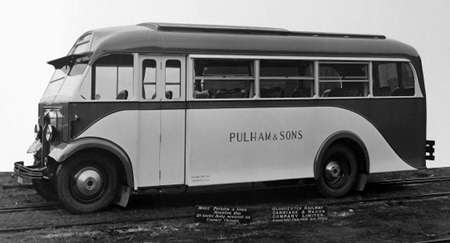
AAD 140

Commer AAD 140 when owned by Pulham & Sons of Naunton, Gloucestershire.

Ian Pope


EV 7580_lr Vehicle reminder shot for this posting


11/06/20 – 07:27

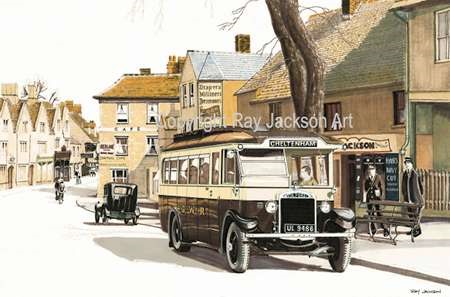
UL 9486

One of four Gilford coaches operated by the Great Western Railway on the Oxford to Cheltenham service pictured at High Street, Witney, Oxfordshire, circa 1930. Although the GWR railway did have a service to Witney and beyond to Fairford, it never completed the route through to Swindon or Cheltenham and in place of this they operated a joint passenger road service with Black & White. I painted this in 2002. The original is now owned by Mr. Dave Jones of Suffolk.

Ray Jackson


Quick links to the  -  Comments Page  -  Contact Page  -  Home Page


London Transport – Leyland Titan TD2 – GX 131 – TD 85

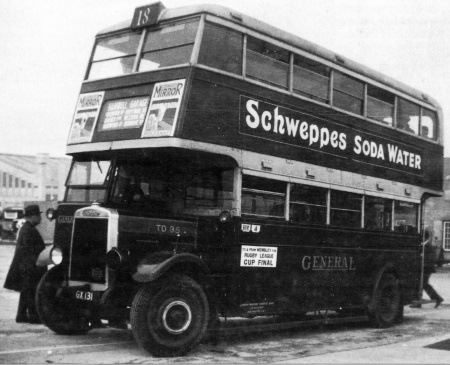
London Transport - Leyland Titan TD2 - GX 131 - TD85
Photograph by D W K Jones Permission to publish granted by Capital Transport Publishing

London Transport
1932
Leyland Titan TD2
Birch H30/26R

In my first supplementary comment on the London Transport low-bridge Daimlers with Duple bodies (posted here), I said the following:
“A further look at D1’s lean-back, but ramrod-straight front, makes me recall the frontal look of the very rare 1932 Birch body. I have seen a photo of one somewhere and will try to find and upload it.”
I have now found the photo (memo to Chris – tidy up books in spare bedroom before ‘her indoors’ comes back from a few days away!) which does show an uncanny ‘austerity’ resemblance, not only at the front, but along the side, too! There are even ventilators above the downstairs windows like the Brush bodies had!
This is an interesting photo of TD 85, taken on 4th May 1935, whilst helping to carry supporters to the Rugby League Cup final at Wembley (Those of you ‘up North’ will be overjoyed at the word ‘League’! As a Southern ‘Union’ person, I am less so!
The bus was one of 30 originally owned by Birch Bros, a company which was an ‘independent’, running bus services within London. LPTB was formed on 1st July 1933, but it took almost to the declaration of war in 1939 before it had finally swallowed up all the independents. Birch Bros., however, succumbed in early 1934. When the bus was taken into stock, it was painted into LGOC/London Transport livery, but there was still a debate about what would be put on the vehicles’ sides. As a result, re-painted buses continued to have GeneraL applied, and it was some years before LONDON TRANSPORT appeared universally. Legally, though, you can see the four words making up LPTB in full, on the bottom front edge. LPTB’s pre-war TD class was the largest of all which came from the ‘independents’, only being disposed of in 1939. Many of those not scrapped went to Liverpool, being painted grey, as were all buses which ran to or by ‘sensitive’ places such as munitions works and military installations. Oil-engined TD85, however, went to an operator in Essex, finally being scrapped in late 1949. Shame!
Because Birch Bros. also ran express services from Kings Cross to Rushden (Northants), they were immune from total LPTB takeover, much to the latter’s chagrin! ! In fact, Birch Bros only finally shut down in 1971, suffering from the all-too-common fall in passenger numbers.

Bus tickets issued by this operator can be viewed here.

Photograph and Copy contributed by Chris Hebbron

———

What an incredibly interesting and historically informative picture and text Chris for which I thank you. I know that what I am about to say is pure coincidence and cannot be the case, but one can’t help feeling sure that the Ministry of Supply MUST have seen this photo when drawing up their "utility" WW2 specification. Just one of those little cases which make the in depth study of passenger transport so utterly absorbing.

Chris Youhill

———

They must have seen it, otherwise it’s too much of a coincidence. Has the Duple look – later Birch bodies were not so balanced or handsome. The rear profile, upstairs, has a whiff of (pre-war) Weymann and a shred of Sheffield (built during the war to peacetime standards in the Tramway workshops).

David Oldfield

———

Glad you found this absorbing, Chris, and agree it could almost have been a template for the austerity design.
One little aside is the use of stencils in the rooftop box. Imagine the problem of getting up there to change the route number every time! The majority of London trams had stencilled numbers and, even at my tender age then, I could spot a number 8 the wrong way round from half a mile away, just as I’m blessed (or cursed) with the ability to spot a spelling error in the same way!

Chris Hebbron

———

23/03/11 – 17:45

Thanks this was really lovely to read my father-in-law ‘Nob’ Horace Brown of Shefford used to work for the Birch Bros, driving the buses. my husband is always talking about it and trying to get a model of the bus he drove this is how I came across your details. Thank You loved it and will show nick, his dad died quite young so it would be nice to find bits out for him to keep and treasure

Mel Brown


Quick links to the  -  Comments Page  -  Contact Page  -  Home Page


All rights to the design and layout of this website are reserved     

Old Bus Photos from Saturday 25th April 2009 to Thursday 4th January 2024