Old Bus Photos

East Yorkshire – AEC Bridgemaster – 4700 AT – 700
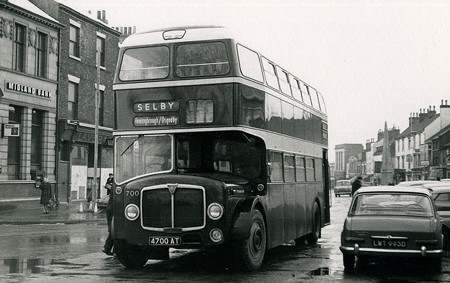
East Yorkshire - AEC Bridgemaster - 4700 AT - 700
Copyright Ian Wild.

East Yorkshire Motor Services
1961
AEC Bridgemaster B3RA 
Park Royal H45/28RD

One of East Yorkshire’s rear entrance AEC Bridgemasters. Just shows the Bridgemaster could look good given the right sort of livery, the Beverley Bar inward profile of the upper deck also helps. Photograph taken at Goole on 22nd February 1968.

Photograph and Copy contributed by Ian Wild


You are quite right. Why didn’t Park Royal think of it? The Beverley profile would have improved many of their 1960s offerings – not just the Bridgemaster.
But where are the number blinds? A strange omission for a normally very fastidious operator.

David Oldfield


I believe that East Yorkshire buses did not start showing route numbers until around 1963, although they were used internally and in the timetables. This was the reason that Hull Corporation had to renumber some of it’s routes in the 1 to 12 series in September, 1963.

Keith Easton


Yet another most nostalgic picture for me, as a lifelong admirer of EYMS, but from a different angle. Right up to my retirement in May 2001 I often worked this route from Arriva’s Selby Depot, and also from Pontefract. Despite quite an infrequent train service the confounded level crossing gates at Goole always seemed to be closed for an age, just so that the trains could enter and leave the adjacent station at walking pace !!

Chris Youhill


So was this a joint service between Arriva (presumably, formerly West Riding) and EYMS, or was it taken over from EYMS later? I don’t think EYMS operate to Selby today, do they?

Chris Barker


To be honest Chris B I’m not too sure about that as I only worked for Pontefract SYRT and the West Riding Depots from November 1987. Certainly though there was no sign of EYMS in Selby or Goole by then so presumably the 1986 De-regulation had caused that change. The intermediate destination blind on the Bridgemaster shows "Hemingbrough/Osgodby" and there was no EYMS presence on that road in my time, so this is an interesting query isn’t it ?

Chris Youhill


It was originally an EYMS service, but passed to West Riding, I believe in NBC rationalisation

Keith Easton


Thank you most sincerely for that explanation Keith – I’m somewhat embarrassed at not thinking of it as the NBC rationalisation scheme had some quite interesting effects here in West Yorkshire and nationally too. Its just another indication of how easily such dramatic changes can fade from the memory in the vast range of topics that are covered by we serious enthusiasts.

Chris Youhill


Yes, thanks for that. I’ve long thought that EYMS oozes interest, not only for its fleet but its history, operations, area of operation and not least the fact that it is still very much in business (independent business!) Long may it continue!

Chris Barker


The Hull to Selby route was numbered 4 by EYMS and was on licence BE3/15, so it must have been in operation prior to the 1930 Road Traffic Act, as it is in the original batch of licences granted to the company.

Keith Easton


28/06/11 – 06:29

Interesting comment on EYMS buses. I have just bought an EYMS bus a Yellow Peril MKH 84 for preservation need some work but will be worth it in the end.

Martin Chaplin


28/06/11 – 09:12

What a very enviable purchase Martin, and all the very best to you in your preservation work. My main memories of these magnificent vehicles is of travelling from Leeds to Bridlington in them when they were new and could be found on that route – with their fifty seats and enormous accommodation for holiday luggage. Later, when I was in the RAF at Patrington (Spurn Point) and occasionally "detached" to Bempton, one of these fine vehicles would appear on the last short journey from Bridlington to Bempton and, if memory serves, this journey operated at a different time almost every night of the week. What glorious days these were !!

Chris Youhill


29/06/11 – 07:00

Hi Martin, it will be great to see a "yellow peril" on the road again, the last time I saw one was in the late ‘seventies. I think that photos of the progress in the preservation would be most interesting and informative.

Keith Easton


13/02/12 – 07:29

I am also looking forward to seeing one of East Yorkshires most iconic vehicles in the shape of a "Yellow Peril " back on the road. Hull born in 1952, I had the pleasure of growing up with the Titans, Regents, Bridgemasters and Renowns – travelled many times on the Yellow Perils particularly when they were used as our school buses from Hessle to Beverley Grammar School in the early 60’s. A pictorial diary of the restoration progress would be excellent. I wish Martin good luck with his project, and hope to see MKH 84 in all its glory in the near future, maybe then we can persuade OOC or EFE to produce its first Beverley Bar model.

John Eggleton


02/05/16 – 14:00

EYMS do currently run Goole to Selby on a Sunday, having won the contract from the council about 18 months ago.

Sam Eyers


23/05/16 – 07:38
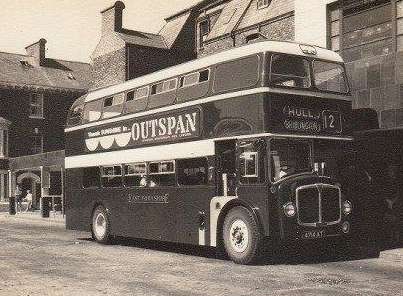
EY BM

EY RG

I thought I would send these along to add to the EYMS archive. One sunny Saturday in September 1961, when I was 14, we had a family day out (West Yorkshire excursion) to Bridlington and I’d been lucky enough to borrow my older brother’s Zeiss camera, with which I snapped these. It seems odd that I only took two pictures, but there were only 12 shots on a film and the processing cost me four weeks’ pocket money. How different it is now with digital. The single decker was buzzing backwards and forwards all the time I was there, and what a handsome vehicle it was!

David Rhodes


29/05/16 – 05:44

Ian Wild’s excellent print of Bridgemaster 4700 AT was, of course, taken in Selby Market Place not Goole.

David A


29/05/16 – 15:52

Two lovely pictures David R and Bridlington bus station was a real gem in those days. The double decker is, of course, on the famous number 12 route from Hull via Driffield, Bridlington, Butlin’s Filey and Cayton Bay. The route survives to this day. The very celebrated single decker is one of the AEC Regals taken over with the business of Everingham Brothers of Pocklington, hence the East Riding registration as oppose to Hull, the norm for EYMS

Chris Youhill


Quick links to the  -  Comments Page  -  Contact Page  -  Home Page
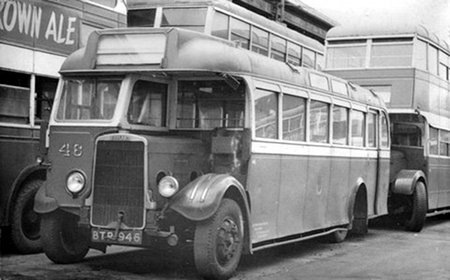


Portsmouth Corporation – Leyland Cheetah – BTP 946 – 46

BTP 946_lr
Copyright P J Marshall

Portsmouth Corporation
1939
Leyland Cheetah LZ4
Wadham B32R

Portsmouth Corporations fleet number 46 was the last of a batch of 6 Leyland LZ4 Cheetahs, 41-46 (BTP 941-946), with locally-built Wadham bodywork, new in 1939. 41 and 42 were withdrawn in 1941, after suffering war damage. This view of 46 at Eastney Depot was taken about 1954 when the remaining four of them were withdrawn from service and were awaiting disposal. Note the sad appearance, bald front tyres and single wheels only on the rear! Although I only holidayed in Portsmouth and Southsea from 1949-1956, I never recall ever seeing these buses in service.
Note the bus is surrounded by some of the nine 1944 Duple-bodied utility Daimler CWA6’s of which virtually no photos seem to exist. In 1959, the chassis were thoroughly overhauled and they were despatched to be re-fitted with Crossley bodies, some of the last Crossley bodies built, only to be scrapped in 1965! With only nine pre-selective gear change vehicles in the fleet, they were greatly abused, with inexperienced drivers using the gear change pedal as a clutch pedal, with lots of juddering. As a visiting Londoner, living in the Daimlerland Merton/Sutton area, it made me cringe!

Photograph and Copy contributed by Chris Hebbron

———

The Cheetahs were bought for the Southsea Sea Front Service, but of course this ceased in September 1939. The bodies had sunshine roofs and a total of six destination screens to inform the tourists of the attractions on the route. The bodies were reportedly heavy for the lightweight chassis, which was fine for a ride down the promenade, but a problem on normal services.After the war they were used on peak time specials when the fleet was understrength, but very little else. Interestingly there is a record of No.43 running on mileage equalisation duties on Southdown Service 138 from Fareham to Cosham over Portsdown Hill. That would have tested its Leyland 4.7 litre engine.

Pat Jennings

———

It’s true the bus behind is one of the CWA6/Duples, as all nine were withdrawn in 1954 to go to Crossley for new bodies, being returned in 1955. Thus they did 11 years with original, and 11 years as rebodied, being withdrawn in 1965/66. But those at the side of the Cheetah are Craven-bodied TD4s of the 131-160 batch. These would be either early withdrawals, or set aside for a work-shop rebuild. CPPTD carried out a lot of rebuilding work on the Cravens bodied TD4s and the trolleybuses from c. 1949-1957/58, although not every member of these batches received such work.

Michael Hampton

———

I agree with ‘Michael Hampton’ with regards to the re-bodying of the ‘Daimler CWA6’. A rather elderly Bus Book I have from 1963 states that they were re-bodied in 1955 by Crossley.
I think it would have been a lot to ask, that a Double Deck ‘Utility’ body last fifteen years, (unless heavily rebuilt), with the dreadful quality Wartime materials allowed by the ‘Ministry of Supplies’ for Bus Bodies. Even the paint allowed was little better than ‘coloured water’!!
Credit must be give to ‘C.P.P.T.D’ for managing to keep the Utility bodies in service for eleven years. Before the eventual & inevitable – re-bodying process.

John

———

Does anyone have a photo of the CWA6’s as re-bodied? I can’t think of any Crossley bodied Daimlers (with exposed radiators that is).

Chris Barker

———

Oldham had fifteen Crossley-bodied CVD6 (322-336) and Manchester had fifty CVG5 with their characteristic body (4000-4049). Also Lancaster had a solitary (I think) CWG5 rebodied by Crossley.
However, it is possible you are thinking of the later Park Royal-designed Crossley body and I have to say I can’t think of any other examples.

David Beilby

———

No, actually I was thinking of the earlier type of Crossley body of the style with the stepped rear windows, which may be called ‘true’ Crossley bodies. The Portsmouth fleet list on Classic Bus Links states that they were re-bodied in 1959, very late for a wartime chassis to be treated, I thought that T Burrows ex London Daimlers were the last to receive new bodies in 1957. Anyone know which date is correct? If it was 1959 as stated by Chris Hebbron above, they would of course have had the Park Royal style of body, still worth seeing with the exposed radiator and strange if they only lasted six years as such.

Chris Barker

———

Chris Barker – I will post a photo of a re-bodied Daimler shortly. They were pleasant enough, but nothing like any other Crossley bodies I’ve seen. What I’m actually after is a photo of one of them BEFORE they were re-bodied! Such photos are be very rare. Any holders of one out there?

Chris Hebbron

———

The date of 1959 cannot be correct for the rebodying as the Crossley factory had been closed over a year by then. In fact they entered service in September and October 1955.
It turns out there were not many batches of Daimlers bodied postwar by Crossley. In addition to those I listed the remaining ones were the nine Portsmouth examples, 250 for Birmingham (2776-2900 and 3103 to 3227) and 35 for Aberdeen (175-204 and 210-214).

David Beilby

———

Thank you, David, for clarifying the revised date to 1955. I, too, took the Classic Bus Link date of 1959.
I notice that Birmingham’s Daimler CVG6 3225 survives and the Crossley bodywork gives only the merest nod to their standard Corporation design!

Chris Hebbron

———

Chris Hebbron has actually sent me a shot of a Portsmouth Crossley rebodied exposed radiator Daimler CWA6 it will be posted in its own right Wednesday 19th January.

Peter

——— Top of this posting ———


Quick links to the  -  Comments Page  -  Contact Page  -  Home Page
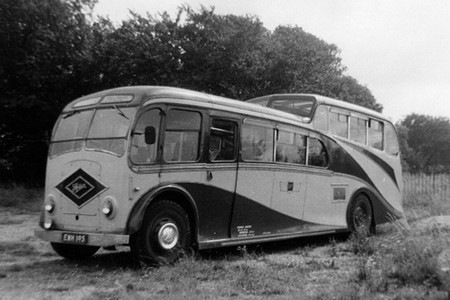


Hargreaves of Bolton – Foden PVSC6 – EWH 195

Hargreaves of Bolton - Foden PVSC6 - EWH 195
Copyright Ian Wild

Hargreaves of Bolton
Foden PVSC6
19??
Whitson RC35C

This great shot was taken at the Botanical Gardens Rhyl in August 1963 and at the time the above vehicle was owned by the Foden Sports and Social Club but it was delivered new to Hargreaves of Bolton. Bodywise is it called an Observation Coach or an Half-deck Coach? I can understand why it ended up with a sports a social club I should imagine that the large luggage locker came in handy for carrying all that equipment. Another question regarding this type of body I have is, were they limited to double decker regulations of length and weight for example or were the single decker lengths and weights allowed?
The PVSC6 had the Gardner 6LW 8·4 litre six cylinder diesel engine there was the option of the Gardner 5LW 7·0 litre five cylinder diesel engine in which case it was designated the PVSC5. In 1949 the Foden FE6 4·0 litre two stroke diesel engine was available which was designated the PVFE6 but only 52 PVFE6s were built as the series was superseded by the rear engined PVR in 1950.

Photograph contributed by Ian Wild


I can’t answer any of the technical questions about this coach, but I always remember these because Dinky Toys made one in the late 1950s and I had one; but to this day I’ve never seen an example of the real thing. There’s an example of the Dinky version here.

KC


Yes, KC – I’d forgotten about these. I used to have one. Weren’t they Maudsleys? It would be interesting to know why Dinky should choose such an unusual design of body and comparatively rare chassis for their model, especially when they were soon to become obsolete in style.

Paul Haywood


Didn’t Dinky do one in BOAC livery? I seem to remember the full-sized versions plying between Heathrow and the BOAC city terminal somewhere near Gloucester Road station – in the days before Heathrow Express, or even the extension of the Piccadilly Line beyond Hounslow West.

Stephen Ford


A couple of model makers made versions of airline-related coaches.
Dinky did this.
Matchbox did this.

KC


Its an observation coach, and Whitson built them on Maudslay, Leyland, AEC, and Foden chassis between 1949 and 1952. A half-deck coach is a different beast altogether using the patented "Crellin-Duplex" design where upper and lower deck seating was arranged to cram as many people in as possible using interlocking "railway compartment" style seating. The end result looked more like a two-level horsebox than a PSV! In prewar years Duple built a few observation coaches (I seem to remember one for an operator in South Wales) but in the post-war period Whitson had a virtual monopoly. The only other post-war example which springs to mind is the Mulliner bodied Morris-Commercial built for the Morris Works Band. This is preserved at the Oxford Bus Museum, but sadly none of the magnificent Whitson vehicles has survived.
The most famous Whitson observation coaches were the Fodens used by Salopia, but Dinky Toys chose to use a Maudslay supplied (in real life) to Embankment of Plymouth as the prototype for their scale model.
The airport coaches you mention were (in a sense) observation coaches, and share the same PSV Circle body prefix (RC) but all of those used by BEA in London (bodywork by Park Royal) and by MCTD in Manchester (bodied by Burlingham and Bond) had a continuous roofline rather than the "stepped" arrangement of a true observation coach, Liverpool Corporation converted a few (previously conventional) single-deckers to this "stepped roof" format in the late 1950s for their own airport service. The vehicles which resulted were not an aesthetic triumph!

Neville Mercer


07/02/11 – 06:04

As has already been pointed out, there was a world of difference between the Observation Coach style and that of the Half-Decker. Both were built to the (then) size limits for single deckers, rather than being restricted to the double decker dimensions. This applied regardless of whether they were mounted on front-engined chassis or rear-engined/underfloor-engined chassis. EWH 195 was one of a pair supplied to Hargreaves of Bolton, the other one being EBN 898. Both were supplied as PVSC6 chassis (Gardner 6LW), but after Fodens acquired EWH 195 they fitted a Foden two-stroke engine, effectively converting it to PVFE6 specification. Incidentally, you can tell the difference between front engined Gardner powered and Foden powered PSVs by the position of the starting handle hole. In the case of the Gardner engine the hole is dead centre, whereas it is slightly offset to the offside when a Foden engine was fitted.

Peter Tulloch


14/04/11 – 05:00

I should imagine this was carrying the Foden band who performed all over the country, they had several Fodens over the years, some had a bandmaster mascot on the rad cap, a uniformed conductor (the musical type) waving a baton.

Bryan Yates


05/10/11 – 17:28

I too had the Dinky model but I also remember the actual bus around North Wales when I was a small boy in the late 1950’s-early 1960’s. I lived in Broughton and we always holidayed further up the coast so saw this bus quite regularly. I also liked the cream-liveried Crosville buses which seemed more exotic than the all green or green and cream Chester buses.
Happy days!

Paul Eaton-Jones


25/10/11 – 07:19

I agree with Bryan Yates’ assumption that this coach was carrying the Fodens Brass Band. My father was a Machine Shop Foreman until his death in 1964, and I can remember seeing the bus now and then around the Elworth works – if memory serves me well it was grey and blue, and sounded as though it had the 2-stroke engine. No doubt the extra storage was useful for the band instruments. On another note, I saw a red half-cab Foden coach at Astle Park steam rally in August – still in the Coppenhalls (Sandbach) coach firm’s livery. Lovely memories!

Malcolm Riley


27/07/12 – 14:50

Reference to Malcolm’s comments about the blue and grey coach for the Foden Works Band….
I was sent a photo a couple of days ago from a friend in the UK who saw what is probably this gorgeous looking old lady just last week at a rally in Newbury….If I knew how to load photos on to this site I’d do it, but maybe a quick Google would stir the memory cells into action, and might also provide more information about its current owners’ show schedule and dates….

Stuart C


27/07/12 – 15:51

Ah….An hour later and I would be kicking myself unmercifully if the old limbs could bend that far….
The old lady I was going on about is not only already well known on here…. www.old-bus-photos.co.uk/  
But ever a star, she even has her own page on Wikipedia…. //de.wikipedia.org/  
I’m sure that it’s just an age thing on my part, but what an absolutely wonderful example of what a British coach was meant to look like….

Stuart C


28/07/12 – 08:40

She’s a very attractive vehicle and the colour scheme certainly enhances her looks, too, Stuart.

Chris Hebbron


14/09/12 – 06:57

Beautiful Vehicle, Astons Coaches Marton operated HUJ 997 Foden PVFR Observation Coach Whitson. They also operated a Foden Crellin Duplex mentioned above KWT 976 with a Lincs Trailer Body as well as two other Crellin Duplex with Mann Egerton. Various other Fodens were operated including well known NBH 950 and JWY 999

David Aston


13/05/13 – 15:25

How many Whitson Observation Coaches were made.

David Aston


02/02/15 – 07:14

I’ve just been doing some research on Whitson’s observation coaches and the answer to "how many were built" seems to be 32 or 33. The biggest customer was the US Air Force which took either nine or ten (depending on which source you believe!) on 30 ft long Crossley SD42/9 chassis. These received the USAF serial numbers N967-976 (or N969-977 in one version, hence the discrepancy in total build numbers). They carried pseudo-Foden radiator grilles at the request of the customer and were delivered in 1951 for use on personnel transfers and by assorted USAF military bands. They appear to have been withdrawn in 1959 and at least one of them (N975) was subsequently sold to a civil operator (Peters of Llanarmon) as TCA 309. It was scrapped in 1962. Next came Salopia Saloon Coaches of Whitchurch and Embankment of Plymouth with five each. Salopia’s were all on Foden chassis, one of the shorter version on PVSC6 chassis (GAW 86), a 30ft long PVFE6 (GUJ 243) and three of the 30 ft version on rear-engined PVRF6s (HUJ 996/7 and JAW 334). Embankment took two on Maudslay Marathon IIIs (EJY 123/4), two on AEC Regal IIIs (FDR 52/3) and one on a Foden PVSC6 (GCO 946).
Four operators had two each. Hargreaves of Bolton took EBN 898 and EWH 195 on Foden PVSC6 chassis, HS Knight of Northampton received BNH 301 (Maudslay Marathon III) and BNH 302 (AEC Regal III), AE Marsh T/A Black and White of Harvington (Worcs) had Marathon IIIs HNP 875 and HUY 204), and ET Straw of Leicester bought Regal III GBC 893 and Regal IV HBC 603.
WEMS of Weston-super-Mare received Marathon III DFR 395. This vehicle was apparently the prototype – it had a slightly higher roof-line on the raised section – and had been an exhibit at the Earls Court Show in Batty Holt livery which might account for its Blackpool registration as they had a subsidiary there. However, it never entered service with the Lancashire firm and stayed with WEMS until 1960.
Other one-off customers were Cowell Bros of Sunderland (Regal III AGR 975), Doug Jones Coaches of Newchurch (Hants) who took Royal Tiger JOT 616 – the only Leyland example, Netherfield of Nottingham (Regal IV NAL 393), and Stanton Bros of Horseley Heath (Staffs) with Marathon III RRF 328.
Second-hand operators of observation coaches (apart from the previously mentioned Peters of Llanarmon) included Cooper of Gilesgate (Durham) who took two former Salopia PVRF6s, Elms Coaches of Kenton (London) who bought Embankment’s Foden GCO 946, and Ubique (also in the London area) who bought RRF 328.
Can anyone tell me of any I’ve missed? Past experience would suggest that there might be others lurking where I’ve failed to notice them!
The body came in two basic versions. The shorter variety can be recognised by having two full window bays on the sides of the raised section, while the 30 ft version has three. Both types could be adapted to suit any engine position (front/underfloor/rear).
In closing, can anybody tell me the liveries used by HS Knight of Northampton (taken over by York’s in 1960) or Stanton of Horseley Heath (who disappeared in 1956)? I have black and white shots of these operators’ vehicles and would like to get an idea of what they looked like in technicolour!

Neville Mercer


03/05/16 – 07:03

Whitson Observation Coaches
Having more or less concluded the History of Astons Coaches now delving deeply into the history of some of the vehicles they ran Have started on
Leyland Panda
Rutland Clipper
Crellin Duplex
Today I start on Whitson Observation Coaches so any points of reference or articles on these much appreciated Astons had HUJ 997 Foden

David Aston


04/05/16 – 14:56

GAW 86 One of the Salopia Fodens was converted to a Lorry are there any photos around?
HUY 204 It is well documented that the Foden won Concourse prizes, but why did HUY 204 Maudslay Marathon have a similar Concourse Badge on it this is at the Wythan Bus Museum

David Aston


19/05/16 – 06:15

I understand that there was possibly another one but records are unclear OFR 922 any one know anything about this one.
USAF Crossley I am led to believe N974 was registered as 8065 KD went to a Liverpool School. N976 was registered as 464 GBM went to Creed,Sandy

David Aston


EWH 195 Vehicle reminder shot for this posting


14/05/20 – 06:48

Black and White of Tipton (Stanton Bros?) also had at lest one.

Bill Parker


19/05/20 – 06:20

BLOTW reveals that Stanton had in fact two. RRF 328, a Maudslay Marathon III, has already been mentioned by Neville Mercer above, but there was also ORF 922, a Tilling Stevens K6LA7, no less. This is probably the ‘OFR 922’ that David Aston was enquiring about.
And I think Bill’s question probably answers Neville’s earlier question about Stantons’ livery!

Peter Williamson


20/05/20 – 07:16

Although it is correct that BLOTW lists ORF 922 as having an observation body, photographic evidence puts this in doubt. This photograph includes what is suggested as being that Tilling Stevens, which has a standard half cab body. Either the coach in the photograph is not ORF 922, or it was subsequently rebodied, which seems unlikely – https://flic.kr/p/or9CVv 

David Williamson


Quick links to the  -  Comments Page  -  Contact Page  -  Home Page


All rights to the design and layout of this website are reserved     

Old Bus Photos from Saturday 25th April 2009 to Thursday 4th January 2024