Old Bus Photos

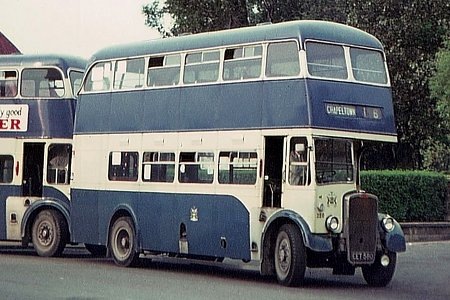
Rotherham Corporation – Bristol K6B – EET 580 – 180
Rotherham Corporation - Bristol K6B - EET 580 - 180
Copyright Ian Wild

Rotherham Corporation
1949
Bristol K6B
East Lancs H30/26R

Rotherham was an enthusiastic Bristol operator until they became no longer available to non Tilling Companies. 180 is one of a batch of four Bristol L6B originally with Bruce B32C bodies delivered in 1949 and all rebodied in 1951 (only two years later) by East Lancs as H30/26R double deckers.

The photo was taken in August 1967 at the Chapeltown terminus of service 16. My information doesn’t include any withdrawal dates but the bus was a creditable 18 years old at the time.

Photograph and Copy contributed by Ian Wild

———

180 lasted in service until 1967, one year later than the other three.

Chris Hebbron

———

Ah! Blue and cream – almost as good as cream and blue (Sheffield).
Living in the far South West of Sheffield, I lived just about as far from Rotherham as I could be and the 69 went to Exchange Street, not Pond Street Bus Station. I am a fan of Bristol engined Bristols but wasn’t aware of Rotherham’s Bristols until long after they had gone. It was the AECs and Daimlers that I remember – and of course the AECs were actually in the minority.
Ironically, Rotherham was to become significant to me – as a musician – in later years, and still is today.

David Oldfield

———

What a coincidence, David. I too lived on the south west side of Sheffield. I was at a training centre in Rawmarsh for 6 months during the winter of 1962/3 and travelled daily by bus. The 69 of course was a joint Sheffield/Rotherham service, Rotherham’s contribution almost exclusively being a Crossley. Rotherham had one single lady driver which was unusual in those days but she was a complete master (mistress?) of the Crossleys. Sheffield used their three ‘stock’ all Leyland PD2s (601-603), with their none standard destination displays on the 69. I seem to remember them having a brown seating material rather than Sheffield standard.
From Rotherham I travelled to Rawmarsh by Mexborough and Swinton. Their lowbridge Atlanteans were quite unusual to my eyes although later I worked for a fleet with 105 of them! Best thing about M&S was the almost exclusive use of conductresses, many of them rather attractive!!
Does anyone have any photos of the M&S Atlanteans?

Ian Wild

———

The interesting question is, why were these vehicles re-bodied after only two years? It’s inconceivable that the Bruce bodies would have been unserviceable after such a short time, I believe Bruce had a good reputation and weren’t they associated with East Lancs? Was it the case that Rotherham suddenly had a desperate need for double deckers? and were the original bodies re-used on other chassis?
Did the fact that they were single deck chassis have any effect on the rear platform of the re-bodied vehicles, such as the Wallace Arnold re-bodied Daimlers for Kippax and Farsley with their two-step platforms?

Chris Barker

———

And it wasn’t a cheap conversion, either. They were delivered as Bristol L6B’s, which were single decker chassis. The Bruce bodies were classified B32C’s which suggests that they were originally coaches rather than single-deck buses. The chassis were then rebuilt to K6B standard and fitted with the East Lancs double decker bodies. It’s likely that even the gearbox/axle ratios needed changing. But, as Chris B says, what were the ‘coaches’ originally planned for?

Chris Hebbron

———

Two-step platforms: there was a fashion for these in the early 50’s: Doncaster had some new Roes in the 120’s with two step platforms and cranked seats- was it a way of dealing with 7ft 6in widths for narrow streets (or narrow washers depending which version you prefer)?

Joe

———

I wonder if it was something to do with Rotherham getting wind of the impending loss of access to new Bristols. They may have taken whatever they could get hold of before the stable door was finally locked and bolted, on the basis that a 6B is a 6B, whatever happens to be sitting on top of it. It is quite probable that there would be a second-hand market for four good-quality coach bodies no more than two years old. From an accounting point of view it is quite likely that the subsequent rebodying would be done through the maintenance budget. So there would be few questions asked (however much it cost), compared with the approval process for purchasing new capital stock.

Stephen Ford

———

PSV Circle fleet supplement P71R dated October 1963 provides further information. Eight 1949 Bristol L6Bs were rebodied with double deck bodies in 1951, fleet numbers 112-114 and 179-184. The displaced single deck bodies were fitted to prewar L5Gs fleet numbers 137/140/142/143 of 1938 and 159-162 of 1939. Of these, at least 137 etc originally had Cravens bodies. All were withdrawn in 1957/1958. Please note these B32C bodies were bus bodies (not coach)- the C refers to central entrance which seems to have been a Rotherham speciality as the Cravens bodies were of the same configuration.

Ian Wild

———

Following on from Ians comment, centre entrances were very common in this area. Rotherham also ran many centre entrance single decker Daimler trolleybuses, a number of which were rebodied at a very young age with Roe double deck bodies. Rotherham were the joint operator with Mexborough and Swinton on services between Rotherham and Conisborough via Mexborough. Most of the ‘tracklesses’ operated by the Mexborough system were centre entrance with only a few very early examples and some wartime second hand vehicles bucking the trend. One of the latest centre door vehicles that I can think of in that area was a Doncaster CT Regal IV that from new was equipped with a centre door body albeit rebuilt to dual entrance later in life.

Dates relevant to the bus shown in the photo above are:-
Date into service – March 1949 (original body was by Bruce on East Lancs frames)
Chassis modified from L6B to K6B and rebodied by East Lancs in April 1951
Withdrawn October 1967 it passed to Autospares of Bingley for scrap in December 1967.
The original single deck body was used to rebody the refurbished chassis of a 1940 L5G of the CET 44x batch numbers 159 – 162

Andrew Charles

———

27/02/11 – 12:00

Some interesting comments here, but does putting a double-deck body on a Bristol L make it a K? I grew up in Bristol and remember all the rebodying that went on but Bristol Omnibus never did a single to double deck conversion. The L chassis was 27′ 6" long, the K 26′ but, by the time of Rotherham’s rebodying, double deckers were allowed to be 27′ long. So how long was 180? Rotherham went on to buy the KS chassis, the only non-Tilling operator to do so; comparing photo-graphs of the two, 180 is almost certainly 26′ long, so the chassis had to be shortened to fit the new double deck body.

Geoff Kerr

——— Top of this posting ———


Quick links to the  -  Comments Page  -  Contact Page  -  Home Page
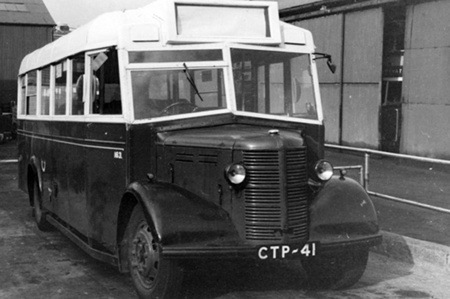


Portsmouth Corporation – Bedford OWB – CTP 41 – 163

CPPTD 1943 Bedford OWB/Mulliner Bus B32F (Withdrawn 1963)
Photograph by ‘unknown’ if you took this photo please go to the copyright page.

Portsmouth Corporation
1943
Bedford OWB
Mulliner B32F

The earlier photo I posted, of a Portsmouth Leyland Cheetah, surrounded by Daimler CWA6/Duple double-deckers, were neatly bridged by the delivery of 10 Bedford OWB’s (1 in 1942, 7 in 1943 and 2 in 1944). All had Duple bodies, save 162 and 163, bodied by Mulliner, more aligned with bodying sleek, expensive Rolls-Royce’s and Bentleys!
I have to say that I never discovered any real reason for such little buses being allocated to CPPTD. Portsmouth’s bus services were already severely curtailed for the duration, with buses being kept away from the seafront and a greater reliance on trolleybuses than hitherto. They lent out double-deckers for periods. Upon delivery, at least some of them were painted grey, but whether this was through lack of maroon livery paint or the proximity of sensitive sites is debatable.
Whatever they did during the war, they led uneventful lives afterwards on quiet routes, although I have seen photos of them going along Commercial Road, the main shopping centre, which suggests that they were called out to perform on busy routes from time to time.
These small, but stout-hearted vehicles were all withdrawn in 1962-63, with 163 going in 1963. One (170 – CTP 200) survives in preservation.
One quirk unique to these buses were the number plates, which always had a tilde between the letters and numbers!

Photograph and Copy contributed by Chris Hebbron

———

Super picture of that wonderful wartime bus, the OWB. Portsmouth must have been faced with extra wartime naval personnel transport duties to receive these, I would think, but they were regarded as "standard 32 seaters" in the wartime allocation system, being the only new single deckers available.
I well remember riding on Ledgards, and White Bus (Bridlington) OWBs, and the ring of their high pitched petrol engines and gear change lingers in my ears to this day.
Several other municipal fleets received OWBs, Bournemouth and Belfast coming to mind. Perhaps extra wartime duties were the common feature.

John Whitaker

———

What a lovely picture of the OWB! In the early post-war period, they were painted standard red/white, and with grey roofs. They were also given upholstered seats from withdrawn vehicles (probably the TSMs, Condors and TD1s, reducing to 27 seats.
One of their uses in the fifties was on mileage balancing with Southdown, and I have read that they were especially useful on the Havant / Hayling routes because they could safely use the Hayling Bridge.
Their use became much more intense in later life, as in September 1958 the Corporation introduced a PAYE route (22) between Lower Wymering and Upper Drayton. I well remember this as this was in my earliest days of bus enthusiasm, and the route was just one road away from my home! At peak periods they could be well-loaded, the supposed "eight" maximum often being exceeded. I remember squatting on a bodywork protrusion opposite the driver in the space in front of the front entrance, and the back of the bus was invisible due to the crowd on board! For this work, they were further down-seated to 26, to provide a luggage space for pushchairs.
The picture could probably be dated quite accurately by anyone who still has records. It has a white roof instead of grey, (repaints to white roofs for the fleet were carried out 1959-1961), but still has a semaphore trafficator (on the pillar behind the driver’s window). Later (c. 1962/63?) the fleet were given flashing trafficators, those on the OWB’s being fitted below the window line.
My class-mates and I who followed this interest used to keep detailed records of when we first saw a bus with a white roof instead of grey, flashing trafficators fitted, and re-seated vehicles (both single and double-deck vehicles). Unfortunately my own lists have long disappeared, probably consigned to a dustbin.

Michael Hampton

———

I was involved for quite a while in 1967/8 in work on the preservation in Leeds of CTP 200. One particular job that I remember doing was to reconstruct the destination blind box which had become badly corroded. Sadly, due to domestic circumstances at the time, I was no longer among the group who eventually put the splendid little vehicle back on the road. I need hardly remind those who know me that I am an ardent admirer of the Bedford OWB/OB – a model which is a modest and unpretentious but stout hearted little trooper if ever there was one.

Chris Youhill

———

30/04/11 – 15:30

Re OWB’s later life. Michael Hampton is quite right re their late use, but I remember their use for the start of the PAYE services between Wymering and Highbury Estate whilst the new Leyland single deck, twin entry/exit, buses were awaited for delivery and service. The doors were operated by a rod linkage between the driver and the doors!!

Bob Townsend


Quick links to the  -  Comments Page  -  Contact Page  -  Home Page
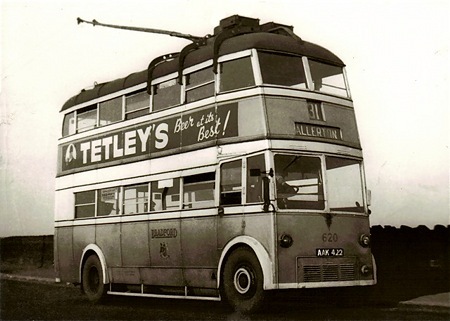


Bradford Corporation – AEC 661T – AAK 422 – 620

Bradford Corporation - AEC 661T - AAK 422 - 620
R F Mack

Bradford Corporation Transport
1935
AEC 661T
English Electric H32/26R

We all have our personal favourites as far as buses are concerned, and I have to confess that mine are, (or were), trolleybuses.
Amongst my earliest memories were the late war years in Bradford, where I so clearly recall the sight, and sound, of Bradford`s “Regen” trolleybuses.
These were AEC 661T types based at my home depot of Duckworth Lane, and were unlike any trolleybuses anywhere else, as they made a NOISE. Their mournful wail could be heard for miles about, especially when braking, and this was due to the double reduction rear axle and full regenerative control. How Bradfordians distinguished them from the Air Raid “all clear” signal I shall never know!
They were new in 2 batches, in 1934 (597-617  KY 8200-8220) and 1935 (618-632  AAK 420-434), and carried early examples of English Electric metal framed bodies, which recent research has discovered, were extremely troublesome right from the off. English Electric metal bodies at that time did not benefit from the expertise demonstrated in the products of Metro Cammel. Having said that, the situation was not helped by tight and hilly schedules, the aforesaid unusual double reduction rear axles, and the fully regenerative control, such that these bodies were virtually shaken to bits after a troublesome 10 year life on Bradford`s granite setts.
Failures were occurring at an alarming rate by the war years, and BCT received permission to rebody 9 of them with Brush utility bodies in 1944, during which process, the regenerative control was reduced. The remainder were rebodied by Northern Coachbuilders in 2 styles, between 1946 and 1949, the last of the English Electric all metal bodies being consigned to scrap in 1947, and these trolleybuses, with their composite bodies, then settled down to a “second life” which was to last into the 1960s.
They still made plenty of noise in their new guise and being a regular rider to school, each one developed its own character for me, and they became firm friends. Sad, I know!

Bradford Corporation - AEC 661T - KY 8209 - 606
I attach a poor quality Brownie Box photo of 606, one of the Brush rebodies, and always my favourites, taken on a quiet 1953 Sunday morning. This photograph is full of nostalgia for me, especially as it was one of the last to carry the older Tattam livery with cream bands and rear dome.
Happy Days! If only I could ride on one again at Sandtoft!

Photographs and Copy contributed by John Whitaker

Bus tickets issued by this operator can be viewed here.

———

Not sad at all – some vehicles, just like people, have characters and the more eccentric ones get recalled the most! How amazing that permission was given to re-body vehicles while the war was on, something I’ve not previously heard of.
I always had a soft spot for the London United Tramways (later LT) A1 and A2 class ‘Diddler’ trolleybuses, unique and also frail bodywise!

Chris Hebbron

———

Fear not John, as Chris H rightly says there’s nothing sad in being fortunate enough to be able to recognise the characteristics of vehicles. It is a fact that, even in large batches of brand new ones, individual machines very quickly display their own particular "natures." As a teenager on frequent visits to relations in South London I was also totally fascinated by the "Diddlers" on outings to Hampton Court and the area.

Chris Youhill

———

Thanks Chris H and Chris Y for the reassuring remarks about my deceased friends!! Good to know that other enthusiasts are just as moved as myself when referring to man-made inanimate objects !!

Thanks for comments about London "Diddlers" from Chris Y and Chris H. I too was fascinated by them, but never saw them "in the flesh". I hold my very fleeting memories of Bradfords EEC 6 wheelers, and single deckers in the same light, as I can only just remember them. It would be great to hear about other trolleybus interests from fellow enthusiasts, as my enthusiasm is for anything old in the psv line, including trams!

But I wont go there!

John Whitaker

———

Chris Hebbron raises an interesting point re. re-bodying of vehicles during WW2. The MOWT (Ministry of War Transport) controlled all allocations of chassis and body manufacture, and supply to customers. I doubt whether operators had much say in most cases; Body builders were allocated orders in batches, and hence Pickering, for example, built small numbers of utility bodies in 1942/3 on unfrozen, and early Guy Arabs, (including a minority on Mk2 chassis), they disappeared again until late 1945, when they were allocated a contract for relaxed single deck utility bodies on Albion chassis, for Scottish operators.
East Lancs were used for re-bodying only, several fleets receiving all metal bodies on reconditioned chassis (mainly AEC) to almost peacetime standard. Brush were unusual, but not unique, in being used for new and reconditioned chassis, viz the Bradford trolleybuses and early AEC Regents for Birmingham. Bradford had 10 AEC Regents with all metal English Electric bodies which dated from 1935/6, and these were just as worn out as their trolleybus cousins by 1944, such that 7 were given new East Lancs bodies that year. I intend to look at the English Electric situation as far as metal framed bodies are concerned, as there were other disasters, notably with a batch of TD3/TD3c buses for Burnley Colne and Nelson JTC. I will submit a post on the subject if there is sufficient interest.

John Whitaker

———

I was delighted to see the Bradford AEC 661T "Regens" 620 and 606 posted on this web site by my best friend John. These were my favourite group of trolleybuses as they made a loud noise and had regenerative braking. Over the last few years I have been doing research into the early years of these trolleybuses 597 to 632 built 1934/35. My findings have been published in the Journal of the Bradford Trolleybus Association "Trackless" 200 to 205 inc. and 211. I can confirm the double reduction differential rear axle drive and the fierce regenerative braking were the main contributory factors leading to the failure of their EEC metal-framed bodies. The noise and vibration made it impossible for passengers to have a conversation inside these trolleybuses when running at speed, such as from Springhead Road to Bell Dean Road on the Thornton route. This leads me to ponder why Bradford specified a double reduction differential drive when a single worm drive differential was working quietly and efficiently on a very similar AEC 661T/EEC in London, namely LTPB 63 delivered some months earlier.

Richard Fieldhouse

———

This site has certainly brought back some memories.
I served an apprenticeship with the English Electric Co. at the Thornbury works in Bradford in the late 50’s. The Trolleybus motors kept the Traction Department busy for many years.
I recall working on the motors in both production and refurbishment and for it’s output it was very compact, good for it’s purpose, but a pain to work on. A common fault with motors returned for Overhaul was the "Square Commutator" Not really square but appearing so due to abnormal wear on opposite sides. Caused it turned out by slightly eccentric brake drums on some vehicles resulting in the motors always stopping and starting at the same point in it’s rotation.

Phil Johnson

———

Amazing the sort of problems which crop up – I should think it required some thinking about to identify THAT problem!

Chris Hebbron

———

I found Phils’ comments and experience at the English Electric Co at Thornbury most interesting and wonder which type of trolleybus traction motors were being overhauled and who were the regular customers. Can I assume Bradford City Transport was a regular as it was a loyal supporter of English Electric traction equipment?

Richard Fieldhouse

———

19/04/11 – 19:20

In the comments on the page for Bradford Corporation AEC661T trolleybuses, some correspondents mention the LUT "Diddler" trolleybuses. In 1962 the last trolleybuses were withdrawn in London and living in a road near the last trolleybus route to close I took my 18 month old son to see the last trolleybus from Hammersmith to the depot at Fulwell. In the event the modern bus was preceded by a "Diddler" from the London Transport Museum decorated with bunting, etc. as for its opening day. Alas, my son does not recall the sight.
For those of you who are interested, if you log on to the "You Tube" website and type in the Search Box "Twickenham Trolleybuses" (without the quotes) there is a film of the first day of operation of the diddlers taken in 1932. It is in black and white and, originally, was silent but a sound track of 1930’s band music has been added.
If you look carefully you will notice that they do not have headlights but it was shortly afterwards at the insistence of the police that a single headlight was put in the centre of the panel replacing the radiator on a IC engined bus.

Phi Jones

——— Top of this posting ———


Quick links to the  -  Comments Page  -  Contact Page  -  Home Page


All rights to the design and layout of this website are reserved     

Old Bus Photos from Saturday 25th April 2009 to Thursday 4th January 2024