Maidstone & District – Guy Arab IV – RKK 996 – DH 456
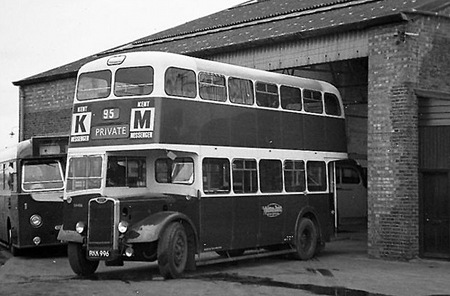
Copyright Ray Soper
Maidstone & District
1953
Guy Arab IV
Weymann H32/26R
Seeing the pictures of Guy Arabs submitted by Andrew Charles and Chris Youhill reminded me of my own experience of these wonderful vehicles. This picture of Maidstone & District Guy Arab IV, (originally Chatham & District), is another fine example. It has much nostalgic value for me personally, because either it or its next door stable mate, DH 455 – I’m afraid at this interval of time, I can’t remember which – was the first double-decker I ever drove.
Opinions about the attractiveness of bodywork are very personal, but I always thought the Weymann bodies on these vehicles were restrained and elegant. They were comfortable, and the buses rode well.
Having been brought up in York, I had virtually no familiarity with Guys before I went to M&D, but I rapidly developed a great deal of admiration for them. To get the best out of them, they required a small modicum of driving skill, (Chris Youhill will know exactly what I mean by this), but driven properly they were very rewarding and had very adequate performance. I never drove any of M&D’s Bristols, apart from Chatham Depot’s Gardner 5LW-engined breakdown vehicle, and had limited experience of their AEC Regents, but for me, the Guys were the best front-engined vehicles they had. Some of M&D’s Leyland PD2s did higher mileages over their lifetimes, but those vehicles were generally operated on rural routes with relatively generous running times, whereas the Guys lived an unremitting hard life.
M&D had about 24 of them, all with Gardner 6LW engines, and all based at Chatham Depot, where they operated the Company’s most demanding urban routes – the heaviest traffic, the hilliest terrain and quite sharp running times. In that role they were both economical and almost unbelievably reliable. Apart from routine maintenance, they just never seemed to develop problems. My involvement in operations at that time extended to gaining a management view, and I came to regard a Guy Arab with a 6LW engine as being about the best you could get for urban services.
Chatham also operated Leyland Atlanteans, introduced to replace the Bristol K5G’s, but they gave the Depot Engineer far more headaches than the Guys. Of course, Atlanteans had the advantage of a larger passenger capacity, but the price paid for that was substantially higher fuel, oil and maintenance costs – occasionally frighteningly so – and more engineering overheads to keep the fleet operational. In the longer term, of course, rear-engined vehicles were the future, and M&D were leaders in introducing them, but back in the 1960’s, when few operators visualised one-man operated double-deckers, their advantage was not immediately obvious.
I have long felt that Guys have been undervalued by some enthusiasts, but I’m not sure why. Maybe it is just relative unfamiliarity with them, compared with Leyland and AEC, or the fact that many people’s first experience of them was of buses fitted with WWII bodies and Gardner 5LW engines. Those engines sounded agricultural, and were sometimes thought under-powered in hilly districts, but a 6LW engine transformed performance without a significant rise in fuel consumption. As far as I know, although many M&D vehicles have been preserved, no Guy is amongst them, (if anyone knows otherwise, please do write a comment), which is a very great pity.
Finally, the AEC Reliance behind DH 456 also brings fond memories to me. One of this batch was the very first bus I drove. I had a short lesson in one the day before I went out in the Guy Arab, I think primarily to satisfy the instructor that I could actually handle a large vehicle.
My sincere thanks, also, to Ray Soper for his permission to use his photo.
Photograph and Copy contributed by Roy Burke
13/02/11 – 16:50
My experience of Guy Arabs was minimal living in Leeds only West Riding having any when I began to take an interest in matters bus and these always played second fiddle to the ill fated Wulfrunians West Ridings lowbridge Arabs were absolute work horses and would probably be still running if asked to! They would prove to be the NBCs last lowbridge buses.
Later I lived in LUT territory and found their Northern Counties bodied Arabs to be just about the last word in what was then conventional bus smooth riding with well built well proportioned bodywork and a virtually flat entrance.
The former Halifax manager Geoff Hilditch wrote a series of articles in the late sixties – early seventies on various chassis he called the Arab solid reliability and really I don’t think that is far of the mark!
Chris Hough
13/02/11 – 18:06
The first bus I ever drove was a Guy Arab with Northern Counties Bodywork and the 5cyl Gardner engine I also was a conductor on these vehicles and I would never describe them giving a smooth ride, harsh yes. They were reliable and you could also drive them with the cab door open in the warm weather and this was the best feature for me, oh and they had nice steering. Can’t compare a front engine bus with a rear engine bus though, especially when rear engine buses were a new idea.
Michael Crofts
13/02/11 – 18:06
I have to say that it looks very odd, to my eyes, to see a Orion body sporting a Guy radiator, but it’s not unattractive. It’s also the first Orion I noticed with sliding windows rather than wind-down ones.
Thank you, Roy, for giving us your experiences of driving them – glad they were positive. Guy’s demise was a sad event – it was a pity that shortage of money meant that the Wulfrunian into service under-developed, there hastening its end.
Chris Hebbron
15/02/11 – 07:08
LUT’s forward-entrance Arabs were Arab Vs, which explains the smooth ride. The suspension and semi-low chassis frame were the main improvements over the previous model. Add the optional semi-automatic transmission and you got what I would imagine to be a perfect bus, but unfortunately so few of those were built for the British market that I never had the pleasure.
Peter Williamson
05/04/11 – 05:45
The M&D bus appears to be a Weymann rather than a Metro Cammell body, re the curved lower edge to the front bulkhead window.
The exposed rad Guy with Orion body wasn’t all that rare after all, Northern General had many (All 5LW’s?) some of which were diverted to PMT prior to delivery, and Exeter Corporation had a 6LW engined batch too.
I experienced the latter and always thought them amongst the nicest looking Orions I’d encountered. Those with Leyland’s BMMO tin fronts and narrow front domes with monstrously thick corner pillars were an assault on the senses. As if these weren’t bad enough, Luton and Blackpool managed to make them even more hideous in lowbridge and full front guise.
Keith Jackson
04/08/11 – 21:39
I would put forward the Park Royal RT-style bodies on East Kent’s FFN-series Arabs as the best-looking on this chassis – as with the RT itself, it’s a style that never seemed to date, and they were excellent buses to work in.
Lew Finnis
29/01/12 – 16:36
At Northern’s Percy Main depot, we had two batches of very similar Orion Guy Arabs, ’12 in all if memory serves’ the first batch were slightly different in that they had ventilator cowls on the side of the roof rather than above the front upper windows. I don’t know if it was an effort to save weight, or money, or more likely both, but they were positively spartan inside, the upper decks were only single skinned with the frame exposed, as a result they had more rattles than Mothercare, the much later Orion PD3’s were a far better finish, they were all double skinned and padded between layers and were much quieter as a result, but it would be unfair to blame the body builders for the short comings of the Guy’s, as all bodies are ‘or rather were’ built to order and you get what you pay for. As with all Northern groups Arabs, they had the almost indestructible Gardner 5LW, and they were an entirely different vehicle to drive than a PD, ‘count very slowly to 4 pausing in neutral to change up, and loads of revs to change down’
Ronnie Hoye
30/01/12 – 07:46
Experience with Orions in Manchester was similar to Ronnie’s. The whole idea of the Orion was to save weight, but they overdid it in the early stages. Metro-Cammell were Manchester’s preferred body builder, but after the first Orions the Corporation moved on to Burlingham while MCW sorted themselves out. The later ones were much better finished, and medium-weight rather than light.
Peter Williamson
30/01/12 – 11:00
Ronnie. I love "more rattles than Mothercare" – you ought to copyright it.
Sheffield, likewise, had the same problem. After over a hundred interim Weymann classics (ie like the Rochdale Regent Vs rather then the "true" post-war classics) they bought around a hundred early Weymann Orion bodies. As described above, they were horrendous and built to the barest standard with no panelling and exposed frame. Subsequent Weymann Regent Vs, like the Manchester Titans and Daimlers, were finished to a proper, acceptable standard – they were very nice vehicles! [I seem to recollect that the Sheffield back-loader Bridgemasters were similarly spartan – certainly around the window pans.]
David Oldfield
30/01/12 – 16:18
Interesting comments about the MCW/Weymann Orion bodies. My memory is that all the M&D Arab IVs had Weymann bodies, although Ian Allen lists them as MCW. (Hasn’t someone explained elsewhere on this site that the decision on the body builder depended on the volume of the order?).
The choice by different operators of a 5LW or a 6LW is interesting, too. M&D chose the latter to replace their 5LW-engined Bristols at Chatham, (their other Bristols had AEC engines). The Depot Engineer at Chatham had no doubt that the 6LW was the progressive choice, not only because it really transformed the vehicles’ performance, (which from a traffic management viewpoint was extremely important), but also because in service the saving in fuel consumption of the five-cylindered engine was hardly significant. I have never seen comparisons, but I’m not surprised at that view.
Ronnie’s account of changing gear with a 5LW amused me – not very different, in my experience, from doing so with a 6LW, although the noise in the cab of M&D’s 5LW-engined Bristol breakdown vehicle was so loud that you could never tell from listening alone whether you’d managed a clean change from 3rd to 2nd.
Some of the M&D Guys did, however, have one truly aggravating feature: the exhaust brake. On most of them it didn’t work, but whether from failure or deliberate disconnection I couldn’t say. I do remember driving DH465 when it had just been overhauled for recertification and getting a throbbing headache from the intolerable noise in the cab caused by the exhaust brake. Does anyone else have any recollection of this contraption?
Finally, the comparative sound of the 2 Gardner engines would make a great entry to the new Old Bus Sounds page. Surely someone more technically competent than I am will post one?
Roy Burke
30/01/12 – 16:20
My contact with Midland Red was fleeting, but I seem to remember they had some pretty spartan double deckers- such design always reminiscent of a vandal-proof public toilet- with an exposed glassfibre front roof dome with the rough side towards us- is my memory playing tricks?
Joe
31/01/12 – 07:52
There were two deciding factors about orders for MCW – which was originally the marketing company and NOT a manufacturer.
One was traditional customers went in one direction or another. Sheffield always went to Weymann, Manchester to Met-Camm. M & D were a Weymann customer. However, as Roy so rightly says, Met-Cam (MCCW) were considerably bigger than Weymann and tended to be allocated the large orders – unless local preference had been voiced. In that way, when the Atlantean came on stream, it was decided that the more popular Highbridge would be made by Met-Cam and Weymann would make the lower volume semi-lowbridge model. Sheffield, a Weymann customer, took most of its early Atlanteans from Met-Cam but had at least two batches from Weymann – despite all being full height.
All Atlanteans and Fleetlines had the better specified bodies and did not suffer the indignity of the lightweight Orion effect.
[Weymann also did the other low volume work – coach bodies – until the two firms did indeed merge as the coachbuilder MCW in 1966.]
David Oldfield
31/01/12 – 07:54
There is possible confusion here between MCW (Metro-Cammell Weymann) and MCCW (Metro-Cammell Carriage and Wagon). MCCW was the body builder, whereas MCW (until 1966) was a design and sales company jointly owned by MCCW and Weymann. Therefore Ian Allan’s habit of describing Weymann-built bodies as MCW wasn’t actually wrong, but just imprecise.
Peter Williamson
31/01/12 – 09:29
…..and of course MCW muddied the waters by putting their name on body builders plates rather than the individual builders themselves.
As a post script, there was a way to identify a Met-Camm Orion from a Weymann Orion.
i) The window construction on the cab door was different (separate on MCCW and as a unit on Weymann).
ii) The saloon front windows were an exact (if radiused) rectangle on MCCW whereas on the Weymanns the bottom of the window curved down towards the outside – an echo of the classic Weymann predecessors but with a straight top rather than that also curving down.
As ever, this was also muddied towards the end when the proud and honourable tradition of Weymann was dogged by industrial problems which caused its eventual demise. The effect was that quite often, between 1963 and the end in 1966, orders were swapped from Addlestone to Birmingham – frequently having been built as a frame before transfer.
David Oldfield
02/02/12 – 07:00
I didn’t know about the cab door. I knew about the bulkhead window, but have recently discovered that it wasn’t as reliable as I thought – especially on lowbridge versions.
What does seem to be reliable is the join of the top of the nearside cab window to the canopy – a straightforward right angle on Weymann but with an angled insert on MCCW. But beware post-1966 bodies. I’ve seen one that looked like a Weymann, only to discover that it was built by Cammell Laird!
Peter Williamson
18/02/12 – 07:17
Luckily one of the West Riding Low Bridge Roe bodied Arabs survives and is currently under restoration. Chris is right that the Arab could still be called on – after 30 years dry stored it started first time and drove out of the shed in November 2011. Hopefully it will be running at Dewsbury Bus Museum open days within the next 12 months
Mark B
18/02/12 – 09:30
Industrial unrest/strikes at Addlestone are a common theme, but what was the source of the unrest. Was mention of closure a cause or effect of eventual closure, or was it something else? (David Oldfield 31/01/12 – 09:29 posting above)
Chris Hebbron
18/02/12 – 09:35
That is very good and welcome news Marky B. The West Riding lowbridge Arabs were fascinating vehicles indeed and full of real character, and the traditional livery suited them perfectly. Many years ago I travelled on one on a busy Friday evening, having with me a very early portable tape recorder. The bus was more than full, overloaded slightly with Bingo hopefuls, and as we ascended the steep hill from Great Preston into Kippax Cross Hills even that sturdy little machine was struggling in second gear – naturally I’ve no idea who the driver was but he certainly deserved a medal for the finest completely skilled and imperceptible change down into first gear that I think I’ve ever enjoyed – a wonderful experience which ZF, Voith and the present day lot couldn’t know anything about.
I was under the impression that none of these little gems had survived, and I can’t wait to see and hear this one in action – great news !!
Chris Youhill
10/09/12 – 07:25
I’ve only just caught up with this site, to my shame, but I was delighted to come across Roy Burke’s contributions about the Chatham & District Guy Arabs, and the operation itself.
Members of the Friends of Chatham Traction (of which I’m Chairman) invariably give these vehicles as the finest bus experience of their youth. This is rather a long time ago now for most of us but we’ve still enough fuel in the tank to be working to restore the sole surviving C&D Bristol K5G, a type which Roy also mentions.
The "8-foot Guys", as I believe they were known, were a revelation to us lads when they arrived in three batches in the early 50s. They were like space-ships compared to the old Bristols. I mean, they had trafficators and string-operated buzzers! And yes, I did go to school on them, from 1959.
Roy, we (FoCT) would be very pleased to learn more of your experiences of Chatham, Luton depot and its buses. Our range of interest extends as far as the withdrawal of the last Chatham Traction bus (in 1970 – the Bristol breakdown vehicle GKE 65, also mentioned). Interesting that you came down from York. I was born and raised in Chatham and have now lived in York for 20 years!
Richard Bourne
11/09/12 – 06:47
Great to hear from you, Richard. I’d be delighted to correspond with you direct about my time at Chatham, and have suggested to Peter that he sends you my e-mail address, for that purpose, although, as you say, it’s rather a long time ago now. I’ve occasionally viewed the C&D site and have followed your efforts to restore GKE 68, a sister of the ex-breakdown vehicle. I’m told, incidentally, that GKE 65 still exists, and might even be for sale, but it’s not, apparently, in good condition.
Roy Burke
24/12/12 – 07:12
I know it is over a year ago now Mark B but this first time starting was only achieved when someone pressed the correct button and held down the right switch at the same time!
Andrew Beever
13/04/13 – 07:29
Lets just say KHL 855 starting up was a team effort! I can’t remember if I pushed the button and you flicked the switch or was it the other way around? I have now managed to track down a recording of her being driven from Saville Street to Belle Isle Depot when she was the Trainer Bus. Sounds fantastic!
Mark B
09/02/15 – 13:56
I’m currently researching for a publication for the OS which I call SOUTH.MOG, the garages, outstations etc of major ops in Southern England. As RKK 996 is standing outside a garage, this would be an ideal pic for inclusion. Would it be Ok to use it, and which garage is it? I suspect Borough Green.
If anyone has historical data on M&D garages, I should be glad to hear from him.
David Domin
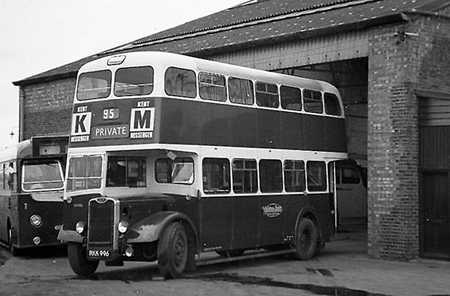 Vehicle reminder shot for this posting
07/08/17 – 06:36
Mark and Andrew, the knack of starting a Guy from cold involved something called ‘decompressors’ I was told. Driver in cab, plus mechanic under bonnet (I was always the former) and he’d lift all the decompressors before saying ‘Right-Ho!’ With no compression in the pots, the engine would spin at an alarming rate. Fuel would flood into them and the garage hand would let them all go together. Never failed but it was usually a couple of hours before you could see across the garage.
Nick Turner
07/08/17 – 16:15
Nick
Gardners normally start fine. De-compressors were normally only used if the engine was low on compression and certainly then you would get a lot of oily smoke
Roger Burdett
09/08/17 – 06:39
Gardner fitted a de-compressor to each cylinder back in the early days when hand cranking was still often used for starting an engine. Reliable electric starters rendered this feature redundant in everyday operation. In a career spanning some 46 years in the bus industry, I have driven Gardner powered vehicles fitted in many different makes of chassis, and I have never, ever known the de-compressors to be used. If it was routine to use them at M&D then the batteries, starter motors or the engines themselves must have been at fault.
Roger Cox
09/08/17 – 06:39
Nick, I would agree with Roger that Gardner engines would normally start without much trouble, even from cold. To assist with cold starts in very cold weather however, there was an excess fuel device mounted on the front end of the fuel injection pump. This was operated by pushing a small ‘plunger’ upwards, which lifted a fuel limiting trigger allowing the injection pump rack to slide further back than normal. More fuel was thus pumped into the cylinders to aid the cold start. On the engine firing up, the design of the governor and linkage to the injection pump automatically returned the rack back to its normal fuelling position. No real need for the decompression levers to be used. However, they could be useful in starting a vehicle with a flattish battery, where using them as described by Nick would often bring even a cold engine to life, when lesser engines would need the slave battery trolley.
Brendan Smith
10/08/17 – 05:56
I bow to the greater knowledge of experts but am merely reporting what happened when starting was difficult at Southdown, Haywards Heath. I felt quite knowledgeable, knowing the device being used was a ‘decompressor’. Sadly, to the majority of most of you on OBP, I was one of those drivers for whom e.g. the gear lever was a total mystery once it disappeared through the floor. My driving ‘religion’ centred on my expertise at driving vehicles safely and considerately, so that I dispensed as professional a service as possible to the passengers who paid my wages. I’m not unhappy overall with what I achieved in this respect but, as Chris Hebbron intimated elsewhere, passenger interface was seldom mentioned, except cynically, amongst the majority of busmen of my era, and I think our public image could have been much better had that not been the case?
Nick Turner
11/08/17 – 06:24
One of the results of having too little directed work in my early technical assistant days was to look at individual engine oil consumption figures for the company fleet. Over a short period I soon discovered that you could track a Gardner engine in need of attention about 3-4 months before imminent failure. As soon as the lubricating oil consumption reached 500mpg it was already in difficulty but it would run until about 350mpg! Failures on this scale were usually underfloor or rear engines where the air intake trunking had become punctured allowing the hoovering of road dirt straight into the engine! The information was useful in warning the central workshops to have an overhauled engine of the right type available, sometimes before depot management had detected a problem!
There were usually signs of the hole being used (or perhaps, made) for the application of disapproved Easy-Start spray in the morning to get the engine going now that it had low compression.
In the first week of arriving at a certain NBC company, after a visit to one depot, the engineer showing me around the company had got used to my prodding foibles and said "Did you see the air trunking on the VRT in the workshop?" I said "No!" He said "I thought not – it wasn’t there at all!" My response – "but I would have spotted a hole!"
Geoff Pullin
Quick links to the - Comments Page - Contact Page - Home Page