Old Bus Photos

West Yorkshire – Bristol GO5G – YG 8986 – 306
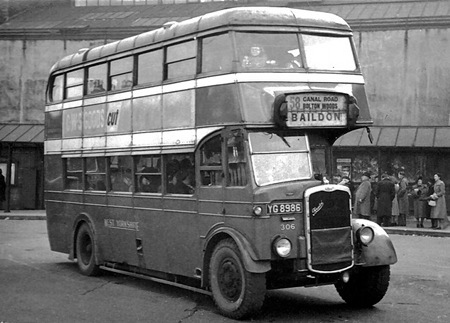
West Yorkshire -  Bristol GO5G - YG 8986 - 306
Copyright Roy Marshall

West Yorkshire Road Car Company
1935
Bristol GO5G
Eastern Counties L53R

West Yorkshire Bristol GO5G 306 with Eastern Counties L53R body built in 1935 is seen at Bradford Chester Street Bus Station about 1950. It is ready to depart to Baildon via Canal Road and this information is clearly displayed on its “bible” indicator. For its return journey, the conductor or driver would release the side clips on the ‘bible” to enable the horizontal flap to be turned to show “Bradford.” The intermediate destination points in reverse order would also be revealed on the hidden “page” after which the ‘bible” was then re-clipped.
No doubt the crews welcomed the adoption by West Yorkshire of roller indicator blinds from 1944 onwards, though the operating handles were still outside and involved a clamber over a hot radiator but there was no more awkward lifting of a heavy “bible” metal sheet arrangement. I wonder what injuries occurred and whether there were any compensation claims with handling of the “bible” indicator metal sheets.
306 was withdrawn from service at the end of November 1950 but the “bible” indicators remained in use with West Yorkshire I believe in 1958 with the demise of the last pre-war Bristol L5Gs.
Can anybody confirm the date of the last pre-war L5Gs? I have only West Yorkshire fleet lists to 1955.

Photograph and Copy contributed by Richard Fieldhouse

———

27/02/11 – 08:39

Thank you Richard for sharing with us this wonderfully composed and evocative picture. I have departed from that very spot countless times when I worked for West Yorkshire at Ilkley Depot. We operated services 63/68 to Ilkley and Ben Rhydding via Manningham Lane or Canal Road, and had just one weekday trip to Baildon – out via route 59 and Baildon Road and return via route 61 and Baildon Green. I never had to use the incredible and ludicrous "bible" indicators and, quite rightly, they would never have been permitted in today’s Health and Safety climate – this legislation is often sneered at, and can be "over the top" on occasion but it was certainly sorely needed in those days. At a quick glance it would appear that the last prewar L5Gs were indeed withdrawn in September 1958. Of interest is the "Tilling Group" swivel radiator filler cap, retro fitted to most vehicles in place of the original flat screw down pattern. Thanks once again for a particularly splendid picture.

Chris Youhill

———

27/02/11 – 11:19

I know I am susceptible to nostalgia, buses being no exception, but this photo has it all for me! As a child, I remember the shape of the ECOC "G" bodies so well, as they contrasted vividly with the post war fleet. They lasted until 1952, as they had provided cover for the company’s "K" type rebodying programme.
I can see them now, hurtling down Thornton Road from Denholm, leaving clouds of smoke in their wake.
What a place Chester Street was for a young enthusiast. Day trips to Baildon and Ilkley on such delights as 306, and their "J" cousins, and stopping off at Harry Ramsdens on the way back. Most of all, awareness of contrasting shape variations amongst the WY fleet. There was that green hut, full of stacks of spare bible indicators, and, as you exited the bus station, at the little parking area to the right, bus backs of differing profiles would persuade you of the delights of BOVRIL, or else pose the question, "Have you McLeaned your teeth today"?
Wonderful memories of a superb fleet in its heyday!
Can it be 60 years since the passing of these fine vehicles?
Thanks to Richard for this post…. Any more WYRC Co. enthusiasts out there?

John Whitaker

———

27/02/11 – 11:25

Yes, a lovely picture with much nostalgic value. I didn’t realise that ‘bible’ indicators were still in use as late as 1958 – they lasted until 1955 in York, where I never heard them referred to by any of the older staff as anything other than ‘flap boards’. West Yorkshire must have been very fond of them because they actually converted some of the vehicles they inherited from York Corporation to bibles from blinds.
The picture indicates, and I assume from Richard’s description, that the hinge was horizontal and that the flap was raised or lowered. That’s how I remember them, but I have seen photos, (pre-war), clearly showing a vertical hinge where the flap was turned like a page in a book. Can anyone throw any light on this?
In addition to being heavy and awkward, a problem with ‘bible’ indicators arose when the vehicle operated on more than one route. It would then be necessary to carry another board, either under the staircase or, on a single-decker, lodged between the bonnet and nearside mudguard. York’s Circle route, with three different destinations, would require a change of board every hour; some photographs suggest an additional slip board, just showing the change in intermediate route points, but I really can’t be sure about that; however the problem was solved, it would have been a tiresome bind for the crews, no doubt.
Thank you again, Richard, for this great picture.

Roy Burke

———

27/02/11 – 16:10

A question for Chris, then…
How did you get a 5G like this one up Browgate into Baildon? With great difficulty?
I remember the ‘flap boards"on York buses: they gave the York fleet a wonderfully old-fashioned & "foreign" look that went with the rest of the place- and the white boards went with the white "lavatory brick" so often seen in York (sorry- "Yark”)!

Joe

———

27/02/11 – 20:03

Roy you are quite right – although in the minority there were versions of these boards where the hinge was vertical and the pages turned "book fashion" – I remember them well and they were around after the War also. Additionally there were other lightweight boards with only one narrow line carrying the ultimate destination in black and the route number in red. They were shaped like a letter "H", with slender legs at either side and the narrow route line midway between bottom and top – these must have been far easier to "hoist aloft" than the full size multi-leaf monstrosities.
Joe, you’ll have the Gardner legal team after you!! Slow steady progress in low gears was essential of course, but the big hearted Gardners would go anywhere you know – however Browgate did admittedly often demand first gear. I have a wonderful piece of video which I took on an enthusiasts’ outing on preserved KDG 26. Knowing what was to come I positioned myself on the nearside front seat and the superb and highly competent driver chose just the right moment to execute a masterly change into first gear without the slightest jerk or click. I often wonder to this day how the GO5Gs and similar models managed to achieve Leeds to Harrogate in virtually the same running time as the present day despite having to tackle the ascent to Moortown, Harewood Bank and Almsford Bank and so forth.

Chris Youhill

———

28/02/11 – 06:45

Eastern Counties were also users of bible indicators although whether they lasted into the fifties I couldn’t say.
Lancs United had their own variant on the bible this was the slot in stencil which was a metal stencil which was back lit. The boards were dropped into the indicator box by the conductor. On double deckers the boards were kept under the stairs and would occasionally fall over with a great clatter.
Preserved LUT Leyland Tiger 114 CTF 423 a 1938 TS7 with Roe bodywork has had the feature restored and can be seen in its restored glory at this link.

Chris Hough

———

02/03/11

Strange how Eastern Counties produced a rather nice five bay body on this and then changed to a six bay design on later construction, as on the North Western K5G’s

Chris Barker

———

02/03/11

In 1934 Keighley-West Yorkshire took delivery of two Bristol G-types – K111/2 (YG 5733/4) – which were the first Bristols to be fitted with Gardner’s new 5LW diesel engine. Previous G-types had been powered by Bristol’s own design of 6-cylinder petrol engine, and indeed the chassis of K111/2 were originally to have been powered by this unit. However they were modified to take the Gardner engines during construction at Bristol, and were subsequently given chassis numbers GO5G.1 and GO5G.2, denoting G-type, Oil engine, 5-cylinder, Gardner. The vehicles were of further historic interest as they were West Yorkshire’s first Bristols and also the first Bristols to be fitted with lowbridge bodywork (in this case 52-seaters by Brush).
Further GO5Gs were delivered to WY in 1935 (including the imposingly handsome 306 in the photo), these as mentioned having ECOC bodywork – the forerunners of what would become Eastern Coach Works. Thus started WY’s long and happy relationship with the hallowed trinity of Bristol chassis, Gardner engine and ECW bodywork that lasted into the ‘Bristol’ Olympian era – only thwarted when Leyland short-sightedly closed the Bristol factory in 1983.
Regarding Joe’s comment on the progress of 5Gs up into Baildon, I well remember a WY fitter commenting that they might have been plodders but they were unbelievably reliable and very economical. His quote was that "they might be slow but they could pull‘t town hall down on a pint o’ diesel!" He may have had a point!

Brendan Smith

———

03/03/11 – 08:39

I can certainly vouch for Brendan`s comment about the pulling power of WYRC 5LW engined buses. I well remember hearing each cylinder in its separate firing as a G mounted Baildon Brow. They could have gone up a house side without stalling! I have similar memories of 5LW West Yorkshire buses on Garrowby, and Hollins Hills!
The AWW batch of 1935 was less common in Bradford, but their reversion to a 6 bay layout was more a return to norm, with the 5 bay batch being very much an exception in ECOC output, a position which continued for the rest of Lowestoft’s pre war production. Strangely enough, photographs of the AWW batch seem to be difficult to find.

John Whitaker

———

12/04/11 – 05:00

Referring to Chris Hough’s comments dated 28/02/2011, from 1945 to 1950/1 we used to have our annual holiday at Lowestoft and we stayed at a house at the back of the town. The road was part of the Eastern Counties route to Oulton Broad and my recollection is the buses had "Bible Board" indicators. They were not as elaborate as the one in the photo but had a pair of what looked like standard side lights to illuminate the boards in the dark. So it seems they did last until then. Incidentally, the Eastern Counties coachworks were just down the road from the boarding house and, periodically, chassis/engine units were delivered to the works from the manufacturer and they were just that, just a chassis, engine, transmission and wheels (no mudguards). They were driven to the works by a man sat upon a box tied to the chassis and wrapped in multiple overcoats and scarves even in the height of summer! I assume they wore goggles because there was no protection of any sort and it must have been grim in rainy or winter weather. The Health and Safety people would have a major fit if that happened today

Phil Jones

———

19/04/11 – 19:14

Several sources quote West Yorkshire, and Eastern Counties as being the only users of the so called "bible" indicator. There were detail differences between the "bibles" of the 2 operators, principally with regard to the illuminating "side lights" as used by ECOC. Of all the (superb) Tilling Group (or Ex Tilling after 1948) companies, ECOC was, perhaps the most typical. Flat terrain enabled the extensive use of 4LW as well as Gardner "5"s, and vehicle life was maximised. All in all, it was a fascinating fleet, and one which I, as a West Yorkshire fan, would love to read more about!

John Whitaker

———

11/03/12 – 07:54

The Ipswich Transport Museum has 4 (unrestored) ECOC/ ECW bodied saloons all ex ECOC. (1 x ADC, 1 x TS B9A, 1 x L5G, 1 x Dennis Ace) A collection of Ipswich area ‘tin bibles’ is on display in the museum………

Eric M

———

11/03/12 – 09:00

Nearly a year later I have just read Phil J’s memories of the bare chassis arriving at ECW from Bristol Commercial Vehicles. Seeing those brave men drive off from the Works in a convoy of 5/6 at a time was a regular sight when I was young and riding my three wheeler bike to wait by the Works entrance to see them set off.
Exactly as Phil says, there was no protection of any kind except a canvas sheet in front of the pedals and that bare box to sit on..gosh it must have been horrible to travel so far..about 160/170 miles on A/B roads back then and on a writhing, floppy chassis with springs set up to take the body weight. They did indeed wear goggles and most wore "Herbert Johnson" motorcycle crash helmets and a scarf over the mouth to combat flies.
On a cold Winter’s day it must have been absolute misery for them. Those big overcoats were always a golden fawn colour..until the front got plastered in dirt and oil when they became "two tone" in a rather unusual way!

Richard Leaman


Quick links to the  -  Comments Page  -  Contact Page  -  Home Page
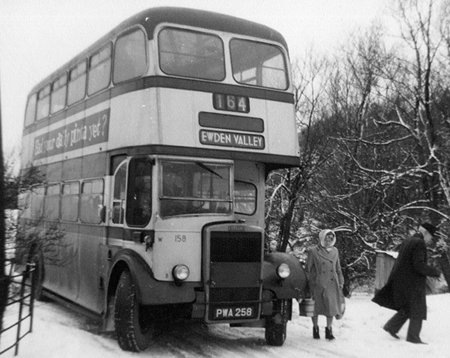


Sheffield Corporation – Leyland Titan PD2 – PWA 258 – 158

Sheffield Corporation - Leyland Titan PD2 - PWA 258 - 158   Copyright Ian Wild

Sheffield Corporation
1953
Leyland PD2/12
Weymann H32/26R

Sheffield operated a number of occasional services to small villages and hamlets to the north west of the City. Ewden Valley Village lay about a mile off the main Sheffield to Stocksbridge route 57 via a Sheffield Corporation Waterworks private road and was primarily home to workers at the adjacent reservoir. Service 164 was sparse but included this Saturday morning journey taken in February 1963 with a few villagers complete with shopping leaving Weymann bodied Leyland PD2/12 at the terminus in the snow. The bus which was allocated to Herries Road Garage was one of the 1953 B fleet batch of 26 such buses originally numbered 142-167 but renumbered later in 1963 with the addition of 2000 to their fleet numbers.

Photograph and Copy contributed by Ian Wild


24/02/11 – 08:10

Coincidence. Was just looking at 687 on the South Yorkshire site before I came here to find 158.
Ewden Valley is part of the beautiful Sheffield "Lake District" of reservoirs (and forestry) to the north of the city. Originally part of the West Riding, the area came into the city with the 1974 Local Government reorganisation.
Note the treacherous conditions with "raw" snow. At least the driver had a manual gearbox to help him cope. I drove part time for Reading Mainline in the ’90s and remember a happy Saturday morning in Reading when none of the side roads had been gritted. [I had never been skating before this…..]

David Oldfield


24/02/11 – 09:19

I worked in Sheffield during that winter. I can’t remember the buses ever stopping, but perhaps they did. I don’t think I missed a day’s work. This bus has- it seems- reversed into its terminus gritless. Presumably with a gentle bit of clutch work it will set off on that lock? Are today’s buses not gritless but gutless- these people wouldn’t have seen one for weeks? Despite the weight at the rear, does the transmission stop them getting a grip or are they just too long to control and the rear weight just makes them jack-knife?

Joe


24/02/11 – 10:11

Joe, I lived through some pretty harsh Sheffield winters in my childhood – notably 1962. Once the ploughs and gritters had been out, the buses emerged. The STD buses very rarely failed the burghers of Sheffield.
With a clutch there is far more control than any sort of automatic gives. This is one reason that all STD buses from 1951 to 1959 were manual. (The advent of "no-choice" on Atlanteans and Fleetlines put an end to this – and possibly the fact that the Atlantean killed off the last trams and was easier to convert tram drivers.)

David Oldfield


24/02/11 – 10:13

Joe – Many of us older drivers know that, in snow, you need grip, not power. The answer is to pull away and accelerate in a higher gear than usual, easy with a manual gearbox.
Also, modern buses have smaller wheels, I’m sure, so a smaller ‘footprint’ in the snow.
There may be other considerations, too, of which I can’t think offhand.

Chris Hebbron


24/02/11 – 21:33

What a handsome body was this penultimate Weymann style, before the advent of the "Orion". I believe that this style was heavier than the Orion, and that it continued after the 1954 Orion body and was known as "Aurora", availability continuing until the late 50s. In fact, Bournemouth`s MF2B trolleys owe much to this design. Not sure about my facts here, if anyone can clarify, but, as an enthusiast, I remember their gradual demise with some regret. They were, in my view, the most handsome of all bus bodies, and were a real "classic", their ancestry being traceable back to the first Weymann metal bodies of 1933. A truly evocative photograph!

John Whitaker


24/02/11 – 21:58

In reply to Joe, I am pretty sure that the bus as pictured had driven in to that position, it would reverse to the right of the photo before returning to the main A616 and the City down the private road which is to the left of the picture.
The nearest bus route to my home was on a pretty steep hill and I can remember in the snow drivers would go as slow as possible at the bus stop whilst the passengers jumped on the rear platform. Rarely did the buses miss in those days. My first two winters at work were 1962 and 1963. The first I was at Rotherham, the second on the edge of Sheffield City Centre, as well as two nights a week at night school. I cannot remember missing either work or night school during those winters due to the weather. I remember the single skin upper saloon domes with ice on the inside – no saloon heaters in those days!

Ian Wild


25/02/11 – 08:38

Rochdale received the Aurora on Regent Vs until 1959 (including the famous Gardners in about 1956) and Bournemouth was receiving the Sunbeams until 1962. The Bournemouths were the same design – except they had five short bays – just as the Rotherham CVG6s, contemporary to 158, had five short bays (and were also 7’6" wide).
The Orion is much maligned – often unfairly – but there is no doubt that this is a far better and more attractive design. Only the roof of the domes was single skinned on the Aurora. Around the front (and front side) windows was double skinned, as was the area around the rear emergency exit. All of this area was single skinned on the Orion.
As I’ve said before, the first upper deck heating on STD buses was the 1325-1349 Regent V/Roes of 1960.

David Oldfield


25/02/11 – 09:37

I can’t quite work it out on the photo, and it might be a trick of the eye with dirt/snow along the bottom, but does this body have the Weymann flair? If so, it would be quite late to have this feature.

Chris Hebbron


25/02/11 – 11:18

Yes, 158 had the Weymann flaired skirt. Also, PD2’s 668 to 687 of 1953 and 688-723 of 1954 had the flair. Straight ‘skirts’ were fitted to this body style for the Regent 3’s of 1954, nos. 178-199, 724-735 and 1154-55. Further deliveries thereafter were Orions.

John Darwent


28/02/11 – 06:59

This body design came out in 1952 or 1953. I have been aware for some time that Croft of Glasgow built similar-looking bodies, and have always assumed that they were Weymann-based – until I discovered that Croft were actually building them several years before Weymann! The one at this link must have looked incredibly modern in 1949.

Peter Williamson


02/03/11

Thanks for the Albion-Croft link, Peter W. The Croft body’s modern look is emphasized by the wonderfully thirties-looking Albion chassis–especially the radiator!

Ian Thompson


06/03/11 – 08:18

The Rochdale 1959 Regent V’s were probably the final incarnation of the Aurora design and what magnificent vehicles they were. When originally delivered in Rochdale’s majestic blue and cream streamlined livery they looked superb. The last four 319-322(TDK 319-322) had platform doors, believed to have been added to the spec so as not to be outdone by Bury Corporation whose Orion bodied PD3’s had this feature and operated on the joint routes 19 and 21T between the two towns. Compared to the Bury vehicles which I always found noisy and rough, the Rochdale Regent V’s with their semi-automatic gearboxes, were much more refined.
One of these vehicles was preserved at Sheffield Bus Museum. Is it still there? One of the 1956 Gardners is in the collection at Boyle Street, Manchester.

Philip Halstead


06/03/11 – 09:09

Yes, it’s still at Rotherham. [The museum moved!]

David Oldfield


07/03/11 – 09:27

I remember the Rochdale Regent Vs (and the preceding Daimlers with basically similar bodies) very well as I used to use the 17 service in Manchester regularly. What impressed me even more than the features Philip mentions was the interiors. They were fairly basic really, with leatherette seats and painted metal window cappings, but who would have thought that two shades of blue, together with a strangely translucent white on the ceiling, could be so restful? With those colours, the smoothness of the drive train and the soporific crooning of the transmission, a 12-minute journey on one of those was almost enough to induce an altered state of consciousness!

Peter Williamson


12/03/11 – 08:00

I agree with Peter, the Rochdale interiors were plain but very clean and fresh feeling. As a child I was a bit susceptible to travel sickness and somehow the Rochdale interiors seemed to calm my problem. It is surprising how interior features stick in ones mind from those childhood days. Manchester’s ‘standard’ bodies were very dark and oppressive inside with dark moquette seats and dark varnished woodwork. In the days of almost universal adult smoking the moquette seating seemed to soak up the stale tobacco fumes even in the lower saloon. We used to travel into Manchester from Rochdale on the 24/90 service, jointly worked by Manchester, Oldham and Rochdale corporations and I would always hope our bus would be a Rochdale vehicle.
The Oldham buses had some distinctive internal features I well remember. Hanging leather straps in the lower saloon with handles similar to horse-riding stirrups. A row of domestic style Bakelite light switches with porcelain fuse holders on the front lower saloon bulkhead above the driver’s cab window. The words ‘Oldham Corporation’ were emblazoned across the front bulkhead in gold lettering – civic pride still existed in those days! And finally the ‘Honesty Box’ on the rear platform. Did anybody ever put anything into it, I wonder? I also remember the Oldham Roe bodies were a bit short on bell pushes in the upper saloon and conductors would give the starting signal from the front with a couple of heavy stamps of the foot on the floor above the cab!
We seem to concentrate our interest in the exteriors of buses but not much is written or photographed about the insides.

Philip Halstead


13/03/11 – 08:05

Philip, I fully agree regarding bus interiors. That was the environment in which you travelled, and it was often very distinctive – location and style of bell pushes (or cords or strips), pattern of light fittings (before the arrival of standard fluorescent strip lights), seats and upholstery – even smells. Perhaps there are a few more interior shots out there to add another dimension?

Stephen Ford


04/06/18 – 07:03

This is a few years after Stephen’s comment which I’ve only just read, but with regard to ‘smells’, I used to love getting a green West Riding tin-front Guy from Sheffield to Ecclesfield back in the 1950’s. Unlike the STD buses, they were cleaned with a pleasant, perfumed disinfectant which I can still ‘smell’ to this day.
At that time, I think both West Riding and Yorkshire Traction buses carried posters on the windows stating ‘Cut the fuel tax. We don’t like it, you don’t like it, it must GO!’. Anyone else remember that ?

Mike C


Quick links to the  -  Comments Page  -  Contact Page  -  Home Page
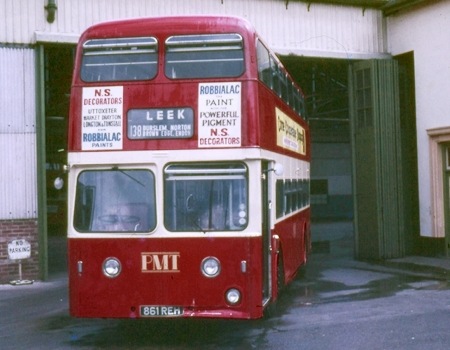


PMT – Leyland Atlantean PDR1/1 – 861 REH – L861

861 REH_lr   Copyright Michael Crofts

Potteries Motor Traction
1961
Leyland Atlantean PDR1
Weymann L39/33F

This is one of a batch of 105 Atlanteans delivered between 1959/1961 and the above picture was taken at the water point at the PMT Newcastle under Lyme depot. It was very rare for this type of vehicle to do the Leek route as it was normally worked by Leyland Titan PD3’s and this bus would normally be on the Longton Newcastle Estates route. So it was a pleasure for me and a first to go to Leek in an Atlantean as I liked driving these splendid vehicles unlike the Daimler Fleetline which I detested. The prefix L in front of the fleet number denotes a low height body which was one of the reasons why this type of bus was normally on the Longton service as there was a low railway bridge in Longton.
During the Potteries annual holidays double deck vehicles would be used on the express service’s to Morecambe and Blackpool, the buses would be either Atlanteans or Fleetlines with Alexander bodies the latter being hard work with their hydraulic throttles and having a top speed of 42 mph, the Atlanteans on the other hand would do between 52-55mph.

Photograph and Copy contributed by Michael Crofts


22/02/11 – 10:06

Thanks, Michael, for this interesting picture of another early BET company Atlantean. As you say, they could really motor, but they didn’t half drink the diesel when doing so. That was just one of the reasons why some operators changed to Fleetlines; lower overall maintenance costs was another.

Roy Burke


22/02/11 – 19:54

Good to see this photo of what was the most common type of bus in the PMT fleet in my time working there. Longton Depot had some of the earliest batch and achieved phenomenal engine mileages of 400,000+ between failures. Frank Ling was the Depot Engineer there and maintained a very high standard of maintenance. My first winter there was a cold one and the Atlanteans frequently failed with the air system unloader valve frozen causing the vehicle to lose all air pressure and hence drive. The unloader valve was mounted under the cab in one of the coldest locations on the vehicle. A rag on a steel bar, dipped in diesel and set alight was the quickest means of unfreezing the unloader and restoring normal operation. Flywheel gland failures were another problem coating the engine bay in oil with the consequent fire risk (wiring fires in the Atlantean engine bays were not uncommon not aided by the wiring insulation becoming brittle with age and falling off). Quite a number of Atlanteans had to be rewired, some being dealt with by local Contractors as the level of work exceeded the available labour in Central Works at Stoke. Leyland tried adding a fan bolted to the fluid flywheel (more correctly the fluid-friction clutch) on a number of buses but there was no real improvement. As originally built, the chassis had rear light units fitted on the rear sub frame and which shone through holes in the fibreglass engine cover. PMT later fitted high level rear lights in the rear ‘tween decks panels thus eliminating the wiring to the sub frame lights located as they were in a very oily environment. The main rear lights were fitted to the lift up rear engine cover and the additional lights were necessary to provide rear lights at night if it were necessary to open the engine cover whilst on the road at night. Oh happy days!!

Ian Wild


22/02/11 – 19:55

The early Atlantean in low height form was a modified lowbridge bus in reality on the other hand the Fleetline with its drop centre rear axle was a true lowheight vehicle from the off It took Leyland until 1966 (four years after the first Fleetlines entered service) before they offered a low height chassis which removed the low bridge layout from the top deck. Having said this the Atlantean PDR1/2 was not one of Leylands finest although when it appeared the AN68 was what the Atlantean should have been from the off

Chris Hough


26/01/13 – 06:24

The seating in the forward part of the upper upper deck on these buses was too low in relation to the window line whilst the rear rows of 4 were too high! This is except the initial row of 4 which were mounted straight onto the raised rear platform resulting in an excellent match between seat height and window level.

Ian Wild


Quick links to the  -  Comments Page  -  Contact Page  -  Home Page



All rights to the design and layout of this website are reserved     

Old Bus Photos from Saturday 25th April 2009 to Thursday 4th January 2024