Old Bus Photos

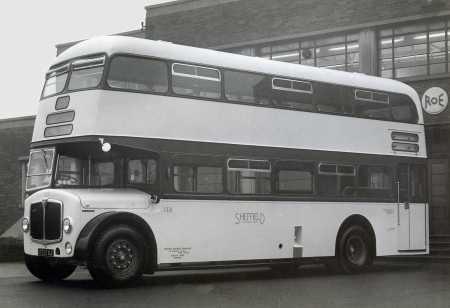
British Rail – AEC Regal III – KRR 261
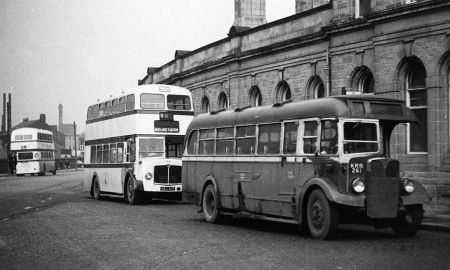
British Rail - AEC Regal III - KRR 261
Copyright Ian Wild

British Rail
1949
AEC Regal III
Weymann B35F

British Rail ran a staff bus between Sheffield Midland Station and Tinsley Marshalling Yard and at various times used this ex Mansfield District bus (fleet number 15), similar KRR 264 and KRB 88 which was an ex Midland General Leyland PS1 with a similar body. All ran in the colours of their previous owners. Later the work was contracted to Chesterfield Corporation who used one of their fleet of AEC Reliances to cover the duties.
One of Sheffield’s 1957 Regent V/Weymann is behind, laying over at the terminus of service 60 to Crimicar Lane. This service had been extended from its former Leopold Street terminus in the City Centre to provide a useful link to the Midland Station. In the background one of the 1960 Alexander bodied Regent V is about to turn left into Pond Street Bus Station.

Photograph and Copy contributed by Ian Wild


11/05/11 – 15:37

Fascinating. Was a regular user of the 60 between Crimicar Lane and Midland Station – especially on the said Regent Vs. Was never aware of – and therefore never saw – the British Rail staff buses of any description. PS1 would have been 1946 onward but Regal III would have been 1947 onward. Other than that, I’m no help at all with the date.

David Oldfield


11/05/11 – 19:32

Not a terribly helpful comment, but I believe C T Humpidge was responsible for the blacking out of the cross pieces on the destination indicators as seen on the AEC Regent V and he took up post following R C Moore’s retirement in May 1961.

John Darwent


12/05/11 – 07:00

Yet another fascinating Sheffield picture. In tram days, there had been additional cars on the Walkley section of the main cross-city route to Intake running between Walkley and the Midland Station, quaintly showing ‘LMS STATION’ on their blinds. When the buses took over from the trams on 8th April, 1956, the new 95 bus service was extended at the Walkley end from the old tram terminus along to Tinker Lane, and additional buses were put on between Elm Tree at the Intake end and Walkley (South Road) where the trams had terminated, but the connection to the Midland Station was severed.
To reinstate that link between the railway station and the city centre, and no doubt to the delight of Fulwood passengers who up until this time had managed to get only as far into the city centre as Leopold Street, alternate journeys on the route 60 Fulwood were extended from Barker’s Pool down High Street and Commercial Street to the Midland Station. Imagine getting off your train to be greeted by just such a sight as this one, of a splendidly turned out AEC Regent V waiting on the station forecourt. The heyday of the bus, indeed.

Dave Careless


12/05/11 – 07:03

Ah what beautiful vehicles! There were 25 PS1’s new to Midland General in 1948 and 24 Regal III’s new to Mansfield District in 1949. The bodies were similar but the PS1’s were bodied by Saunders, withdrawal of these started in 1962 and was completed in 1964, Two went to British Rail, KRB 87/88 in 5/64 and 4/63 respectively. About a dozen of the Regals were transferred to Midland General in 1958 and whilst MDT began to withdraw their remaining ones in 1962, MGO kept their acquisitions until 1967, just short of 20 years service. They usually worked out of Alfreton garage on MGO’s ‘rural’ services E2,E3,E4 and E5 between Alfreton and Matlock, routes with some very steep hills, but their 9.6 litre engines could out-perform the later LS’s and MW’s any day! I remember being taken to Matlock on summer Sundays and I loved to travel on these, which were always kept in beautiful condition. On arrival at Matlock Bus Station, they kept company with Silver Service’s wonderful vehicles and North Western’s Bristol K’s. Matlock was a great place to visit then!
Fortunately, one of the Regals, KRR 255 is preserved and I believe it usually resides at the Midland Railway Centre, Butterley, Derbyshire.

Chris Barker


12/05/11 – 07:05

The KRR Regal IIIs were new in 1949. KRR 255 is preserved and active.

Peter Williamson


26/10/11 – 10:45

After service with British Rail KRR 261 went to Sykes a dealer at Worsborough Dale South Yorkshire.
Does anybody know if this dealer is still trading?

Gren


01/12/12 – 15:53

Am I right that Paul Sykes of Sykes is the same Paul Sykes who developed the giant Meadowhall mall in Sheffield & other ventures, one of the richest men in England?
He probably doesn’t need to strip buses much now, but is the company or yard still going?

Joe


09/06/14 – 06:55

British Rail in 1949?
oh no! Please gentlemen, surely it could only have been British RailWAYS ?
Unfortunately that error seems to be perpetuated by most of the present day railway and model railway press.
Despite that pedantic comment on my part, I have to say that I find this to be a marvellous site which I visit regularly.
Thanks to all involved

JOJ184


09/06/14 – 11:09

JOJ184, I’m afraid you are making the same error as those you are complaining about. There is nothing pedantic about accuracy and you are being accurate. Far too many people, particularly those working for various media, who claim great education, research and gravitas, daily project errors onto the airwaves, into print and on line.
Given their standing and the widespread unthinking acceptance by the public of what they read and hear, especially from rolling news and internet sites such as Wikipedia, historians and researchers of future generations are going to have their work cut out to reach the truth.
Rant over!

Phil Blinkhorn


10/06/14 – 07:56

I’m not sure that anyone is being accurate actually. 1949 is the year the bus was new. The date it was photographed with BR is as yet unknown. It would be helpful if someone could post the date on which BR changed its name, then we might have a firmer basis for saying which name should be used.

Peter Williamson


10/06/14 – 07:57

Phil, whilst wholeheartedly agreeing with your comments above I think JOJ184 has misinterpreted the heading caption to the photo.
While it is somewhat misleadingly put as British Rail 1949, the year is actually referring to the AEC Regal III/Weymann build date.
If you look closely at the side of the bus it is sporting the double arrow logo of British Rail and would have been taken sometime after 1965 hence on this occasion British Rail is the correct terminology.
Strange how the board was still known as "The British Railways Board" long after the name British Rail came into use.

Eric Bawden


10/06/14 – 07:58

KRR 255 is here https://www.flickr.com/photos/emdjt42/3601052489/

John Darwent


10/06/14 – 07:59

If I recall the British Railways rebranding took place around 1965 and included the change of name, the both ways logo and a typeface- Rail Alphabet. This justified a memorable edition of Design Magazine. It was a major step forward- clear and attractive. Apart from London Transport and its successors I’m not sure if any other combination of transport providers has ever done anything like this: logos have been generally messy, undistinguished or unnoticed and liveries- shall we say- lacking in design coherence and simplicity. Some, like SYPTE’s red and yellow or Lincolnshire RC / YTC’s purple and yellow were just awful.

Joe


10/06/14 – 07:59

For the record, JOJ184, British Railways changed its trading name to British Rail in 1965. So none of this thread would include WAYS!!

Chris Hebbron


10/06/14 – 08:02

Wasn’t the Sheffield Midland-Tinsley staff shuttle worked subsequently by SUT (using East Midland buses on summer Saturdays, when all SUT’s coaches would be in demand), and then by Booth & Fisher? I imagine the need for the contract came to an end when BR realised just what a white elephant Tinsley marshalling yard was.
And I’m sorry to be a pedant here: but, Phil and JOJ184, the British Rail reference is correct as the picture must date from after the British Rail corporate launch in 1965 . . . as the bus is clearly sporting the BR double arrows.

Philip Rushworth


10/06/14 – 08:03

I’ve answered my own question. Wikipedia says that British Railways traded as British Rail from 1965. My copy of BBF5 is dated April 1965 and shows KRR 261 still with Mansfield District. Therefore the photograph must have been taken in 1965 or later, so that "British Rail" is probably correct.

Peter Williamson


10/06/14 – 15:56

The point about the discrepancy between the date of the bus being built and the date of the photo is well made, as is the fact that the vehicle bears the British Rail logo, dating the picture to 1965 or later. With regard to the British Railways Board and the British Rail name, Peter Williamson has it spot on. British Rail was a trading and marketing name so, had this been a non nationalised company it would have been listed at Companies House as British Railways t/a British Rail.

Phil Blinkhorn


10/06/14 – 15:57

Paul Sykes the bus scrapper is also Paul Sykes the builder of Meadowhall and now chief backer of UKIP

Chris Hough


11/06/14 – 07:48

"British Rail" may be chronologically correct for the photograph, but it is still grammatically gormless. I still resent the term "Rail Station" which, to me, indicates a repository for bulk steel strips, not a boarding and alighting point on a particular mode of transport. Would Gerard Fiennes, if writing today, entitle his book, ‘I Tried To Run A Rail’? I can just about accept "Train Station", which is compatible with "Bus Station", but the correct term for the transport infrastructure is ‘Railway’, whatever the marketing morons would wish to thrust upon us. (Dr Johnson is dead; long live Dr Johnson.)

Roger Cox


11/06/14 – 07:50

For clarification, I took the photo on 10th February 1968 hence well into British Rail days

Ian Wild
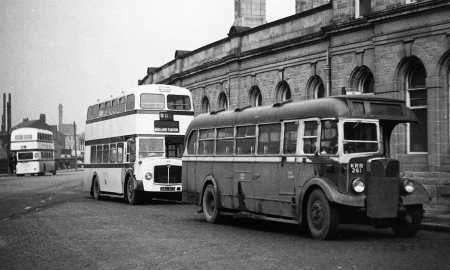

KRR 261_lr Vehicle reminder shot for this posting


24/02/15 – 15:02

EFE produced a model of an AEC Regal in British Railways livery. It has the registration HKL 842 (Sheffield?) and the code 851-SOM on the sides. Does anyone have any information about this vehicle?

Ian Rawstron


25/02/15 – 06:04

HKL would be a Kent registration Ian.

John Darwent


25/02/15 – 06:05

If you look at:
//www.classicbuses.co.uk/mdreg.html  and scroll down a bit there is a detailed history of the whole batch with a couple of photographs. It was new to Maidstone & District.

David Beilby


Quick links to the  -  Comments Page  -  Contact Page  -  Home Page
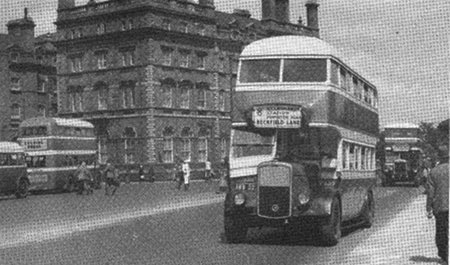


York – West Yorkshire – Bristol GO5G – AWW 27 – Y 327

York Station
Copyright Keith A Jenkinson

York – West Yorkshire
1935
Bristol GO5G
ECOC H58R

This picture was taken at York Station in 1937, and shows the vehicle, in its original livery, on the ‘Circle’ route – 1/8, Tang Hall – Beckfield Lane – Burton Stone Lane. The vertical line in the middle of the ‘bible’ indicator clearly suggests that the flap would have been turned over like the page in a book rather than being raised or lowered. However, the entire ‘bible’ would have needed to be changed some 15 or 16 times a day on this service – something of a chore for the crews.
To my shame, I have to say that, despite some of them being in service until 1952, I have no personal recollection of the Y-WY GO5Gs; the 1939 K5Gs, (and the 1938 K5Gs, after rebodying), were regularly used on routes with which I was very familiar and I knew those buses well, but I just don’t remember the GO5Gs. My only excuse is that Y-WY introduced Bristol K6Bs on the circle route – maybe in part because they had blinds – by the time I was about six years old, so the GO5G’s must have been used elsewhere in the system, (e.g. taking John Whitaker to Leeds!).
Behind Y327 is Y413, an ex-West Yorkshire lowbridge Leyland TD1; opposite is Y329, another GO5G.
My thanks to Keith A Jenkinson for his kind permission to use the picture.

Photograph and Copy contributed by Roy Burke

———

09/05/11 – 07:57

There is something about the character of Bristol buses…old ones anyway. Business like, efficient, and thoroughly economic, and absolutely oozing with character. This photograph just sums it up for me. My Bradford based memories are of the lowbridge variety, so it was always a pleasure for me when, as a child, we went to, or through York, as the highbridge version was a rare treat.
Thanks for the memory Roy!

John Whitaker


Quick links to the  -  Comments Page  -  Contact Page  -  Home Page
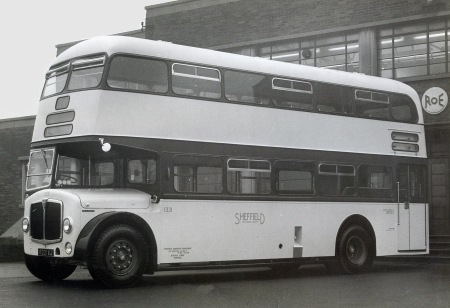


Sheffield Corporation – AEC Regent V – 6331 WJ – 1331

Sheffield Corporation - AEC Regent V - 6331 WJ - 1331

Sheffield Corporation
1960
AEC Regent V 2D3RA 
Roe H39/30RD

This was part of another big order that Sheffield placed with AEC in this case for a total of 71 Regent V 2D3RA model, all delivered in 1960.
1331 was part of the B fleet contingent of 25 buses all of which had this style of Roe bodywork whilst the A fleet received vehicles bodied by Weymann and Alexander.
Items to note in comparison with Roe bodied Leyland PD3 fleet number 462 delivered the year previously is the reduction in the number of sliding windows by two in each side of each deck but the inclusion of vents in the front top deck windows plus of course the addition of platform doors. These were manually operated by the conductor and would no doubt be appreciated on some of the longer services such as the 72 to Castleton in the Peak District. I have a watercolour painting done for me many years ago by a good friend of one of this batch operating on service 72 between Bamford and Hathersage.
Comparing this bus with Roe bodied Regent III fleet number 1265, the change of livery to include a cream painted radiator surround gives the bus a lighter appearance whilst in this case the legal owner is Sheffield Transport Department.
Although many of this batch were withdrawn in 1972 (maybe at the expiry of their second CoF – 7 years initially plus 5 years recertification), my PSV Circle fleet list shows this bus as still in service in October 1973.
This is another Coachbuilders official photograph taken at the Roe premises in Crossgates, Leeds.

Photograph and Copy contributed by Ian Wild

A full list of Regent V codes can be seen here.

———

04/05/11 – 11:49

Here we have it, Ian. My absolute favourites from my Sheffield childhood. Although, for the most part, built at the end of 1959, only about half were delivered on 1 January 1960, the rest were delivered on 1 April with the residue of Weymann and Alexander buses.
There was a minor difference in that one sub set had an extra slider (on each side) just behind the bulk-head inside. I think these were what I called the Leadmill set – found on the 12, 22 and 59. The East Bank set were delivered in April and were put to work on the 38. It leads me to surmise that 1331 was an April, East Bank, bus. [Often, lower fleet numbers seemed to arrive before higher ones.]
I’m still hoping that 1330, at Aldwarke, will eventually be rebuilt and take to the road.

David Oldfield

———

05/05/11 – 07:05

A classic photograph, with the fluorescent lights fully on in what was apparently the Roe drawing office in the background, where these wonderful bus bodies were designed and detailed!
1331 as it happens was the last Roe bodied Regent V in service at Sheffield, being finally withdrawn on 13 May, 1976. The other three of the batch which accompanied 1331 into that last year of back loader operation were 1332, 1336 and 1339, the three of them coming off the previous month. For the record, 1331 completed a full last day in service on that May day, shuttling back and forth between Sheffield Lane Top and Bradway on the 76; a fine testament to a superb vehicle.

Dave Careless

———

05/05/11 – 12:16

Bradway (75)? or Lowedges Road (76)?

David Oldfield

———

06/05/11 – 06:59

To all, interest in the Sheffield Transport/SJOC matters are certainly gaining momentum!
The comments on the later intake of Leyland PD2/20 and 30, followed by the longer PD3/1 vehicles is a very interesting point. Undoubtedly, the problem of the Leyland change in the gearbox specification was a hard blow, particularly with respect to the newly trained, ex tram drivers. Possibly Leyland thought that Sheffield would turn to the Pneumocyclic option. The 40 PD2/20 Roe bodied batch in 1956 were taken into the A fleet, featuring the latest constant mesh/synchromesh gearbox. They were mainly replacement buses and would be driven by experienced drivers. Conversely, as time went by, the former tram men gained more driving experience and were able to master the buses lacking synchromesh on 2nd gear. Very definitely the 30ft long PD3/1/Roe buses, much heavier than the PD2 versions,were a problem to many skilled drivers,on steeply graded routes. To this end, the Chief Driving Instructor Charles Deamer devised a method of "Snatch changing" (a brutal change from 1st to 2nd gear) when starting on steep hills and this method was also used on the PD2’s. However, the driving staff preferred the easier life when in control of the AEC Regent Mark 111 and Mark V versions of 27ft and 30ft buses. Manager C.T.Humpidge re-introduced fluid transmission/Monocontrol to Sheffield A,B,& C fleets in 1964/5 and no further synchromesh buses entered service.

Keith Beeden

———

06/05/11 – 07:19

Well David, it was a long time ago! Perhaps it did a stint on both, but all I can say is that it was out all day, didn’t break down, and definitely wasn’t on the 33 from Lane Top to Hemsworth!!
1331 had a spell at Bramall Lane garage early in its career, as it shows up there in the allocation list dated 11th January, 1963, (with eight of its sisters, 1325-1330, 1332 and 1349) but that garage closed later that year, so presumably was an East Bank bus after that for most if not all of its working life. Fascinating hobby this, isn’t it!

Dave Careless

———

06/05/11 – 15:36

Certainly is and its good to know there are other Sheffield expert/enthusiasts out there. We may be outnumbered by the West Yorkshire lot and we can’t post as long as East Yorkshire but we will fly the flag for the People’s Republic of South Yorkshire (!!!).

David Oldfield

———

07/05/11 – 06:06

At PMT all the Leyland Titans, both PD2 and PD3 had the Leyland GB83 constant mesh second gearboxes. The driving school there taught the snatch change method of getting from 1st to 2nd on a hill start. Although not in the same league as Sheffield, the Potteries area did have a number of steep hills to negotiate. Once you got the hang of it, the snatch change was quite easy. The gear lever travel on the GB83 was much shorter than on the synchromesh second unit (think that was a GB74) which made the buses so fitted that much easier to drive. I queried the non use of synchro 2nd gearboxes at PMT and was told that the constant mesh 2nd gearbox had a generally longer service life between repairs. Even the Matador recovery vehicle had acquired a Leyland 0.600 engine and a GB83 gearbox!

Ian Wild

———

09/05/11 – 08:16

The Sheffield thread is fascinating. My brother-in-law-to-be was doing a practical stint at Laycock’s in 1960, so I went up to join him for a couple of days and we went merrily tram-riding only months before closure. My very favourites were the 1937 batch, but they were all very stylish, so it’s fitting that the 1959-60 Regents (which I assume were the tram-replacement batches) were so handsome. Even the Bridgemaster (not usually a favourite of mine) is well-proportioned—with the bonus of a prodigious seating capacity.
Keith Beeden’s point about hardened gearwheels is an eye-opener: I knew that many variables affected the music of the same gearbox in different vehicle types, but I never realised that mere (!?) metallurgy could play such a part. But it makes sense: cardboard gearwheels wouldn’t sing. Could the hardened teeth that Keith mentions have been used in the NTG…-reg 1954 Rhondda Regent IIIs? They certainly had a distinctive whine.
I’ve never driven a PD2 (except for an RTW) so I don’t know whether a clutch stop was fitted or not, but it certainly should have been! A clutch-stop would save wear on the cones when engaging 1st or 2nd from neutral, but I guess the builders judged that synchromesh had made that wonderful, simple device redundant.

Ian Thompson

———

09/05/11 – 08:19

A driver at Manchester once told me that the problem with the snatch change from first to second on the half-synchro PD2s was that every bus was different. Some required more skill than others, and some would not accept a snatch change no matter what. He found it more reliable to move the lever out of first, across the gate and gently forward, slowing the clutch down on third gear synchromesh, and then snick it quickly back into second.

Peter Williamson

———

10/05/11 – 07:13

A very ingenious solution, Peter!

Chris Hebbron

———

10/05/11 – 07:15

Ian, I agree with you about the Sheffield Domed trams (1936 – 1939 + war-time rebuilds). The majority of the tram replacement buses were 27′ Regents and Titans and I think, strictly, the only 30′ Regent V tram replacement buses were the Weymann and Alexander examples (A fleet). The Roe were B fleet – and there were no B fleet trams!
I also agree with you about the Bridgemaster which looked good in Sheffield colours and with the traditional back end. It was the front loader which looked all wrong.
Was never aware that the Bridgemasters caused any problems with reliability. That being the case, what was really the problem with it? Interesting to think of a comment I read that AEC pondered the possibility of replacing the Regent V AND the Bridgemaster with the Renown. Again, never heard of reliability problems with them either. …..unless anyone out there knows otherwise.

David Oldfield

———

12/05/11 – 9:39

Thanks for the clarification, David. I’ve never understood the Sheffield A-fleet/B-fleet distinction though, so perhaps you could outline that for me as well.

Ian Thompson

———

A Fleet: wholly owned by Sheffield Corporation for routes entirely within the City bounds, including those which replaced tram routes.

B Fleet: owned jointly by Sheffield Corporation and the Railway Companies or Boards. [Sheffield expanded its borders progressively from about 1920 until 1974. B fleet routes included some on the outer edge of the City which had previously been in Derbyshire or the West Riding and some which went over the borders.]

C Fleet: owned entirely by the Railway Companies or Boards. These routes included some Derbyshire routes but also all the long routes, including Manchesters and Retford/Gainsboroughs. For most, although not all, of its existence, C Fleet buses shared the same livery and generally similar types to the A (and B) Fleet.
Management of all three fleets and routes was common, types of vehicle were similar (although platform doors and different seats may differentiate) and, of course, coaches would be B and C Fleet.
The JOC (Joint Omnibus Committee) was set up in 1927 principally with the LMS and LNER Railways. With Nationalisation in 1948 these became Midland and Eastern Regions. The formation of NBC in 1969 caused the disbandment of the JOC – which had in effect performed as a regional bus company such as, and in the territory of, Yorkshire Traction and North Western. Many C Fleet buses were then, at this time, dispersed among NBC subsidiaries, notably Yorkshire Woolen. JOCs seemed to be a very Yorkshire thing – Halifax, Todmorden, Huddersfield – although Railways always had a stake in BET and Tilling companies as well prior to NBC formation.
Although the Corporation retained most Derbyshire work, the remaining Manchester route (48) became a North Western operation and many of the others became joint with operators with whom they had previously work anyway.

David Oldfield

———

6331W J _lr Vehicle reminder shot for this posting

———

16/01/12 – 16:34

A somewhat belated response to the comment on snatch gear changes with Leyland PD2’s and PD3’s. I learned to drive in a PD1 in 1962 and was taught the technique at that time, as this was with Eastbourne Corporation there being no serious hills to contend with I can’t remember having to use it. However I joined Southdown in 1969 at Eastbourne and soon had cause to brush up the trick especially on the 12 route to Brighton which also included trips to estates at West Dene and Tongdean on the outskirts of Brighton which were very hilly (one reason the PD3/5’s went west). Probably the worst stop was at Downs Golf club 2/3rd’s of the way up the hill out of Eastbourne, not something you looked forward to with a good load of holidaymakers in the summer. I’ve never heard of the trick told to Peter Williamson, of using the synchro on 3rd gear to slow the gearbox when changing 1st to 2nd but I did use the same method but using 4th to make selecting 2nd gear when stationary much easier and quieter otherwise 2nd would grate noisily, I read this somewhere but can’t remember where. The same technique worked equally well when used with the direct air operated Pneumocyclic box as it cut out the jolt when engaging 2nd when stationary.

Diesel Dave


Quick links to the  -  Comments Page  -  Contact Page  -  Home Page


All rights to the design and layout of this website are reserved     

Old Bus Photos from Saturday 25th April 2009 to Thursday 4th January 2024