Old Bus Photos

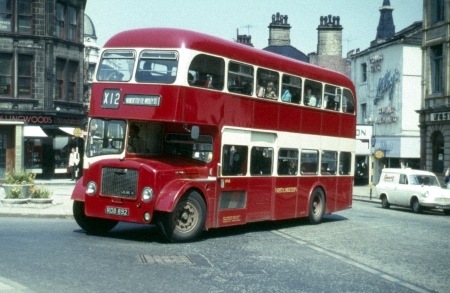
North Western – Dennis Loline III – RDB 892 – 892
RDB 892_lr
Copyright Roger Cox

North Western Road Car
1961
Dennis Loline III
Alexander H39/32F

This picture, taken on a Saturday in the summer of 1966, shows Dennis Loline III No 892 of North Western turning from Commercial Street into George Street, Halifax, on its trans Pennine X12 run from Bradford to Manchester. Double deckers were often used on Saturdays on this service, and the Loline was easily the most appropriate decker for the purpose in the North Western fleet at the time. I never saw an AEC Renown on this service, and I doubt that, with its four speed gearbox and high ratio rear axle (reputedly giving a 48 mph maximum speed – almost as fast as a Loline) it would have been very suited, though they might have been used. However, the Loline, with its exceptional stability, 6LX engine and five speed gearbox, was ideal for the job. I took several trips across to Manchester on these buses, and they were fine performers on this taxing route. Later that year, on leaving Halifax, I drove the 6LW powered versions of the Loline for Aldershot & District, and found them to be most impressive buses. Had Dennis been more consistent in marketing the Loline – it was forever being withdrawn from their catalogue and then subsequently reinstated, North Western might never have taken the Renown, though BET central purchasing policies might have been the ultimate decider.

Photograph and Copy contributed by Roger Cox


02/06/11 – 05:59

Lovely photograph Roger. As a lifelong fan of Bristol products, I also had a soft spot for the Dennis Loline – being in effect a Lodekka built under licence for the open market. I must admit to preferring East Lancashire or Northern Counties bodywork on the Loline, as Alexander’s ‘balloon roof’ style, although not unattractive, appeared somewhat top heavy to many. That said, the nicely proportioned North Western livery did its best to distract the eye, and it is interesting to note from the photo that the company had specified sliding doors rather than jack knife ones. The Northern Counties-bodied Loline IIIs purchased by Halifax JOC looked particularly attractive in that undertaking’s green, cream and orange livery. Some of the last Loline III’s (including the Halifax ones) had Bristol rear axles, with some even sporting Bristol scrolls on the hubs, but whether the Halifax vehicles had the latter feature I do not know. Dennis did seem a little inconsistent to say the least with their marketing, as you state Roger. Mind you there was also added low-height competition from AEC’s Bridgemaster and Renown, plus the Albion/Leyland Lowlander around the time the Loline was trying to establish itself, which may have had a bearing on things.

Brendan Smith


03/06/11 – 07:29

I agree with your comments, Brendan. The Loline I was a very close copy of the Lodekka – I believe that the Loline displayed at the 1956 Commercial Show was, in fact, a Lodekka with cosmetic alterations by Dennis. The genuine Loline I did have Dennis clutch, gearbox and front axle, and full air braking system – the Lodekka had air/hydraulic brakes – and the mechanically very similar Loline II, which had a forward entrance, appeared before the FLF/FSF Lodekka, though it is probable that Dennis and Bristol shared their design ideas on the concept. The Loline III, which generally had a Dennis rear axle, was much more of a Dennis design, and, having driven conventional transmission Lolines I and III, and LD and FLF Lodekkas, I found the Loline III to have been the nicest of them all. In particular, the Dennis five speed gearbox was very light and easy to use, and the gear positions followed the gate format popularised by the AEC Reliance – R and 1 at the far left and protected by a detente spring (the Reliance had a ledge and the gearstick had to be lifted) then 2,3,4 and 5 in a straightforward H pattern. The Lodekka gearbox was heavier to use, and had 1,2,3 and 4 in the H pattern, and 5 could be engaged only through 4 by moving the gear lever to the right and then forward. If one’s progress was baulked for any reason whilst in fifth, then one had to wrestle the lever back through fourth to reach neutral and the other gears. Whereas 5th was treated as a normal cruising speed even on town work with the Loline, Lodekka drivers seldom went above 4th except where the open road beckoned. The Loline I also had 1,2,3 and 4 in the H pattern, and 5th was engaged by moving the gear lever forward to neutral and then to the right and back again in a U movement. This did enable neutral to be reached directly from fifth. The Halifax Lolines did have Bristol rear axles and were so marked on the hubs. Sadly, I had left my job in the Traffic Office at HPTD Skircoat Road in 1966, and those Lolines arrived the following year, so I never got a chance to drive these fine semi auto machines. By that time I was driving the Aldershot & District examples, all of which had sliding passenger doors. I have a number of other Loline pictures which I will submit in due course. As you have pointed out, the operator’s livery could transform the appearance of a bus body. When Aldershot and District was merged with Thames Valley, the initial overall maroon livery of Alder Valley made the Alexander and Weymann Orion bodies look truly awful. As for the standard NBC livery…………!!!!!

Roger Cox


03/06/11 – 17:10

I agree entirely with your view on the advantages of a sympathetic livery Roger. The much maligned appearance of the MCW Orion and siblings – which incidentally I always liked as clean, smart and functional – was made to look positively immaculate by the Bradford City Transport blue and cream scheme.
I’ve found out much of interest from this Loline topic – I’ve always laboured under the misapprehension that the Loline differed little other than in badging and engine etc from the Lodekka – one’s never too old to learn !!

Chris Youhill


03/06/11 – 17:34

At the risk of being boring, I couldn’t agree more with the positive comments on the Loline, Chris’s comments on the Orion and the general comments on livery and its effects on the looks of a vehicle. It was good that the Lodekka was available outside BTC in this form. (Sheffield’s Orions didn’t look bad either.)
I have to say, though, that I still prefer the Renown – but then I would say that, wouldn’t I? [I regularly rode both down the Oxford and Palatine Roads in Manchester as a student.]

David Oldfield


08/06/11 – 09:50

Reading Corporation had three batches of Dennis Loline IIIs, arriving in autumn 62, summer 64 and late 66/early 67. They carried handsome East Lancs bodywork and had derated Gardner 6LX engines. The first batch had Dennis-built 4-speed gearbox, which seemed to challenge some of the Corpo drivers, cosseted as they were by the nice forgiving gearboxes fitted to the Regent II and IIIs and the Crossleys. A missed gear gave forth not so much a crunch as a resounding clang, often heard when engaging second from rest—something that made me wonder whether they had no clutch-stop. All hubs bore the Dennis name.
The later batches had a Bristol plate on the rear hubs only, and a Bristol 5-speed gearbox with 5th blanked off! Yet even without the potential for extra fuel-saving that a live 5th would have afforded, the Lolines managed over 13 mpg in this fairly hilly town. A few years back I had a drive of 76, a preserved survivor of the last batch (now with 5th UNblocked) and it was a real delight. The first two batches were withdrawn after only 12 years’ service: I hate to think how many excellent vehicle countrywide were swept off the road by the abolition of conductors!
In Classic Bus No 22 (April-May 1996) Gavin Booth and Stephen Morris compare a Renown, a Loline and a Lodekka. With all due respect to David O and all AEC enthusiasts, the Dennis Loline acquits itself very well.

Ian Thompson


08/06/2011 09:52

What excellent liveries we used to have in BET days. Fleets had a real sense of identity. There were a number of Red and Cream BET fleets but there were subtle differences in colour and layout between three contiguous BET Companies – North Western, PMT and Trent. Each was appealing in its own way. Sadly we lost it all in the Corporate blandness of NBC and as for today’s "liveries" – well the less said the better. No identity – just Multi National imposition.

Ian Wild


09/06/11 – 08:29

Not offended, Ian T, I’m sure it did acquit itself very well. I know no-one with half a brain who would denigrate either the Lodekka or the Loline.

…..not to mention Yorkshire Traction.

David Oldfield


13/03/12 – 06:09

I read that Dennis only went looking for bus orders when their other lines were having a lean time in sales, much preferring fire engines and other things than building buses. Also, as with Daimler, they took Cummins when Gardner were hard to come by and that cost them so much it effectively made them give up on commercial vehicles. Daimler took a big hit too with the Roadliner. If only, Cummins had made a better engine or Gardner had better supply! I read the comment of Mr Hilditch, GM of Halifax where he found Dennis to be the best engineered product he had come across.

John (tee)


30/11/12 – 13:21

Following up Ian Thompson’s comment above of 08/06/11, my experiences of driving the Reading buses he mentions were slightly different. I found the Regent III box less forgiving than he suggests, but it was at least consistent, so you only had yourself to blame if you got it wrong. The Dennis 4-speed boxes were far more forgiving; the gears more or less found themselves and you could almost forget about the clutch. As Ian surmises, they had no clutch stop, but there was no excuse for clashing the gears when pulling away. The options were straightforward. If you were only making a short stop, you simply dropped the stick into 2nd as you came to a stand. If you had to stop in neutral, it only required a bit of patience to drop the clutch and wait a bit; ideally you anticipated the conductor’s bell. You were never going to get a racing start anyway, as the accelerator pedal was fitted with a mechanical interlock which only released once the doors had closed. The Bristol box did have a clutch stop, and for someone like myself with long legs it was all too easy to depress the clutch a bit too far and then you really were in trouble. These buses were never so well liked as the earlier batch, as the lack of the 5th gear significantly reduced the top speed – 35mph at best compared with the over 40mph of the earlier ones.

Alan Murray-Rust


30/11/12 – 17:39

Alan, I agree entirely with your assessment of the relative merits of the Dennis and Bristol gearboxes. I didn’t drive the Reading Lolines, but I had extensive experience of the Aldershot and District Mark 1 and Mark III machines, and also occasionally drove Bristol FLFs. The A&D Lolines had Dennis five speed gearboxes, without clutch stops, and they were, without doubt, the finest constant mesh boxes that I have ever handled. They responded to a light touch – you could engage gear cleanly with the pressure of two fingers on the gear lever – and any crunching noises were a testament to sloppy driving practice, not engineering deficiency. The Bristol box was heavier and stiffer in its lever action, making neat engagement of gears more difficult to accomplish. The four speed Dennis box, coupled with the Dennis axle, had properly spaced ratios for a decent top speed in fourth. The five speed boxes, Dennis and Bristol, gave a top speed of around 30 mph in fourth (direct) gear, and the overdrive fifth brought top speed up to around 50 mph. Thus, a Bristol five speed gearbox with the overdrive blanked off would have limited road speed to 30 mph. I have commented above that, because of the gate layout and ease of using the Dennis five speed box, Loline drivers used fifth gear as a normal cruising ratio. The fifth gear on the Bristol was engaged in a contorted "dog leg" action through fourth, and getting the gearstick back into neutral and the other gears could be something of a struggle if the bus was baulked for any reason. In practice, Lodekka drivers only used fifth when faced with a clear, open road, and generally never went above fourth in urban settings. The Loline III was much more than a licence built Lodekka. It was a rather nicer machine in many respects. I cannot understand why Reading specified Bristol gearboxes and axles on its 1964 Lolines. Aldershot was taking Loline deliveries at the same time, and these had Dennis units throughout. Later, when Loline production was drawing down, the Dennis company used Bristol transmission components instead of manufacturing penny numbers of its own axles/gearboxes (the Halifax Lolines had Bristol rear axles also). This would explain the use of Bristol components in the last batch of 1966, but not in the 1964 buses. The small Dennis company had high engineering standards. As an example, the O4/O6 engines were the only British production diesels to have four valves per cylinder, and they incorporated timing gears at the back of the block and wet cylinder liners, all achieved in a powerful, entirely trouble free design. Other engine manufacturers who tried to incorporate such features didn’t entirely succeed.

Roger Cox


20/10/13 – 07:26

Very interesting reading, folks. Thanks so much for the good information. I do have a question, though, and one which I have been totally unable to resolve.
Was the sliding door on the Loline manually operated, or was it powered? I travelled on Lolines in Liverpool (Crosville), but cannot remember if the door opened automatically, or had to be opened by hand.

Terry Hill, Ottawa


20/10/13 – 11:08

Terry, the doors on these buses were air pressure operated, usually by the driver, but the conductor had a control to use if required. I drove the Aldershot & District Alexander bodied Lolines which, apart from having the 6LW engine instead of the 6LX, and 68 rather than 71 seats, were otherwise identical. Fine buses!

Roger Cox


20/10/13 – 11:09

The doors were powered. On North Western’s batches they all gave trouble sticking from time to time and sometimes wouldn’t close when climbing a steep hill, especially in later life. The main problem with them as time went on, particularly with the North Western Alexander bodied batch, was the door would start from open and, as long as the vehicle was on a relatively flat road or heading down hill, would accelerate hitting the front door post with a loud bang instead of travelling at a constant pace and slowing as it reached the closed position as the manufacturer had intended.
Considering the short distance the door had to travel the noise and the eventual damage caused was quite spectacular. The door, the door post and the mechanism all deteriorated, the results being sticking doors, damage to the frame around the door post, distorted doors and at least one instance of a door falling off as related by Peter Caunt in his book North Western – A Drivers Reminiscences.
In fact to quote him on the speed of the doors makes the point:
"This does not really describe adequately the speed at which the door closed or the terror that it inspired in those around it. What happened was the door would be open and the driver would move the lever to the closed position. For a couple of seconds nothing would happen then the door would close like lightning and would knock the hell out of the front corner pillar of the bodywork….when the door was opened it often moved sedately and correctly as though trying to inspire passengers with its genteel behaviour. The fact that it almost pushed the front off the bus when it closed is neither here nor there."

Phil Blinkhorn


20/10/13 – 17:09

Phil, the doors on the Aldershot Lolines would sometimes hit the front door pillar with a bit of a bump, but nothing worse, and (pre NBC) booking this off as a defect always got the thing sorted out. The system was designed to cushion the closing and opening action at a point just short of the end of the door travel, and the last part of the motion was completed at very slow speed. The problems you mention must have arisen from sloppy maintenance or shortage of spares or over tight engineering budgets, or a combination of all three (welcome to the world of the present day big groups).

Roger Cox


20/10/13 – 18:07

The ex Ribble Burlingham bodied PD3s at Southend suffered from the same symptoms as mentioned above. The crews referred to them as Bacon Slicers.

Philip Carlton


21/10/13 – 07:13

Crosville did not operate Lolines in Liverpool, unless an odd ex-North Western Road Car example slipped in under the radar from Warrington.
Crosville (in Liverpool) operated lots of Bristol Lodekkas (FSF & FLF) with front 4-leaf powered doors and lots of Bristol Lodekkas (LD and FS) with rear 2-leaf manual doors.

Dave Farrier


21/10/13 – 17:45

Could be from Warrington. I travelled regularly between Liverpool and Prescot. That route was served by both Crosville and Liverpool Corporation Passenger Transport. LCPT buses, which were unheated at that time, were known on the route as "Corpy ice-boxes"; it was worth the extra couple of pennies to ride on a heated bus in the Winter!
Thank you, gentlemen, one and all, for your information (and your anecdotes). My Dennis Loline is actually a 1/76 scale model, and is an exhibit in my fictitious "Heathersfield Rail/Road Museum" which I am developing as part of an "00" gauge model railway layout. I am currently writing an extensive catalogue of exhibits, and I want to make sure that the information contained therein is as accurate as I can make it (as a retired technical writer, I’m a bit obsessive about accuracy).
My model (made by Britbus) is in SELNEC Southern livery, has fleet number 889 and the licence plate number is RDB 889. If anyone has any information specific to this bus (the real one!), technical, historic or anecdotal, I would be very interested to hear about it.

Terry Hill


29/10/13 – 13:22

Terry, a picture of RDB 889 may be found here:- www.flickr.com/photos/1  A very sad looking ex NWRCC Loline after disposal by Crosville is shown here:- www.flickr.com/photos/2

Roger Cox


30/10/13 – 17:26

Loline RDB 889 had chassis number 1019L3AF2B1 and Alexander body number 6681. It was one of those equipped with the five speed gearbox and was delivered to North Western in December 1961.

Roger Cox
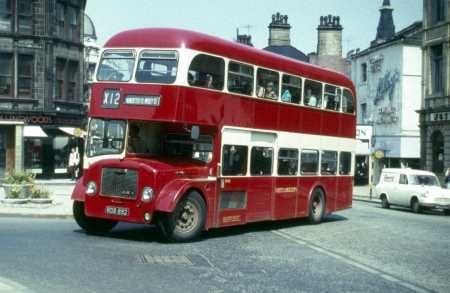

RDB 892_lr Vehicle reminder shot for this posting


28/07/17 – 16:31

I know this subject is a few years old now but I have only just found your interesting website, I drove both types of Lolines at Reading and agree with Alan Murray-Rust about the 4 speed Lolines being easier to change gear than the 5 speed version. If you didn’t engage 2nd gear as soon as you stopped at a bus stop it was hard to engage after idling in neutral. They were confined to the busy 15 and 25 routes when I drove them which were converted to OMO a few years later using brand new Scalia Metropolitans which were like Rolls Royces after the Lolines.

Ray Hunt


Quick links to the  -  Comments Page  -  Contact Page  -  Home Page
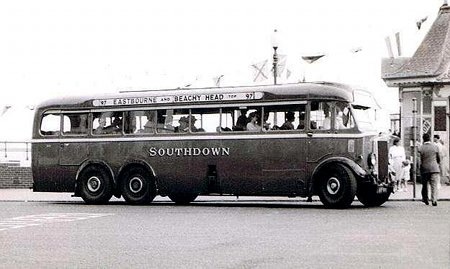


Southdown – Leyland Tiger – AUF 851 – 51 (551 from 1937)

Southdown - Leyland Tiger - AUF 851 - 51 (551 from 1937)
Copyright Jack Turley/Dinnages

Southdown Motors Services
1934
Leyland Tiger TS6T
Short Bros. B40C (B39C from about 1946)

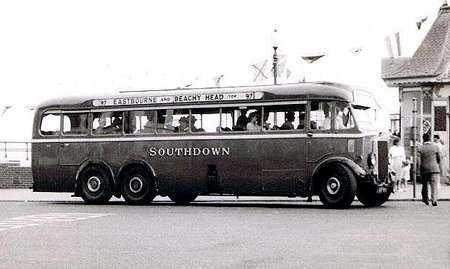
Two of these impressive and handsome vehicles (51 & 52) were purchased in 1934 for the Eastbourne to Beachy Head tourist service. The local authority would only allow the service to operate with single-deckers, so Southdown decided to buy the largest single-deckers available at the time, which, by law, had to be 30 foot long six-wheelers. Long-time Leyland adherents, they settled on the fairly rare TS6T (T standing for Trailing Axle), which enabled them to carry 40 passengers on the profitable route. A further two (53 & 54) were bought in 1935, this time TS7T’s.
Originally fitted with Leyland 8.6 petrol engines, they were all fitted with 8.6 diesel engines in 1940. Despite their luxurious appearance, they were considered to be buses by Southdown, bearing the name in letters rather than ‘real writing’!
After their hard lives, they were all withdrawn from service in 1952.
The photo shows 551, in about 1950, about to depart from Eastbourne Pier and grind its way up to the top of Beachy Head. Note the driver in his summer uniform.

Photograph and Copy contributed by Chris Hebbron


29/05/11 – 17:46

What truly magnificent vehicles, and even further enhanced by the cream side destination boards. My own experience of the ascent on service 97 to Beachy Head is confined to the delightful open top Guy Arabs in the 1960s – and there’s scarcely any need to go into detail about the delightful acoustics of that journey !!

Chris Youhill


29/05/11 – 19:15

Yes, the austerity Guy Arab II’s were converted to open-top around 1950-51 and some re-engined with 6LW engines for the Devil’s Dyke/Beachy Head services. The service became 197 around that time, too. The open-toppers were used all along the South Coast, even a couple on Hayling Island. They lasted until about 1964.
Unlike the TS6T’s, the basic Guys were regarded as coaches and given ‘Southdown’ side panels in ‘real writing’!
A 1964 film, The Chalk Garden, has Hayley Mills and Deborah Kerr boarding one of them, with it pulling away.
I don’t know how extensive the rebuilding of the bodies was, but they always looked impeccable, right to the end. Southdown were a class act.

Chris Hebbron


30/05/11 – 06:25

So true Chris H, Southdown were exactly as you say – "a class act." The winning combination of high quality handsome vehicles and impeccable maintenance was perfected even further by perhaps the most dignified of all liveries in such very pleasing colours.

Chris Youhill


31/05/11 – 11:40

and what about the Harrington Cavalier coaches with only 28 seats for there road cruises.

Roger Broughton


31/05/11 – 11:58

By the late 1960s, the Devil’s Dyke service was operated with convertible ‘Queen Mary’ Leylands. At Southdown, vehicle allocation, (including when the tops were to be removed), was decided by the Engineering Department rather than the Traffic Department, unlike other companies I knew, a practice that didn’t always contribute to efficient traffic management. Their policy on which style of company name to apply to any particular vehicle or type, was inconsistent.
I am well aware of Southdown’s reputation amongst some enthusiasts, and I have no desire either to offend anyone or spoil their image of the company. Certainly Southdown itself thought it was a ‘class act’, a view it didn’t hide from its BET neighbours.
However, at the risk of being thought sour, I remain to be convinced that Southdown was anything out of the ordinary. From an enthusiast’s point of view, its fleet was less interesting and in some ways less operationally imaginative than, for example, neighbour M&D’s fleet. For instance, I always thought M&D’s AEC Reliance coaches with ZF 6-speed gearboxes were decidedly better for both drivers and passengers than Southdown’s Leyland Leopards with Eaton 2-speed axles.
The standard of maintenance and turnout was high, granted, but the same could be said of pretty well all major operators; their livery was attractive, (even though the capital letter version of the name was distinctly old-fashioned), but, again, the same could be said of many other operators.
By coincidence, this posting follows one of Richard Fieldhouse’s lovely postings: – a West Yorkshire K6B. Having been involved at close quarters with the management of both companies, I have little doubt about which of them was operationally the ‘class act’. From a management viewpoint, West Yorkshire would win hands down every time. Sorry if I have upset anyone.

Mr A Non


01/06/11 – 08:21

I don’t have any professional reason to hide my identity but, in confidence, I can pass on similar comments from friends in the industry.
The professional perspective and that of the enthusiast often differ and I have spent hours with professional friends explaining cogently why certain things had to happen which leave enthusiasts in a spin – including the splitting up of that sacred cow, London Transport.
Personally, I couldn’t agree more about the superiority of the ZF Reliance (and M & D). I also include Southdown and Ribble amongst the all time greats – but one of my professional friends pointed out (with proofs and from personal experience) that both were basket cases when sold off by NBC at privatisation. […..and then there was the criminal end of those proud coach operators Yelloway and Sheffield United Tours (aka National Travel East) under the leadership (?) of ATL Group.]

David Oldfield


01/06/11 – 13:30

Mr Non,
You know, you should never speak ill of the dead!

Chris Hebbron


16/01/12 – 17:35

I was born and lived in Southdown territory for over 50 years and drove for them for almost 22 years at their Eastbourne depot from 1969 so worked quite a few trips to Beachy Head but I regret only with the convertible PD3’s, except for a couple of "memorable" trips with a Bristol LD6B borrowed from BH&D for a summer season. The lack of performance was embarrassing so much so that drivers on the local private coach companies complained to the management of their sluggish efforts to climb the steep twisty road up out of Eastbourne. The company was definitely a "class act", although conservative in it’s choices the vehicles were always solid reliable and very comfortable with well upholstered higher backed seats in an attractive patterned moquette, the same standards were maintained until the end of the PD3 deliveries after that they got pretty much what they were told as did all NBC companies. We felt at Eastbourne that our standards of maintenance and cleaning were higher than any other depot a view borne out when we drove vehicles from other depots (yes we were snobs) but of course all this went downhill as NBC increased it’s stranglehold on the company and things sunk to a low level, a brief respite when it was privatised (so it was a basket case) then came Stagecoach about whom I would rather say nothing. What followed was an extremely sad and messy end to a very proud and respected company but in it’s prime a true CLASS ACT by any ones definition.
R.I.P Southdown

Diesel Dave


17/01/12 – 07:07

To be fair, Dave, it may not be (traditional) Southdown but, by all modern standards, Stagecoach IS a class act. It’s just not enthusiasts’ heaven – no one makes vehicles today that are interesting enough!

David Oldfield


17/01/12 – 15:54

Very belatedly, I’ve just seen A Non’s comments above, which, by chance refer to the three companies I knew well in the 1960’s: Southdown, Maidstone & District and West Yorkshire. I was both surprised and gratified to see that views I’ve always had, but have often kept to myself for fear of offending others, are shared by at least one other person. I think he’s spot on. First, I agree wholeheartedly that M&D’s AEC Reliances, with their 6-speed ZF gearboxes, were decidedly superior to Southdown’s Eaton 2-speed axle Leyland Leopards, both to drive and from a passenger standpoint. A Non is absolutely right, in my view, and I was glad to see David Oldfield’s endorsement of his comments. A Non is also correct, I believe, in describing M&D’s fleet policy as being more imaginative than Southdown’s. M&D didn’t always get it right, (as their sad experience with the Albion Nimbus and the early Atlanteans demonstrates), but they displayed a greater concern for their passengers and staff than their conservative southern neighbours.
I agree with him, too, in his assessment of the management and management style of Southdown. They certainly made no secret, to their BET neighbours at least, of their own superior opinion of themselves. M&D and Southdown operated a number of long joint services with each other – to the point, unusually, of each company’s staff operating the other’s vehicles – but the relationship between the two managements was not especially close or particularly friendly. M&D’s Traffic Department co-operated more closely with East Kent, and both regarded Southdown as stand-offish. M&D was a pleasant company whose staff enjoyed intimate working relationships; Southdown was not.
A Non’s right about the influence of the Engineering Department at Southdown over matters that at other companies were regarded as Traffic Department issues; that policy caused unnecessary operational problems and costs, and made for relations between Traffic and Engineering that were often strained and always distant, as I know from personal experience.
Finally, A Non is totally correct in his judgment that West Yorkshire were a better managed company than Southdown. Southdown had a clumsy and inefficient management structure that may have flattered its own perceived superiority, but it cost more money than it was worth, it made decision-making difficult, and it had seriously demotivating consequences. In their own way, the Traffic Department at West Yorkshire had a high opinion of itself as Southdown’s did, but with one major difference: they were justified in their opinion. As a number of correspondents have pointed out, enthusiasts’ recollections of those days are sometimes coloured by memories of nicely turned out vehicles in smart liveries, perhaps ones they didn’t often come across and which therefore have extra nostalgic value. The managerial realities of the companies involved, however, does not always correspond with those recollections. I’m very sorry if I have offended any Southdown fans, but A Non raised important and valid points that were worth making even if they are often left unsaid.

Roy Burke


17/01/12 – 16:00

I’m assuming, David O, that your comparison is with the other big groups and am genuinely interested in learning in what respects it outshines the others. You’re right about the lack of ‘interesting vehicles around today, although ‘bottom fishing’ around the small independents sometimes produces the odd gem!

Chris Hebbron


17/01/12 – 16:01

Sorry, David. I totally disagree about Stagecoach. I have worked for this operator in the past, and now have to put up with a very poor and unreliable bus service through my village to the neighbouring towns. The Stagecoach maintenance budget is greatly over constrained, with buses suffering from extended silly faults that could be easily fixed with suitable finance. The basic obligation of a bus operator is to run the service(s) safely and reliably with clean, inviting vehicles. This is impossible if maintenance standards do not measure up. Deregulation gives bus operators carte blanche to run what they like and charge well above a reasonable margin in fares. Stagecoach has just handed out £340m to shareholders with Brian Souter and Ann Gloag personally getting £88m between them. A bit more on maintenance would be more appropriate. The present structure of our public road and rail transport industries is a disgrace.

Roger Cox


17/01/12 – 17:57

I am but a humble professional musician/music teacher with a PSV who has spent many (many) years driving buses and coaches (and preserved vehicles) on a part time basis.
I am never "opinionated" because all my comments are considered and based on fact and verifiable material. Different managers, companies and sheds may occasionally fall short of the mark; politicians may ensure that expensive initiatives funnel investment into city areas and away from the rural population but Stagecoach has been vilified, often unjustifiably, for being Stagecoach. [I am talking about the mature company, not the young "pirate". I am talking about the experience of industry professionals and real passengers alike.] You may not like them – that is your prerogative – but that is not my point. Only Stagecoach and Go-Ahead consistently win awards and plaudits from within and without the industry. It is on material like this – gleaned easily from publications like Route One and Bus and Coach Buyer – that I base my comments. …..so yes, Chris, I am comparing with other groups. And, Roger, it doesn’t mean that I don’t agree with you substantively and everything else. …..oh and, I don’t – and never have – had shares in Stagecoach or any other company.

David Oldfield


18/01/12 – 06:30

A number of interesting comments in this thread about the superiority or otherwise of certain operators but I will just confine myself to pointing out that if you go today to the exact spot where that photo was taken, you will find that the view is unchanged sixty years later (including the lamp post in the background) and that you may still board a bus there for Beachy Head although it may well be a Scania double decker of Brighton & Hove. A visit to Eastbourne is recommended for the annual running day in August which usually includes journeys to the top of Beachy Head in a PD3, a journey I first made some 45 years ago (and have the tickets to prove it).

Nigel Turner


18/01/12 – 06:31

In the area I live in, First Group operate the majority of services, with a few contributed by Stagecoach. These days, I much prefer to travel on a Stagecoach vehicle – their service locally seems generally more efficient, and cleaner. I could almost be attracted to modern buses! That is not say that First are inefficient or grubby, but they are not in the same ball park as Stagecoach in this neck of the woods. In general, the First Group local stock consists of some quite elderly vehicles too, which doesn’t necessarily help the image – but would the man in the street or on the seat notice this? Like some others here, I have no shares in any bus company and have never been employed in the bus industry – just an observer and passenger for many years, and this is just a personal view. Others can disagree, and we will enjoy reading the other comments in due course.

Michael Hampton


18/01/12 – 06:32

Thx, David, for quoting the source of your knowledge about Stagecoach (and Go-Ahead). Roy, it’s not whether ‘fans’ are offended by ‘insider’ comments – I think most of us contributing on this site are old enough to appreciate and welcome measured and informed opinion, rather than be influenced by one livery over another or the smartness of staff uniforms! I, for one, find these discussions useful and I’m sure I’m not alone. One point: for many years, Southdown had a fare-sharing arrangement with Portsmouth Corporation, which involved route-balancing swapping of buses (but not crews) at the year-end, usually with Portsmouth buses on Southdown routes, but I recall one year where the reverse happened. Do you know what the relationship was like between these two organisations?.

Chris Hebbron


18/01/12 – 08:39

A very interesting observation, Nigel, on the unchanged scene after 60 years. almost unheard of in this day and age! And thanks for the heads-up on the annual running day. Where would the actual date be published?

Chris Hebbron


18/01/12 – 10:36

Interesting observation, Chris H. Anyone who’s ever read any of your comments on this site will recognise both your own extensive knowledge of the industry and your commitment to remembering and understanding it in an informed, realistic and unbiased way. On the other hand, there are lots of comments, (you can see some on this page alone), that rate an operator on the basis of well turned out vehicles. Maybe I’m just sour, but I do rather disagree with the often expressed view – it’s clearly your view, and I have no wish to upset you – that Southdown were a ‘class act’. Operationally, they were often inefficient in many regards, certainly in comparison with West Yorkshire. The company seemed to encourage compartmentalisation, which in turn discouraged contact and co-operation both internally and with other operators. I found this to be in stark and unhelpful contrast with everything I had seen at WY and had been taught at Maidstone & District.
I can’t, I’m afraid, throw any light on your question, Chris, about the arrangements at Portsmouth between Southdown and Portsmouth Corporation, since I was based in Brighton. However, illustrative of the point I’m trying to make is that in the year and more that I was there, I never met my ‘oppos’ at Portsmouth – my request to do so being summarily dismissed as unnecessary – and I recall speaking to them by telephone only once. Similarly, although we were of course heavily involved in the Brighton Pool with Brighton Corporation and Brighton, Hove & District, those operators were regarded more as competitors for staff than as partners. No need was seen for contact between us at an operational level, (the idea was variously described to me as ‘dangerous’ and ‘pointless’), and there was none.
This site is not the place for gripes, however, and I repeat my apologies for attacking a reputation that many fans hold dear. I just don’t share their view. I have a high opinion of the operational efficiency of West Yorkshire, and I have the fondest possible regard for Maidstone & District, ramshackle and bumbling though they occasionally were. Both were, in my experience, better, (and definitely happier), operators than Southdown.

Roy Burke


18/01/12 – 13:56

But apologies are not required, Roy. We speak as we find and, as some of us have already intimated, the professional and insider view can be at variance – sometimes wildly – with that of the enthusiast. My conversations with "professional" friends constantly bear this out.
[Personally, I would go for M & D and their Reliances – as well as their later Leopards.]

David Oldfield


18/01/12 – 14:47

I simply have to agree with Roy`s comments on the general points of difference between the likes of "West Yorkshire" and "Southdown"!
The former Tilling group`s whole ethos was based on rugged efficiency with a truly Northern "no nonsense" approach, whereas the more noted BET operators always seemed to have the politicians ideal of putting on a "frontal image".
Certainly, in the Bradford area, I do not recall any adverse comments about West Yorkshire, it being an organisation which always commanded public respect. Unlike YWD, or Hebble, its vehicles were always well turned out, and the whole operation exuded total efficiency! Other members of the group always gave me the same impression, United coming to mind.
I know I am only an enthusiast, and not an "insider", but I was well tuned in to public awareness, and this feeling was, I am convinced, well founded.
It is a great pity that this superb bus operator is no longer with us, as, like so many of our industrial organisations of the past, we did not know what we had until we lost it!
As for the present day, I have no interest whatsoever, and suggest we stick to the 1970 (or earlier?) limit for this website!

John Whitaker


19/01/12 – 05:29

Well my comments certainly provoked a varied response from several of my fellow contributors to the site which I suppose is one of it’s aims.
I have to admit my admiration for Southdown came about during my childhood from the early forties so has no basis in administration or engineering just my personal experience of being a passenger and enjoying that. I did drive some of M&D’s Reliances and Panthers on the Heathfield cycle routes and enjoyed the experience very much, if I am honest I must admit that I found the Reliance a far better vehicle to drive whether in bus or 6 speed coach form. If you took the time to master it the Leopard with 2 speed axle was a pleasant vehicle to drive but the engine never pulled as willingly as the AEC motor and the controls were much heavier. So you see my admiration for Southdown is purely a childhood fantasy and I will be forever prejudiced, thank you for indulging me.

Diesel Dave


19/01/12 – 05:30

If I could add my two penny worth to the debate. My vote for the class acts in the North East would go to three independents, OK Motor Services of Bishop Auckland, who had a mixed fleet of new and used vehicles and ran a number of services, and two one route operators, Hunter’s of Seaton Delaval and Economic of Whitburn, the last two had very similar livery’s, but all three had beautifully turned out vehicles, and you could almost set your watch by them. As for Tilling and BET, I worked for a BET company, Tynemouth and Wakefields a subsidiary of Northern General, our buses weren’t bad but Tyneside, another Northern subsidiary, were always immaculate, to be fair they had a much smaller fleet than us, but if I’m honest I would have to say that in general, United ‘a Tilling group company’ always seemed to have a slight edge, but nostalgia’s not what it used to be

Ronnie Hoye


19/01/12 – 17:49

The Eastbourne Running Day has its own website www.eastbourne-classicbus.co.uk
This years event is on Sunday July 22nd and already promised are a Leyland Lion, AEC Regent III, Regent V and Leyland PD2 ex Eastbourne Corporation, a Guy Arab and Leyland PD3 ex Southdown and an AEC Reliance ex East Kent. I spent my holidays on the South Coast in the 1960s and 1970s riding on buses like these, well perhaps not the Leyland Lion!

Nigel Turner


27/01/12 – 06:29

As a former West Yorkshire engine fitter from 1969 to 1987, it is heart warming to read comments about the company being a ‘class act’. From an employee’s viewpoint WY was a good company to work for, with generally good facilities and working conditions. Certainly the atmosphere at the Central Works, Body Shop and Head Office complex in Harrogate was that of one big family – with all that that entailed! Despite the loss of our attractive ‘Tilling’ bus and coach liveries under the aegis of the NBC, and the relentless governmental drive towards one-person operation (whether it was needed or not), WY remained a well-run and generally well-respected organisation. Brian Horner was general manager for much of the NBC period, and in many peoples view built on the standards inherited from his predecessor Jack Lawrence. The bus and coach fleet were generally well-presented for what was a fairly large concern, and the tours and holidays side expanded under the steady hand of the late Gordon Dingle. The company had a policy of continued modernisation of its depots, offices and other facilities, and in the 1980’s WY devised a preventive maintenance programme to further improve vehicle reliability, based on its own data relating to component life. West Yorkshire was indeed a ‘class act’ and is sadly missed by many including me. I still have a soft spot for Southdown though……..

Brendan Smith


28/01/12 – 06:34

The Southdown engineering department had a penchant for cutting down the engine output of their Leylands and Guys, ostensibly in the interests of fuel economy, and road performance suffered. I recall particularly a ride in the early 1960s on one of the very fine Park Royal bodied Guy Arab IVs on route 23 between Crawley and Brighton, a service that encountered some pretty stiff gradients across the Weald and over the South Downs. The governor of the bus’s 6LW had been reset to such a low level that the engine died back at a road speed of about 25 mph. I always felt, also, that Southdown Leylands decidedly lacked sparkle on the road.

Roger Cox


17/12/12 – 11:24

I worked twice as a PSV conductor for Southdown Portsmouth depots in the 1960s as a student holiday job and had the fortune to work on PD3s of the time. As for the comment for nowhere for the conductor to stand, it was the custom for them to stand at the front at the base of the staircase and lean through an open window area over the left hand side of the front mounted engine to keep the driver company (obviously when safe to do so). The driver’s job was not so lonely and isolated as it is now on the ‘one-man bands’ that we have all become used to! Some drivers hated the PD3s especially the so-called’one-leggers’ which had a gearing system at the top of a long metal column that was mounted on the floor. I must admit that I considered the introduction of the ‘Queen Marys’ in 1957, when I was still attending school, unusual in the light that most bus companies were looking towards the introduction of Leyland Atlanteans in their fleets. Many PD3s came up to Leicester, where I now live, having being purchased by ‘Confidence’ for use for transporting the then British Shoe Corporation employees.

Bernard Robinson


03/01/13 – 11:23

I used to be a frequent traveller on Southdown route 12 (Brighton/Seaford/Eastbourne) in the late ‘forties and early ‘fifties. But this is about route 126 that went over Hindover Hill. I was assured in my youth that the name "High and Over" was a form of "Hindover" that was invented by the Southdown company in the ‘thirties.
Can anyone shed light on that?

Ron


AUF 851_lr Vehicle reminder shot for this posting


15/04/16 – 07:08

Just another comment about Route 126. It ran from Eastbourne to Seaford, via Polegate and Alfriston. I used to use it as a local holiday treat when resident as a kid in Eastbourne during the late 1940s, early 1950s. My real memories of it were grinding up the long hill of ‘High and Over’ just before entering Seaford on the last lap of the journey, but another memory is that I think there must have been a vehicle size restriction on this service because I do remember how tight the parking was for the bus stop outside the famous old pub in the centre of Alfriston. Also, as an aside, does anyone else remember Drusilla’s on this route – a well known tourist destination on this route for its zoo and miniature railway?

Roger Bristow


Quick links to the  -  Comments Page  -  Contact Page  -  Home Page


West Yorkshire – Bristol K6B – HWW 863 – 774

West Yorkshire - Bristol K6B - HWW 863 - 774
Copyright Roy Marshall

West Yorkshire Road Car Company
1950
Bristol K6B
ECW L27/28R

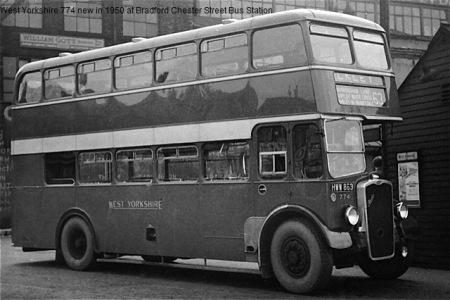
West Yorkshire 774 (DB 36) Bristol K6B is seen new at Chester Street Bus Station, Bradford on the Ilkley stand in 1950 on the 63 service via Manningham Lane to Shipley, an intermediate place before Ilkley. The service at this time ran every 30 minutes with the alternate bus in the hour running as a 68 service via Canal Road to Shipley and then to Ilkley. Only recently had the 63/68 service been operated by double deckers due to a revision of the route in Ilkley which now avoided a low railway bridge in Ben Rhydding. The Bradford to Ilkley service was previously operated by single decker pre-war Bristol L5Gs and Bristol JO5Gs.
This was a route I used often and loved the challenge to the buses climbing Hollins Hill and also the (A65) road dip under the railway bridge near Burley-in-Wharfedale. This bridge was removed after the line from Burley to Otley closed in March 1965. The road level was then changed so no more excitement at testing the bus suspension.
The Bristol K6B/ECW buses were the workhorses for many BTC fleets during the fifties and sixties and this was certainly the case with West Yorkshire. I can never recall a breakdown and the Bristol K6B was certainly a most reliable type of bus. A lovely feature which I often heard on a still evening at home was the throb across the fields of the Bristol AVW engine caused I think by the fuel governor. Perhaps someone with more expert knowledge of Bristol bus mechanics can explain.
Another interesting feature at Chester Street Bus Station seen on the photograph was the green hut adjacent to the Ilkley stand which served as the Inspectors Office. This hut had also the store racks for the “bible” indicators used on most of the pre-war West Yorkshire buses. This hut was always a fascinating place for a small boy to watch the busy activity of the drivers/conductors collecting or returning these cumbersome indicator boards.

Photograph and Copy contributed by Richard Fieldhouse

A full list of Bristol codes can be seen here.

———

25/05/11 – 16:52

Dare I be precocious enough Richard to say that this excellent piece was written specially for me ?? – a tongue in cheek remark obviously. This is a route known very well to me as a passenger and, later, as a conductor when I worked at WYRCC’s Ilkley Depot in 1960/1. As you rightly say, the Inspectors’ green hut in Chester Street was a constant hive of activity.
Did you know that Chester Street was actually the public thoroughfare right through the centre of the bus station??, although virtually all motorists assumed that it belonged to The Company and so didn’t dare to use it !! Sometime after the "double decking" of the Ilkley services the hourly 68 was discontinued (apart from a few peak hour trips Monday to Friday) and the half hourly service became entirely 63 via Manningham Lane.
There were actually two adjacent railway bridges over the A65 below Menston and, as you say, it was somewhat terrifying for passengers and drivers on the approach, as it seemed certain that the bus roof would be rudely removed – and the sensation was even worse with Samuel Ledgard’s highbridge vehicles.
I can’t honestly remember the intermediate destination blinds being as commendably detailed as shown here – later editions showed only Manningham Lane, Shipley, White Cross. The bottom line in this picture is a little blurred but appears also to say Burley Ben Rhydding. Incidentally the Company seemed to think that Bradford residents would not have heard of Ben Rhydding and so the rule was that on leaving Bradford "ILKLEY" would be shown, and upon reaching the area of local knowledge at Burley the display had to be altered to show "BEN RHYDDING." I’m always blissfully happy to be reminded of those lovely enjoyable days so thank you again.

Chris Youhill

———

26/05/11 – 07:30

Very interesting comments about Bradford. Whilst I have a good knowledge of the present day city centre, I’m afraid I have no memories of how it was. Would I be correct in thinking that Chester Street Bus Station was taken out of use when the interchange opened? Do any traces of it still exist or has it been completely obliterated? I’ve seen many a photograph taken against the background of the white wall and always thought it looked a very evocative place.

Chris Barker

———

27/05/11 – 08:35

I’ve no idea, Chris B, about the present status of Chester Street but I’ll certainly have an "on site" look next time I visit the National Media Museum only a couple of hundred yards (or metres nowadays) away.

Chris Youhill

———

27/05/11 – 08:37

Chester Street closed with the advent of the Interchange. Chester Street is now just a street and is changed totally although some of the buildings on the"West Yorkshire" side still exist

Chris Hough

———

27/05/11 – 09:35

I fear, Chris Y, that you will be sadly disappointed, although not surprised, at the present state of Chester Street. It is now a busy dual-carriageway – part of a typical inner-city gyratory road system. However, some of the background buildings seen on old bus photos are still recognisable, eg. the roof lights of the old Public Baths in Morley Street (now a Wetherspoons).
On the Hebble side, there’s a new building, but the West Yorkshire loading area now seems to be a car park. The much-rebuilt 1960s Mecca Ballroom multi-storey, seen in latter day photos of the bus station, still dominates the background at the western entrance.

Paul Haywood

———

29/05/11 – 07:18

Chris B, as Chris H says, Chester Street bus station was closed following the opening of the Interchange in I think, 1977 – the year of The Queen’s Silver Jubilee. Chris Y’s comment about Chester Street being a public thoroughfare is most interesting, as I remember the roadway very well, but must admit would not have dared to use it for the reason outlined by Chris! The bus station spanned an area between Little Horton Lane (opposite the Silver Blades ice rink) and Morley Street (opposite the top end – or rear – of The Alhambra theatre). It was a place of much interest to the enthusiast with West Yorkshire, Yorkshire Woollen, Yorkshire Traction, Hebble and Samuel Ledgard vehicles using it. (Am I right in thinking that Ribble also used it for coaches linking Lancashire and Yorkshire?) In the mid-sixties Bradford CT added even more variety with its AEC Regent Vs and Daimler CVG6LXs, following an agreement allowing joint operation of the Bradford – Eldwick – Dick Hudson’s service with West Yorkshire. It seemed strange at first seeing a bright blue ‘Corporation’ bus in what otherwise seemed to be a mainly red ‘Company’ bus station, but Bradfordians are not easily fazed and took it all in their stride! As Paul states, Chester Street still exists, but sadly as yet another stretch of dual carriageway.

Brendan Smith

———

31/05/11 – 18:49

This piece was written for me too, Chris. What amazing memories it conjures up! Many a time have I boarded the bus for Ilkley at that very spot against the famous green shed.
I knew Chester Street as a lad, right up to leaving Bradford in 1968, and remember the through street so well, and can count 6 operators who used the facility:-
West Yorkshire, Ledgard, Hebble, Yorkshire Woollen, Yorkshire Traction, and Sheffield (C ?).
West Riding also came into Bradford, but from memory, did not use Chester Street.
I always associate older generation Bristols with Gardner "5"s, but the AVW was extremely characterful from a "music" point of view, and made for an extremely fast bus. I can remember "flying" along on the routes out of Bradford, especially past Shipley, and the HWW batch represented, to me, the pinnacle of ECW post war design. Flush interior sides, tubular seats, and metal framing all came together in these vehicles to produce a quality of vehicle not yet bettered, in my view. Superb buses!

John Whitaker

———

01/06/11 – 07:44

I’m glad there is such affection for the Bristol K (especially the 6B). Many people seem to turn their noses up, calling them boring and bog-standard etc. and I hate to hear it. For sure, you could find them from Lands End (Western National) to Northumberland (United), and Yarmouth (Eastern Counties) to Pwellheli (Crosville)- and a lot of other places and operators in between (take a bow, West Yorkshire). But you will notice that all of the extremities I listed are coastal holiday destinations. For me Bristol K6Bs (and their melodious note in second and third gears, which I could cheerfully listen to for hours) are inextricably associated with happy memories of seaside holidays. (And the sun always shone!)

Stephen Ford

———

01/06/11 – 07:47

I agree fully John with your commendation of the "HWW" DBs, but their super qualities were suddenly eclipsed for we Ilkley folk when 806 – 809 (DBW1 – 4) arrived – 8 feet wide and with classy white steering wheels. Originally having open platforms (returned later to ECW for doors) they seemed quite simply enormous and spacious and they are a batch from my teenage years which I still hold in great affection.

Chris Youhill

———

01/06/11 – 07:50

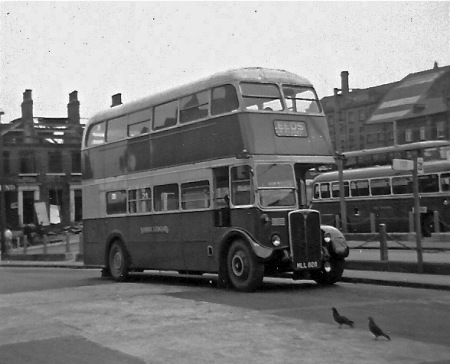
MLL 828_lr

The Chester Street, Bradford thread made me dig out this photo of Ledgard MLL 828 (former RT3518) which clearly shows the through road between the chain fences separating the West Yorkshire stands from "the others". Unlike most of my photos, this one has the date 14 June 1964 written on it, and it shows the buildings on Little Horton Road being demolished to make way for the Silver Blades Ice Rink (owned by Mecca but not a Ballroom as I mistakenly said in my previous thread.)

Paul Haywood

———

01/06/11 – 10:22

I agree about the 806 – 809 batch Chris, but when the "new" excitement wore off, and in quiet contemplation (!) I do not think the S series 4 bay design had quite the same balance as the classic final version of the first post war 5 bay style.
I greeted the first DXs with absolute rapture, but looking back, I do not personally hold them in quite the same esteem as the HWW series. Something to do with my age perhaps!

John Whitaker

———

01/06/11 – 10:22

Stephen, among my many fond memories of the "DB"s one of my favourite recollections couldn’t possibly be further from the seaside !! When I was a conductor at WYRCC Ilkley Depot any of our Lodekkas away for the statutory two weeks overhaul was replaced by a "KDB" from Keighley – one of the batch between KDB 54 -7. One foul Winter evening, with very heavy snow, I left Ilkley with the 5.25 pm to Haworth on service K12 driven by Brian Wadsworth. After we left Addingham to climb to the "whited out" summit at Marchup Cottages the bus began to boil very seriously. This, of course, was long before two way radios and mobile telephones and we felt rather as if we were approaching the North Pole. – "Only one thing for it" said Brian "We’ll have to fill it up with snow." We both set about the task with gusto, while the red hot radiator and engine hissed and tinkled in astonished protest. Once we achieved the necessary level we resumed the journey – to Haworth and back to Ilkley for 8.07pm – without incident. Looking back of course, with the benefit of hindsight, it was a really foolish first aid measure which I imagine could have caused considerable damage – if Brendan is reading this I must plead forgiveness on the grounds of youthful ignorance of engineering matters and hope that he won’t hold it against me !!

Chris Youhill

———

01/06/11 – 11:22

I agree with Stephen on every count – especially the AVW

David Oldfield

———

01/06/11 – 16:50

With such foul weather, I assume, Chris Y, that the radiator was emptied and re-filled with water/antifreeze mix later, to avoid saying goodbye prematurely to the radiator and/or block!

Chris Hebbron

———

02/06/11 – 05:57

Don’t worry Chris, most people would excuse your first aid measure, as you and your driver showed great initiative under extreme conditions in order to keep the show on the road! Your escapade reminded me of a tale related by Ken Robinson, for many years engine shop foreman at West Yorkshire’s Central Works. Ken was going home to Knaresborough one evening after work, and noted that the bus he was travelling on (a Lodekka) had started to boil en route. On arrival at the bus station the bus was steaming away merrily, but the driver seemed oblivious to this and was about to depart for Harrogate again when Ken intervened. Built like a Foden truck, he was a very fair man, but one who did not suffer fools gladly and spoke his mind when ruffled. He informed the driver who he was, and said under no circumstances was he to leave the site without filling the bus up with water. The driver, no doubt trying to avert being reported, duly did this, and Ken went on his way. Ken said he had only realised a little while later what he had asked of the driver, and hoped that the Lodekka’s red hot radiator and cylinder block had not cracked when the cold water had been poured in!! Thankfully all must been well as he heard no more about the incident, and no doubt gave a sigh of relief that the driver had not reported HIM!!

Brendan Smith

———

12/06/11 – 07:54

My best memories of all types of Bristol are from WYRCC service 30 between Bradford and Leeds. From Bradford the route ran along Canal Road, then up Kings Road with a right turn into steep Queens Road, which is where the fun began. There were almost inevitably passengers to alight/board just after the lights, and if the driver was really unlucky, also at the stop a little further up, which meant a standing start on a steep incline just before the gradient became even worse prior to the junction with Bolton Road. I recall that on a fully-laden bus on this steepest section all conversation would cease as the driver waited for the very last engine beat before engaging bottom gear in the crash gearbox. If successful, (as it usually was), there would be a collective sigh of relief, and a settling down for the long slow haul up to Bolton Junction, a stretch of road shared with Bradford trolleybuses which flew up the gradient in great contrast to the grinding Bristols.

Robert Appleby

———

13/06/11 – 07:59

Very evocative, Robert, I can picture the scene vividly, just as you describe!

Chris Hebbron

———

19/06/11 – 10:28

Your stories of boiling Bristols takes me back to the early 1950’s and to the sunny fields of Somerset. My Great Aunt had a farm at Somerton and my mother and I used to travel from Bristol to stay for a week or so during the school holidays. At the time my father had a firm’s car but could not use it privately so to get there involved a journey on the bus. Leaving Prince Street (the original bus terminal), we rode on mostly Bristol GO5G or Lowbridge K Bristols, the height being important due to the number of railway bridges on the A38 as the old Radstock coal lines and the wonderful Somerset and Dorset railways crossed over the road.
The journey was around forty miles down to Street where the route ended and my most clear memory was that it seemed to take the whole afternoon to get there and when we arrived the bus was always boiling merrily but nobody seemed concerned! The stop was outside a hotel and maybe the driver topped up for the return journey home with water from there.
The onward journey to Somerton was around 5/6 miles and for that part my memory is dim but with the benefit of age, I’m fairly sure it was probably done in a locally run Bedford OB.. another of my favourites!
Memories! I’m sorry my posting is not about the Yorkshire days but back then, it might as well have been in Africa for us Southern softies!

Richard Leaman

———

11/07/11 – 07:36

Like Stephen, I too am glad there is much affection for the Bristol/ECW K (and come to that, its single-decked sibling the L). It has all the hallmarks of a classic bus in having a well-engineered chassis with an enviable reliability record, a soundly-constructed yet attractively-styled body, and above all else a fitness for purpose. The melodious gearbox was an added bonus, together with that ‘chuckle’ from the transmission sometimes heard when setting off up a gentle incline.
Robert’s comments about the notorious hill starts at the Queen’s Road/Bolton Road junction in Bradford brought back memories as I know that area well. Another ‘unlucky driver’ spot was the bus stop towards the top end of Hollins Hill between Shipley and White Cross, which served the residents of Esholt. For a while in the mid-sixties I travelled by bus to school in Bradford each day from Harrogate (route 53 via Otley) and dreaded this stop on the journey home, where speed was obviously of the essence. A ‘drop off’ here meant an endless crawl in a low gear to the top of the hill for the poor bus and its driver – even with the newer Lodekkas. As a schoolboy I found it both fascinating and frustrating that passengers only ever seemed to alight here – nobody ever boarded! In my schoolboy mind I was convinced that ‘they’ did this deliberately, rather than catching their own Esholt (65) bus home! For much of the journey Samuel Ledgard ‘deckers could also be seen, and a schoolboy cheer could often be heard when ‘our’ West Yorkshire steed overtook one at a bus stop – only to be replaced with a "boo!" when the ‘Sammie’s’ passed us at a bus stop later on! Happy days indeed.

Brendan Smith

——— Top of this posting ———


Quick links to the  -  Comments Page  -  Contact Page  -  Home Page


All rights to the design and layout of this website are reserved     

Old Bus Photos from Saturday 25th April 2009 to Thursday 4th January 2024