Old Bus Photos

Widnes Corporation – Daimler CWA6 – FTF 207 – 59
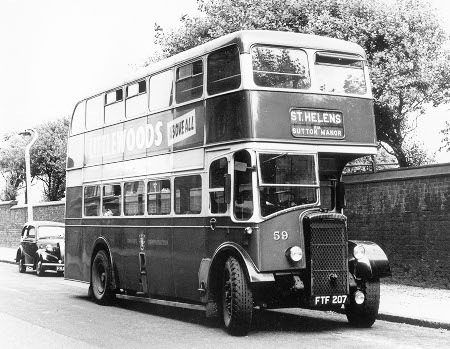
FTF 207_lr
Photograph by ‘unknown’ if you took this photo please go to the copyright page.

Widnes Corporation
1945
Daimler CWA6
Duple UL55R – East Lancs L27/28R 1955

This photo was sent to me by Richard Mercer after he had seen the posting of the London Transport Daimler D1 which also had a Duple body, but as Richard points out this one is more rounded with softer edges and not so angular as the LT one.  As there is only one year between this vehicle and the LT one it leads to the question was this bus rebodied before this shot was taken, and if it was, is it possible that it was done by East Lancs. What I like about it is the very shapely cab door, side window and windscreen the driver had good visibility from that cab. Richard has fond memories of this bus which was photographed in St Pauls Road Widnes as it was his school bus in the 1950,s. The bus was withdrawn in 1967 and went to a dealer in Wombwell South Yorkshire I do not know if it had a life after that, if you know, let me know.

Photograph and information contributed by Richard Mercer

A full list of Daimler codes can be seen here.


12/06/11 – 10:41

The asymmetrical upper deck window arrangement was not as may be thought a simple repair job but the standard adopted by Widnes for all its new double deck deliveries until the switch to saloons in the nineteen sixties.

Chris Hough


12/06/11 – 11:27

This looks like an East Lancs body to me, and this is borne out by another picture of this bus on the Omnicolour Bussslides website. East Lancs apparently managed to convince the authorities that it could not adopt the severe austerity style of construction specified for the standard Utility bodywork without disrupting production, and its wartime bodies were built to the usual East Lancs appearance, though one imagines that the general embargo on the use of lightweight alloys and other materials must have applied. It is possible, therefore, that the body shown is original. However, the neat, well proportioned lines of the body on this Widnes bus certainly looks like an East Lancs product of the 1950s to me.

Roger Cox


13/06/11 – 07:46

I am no expert on these matters but it definitely looks like a rebody to me. The radius corner flush mounted side windows and sliding ventilators don’t look like those from a utility body and the front and rear domes are too rounded. It does have an East Lancs look about it though.

Ian Wild


13/06/11 – 07:48

FTF 207 was indeed rebodied by E/Lancs with this lowbridge body in 1955. Several Daimlers from the same batch and and also the 1943 batch received E/Lancs highbridge bodies around the same period.
My information is taken from the 1965 edition of Ian Allan British Bus Fleets book 6, Lancashire Municipal fleets.

Eric


13/06/11 – 07:51

Yes indeed. BBF6 has this as rebodied by East Lancs in 1955. However, it is shown as L55R rather than H55R, with FTF 208 rebodied at the same time as H60R.

Peter Williamson


13/06/11 – 10:41

As a stranger to the area and the operator I can’t possibly comment on the accuracy of the fleet lists, but unless its an optical illusion it certainly looks like a highbridge body. It is an extremely handsome vehicle – however tall it is !!

Chris Youhill


13/06/11 – 10:32

If you look at the handrail running alongside the upperdeck off side windows this confirms that it is a sunken gangway lowbridge body and the roofline is much flatter than the highbridge version.
My home town of Huddersfield had two batches of Regent III’s in 1954/5 with identical lowbridge bodies to this one. They also had a batch of highbridges in 1955 with a much more rounded roof profile. Leigh Corporation also had a batch of lowbridge Regent III’s around the same time and there is a photo of one of these in the 1965 BBF6

Eric

There is a shot of a Leigh Regent here and a Huddersfield one here.

Peter


13/06/11 – 12:11

I’ve just had a look at the photo of the Leigh one and whilst it is of the same general style as the Widnes/Huddersfield bodies I have noticed that the windows are not as flush as in the newer bodies and the radius corners of the pillars are slightly more angular. So the Leigh bodies are to the earlier design of about 1951. Again, Huddersfield had a batch each of highbridge and lowbridge bodies to this design delivered in 1951/2 the highbridges being 170-5 (FVH 170-5) of 1951 and the lowbridges 226-31 (GCX 26-31) of 1952. The also had a batch of highbridges delivered in 1950, 163-9 (EVH 563-9) but these bodies were of a totally different style altogether. So perhaps this shows that East Lancs were "on the ball" when it came to body design and updating.

Eric


14/06/11 – 08:23

Another good way of telling that it’s lowbridge is the gutter moulding above the lower saloon. This dips down behind the cab and then up again at the rear bulkhead and is in line with the floor. The drainage from the upper saloon floor would be behind that moulding.

David Beilby


15/06/11 – 07:09

I found this very confusing at first. I’ve never seen a picture of this before and I was initially unable to decide between Duple or East Lancs but it clearly is the latter as has now been proven. I think the confusion can be explained through the links posted by Peter W, this vehicle is obviously 7ft 6in wide, which gives the impression of extra height although it is lowbridge and dissembles the East Lancs look to a degree. The Leigh and Huddersfield vehicles are clearly 8ft wide and look more as you expect East Lancs to look for the period.
How nice to read that it achieved 22 years service!

Chris Barker


15/06/2011 15:55

Perhaps the missing push out ventilator on the off side upperdeck front window makes some people question if it is an East Lancs body and I think it does detracts slightly from what is an otherwise classic design of the period.

Eric


16/06/11 – 09:20

East Lancs bodied the majority of Widnes fleet in post war years a batch of East Lancs bodied PD2s which were to prove Widnes last deckers all had the winking eye upper deck treatment East Lancs even bodied a rather bizarre coach for Widnes in the sixties They switched to Nationals and later the Lynx when these became available

Chris Hough


Just dug out my very well thumbed BBF No 6 Lancashire – dated 1960 (Price 3/6d) and 59 was definitely East Lancs L57R rebodied in 1955 on the original CWA6 utility chassis. Some of this batch were CWD6 and some retained their utility bodies and were never rebodied at all. I remember seeing a utility bodied example in St Helens in the early 1960’s probably 1961/2 from memory.
For the record if anybody is interested according to this issue of BBF6 (and they were normally pretty accurate in those days) the details of the batch still in stock at 1960 are:-
49/51/53/60 – East Lancs H60R rebodied 1955
54 Northern Counties UH56R
55/56/57 Duple UH56R
58 Duple UL55R
59 East Lancs L57R rebodied 1955
So 59 was the only lowbridge East Lancs rebody.
I have them all underlined as being ‘copped’ apart from 54 which I have crossed out so it must have been an early withdrawal.
I agree that the single front ventilator which was a Widnes trait made the buses look a bit ‘botched’ and detracted from what otherwise was a tidy fleet. I presume the logic was that passengers wanting the fresh air treatment could choose to sit on the nearside while those of a less robust disposition could take to offside!
I remember a spotting trip to Widnes in 1962 when I copped these buses and at that time the new Widnes-Runcorn bridge had not long been open. We took a walk over it and the old Transporter Bridge was in the process of being dismantled. I regret that I never saw it in operation.
It was only after the opening of the new bridge that Widnes buses ventured over to Runcorn and previously terminated on the Lancashire side of the river to allow passengers for Runcorn to alight and go as foot passengers on the Transporter.
The bus drop-off point and the old Transporter Power Building is still in place at the end of a side street of terraced houses. The rest was all demolished.

Philip Halstead


21/08/15 – 06:02

58 and 59 were the only two in the fleet with the side gangway upstairs (handrail visible on 59), the seats being four in line on the nearside. 58 was a more decrepit unit so was probably in original form? My grandmother would never travel on upper decks as smoking was allowed, hence the ventilators. Downstairs she would try to avoid the offside seats on these two as headroom was restricted because of the sunken gangway upstairs. I witnessed many a cracked skull.

Kenneth Aaron


06/09/17 – 06:28

3 that I know of, 49, 51 and 60, had Leyland bodies in the mid 1950’s

Richard Mercer


16/05/20 – 06:32

I was interested to read the comment by Chris Hough (12/6/11) concerning the asymmetric upper deck window arrangement on Widnes buses.
My father J H (Harry) Craggs was general manager of Widnes Corporation for many years (from around 1950-1965) and I recall very clearly, when I was a young boy, he mentioned the reason for this unusual configuration! He told me that one window was sufficient to get good upper deck ventilation… two were not necessary and having both opened at the same time could cause drafts. It seemed both logical and fascinating at the time and I never forget this unusual conversation, even all these years later!

John Craggs


Quick links to the  -  Comments Page  -  Contact Page  -  Home Page
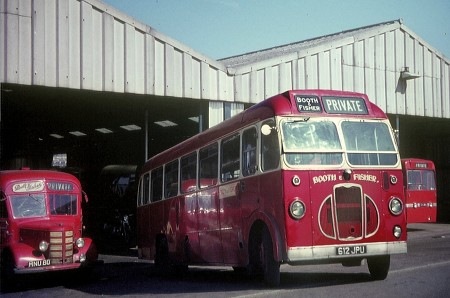


Booth and Fisher – Bristol SC4LK – 612 JPU

 Booth and Fisher - Bristol SC4LK - 612 JPU
Copyright Ian Wild

Booth and Fisher
1957
Bristol SC4LK
ECW B35F

Booth and Fisher operated a selection of stage and works services from their depot at Halfway on the South Eastern outskirts of Sheffield.

Whilst their staple stock for many years were Bedford OBs, they also bought AEC and Leyland single deckers new and amassed quite a collection of Albion Nimbus as well. Relatively unusual second hand purchases were two of these Bristol SC4LK from Eastern National in the late 60s. This one was Eastern National 446, the other ex 451 had the splendid registration 9575F. I suppose a common theme of Bedford OB/Albion Nimbus/Bristol SC was "lightweight" but then they did operate in the flatter areas across towards Worksop. 612 JPU is seen outside their depot in either 1967 or 1968 in company with other members of the fleet.

Photograph and Copy contributed by Ian Wild


08/06/11 – 09:57

Very nice indeed to see a smart but totally unpretentious livery and a very clean and tidy looking depot. I never came into contact with Booth and Fisher, but they appear to have been an operator with the right priorities – too many are just the opposite, employing "spin" with nothing behind it – especially nowadays.

Chris Youhill


09/06/11 – 08:35

Strictly speaking, Booth and Fisher were a Derbyshire operator. Their depot is round the corner from the Halfway Supertram terminus and came inside the Sheffield boundary when the city expanded in 1967. The photograph must have been taken very shortly after this event.
The trunk B & F route (Sheffield to Halfway via Coal Aston and Eckington) became SYPTE 253, briefly operated by "Aston" after deregulation. They were, in turn bought out by Stagecoach (then East Midland at Chesterfield) who run this route to this day as part of their new, expanded, Sheffield network. Stagecoach. of course, now operate out of the former Yorkshire Terrier depot in Holbrook – just up the road from the B & F depot.
The B & F depot passed to SYPTE when they bought out Booth and Fisher and only recently TM Travel (now part of the same group as Trent Barton) moved into this depot – by now abandoned by First Group – from their nearby Stavely HQ.
In latter years, B & F built up a large fleet of AEC service buses (and DPs) and Ford coaches. The last to be bought were a sizeable number of 6MU4R Reliances with Grant specification Panorama Elite III Express bodies – all of which passed to SYPTE.
The featured SC4LK would have fitted in with the fleet at the time, though. It was sometimes known as the Bristol SB – fulfilling that role for Tilling Fleets – and even had propriety Bedford axles and other components. SCs were built in such small numbers that minimal expense was the order of the day for R&D.

David Oldfield


09/06/11 – 08:36

If I remember rightly they also had an ex Guy single deck demonstrator with the reg no GUY 2

Roger Broughton


09/06/11 – 08:36

Two of Booth and Fishers more unusual AECs were a pair of Park Royal bodied Monocoaches bought in 1955 These were fitted with a lower profile body than was the norm to pass under the many low bridges in the area One of the pair WRA12 is preserved at the South Yorkshire Transport Museum in Rotherham

Chris Hough


09/06/11 – 08:38

Like you Chris, I never came into contact with this well known operator, but vividly remember the name from the fleet news in Buses Illustrated as a teenager – Booth & Fisher, Halfway – as it always raised a smile. As you say, the livery is indeed smart and unpretentious, and all the better for it in the eyes of many. I’ve never quite understood the trend to dress modern buses up as circus wagons in order to attract motorists out of their vehicles. Most cars are single, or two-tone in colour, as manufacturers wish to convey a ‘perceived quality’ image. How many people would be attracted to a family car with a fancy colour scheme and vinyls covering the windows so only the driver could see out? Amazing how such established concerns such as East Yorkshire and Delaine’s (to name two) manage to retain a dignified traditional livery in a modern style. Ah! Quality!

Brendan Smith


09/06/11 – 08:40

Well Chris Y, Booth and Fisher are long gone but their depot survives and is operational! Their fleet strength was around forty vehicles and when they sold out to South Yorkshire PTE, the garage was used by SYPTE for some time before being deemed surplus to requirements. Today, it houses the fleet of TM Travel, a Wellglade (Trent Barton) subsidiary who have operations in Sheffield and North Derbyshire with around 100 vehicles.

Chris Barker


10/06/11 – 09:49

Roger mentions the ex GUY demonstrator Guy 3 This bus was exhibited at the 1950 Commercial Motor Show In 1957 it was acquired by Ledgards as part of the takeover of Kitchen of Pudsey It ran for Ledgards until they were taken over by West Yorkshire RCC in 1967

Chris Hough


10/06/11 – 09:55

In 1973 B&F bought some 12 year old Reliance service buses from Maidstone and District, and these passed to the PTE in 1976 when they were already 15 years old. You might think that SYPTE would have sent them off to Barnsley for scrap, but they kept them until 1980 when they were resold (as part of a job lot which included a Seddon Pennine IV-236 "midibus") to Silver Star of Upper Llandwrog (Gwynnedd). Repainted into Silver Star’s attractive two-tone blue and cream livery they gave good service for a few more years on the company’s stage services from Caernarfon to Rhosgadfan and Cesarea, suggesting that they had been excellently maintained by both M&D and B&F/SYPTE. Booth & Fisher were indeed a classic independent!

Neville Mercer


13/06/11 – 07:55

I have a record of three ex Maidstone Reliances with Booth and Fisher (but there may have been more).
336 NKT acquired 7/73
334 NKT acquired 8/73
340 NKT acquired 6/74
all with Weymann DP40F bodies.
I can’t be certain now about the accuracy of the acquisition dates, they may be the dates on which I first saw them.

Ian Wild


13/06/11 – 10:48

Check out this link for a comprehensive fleet list of Booth and Fisher.
You missed 332 NKT, Ian, see fleet list. Bought 1975 with the last three 6MU4R, the last ever purchases before selling out to SYPTE. It had slipped past me that the last two were Duple bodied.

David Oldfield


12/01/12 – 09:05

I am looking for people who used to work for Booth & Fisher and knew my husband Ian Fretwell. I am going to give him a surprise party next year for his 65th. So I am trying to find as many of his old mates as I can, if anyone knew him please get in touch with me through this website. Or if anyone has a better idea on how to find ex Booth & Fisher employees please let me know.

Wendy Fretwell


28/04/12 – 07:48

Between 1958 & 1965 I attended Westfield Comp. As I lived in Frecheville I had a school bus. Normally Frecheville, Birley and Base Green pupils were transported by Sharpes of Beighton. Over the years they had SBs augmented later by SC4LKs and LWL6Bs ex Lincs Road Car. When the coaches were off doing coach work then one or more buses would be borrowed from Booth & Fisher. These were always from the large selection of OBs and OWBs. I doubt any-one had a more varied OB fleet than Boothies. Bodies included Allsop, Mulliner, Beadle, Barnaby, Roe, Woodhall-Nicholson and Duple. We never knew what would turn up, but could be sure of the bus having character!!

Les Dickinson


18/05/18 – 06:50

Does anyone know how large the fleet was around 1970, they had an impressive garage which could hold most if not all of the fleet under cover.

Jim


23/05/18 – 06:41

Jim, from 1970 the fleet tended to hover around 40. According to "South Yorkshire’s Transport" (Scott Hellewell, Venture, 1996) in 1973 44% revenue came from contracts (mainly NCB), 42% from stage carriage (Dronfield local [jt SCT/CCT]], Killamarsh-Dronfield-Sheffield, Beighton-Killamarsh-Worksop), 12% private hire/E&T, 2% garage business. The premises are still in use to today as the depot of Wellglade subsidiary TM Travel.

Philip Rushworth


17/07/18 – 06:39

Can anyone answer this question that has baffled me for years.
As you drive past Clowne ponds you reach the crossroads of the Worksop to Chesterfield road, driving straight over for about 1/2 mile use to be a lane on the left that led to either 1 or 2 possible railway houses, in the yard was parked about 6 buses red I think, this was in the 70s and 80s,who was this firm, Kirkby Andrews were based in Harthill at that time but this wasn’t actually in the village, anyone know.

Jim


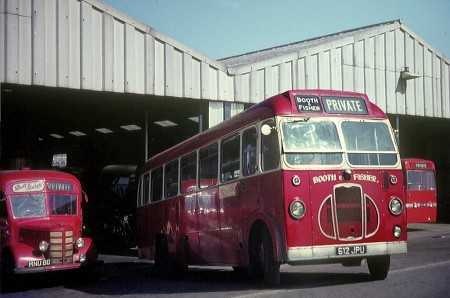
612 JPU_lr Vehicle reminder shot for this posting


16/06/20 – 07:07

I was born and brought up in Halfway, my father was a mechanic at Booth and Fisher. Shortly before the two AEC Monocoaches appeared they had a white Sentinel demonstrator on the Sheffield service for a while.
It was the first "flat fronted" bus seen around here. Mid entrance if I remember correctly.

John Hinchliffe


Quick links to the  -  Comments Page  -  Contact Page  -  Home Page


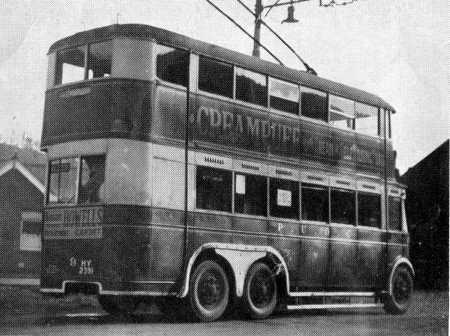
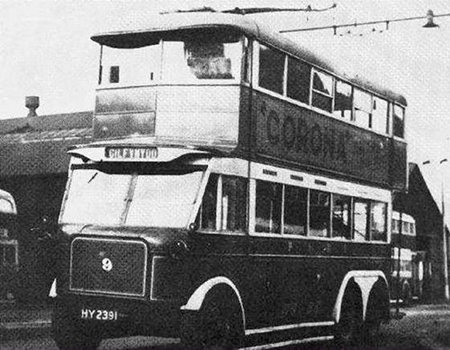
Pontypridd UDC – Bristol E – HY 2391 – 9

HY 2391
Copyright Brizzle Born and Bred

HV 2391_lr
Photograph by ‘unknown’ if you took this photo please go to the copyright page.

Pontypridd Urban District Council
1931
Bristol E
Beadle H60R

Some time ago, I posted an item about a Portsmouth Corporation trolleybus, one a several which were lent to Pontypridd during the war. Hull did so, too.
Pontypridd UDC had a fleet of trolleybuses which, during the life of the system, (between 1930 and 1957) in total, amounted to just 17 in total, initially with 7 all-English Electric single-deckers.
These were augmented by two double-decker demonstrators in 1930/31, eventually purchased in 1932, one being an all-Guy BTX.
1945 brought 4 Karrier W’s, bodywork shared equally between Weymann and Park Royal, and four more in 1946, two bodied by Weymann and two by Roe. The last eight formed the entire fleet from 1947 to the end 1957, bar the two with Roe bodies, which were withdrawn in 1955.
The other 1932 demonstrator (above) was a very rare bird indeed, a Bristol E with Beadle bodywork, which lasted until 1946. In 1929, Bristol developed two six-wheeler chassis, the C and E types. Despite six-wheel chassis being popular at the time, only two of each type were ever built and, of these four, only the two E-type were ever bodied. One went to Doncaster Corporation, the other to Pontypridd UDC, both in trolleybuses form, the only trolleybus chassis Bristol ever built!

Photograph and Copy contributed by Chris Hebbron with acknowledgement to Peter Gould’s Fleet List website.

———

14/06/11 – 08:30

One of the two Bristol trolleybus chassis (E101) was fitted with a Roe body and delivered to the order of Doncaster Corporation (registered DT 2620). It ran on loan there from August 1930 until Feb 1932, when Doncaster purchased it as No 31. It had a BTH 60hp motor. Doncaster apparently encouraged the development of the trolleybus version of Bristol’s 6-wheel motorbus. But they did not buy any more, continuing to purchase Karriers instead for successive pre-war deliveries.
The other trolleybus chassis (E102) was constructed in 1930 by converting 3-axle motor bus chassis C101. This was fitted with a Beadle 60-seat body, and is the one shown as Pontypridd UDC No 9. It ran as a demonstrator at Pontypridd 1931-32, then purchased by them. It had a Bull motor.
In spite of their rarity, both led full service lives (Doncaster to 1945, Pontypridd to 1946/7).
Apparently one of each type (i.e. a 3-axle C-type motorbus and and a 3-axle E-type trolleybus) were exhibited in chassis form only at the 1929 Commercial Motor Show.
This is from information in Geoff Lumb’s "British Trolleybuses 1911-1972", supplemented by "British Trolleybus Systems" (Joyce, King & Newman).
It’s probable that Bristol wanted to concentrate more on the motorbus side, especially when the Tilling-based companies moved to support them strongly when they moved away from the Tilling Stevens marque in the early to mid-thirties.

Michael Hampton

———

15/06/11 – 07:06

Thx for that useful additional information, Michael. The Doncaster one was even more non-standard with the Bull electric motor, a make I’ve never heard of! The wonder of rare vehicles is that a photo exists of them. For example, Portsmouth Corporation bought its sole AEC Regent before the war, which, typically, was destroyed, thanks to a certain A Hitler. I’ve never seen a photo of it.

Chris Hebbron

———

16/06/11 – 09:27

Chris, You may not have heard of Bull Motors but their factory at Ipswich survived until around 2000. Their products were often fitted to trolleybuses made by another Suffolk company, Garretts of Leiston, an example being one built for Copenhagen which has just been put in to service at the East Anglian Transport Museum at Carlton Colville after restoration.

Nigel Turner

———

16/06/11 – 09:30

I had a vague memory that Doncaster’s first trolleybuses were Garrett double deck 3-axle vehicles, with Bull motors and Roe bodies similar to those supplied in the same year based on Karrier E6 chassis. When checking this in Geoff Lumb’s book I mentioned last time, it turns out that Bull Motors Ltd were a firm in the same group as Garrett, which was Agricultural and General Engineers Ltd. Garrett’s were based at Leiston, Suffolk, but I don’t know where Bull Motors were located. They supplied motors to most (if not all) Garrett trolleybuses.
Garrett’s made trolleybuses from 1925 to 1930, when they decided to withdraw from that sector. This decision led to Bull’s supplying motors to both a Karrier-Clough demonstrator, and the Bristol for Pontypridd.
Garrett’s decided to withdraw rather than modify their designs, as although the batch supplied to Doncaster had similar Roe bodies to the contemporary Karriers, there were differences underneath. The floor height of the Karriers was 2ft 1in, which was 9ins lower than the Garretts. I haven’t been able to trace Bull Motors equipment being supplied to any other manufacturers’ vehicles.

Michael Hampton

———

16/06/11 – 10:20

Bull motors were fitted to some ADC chassis for Bradford, as well as Garrett and I believe this firm was owned by E.R. and F.Turner of Ipswich.

John Whitaker

———

11/06/12 – 14:29

A complete history of Pontypridd Trolleybuses was passed to Trolleybooks, the joint publications panel of the British Trolleybus Society and the National Trolleybus Association, two years ago. It should, hopefully, appear soon.

David Bowler


Quick links to the  -  Comments Page  -  Contact Page  -  Home Page


All rights to the design and layout of this website are reserved     

Old Bus Photos from Saturday 25th April 2009 to Thursday 4th January 2024