Old Bus Photos

East Kent – Dennis Lancet UF – HJG 18
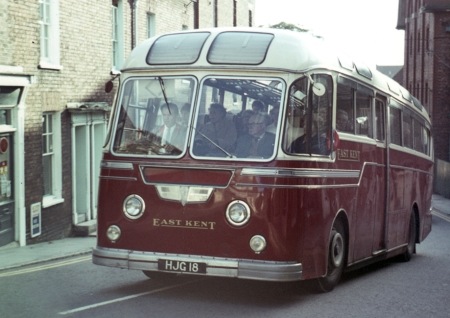
East Kent - Dennis Lancet UF - HJG 18
Copyright Roger Cox

East Kent Road Car Co Ltd
1954
Dennis Lancet UF
Duple C41C

This picture of East Kent HJG 18, a Dennis Lancet UF with Duple C41C body, was taken in Rye in 1967. East Kent, like fellow BET operator Aldershot & District, was a great fan of the pre war and post war vertical engined Dennis Lancet, and, in 1954, took delivery of 30 of the underfloor engined Lancet UF. This was the largest single order for this model, of which only 71 examples were built between 1953 and 1961. Aldershot and District tried out the Strachan bodied Lancet UF demonstrator, but bought none, though it continued to run the unique Dennis Dominant for fifteen years. One can now only speculate as to the reasons for the commercial non acceptance of the Lancet UF. Certainly reliability could not have been a problem. East Kent kept their UFs for 14 to 17 years. The low driving position was received with suspicion in certain quarters back in 1953, yet now it is a standard feature on touring coaches. The power plant was a horizontal version of the advanced, smooth running 24 valve 7.58 litre O6 engine fitted in the Lancet III, though the maximum engine speed was raised to 2000 rpm to give 110 bhp. Some later examples for Glenton Tours had the 120 bhp 8 litre version of this engine. The gearbox was the standard Dennis five speed constant mesh unit with preselective overdrive, but revised to operate in the conventional sequence with lowest gears to the left and highest to the right – the vertical engined Lancet gearbox worked the "wrong way round" from right to left. Possibly a major factor in the low uptake of the Lancet UF was the employment of a fully hydraulic braking system, which has never been popular with engineers outside of London Transport and Midland Red. Hydraulic fluid is costly, whereas air for air pressure or vacuum brakes is free. It is noteworthy that the initial version of the AEC Reliance that came to reign supreme with both East Kent and Aldershot & District had a straightforward, direct top (not overdrive) five speed synchromesh gearbox and vacuum brakes, though their wet liner engines were certainly not trouble free.

Photograph and Copy contributed by Roger Cox

———

03/07/11 – 19:59

I’m ambivalent about Dennis. I don’t have much time for modern Dennis Dust-carts – although there are some great might have beens that never followed through their promise with reliable service (especially the Falcon V and R Series). The R Series is actually one of the best coaches I’ve ever driven – including Setras, ZF Reliances and REs.
Having said that, the Loline (albeit a Lodekka clone) was a superb bus. East Kent and A & D weren’t the only operators to take to Dennis Lancets in a big way – so did Tracky – and Glenton gave theirs a full service life. None of these would have willingly run rubbish.
Dennis always seem, even with their current dominance, to fall short of the quality of the late lamented AEC, Bristol and Leyland.

David Oldfield

———

06/07/11 – 07:24

The Dennis UF was tried on A&D as you say and it was used on a number of routes however it was not "hitting the spot" with A&D who were already looking at AEC Reliance and being lighter and more cost effective. The UF was a much heavier vehicle. As we see from history, they went the AEC route in the end. There was also a problem with the UF overheating on hilly routes.
Hope this adds a bit of an update for you.

Doug Sneddon

———

06/07/11 – 13:50

The Lancet UF was a bit heavier than the early vacuum braked AEC Reliance, but not by much. The chassis weight of the Dennis was 3ton 17cwt, against 3ton 14cwt for the AEC. I hadn’t before heard of overheating problems with the Lancet, but the type was pretty rare and information about its performance in service is similarly scarce. I suspect, also, that operators were suspicious of the low driving position, especially for bus work, and also put off by the full hydraulic braking system and the double reduction rear axle. The AEC, with its single reduction rear axle, vacuum brakes and direct top synchromesh gearbox would have suggested a simpler vehicle to maintain, as well as being easier to drive. I am not a great AEC fan (the Regent V with conventional transmission was a somewhat primitive and noisy vehicle to drive, and not a patch on the Regent III), but the AEC five speed gearbox in the Reliance was a delight to use. The AEC wet liner engines were certainly not trouble free, though.

Roger Cox

———

08/07/11 – 06:16

I have to amend my comment under the picture at the top of this entry. The Dennis five speed gearbox, as Ian Thompson has correctly pointed out elsewhere, was a sliding pinion (i.e."crash") gearbox, not a constant mesh unit. With the engine and gearbox remote from the driver, smooth gear changing would not have been easy to accomplish, and the Reliance would have scored over the Dennis on this point also.

Roger Cox

———

09/07/11 – 07:07

With East Kent they were always referred to as ‘Spaceships’ for fairly obvious reasons. I must be one of the few who has conducted on one – an urgent relief to a Dover-Ramsgate journey with nothing else available (1966, I think). It caused a bit of confusion but was welcomed by passengers left behind by the service car, especially as it had started raining.

Lew Finnis

———

10/07/11 – 07:39

I cannot claim a great pedigree of Lancet UF driving (but so rare; who can?) However the one I have driven was a "Chinese" gearbox with low gears on the right hand side of the gate. I wonder if the reference to a normalised change is confused with the optional Meadows gearbox, particularly found in some of the later Glenton fleet. To continue and hopefully elaborate on the gearbox. It is very true to say the large and heavy box was very old fashioned compared with the AEC 5 speed. Yes, the lower gears were sliding mesh (4th of course being direct so strictly speaking no gears involved). But 5th was constant mesh engaged by preselected dog clutches – but here’s the thing, even though constant mesh, the gears were straight cut and therefore tended to be noisy (or according to taste, musical) even at cruising speed.

Nick Webster

———

10/07/11 – 07:41

An interesting experience, Lew, especially when trying to get the fares from the passengers sitting in the front nearside seats low down beside the driver. What was the opinion among the East Kent driving staff of these Lancet UF "Spaceships"? The East Kent fleet of 30 was the largest order ever placed for the type.

Roger Cox

———

11/07/11 – 07:41

Thanks for your comments, Nick, which give us a valuable insight into the characteristics of the Lancet UF. The vertical engined Lancet and the Lance double deckers certainly had "right to left" upward selection of the gears – why on earth did Dennis persevere with this arrangement so long after the rest of the industry, including Guy (GS type excepted), had standardised on "left to right"? – but my understanding that the Lancet UF gearbox worked in the logical pattern comes from the "Modern Transport" magazine road test of the type in March 1954, which refers to the selection of overdrive being accomplished "by moving the main gear lever from the direct drive position to the right against a spring and then forward". I certainly wasn’t aware that the later Glenton coaches, presumably the 8 litre version, had Meadows gearboxes. I recall from somewhere that the Meadows gearbox had a "Chinese" gear selection layout as well. Whilst on that subject, David Brown gearboxes also had strange selector layouts, as anyone who has driven a Bristol SC4LK will know.The Clark/Turner gearbox in the Bedford VAL was another strange creature. No doubt there were others.
Dennis appeared to lose its way somewhat in the immediate post war period. The Lancet III was a quite successful type, and the lighter goods vehicles also sold well until undercut and overtaken by the cheaper lightweights from Bedford and Ford. In part, the firm suffered from the sudden loss of both of the Dennis brothers within three months in 1938 – Raymond Dennis was only 59 years of age, and John was 67 – and the post war heavy lorry business was dominated by British Road Services which placed the bulk of its orders with Leyland, AEC and Bristol. The advanced O6 engine soon proved to be too small at 7.58 litres, and later 8 litres, for the heavier demands of the late 1940s onwards. Had the firm upgraded the earlier O4 from four to six cylinders it would have had a 9.8 litre engine of some 125 bhp to take on AEC and Leyland. Instead, Dennis developed six cylinder engines of 5.0 and 5.5 litre sizes, that must have barely recovered their development costs as the mass producers increasingly captured the lighter end of the market. The survival and success of Dennis today, albeit in a decidedly different guise, is one of the surprises of our time.

Roger Cox

———

11/07/11 – 10:35

Although various Gardner, Leyland and Rolls Royce power plants were used, British Road Services was BTC and therefore was a (new) BRISTOL operator. [The only period when Bristol was a serious HGV manufacturer.] It is true that they operated other makes, including AEC, but for the most part these were vehicles taken over from the small independents who were nationalised. Those of you who have read the excellent Barber/Davies Wallace Arnold books will know that the associated Barr Haulage business was nationalised and became part of BRS.

David Oldfield

———

12/07/11 – 05:44

Strange gearboxes I have known.
I once had a ride on one of Brown’s (Donington Wood) Sentinels. The driver said it had a Meadows box. The arrangement was not only switched right-to-left but also top to bottom. This probably meant that the gearbox was of standard layout internally but there was an extra fulcrum in the linkage. This was after all one of the very first underfloor-engined vehicles.
F & H Dean of Newton Heath was a subsidiary of Maynes (Manchester) and ran a fleet of Bedford coaches. As a teenager I travelled on two of the SBs, one with a Bedford 4-speed box and one with the weird Clark/Turner 5-speed unit mentioned by Roger. But both were switched round right-to-left, with the low gears on the right and the high on the left.
Finally I was involved in the failed attempt to preserve a Foden PVD6 of Garelochhead Coaches. When we went to collect it we found it had an unmistakeable Foden gearbox – i.e. with super-low and super-reverse – but again switched around right to left. We wrote to Foden, who said they had never built a gearbox like that and it must have been rebuilt by the operator. We wrote to the operator, who said it had been like that from new.
All sorts of stuff goes on that nobody knows about!

Peter Williamson

———

13/07/11 – 07:24

Early utility Guys delivered to London Transport (and no doubt other operators), had the left and right gates reversed. Guy later changed the gate to the conventional one. To avoid driver confusion, LPTB cut a couple of inches off the top of the (I think) non-conventional gear levers. It seemed to work, although you’d soon learn that pulling away in third was silly!

Off-topic I know, but it’s good that mention’s been made that Bristol built HGV’s for British Road Services. Here is an excellent example of their product: at this link

Chris Hebbron

———

18/07/11 – 11:42

Most interesting to read Nick Webster and Roger Cox’s comments on Dennis Lancet UF gearbox variants. I certainly had no idea of the option of a Meadows box, which was perhaps chosen as being more manageable for new drivers than Dennis’s own excellent but unusual product. I’ve got a "Driver’s Handbook for Lancet U/F Diesel" publication 320c (surely they never offered a petrol version?!) which illustrates the gate with Reverse to the right and back and with Overdrive to the left and forward—exactly as on the halfcab Lancets. But the table of ratios shows 3rd as 1.55:1, whereas in the postwar Lance and most?/all? postwar Lancet half cabs 3rd was 1.66:1. I’ve also got a note, copied from a prewar magazine, that the 1936 O4-engined Lancet could be had with either of the following ratios:
0.69:1, 1.00:1, 1.55:1, 2.74:1, 4.54:1 and R 5.84:1.
0.69:1, 1.00:1, 1.55:1, 2.94:1, 5.18:1 and R 6.66:1.
That second option gives a good wide spread, but the ratio gap between 3rd and 2nd looks a bit daunting!
All this choice seems to fall in line with Dennis’s willingness to give customers what they wanted—not that such generosity always did the company all the good it should have done!
Was the choice of a double-reduction rear axle for the U/F partly aimed at providing as low and uncluttered a floor as possible? The bevel crown-wheel/pinion ratio is less than 1.5:1, with a further reduction of over 4:1 in the hub. This way the diff housing is much smaller than with the usual CW/P ratio of about 5:1. The drawing does not show the housing as being offset to one side. Again, a bewildering variety of alternative overall ratios is given.
Stuck onto page FRA1 of the "Lancet U/F Instruction Book" publication 373c is a note saying:
"The axle described in this section is the F.101-2 fire engine type used with the all indirect drive gearbox. If a conventional gearbox is fitted to a chassis such as the Lancet U.F. then the spiral bevel wheel is mounted on the other side of the differential unit case so that the difference in input shaft rotation is accommodated. In other respects the axles are the same."
Visions of a bus with 5 reverse gears and only a crawler for forward motion…

Ian Thompson

———

18/07/11 – 22:59

Ian, that second gearbox option on the O4 Lancet would have given it Alpine hill climbing ability, albeit in reverse.
I have to admit a soft spot for Dennis (had anyone noticed?). It was always a relatively small firm, but its engineering was of a very high order. The Lancet III with its advanced 24 valve engine proved to be an outstandingly reliable power plant, and numerous small, and some not so small, coach companies held this model in high esteem. According to the book "Dennis-100 Years of Innovation" by Stewart J. Brown, Dennis’s best year for sales before the Hestair takeover was in 1949 when it sold 1096 buses and lorries, and it is probable that the Lancet III formed a major part of that total. It was sad that the UF version didn’t win the same level of support, and the company could surely have amended the specification to accord with the clearly emerging engineering preferences of the bus industry. The pointer was the outstanding success of the AEC Reliance, and one can only wonder why Dennis did not try to emulate as many features as possible of that top selling model. By 1958, Dennis had a new five speed constant mesh gearbox in the Loline, which also had air brakes. Why wasn’t the Lancet UF re-engineered to accept these features? Similarly. a single reduction rear axle option and a revised chassis front end without the "drop" could surely have been offered at modest cost. Instead, Dennis pursued several lines of development that ultimately led nowhere, the Jaguar engined low floor front wheel drive ambulance being the extreme example. One should be grateful that the company is still with us, though it is now a very different creature from the Dennis of fond memory.

Roger Cox

———

19/07/11 – 06:56

After about 1950 the market for new buses and coaches contracted suddenly, making it impossible for all of the manufacturers who had been successful during the shortages of the early postwar years to continue to thrive in the same way. There just wasn’t room for them all in the marketplace. The major market for the Lancet UF would have been the BET operators, who would have been instructed not to buy it. Little point in investing in further development of a product which could only be sold to independents.
Therefore I don’t believe the apparent decline of Dennis in the PSV market in the 1950s should be seen as a failure. Dennis were doing what they wanted to do, and what they did best, which was niche marketing. For years they didn’t waste any effort on the PSV market unless there was a niche to fill. Even the Dart would have been seen as a niche product when it was launched, but changes in the marketplace turned it, and Dennis, into something else.

Peter Williamson

———

23/07/11 – 08:38

Dennis had several BET company customers for the J3/J10 Lancet in the early post war period, and East Kent did initially buy the UF version. Aldershot and District, North Western and City of Oxford all bought the Loline, so that, whilst it is true that the BET group were AEC/Leyland orientated, there is no evidence that Dennis could not have sold a re-engineered Lancet UF to companies that wanted it. Before the advent of the Fleetline, Daimler was almost exclusively a supplier to municipal fleets, but the Fleetline soon found a place in the BET order books. Dennis’s emergence in niche marketing didn’t really happen until the Hestair takeover and the abandonment by the company of hgv production (dustcarts excepted). Much of this was a means of testing the psv market to find a new place for the company in a market then dominated almost exclusively by Leyland, whose arrogant "take or leave it" attitude under Donald Stokes generated a groundswell of resentment in the bus operating industry (including NBC!). With the development of the Javelin and the Dart, Dennis found mass markets, and the small production runs of almost bespoke models ceased.

Roger Cox

———

25/07/11 – 08:57

Sorry, what I meant by niche marketing (which may not be quite the right term) was not small-volume as opposed to large, but addressing a gap in the market as opposed to competing head-on with similar products.

Peter Williamson

———

26/07/11 – 07:33

Regarding the BET Group, something I’ve just remembered, and which I’m sure Dennis would have been well aware of, is that Atkinson developed the Alpha single-decker at the specific request of North Western, who were then ordered to buy Leylands instead. The NWRC Chief Engineer, who had overseen the development, resigned as a result. I don’t think this BET policy was due to engineering preference so much as the availability of bulk discounts for group purchases.

Peter Williamson

———

04/08/11 – 21:35

As far as I can recall, the drivers had no great gripes about them, other than the low driving position. From what I remember, they had a good turn of speed. They certainly soldiered on for a long time on the Port shuttles for Sealink and Seaspeed foot passengers after they had been taken out of front-line service.

Lew Finnis

———

28/10/11 – 14:12

My uncle worked as a driver at East Kent’s Herne Bay garage in the 1940’s – 1950’s, driving Leyland Tigers (TS8) and he said that he was not fond of the Lancet UF’s due mostly to the gearbox, and it’s remote location. He reckoned there was only one driver at Herne Bay that could actually drive them properly on tours work. He was also quite scathing about the Morris Commercial Imperial deckers based at Herne Bay – but that’s another story.

Mike

———

17/12/11 – 16:33

I was looking at your web site re bus tickets and buses as I am writing a small piece for our village news round. As a boy I remember a coach similar to to the one described above. It had a double seat adjacent to the driver at the front and the door was situated along the side in the middle. I remember the reg as being HAY 111 and was owned I believe by Birchers or Ridgeway and Windridge and operated under the name of Victory Coaches in Ibstock Leicestershire approx late 50s any use or can you confirm anything. I do remember other firms in the area described in the web site Brown Blue and Gibsons, others in our area were Rudins, Blockleys

Peter Stirland

———

18/12/11 – 07:33

HAY 111 was an AEC Regal IV which had Gurney Nutting C41C bodywork. It was new in 1951 to Windridge, Sons & Riley t/a Victory of Ibstock. When they sold out to Browns Blue in 1958, this vehicle was included in the sale and served with BB until the end of their operations in 1963. As Midland Red didn’t keep any of the vehicles, it passed to Yuille of West Hartlepool but I’m afraid I know nothing of Yuille.

Chris Barker

———
HJG 18_lr Vehicle reminder shot for this posting

———

10/09/12 – 07:15

Mention has been made about the turn of speed attributed to the East Kent Dennis Lancet UF. Based on examination of what is believed to be the last remaining example (just about!) I can reveal that this one at least is fitted with a higher ratio back axle than standard and the later and larger 8 litre engine. The axle appears original and the engine has tags indicating that it was fitted by East Kent, rather than some subsequent owner.

Nick Webster

———

11/09/12 – 07:27
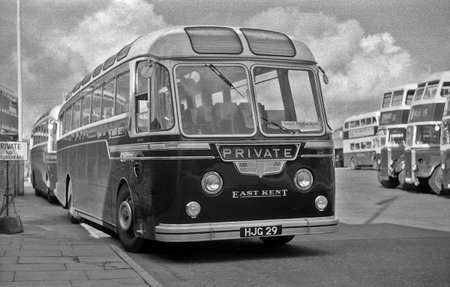
HJG 29_lr

Here is another of these fine East Kent Lancet UFs. HJG 29 is seen pictured in Canterbury Bus Station in 1961. Another vehicle of this class is parked behind it. This handsome 1954 style of Duple body compares very favourably with the bulbous abomination fitted to 1961 Black and White Reliance 8222 AD. It was somewhere about 1960 that Duple began to lose its way in my opinion.

Roger Cox


Quick links to the  -  Comments Page  -  Contact Page  -  Home Page
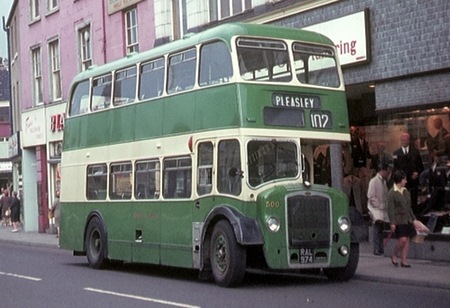


Mansfield District – Bristol Lodekka LD6G – RAL 974 – 500

RAL 974_lr
Copyright Ian Wild

Mansfield District Traction Company Limited
1954
Bristol Lodekka LD6G
ECW H33/25R

I always liked the Bristol Lodekka with the original long grille-thought it gave the bus a more purposeful appearance. A chance visit to Mansfield in August 1968 found this example which appeared to be in excellent condition for its age.

Photograph and Copy contributed by Ian Wild


29/06/11 – 13:03

In 1969 several of these early Mansfield Lodekkas moved north to West Riding to enable the ill fated Wulfrunians to be withdrawn They entered service in Mansfield green and were quickly joined by others from Midland General and Lincs. Later some twenty plus almost new FLFs came from Bristol to complete the exercise

Chris Hough


29/06/11 – 14:44

Ah! delight in Mansfield, one of my favourite places. Firstly I agree with Ian about the long grille Lodekka, I’ve always thought the same. Secondly, this is particularly interesting because it was Mansfield District’s first Lodekka, new in 1954, platform doors fitted in 1957. I’ve always tended to think of Mansfield District as a sort of Mansfield Corporation, with its history of tramway operation and lots of high frequency short distance services, a very good example of which was the 102 as shown. In 1964, the Saturday service was; first bus 4.40am then every 10mins until 9am then every 5mins until 6.20pm then every 10mins until 11pm (last) and this wasn’t the only service between Mansfield and Pleasley, a timetable wasn’t really necessary! I find it a little odd that this bus isn’t sporting a full blind display, Mansfield District, Midland General and Notts and Derby were normally very fastidious about such things and their inspectors would ‘have a word’ with the conductor if the blinds weren’t displayed perfectly! The correct display in the via box for the 102 would have been MANSFIELD CENTRE, CHESTERFIELD ROAD, PLEASLEY (some journeys carried on to New Houghton)
As Chris H rightly says, some of these vehicles were transferred to West Riding as Wulfrunian replacements and were apparently considered to be amongst the better ones so transferred, not surprising considering MDT/MGO’s excellent maintenance standards. Also unusual is that this vehicle carries no adverts of any sort and I think looks much better for it!

Chris Barker


30/06/11 – 05:29

I too much preferred the long radiator and the traditional Bristol shape of it to the later version, which always gave me the annoying impression of having been in a lower end collision and being amateurishly repaired by "chopping off the damaged bit and putting in a new straight lower shape." I also have an aversion, on all buses, to front square number plates with two rows of three characters – the normal long number plate with all characters in one line looks far tidier at the front and, in many cases, even at the back also.

Chris Youhill


30/06/11 – 05:35

This vehicle’s sister, RAL 976, did some sightseeing work here in Halifax, Nova Scotia in the early seventies, alongside an ex London RT, and at the time made a fine sight in its green livery, I think it had been with West Riding before export to Canada. It moved on years ago, to destination unknown, and I suppose it presumably could still exist, but more than likely has succumbed to the scrapman’s hammer by now.

Dave Careless


30/06/11 – 16:07

I am not at all surprised to observe the superb condition which the Mansfield Lodekka demonstrates! Ignoring any design preferences of individual enthusiasts, I struggle to define any ECW bodied vehicle as being "worn". Most would seem to be capable of completing a 40 year life cycle.
Undoubtedly the finest exponents of bus building which ever existed, the quality and innovation of which was, in my humble opinion, totally unmatched. It is to be greatly regretted that this wonderful company was allowed to disintegrate!
ECW bodies never failed to exude total quality, their obsolescence being defined simply in terms of "fashion".
I have no "axe to grind", and enjoy, as an enthusiast, other products than those from Lowestoft, but wonder if former professionals from within the industry are able to destroy this "illusion" of mine?

John Whitaker


01/07/11 – 05:19

Although I cannot fault the general impression of these vehicles, I was never that keen on the ‘hump’ below the driver’s cab, giving to me, at least, the impression that it had had a front-end shunt and was yet to be repaired!
AS Chris B says, the absence of adverts greatly enhances its looks. Were that they’d all been like this!

Chris Hebbron


25/07/11 – 21:01

The Photo of RAL 974 is not standing on the 102 Rank and as a driver for MDT I am suggesting that the vehicle will be driven round to Queen Street to duplicate the service 102 bus to Pleasley hence the via blind is left empty.

John Hellewell


I have put this comment on exact as I got it, I did not get the next to last word but had a good laugh when the penny dropped well done Mr A Non

15/08/11 – 13:01

old5oo thank you 44 sinse i drove her the fleet numbers500to 532 all back rsenders niceone

A Non


16/09/14 – 07:44

I used to be a driver for Mansfield District from 1968 and my father did fifty years for Mansfield it takes me back. I still am in the bus industry I’m a supervisor for West Coast Motors on the west coast of Scotland it was a good time at MDT. I was at Midland Travel as well.

Colin Steele


16/09/14 – 09:54

"ECW bodies never failed to exude total quality…"
Not quite, John. The B51 coach body was an absolute aesthetic and structural abomination, utilising large areas of unsupported glass fibre that simply collapsed in service. All the fittings were flimsy and the luggage boots leaked rainwater and road dirt. It was produced under the directives of the Stokes ‘led’ Leyland empire and so bad was it that it must have hastened the ultimate demise of ECW.

Roger Cox


16/09/14 – 12:08

Yes, but I think that it’s a given that any Stokes era history is a period not to savour and that John was thinking of "real" ECW in the same way that I differentiate between Leyland and British Leyland. You are absolutely right that the B51 was an abomination but its failings revolve around British Leyland trying to slap a body literally designed around a rear engined vehicle (the Bristol RELH) onto mid-engined designs without any thought to structural integrity. [Even the earlier, purer, versions on Leopards for SELNEC/GMT suffered similar problems but they were too embarrassed to mention it at the time.] Sadly, at the same time as the B51, Willowbrook offered its own abomination, the 003. Duple were not much better either and, as we all know, Plaxton eventually joined the slide into mediocrity or worse.

David Oldfield


17/09/14 – 07:13

I seem to recall that United took some Leopards with the plasticky B51 bodies for National Express work. The chassis did not have sufficient fixings to cater for the enormous boots required, worked themselves loose and at least one fell off, strewing luggage all over the motorway.

Chris Hebbron


19/09/14 – 07:03

None at all Chris. It was an unsupported boot. Originally the body was (semi) integral with the RE frame – and thus very rigid and strong. Here began its troubles.

David Oldfield


20/09/14 – 05:57

I wonder who dominated here, David O, engineers or accountants!

Chris Hebbron


20/09/14 – 09:27

No brainer Chris. Got to be accountants. Whenever there’s a choice between experts/professionals and accountants the outcome is chaos – just have a closer look at the accountants. You don’t have to look too far to see who is at fault.

David Oldfield


05/10/15 – 07:07

RAL 974

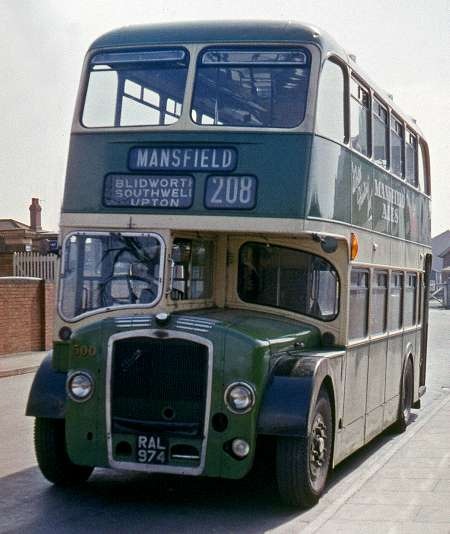
I’ve finally dug out my photo of RAL 974 taken in Newark in 1961, at which time it was wearing advertisements.

Roger Cox


06/10/15 – 07:11

Thanks Roger, for that wonderful photo, Mansfield District had several services between Mansfield and Newark but the principal ones were the 208/209 which combined to provide an hourly headway (even on Sundays) between the two towns by slightly different routes. On Saturdays the frequency was doubled up to half hourly for most of the day.
Although Newark had a bus station, for some reason all the MDT services at that time terminated at Northgate railway station which can be seen in the background. They did move into the bus station in later years.

Chris Barker


07/10/15 – 06:59

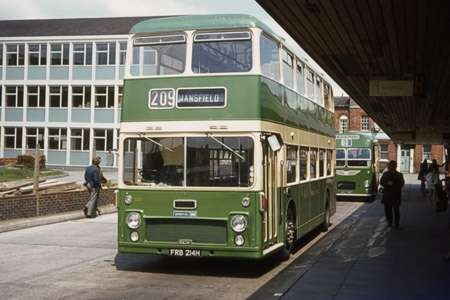
FRB 214H

Here is a slightly more modern Mansfield District vehicle – but still in the traditional livery – a Bristol VRT/ECW Series 1, seen in Newark Bus Station about to return to Nottingham via the 209 route in 1971.

John Stringer


07/10/15 – 15:52

Slip of the fingers there John? It says "Mansfield" on the blind! Nottingham was the 215. The fundamental difference between the 208 (via Blidworth, Southwell, Upton – as shown on the Lodekka) and the 209 was that the latter ran via Rolleston and Fiskerton between Newark and Southwell. I fancy it was meant to substitute for the train following closure of the Rolleston Junction – Southwell branch line.

Stephen Ford


Quick links to the  -  Comments Page  -  Contact Page  -  Home Page


Aldershot and District – Dennis Lance K4 – LOU 40 – 212

Aldershot & District - Dennis Lance K4 - LOU 40 - 212
Copyright Roger Cox

Aldershot and District Traction Company 
1953
Dennis Lance K4
East Lancs L28/28R

This picture was taken in Woodbridge Road, Guildford, about 1961, and shows one of the 32 "tin fronted" Dennis Lance K4 buses unique to the Aldershot and District Traction Company. The first 20 of these had East Lancs L28/28 bodywork of the type shown, and the final 12 were bodied by Weymann with a version of the Orion, again seating 56 with 28 on each deck. The Gardner 5LW engines in these buses were removed from withdrawn Lancets of 1940 vintage, but were rebuilt and updated to the latest specification to virtually new standard. As usual with A&D buses, these vehicles had five speed gearboxes. I never drove one of these, but I understand that, with their slow revving (1700 rpm) 94 bhp engines they were less than lively, and not popular with the Aldershot and District driving staff, who christened them "Lulus" from their registration letters. The motorcycle and sidecar combination overtaking the bus is entirely characteristic of those times and something that is never seen today. I cannot identify the make of motorbike, but it is certainly something of a veteran itself as it has girder type front forks.

Photograph and Copy contributed by Roger Cox

———

26/06/11 – 11:32

The same nickname was given by Samuel Ledgard staff to ex London RT LLU 803 – her thunder was somewhat stolen though by the later arrival of some RTLs with the same "Christian name."
Despite the cumbersome and leisurely progress of the A & D Dennis Lance I have to say that it is an extremely attractive vehicle indeed – the characterful destination display and the beautiful livery of that operator being the icing on the cake.

Chris Youhill

———

26/06/11 – 19:59

Aldershot and District always had a small engine policy, and it is difficult to understand why the Lance K4 should have been singled out by certain staff for a modest performance. The pre war Lances with the high set radiator style (as on the Lancet II and III) were delivered with Dennis four cylinder sixteen valve O4 engines of 6.5 litres giving 82 bhp. Most of these early Lances were later rebodied and refitted with 5LW engines, and the wartime Guy Arabs also had the 5LW powerplant. The first postwar ‘deckers were Lance K3s with the Dennis O6 of 100 bhp, and these were lively, smooth running buses, and the following K4s of the type shown above must have seemed much more sedate by comparison. Then came Lolines powered by the 6LW engine, and it is probable that, by a certain point in time and within the experience of some drivers, the Lance K4s were the only double deck buses in the fleet still using the 5LW. My experience of the K4 as a passenger indicated that its road performance was fully up to the general standard of the time.

Roger Cox

———

27/06/11 – 11:48

Happily, Tim Stubbs and Malcolm Spalding rescued sister ship A&D K4 220 some years ago, and it has been a regular at running days and other events for at least seventeen years. I’ve had the very good fortune to be on the driving rota, and it really a most characterful bus, with the reassuring thump of the 5LW and the unique 5-spd gearbox, with 1st, 2nd and 3rd sliding (not constant)mesh and preselective overdrive. The cab is not a model of comfort or convenience, but the steering is a joy. Brakes are vacuum over hydraulic, and seem to need frequent adjustment but are wonderfully progressive in action.
Seating is 28 on each deck. On top, counting from the front, the seats are for 4, 4, 3, 4, 3, 4, 3 and 3. Even on a 27-long body eight rows upstairs was still less common than seven on mid-fifties lowbridge bodies but—as on contemporary Roe lowbridge products—the back seat upstairs is set as far back as it can be without compromising staircase headroom, so there’s plenty of knee room between seats.
She’s admittedly slow in hilly country, but will do 48mph on the flat and on a well-chosen route puts the miles behind her surprising quickly.
Tim’s K3 of 1950, with the Dennis O6 engine, is 6" narrower and a foot shorter but is actually slightly heavier than the K4. Unlike the 5LW, the amazingly smooth O6 is a spinner, not a slogger. The difference in engine gives the two otherwise very similar vehicles a totally different character. The 5LW demands a well-adjusted clutch-stop, but the lighter flywheel of the O6 makes it unnecessary for upward changes—except 1st to 2nd on hills.
These two vehicles are wonderful survivals, and it’s a pity that none of the lightweight (and apparently very lively) Weymann Orion-bodied K4s survived. When I first saw one at Reading Station the pop-rivets put me off. How could my schoolboy judgment have been so flawed!
There should be Dennis delights at Alton Running Day, Hampshire, this July the 17th, and the big event is 100 years of Aldershot&District at Farnborough, Hants, Sunday May the 27th 2012.

Ian Thompson

———

28/06/11 – 06:24

Ian, I lived in Farnborough, Hants, for nine years from the mid sixties, by which time the Loline reigned supreme in the A&D double deck fleet, and I had a spell at Aldershot depot as a driver before returning to the admin side of the bus industry at Reigate. Although I have travelled as a passenger on the A&D K3 and K4 Lances, and my knowledge of Dennis buses goes right back to 1946 to 1949 when, as a child, I used to travel with my mother on the pre war O4 engined East Kent Lancet IIs between Faversham and Herne Bay, I have never driven a Lance or a Lancet. I have always had a strong regard for traditional Dennis machines, and Dennis were the only British manufacturer to put oil engines with four valves per cylinder into quantity production. Crossley made a wartime prototype "four valver" that performed well, but when Saurer asked for a royalty or licence fee for the use of its combustion chamber design, Crossley hastily redesigned the engine as a "two valver" with catastrophic consequences for reliability and performance. I am envious your driving sessions in these old Dennis buses, and it is wonderful to see them in preservation. My own short lived foray into the preservation scene was as part of a group that saved the Dennis Ace YD 9533. The costs of restoration became prohibitive, and we sold it on, and it is now thankfully a regular on the rally scene. The Ace was certainly an interesting machine to drive with its central accelerator pedal! I now live in East Anglia, but I will certainly bear in mind next year’s Aldershot and District centenary

Roger Cox

———

28/06/11 – 11:38

Roger, I’m equally envious of your youthful rides on 04-engined Lancets. From what I’ve heard, they were livelier than one might expect from only 6.5 litres. I believe one is preserved and I very much hope one day to have a ride on it. I used to think the days of four-cylinder engines powering full-size buses were behind us, but the new Alexander-Dennis diesel-electrics in Reading, Oxford and Manchester seem to manage very nicely with their little fours.
When I worked at Smiths in Reading there were still 04 engine bits in the workshop, although the last 04s were probably off the road by 1960.
The only Ace I’ve ever ridden on in genuine service took me from Yarmouth to Freshwater, Isle of Wight, but the sound was all wrong as it had a Bedford OB engine and gearbox.
I can see why Crossley had for legal reasons to hurriedly redesign the Saurer combustion chamber, but I wonder why at the same time they abandoned the 4-valve head? That surely wouldn’t have infringed any patents.
The Reading downdraught-engined Crossley deckers were certainly slow, with their UW of 8.3.1, and they tended, oddly, to be used on the hillier routes, but they lasted for 18 years, so the workshop must have got a feel for keeping them happy.

Ian Thompson

———

29/06/11 – 06:52

Ian, your comments on Dennis and Crossley machines has prompted me to add a few more. My memories as a four to seven year old might now be optimistically tinged with nostalgia, but I do recall the curious muffled drumming sound of the Dennis O4 engines, very different from the local Maidstone and District Tigers (petrol and diesel), but the progress was very smooth and lively. I loved those old Dennis Lancets, and the high mounted radiator offset to the nearside denoted a truly independently minded manufacturer. The later Lancet III was surely one of the finest vehicles of its time.
I have some b/w pictures of three Smiths of Reading Lancets that brought a private party to Hampton Court in 1961. I will send them to the site in due course.
Still with Reading, I have a few pictures of that operator’s all Crossley DD42/8 machines which, as you say, were fitted with the downdraught engine that represented AEC’s attempt to mitigate the abysmal characteristics of the HOE7. I took the pictures in 1967 by which time the Dennis Loline reigned supreme in the double deck fleet. Having moved to the Gosport area when I was nine years old, I frequently saw the Portsmouth Crossleys in service, but I never travelled on a bus of this make until 1958, by which time I was living in the Croydon area. This was the year of the seven week London bus strike, and an outfit grandiosely calling itself "The People’s League for the Defence of Freedom" obtained permission to run some routes during the stoppage. One of these was route 2 between Croydon and New Addington, and two of the four buses allocated were ex Lancaster Corporation all Crossley SD42 (the others were an ex Crosville TD7 and an ex Lytham St Annes CWA6). Admittedly the Crossleys were 11 years old by then, and always well loaded, but I was amazed by the truly mediocre hill climbing performance of these machines. I have a picture of HTC 614 at New Addington taken with my trusty Brownie 127, and will send it in sometime.

Roger Cox

———

29/06/11 – 06:58

The strange thing about the Crossley HOE engine was that they never cured, or bothered to cure, the breathing problems that became apparent with the conversion to two-valves per cylinder. Yet, when AEC took them over, the problem was sorted out quite quickly!

Chris Hebbron

———

29/06/11 – 19:41

Chris, judging by the comprehensive "Crossley" book by Eyre, Heaps and Townsin, the Crossley Motors company did not take kindly to external criticism, and any that was forthcoming merely served to strengthen the firm’s intransigence, a very curious attitude to adopt in a fiercely commercial environment. Thus, not only did it take no meaningful action to solve the shortcomings of the HOE7, but it appeared to resent the AEC solution that appeared as the downdraught engine, even continuing to supply unmodified HOE7 engines in new buses. A similar cussedness was displayed in respect of the steering geometry on all Crossley buses. A simple readjustment in design would have cured the exceptionally heavy steering characteristics, that, in the case of the three axled "Dominion" trolleybuses, bordered on the impossible, but Crossley would not shift its position. No wonder AEC got fed up.

Roger Cox

———

30/06/11 – 05:33

What amazes me about Crossley is the difference in attitude between their chassis and body departments. Whereas the chassis people stuck stubbornly to their own ideas come what may, their first standard postwar body was designed not by Crossley but by Manchester Corporation. The special Manchester features – curves, waistrail steps and cantilever platform – quickly became optional, and even the first Liverpool bodies were actually the de-Manchestered Manc design reworked as a four-bay body with a flat front, as required by the Liverpool spec. I don’t think Crossley ever designed a double-deck body from scratch at all, although their postwar framing system was all their own.

Peter Williamson

———

01/07/11 – 05:27

Thank you Roger and Peter, for mentioning the diverse attitude of the two parts of Crossley, one self-serving and the other accommodating towards its customers. As we know, a chain is only as good as its weakest link!

Chris Hebbron

———

03/07/11 – 19:54

Talking about Track routes to this day the Arriva service 268 Dewsbury- Bradford service is still referred as the Track although in tramway days the service only went as far as Moorend as did service G in bus days.The service 281 Bradford to Thornhill is always referred as The Donkey for obvious reasons.

Philip Carlton

———

30/04/12 – 07:53

Roger, in his copy, records that these vehicles had five-speed gearboxes, but I seem to recall that they had four-speed boxes with overdrive. The driver would move the lever in a semi-circular way to gain overdrive. I only travelled on them from Woking to St. Peter’s Hospital, Ottershaw, a very flat route, so was never able to judge their hill-climbing capabilities. When living in Portsmouth, I did travel on the Petersfield – Guildford route as far as Milford on a couple of occasions, but that was on a Loline. I imagine that the Lances would also have been on that challenging route over the North Downs and I’d have loved to have ridden on them up there!
A childhood delight was going on holiday, around 1950, from Kingston – Southsea on a duplicate Southdown Leyland Cub coach. But I digress!

Chris Hebbron

———

30/04/12 – 09:12

Oh, there you go – as Chris Youhill has said elsewhere, that’s the fun of this site. Digress away. After the pathetic failure that was yesterday’s Cobham/Wisley event, we may only be left with our digressions!

David Oldfield

———

01/05/12 – 06:48

Well, the weather must have been appalling, if Gloucester was anything to go by, but were there other problems, too, David?

Chris Hebbron

———

01/05/12 – 06:50

Chris, the Dennis gearbox was an overdrive unit, giving five gears in all. Overdrive was a preselective gear designed using Maybach principles. To engage from fourth, the gear lever was moved at any time, as with a conventional preselector, to the left and forward, and actual engagement occurred when the accelerator was released to allow the revs to die. When the accelerator was pressed again, fifth gear was already engaged. To change down, the lever was moved back to the fourth position, and engagement occurred when the accelerator was released and then pressed again to raise the revs for the fourth ratio. Sadly, I have never driven a Dennis with such a gearbox, though I have travelled many miles as a passenger on Lances and Lancets so equipped. Ian T is the expert when it comes to practical experience.

Roger Cox

———

01/05/12 – 06:51

Is that Arthur and Olive from On the Buses just passing?

Philip Carlton

———

01/05/12 – 19:27

We were discussing this on Sunday, Chris, saying that the organisers might use the weather as an excuse. The weather was atrocious – but that wasn’t the problem. Most of the "runs" were a circuit of the airfield – not a decent run on proper roads. The 499 to/from Weybridge Station was supposed to be half modern low-floor vehicles – it was even worse. More of them, supplemented by re-engined RMs. I have friends "high" in the industry who said after Dunsfold, and then this, they will no longer be supporting it. Likewise people in the business who are enthusiasts who brought their own vehicles from wide and far. We were charged £10 to enter, get soaked and find nothing to entertain us – and a further £2 for the programme. Sorry you got me going Chris, but it wasn’t the weather and, despite living up the hill, it won’t be in my diary next year.
Rant over, now let’s get on with friendly sharing of expertise and experience.

David Oldfield


Quick links to the  -  Comments Page  -  Contact Page  -  Home Page


All rights to the design and layout of this website are reserved     

Old Bus Photos from Saturday 25th April 2009 to Thursday 4th January 2024