Old Bus Photos

Sheffield Corporation – Leyland Titan PD2 – RWJ 713 – 713
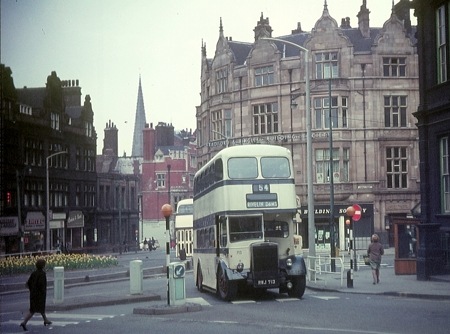
Sheffield Corporation - Leyland Titan PD2 - RWJ 713 - 713
Copyright Ian Wild

Sheffield Corporation
1954
Leyland Titan PD2/12
Weymann H32/26R

It’s 27th April 1968 and Sheffield 713 turns from Leopold Street terminus into West Street on another trip out into the country at Rivelin Dams.
713 was one of the batch of 56 (the largest single batch of buses purchased by Sheffield) delivered in March/April 1954 to replace trams on the Ecclesall – City – Middlewood route. Apart from accident victim 707, all the batch were withdrawn in 1967 and 1968 so 713 had only a short service life left by the time of this picture.
Nowadays Sheffield Supertram runs through the middle of this picture on its way to Middlewood but via a different route that 713 and its sister vehicles would have taken countless times during their 13/14 year life.

Photograph and Copy contributed by Ian Wild

A full list of Titan codes can be seen here.

———

13/09/11 – 07:53

April 1968 – my last few months in Sheffield as a student and I well remember these PD2s. Service 54 ran to a reservoir/control room just over the border in Derbyshire but was nevertheless a Corporation A route rather than a Joint Omnibus Committee B route, as was generally the case with cross-boundary services. The terminus was at the Norfolk Arms, now no more.

Geoff Kerr

———

13/09/11 – 17:00

Can anybody please enlighten me on the road layout at this point in 1968. On the face of it, there is a roundabout with yellow flowers but behind PD2 No. 713 is a rear engined machine seemingly turning right into Church Street ‘wrong way’. Also, there is a ‘No Entry’ sign at the Leopold Street corner.

John Darwent

———

14/09/11 – 07:43

Would that be The Norfolk Arms at Ringinglow Geoff ?

Roger Broughton

———

14/09/11 – 07:44

You’re not the only one who is intrigued, John. I was in the fourth form at school along the route of 713 when this was taken and cannot remember this odd layout – which is at the confluence of Leopold Street (to right), West Street (where 713 is entering), Church Street (where early Atlantean is heading) and Town Head Street (off to the left). The spire in the background is Sheffield Cathedral.
The Norfolk Arms was always well within the city limits. Even though they are different and wider now, there was always a great deal of countryside on the south and west side. In the post 1974 Sheffield, half the area is countryside, a third of it in the Peak District National Park.

David Oldfield

———

14/09/11 – 07:45

A one way loop had been introduced earlier in the 1960s comprising Leopold St, Church St and Fargate. Coming along Leopold St, traffic could turn left into West Street(as 713), right (wrong side of the roundabout)into Church St(as the Atlantean) or go straight ahead down Townhead St. Similarly traffic inbound on West St could use the roundabout in the conventional way and access Church St merging with the loop traffic from Leopold St. Sounds complicated written down but hope this assists.

Ian Wild

———

14/09/11 – 07:47

Nice buses these, but to me they always seemed slow and ponderous compared to the SWE-registered Regents with the same style of Weymann body, except for the outswept panels.
The AEC’s had that barking exhaust, and would come tearing out of the platforms in the bus station on their way to Hackenthorpe and Hemsworth, making Pond Street sound more like a racing car circuit than a municipal bus station. They had a smarter style of wheel nut ring as well, but I’d better not get going on that topic or there’ll be no end to it. What a splendid city for buses though, in those days.

Dave Careless

———

14/09/11 – 16:56

The Norfolk Arms mentioned above was on Manchester Road. The Norfolk Arms at Ringinglow is still very much in existence.

Stephen Bloomfield

———

14/09/11 – 16:56

What can I do, Dave, but agree with you. I had far more contact with the Regent IIIs than the PD2s – and did not regret it for one minute.

David Oldfield

———

15/09/11 – 09:27

Thank you for the explanation Ian. I worked in George Street from 1961 through 1964 but cannot for the life of me remember the one-way loop. Probably attentions towards the fairer sex had taken over at that time.
Ah well.

John Darwent

———

16/09/11 – 09:26

John, I think the one way loop came in later than 1964 which is why you wouldn’t recall it.

Ian Wild

———

17/09/11 – 08:04

Thanks Stephen, yes I know, we often call in when been out walking.

Roger Broughton

———

18/09/11 – 06:10

Photographs of this batch of buses always make me think of Endcliffe Park in Sheffield; you could see and hear them through the trees at the edge of the park, running along Rustlings Road every few minutes back and forth to Fulwood on the busy 88 service.
I remember going to the park on one of these one summer afternoon with my mother in the early sixties, and on getting off the bus, seeing for the first time in a toy shop window on Ecclesall Road an ‘Exide’ version of the Dinky Toys double decker. I pleaded for one, but it wasn’t in the equation, as despite whining and moaning all afternoon, it was apparent that an ice cream was as good as it was going to get! About four years ago, I finally bought one on eBay; it didn’t have a box, but it was considerably more than the modern day equivalent of 4/2 !!

Dave Careless

———

23/10/11 – 07:43

Hi very interesting site, much enjoyed. On this page, however, there is an error The Route 54 Rivelin Dams ran out of Pinfold Lane. The Route 51 Lodge Moor ran from Leopold Street. Route 51 was my first route as a rookie driver. The buses on that route during the 60s were AECs and on my first ever trip I was unable to get the handbrake off. I never experienced an AEC in driving school and was unaware that it was necessary to put ones foot down on the footbrake in order to release it. See this photo of mine of a PD2 I had driven to Rivelin Dams – //www.geograph.org.uk/

Dave Hitchborne

———

23/10/11 – 08:10

Sorry to argue, Dave, but the 51 and 50 left from Pinfold Lane – not far from Scout HQ and shop. I was a regular on the 51 from a young age, visiting family.

David Oldfield

———

04/12/11 – 07:46

Did the 54 later only go to Wyming Brook?

James Walker

———

15/03/12 – 09:30

Sorry, but I’m going to argue the point on this till the cows come home and my wife/clippie and I remember the Dore 50 and the Rivelin Dams 54 running from Pinfold Street and the Lodge Moor 51 ran from Leopold Street. Another reason for remembering the 51 running from Leopold Street is that it went from town via West Street and came back via Division Street and Barker’s Pool. On one occasion I was waiting to turn out of Barker’s Pool onto Leopold Street with a sports car in front when the driver of a Walkley 95 waived us both to proceed into Leopold Street. The sports car set off and I followed waiving and thanking the 95 driver when I suddenly realised that the sports car had stopped around the corner at the pedestrian crossing and I was inches away from it when I stamped on the brakes. The bus stopped, but my reserve conductor was hurled to the front of the bus where I heard him whack the bulkhead behind me. He then spent about 10 mins in Leopold Street instructing me on his knowledge of the English language. I believe his name was Abdul Roafe and I have a photo of him.

Dave Hitchborne

———

16/03/12 – 12:45

Regarding the debate on the 50, 51 and 54, I have had a look in the STD Timetable and the following is stated;

October 1951 T/T
50 Departs City (Trippett Lane) *
51 City (Pinfold Street)
54 and 55 City (Leopold Street)

May 1960 T/T
50 Departs City (Pinfold Street) *
51 City (Pinfold Street)
54 and 55 City (Leopold Street)

So, apart from the 50 moving a few yards to align with the 51 at Pinfold Street, they all remained more or less the same during this time scale. If there were subsequent alterations in the 1960’s, I can’t say as I don’t have the records but it seems that, at the moment, David O is ahead on points! Perhaps someone has a timetable to confirm departure points and routes taken in subsequent years.

John Darwent

———

17/03/12 – 06:22

Thank you for your defence, John. On reading Dave H’s post, something occurred to me. The 51 eventually became a cross city service to Gleadless/Herdings. At that point it would have travelled along Leopold Street from Gleadless to Lodge Moor. It would then go down Townhead Street and turn up broad Lane. In the other direction it left Broad Lane to end up going down Trippett Lane.

David Oldfield

———
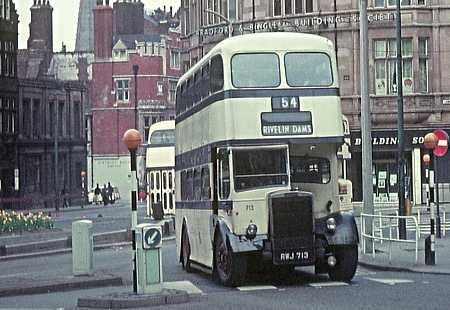
RWJ 713_closeup Vehicle reminder shot for this posting

———

18/03/12 – 07:46

Regarding Sheffield Corporation buses in the 1950s does anybody remember a bizarre religious sect who took advertisement space with such warnings as ‘The Wages of Sin is Death’ and other warnings. Bringing the subject right up to date I notice that here at Lothian Buses we have a number of buses with the advertisement ‘Try Praying’.

Philip Carlton

———

19/03/12 – 09:18

Interesting observation Philip. Is the advertisement aimed at Edinburgh citizens in general, or just passengers waiting for buses provided by one of Lothian RT’s major competitors do you think?

Brendan Smith


Quick links to the  -  Comments Page  -  Contact Page  -  Home Page


Provincial – AEC Regal I/Regent I – EHO 282 – 15

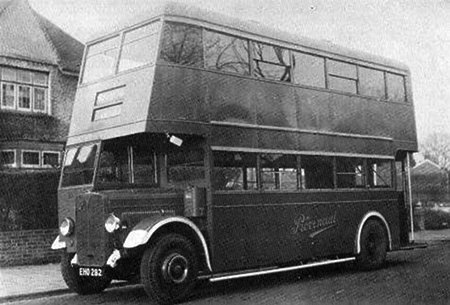
Provincial - AEC Regal/Regent I - EHO 282 - 15

Provincial (Gosport & Fareham Omnibus Co)
1943
AEC Regal I/Regent I
Reading H??/??R

Doubt exists about the vehicle chassis type, but here is the story as of now.
In 1943, Mr Orme-White carried out his first (of many) vehicle re-constructions, involving an AEC Regal I (although recent research suggests it was a Regent I chassis), purchased from the War Department with the registration DK 7791. The original source of the chassis is unknown.
Provincial re-conditioned the chassis, fitted a 7.7 litre AEC engine and got Reading’s of Portsmouth to body it. It was their first double deck offering, of utility specification and painted wartime grey. It was also re-registered EHO 282 and numbered 15.
In 1952, it was rebuilt again by Reading and lasted in service until 1959. Its body was then donated to number 12 (FHO 604) and the chassis scrapped.
What is interesting is that a small and almost unknown bodybuilder was given permission to build an austerity body and it might well have been its sole effort. The year of build was after the initial austerity bodies had been built on ‘unfrozen’ chassis, but before full-scale austerity bodybuilding had got underway. Did Reading come up with its own design or use someone else’s austerity plans? If the latter, the question is whose does it resemble?

Photograph Reading Coachworks (from the website below).
Copy contributed by Chris Hebbron using material by Ray Tull and
Stewart Brett from the website //www.regent8.co.uk/regents.htm

———

08/09/11 – 14:27

What clue is there in the fuel pump on the bulkhead?

Joe

———

08/09/11 – 14:28

Probably of no significance at all, but the next registration to the original donor vehicle, DK 7792, was a Regal supplied to Yelloway in 1932.

Stephen Ford

———

08/09/11 – 14:29

The DK registration on the chassis was a Rochdale area plate.

Roger Broughton

———

08/09/11 – 14:30

Looks like a semi-floating hub at the back, so can’t be later than 1932. And what a well-proportioned body!

Ian Thompson

———

I lived in the Gosport area as a child from 1949 to 1952, and well remember the Provincial (Gosport & Fareham) Regents. These initially puzzled me as their sound was so unlike the London Transport AECs that I recalled as a very small boy from 1946, when I lived in Selsdon, Croydon. I personally much preferred the Guy/Park Royal bodied Guy Arab IIIs that served the Alverstoke and Haslar Route 11 on which I lived, and the Arab III is still one of my favourite bus types.
It is now thought that EHO 282 was a Regent. The Regal had a longer wheelbase than the double deck chassis. The photo indicates that the proportions of the bus are in keeping with those of a Regent, whereas a double deck body on a Regal would have necessitated a short length behind the rear axle to keep within the 26ft overall length limit of the time.

Roger Cox

———

10/09/11 – 07:42

One thing I didn’t mention originally was the bespoke double destination blind boxes, a Provincial’ feature, even then. All extra work in austerity times.
And are they safety rails high up on the upper-deck front windows? They don’t look like vents or the like.
It looks as if there’s a Regal/Regent badge on the radiator grill itself – pity it’s illegible.
Thx for the additional comments which have shed some more light on this intriguing bus.
And I think most of us echo Roger’s comment about proportion – austerity bus bodies have a charm of their own.

Chris Hebbron

———

10/09/11 – 07:43

And Roger could that also be the explanation as to why the Leon Lion had a centre entrance utility body fitted?

Chris Barker

———

11/09/11 – 08:18

I think that you have hit on the answer about the Leon Lion, Chris. Photos can be a bit misleading sometimes, but the picture of the Lion does seem to show that the rear wheel is located directly under the rearmost but one window on this five bay body. The centre bay is decidedly wider than the rest, so that all the other bays are obviously of pretty short length, and the rear axle seems to be located well to the rear of the bus. A centre or front entrance would have been the best solution in the circumstances.

Roger Cox

———

17/04/12 – 14:18

The original post mentions Mr Orme-White. I’ve no idea how true it is, but I have been told that Mr White of the Provincial Tramways group (Gosport and Fareham, Portsdown & Horndean among others) was the same Mr White of White’s Removals, and this is the reason behind the removal company’s "sponsorship" of some trams under restoration in the Portsmouth area.

Pete Davies

———

11/07/12 – 18:39

I contacted White & Co. (Removals) of Portsmouth, Pete, and, after a period of silence, while the family tree was being consulted, they’ve advised me that there seems to be no connexion between H Orme-White and their family.

Chris Hebbron

———

12/07/12 – 19:29

Now there`s a name to savour! This was a fleet just made for enthusiasts, and my early experiences of being a bus enthusiast are saturated with the delights of this wonderful fleet. I am just amazed that it does not enter these columns on a more regular basis. I remember they had an AEC "Mandator" petrol tanker rebodied as a bus, and have often been tempted to join the Provincial Society, but one cannot be "in everything"
Mention of Mr Orme White reminds me that the family were connected with the Imperial Tramways group, who had interests in Grimsby, Middlesbrough, and , pre Sir Clifton Robinson, with one of my favourite tram fleets, the London United! I think they also had connections with the ill-fated Mid Yorkshire Tramways too.
Lets have more Provincial content, and, in the meantime, may I recommend those who are able, to make the journey to Crich, where LUT No.159 is about to be unveiled after a beautiful restoration to its pre-Underground Group condition. As a TMS member, I do have an axe to grind, but it really is a wonderful expression of the art of vintage vehicle restoration, under the professional care of the TMS staff, and the "LCC Tramways Trust".
Sorry to go all "trammy"….it won`t happen again!

John Whitaker

———

John W is right to applaud the Orme-White family and their link with some great companies such as London United Tramways and the Provincial Tramways Group.
I believe the Gosport & Fareham Bus Company running under the name Provincial started in 1929 and replaced the trams. By 1936 they had bought several AEC Regents with Park Royal bodies. Some of these buses were still running in 1963 when I visited Gosport. I rode on one of these buses and this experience was magic, as the sound from the AEC crash gearbox was something never to be forgotten. The Provincial Company had some very interesting buses and hopefully someone has some photos to post on this web site.

Richard Fieldhouse

———

14/07/12 – 07:48

I probably feel about LUT’s ‘Diddlers’ the way John W feels about LUT’s trams. YouTube has a couple of short films about ‘Diddlers’ on their inauguration day in May 1931, but there are several antiquated (albeit covered-top) LUT trams putting in an appearance, too. It’s wonderful to see that long-gone world, 88 years ago. Little traffic, an open-top NS bus, steam roller, conductor punching tickets, driver’s white summer coat, evocative soundtrack…I feel the eyes watering now! Enjoy HERE: www.youtube.com

Chris Hebbron

———

14/07/12 – 10:56

I too, Chris, am captivated by that era of summer coats for drivers, with the odd steam roller about! I don`t quite remember it, but it is of extra fascination because it is close, but not quite akin to our earliest memories. I have always been fascinated by history, especially from the early 19C., when I like to imagine myself involved at the time of my (other hobby) family history characters!
I regard the Diddlers as part of the LUT story, and, as such, they have an appeal of their own. I do not think they were particularly attractive vehicles, but that is of no consequence; they were very much an "in house" product of the Underground Group, built "in house" by UCC, and were not intended, design wise, to appeal to the general transport "market", but more intended to resemble the "Feltham" trams.
This whole period of tram to trolleybus conversion, and the early days of London Transport provides enough material for years and years of OBP correspondence!
I should have mentioned earlier, that the White family, George White in LUT days, were also involved in the early days of Bristol Tramways, which had Imperial Group connections too.

John Whitaker

———

14/07/12 – 18:04

I shall look forward to seeing LUT’s 159 at my next visit to Crich, John. It must have been a huge task to recreate all that top deck ‘cast-iron’ alone. At the other end of the spectrum, I have a soft spot for Feltham MET 331, looking much sleeker and stylish than its mainstream cousins.
I hold no special brief for London Transport, but what it achieved from its 1933 creation to 1940 was amazing….with sliderules, but without computers!

Chris Hebbron


Quick links to the  -  Comments Page  -  Contact Page  -  Home Page


City of Gloucester/Western Travel – Bristol RELH6L – WHW 374H – Bristol 2062

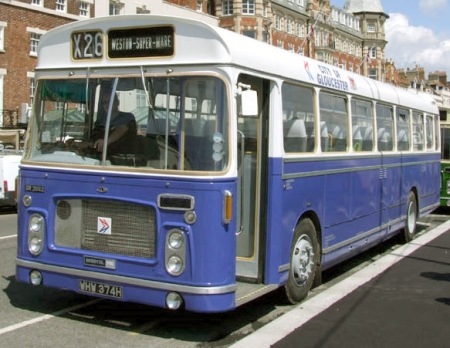
City of Gloucester/Western Travel - Bristol RELH6L - WHW 374H - Bristol 2062
Copyright Rob McCaffery

City of Gloucester/Western Travel
1969
Bristol RELH6L
ECW DP49F

Gloucester’s first public transport was horse trams, in 1887, then electric trams in 1904, immediately becoming municipal. Livery was crimson lake and cream, becoming battleship grey during WWI and remaining so until closure in early 1933. Interestingly, during WWI, track was ripped up from little-used sections and used to extend an existing route to Brockworth Airfield. A tram was then converted to pull railway trucks some 6 miles through the streets! Good job the route was virtually flat!
Replacement bus services started in 1929, using a succession of Vulcan Duchesses and Thorneycroft BC’s (all, bar four, with normal control) , with Gloucester Railway & Carriage Works bodywork, the original tram livery being reinstated. Later on, four of the oldest Thorneycroft vehicles were, oddly, sent all the way to C H Roe in Leeds to have their entrances moved to the rear of the vehicles!
On 12th June 1936, in a novel move, Gloucester Corporation leased their services to Bristol Tramways and Carriage Company Ltd. All vehicles in the Corporation fleet were officially transferred to the Bristol company from this date, although the actual transfer had already taken place in the April.
As part of the agreement, the former 35 Gloucester Corporation vehicles did, however, continue to carry Gloucester on the side and bear the city’s coat of arms, a fitting reminder of the days of Gloucester Corporation Transport. In fact, the coat of arms continued on the agreed number of buses, right through nationalisation with the National Bus ‘N/Shadow Arrow’ logo, too, and on until Stagecoach West took over Western Travel’s empire in Gloucester, Cheltenham and Swindon, in 1993.
Western Travel painted their buses predominately in blue, which brought some colour after the dreary red and greens which hitherto had covered the country and, in the early transitional days, still also bore the double ‘N’ Arrow. They inherited and continued to run Express services, some of which were seasonal, to such places as Bath, to Weston-s-Mare and to Coventry (via Stratford on Avon). They also ran a really long-distance one to Weymouth and it is on the seafront there where we see Bristol 2062 (WHW 374H), a 1969 dual-purpose Bristol RELH6L/ECW DP49F body in City of Gloucester dual vehicle colours at Weymouth Rally – June 2011. This example was never in dual-purpose colours, but sister-vehicles were and it has only just been painted in this livery, for a few months, as a tribute to Gloucester public transport. Note the Gloucester Coat of Arms as well as the shadow ‘N’ logo.
I travelled on one of the type to Coventry on one occasion and found them very good for DP vehicles. Certainly better than my going to Weston-s-Mare on one occasion on a Leyland Olympian – 45mph for 70-odd miles on the M5, but with a good view from the top deck when we finally glimpsed the sea! By this time, these services were on borrowed time, what with vehicle and driver shortages; a shame really, for, in my experience, they were always well supported.

Copy contributed by Chris Hebbron
Photograph by kind permission of Rob McCaffery

———

04/09/11 – 07:45

As a coach enthusiast, after the ZF Reliance, the RELH is my favourite vehicle and whilst I have no problem whatsoever with the Gardner engine my preference is for the RELH6L. Having driven both, this is not purely an "enthusiast" thing.
The featured vehicle had DP seating but many similar vehicles elsewhere had the very comfortable full coach seating, making them suitable for National Express – if not touring. As a student, I travelled many happy miles on such East Midland vehicles (both Gardner and Leyland powered) as well as the North Western and Ribble RELH6Ls with MkII (my designation) coach body. My first long distance REL6G "cruise" however was by West Yorkshire on Yorkshire Services from Sheffield to London.
In old age, I now find myself with both musical and PSV connections in Gloucester.

David Oldfield

———

08/10/11 – 05:46

Western Travel each depot had its own colour, with yellow flash
Cheltenham red.
Stroud green.
Swindon red.
Gloucester blue.
Coaches, as per depot.
Service trucks yellow.
Vans as per depot.

Mike

———

29/04/12 – 07:56

The RELH with ECW coachwork was really solid, quiet and comfortable vehicle to ride on but the early models with crash gearboxes combined with it’s rear engine took some time and practice to master rewarding when you got the knack. The ECW body had one major fault which became all too obvious the first time you had one on a busy express run with a load of luggage and it rained, there was a small luggage locker behind the engine with the door in the usual position at the rear when that became full the underfloor lockers had to be used the doors to which were quite shallow but heavy and fitted at the lowest part of the side panels which being within the wheelbase meant they collected all sorts of muck and water in the aforementioned rain which made opening them in those conditions unpleasant to say the least. The overall low build of these vehicles meant that even looking into the lockers let alone putting in or removing heavy suitcases was not good for your back muscles. The later Plaxton bodied had higher mounted and lighter locker doors which made them much easier to use and less dirty and painful. The later semi-automatic gearbox made them much more pleasant to drive, I too preferred the Leyland engined version.

Diesel Dave


Quick links to the  -  Comments Page  -  Contact Page  -  Home Page



All rights to the design and layout of this website are reserved     

Old Bus Photos from Saturday 25th April 2009 to Thursday 4th January 2024