Old Bus Photos

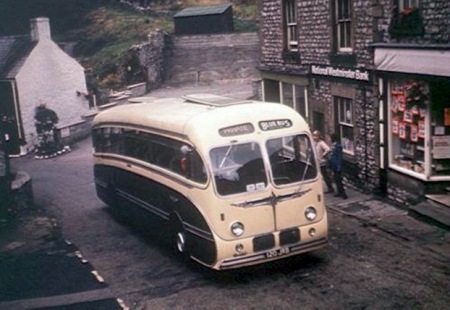
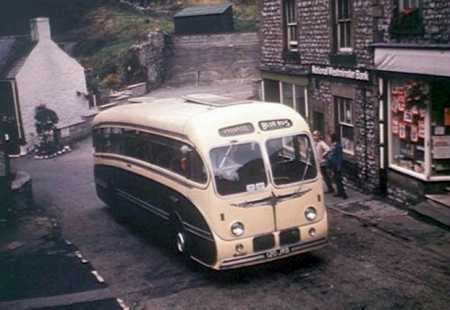
Blue Bus Services – Daimler Freeline – 120 JRB – Dr 18
Blue Bus Services - Daimler Freeline - 120 JRB - Dr 18

Blue Bus Services
1959
Daimler Freeline CD650H
Burlingham Seagull C37F

The above photograph was given to me by the ex Blue Bus Inspector the late Ken Baker, when I worked for Derby Borough Transport, and was in charge of the Blue Bus operation at Willington, before the fire.
He had no idea where it was taken, but he thought it was in the Derbyshire Peak District somewhere, where as I thought it was in Yorkshire. Perhaps somebody will be able to identify the location?
120 JRB was unusual for a 30ft – long coach in that it was only fitted with 37 seats, the usual maximum being 41. Contemporary reports state that it was fitted with translucent panelling which could be lifted for ventilation. It was also fitted with an air operated pre-selector gearbox, and it was reported that it could travel at 55mph.
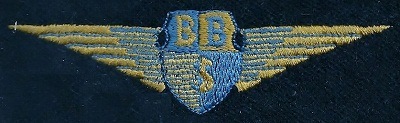
Blue Bus Service Fleetname Wings

This coach was the first vehicle to carry the “Wings” emblem in place of the “Blue Bus Services” fleet name. If anybody is interested I have a Blue Bus Services page on my website, which can be found at this link.

I hope someone comes up with the location of 120 JRB.

Photograph and Copy contributed by Stephen Howarth


19/12/11 – 11:06

Good picture, possibly taken in Wirksworth, Derbyshire.

Roger Broughton


19/12/11 – 14:21

You have set us a teaser as to where this is! The pale grey stone suggests that it is in the southern part of the Peak District- but where is/was there a Natwest Bank? Wirksworth doesn’t look right on Google Earth- goldish stone & brick- & has a big Natwest: this is/was a part time branch. I wondered about Youlgreave…..

Joe


19/12/11 – 17:19

Joe, Youlgeave (Pommy) hasn’t had a Natwest Bank, the stone is similar to both in fact all of the Peak District.

Roger Broughton


20/12/11 – 06:50

Well the few bits that I can add having worked for National Provincial and later National Westminster Bank are that the picture was taken after February 1971 and the size of the Branch would suggest that it was an "Agency" open one/two days per week. These were attached to and run by much larger Branches so that would seem to indicate that it is not too far from a large town or city. Oh that I had my old Sorting Code book because with a bit of work you could eliminate possibilities using Google Earth! Sadly, we always had to destroy them.
I’ve just researched Pateley Bridge because the road layout at the top of the hill is similar but the Bank is Barclays and too far around the bend. So not much help but any old Yorkshire/Derbyshire Bankers out there might get closer.

Richard Leaman


20/12/11 – 06:51

A flash of inspiration suggested Bonsall. Have a look at Google maps. I think the picture was taken from an upstairs window of the Kings Head, looking down Yeoman Street. The end of the cottage in the distance is fairly distinctive.

Stephen Ford


20/12/11 – 09:29

Well done Stephen- it is indeed: Yeoman St Bonsall. The shops have been prettified into houses and the bank is no more but looks much the same. The pub car park, probably once some cottages, has been improved: in fact the whole place looks smarter. It is possible that the pic was taken from the memorial plinth, but it was probably higher.
I’ll stick to my guns, though, Roger, on the stone: it was always noticeable that the stone changed going south from squarish often goldish stones to this pale grey rubbley stuff, often found around those tiny sheep fields/pens. Compare say Baslow with here.

Joe


20/12/11 – 10:21

I wonder were the coach is heading as the road out of Bonsal towards Brightgate is very narrow.

Roger Broughton


20/12/11 – 11:24

My guess would be that it was either a trip to view the well-dressings (July) or a pub visit at the end of an organised sightseeing tour. Roger is right, Bonsall was the end of the line for buses (and still is). At the time it was North Western territory with a fairly regular service from Matlock, nowadays G & J Holmes and an hourly service during the day on weekdays.

Stephen Ford


20/12/11 – 12:27

An amazing flash of inspiration, Stephen; I can’t fault it. Think of the chances that, from such a small group as us, someone would triumph! You shall have a gold star!

Chris Hebbron


20/12/11 – 14:24

O come on, Chris. There’s some shared brain power among us – and we’re probably all getting on a little bit now!
Coming from the Peak District end of Sheffield, the whole PD is my (favoured) stomping ground. Now exiled in the south, Bonsall was a regular part of run out in the car I did when visiting aged (now dead) parents. I only ever went UP hill from Cromford and never had the perspective of this photo – looking down.

David Oldfield


21/12/11 – 07:21

While it’s true that there are some widely-travelled folk amongst us, it still surprises me how many questions thrown at the website are answered. I’ll compromise by awarding Stephen only a silver star, then – okay?

Chris Hebbron


21/12/11 – 07:22

I’ve played around on Streetview, and if you paste this link into your browser, you can see the scene as it is today when map loades drag and drop the little orange man to the Kings head at this Google maps link.

KC


21/12/11 – 08:56

Hy Hulley, now there’s a name from the Peak District, nearly had the variety of vehicles of Barton, some out of COF vehicles would be parked on open land opposite the garage in Baslow, now luxury flats are parked there ! The business is still operating as Hulley under the Woolicrofts ownership ex Silver Service of Darley Dale. In the 1978 Busus annual there is a good article on Peak District operators from the 30’s.

Roger Broughton


21/12/11 – 08:57

Scrooge! I didn’t mean that Stephen didn’t deserve the Gold Star – I’ll reinstate it and take this opportunity to say Happy Christmas to ALL friends on this wonderful site.

David Oldfield


21/12/11 – 11:41

………and I’ll second that, a Merry Christmas and a happy New Year to all.

Chris Hebbron


21/12/11 – 12:03

That must have been one of the last Freelines built – also one of the last Daimler 10.6 litre engines. Wonder if Blue Bus managed to acquire a stock chassis at a knock down price for being a loyal Daimler customer? The steering wheel position in the Freeline always looks too high although presumably the drivers seat was similarly raised to achieve the required min 6"/max 10" clearance between the top of the seat cushion and the underside of the steering wheel rim required by the Conditions of Fitness Regulations.

Ian Wild


21/12/11 – 13:50

When I said inspiration, I didn’t mean the miraculous sort (or sticking a pin in a map at random either)! I was just thinking of places I have visited that might fit, then checking them in Google. Roger mentioned Brightgate just to the north of Bonsall, and we have in fact camped in a very old static caravan at Brightgate farm a few times. Even in the prettified state that Joe referred to, Bonsall is a grey village and can look a bit dreary in anything less than brilliant sunshine. I think my inspiration was along the lines of "it looks grey enough to be Bonsall!"

Stephen Ford


21/12/11 – 14:55

Stephen, The Barley Mow on the Slaley Rd out of Bonsall is a very good watering hole which has recently changed hands, good beer and food.

Roger Broughton


22/12/11 – 06:32

It certainly wasn’t one of the last Freelines, I’m not sure when production officially ceased but Great Yarmouth took some in 1964 with ‘B’ registrations. It would have been, however, one of the very last Burlingham Seagull’s to the original design. By no means a unique combination and yes, all of them appeared to have very high steering wheel positions, what is not immediately apparent is that this one had three long panoramic windows on each side and one piece windscreens, not the horizontally divided opening type. I think Yelloway had some to this diagram also. Delivered in June 1959 only just in time for that years summer, I think that was the last season of this particular shape. If Blue Bus had waited till the following year, they could have had the Seagull 70 body, now that would have been a unique combination!

Chris Barker


22/12/11 – 06:33

With Streetview you can actually get a link for the exact view you want rather than the map. Here it is: //g.co/maps/gysy4
Hulleys are indeed still operating, but I’ll have to look up their history. I think the link with Wooliscroft/Silver Service was short-lived and they had to be rescued by someone else.

Peter Williamson


22/12/11 – 07:46

If what Chris says is true, then that would indeed make it the Seagull VII and 1959 was about as late as you could get.
I know Hulley’s became independent of Wooliscroft but have no idea of the eventual (current) ownership. Some hazy reflection puts them back into the Hulley family but I could never swear to this.

David Oldfield


23/12/11 – 06:52

There is a history of Hulleys on their website //www.hulleys-of-baslow.co.uk/  which explains everything. The fleet now looks very smart in a dignified blue and cream livery which was originally inspired by second hand purchases from South Notts.

Peter Williamson


23/12/11 – 06:53

I am pretty sure the Great Yarmouth Freelines were the last, certainly for the home market. They were bought while Geoffrey Hilditch was the General Manager, a man who had very firm ideas on bus purchasing and as an engineer tended to go for high specification designs on the grounds they gave better pay-back in the long term. He took these principles to Halifax and then Leicester where he subsequently held the GM posts.
It always seemed strange to me that while Daimler were very successful with their double deck designs, eg the CVG and the Fleetline, they were never as successful with single deckers. The Freeline was a well engineered chassis but on the heavy and expensive side at a time when the industry was moving to lighter weight and lower cost. The subsequent Roadliner seemed to be a disaster from the start.

Philip Halstead


23/12/11 – 06:55

Premier Travel and Valliant of Ealing were also customers for the Seagull Mk VII, amongst others. The first Mk VII, on Leyland Tiger Cub chassis, appeared at the 1958 Commercial Motor Show in Seagull Coaches of Blackpool livery, just like the original Seagull at the 1950 show. Several of the Valliant examples plus all four Yelloway examples ended up with Premier Travel, joining the one they bought new, which made Premier Travel the largest operator of the type. Burlingham’s offering for underfloor engined coaches in 1960 remained the Seagull Mk VII, the Seagull 70 only appearing for the 1961 season, ie a year later than the similarly styled Seagull 60 for forward engined chassis appeared.

Dave Williamson


23/12/11 – 12:15

I made several journeys in the Gt. Yarmouth Freelines in the early seventies when they were on hire to Eastern Counties and they were very pleasant vehicles to ride in – a sort of up market Bristol MW. I believe Yarmouth had a good line in hiring them to coach operators whose vehicles had broken down in the area.

Nigel Turner


24/12/11 – 06:46

The only time I ever saw the Great Yarmouth Freelines was at Huntingdon St Bus Station, Nottingham in the mid sixties. One would sometimes appear as a summer Saturday extra on Trent’s Great Yarmouth service. At this time, Trent often hired in Norfolk Motor Services coaches as required – presumably the Freeline was part of this arrangement?

Bob Gell


11/08/12 – 07:32

Belated update on 120 JRB (have only just discovered your site) – am most impressed by how quickly the location of this shot was nailed down, incidentally! Lovely image of what was – arguably – the final Daimler-engined Freeline (Burwell & District had the other such chassis that could make the same claim to fame). The lack of window-pillars made quite a visual difference, certainly in the flesh.
Stephen asks if anyone knows the whereabouts of Dr 18: am guessing we know of her early years in preservation and subsequent re-emergence in a Barnsley scrapyard (what DID happen, though?) – since then, Dr 18 has covered quite a few miles, changing hands along the way several times, until (last I heard) she was in a barn near Uttoxeter with several other vehicles (so, not far from her Willington home) awaiting her turn for restoration. Somewhere, I have two or three colour shots of her in this location. If and when I find them, I’ll scan and submit.
Would LOVE to meet up with Dr 18 again though, so if anyone has more recent info (I’m going back at least half-a-dozen years, via a contact)…

Clarence


13/10/15 – 06:20

Some 3 years on since the "turn" comment (11/08/12), the vehicle is still in the same shed in the same condition. Would feel that restoration really quite unlikely now.

Roger Burdett


07/12/15 – 06:15

Freeline 120 JRB is indeed located near Uttoxeter together with CD650 SRB 425 and is owned by Mr Andy Mould. It is indeed the only ‘complete’ surviving Freeline in GB and is well worthy of restoration. It is mechanically sound but does need a full body restoration. It is now unique.

Gerald Anthony


02/08/16 – 17:27

How nice to hear this coach has been preserved. The last I heard was that it was rotting in a scrapyard in the Bradford area.
I was Youth Club Leader at Stretton Church during the 1960`s (Stretton being on the Blue Bus service route)
We had a"Blackpool Trip" every year in September and would always ask for this coach known as "Daimler 18" because our coach enthusiasts liked the sound of the powerful Daimler engine and the hissing of the air operated clutch.
I have a painting of 120 JRB standing outside Repton Church.
I remember we paid less than £1 per person for the coach (out for 20 hours on a 240 mile round trip) and a ticket to see Cliff Richard in Blackpool plus a tour of the illuminations.
We also asked for "Frank". one of Blue Buses`s young drivers.
Those were the days !!

Philip Whieldon

120 JRB_lr Vehicle reminder shot for this posting


17/08/16 – 09:56

I was kind of hoping you might shed some light on the whole Seagull Mk7 history as I am the owner of Blue Bus Dr18 120 JRB I can find very little other history on this period of Burlinghams activity and just wondered how many ‘plastic pigs’ were built, the body panelled entirely in fibreglass providing all the outline with a straight framed body must have been a brave step and taken a lot of development, although far from their finest hour, having restored BMS 415 many years ago I can fully appreciate how good they could be and 120 JRB is far from that build quality even evident after many years.
So I would be keen on know just how many were built I am aware of 999 EAE was 7 body numbers apart but I am told two of those numbers were allocated but never used.
Any information would be gratefully received.

Andy Mould


18/08/16 – 06:48
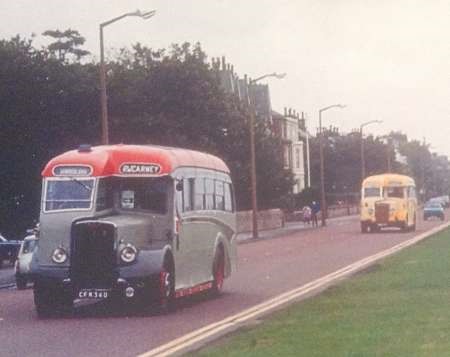
CFK 340

Reference comment of Andy Mould 17/08/16. his restored coach BMS 415.
Behind CFK 340 is BMS 415 returning from Manchester Museum 3rd of April 1982 location of photo is unknown any detail be gratefully accepted.

Alan Coulson


Quick links to the  -  Comments Page  -  Contact Page  -  Home Page
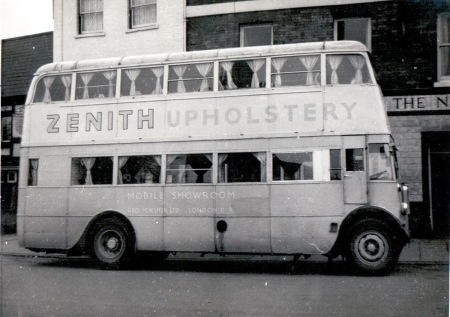


London Transport – AEC Regent 1 – BXD 474 – STL 806

BXD 474_lr
Copyright Victor Brumby

London Transport
1935
AEC Regent 1
London Transport (Chiswick) H56R

Below is the note I wrote on the back of the above photograph.

BXD 474, this yellow and blue STL (806) was seen in Kettering on March 10th. 1958. Driver Robert Carter advised that his company, Zenith Furniture, had this mobile showroom-converted AEC and two more ex-London STLs converted to pantechnicons.

I still have the 1954-7 tax discs for this bus…..
I also saw a few pantechnicons, running for Albro Furniture, during this period, all ex-STLs.

Photograph and Copy contributed by Victor Brumby


14/12/11 – 18:05

Surplus STL’s certainly got around in their twilight years. Yellow and blue sounds more like ‘happy playbus’ colours for children! Like the cab door.

Chris Hebbron


16/12/11 – 13:03

What exactly went on around that first bay? Looks like a bit of "scrapheap" coachbuilding… was there another access to the cab from the saloon? You may get in that way, but you’ll never get out!

Joe


16/12/11 – 13:19

Strangely enough, I think (minus the door) that WAS the size of the cab entrance. As for the scrapheap coachbuilding, that may also be perilously close to the truth. These bodies, or at least some of them, were prone to terminal collapse – body "sag" – in common with many of those built by NCB. The first bay may have been due to repair of such "sagging" bulkhead damage.

David Oldfield


17/12/11 – 07:30

Mention of the improvised cab door brings me to a question. The Metropolitan Police over the years imposed a lot of restrictions on LT and it’s predecessors. As examples I quote their refusal to accept, pneumatic tyres, enclosed staircases, cab windscreens and cab doors then in the RT era 8 feet wide buses in general service. I am not aware of any other British Police Force in any other provincial town or city interfering so much in bus design. Does anyone know why the Met had such extensive powers when this sort of interference didn’t seem to apply to other forces?

Philip Halstead

Good question Philip


17/12/11 – 07:34

Although what I’m saying may be well-known to some, it will not be to all. The Metropolitan Police had a very conservative approach to vehicle design and one aspect of that was not allowing cab doors to be fitted. Hence when in use as a showroom it would need to be a little more secure and I suspect that was why it the door looks so out of place and is obviously home-made.

David Beilby


17/12/11 – 07:38

I’m fascinated with the date of this picture. Monday, March 10th, 1958 was the day that my mother and I flew from London Airport to Montreal, as we were emigrating to Canada. We stayed with some distant relatives in Tooting before flying out, and I spent a large part of that last day watching LT trolleybuses whizz back and forth on the 630, whilst Victor Brumby was apparently chasing this old STL around Kettering with his camera. Trust me, there was a lot more snow on the ground in Montreal than there was in Kettering that day!

Dave Careless


19/12/11 – 06:24

Other aspects of the "progressive thinking" of the Metropolitan Police were the initial refusal to accept four wheel brakes and passenger entrance doors.

Roger Cox


19/12/11 – 11:03

London Transport, when lending its ‘Godstone’ STL’s to Merton Garage to assist the red 127 lowbridge route buses, had to ensure that its sliding doors were left open all the time, even draughtier than the standard front-entrance ‘green’ STL’s which did, to some extent, cater for not having any doors at all. Philip does raise a good question and I must admit I’ve never heard of such a ‘controlling’ police force as the ‘Met’ anywhere else in the UK. After the initial batch, not more fully front-entrance ‘red’ Q’s were built, as it was considered dangerous as passengers boarding/alighting might fall under the front wheels. I always smiled at early rear-entrance single-deckers, which had offside longitudinal seats right to the back and could have projected unwary passengers out of the rear platform when cornering hard! No mention of this was made, but they were mainly converted to front entrance later.

Chris Hebbron


31/12/13 – 07:09

It’s interesting to see that this STL has a Brighton registration BXD

Bix Curtis


31/12/13 – 12:02

Sorry, Bix, but "BXD" is not a Brighton registration, at least not in the era when this bus was first registered. BXD was definitely a London registration of c.1934/35. In that era, Brighton were using CD and UF as their main letters, with the appropriate sequential prefix. ACD and AUF appeared in 1934, and the progress letters were issued at a quite similar pace to London’s before the war – although of course London had many letter sets allocated to them, compared to Brighton’s two! (What I mean is that London buses were receiving say, FXT registrations in 1938/39, and Brighton had FUF. In wartime, many utilities in London had "G" prefix to the various letters used, and Southdown’s Guy utilities had GCD and GUF plates).

Michael Hampton


01/01/14 – 09:19

Going back to the comments of 2011 on the Met Police, the City of Manchester Police Force was equally as interfering and restrictive, though with far less influence on design than on operation. The operation of buses along Market St Manchester was always a problem and, in their own right prior to the institution of Traffic Commissioners and then, once that august group had been set up in the North West, by using considerable influence on them, the constabulary vastly influenced the pattern of service and the vehicle types used for over half a century. Henry Mattinson’s excellent long distance express bus scheme being at first truncated then almost totally demolished – with a great deal of aiding and abetting from taxi operators and the railway companies, was the first major interference, though there had been minor ones for over a decade before. The inconvenient siting of the long distance service terminal at Lower Mosley St and the restriction of North Western’s medium distance services to this outpost far from shops and offices was down to the police.
Other inconvenient termini were located at Stevenson’s Square and the rather enigmatic Royal Exchange which, apart from the airport coach stop, was not at the Royal Exchange at all. Until the appearance of the Atlantean, the only 30 foot long double deckers approaching the city centre were Mayne’s AECs which were kept away from the centre getting no nearer than Newton St., and the Crossley Dominion trolleybuses which reached Piccadilly but only on rush hour and Saturday service. Bus stop siting in the city centre, again under police influence, precluded use of forward entrance vehicles until Salford’s 27 ft PD2s appeared on the 95/96 and later the 57/77 in the early 1960s.
The Atlanteans were restricted to services away from Market St for years and whilst the major reason for not ordering more and keeping the Fleetlines that followed to Wythenshawe routes was down mainly to conservatism at 55 Piccadilly and the need for crowd movers for Wythenshawe, there is strong evidence that the police made it plain for some years that 30ft rear engined vehicles were not welcome on Market St thus restricting the best use of the vehicles. Like the Met the constabulary eventually had to yield to the pressures and realities of the industry and the time.

Phil Blinkhorn


01/01/14 – 10:05

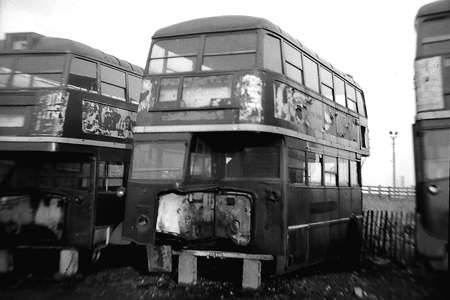
stl

Mention was made earlier of some STLs being rebodied as pantechnicons. Several of these had their STL bodies removed by Southend Corporation Transport at their depot. A photo exists of one with the body in process of removal. The old bodies went to a Corporation dump at Shoebury, where withdrawn trolleybuses were also sent. Above is a shot of a couple of the discarded bodies.

Brian Pask


01/01/14 – 10:12

Is there any evidence, Phil, that the police in Manchester influenced the design of buses, as I earlier indicated that the Met certainly did?

Chris Hebbron


01/01/14 – 11:12

Hi Chris, Happy New Year. There is no evidence that the design of buses in terms of use or not of doors, tyres etc. for use in Manchester was directly influenced, or should we say interfered with, by the City of Manchester Police in the same way as the Met.
On the other hand, as I have shown, the types of vehicles used in parts of the city centre and restrictions on operations had a very direct influence on the size and types of vehicles purchased not just by MCTD but on a number of operators in the areas surrounding the city and certainly the location of termini had a profound influence on the daily lives of shoppers and workers.

Phil Blinkhorn


01/01/14 – 12:37

I agree that initially as a student anxious to return home to Sheffield, and latterly as a Sale resident wanting to go almost anywhere, LMS was very inconvenient – and Chorton Street not a great deal better. Looking back with a historical perspective it makes some sense – but none as a passenger. [There were similarly strange termini in Sheffield with the small Bridge Street Bus Station and the Castlegate stands – which may have made operational sense but were not in the least bit helpful to passengers needing to cross the city centre to get there.]

David Oldfield


03/01/14 – 08:13

I can’t help thinking that one of the effects of the remoteness of bus termini is to reduce awareness of what services are available. MCTD did very well in including all North Western’s Manchester services in its timetable, but how many people bought timetables? My childhood experience was that most of my parents’ awareness of bus services outside our immediate locality came under the heading of "word gets about". If people see buses showing certain destinations then they may enquire about them, but if they don’t, it may never occur to them that such a service exists.
Chorlton Street was built as an overflow to Piccadilly, and for many years MCTD restricted it to the least-used services in order to inconvenience the minimum number of passengers. But of course that also reinforced its obscurity, meaning that most Mancunian bus users had never even heard of it.
Then there was the problem of Salford. Most services heading west from Manchester didn’t go from Manchester at all, but from Salford.
How many people knew about that, I wonder?

Peter Williamson


03/01/14 – 12:13

Peter, the Salford situation is interesting. Under Henry Mattinson’s Express Service scheme, Salford buses ran through the Manchester city centre to Stalybridge, Hyde, Guide Bridge and Stockport. Once the scheme was decimated, and with Deansgate being added to Market St as another thoroughfare of "concern" to the constabulary, most of those routes Salford served retreated to that city’s side of the Irwell to join the remainder of the services showing Manchester on their blinds. Due to an earlier tramway dispute Salford buses did not cross Deansgate on anything other than those on the scheme. Victoria became the major terminus (though the bus station was nearer Exchange station) and was shown on blinds for services wholly within Salford, Manchester being shown on services from elsewhere. King St West was also a terminus, handy for those shopping at Kendal Milnes but not much good for most passengers need ing to get into the city centre and the patrons of the Docks service which terminated there would hardly have been KM’s customers until well into the second half of the 20th century. (For non Mancunians, Kendal Milnes was the Manchester equivalent of Harrods and for many years had the same owners).
The exceptions by the outbreak of World War 2 were the 15 from Worsley which ran through to Guide Bridge and the 35 from Bury, both of which were truncations of express services, the 35 logically should have run through to Piccadilly but was cut off at Cannon St. After the war there was a dispute about the termination of tram services where Salford used Manchester rails on Deansgate which exacerbated the much earlier dispute about the use of rails on Blackfriars Bridge and led to a great deal of bitterness between 55 Piccadilly and Frederick Rd. The 15 was cut back to run only from Worsley to Manchester but did reach Piccadilly and, until the new bus station was finished, terminated in view of Albert Neal’s office. Salford made sure its vehicles on the route were the most up to date and, when it needed no new vehicles for almost a decade, always turned out its smartest Daimlers to sit within Albert’s view. It was one of the first routes for Salford’s Atlanteans but by that time the terminus was within the new bus station.
Some peace was restored in January 1951 when Salford’s services from Swinton and Pendlebury were joined to Manchester’s services from Reddish Thornley Park and Bulls Head to form the 57/77 services. This became possible as no trams now ran on Market St and congestion had eased. The experiment was a success and was followed in November 1955 by the joining of the East Didsbury to Piccadilly service to the Whitefield to Victoria service to form the 95/96 services. With a common terminus at either end, these routes differed in both Salford and South Manchester but shared the same route through the city centre.
What is odd in all of this is that many long distance coaches both privately and group owned operating from outside the area to Blackpool, Southport and Morecambe ran along Market St., which formed part of the A6, without any intervention by the authorities and on summer Saturdays added to the chaos. for road users and pedestrians alike.

Phil Blinkhorn


06/06/16 – 06:45

Reference the police "interference" in London, what seems to be forgotten in the ensuing years is that the Police were also "the Commissioners for the Metropolis" thereby giving them direct control which the other cities did not have. this is why we were instantly harangued by constables for inventing short cuts on service! the famous one was forgetting to turn right at Marks and Spencer (?) at Marylebone Road on the "Z"!
Next one! has anyone remembered "The Excursion Route" insisted on by North western Traffic Commissioners which involved a lengthy circumnavigation of Central Manchester?

Pete Bradshaw


06/06/16 – 10:53

Presumably the Excursion Route was meant to avoid coaches from particularly the East Midlands and Staffordshire en route to Blackpool clogging Market St on summer Saturdays. My recollection is that in the 1960s it was regularly ignored.

Phil Blinkhorn


Quick links to the  -  Comments Page  -  Contact Page  -  Home Page


Southern National – Bristol Lodekka – AUO 523B – 2053

Southern National - Bristol Lodekka - AUD 523D - 2053
Copyright Roger Cox

Southern National
1964
Bristol Lodekka FLF6B
ECW H38/32F

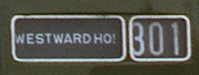
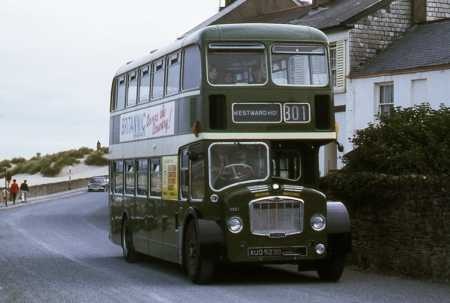
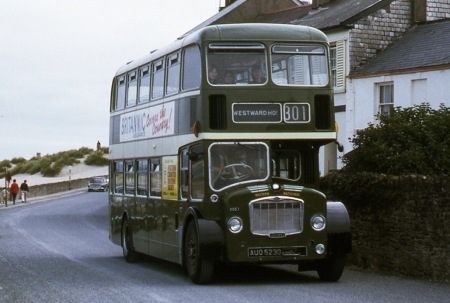
Stephen Ford asked, "Was Westward Ho! (Southern National) the only one that included an exclamation mark?"

I don’t know the answer to that, but here is a picture of a Bristol Lodekka displaying that very destination.

Westward Ho

The bus is an FLF6B with ECW H38/32F body delivered to Southern National as their number 2053 in December 1964. It is seen here in the summer of 1970 carrying the Western National identity following the NBC decision to phase out the Southern National company name.

Photograph and Copy contributed by Roger Cox

A full list of Bristol codes can be seen here.


11/12/11 – 11:14

Would a D registration make it 1966? … and when did the NBC come into being….?

Joe

Thanks for that Joe pressed the wrong key there I think


11/12/11 – 20:05

Joe, the National Bus Company was formed in November 1968, but did not actually come into being until 1st January 1969, when the assets of the state-owned Transport Holding Company (THC) were transferred to it. On 1st March 1968, the British Electric Traction (BET) group’s British bus subsidiaries became wholly owned by the THC, thus becoming fully state-controlled at this point. It’s interesting to note that the THC’s forerunner, the British Transport Commission (BTC) also took over the railway shareholdings of BET’s bus operating subsidiaries in 1948, following nationalisation of the railways. Although BET remained in overall control and in the private sector, some of the BET shares held later by the BTC/THC were quite large. For example it held 50% ordinary share capital in Midland Red, City of Oxford , East Midlands, Hebble, Western Welsh and Yorkshire Woollen District, and nearly as much in East Yorkshire, North Western and Yorkshire Traction. All fascinating stuff as to who owns what, and doubtless no less complex today!
Regarding the age of the FLF Joe, if it had been a ‘D-Reg’ model, it would most likely have had only one cream band to its livery, as ECW omitted the upper deck one from 1966. What a handsome beast it is though, and that Westward Ho! destination surely demands to be shouted out loud!

Brendan Smith


12/12/11 – 06:40

And for the first two or three years, it was, to a large extent, pretty much ‘business as usual’ but then the corporate image brigade were brought in and, well you know the rest! However, enough of that, this post reminds me of a journey I once made on a similar vehicle of my local operator Midland General, but with a Gardner engine. I was bound for Nottingham but the FLF failed at Kimberley (a VERY unusual occurrence for MGO!) Because the frequency was good at this point, we only had to wait five minutes or so for the next bus to come along which was another FLF but with a Bristol engine. I could recognise the sound but I knew nothing about the performance or merits of the different engines and I always remember how much faster the Bristol engined one was. A driver told me later that the Bristol was a faster revving engine and although I’d always been a Gardner fan, I had to concede that the Bristol was the livelier performer!

Chris Barker


12/12/11 – 06:41

Prior to the Lodekka/FLF era, the services in the North Devon area were operated by fairly elderly K’s. Many of these had one-piece blinds combining the three digit route number and the "via" display. Towards the end of their lives, the route numbers were changed from the 100 to the 300 series. Rather than buying new (non-standard) blinds, SN simply pasted a permanent 3 inside the glass where it would obscure the 1.

Stephen Ford


13/12/11 – 08:52

The resort of Westward Ho! was named after the book of the same name by Charles Kingsley who also wrote the Water Babies
The action of the book took place in the same area of Devon and a group of speculators decided to cash in on the name

Chris Hough


13/12/11 – 08:53

After having some of the clearest and most informative destination displays in the early 1950’s, the BTC/THC companies generally fell from grace in later years and the above photo is a good example. The taped over aperture with minute lettering for ‘Westward Ho!’ is typical of where things ended up. It made the destination very difficult to read at any distance. Crosville was particularly bad with not only a very small ‘slot’ for the destination but they used a very light font as well. The ‘T’ shaped format which some of the group companies used seemed to give a clearer display.

Philip Halstead


13/12/11 – 08:54

Many of us thought it a shame that the various BET and THC liveries vanished in the early seventies. As Chris says, it appeared to be ‘business as usual’ for a while – new owners of businesses generally seem to leave things outwardly unchanged for about two years, before making what is now termed ‘a bold statement’. Some of the simplified liveries and fleet names applied to NBC coaches in the formative years were quite attractive – those adopted by Northern, Ribble and Greenslades spring to mind. When I heard that West Yorkshire Road Car had placed an order for Plaxton-bodied Bristol RELH coaches in the early 1970’s, I visualised them arriving in rich cream, with a deep waistband of maroon and large fleet names a la Ribble. Alas, this was not to be. They were delivered in the new corporate all over white livery with large NATIONAL red and blue lettering, and a very discreet (ie: tiny) West Yorkshire fleet name over each front wheel arch. To many of us this signalled that the era of quality and refinement had been replaced by the age of circus wagon-style ‘impact’. Relating to the FLF photo, Western and Southern National lost more than most with the whitewashing of it’s fine Royal Blue fleet.

Brendan Smith


13/12/11 – 11:19

But it wasn’t just the liveries that were third class, it was the quality of the paint itself. The rich, shiny finish of Tilling Green or Red would have been far superior to NBC Leaf Green and Poppy Red (which rapidly faded). [Typed Poopy Red. I think that was a Freudian slip!] The less said about National White the better!!!

David Oldfield


13/12/11 – 12:54

One of the worst companies for poor blind information was Eastern Counties who often showed a route number and the word service which did nothing to help the intending passenger Thec SBG companies were notorious for the extensive use of paper stickers a practice that still exists in the First Edinburgh fleet

Chris Hough


13/12/11 – 12:55

The green wasn’t too bad, but Poppy Red was a pathetic colour, even before it faded! Fortunately, in Gloucester, anyway, it only appeared on the few Cymru Genedlaethol/National Welsh buses from the Forest of Dean/Monmouthshire direction. And they couldn’t even get the Welsh right, either, since the above means National Wales! Being quirky, I quite liked having buses with Welsh on one side, but, my, it caused a stir among the local populace! Never, mind, the two colours didn’t last long and the ill-fated company not that much longer, into bankruptcy.

Chris Hebbron


17/12/11 – 07:41

I agree the NBC corporate colours were a terrible choice. The colours all looked ‘washed out’ and insipid when newly applied and none of them wore well, fading to a matt hue, particularly the poppy red. I thought the light grey wheels looked tacky and the grey/silver fleet numbers were virtually illegible.
The National white was passable on the modern coaches of the time such as the Plaxton Panorama or Duple Dominant but looked awful on the more shapely older designs. Not one of the best periods for the industry.

Philip Halstead


17/12/11 – 08:29

Thinking about those NBC colours, it is odd how such a dreadful set was chosen so was the choice down to one individual or group because I remember everybody hating them from the day they appeared? Surely the marketing men must have had some comments from the public which might have had some impact? Why did they stay in use so long?
Similarly, the current First Bus white, pink and purple is something that only looks passable on brand new vehicles but soon gets to look shabby and on the remaining old Dennis Darts, now rather battered and careworn, it looks dreadful.
Where and why have all of the interesting, vibrant and carefully chosen liveries gone…it cannot be cost just a lack of corporate interest or understanding that image is a very important part of building a successful Company.

Richard Leaman


17/12/11 – 16:24

Well I’ve heard it said that when you are a public company which is quoted on the London Stock Exchange, then the market expects a ‘corporate image’ to be applied, although the Go Ahead group seems to disprove this. Perhaps it’s simply a matter of cost reduction and expediency with good measures of misguidance and indifference also!
Regarding the NBC colours, I remember that when the first white coaches appeared, the ones which had glass panels at the rear incorporating the registration and fleet name had these altered to display N A T I O N A L in alternate red and blue letters. Apparently, this had to be quickly altered because it raised objections from the Police as only they are allowed to display illuminated blue signage on the rear of vehicles in darkness.

Chris Barker


17/12/11 – 16:25

When it was first set up, NBC tended to allow companies to follow their traditional paths. Then, in 1972, Freddie Wood was appointed Chairman, and from that point began the fixation with grandiose self importance as befitted "The Biggest Bus Company In The World". Thereafter, uniformity, standardisation and direction from the centre became the established order. Not only did the liveries descend to a nadir of mediocrity, but the standard font adopted for the group was unparalleled in its clumsy ugliness.
Now, with the dominant groups of today, we are back to much the same thing, with over tight constraints on budgets (particularly in the matter of maintenance) and minimal delegation of initiative to the local management. And as for some of the liveries……….

Roger Cox


18/12/11 – 07:59

…..and it’s all the swooping lines up, down and across the bodywork which look so out of place on what is essentially an oblong box with straight lines. Full marks to those few independents who have liveries which, although of varied hue, still have the dignity of style of the above vehicle and eschew purples and pinks!

Chris Hebbron


19/12/11 – 06:15

…..Epsom Coaches, the other Richmond, the Delaine – to name but three.

David Oldfield


27/01/12 – 06:25

I wholehearted agree with the adverse comments regarding the NBC liveries which replaced so many attractive colour schemes developed over many years which were instantly recognised by passengers and enthusiasts alike, it seemed to me to be corporate vandalism. I once asked a junior NBC manager why they chose to paint the coaches white he replied that it was a colour no one else was using at the time, when I asked had it not occurred to anyone that there was a good reason for that, maybe it was because other people realised that it showed dirt very badly and faded to a dull grey all to quickly, to which I didn’t get a proper answer.

Diesel Dave


25/02/12 – 07:18

Enjoying the various posts on the subject of NBC liveries. Perhaps the most ignominious change was in the North East, where the glorious rich ruby red of Northern General was repainted in awful pale, fading poppy pink! What was the name of the NGT red paint, anyone able to tell me? It really seemed redder to me when I was a kid!
Even worse, now – I’m surrounded by FirstBarbie!

Pwhisto


25/03/12 – 09:03

I heartily agree with the adverse comments about the poppy red and the peculiar green colour but my understanding is that they were a response to a Ministry circular of 10/71 which basically said that there were too many accidents at night caused by people running into buses painted in dark colours so buses should be painted in lighter colours. I recall that this was based on research in Scandinavia which showed that lighter coloured vehicles had less accidents and the Ministry also encouraged UK car owners to buy lighter coloured vehicles at much the same time.

Peter Cook


23/02/13 – 13:30

Whilst I agree with the posts that the NBC corporate colours could have been better it is noticeable that at bus rallies there is a growing number of vehicles appearing in NBC livery – including some that pre-date the formation of the NBC and could carry earlier company liveries. I cant help thinking that this shows that NBC corporate livery is actually liked by many – it was certainly better by far than the disgusting liveries of some of todays group, particularly First and Stagecoach. In answer to the writer who asked about the old Northern colour – this was officially know as BET Dark Red and was one of several colours specified by the BET Group for use within the BET companies – although of course many BET group companies used their own livery that did not incorporate a group standard colour. BET Dark Red was common to Northern General, East Midland, South Wales, City of Oxford and several smaller companies. It should be noted that although being a standard colour within BET the shade did vary slightly between companies due to different paint manufacturers.
In the early 1970’s I was involved in collecting many samples from all around the country and its very interesting to see just what a colour looked like even where a supposed ‘standard’ existed – I have in my possession several different shades of Tilling Green for example.
For a real mystery how about the so called ‘Ribble Red’ used for a few months by the new Alder Valley company prior to NBC Poppy Red – the colour is NOTHING like true Ribble Motor Services red !!. I’ve recently resprayed an EFE Bristol FLF in this colour which was matched from the original sample in my possession – it does look good.

DorsetBus


23/02/13 – 18:04

Can we see a photo of it, then, please, Dorsetbus?

Chris Hebbron


26/02/13 – 12:32

I wonder if the preservation of buses in non-authentic NBC liveries indicates the age of the preservationists concerned? I suspect that nostalgia grips us all in connection with a particular period of our lives. For me, the bus scene was from about age 3 (1952) to 15 (1964) and from there on it was downhill all the way! (Now I am a grumpy old man who can remember how much better it was then). But in 40-50 years those who are now in the 3-15 age range may well remember purple and pink Barbie Lockheads, or blue red and orange Souter Stagecoaches [or even, perish the thought, washed-out green and white Arriva Departures] with an equally warm and wistful glow.

Stephen Ford


26/02/13 – 13:32

Just as an aside to the colour scheme debate, does anyone agree that the Stagecoach hybrid double decker green scheme is probably the strongest and most appealing of the corporate identities around at the moment?

Phil Blinkhorn


26/02/13 – 13:33

As a grumpy old man born in 1952, I agree with you Stephen. My golden age is 1947 (Regent III/PD2) to 1969 (end of RegentV/PD3/FLF). There have been bright spots (both Leyland – the AN68 version of the Atlantean and the Olympian are worthy classics) in later times, but not many. As a coach man, the heavy Reliances, REs and later Leopards, as well as modern Tigers as well. The old liveries were aesthetically far better than modern and I prefer original to later. Even Sheffield had two alternative liveries and the Roes moved from to another with repaints under different General Managers. Authentic liveries to the vehicle are therefore correct – if not acceptable. [I think RTs and RMs in National Leaf Green are HORRIBLE!

David Oldfield


26/02/13 – 15:27

I know that there are still many on this forum who buy into the bad press of Stagecoach – most of which was press fabrication or exaggeration. [If you don’t believe me, consult OFFICIAL history, and I don’t mean just Stagecoach archives.] Their new corporate livery is fairly restrained but things like Gold and the "Green" liveries are lessons in restraint. Mind you, I think I would still put Go-Ahead ahead!

David Oldfield


26/02/13 – 17:25

I want to respond to two points in this thread. Firstly not everyone born in 1952 is grumpy, I’m actually quite nice [at times]. Secondly choice and memories of colour depends where you grew up. In Taunton it was green WN/SN buses and green/two tone greens of various WR diesel hydraulic locomotives plus green DMUs and a reminder "to eat your greens" which ultimately leads to that famous bus photographer’s quote – the other side is always greener.

Ken Jones


27/02/13 – 05:48

Well Ken. Somebody has to be nice, so it might as well be you. Congratulations. You have the job!

David Oldfield


27/02/13 – 05:49

Colour Schemes, Stephen: the other day I saw an Arriva repaint in cream, with the dark blue skirt but a turquoise (instead of cream) curl behind the door. Are we returning to normality?

Joe


04/04/13 – 06:19

Thank you to the person who asked about seeing a picture of my respray in Alder Valley Dark Red on an EFE FLF. Yes I’ll be only too happy to put a picture up once its finished – I’m now also doing a Bristol RE in the same livery having got the required info together so I’ll add a photo of this as well. Please give me a while though as I’m re-organising my workshop and with two upcoming model railway shows to attend with my layouts it may be later in the summer before I can finish the buses. Then its on to several other repaints such as a City of Gloucester (blue) VRT / Leyland National and RE in NBC style and then the first of the next steps – scratch built West Riding Guy Wulfrunians – more on that project later if anyone is interested.

DorsetBus


AUD 523D_lr Vehicle reminder shot for this posting


17/07/13 – 07:09

Just picked up on this thread with regards to NBC livery. When I first took an interest in buses in the 70s our school buses were Cumberland FLFs which were gradually being turned out in poppy red. At the time they seemed fresh and modern and the old livery seemed dark and past its sell by date. Not sure I would still agree though! Towards the end of the decade I went on a tour of the Leyland National factory. Apart from a pair of buses for McGill at Barrhead it seemed to be a sea of poppy red and leaf green. However, the shades of these so-called standard colours varied significantly from operator to operator. When I asked about this I was advised that each operator specified a different mix. The other NBC shade that I was very familiar with at that time was the yellow used by Northern on vehicles in the Tyne and Wear area. This was a shade of cadmium yellow as used by TWPTE (the British Standard was called Goldcup) and it worked much better than poppy red in an urban environment. What I don’t understand is why EFE keep churning out models in this livery but of a shade that is considerably paler and therefore very insipid. It is too light to even be excused as colour scaling!

Mike Morton


17/07/13 – 09:09

In response to Phil Blinkhorn’s ‘aside’ on this subject I agree the Stagecoach hybrid green livery is by far the best I have seen on a double decker for many years and is closely matched by the current Newport Buses livery on their single deck Scanias now operating the Park and Ride service in Cardiff (no doubt much to the ire of that City’s transport dept).
As a further aside, even the temptation of free Wi-Fi on Stagecoach hybrid operated route 50 in Manchester wasn’t sufficient to prevent me from route testing the new Metroline trams from East Didsbury to the Media City.

Orla Nutting


18/07/13 – 07:26

By coincidence, for the first time in around 10 years i was in the Newport and Cardiff areas 3 weeks ago and totally agree with Orla’s comments.

Phil Blinkhorn


Quick links to the  -  Comments Page  -  Contact Page  -  Home Page


All rights to the design and layout of this website are reserved     

Old Bus Photos from Saturday 25th April 2009 to Thursday 4th January 2024