Old Bus Photos

Eastbourne Corporation – Daimler Roadliner – DHC 786E – 86
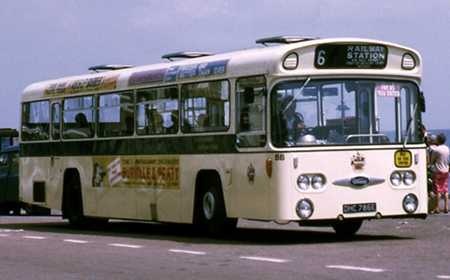
Eastbourne Corporation - Daimler Roadliner - DHC 786E - 86
Copyright Roger Cox

Eastbourne Corporation
1967
Daimler Roadliner SRC6
East Lancs B45D

Here is a shot of the Eastbourne Roadliner, that Diesel Dave referred to under the Halifax Corporation – Daimler Roadliner on the 4th of January heading. Cummins earned such a bad reputation for its V6 engine (and the corresponding V8) that it is a wonder that it survived as a company. For years, Cummins used its own fuel injection system in which the pump pressurised the fuel lines but the injectors were individually actuated by a separate camshaft. It is rumoured that Cummins devised this system to avoid paying royalties to the inventors of the in line fuel pump, the German Robert Bosch company. In Britain, Lucas/CAV manufactured pumps under Bosch licence. The Cummins system rendered the engine unresponsive to modest movements of the accelerator – the engine was either "on" or "off". I never drove a Roadliner, but I have driven Lynxes and Olympians powered by the later L10 engine, and they were crude and rough. Proper fine control of the engine was impossible. The present day "B" series engine and its derivatives used in ADL buses was originally a design of the Case Corporation, and does not have the traditional extreme Cummins characteristics.

Photograph and Copy contributed by Roger Cox

———

22/03/12 – 08:16

I think Cummins survived (at least in Britain) because the passenger and freight markets don’t talk to each other much. The V engines may have been as bad in both, but Cummins were also building inline engines which seem to have been very successful, and which marked the beginning of the end of Gardner supremacy in ERF and Atkinson trucks among others.
What I find more surprising is the way the bus industry embraced the L10 after its earlier bad experiences.

Peter Williamson

———

22/03/12 – 13:41

Cummins came badly unstuck with some diesel-powered trains a few years ago, with them having to replace the unreliable engines at some cost to themselves.

Chris Hebbron

———

22/03/12 – 13:41

Many examples can be found where British companies made the best product in the world and then just sat back and allowed the rest to catch up. When the power to weight legislation came in the six cylinder inline Cummins did become popular with ERF and Atkinson buyers in the haulage sector, but it was more a case of supply rather than choice. The Cummins was more readily available than the Gardner, but it wasn’t as reliable and devoured fuel at an alarming rate. Gardner did have a ‘240’ inline eight cylinder marine engine that was very reliable for the job it was designed for but as a vehicle engine it wasn’t, but in fairness it was being asked to do a job for which it was never intended, marine engines tend to work for long periods at more or less a constant RPM, where as the RPM on a vehicle is constantly fluctuating, it gained a reputation as being unreliable. Gardner tried fitting a turbo to the 180, but through complacency they eventually fell victim to the classic British motor vehicle disease of failure to invest in development

Ronnie Hoye

———

22/03/12 – 13:42

Whatever merits the L10 may have had as a lorry engine, and one can but reflect upon such "merits" in the ultimate fates of ERF and Seddon Atkinson, it was not a good bus engine, having crude response to accelerator pressure resulting in very rough and jerky ride standards. Along with the Seddon Pennine IV, I would nominate the Cummins powered Lynx as the most horrible vehicle type that I have ever driven. Likewise, the Cummins Olympian was not a patch upon the sophistication of its Gardner equivalent. The L10 was enlarged into the 10.8 litre M11, and early tests with this engine proved that it was totally unsuitable for bus work. It is noteworthy that, along with ERF and Seddon Atkinson, the M11 has now virtually disappeared from the road haulage scene. The smaller "B" series used initially in the Dart and later in ADL ‘deckers as well is a much superior design.

Roger Cox

———

23/03/12 – 06:30

Rolls-Royce made the Eagle Diesel engine for lorries, which was not too good, and metamophosed into a Cummins engine on takeover, in the end, also not very good, I believe. Was the Eagle ever fitted into buses. I believe it was rather large.

Chris Hebbron

———

23/03/12 – 06:30

I am surprised at the comments about the Cummins L10 engine. My fleet took a batch of L10 powered Olympians which I viewed with some trepidation. However they matched the 6LX engined Fleetlines they replaced almost exactly in fuel consumption despite having rather more go about them. After an initial problem with cylinder head gasket failures (quickly modified and repaired by Cummins) reliability was exemplary and they were a delightfully simple to work on. Very different from their successor vehicles fitted with the Swedish engine – needed a fuel tanker to follow them round each day and not nice to work on. As for drivers’ comments about the L10, well there was nearly an international enquiry each time one of the fleet worked from the main depot after any repair work had been completed. The ones they couldn’t stand were some early Gardner Olympians with Voith transmission. The comment about replacing engines in diesel trains, I’m pretty sure this referred to trains built with MTU power units as the Cummins NT14 had given excellent service in BR built trains.

Looking at the photo of the Eastbourne bus I am struck that it would not look out of place amongst todays single deckers. It looks smart (the livery helps there), modern, well proportioned and purposeful. What a pity the Roadliner didn’t succeed as the concept was excellent. Still, neither AEC nor Leyland fared much better with early rear engined single deckers.

Ian Wild

———

23/03/12 – 07:14

SYPTE specified Rolls Royce Eagles to special order for all their Dennis Dominators and all their MCW Metrobuses. This only ended when they began a period of single deck purchase and operation with the Volvo B10M Alexander PS era. One must therefore assume that they were happy with their Eagles – which all had full service lives.
Roll Royce (Eagle) engines were bought by Perkins – not Cummins. (I believe they eventually, by a series of buy outs, ended up in common ownership – but the Eagle became a Perkins).

David Oldfield

———

23/03/12 – 09:35

Thx, David.

Chris Hebbron

———

24/03/12 – 09:19

From what I remember reading at the time, I’m pretty sure the Cummins L10 was designed specifically as a bus engine, and wasn’t used in lorries.
As for the Rolls Royce Eagle, I’ve heard exactly the same about that as Ronnie says about the 8-cylinder Gardner – that it was designed for marine use and wasn’t much good on the road. SYPTE chose it for extra muscle, which they felt they needed, and that being the case, they probably felt they had no choice but to stick with it. With the number they had, they would at least become world leaders in making it work!
Bristol Omnibus also used five or six Rolls-Royce powered Metrobuses in Bath. Anyone familiar with Bath and Sheffield will quickly see the connection!

Peter Williamson

———

24/03/12 – 09:20

Referring to Roger’s comments, the most difficult things I ever had to drive were a couple of ex Shearing’s L10, ZF manual Leyland Tigers. I always put it down to the clutch not being man enough for the job, but maybe I was wrong. Rogers comment about crude response to accelerator pressure producing a rough, jerky ride certainly rings true. Taming the beast was a challenge and then rejoicing when you got the knack! [One of my favourites was a ZF manual Tiger with TL11(260) engine.]
Not really experienced in the engineering or operating side, the number of negative comments on the L10 comes as a surprise. I have driven M11 powered Dennis Rs with AS-tronic – including a jaunt to the south of France – and found it most enjoyable experience. [I have known one vehicle for about six years. The engine has never given cause for concern.]

David Oldfield

———

24/03/12 – 18:08

The Gardner 240 bhp 8LXB was widely and successfully used in lorries; its problem was that it was physically large and very expensive. The 6LXB/C/D, even in turbocharged form, increasingly became unable to meet minimum power to weight requirements in the the haulage market. To compound the problem, British lorry manufacturers always charged a premium over and above the extra cost for Gardner- in his "Gardner" book, Graham Edge illustrates that the extra cost for a Gardner 8LXB of £1367 became a mark up of £3000 in the ERF sale price. In the straitened economic circumstances of the 1980s, the much cheaper Cummins L10, which was certainly widely installed as standard in Seddon Atkinson, Foden and ERF chassis, became the preferred option. I am not challenging the reliability or fuel economy characteristics of the Cummins, but I do hold fast on its unsatisfactory throttle response features. The Wikipedia entry on the Roadliner says, "The Cummins V6 had that manufacturer’s patented intermediate-pressure fuel pump and governor system, supplying the fuel to open-cup injectors through internal drilled fuel galleries, four-valve cylinder heads and tappet-actuated injection. This made the engine less than suitable for slow speed stop-start work……". The same characteristics were carried over into the L10.
Taking up Ian Wild’s point about a certain "Swedish" ‘decker engine, the two Gardner Olympians outstationed at Ramsey in the Huntingdonshire Fens could complete two days if required on a tank of fuel. The Volvo Olympians that replaced them not only drank fuel at a prodigious rate, but were equipped with smaller tanks, and had to be filled up twice in the same day. They also possessed the endearing characteristic of blowing out all the power steering fluid. With the Voith three speed transmission, which required the engine to scream up to near maximum revs in the lower two gears before changing up, they were, in my view, despite their powerful performance, decidedly less than impressive. I have also driven TL11 powered Olympians, which were smooth, civilised machines. Given a more enlightened political approach at the time, the TL11 had development potential that could have been reflected in a much stronger present day British engineering industrial base.

Roger Cox

———

25/03/12 – 09:07

Rolls Royce engines in trains (Bedford – St Pancras DMUs circa 1960) were a disaster, having an unfortunate propensity to ignite spontaneously. In the mid 1980s British Rail insisted on dual sourcing for the big class 158 fleet, so that some were fitted with Perkins engines, which proved inferior to the Cummins unit. (I think they may also have been fitted in some of the class 165s for the same reason, and with no better results.)

Stephen Ford

———

25/03/12 – 09:08

Being an enthusiast rather than an engineer, I have found Roger’s insight of the operational drawbacks of the Cummins L10 quite fascinating. Wasn’t this the standard engine fitted to the MCW Metroliner 3 axle double deck coaches new in the early/mid eighties?

Bob Gell

———

25/03/12 – 18:55

On the subject of reliability, a survey taken in 1979 by "Transport Engineer", the journal of the Institute of Road Transport Engineers investigated the maintenance costs of 9488 heavy lorries, fitted with 16 different engine types, operating at 30/32 tons gvw. This entirely independent review showed the 6LXB at the top of the list, costing just 0.265 pence per mile to maintain, with the 8LXB in close second place. This survey predated the introduction of the Cummins L10, which appeared in 1982, but the earlier Cummins straight six ranges occupied third and sixth places in the list, very creditable indeed. Doubtlessly the later L10 would have returned similar figures. Interestingly, the Leyland O680 and 510 came fourteenth and fifteenth respectively, just above Scania, the costs for which were six times those of the 6LXB. One can only reflect upon the figures for contemporary engines, with their high turbocharging pressures and costly emission control systems, together with their propensity to drink fuel like a dipsomaniac.

Roger Cox

———

30/03/12 – 07:05

I recall from my days on Southdown just after it’s sale to Stagecoach one of our depot fitters being less than impressed by the Gardner engines lack of oil tightness when fitted to a batch of recently delivered Olympians when compared to the Volvo D10M’s bought by the independent Southdown. He said you could get to work almost straight away on the Volvo when necessary with only a minimum of cleaning, whereas the Gardner took some time to get clean enough to work on.

Diesel Dave


Quick links to the  -  Comments Page  -  Contact Page  -  Home Page
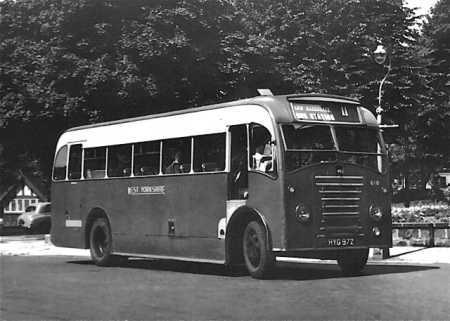


West Yorkshire – Morris Commercial – HYG 972 – 618

West Yorkshire – Morris Commercial – HYG 972 – 618
Photograph by ‘unknown’ if you took this photo please go to the copyright page.

West Yorkshire Road Car Company
1949
Morris Commercial
Beadle B35R

618 was one of a pair (with 619) of Morris Commercial/Beadle buses bought by West Yorkshire in 1949. They were equipped with new Morris Commercial running units and a Morris-built Saurer 6 cylinder diesel engine. I believe Beadle produced this chassisless design for the BTC Group ex Tilling Companies with the intention of using re-conditioned parts. Crosville bought 22 Beadle chassisless buses with re-conditioned Leyland Cub parts and there maybe other operators with similar buses but I am not of aware of any other new-build Morris Commercial/Beadles like West Yorkshire 618/619 with other ex Tilling Companies.
618 and 619 never strayed from Harrogate and always seemed to operate on the local services in the town. Both buses had short operational service lives and lasted only until July 1956. Maybe these two buses were regarded as experimental by West Yorkshire which may explain their short time in service.
They were both then converted into depot service vans which extended their time with West Yorkshire for a year or two but both had been disposed of by 1959.

Photograph and Copy contributed by Richard Fieldhouse


18/03/12 – 15:20

Beadle actually built a single batch of 12 Morris/Saurer integrals for BTC Companies in 1949 with build numbers JCB82-94.
They were:
LTA 148/149 – Western National 2019/20.
MHU 246/247 – Bristol Tramways 2500/1.
HYG 972/973 – West Yorkshire RCC 618/619.
MHN 601/602 – United Automobile CBM 1/2.
FBD 915/916 – United Counties 115/6.
JRU 62/63 – Hants & Dorset TS 846/7.

John Stringer


19/03/12 – 09:13

The United Auto pair (later renumbered M1/2) were even shorter-lived than the WYRCC ones. Retired by UAS in 1955 they went to Bryn Melyn Motor Services of Llangollen which retired them in 1959 – it appears that they were then scrapped. Similar Beadle monstrosities with Bedford running units had equally short life spans and one can only presume that they were cheap!

Neville Mercer


19/03/12 – 09:14

What fascinating vehicles the Beadle-Morris integral buses were. Interesting how the batch was split into pairs for six operating companies John, and one wonders whether they may have been BTC trial vehicles perhaps. The West Yorkshire ones were renumbered SM1/2 (Single-deck, Morris engine) in 1954, and one or two of the older fitters referred to them as Morris-Saurers, due to the engines described by Richard. As stated above, West Yorkshire’s examples were converted by the company into rather neat- looking depot vans, becoming 1023/4 in the service vehicles fleet. (SM2 was converted in 1957, and SM1 in 1959, although both were withdrawn from passenger service as Richard says, in 1956). Each had hinged panels fitted partway along the roof, from the top of the rear doors forwards. This allowed heavier items to be loaded or unloaded using an overhead crane or an ‘iron man’ portable winch. Each vehicle was also shortened from a point behind the rear axle, and their side windows were panelled over. They were painted Tilling green with gold fleet names for their new role, and looked quite attractive conversions.

Brendan Smith


19/03/12 – 14:13

I would be interested to know more about the two operated by Bristol Nos 2500/2501. The registration numbers are from 1949 when I was still in a pram but I cannot recall ever seeing or hearing anything of them. Does anyone have any pictures or idea where they were used and sold/scrapped? They don’t exactly look like things of beauty!

Richard Leaman


19/03/12 – 15:30

Quite interesting that the Ex Tilling companies specified Beadle chassisless units as service buses, whereas the BET used Beadle for batches of coach bodies during these years, using reclaimed pre war running units.
I believe that some BTC companies also received integral Beadle service buses using reclaimed units, the Crosville examples coming to mind, with Pre-war Leyland Cub units.
Another fascinating exercise was that at Eastern Counties, where Dennis Ace units were used in ECW single deck bodies in a similar "chassisless" enterprise.
Quite an interesting subject to look back on, and well worth opening up to wider discussion!

John Whitaker


19/03/12 – 17:34

Does anybody know of any pictures of the two WYRCC examples after conversion to depot service vans.

Eric


19/03/12 – 17:37

The Bristol Tramways pair didn’t last long either, being sold to a dealer in November 1958 and later passing to a showman.

Michael Wadman


20/03/12 – 15:57

Another fascinating posting from Richard F. Thanks very much, Richard.
As my friend John W points out, this is a most interesting topic that raises a whole range of issues. As John W also points out, for instance, Beadle were involved in the early 1950’s with all three South-eastern BET companies, who had quite a lot of semi-chassisless or integral vehicles, with Leyland, AEC and Commer mechanicals. These, as far as the Leyland and AEC running gear was concerned, were largely constructed re-using pre-war parts. (M&D also experimented with integral vehicles by Harrington/Commer, and even a single Saunders-Roe vehicle, fitted, I think, with a Gardner 5LW engine).
However, all these vehicles, whether buses or coaches, were intended for standard operations rather than for lighter duties like the Morris Commercials. I wonder how such an apparently unlikely combination of Nuffield, Beadle and the BTC came about. After all, Morris were hardly mainstream PSV manufacturers, and why was a Saurer engine chosen over other, well-known alternatives?
The ‘wider discussion’ John W calls for might also include the not altogether successful history of light-weight vehicles in general. WY and many other large operators had a few Bedford OBs, which were also quite common amongst independents, but with the possible exception of the Bristol SC, the production of a good light-weight PSV seems to escaped most manufacturers. In my day, there was the unlamented Albion Nimbus, and I guess most of us can remember awful Ford Transit or Mercedes-Benz van-based vehicles, (post OBP period, thankfully!). The prevailing view I remember, however, was the seeming attractiveness of lower initial price and running costs were always going to be outweighed by shorter vehicle life and less dependable service, as well as lack of appeal to passengers. As a senior M&D manager once said to me, ‘Light weights aren’t worth a candle. We should stick to having the right tools for the job!’

Roy Burke


20/03/12 – 17:18

Agree with the M & D manager wholeheartedly but the Albion Victor VTL21 (with Leyland 0.375 engine) was, rather like the Gilford in recent threads, very highly regarded by those who took a chance and bought one. [They were really Leyland’s own answer to the Bedford SB13 – which had the same engine. Significantly, for what they were (light-weight) all Leyland powered Bedfords were at least rated well, if not highly.] The Albion Victor suffered, like the Bridgemaster and FRM1 from being introduced onto the market after newer, more popular designs had cornered the market. It was also more expensive than an SB13!
As for the Morrises….. They had limited prewar success with the Viceroy and Dictator but then withdrew in the face of competition from the big boys. They tried again with an OB sized vehicle after the war, but no-one toppled the OB. Morris had a long and honourable tradition but by 1950 had very old-fashioned engines. Thus when they merged with Austin to form BMC, they also acquired Austin engines and gearboxes which were more up to date and, frankly, better. There wasn’t anything suitable in the cupboard for commercials, so Morris used a Saurer engine built under licence – so strictly it was their own. [Shades of Crossley – sic.]

David Oldfield


21/03/12 – 07:34

The Morris Commercial diesel engines were licensed built Saurer designs that came in 3.4 litre 4 cylinder and 5.1 litre 6 cylinder versions. These engines later had their capacities increased to 3.8 litre and 5.7 litre respectively, and continued in production under Leyland ownership, when they were called the 4/98 and 6/98 – the "98" was the bore measurement in mm, and the stroke was 125 mm.
Saurer pioneered a version of the toroidal piston cavity, sometimes used in conjunction with a four valve head. Other engine makers using the Saurer principles were required to pay royalties, which Crossley, for one, refused to do, with catastrophic consequences for that Company.
The pre-war Morris Commercial bus models had imposing names such as Viceroy, Dictator, Imperial and Director, and some, at least, were designed by AEC’s former Chief Designer Charles K. Edwards, but they did not earn a good reputation and soon vanished from the scene.
Apparently, one of the early Beadle chassisless buses was fitted with Dennis Ace running units and went to Eastern Counties. Perhaps this vehicle was the inspiration for the 16 ECW/Dennis chassisless buses of 1950 that used Ace components.

Roger Cox


21/03/12 – 11:50

Fascinating responses from Roy and others on the "chassisless" debate, which seemed to be "raging" 1949/50 ish. and especially the strategic differences between BTC and BET, with all sorts of side players such as Sentinel.
I know Bristol/ECW had a captive market, but the ensuing chassisless LS was perhaps strongly influenced by this activity, and it was far more successful than the Leyland and AEC variants, even though later replaced by a "Chassis" MW version.
Most of the rural bus operators probably needed lightweight vehicles for sparse and unremunerative routes, and hence the "WYRC "Flying Pigs" and their post war replacements in the form of Beadle OBs , but it would seem that Bristol were intent on using the lighter weight of this concept as a way forward with fuel efficiency for full size vehicles. Just how successful this sort of approach was is not for me to say, as my bus operating experience is "nil".
Was the success of the LS due mainly to its lack of competition, or was it truly a bus operator`s dream?

John Whitaker


22/03/12 – 08:11

Eric, there is a photograph of the pair of West Yorkshire depot vans in a book by Colin Wright – ‘Bus Company Service Vehicles’ (Trucks in Britain Vol 4). I had not realised just how much shorter WY had made them during their conversion until I had hunted out the book again. Looking at the picture of the vans, there are only two bays within the wheelbase, instead of the four present when in bus form. Their integral construction no doubt made the removal of the various unwanted parts easier than on a chassised vehicle. They were fascinating vehicles, but it has to be said that the Beadle bodies did look quite quaint – the styling being somewhat at odds with the technological image associated with integral construction at the time.

Brendan Smith


22/03/12 – 13:31

Thanks Brendan for the information and description. I’ll keep a lookout for that book at events this summer.

Eric


22/03/12 – 13:32

Quaint is not the word I would have chosen for their bodies, Brendan: the kindest I could be would be eccentric!
Its fascinating the way there are hints of ECW with the cream/white strip above the windows.

Chris Hebbron


25/03/12 – 08:58

The comments on lightweight buses stirred some memories. West Yorkshire Road Car took delivery of four ECW-bodied Bedford VAM14 service buses in 1967 (SML 1-4: Single-deck, one Man operation, Leyland engine). They were part of a THC order for twenty (Western National and Eastern Counties were the other recipients) and were meant to be a stop gap measure pending the Bristol LH going into production in 1968. The VAM appeared to be a well-respected lightweight chassis, being popular with many small to medium-sized operators in the independent (especially coaching) sector. Sadly however, the four WY examples lasted barely four years in the fleet. Apparently, they went through quite a few clutches and prop shafts in that time, and they were not too popular with drivers. The Leyland 0.400 engines proved reliable however, and the buses were simple to maintain and repair, but fitters at Grove Park depot (home to two of the VAMs) felt they were just ‘too lightweight’ for their intended duties. Much as Roy, David and the M&D manager would probably concur.

Brendan Smith


14/09/12 – 07:12

The two mentioned JRU 63 and JRU 62 ended up at Aston Coaches Marton in February 1963 and were operated in the PSV fleet for a short time then sold to French Collett Cumnor, Astons also has a number of Leyland Beadles EFU 855/841/842

David Aston


HYG 972_lr Vehicle reminder shot for this posting


19/07/14 – 08:07

Over two years ago this thread discussed Beadle chassisless buses with Morris running units. Neville Mercer wrote:-
"The United Auto pair (later renumbered M1/2) were even shorter-lived than the WYRCC ones. Retired by UAS in 1955 they went to Bryn Melyn Motor Services of Llangollen which retired them in 1959 – it appears that they were then scrapped. Similar Beadle monstrosities with Bedford running units had equally short life spans and one can only presume that they were cheap!"
Two points arise.
1. is there any possibility that the bodies of the Llangollen pair were those shipped to Macau – with or without chassis?
2. The Bedford OB/Beadle chassisless, ex-ENOC which went to Macau lasted in arduous service until 1974/75.
In both cases reference to my book (DTS Publishing) gives details.

Mike Davis


Quick links to the  -  Comments Page  -  Contact Page  -  Home Page


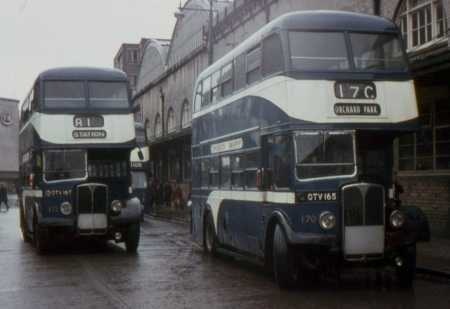
Hull Corporation – AEC Regent III – OTV 165 – 170

Hull Corporation – AEC Regent III – OTV 165 – 170
Copyright Bob Gell

Kingston upon Hull Corporation Transport
1954
AEC Regent III
Park Royal H30/26R

This photograph was taken in Summer 1969, at a very familiar location in Hull and it shows 170/2 OTV165/7 of the KHCT fleet.
During 1967, KHCT acquired no less than 36 of these Park Royal bodied Regent IIIs from Nottingham City Transport, exactly half of the batch of 72 such vehicles registered OTV 127 to OTV 198 and delivered to Nottingham City Transport between June 1953 and October 1954. They were numbered 150 to 185 by Hull, but not one of them had a Hull fleet number that matched its registration! The front destinations were altered to Hull specification; the rear ones were panelled over. They were withdrawn by Hull between 1970 and 1972. One vehicle, 157 (OTV 137) then became a training vehicle, and still survives; it can usually be seen at Sandtoft Trolleybus Museum, restored to its original NCT livery.

Photograph and Copy contributed by Bob Gell

A full list of Regent III codes can be seen here.

———

15/03/12 – 09:30

What an evocative picture, even if they are not native KHCT buses, how well the streamline livery sits on them! The location is, of course, the Coach Station in Collier Street. How lucky we were in Hull to have a coach station; instead of a mundane bus station, like other places. It was called coach station from being opened in 1935, this in spite of the fact that KHCT never owned any coaches for general service until the 1980’s! 170 has just arrived from Orchard Park via Beverley Road on the circular service 17C, whilst 172 is arriving from Willerby road on service 81. I recall OTV 137 at Sandtoft in the early 1980’s carrying the streamline livery of KHCT.

Keith Easton

———

15/03/12 – 09:30

I remember them new in Nottingham, where they ousted the pre-war Regents on the Bilborough, Broxtowe and Strelley services (13, 16, 16A, 30, 32, 56, 60, 62). In fact Bilborough depot’s allocation was almost entirely from this series. They also filtered onto a few other individual routes. I am pretty sure they never or rarely appeared on the Arnold group of services (10, 20, 20A, 52, 57) which retained pre-war vehicles until the arrival of the exposed radiator Regent Vs in 1955-56.

Stephen Ford

———

15/03/12 – 09:30

I remember these coming to Hull and causing me a lot of confusion, or at least the one that survives did. I saw it (157) and in my mind matched registration number to fleet number. I happened to go to Nottingham later that same day and was somewhat surprised to find OTV 157 running there. It was a little while after before I realised my mistake and that I hadn’t seen the same bus working for two operators on the same day!

David Beilby

———

15/03/12 – 12:09

In addition to these ex Nottingham buses Hull also bought ex St Helens RTs (see here) one of which BDJ 87 is preserved at the Lathalmond Museum in Saints livery. In addition Hull bought ex Newcastle Daimlers with Birmingham style bodywork (see here) and some AEC Regent IIIs also with MCW bodywork from Leicester.

Chris Hough

———

16/03/12 – 07:27

In addition to Nottingham selling these to Hull three of the batch went to Grimsby-Cleethorpes. I remember conducting on them and thinking they seemed pretty archaic compared to our Bridgemasters.

Philip Carlton

———

16/03/12 – 12:46

The Grimsby-Cleethorpes trio were OTV 159/161/163, purchased by GCT in 1967 to replace their 3 1946 RT Regents, 80-82 (JV 9900-9902). The Nottingham vehicles initially took over these three running numbers, but then became 112-114 in 1969 to release the earlier numbers for new Daimler Fleetlines.

Stephen Ford

———

19/03/12 – 09:24

Stephen – As you say, the OTVs were the basic allocation at Bilborough depot for most of their time in Nottm; the remainder of the batch was based at Parliament St and spent most of their time on the Beeston rota. After trolleybus conversion, they also appeared on Wells Rd routes 40 and 47 until withdrawn. I also never saw any on the Arnold (Sherwood depot) routes.
Philip – I agree your comment about these appearing archaic; I have subsequently found in Alan Townsin’s TPC book on Park Royal that these vehicles had been due for delivery in 1950, hence the 5 bay bodies, half drop windows, and late 40s, early 50s style interiors, with varnished/polished wood, which were a world away from the Park Royal Regent Vs delivered in 1955/6. But at least they were 8’wide!

Bob Gell

———

21/04/12 – 08:39

One of the trio of OTVs sold to Grimsby Cleethorpes also survives in preservation. The bus concerned is Nottingham 161, which can be seen at the GCR Heritage Centre at Ruddington, near Nottingham. It is also restored to Nottingham’s green with cream bands livery.
The original order for the buses that became the OTVs was for 112 buses, placed in 1948 for delivery from 1950. When the 72 OTVs came in 1953/54 the chassis had to be shortened to 26 feet from 27 feet (one foot removed from the rear overhang) to suit the Park Royal bodies which, at 26 feet long, were to the pre 1951 legal length for a two axle double decker. The choice of a five bay body must have been down to Nottingham as Park Royal had a four bay body for the Regent III in production from 1947 (examples supplied to Huddersfield, Morecombe and West Bridgford). The choice may have been to standardise on the half drop windows used, which were as used in the BUT 9641T trolleybuses. Another feature, also seen on the 9641T trolleybuses, was the placing of the batteries under the stairs (as with the RT) rather than in cradles on the chassis side (as with Nottingham Met-Cam and Roberts bodied Regent). The 72 vehicle were almost identical. Variations were 150 with its opening front upper deck windows and the last deliveries of 1954, which had to have a second rear lamp to meet changed legislation fitted. This was incorporated in the bottom of the grab rail positioned against the back platform window. The balance of the 112 were received as the ten SAUs and the 30 UTVs.
The OTVs did certainly dominate the allocation at Bilborough Depot, which, from memory, was from about bus 156 to bus 198, until replaced by NAU and RTO Fleetlines in the middle 1960s. Bulwell also had its Roberts bodied Regents replaced by Fleetlines (RTOs) about 1964. The others were based at Parliament Street and were used on a variety of services including the Beestons, the West Bridgfords, the Sneinton Dales and the 25 and 58. From my observations Parliament Street’s share of the Arnold services were worked by PD2s, but what worked these prior to the arrival of the PD2s? Prior to the arrival of the Regent Fives Sherwood had an allocation of the Daimlers with both Brush and Roberts bodies.

Michael Elliott

———

21/04/12 – 11:49

Thanks Michael. I don’t actually ever remember seeing PD2s on the Arnold routes. My recollection is of wall-to-wall Regent Vs from 1956, prior to which memory says that they were operated by pre-war Regents (Metro-Cammell and Cravens). However I have seen enough photos to convince me that my memory is not infallible! – Daimler CVD6s were also used. It is also certain that the 10 was often singled out for the left-overs – utility CWA6s or second hand pre-war Halifax Regents. Also, in the early 50s, the Redhill route that became the 57 was one end of a cross-city 4/4A from Beeston, often served by 1948 Metro-Cammells. Similarly, the 3 Sneinton Dale was originally a cross-city service, starting at Radford (Addington Road) and at that time invariably pre-war Regents. Both the 3 and 4/4A were split in two, I guess, around 1952/53, Redhill becoming 57, Radford 58, and a new extension beyond the Sneinton Dale terminus of the 3 became 59.
The Parliament Street OTVs were also widely used on the Trinity Square-Bestwood area services (6, 17, 18, 28) and the Gordon Road routes (9, 23, 54, 65).

Stephen Ford

———

01/05/12 – 07:06

Hi Stephen – The link between Beeston and Arnold dated back to April 1933 when service 4 was linked to services 10 & 20. At that time service number 4 was used for the Beeston to Nottingham part of the journey and 10 or 20 used for the journey through to Arnold. Service 10 ran via Mansfield Road past the Home Brewery to Redhill Road then via Redhill Road to the Mellors Road junction. Service 20 ran via Mansfield Road then via Nottingham Road (Arnold), Front Street, Church Street and Mellors Road to the Redhill Road junction.At this time all journeys between Beeston and Nottingham whether by via Derby Road or Castle Boulevard were service 4 until 2nd April 1944 when journeys via Castle Boulevard became 4A. When the Arnold tram service was converted to bus operation from 6 September 1936 service number 10 was used for the service between the Old Market Square and Valley Road, Sherwood. Service 20 still operated between Mellors Road but ran through to Trent Bridge via Arkwright Street. The service to Redhill Road via Mansfield Road then became the 4, running through from Beeston (via either Derby Road or Castle Blvd). The split between Beeston and Arnold took place from 25th May 1952 when the 57 was introduced between the Old Market Square and Redhill and the 4/4A became solely a service between Beeston and the Old Market Square.
Through operation by service 3 between Sneinton Dale and Addington Road, Radford ceased from 12th April 1953 when service 58 was introduced between South Parade and Radford.

Michael Elliott


Quick links to the  -  Comments Page  -  Contact Page  -  Home Page


All rights to the design and layout of this website are reserved     

Old Bus Photos from Saturday 25th April 2009 to Thursday 4th January 2024