Old Bus Photos

Hull Corporation – AEC Regent III – FBC 284 – 103

Hull Corporation - AEC Regent III - FBC 284 - 103
Copyright Robert Mack

Kingston upon Hull Corporation Transport
1949
AEC Regent III 9612E
Weymann H30/26R

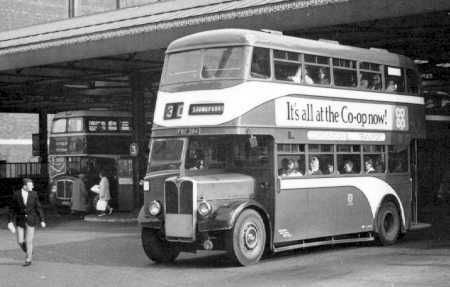
As part of the replacement programme for the post-war AEC Regents, by Leyland Atlanteans, a number of second-hand vehicles were purchased by Hull Corporation. As mentioned in a previous Hull Corporation posting one of these batches were twelve AEC Regents from Leicester Corporation, which were purchased in 1966. They were allocated fleet numbers 201 to 212, but this was amended in October, 1966 to 101 to 112. Nine of the vehicles which were then in service had their fleet numbers altered, but 109, 110 and 112, entered service carrying the new numbers. Registration marks were FBC 282 to 288, 291 to 295. They were withdrawn between November 1968 and December 1969. The photo shows 103 (FBC 284) leaving the Coach Station on service 30 to Stoneferry.

Photograph and Copy contributed by Keith Easton

A full list of Regent III codes can be seen here.


29/04/12 – 17:06

The streamlined livery on this strangely old-fashioned body style gives this bus a very 1930s feel.

Paul Haywood


30/04/12 – 07:42

The bodies were actually MCW, not Weymann, based on a design going back to 1933! Obviously upgraded and updated, but nevertheless to the old basic shape. Very attractive too, but I think they looked even more wonderful in Leicester’s glorious maroon and cream. LCT had another batch of Mark IIIs, with Brush metal bodies, and these too were very attractive vehicles, the post war Brush metal framed bodies being most unlike the composite style.
Leicester was a most interesting fleet, right from the early days, and one which I plan to study in a bit more detail as I have lived near Leicester now for over 40 years.
Anyone fancy joining in?

John Whitaker


30/04/12 – 09:07

Talk about unobservant, I’d not even looked at the "title" paragraph. Just to be really awkward, John, they are MCCW (Metropolitan Cammell Coach Works). MCW (Metropolitan Cammell – Weymann) was a marketing company until the two firms merged in 1965/6 to form a new MCW manufacturing company.

David Oldfield


01/05/12 – 07:03

I thought MCCW stood for Metropolitan Cammell Carriage and Wagon (Co Ltd). That’s what it said on Manchester Corp’s body plates.
I think that more than anything else it’s the sharply raked-back of the front, and consequent small first upper deck window, that makes this design look so archaic.

Peter Williamson


01/05/12 – 07:04

Hi David – Sorry MCCW stood for Metropolitan Cammell Carriage and Wagon, a builder solely of railway rolling stock until a diversification into steel framed bus bodies circa 1930. Bodies of the same basic design as FBC 284 were also supplied to Nottingham, Salford, Wallasey and Glasgow (Glasgow’s were built by both MCCW and Weymann’s).

Michael Elliott


01/05/12 – 19:38

Peter and Michael, I knew that and was just waiting for someone to correct me. It was a moment of unforgivable senior madness. Forgive my lapse of standards. [see other post!!!]

David Oldfield


16/07/12 – 06:23

I remember both these and the Brush bodied ones in service in Leicester. Powerful engines and pre-select gearboxes gave a very smooth ride – far more refined than the All-Leyland PD2s, in my opinion.

Adrian Griffiths


13/07/18 – 07:35

Does anyone know if Hull CT reregistered these purchases with local registration numbers. Reason for asking is that there has recently been posted on the Old Hull facebook page a picture of a bus not in any of the Hull operators livery but bearing a local reg No GKH 384.

Reg Oakley


14/07/18 – 06:57

The bus in the photograph Reg Oakley refers to is a Leyland TD series, and its registration matches its age, falling in the gap between a batch of Hull AEC Regents and a pair of East Yorkshire Leyland TD7s. Therefore it isn’t a re-registration. Hopefully someone will recognise it.

Peter Williamson


14/07/18 – 10:56

I’ve created the link below to the facebook page mentioned by Reg Oakley (above) – creating such a link is perfectly within the rules. If you scroll down the comments on the said facebook page you’ll see that the vehicle has been identified as being ex-Hull Corporation, one of four Leyland TD7/Leyland diverted to Hull in 1942, 200-3 (GKH 381-4).
In the facebook pic (reputedly taken in 1960, the year of GKH 384’s withdrawal from the passenger fleet), it looks as though it might have been transferred to an alternative council department.

The Facebook link is www.facebook.com/photo.php?fbid

David Call


16/07/18 – 07:50

Titan no. 203 went to the City Engineer’s Department for staff transport to new estates on the edge of the city and was given an all green livery and lasted until sometime in 1963. Believed scrapped in 1964.
Regents 245 and 250 also went the City Engineer in 1966.

Malcolm J Wells


17/07/18 – 06:31

This bodywork reminds me so much of Provincial of Gosport’s similar-bodied pre-war buses – only the post-war radiator giving the game away as to the Hull version’s relative newness!

Chris Hebbron


Quick links to the  -  Comments Page  -  Contact Page  -  Home Page


Harveys (Mousehole) – Albion Nimbus – RJX 250

Harvey ( Mousehole) - Albion Nimbus - RJX 250
Copyright Ian Wild

Harveys, Mousehole, Cornwall
1963
Albion Nimbus NS3AN
Weymann B31F

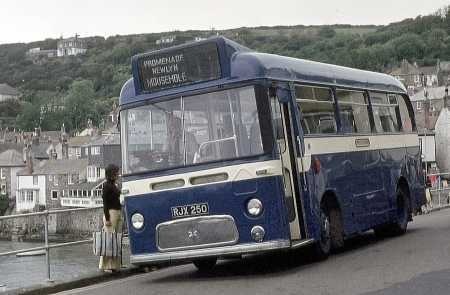
This former Halifax Nimbus found its way down to deepest Cornwall where local Operator Harveys operated it on their share of the Penzance to Mousehole service which was joint with Western National. The route negotiated narrow streets and sharp corners in Mousehole and this little bus must have been ideal for the service. The photograph was taken on 13th June 1974 so Harveys managed to run it despite all the shortcomings of the type. Mind you, Halifax is rather more hilly!

Photograph and Copy contributed by Ian Wild


27/04/12 – 07:30

Harveys certainly put it to good use as it was still in the fleet when they were taken over by Western National in 1988. It even operated for them although unfortunately when I visited Penzance in that year it was laid up with a defective gearbox. Spares were not that easy to come by by then!
It was subsequently preserved but I don’t think it’s been too active in recent years.

David Beilby


27/04/12 – 07:31

This bus survives in preservation and has been restored to Halifax colours.

Chris Hough


27/04/12 – 07:33

Halifax purchased these Albions for the route out to Hepstonstall where there was minimum clearance. At least two of the batch were painted in reverse livery for private hires.

Philip Carlton


27/04/12 – 08:41

Great to see this bus in Mowzell! Having taken a black & white photo of this in Penzance in the late 1960s, I’m pleased to see that it is in a blue livery as I had always wrongly remembered it as being green!

Paul Haywood


27/04/12 – 10:23

How attractive this wee bus looks in the very smart blue and white livery shown here. What a pity the Albion Nimbus was such a stinker in service – one lasting for 25 years, as David relates, must be a national record! My only personal knowledge of the Nimbus is the extremely unflattering remarks made about it by staff at Maidstone & District’s Central Works, where it was regarded as a joke in the worst possible taste.
This posting raises again, however, the subject of lightweight/small capacity vehicles, and the inability of major manufacturers ever to make one that proved itself in service to the satisfaction of of operators. I’ve re-read the postings on the Guy GS; there isn’t one on the Dennis Falcon which found some favour with Aldershot & District, (unsurprising), but with very few others. Why not?

Roy Burke


27/04/12 – 10:28

The Western National contingent was Bristol SUS’s, and before that Beadle re-bodied Bedford OB’s (or possibly OWB’s).

Stephen Ford


27/04/12 – 11:38

Bizarre, Roy. I was contemplating making a similar comment myself – so now I will! In earlier time Western National ran Dennis Aces (or was it Maces?) on the Mowzell. I’m certainly of the heavyweight fraternity and full-sized light and medium weights just not cut it. As you say, the problem is when you need something of small dimension. The Guy GS, and probably contemporary Falcon, were far better engineered than any Mercedes (the better end of the modern market) let alone an IVECO or Renault.
The Tranny is too small, but better engineered than most. [Against all the odds and expectations, Luton and District got over a millions miles of reliable service from their 16 seat Bread Vans.] Unfortunately, cutting a Bristol LH down – which in theory should have given you a "heavy" small bus – didn’t work either. Probably the worst thing I’ve ever driven was an LH/ECW 25 seater – ex Blue Saloon, Guildford.

David Oldfield


28/04/12 – 07:39

Funny David should mention the Bristol LH, shortly after I left Percy Main for pastures new with Armstrong Galley, we took delivery of a Bristol LHS-305 with Plaxton C35F body, which soon became known as the ‘Stotty Box’ (stott is a Geordie expression for bounce) it was bad enough in dry conditions, but in the wet it was like trying to drive a mobile trampoline on an ice rink

Ronnie Hoye


28/04/12 – 07:40

When I was a Traffic Clerk at HPTD, I spent quite a few hours in the Halifax Nimbuses when learning to drive psvs in January 1965, and I always liked them, a view not shared by the majority of the Halifax drivers, more used to the brute force technique required of the Leopards and Titans in the fleet. I often drove on the second half of late turns on the 46 Heptonstall route, which seemed always difficult to cover, probably because of the unpopularity of the Nimbus. Despite the midget proportions of the Nimbus, the 46 route was conductor operated to enable the unbelievably tight reversing point at Heptonstall to be negotiated without major restyling of the bodywork. Later, the route was extended further into the village on a loop terminal working that allowed the operation of full sized saloons, and the Nimbuses were no longer required for Heptonstall, though some were retained for a while for the very rural 60 and 61 services to Mill Bank and Beehive. Some five years later, I used to drive the almost identical ex Western Welsh Nimbuses at weekends for North Downs of Forest Green.

Roger Cox


28/04/12 – 07:41

Unfavourable comments about the Bristol LHS are something I thoroughly agree with my experience of the type came after I joined Lincolnshire Road Car in 1991 at that time they had two with ECW bodies ex LCBS and at least one with Marshall body ex Gash of Newark.
They were all very unpleasant to drive with heavy steering, if anything heavier than the longer LH, the gear change on both was horribly stiff and imprecise the brakes like most Bristols was their only saving grace. Later another one appeared this with a Plaxton coach body and joy oh joy power assisted steering which life somewhat easier, the ride on all was lively to say the least. Overall eminently forgettable vehicles.

Diesel Dave


28/04/12 – 08:59

Although Mr Hilditch was not a fan of the Nimbus the replacement vehicles were roughly the same size. These were a batch of very short AEC Reliances with Pennine bodywork which looked almost identical to the nimbuses. These AECs lasted until the advent of the PTE.

Chris Hough


28/04/12 – 17:07

During my time at E.C.O.C. in Cambridge (1972-75) there were several Bristol LH’s and one LHS. they were used on OMO route 139 from Histon/Impington to the New Addenbrooke’s Hospital. Every one had extremely heavy clutch pedal operation, and as in previous comments they were not at all popular with the drivers. The LHS was referred to as ‘The Baby Bouncer’ as part of the journey was along Mill Road past the Maternity Hospital. On a return visit to Cambridge in 1997, I noticed that they were using one of the LH’s as a driver training vehicle.

Norman Long


29/04/12 – 08:03

I drove a Bristol LHS/Plaxton 35 seater at J. J. Longstaff of Mirfield. I never liked the way the pedals came out of the floor as in a car. One Sunday we used it on the service from Mirfield to Dewsbury and my clippie Kathleen referred to it as the sardine can.

Philip Carlton


01/05/12 – 19:52

Thanks, Ronnie Hoye! Can’t get that wonderful expression Stotty Box out of my head: it’ll keep me in smiles for months to come!

Ian Thompson


03/05/12 – 07:58

In the companies where I worked, the LHS was known as the "Baby Bouncer".

Roger Cox


04/06/12 – 17:08

Well I passed my PSV test on this very bus and had the privilege of driving her between Mouzel and Penzance many times. I am Vincent Harveys son and I now live in Australia.
My dad and uncle ALWAYS kept her in top order. Glad to know she’s being cared for still.
By the way, the family business was sold to Grenville Motors of Camborne.

Nick Harvey


10/05/18 – 05:47

I now own this Nimbus and it has returned to Cornwall for the first time in twenty years. She has fallen on hard times but will hopefully be returning to the road next year. Can’t wait to take her home to Mousehole.

Steve Cocks


11/05/18 – 06:40

I visited Mousehole on Sunday 9 June 2013 travelling on the First Devon and Cornwall service 6 bus from Penzance.
At the time it was the Mercedes-Benz Vario type that was used on the service because of the tight turns and narrow streets of the village. On the morning of our visit there wasn’t a suitable bus available for the service and so an Optare Solo was used. However, this type wasn’t able to negotiate the full route as it was too wide/too long so had to terminate at the ‘The Old Coastguard’ a hotel a little way short of the normal terminus.
The Solo ran until the 1115 trip from Penzance/1143 from Mousehole after which a Vario became available commencing with the 1215 service from Penzance/1243 service from Mousehole.
I took a few photographs of the Vario as it made its journey in the narrow part of the village which show the challenge the buses and drivers have. I don’t know what vehicles they are using these days. www.ipernity.com/doc/

David Slater


14/05/18 – 07:16

Glad to know she’s in safe hands, Steve. Keep us posted on progress, won’t you/

Chris Hebbron


14/08/20 – 06:29

RJX 250 as she is now. Mechanical work is progressing well with the braking system overhauled gearbox removed to repair clutch. Blue undercoat has started to be applied. Hopefully back to Mousehole in 2021.

Steve Cocks


Quick links to the  -  Comments Page  -  Contact Page  -  Home Page


Sheffield Corporation – Leyland Olympic – RPA 771 – 211

Sheffield Corporation - Leyland Olympic - RPA 771 - 211
Copyright Ian Wild

Sheffield Corporation
1952
Leyland Olympic HR44 
Weymann B44F

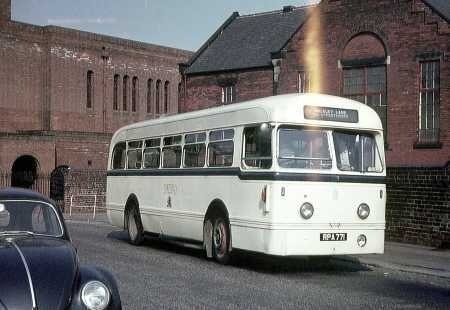
Sheffield bought three early Leyland Olympics in 1951 and followed up two years later by the acquisition of this former Demonstrator. It put in a good service life lasting until 1968 when it was sold to Dodd, (Dealer) in Dromera, Ireland. I wonder if it found a buyer or whether it was scrapped? The bus was originally fleet number 211 being renumbered as shown in the 1967 scheme. This photo was taken on 10th June 1967 at the Hillsborough terminus of the 31 Lower Walkley service which was characterised by narrow streets and steep hills.

Photograph and Copy contributed by Ian Wild


25/04/12 – 05:16

I think I remember these in Sheffield: were they the "integral" versions? Some had an Olympic torch badge on the front, I think. They always seemed high-floored (the opposite to what you could expect) and a bit awkward, but presumably suited the route.

Joe


25/04/12 – 05:17

From 1952 until 1956 I lived on the 31 and travelled on these and the back loader Royal Tigers. This is now a terminus for Stagecoach 52 and is also close to where the Malin Bridge branch leaves the main Supertram line to Middlewood.

David Oldfield


25/04/12 – 08:36

Can anyone tell me what size engine were in these Olympics please. I believe the King Alfred Olympic that is currently being restored and nearing completion was rescued from Ireland. I always thought it was a great shame that one of the Halifax Corporation Worldmasters were not saved for preservation especially fleet No1 – KCP 1 what a great registration number! Two of these vehicles ended up in Ireland with Keneallys coaches.

Richard McAllister


25/04/12 – 09:20

The Olympic was the integral predecessor of the Royal Tiger and shared all the same mechanical units – including the 9.8 litre 0.600. They were high floored and probably awkward – but what else would you expect of an early underfloor vehicle? [The open backed Royal Tigers 222/223 were even more awkward.] As for suiting the route, they only suited it for the operator (dimensions and power for a hilly route) certainly not passenger friendly – especially the aged and infirm. Passenger comfort only became a priority from about ten years later when technology and new designs allowed it.

David Oldfield


25/04/12 – 15:27

Yes- they looked like the ugly sisters in the sixties- especially as you say, the Tiger rear loaders. My point is that I assume in an integral bus you are not fixing a body to a one-size-fits-all chassis and could therefore make some allowance for the passengers… or what’s the point (I think that was the problem- there wasn’t one…?… or was weight reduced?) What were the advantages? You were presumably stuck with the basics of the original body for good?

Joe


25/04/12 – 16:33

Modern integral buses are monocoque, just like cars (which also used to have separate bodies/chassis)and, I think, are almost universal nowadays. You’re right, though, Joe, you picks your body length, they bold on all the mechanicals and you’re stuck with it. London Transport’s tram/trolleybus department, separate from its bus department, created integral trolleybuses around 1937, using several companies to build them, including Brush and Leyland. Strange how long it took for this system to begin to become popular, around the time when Olympics were coming off the lines and said trolleybuses were starting to go to the scrapyard!

Chris Hebbron


25/04/12 – 16:37

Leeds single deck requirements were few in post war years indeed they only bought 10 saloons in the fifties but managed to have three chassis types! These were 5 AEC Reliances 3 Leyland Tiger Cub and a pair of Guy Arab LUFs. All had the same body layout which was B34C + 14 crush load standees in a central vestibule opposite the doors. Like Sheffield’s Royal Tigers the steps were vertiginous and deep most off putting for intending passengers. Getting a push chair aboard was a major logistical exercise! The overall body shape was common to all ten but the final pair of Reliances had a more upright profile. They were mainly confined to two routes one of which passed under a low bridge and another which crossed the canal on abridge with weight restrictions.

Chris Hough


25/04/12 – 17:39

Joe, the intention with all early integrals was to save weight – it was impossible to be passenger friendly until the dawn of the rear-engined bus. Unfortunately, all of the major manufacturers found that the weight saving margin was no where near enough and that, quite the opposite, there were major weaknesses – often around suspension mountings. This was certainly true of the Bristol LS which transformed after five years into the almost identical MW chassis. Similar problems beset the AEC Monocoach which died out in favour of the Reliance. The other problem was that British operators preferred, and still do, to choose their own bodywork – cf the Leyland National of later years. Ironically the change from LS to MW and Monocaoch to Reliance were not so evident as the separate body chosen for the separate chassis tended to be identical, in all other respects, with the earlier integral body. [Come to think of it, many moved over to the Royal Tiger with identical Weymann coachwork!]

David Oldfield


25/04/12 – 17:39

Just wait until someone discovers the advantages of "demountable" bus bodies: bodies can be changed or swapped on a "chassis", giving greater flexibility, more opportunities for upgrading, and cutting service times. Why didn’t anyone think of that before?

Joe


26/04/12 – 06:14

1904 is beyond most people’s memories, Joe.

David Oldfield


26/04/12 – 11:39

There were demountable bodies in the early twenties, Joe, although they were usually in the form of exchangeable lorry/charabanc bodies. It never carried over, though into exchangeable bus bodies, to my knowledge, at least, not in a big way.

Chris Hebbron


26/04/12 – 11:40

Nice one, Joe. However, the idea of demountable bodies does actually go back a long way. Maidstone and District started in 1911 with three Gilford chassis; these had bus bodies during the day which were changed for lorry bodies at night. I believe the lorries were used to carry vegetables to and from Covent Garden. I’m sure there are plenty of other examples elsewhere, too.
No doubt David is right when he talks about weight saving being a factor in the development of integrals, but I rather suspect that other motives in early post-war attempts were to use parts from pre-war chassis, and to generate extra work for the maker. Beadle, of course, were prominent in this field; others included Harrington and Saunders-Roe.

Roy Burke


27/04/12 – 07:22

I remember this bus from my student days and wondered why there was an odd one with a Surrey registration.
It would have demonstrated for Weymann, who were based at Addlestone. Evidently it was never fitted with standard Sheffield blinds. I never rode on the 31 although I had "digs" near Crookes on the 52 route.
The open-platform Royal Tigers used on the same route looked odd and a bit reminiscent of Edinburgh; I think the local Inspectorate had something to say about the arrangement.

Geoff Kerr


27/04/12 – 08:39

Yes, Geoff, there were responsible for the fitting of the odd looking emergency door at the rear – NEXT to an open rear platform!
Roy, what said is true but Weymann and Park Royal never did a Beadle with second-hand parts.
I type this about my home town of Sheffield from two miles up the hill from Addlestone. Funny old world.

David Oldfield


27/04/12 – 09:34

And I, a Surrey-ite, who long ago moved away, still visit my brother in Ottershaw, just across the M25 from you, David. Incidentally, whatever happened to Weymann’s works? I assume it no longer exists.

Chris Hebbron


27/04/12 – 10:35

Well, for the initiated Chris, I’m typing IN Ottershaw itself! [Funny AND small world.] Until I retired a year or two back, I passed it on the way to school – St George’s College – but ever since the turn of the millennium it has been a deserted, speculative, office block awaiting tenants. All glass and security guards with nothing to do! You must know that Addlestone Garage is a gated development (yes, in Addlestone) and the Co-op long ago made way for Tescos.

David Oldfield


28/04/12 – 08:48

A remarkable coincidence, indeed, David!
Pardon my irony when I say that the changes you mention pass, nowadays, as progress. The supreme one, though, is the gated development!
My abiding memory of Ottershaw is the Aldershot & District Dennis Lances passing by to and from Woking and the occasional ride on them as part of my journey from Portsmouth by rail.
Lovely buses. The whole area was a hotchpotch between London Transport and A&D and you could never be sure what company’s bus would pop out from some side turning.
Also, Ottershaw was the last/first telephone exchange in the London Area and I would use a callbox there to make calls to my London relatives at local call rates. Some would say miserly, I call it ‘being careful’! Happy days.

Chris Hebbron


28/04/12 – 14:47

You could have been a Yorkshireman!!!

David Oldfield


20/07/12 – 15:48

One of the benefits of the open platforms was that passengers could "hop off" whilst the vehicle was approaching the stop, preventing the driver having to do steep hill starts. The conductor would be ready with his finger on the bell to let the driver know he did not have to stop. No H&S in those days, conductors encouraged it. I got very good at jumping off buses coming up Haymarket to turn right up high street on my way home from school. I believe that is why London kept the Routemasters so long, people could hop on & off where they liked, speeding journey times.

Andy Fisher


21/07/12 – 07:38

Is that Haymarket, Sheffield, Andy?

David Oldfield


21/07/12 – 12:10

While the subject of bell-ringing comes up (not campanology, silly!) I recall, post-war, the LT conductors giving three rings to signify to the driver that the bus was full up and he could ignore queues at future stops until some passengers got off. Standing was unlimited post-war, I seem to recall, or the limit was ignored, then became eight, and eventually five. Admittedly, buses engines/brakes are more powerful (the latter more vicious, too!) but it was amazing how much more fluid passenger movement was then. They moved around the vehicle, up and down stairs and got on/off the platform effortlessly ‘whilst the bus was in motion’, moved around the vehicle. Despite my advanced years, I’m still fit, yet wouldn’t do those things now, apart from moving to the exit before the bus stops and that with great care and a tight grip on stanchions!
I used to love travelling on worn-out LT/ST’s, overloaded beyond belief. Juddering clutches, slow acceleration in waves, the vehicle leaning alarmingly round any corner. Despite all that so-called gentleness, an aunt of mine failed to stop me, as a baby, from falling out of her arms when she was climbing the open staircase of an LT and being caught by a surprised man, unharmed, so they say! Some of you might regret this, boring you with such tales!

Chris Hebbron


23/09/17 – 07:02

Regarding the bells, I was a conductor in Sheffield, with a good driver you became a good team and could trust each other, so not just quick bells for passengers getting off but when the last passenger had one foot on the platform and one hand on the pole it was ding ding, if in doubt assist them on with their spare arm. Yes for us three bells was full up and a shower of bells was emergency stop. We didn’t like the passengers using the bell because it sometimes confused things, we preferred the request of next stop please verbally.

Pete


Quick links to the  -  Comments Page  -  Contact Page  -  Home Page


All rights to the design and layout of this website are reserved     

Old Bus Photos from Saturday 25th April 2009 to Thursday 4th January 2024