Old Bus Photos

Newcastle Corporation – AEC Regent V – 158 – 158 AVK
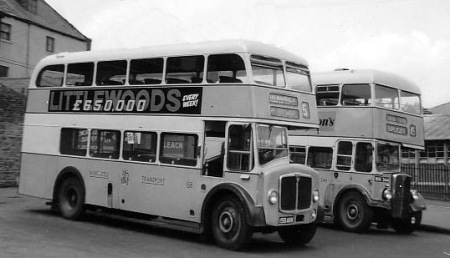
 Newcastle Corporation - AEC Regent V - 158 - AVK 158

Newcastle Corporation
1957
AEC Regent V MD3RV
Park Royal L30/28R

In 1956 Newcastle took delivery of 20 AEC Regent V’s with Park Royal H34/28R bodies, they were XVK 137 to XVK 156 and were numbered 137/156. The following year another 20 arrived, registered 157 AVK – 176 AVK and numbered 157/176 – 167/176 were the same as the previous batch, but 157/166 were L30/28R low bridge variants specifically bought for the service 5 to Darras Hall and Ponteland via the Airport, but they did venture onto other routes on occasion. I think some of the high bridge vehicles went to OK Motor Services at Bishop Auckland but I do not know if any of the low bridge type were sold on. I’m not a lover of ‘tin fronts’ and much prefer the exposed radiator type, but the AEC versions seem to be a bit less brutal in appearance than some others. The Regent III standing next to 158 is from the same batch as NVK 341 which has been beautifully restored and is now part of the N.E.B.P.T. Ltd collection.

Photograph and Copy contributed by Ronnie Hoye

A full list of Regent V codes can be seen here.

———

28/05/12 – 08:17

Aah, now I’m feeling all nostalgic! A wonderful photo of two of my all-time favourite classes of Newcastle bus in Morden Street. The Regent V is, of course, the answer to Dave Lazzari’s recent query in the Q&As section. I liked the highbridge version too but I have happy memories of the lowbridge ones on trips out to the airport on service 5 – happy days! The Regent III has to be the ultimate Newcastle Corporation bus, absolutely stunning! I have vivid memories of travelling on them on the Spital Tongues Circle [service 8] and the 1s and 2s. In those days large numbers of buses and trolleybuses were parked in Morden Street mainly between the peaks.

Alan Hall

———

29/05/12 – 17:20

I agree the AEC Regent V tin front was the best looking of the lot. It always gave me the impression of a big smiling face. (Been reading too much Thomas the Tank Engine!). The Park Royal body of this era was beautifully well proportioned and blended with the AEC front so well. A total contrast to the later incarnations using Bridgemaster parts which were the absolute pits! (eg Southampton’s examples).

Philip Halstead

———

30/05/12 – 17:41

Phillip H, you’re being unnecessarily generous by describing the version Southampton had, as the absolute pits. I’ve always regarded them as shoe boxes with holes cut in. It didn’t matter whether the apparition was on a Regent V or on a PD2A, the effect on my eyes was the same.
The Newcastle one illustrated above looks – to me – more like the East Lancs body which Southampton had on most of its Regents, or the standard for the RT. FAR more pleasing to the eye.

Pete Davies

———

31/05/12 – 08:08

As I’ve said before, just about the ugliest body ever built – based on the front-entrance Bridgemaster and the Atlantean design, or lack of it! The highbridge version of the posted design was one of the best ever – also produced by Roe and Crossley. Obviously the RT and RM bodies were classics, but after that the ACV group lost the plot. Only with the AN68 era body did they regain it.

David Oldfield

———

31/05/12 – 20:24

Except for a few examples of absolute boxes on wheels built on Park Royal frames Roe built their superb traditionally styled bodywork on front engined chassis until the demise of these as an option. The thirty foot Daimlers and AEC Regents bought by Leeds in the sixties were true examples of the coach builders art Whereas the front entrance bodies on a small batch of rebodied Tiger chassis owned by Yorkshire Traction were perhaps the very nadir of the Roe out put.

Chris Hough

———

01/06/12 – 07:07

I particularly like this combination of AEC and Park Royal. It’s a very well balanced and good looking vehicle. I can think of Western Welsh and Maidstone and District who took them as well and one or two independents also. Does anyone know of any more?

Chris Barker

———

01/06/12 – 07:09

The traditional composite Roe body, derived from the original Pullmans, has never been bettered. The last were Daimler CVG6s for Northampton in 1968. The Park Royal framed bodies were as a result of Park Royal needing extra capacity as a result of "too much" work – almost certainly the build of Routemasters from 1962 to 1968.
It was, indeed, a small batch of Tiger rebuilds which had the same appalling body as that at Southampton and Swindon. The 1965 Tracky PD3s had a quite pleasant Roe version of the Park Royal body on a number of Sheffield Regent Vs. These looked a little better than the bodies on East Kent Regent Vs and the front engine Bridgemasters.

David Oldfield

———

01/06/12 – 10:05

Further to Chris Barker’s comment, the thirty-foot version of this body looked particularly fine. The first pair – exhibited at the 1956 Commercial Motor Show – were for Cottrell’s of Mitcheldean, and a convertible open-topper for Western Welsh. A further batch were supplied to City of Oxford, after which Park Royal switched to the MCW ‘Orion’-inspired box.
I must say though, that despite their well balanced good looks, these bodies were of fairly lightweight aluminium alloy construction and were disappointingly hard riding and bouncy both on Mk. V and PD2 chassis in my experience.

John Stringer

———

01/06/12 – 15:57

John S..I must confess to no longer being a regular bus user but this week rode on a "58" plate Volvo/Wright double decker and was astonished at how appalling the ride was. Taking a top deck front seat meant I enjoyed a narrow staircase that I nearly fell backwards down because the driver set off with the usual foot to the floor take off then suffered a mix of rolling, swaying and undamped vertical bouncing on the cramped seat. Has the bus industry absolutely no idea whatever about how suspension works? Do they know nothing about adapting spring rates to the vehicle weight, correct damping control, anti roll bars, progressive spring/damper settings to allow a calm ride both when empty or fully loaded? This has been the daily work of the motor industry for decades and is not "magic". Do any PCV builders ever drive a car..ever wonder how to provide a safe and comfortable ride or is it just an industry of dinosaurs who get a batch of lorry chassis parts, bolt them together on a cheap frame and nail a poor quality body on top hoping it will all come out alright? I apologise for being off thread saying this but John’s experience of Mk.V and PD2 chassis reflected exactly mine..just 55 years later!

Richard Leaman

———

01/06/12 – 20:41

I recall Maidstone & District’s Park Royal bodied Regent V’s on the 15 route from Hastings to Eastbourne which as John Stringer says were lightweight in build which made the ride quite lively and the performance very brisk. The beautiful balance of the body dimensions combined with the AEC bonnet design, which I always admired, made this combination one of my favourites the fact that they followed M&D’s batch of ugly Orion bodied PD2’s meant they were doubly appreciated. The AV 470 engine fitted to M&D’s had a very rorty exhaust note especially in a confined street which if the revs were taken to the limit made a waffling sound as the governor cut in.
Richard Leaman’s about the ride and lack of comfort of modern vehicles hit one or two sore spots with me as at 6ft 1in tall space is to say the least limited.

Diesel Dave

———

02/06/12 – 11:51

Four of those Maidstone & District Mk. V’s were surprise temporary additions to the Calderdale J.O.C. fleet in 1972, two highbridge ones operating in Halifax and two lowbridge ones at Todmorden.
By the time I started at Halifax the following year three had already gone, but the last one 362 (VKR 479) was still soldiering on – still in faded M&D livery – but unfortunately was withdrawn just before I passed my PSV.
The AV470 engines left them seriously underpowered for climbing our local mountains, and they were not popular with the drivers – most of whom were not very keen on our own AV590 ones to start with.
Conductors disliked them because of their platform doors, which I believe were not driver-operated probably on safety grounds, and which they had to open and close themselves. Of course according to the rule book it should have been no hardship, because they should have been in attendance on the platform whilst passengers boarded and alighted anyway, but, you know……..! They did make nice exhaust sounds though.
Hebble had four similarly powered short Mk. V’s with Northern Counties bodies new in 1962 which had also really struggled up the same hills and had seemed an ill-advised choice, though they could ‘crack on’ once they got out of Halifax on flatter roads such as on the route to Leeds, but I imagine the M&D ones may have also been higher geared so would have been quite breathless.

John Stringer

———

02/06/12 – 11:52

Interesting comments from both Diesel Dave and John S on the riding qualities of the Orion and later Park Royal bodies. The M&D Regent Vs were an odd choice – a mere 22 of them, (14 highbridge and 8 lowbridge), sandwiched between 70-odd PD2s and the Atlanteans, which Dave will have come across early in their lives, as they were first introduced at Hastings. The company never bought any other AEC double deckers or Park Royal double deck bodies. Maybe they were influenced by neighbours East Kent? Because the Regent Vs were rare, I cannot comment personally on their riding qualities, my experience of them being limited to a couple of hours driving one, from which I can certainly confirm Dave’s memories of the rorty exhaust note.
On the other hand, the Orion bodies on M&D’s Guy Arab IVs rode very satisfactorily, in my view. Could that have been because of the Guy chassis, or simply the terrain of the Medway towns where they operated? (unlikely, I should have thought). Also, although Dave describes the Orion bodied PD2s as ‘ugly’, I always thought the Arab IVs looked businesslike and smart; perhaps that’s because they were essentially urban vehicles. (There’s a posting of one on this site). It wouldn’t do for all of us to agree on everything, any way, would it?

Roy Burke

———

03/06/12 – 07:06

Mention of the Maidstone and District Regent Vs reminds me that they had notices in both saloons explaining that the buses were a temporary measure pending the delivery of new buses.

Philip Carlton

———

03/06/12 – 07:07

Gosh, John, I had no idea that M&D’s Regents found a second life with Calderdale J.O.C. 362 is presumably Calderdale’s number; at M&D, it was DH479. All four of the AECs that went to Calderdale would have been close to the end of their COFs, dating originally from 1956, (and being re-certified for 5 years from 1968), which will be the reason, no doubt, why they didn’t stay long.
Conductor-operated rear doors were pretty much the norm in those days, I think, with provincial operators; the usual practice was for them to be left open in urban areas; conductors busy taking fares – especially upstairs – just wouldn’t have been able to keep opening and closing them at every bus stop. It’s a practice that every Tilling conductor, for example, would have known very well with Bristol Ks and Lodekkas. The draught-saving value of doors over open platforms was primarily felt on those parts of a journey that had longer intervals between stops.

Roy Burke

———

03/06/12 – 11:14

Roy, the M&D Mk. V’s that came to Calderdale J.O.C. were highbridge 361/362 (VKR 472/479) and lowbridge 363/364 (VKR 36/37), the last two looking very similar to the Newcastle one on the photo. They were acquired in January 1972, 361/3/4 being sold in June the same year, but 362 lasting until early 1973.
The lowbridge pair went to Todmorden, whose depot could only accommodate lowbridge buses, and though as AEC’s they stuck out like a sore thumb in this previously Leyland-dominated town, and the growly exhausts rattled a few windows, the M&D livery looked reasonably at home, being not unlike the former T.J.O.C. colours.
362 even went for further service with Ede (Roselyn Coaches) of Par in Cornwall before travelling all the way back up north to be scrapped by a Barnsley breaker in 1979.
364 was acquired for preservation but was scrapped in 1976.
The Geoffrey Hilditch era at Halifax ensured that both local enthusiasts and employees were always kept entertained !

John Stringer

P.S.
When I say ‘both local enthusiasts’ I don’t mean there were only two of us !

———

03/06/12 – 19:38

"Both local enthusiasts"! As you say, John, there were decidedly more than that, and, unlike many other senior figures in the bus industry (then and now), and to his everlasting credit, GGH didn’t regard bus enthusiasm as some kind of severe, untreatable mental aberration. He was always receptive to those who shared a genuine and constructive interest in buses.

Roger Cox

———

04/06/12 – 07:52

The Maidstone & District Mk V’s weren’t the only ones to migrate north. Western Welsh LKG 661 operated for Ideal Service (H. Wray) of Barnsley after disposal by WW, although I imagine Ideal acquired it from one of the Barnsley dealers. I travelled on it once and I wonder if anyone knows what engines the Welsh ones had?

Chris Barker

———

04/06/12 – 17:19

Thank you, John, for the extra information on the ex-M&D Regents. However, I’m left a little bewildered by the fate of 364, (VKR 37, M&D DL37). Regular correspondent Chris Youhill recalls driving a preserved lowbridge Regent many years after 1976, and from memory, I was sure it was DL37. Is it possible this vehicle did actually make it and was not scrapped after all? If not, which of the 8 lowbridge Regents was preserved? I believe one of the highbridge Regents has been preserved, too, but I don’t know which one.
Your comments, and those of Roger, about the accommodating attitude of Mr Hilditch towards enthusiasts rang a mildly ironic note with me. At M&D, it was emphasised to me that the vehicles were the company’s rolling assets, and that my feelings towards any of them should be based purely on operational criteria. Hence my acquired respect for 6LW engined Guy Arabs, which had the best record of any of M&D’s very varied fleet, and the reservations I developed towards their Atlanteans.
I can’t help, Chris, with information on the engines fitted to Western Welsh’s Regent Vs, but no doubt someone more knowledgeable than I will be able to give the answer. I do remember, however, a lot of them had a shallow concave dent in the rear, caused by them bottoming out on the swichback roads of Carmarthenshire.

Roy Burke

———

06/06/12 – 07:42

It’s unusual that Maidstone and District, Newcastle and Western Welsh all bought both highbridge and lowbridge versions of this same combination.
Regarding the engines on the Western Welsh examples, I thought the picture was not straightforward and I was correct. The lowbridge variants were on D3RV chassis and had AV590 engines, whilst the highbridge ones were MD3RV chassis with AV470 engines. Some of them lasted from 1956 to 1972 which was a long time by Western Welsh standards.
678 was one of the last and ended up in France, from where it was recovered for preservation a few years ago. It is now in the custody of the Cardiff Transport Preservation Group.
The most interesting disposal was of 671, which after a brief sojourn at Knowsley Safari Park moved to Armstrong, Westerhope and then passed to Tyneside PTE as their 81 in 1973, being withdrawn in 1974. I’ve not seen pictures of it but it would have looked a lot like Newcastle’s if it got repainted!

David Beilby

———

06/06/12 – 09:44

David, if they were D3RV they had the A218 engine from the Regent III. The Series 2 chassis (e.g. 2D3RA) had the AV590 – the main point of the change to Series 2.
Originally the AV470 "medium weight" Regent V was meant to be the norm. Some operators, however, only wanted heavyweight and insisted on what became the D3RV version. The wet-liner AV590 was not ready, the A218 was available. [Many regret that the AV590 eventually was!]

David Oldfield

———

11/06/12 – 08:34

David Oldfield is quite right that the A218 engine was far superior to the AV590 at least when fitted in the Regent V being quieter and smoother running I drove both types for Eastbourne Corporation in the 1960’s. Regarding my comments about the MCW Orion being ugly I think depends very much on the livery applied, I was recently looking at photos of Orion bodied PD2’s of Halifax fleet and finding myself admiring them in that wonderful green, orange and cream colour scheme, whilst liking M&D’s livery it didn’t seem to suit the Orion as well as it did the Park Royal or Leyland bodies that preceded them.

Diesel Dave

———

14/06/12 – 18:14

A very handsome vehicle. I saw one at Theydon Bois running day Sept 2011.

Bill Hogan

———
158 AVK_lr Vehicle reminder shot for this posting

———

08/09/12 – 07:21

Further to comments above, another operator of the 30-foot Park Royal body was A Mayne of Manchester www.flickr.com/ These were LD3RAs, so presumably had the A218 engine. Mayne re-ordered from Park Royal and got this: www.old-bus-photos.co.uk/ Is it any wonder they then went to East Lancs?

Peter Williamson

———

09/09/12 – 07:12

Further to my much earlier posting, here are two views of a rather nice Cottrell’s of Mitcheldean 30 footer.
www.flickr.com/photos/lenmidgham/5266671044/
www.flickr.com/photos/lenmidgham/5266061949/

John Stringer

———

10/09/12 – 07:21

These vehicles pre-date my arrival in Gloucestershire and are interesting for that fact alone. Cottrell’s always needed ‘big boys’ for their services and the 30-footers fitted the bill. A much lamented operator. Thx, John.

Chris Hebbron


Quick links to the  -  Comments Page  -  Contact Page  -  Home Page


Portsmouth Corporation – AEC Regent I – RV 719 – 35

Portsmouth Corporation - AEC Regent I - RV 719 - 35
Photograph by ‘unknown’ if you took this photo please go to the copyright page.

Portsmouth Corporation
1931
AEC Regent I
Short Bros. H26/24R

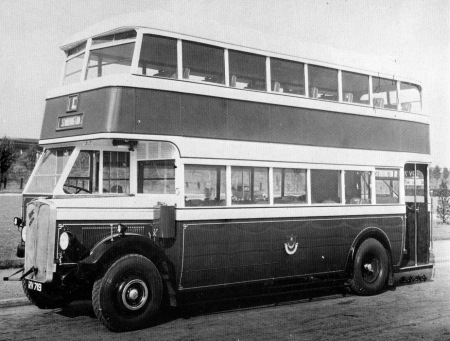
This vehicle was one of two early diesel-engined buses bought by Portsmouth Corporation in 1931, the other being a Crossley Condor. They were both bought as an experiment and compared with four Leyland Titan TD1, bizarrely, petrol-engined versions, because Leyland didn’t offer a diesel engine then!
This ‘snouty’ AEC Regent, the Condor and two of the four TD1’s, were bodied by Short Bros. The body exudes a light, airy feel about the inside. Note the grills above the front downstairs window and the destination blind in the rear-most downstairs side window. Sadly, this unique vehicle in the fleet was destroyed by enemy action in 1941. The corporation, shortly after purchasing it, standardised on diesel-engined Leyland Titans and no more AEC buses were ever purchased. There are some intriguing aspects to this photo – firstly, there are two plates affixed to the radiator. One may well say Regent, would the other one say ‘diesel’? Secondly, it has a starting handle (for a diesel?), and, thirdly, the upper structure still appears to be in undercoat, yet the lower deck is gloss painted and lined out!

Photograph and Copy contributed by Chris Hebbron

———

25/05/12 – 07:48

I’ve seen a few pictures of pre-war (and wartime) diesels with starting handles. I seem to remember Roly Wason, in his entertaining book "Busman’s View" mentions that in West Hartlepool they would put a rope on the handle so that relays of men could "flick over" a recalcitrant bus.

Stephen Ford

———

25/05/12 – 07:49

A lovely photo of the classical era when buses were evolving. I believe the second plate on the AEC “Regent" radiator is “Oil Engine”. This plate was fitted to many AEC “Regents" with diesel engines in the period up to about 1935. Bradford Corporation “Regents” 396 to 419 of 1935 with 8.8 litre diesel engines had their radiators fitted with a second plate with “Oil Engine” inscribed.

Richard Fieldhouse

———

25/05/12 – 15:06

This attractive bus raises many questions, probably unanswerable, but here goes….. Portsmouth buses traditionally had the lining-out on the upper deck panels also. Was this only on later models, or could this have been a "rushed" official photo? In warm weather, it must have been quite hot on both decks with such limited ventilation. Were they modified later? Never having ridden in one, was there extra leg room on the front upper-deck seats under the "piano front" or was it panelled off purely for the destination box? Finally, the upper deck seats seem very high in relation to the height of the roof. It almost has the proportions of a lowbridge bus. Were they high-back seats or was it just a very high upper deck floor?

Paul Haywood

———

25/05/12 – 15:07

…..and, of course, the legend "Leyland Diesel" adorned the bonnet side of PD2s and PD3s right up to the end – despite "Leyland Petrol" being a thing of deepest history!

David Oldfield

———

26/05/12 – 06:38

With regard to Portsmouth Corporation not buying any further AEC buses after the Regent 1 they did in fact buy a batch of Swifts in 1969 with Marshall B42D bodywork I believe they were numbered 175-188 but I am not certain of those numbers.
Some Regent Vs also had a badge on the bonnet side which said AEC Diesel.

Diesel Dave

———

26/05/12 – 06:39

Paul, although no more experienced in this era than you, two points. (1) In order to avoid patent problems with Leyland and their low-bridge design, AEC came up with the camel back – a hump all the way down the middle. (If this is one, the photo is washed out at the roof and wouldn’t show it.) (2) There was a period of full-drop windows. If this is one of those, it would not be self evident with the windows fully closed.

David Oldfield

———

26/05/12 – 06:40

Thx for confirming my ‘oil engine’ thoughts, Richard.
To answer your thoughts as best I can, Paul, all buses were lined out, top and bottom, and this never changed, although it was simplified post-war. I’m inclined to think this is a ‘rushed’ official photo, although CPPTD often had their ‘tween decks adverts painted on for a long-term contract and might have been prepared to receive the bus like this for such an advert.
The ventilation might have been better than appears, for many buses, of the time, had one-piece sliding windows which came down about two-thirds of the way, worked by a car-type handle. I didn’t recall this type of seat back being any higher than was normal for slightly newer buses, so low window bottoms or a high floor must have been responsible. There was no need for lowbridge buses within its territory.

Chris Hebbron

———

26/05/12 – 06:42

The nameplates on the radiator say "Regent" and below "Oil Engine". This Portsmouth bus must have been an early recipient of the then very new 8.85 litre version of the AEC oil engine with the Ricardo Comet indirect injection system. This motor, which became successful and well known as the "8.8", appeared from mid 1931 in replacement of the indifferently reliable Acro head A155 engine, which had a capacity of 8.097 litres. The retention of a starting handle was quite common on early oil engined Regents.
It is noteworthy that, at about the same time as it bought this solitary AEC, Portsmouth purchased an example of the Crossley Condor with the 9.12 litre direct injection engine, and this must have impressed the Corporation rather more than the Regent, since another 20 buses of this type were bought in 1932. The continued specification by Portsmouth of the Crossley direct injection engine was another interesting feature, as by then, the indirect injection VR6 version was much more widely favoured. In any event, contrary to the experience of operators elsewhere in the country, the Crossleys earned their keep, turning in an average fuel consumption of 9.5 mpg until they were withdrawn in 1947. Probably on the strength of this earlier experience, notwithstanding a subsequent very successful allegiance to the Leyland Titan, Portsmouth bought more Crossleys in 1948, but the DD42/5T type proved to be another creature entirely in the reliability stakes. I must acknowledge that the sources of my information above are the books "Blue Triangle" by Alan Townsin, and "Crossley" by Messrs Eyre, Heaps and Townsin.

Roger Cox

———

26/05/12 – 06:43

I should have mentioned in my first ‘blurb’ that the bus was blinded route ‘D’ and ‘Stubbington Avenue’.

Chris Hebbron

———

26/05/12 – 16:52

Thanks, David and Chris for your replies. Yes, Chris, if I tilt my screen I think I can just about make out a domed roof which would explain the upper-deck proportions. However, I’m still not convinced about it being highbridge. In 1931, Belfast Omnibus Co. bought a batch of Short Bros Regents which, to my untrained eye, look almost identical, but these were classed as lowbridge. There is a photo of one on page 9 of "The British Bus Scene in the 1930’s" by David Kaye. Could the confusion (on my part) be to do with them being "low height" as opposed to having a lowbridge sunken-gangway seating layout?

Paul Haywood

———

26/05/12 – 16:53

Thx, Roger, for that interesting info. I never realised that pre-war Crossley engines were direct injection and produced such good mpg figures. They should have updated it, rather than introduced the HOE one, which had such a poor reputation, after they stopped infringing Saurer’s patent. Incidentally, whilst most of them were withdrawn in 1948, the rest were withdrawn in ones and two’s, the last in 1951, at 20 years old. And CPPTD also bought some DD42/7’s after the 5’s above: what gluttons for punishment! Probably a distress purchase, such was post-war bus/coach demand.

Chris Hebbron

———

28/05/12 – 07:51

Many thanks Chris, for this superb posting!
This was a fascinating and speedy era in bus development, and Portsmouth Corporation was a standard bearer in that department. They had batches of TD2s TSMs, and Crossley Condors, all with the same composite EEC bodies, so, from the rear, they would all look alike, and even the first TD4s had a similar 5 bay metal framed version.
It was a truly fascinating fleet, to say nothing about the 6 wheeled Karriers of a mere year or two earlier.
I think this Short bodied Regent is one of the first of the style which replaced the camel roof type, and was very common, mainly on AEC and Leyland chassis, all over the country.
Obviously, PCT were not particularly impressed with the AEC "oil engine", or Regents in general, as future orders, post 1933, were Leyland dominated, and one wonders why the trolleybus fleet became AEC based. Perhaps something to do with a liking for EEC equipment offered by the AEC/EE partnership?
Just imagine what it would have been like to be an enthusiast in Pompey in the 1930s, with such a fascinating bus fleet, and so many experimental trolleybuses too! Its the stuff that dreams are made of!

John Whitaker

———

28/05/12 – 07:52

I feel this must be an official view, taken I suspect by the bodybuilder, but why the upper deck painting was not complete is beyond me. This bus and all the other Short bodies bought by Portsmouth were highbridge, photos of all the others had the seat backs visible through the windows, they must therefore have had a high floor. This same characteristic is shown on Short bodied TD1 and TD2’s with Southdown.
A summer photo of one of Portsmouth’s Short bodied TD1’s shows 3 upstairs windows each side open a good half way, so ventilation would have been fine.
Finally Service C/D didn’t run to Stubbington Avenue, so I suspect the screen were set randomly for the official photo.

Pat Jennings

———

29/05/12 – 06:49

Just to confirm Diesel Dave’s comment about post-war Portsmouth AEC’s. There were 12 saloons, all of them Swift 2MP2R chassis, and had Marshall B42D bodies. They were numbered 176-187 (NTP176-187H), entering service in Aug/Sep 1969. They followed two batches of Leyland Panther Cubs, 12 with Marshall bodies, and 14 with Metro-Cammell bodies (all B42D, new March to Oct 1967, Nos 150-175). I recall reading that the AEC Swift and Leyland Panther shared the same chassis frame design, as AEC was part of the Leyland group from 1962. But I don’t know what similarities there were between the smaller Panther Cub and the Swifts delivered to Portsmouth, apart from overall length – Portsmouth did not want maximum size 36-footers for it’s city routes. It’s generally acknowledged that the Panther Cub was not a great success, and Portsmouth began withdrawal in 1977 – a mere 10 years – the final ones going in 1981. The AEC Swifts went swiftly however (oops! – sorry!) – The MAP project in 1981 saw the fleet significantly reduced, and the remaining Panther Cubs plus the 12 Swifts, (and 14 Leyland Nationals, only 5 years old) were all withdrawn and sold.
On a different note, the Portsmouth Regent No 35 with it’s Short Bros body could be theoretically compared with it’s Southdown equivalent. But Southdown’s version (also with Short Bros highbridge body of similar design) was petrol engined, and hired, not owned. It was their No 10, and was lettered on the sides for a route in Horsham. Thus it is very unlikely that the two were ever side by side at South Parade Pier!
It is one of those fascinating details that Portsmouth had two AEC double-deckers pre-war, both were numbered 35, and both had comparatively short lives. Our featured Regent was destroyed in the air-raid of 10 March 1941, and only the engine was salvaged and sold to Nottingham Corporation. The previous 35 was an AEC "B"-type purchased in 1926 from LGOC via a dealer(new c.1913) with a Dodson body, along with ten other Dodson bodies, which were used on the original 10 Thornycroft Js. It didn’t last long, but in it’s short career it was re-registered from LF 9344 to BK 2342 (transferred from a service vehicle), and had it’s body replaced by one of the Wadham bodies from the original Thornycrofts, albeit cut down to a single-decker! It was withdrawn from PSV use in 1927, and was used as a petrol tender until 1930 – probably to keep the thirsty Karrier 6-wheelers going in service.

Michael Hampton

———

30/05/12 – 07:21

Thank you, Michael, for the additional information, especially that of the first 35 and its interesting life.
You mention the air raid of 10th March 1941 (with the loss of quite a few vehicles, including two Crossley Condors) but I’ve never seen mention of which depot it was. I assume from the loss of buses, not trolleybuses, that it was North End and not Eastney.

Chris Hebbron

———

30/05/12 – 13:30

Thanks Chris for your kind comments. All the books and notes I have state that it was Eastney depot which was badly damaged on 10th March 1941, destroying ten buses, and damaging others. Both trolleybuses and motorbuses were kept at North End and Eastney depots. My source says that the incendiary bombs hit the bus garage and workshops. There was also damage across the city, and several major trolleybus routes had to be curtailed until wiring and road repairs were completed. There was bomb damage at North End depot, too (date not given), but this was restricted to store rooms, no vehicles apparently involved. But no trolleybuses received major war damage at either Eastney, North End, or on the streets.

Michael Hampton

———

30/05/12 – 17:37

DSCN1173

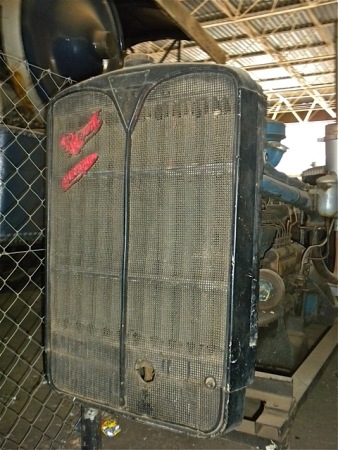
Last year I visited the Transport Museum in Johannesburg a took a photo of an AEC Regent radiator mounted on a sub-frame with a 8.8 litre engine circa 1935.
The stored exhibit had lost its the AEC triangle badge but does have "Regent" and "Oil Engine" plates on the radiator wire mesh as well as the spline for a starter handle. I would have posted this photo sooner but made the previous entry when on holiday. Chris, please keep posting these lovely pre-war photos of Portsmouth Corporation.

Richard Fieldhouse

———

31/05/12 – 10:50

Well, Richard, what an unusual find and way to prove a point! As for other ‘Pompey’ photos, I’ve a couple more up my sleeve. The quick and sad end of CPPTD, I try to keep at the back of my mind!

Chris Hebbron


Quick links to the  -  Comments Page  -  Contact Page  -  Home Page


Tynemouth and District – Guy Arab III – FT 6572 – 172

Tynemouth & District - Guy Arab - FT 6572 - 172
Photograph by ‘unknown’ if you took this photo please go to the copyright page.

Tynemouth and District
1949
Guy Arab III
Pickering H56R

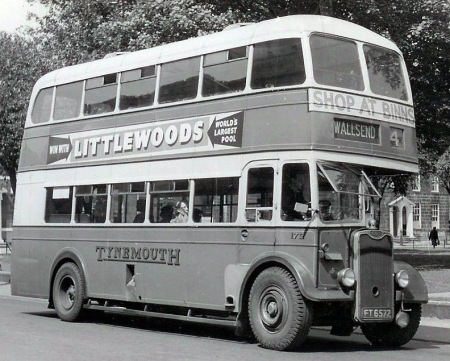
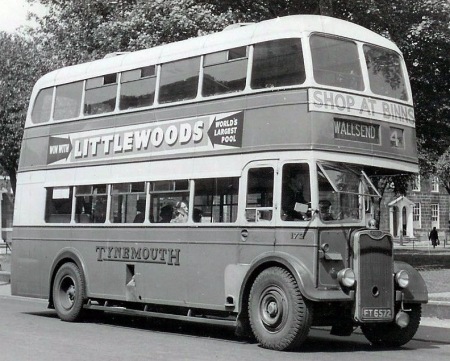
Here’s another odd ball for you, it’s a Guy Arab from Northern General’s Tynemouth and Wakefields subsidiary. I would guess from the registration it’s from about the late 40’s. I don’t know how many were in the batch or who built the bodies, but they’re unlike any other of Northern’s Guy’s that I know of. Northern were huge fans of the Gardner 5LW, and the vast majority of their Guy’s were fitted with them, but for reasons unknown to myself these vehicles came with a Meadows engine, were they perhaps re bodies? The engines were later changed and many had the 5LW fitted as replacements, but at least one of them ended up with an AEC unit, this ones also got the Indian Chief radiator cap, I wonder if that survived? I can remember them, but by the time I started at Percy Main they were long gone.

Photograph and Copy contributed by Ronnie Hoye


23/05/12 – 09:32

It looks very like a locally built Northern Coachbuilders body. Sheffield used them as an alternative to Weymann. Sheffield’s last were delivered in 1950, I think NCB closed shortly afterwards.

Ian Wild


23/05/12 – 09:33

This appears to be a Northern Caochbuilders bodied Guy Arab III Tynemouth had some similar chassis with Weymann bodywork Northern General also bought NCB bodied Guys but these had a short life with NGT.

Chris Hough


23/05/12 – 09:35

The bodies on these Meadows 6DC630 engined Arab IIIs, of which there were ten delivered in 1949, were by Pickering, and reputedly had metal frames. This picture, and some accompanying information, may also be found on this site:- //www.flickr.com/  From this, it appears that all the Meadows engined Arabs, apart from No. 169, which received a 5LW, were re-engined with AEC 7.7s. The Meadows unit was very compact – like contemporary Dennis and Daimler designs, the timing gears were located at the rear of the engine – and the Meadows engined Arab had a short bonnet that could not accommodate the 6LW. Most operators that purchased Meadows engines replaced them with alternative power plants at the first C of F renewal or earlier. Though powerful, this motor had reliability problems – it was rumoured that the troublesome crankshafts were sourced from eastern Europe – and, by the standards of the time, it was deemed to be fuel thirsty, though it would probably compare favourably with the dipsomaniac beasts of the present day.

Roger Cox


23/05/12 – 09:36

I’m only guessing but, going by the style of the upper deck front windows I’d say they were Northern Coach Builders bodies. It ties in with the operating area, anyway.

Eric Bawden


23/05/12 – 09:37

Coach builder was Northern Coach Builders of locally Newcastle.Yorkshire Woollen had some identical buses.The photograph must have been taken on a hot day judging the way the driver has had to open the windscreen. If only you could do that on say a Wright bodied Volvo.

Philip Carlton


23/05/12 – 09:38

What a wonderful posting! and a perfect compliment to last year’s debate about Pickering utility bodies, because that’s who built these. There were ten of them, FT 6565-74 and they were delivered in 1949. I believe these were Pickering’s only post war double deckers. It has a strong hint of Northern Coachbuilders about it and as NCB probably had a full order book at the time, perhaps Pickering were able to offer a quicker delivery and of course, they had done a lot of work for Northern General previously. I think the result was a very fine looking vehicle!

Chris Barker


Ronnie – the body on this Guy Arab Mark Three is by Northern Coachbuilders. Northern Coachbuilders were based in Newcastle and bodied both buses and trolleybuses for Newcastle Corporation amongst others and ceased trading around 1951.
Northern General also had some Arab Threes with Northern Coachbuilders bodies. One such bus was 1236 BCN 136, which had the typical Guy Arab ‘snout’. The Meadows engine, whilst having a cubic capacity 10.32 litres was fairly compact and didn’t need the extended bonnet required by the physically larger Gardner 6LW. However, the Meadows engine proved unreliable and most were replaced by engines of other makes – usually a Gardner but also AEC and in the case of Midland Red their own K type.

Michael Elliott


23/05/12 – 09:40

According to my 1962 British Bus Fleets book, this bus is a 1949 Guy Arab III with a Pickering body.

Stephen Bloomfield


Thanks everyone I have replaced all but one of the ?s any offers on the seating capacity.

Peter


23/05/12 – 10:29

According to BBF 10 the vehicle seating capacity was 56.

Stephen Bloomfield

———

23/05/12 – 16:48

A correction to my earlier claim, there were apparently thirteen of these bodies, the ten Guy’s and three on re-conditioned AEC Regents of 1937, also for Tynemouth, FT 4220-4222. I wonder if they were ever photographed?

Chris Barker


23/05/12 – 16:49

The information on the flickr link that Roger provided says that these Pickering bodies were designed to resemble NCB bodies. Notice the difference in height between the front upper deck windows and the side windows, and compare that with a real NCB body here //www.flickr.com

Peter Williamson


24/05/12 – 08:16

Chris, three of the Regents you mention – FT 4220/2 were sold to Provincial in 1957 to replace some of the vehicles they lost in a garage fire, you can find pictures of some of them on the Provincial Bus Enthusiasts Website, there is also a picture of one of them with its pre war front entrance Weymann body

Ronnie Hoye


24/05/12 – 08:17

I don’t think there’s a difference in depth, just a deep valance moulding over the windows. BH & D used to do the same, presumably because they both ran in sunny areas! It certainly makes a difference to the appearance.

David Beilby


25/05/12 – 07:38

Is it possible that Pickering used NCB frames for these bodies?

Eric Bawden


26/05/12 – 06:54

Apparently not, Eric. According to the info on the Flickr posting they were all-metal, whereas NCB only built composite bodies.

Peter Williamson


26/05/12 – 20:15

Is it not possible that these bodies were built on Park Royal frames? The profiles are very similar to the standard Park Royal body, also built by Guy themselves, on Arab IIIs.

Roger Cox


02/01/13 – 07:45

As a Geordie can I please clarify this is a Pickering body, not NCB. NCB bodies did not have the slight curve (taper?) to the front upper deck windows.
I used to see these when I was a young lad.

Peter Stobart


02/01/13 – 14:21

Talking about Guys with Meadow engines, LTE’s G436 was a speculative venture in 1949 by Guy, anxious to keep bus production going after the war, with London orders if possible. It employed an updated Guy Arab III chassis, with a Meadows 10.35 litre engine, fluid flywheel and pre-selector gearbox. It had a Guy body (5-bay) built on Park Royal frames that looked loosely like an RT forever allocated to a one-bus backwater route, the usual destiny for LTE’s non-standard buses, it was withdrawn in 1955, then went to Jugoslavia.
See here: www.modelbuszone.co.uk/

Chris Hebbron


03/01/13 – 06:24

It is rumoured that G436 was either "gifted" or sold at a very reduced price to the Tram and Trolleybus Department of LTE as a tempter for future orders for tram replacement buses. The chassis was modified from the standard Arab III to allow the fitment of RT class bodywork, though G436 itself had the usual provincial style Park Royal body. A second chassis, designed to accept all the standard Park Royal and Weymann RT8 bodies of the RT class, was offered by Guy, but never delivered. G436 had a full air operated braking system, together with a fluid flywheel and an air operated four speed preselector gearbox. As far as is now known, the 10.35 litre Meadows 6DC630 engine was fully rated at 130 bhp, which would have made the bus decidedly more sprightly than the RT/RTL/RTW family which had engines de-rated to 115 bhp. Quite apart from the uphill struggle against London Transport’s infatuation with standardisation, the dubious reliability of the Meadows unit would have handicapped Guy’s attempt to get a postwar foothold in the London market. Perhaps the GS order was some kind of consolation prize. G436 spent its final two years or so with LTE on the short 121 route between Ponders End and Chingford. A certain 13 year old Guy fan made a special pilgrimage from Croydon to Chingford in the summer of 1955 to see this bus and sample it as a passenger. After waiting patiently at length for its arrival, and observing only RTs on the service, an enquiry put to one of the RT drivers elicited the information that G436 had been withdrawn from service at the end of February!

Roger Cox


19/05/16 – 06:18

Much has been written about the origins of these Pickering double deck bodies for Tynemouth, but this much I know.
I bought a secondhand Britbus model of G436 the London Transport Meadows engined Park Royal bodied Guy. Firstly after dismantling it, I filed away the rain strip over the top of the front upper deck windows. Secondly I replaced the half drop windows with sliders. It is often difficult to remember what the rear of a bus looked like without the aid of photographs. But, based on memory I deepened the rear emergency windows on the top deck at the rear of the bus and placed a vertical dividing strip down the rear staircase/ platform window. Finally I repainted it in Tynemouth livery, added appropriate transfers and Hey Presto, what did I end up with a Pickering bodied Guy.
So I submit that these bodies had Park Royal frames and were panneled and completed by Pickering.

Anon


13/04/18 – 05:47

I agree that this appears to have been built on Park Royal frames, the shortened bays on the trailing edge of the rear axles the clue. Thereafter its all cosmetic work, but the fact these were built on sturdier ground than Pickering’s wartime contributions suggests imported metal frames. NCB were all timber framed bodies and likewise of dubious quality apart from the final sanctions which were of ECW outline.

Keith


19/04/18 – 06:47

I can remember these vehicles operating on this service, although they were soon replaced by more modern vehicles. Indeed it seemed to me that this route (Whitley-Wallsend-Gateshead) often received new vehicles to operate it, displacing earlier vehicles to other routes. It was also noticeable that routes were allocated specific batches of vehicles to operate them. Living in Whitley Bay, other routes that I was familiar with were the 5 (Newcastle-Whitley Bay Cemetery) operated by the ECW rebodied TD5s, 7 (North Shields Ferry-Blyth) operated by NCB bodied AEC Regents, and 8 and 12 (North Shields Ferry-Whitley Bay Bandstand) operated by Weymann bodied AEC Regents.
One other point, the vehicle in the photo is carrying the route number 4, but at some time, it was renumbered 1. I have a timetable from 1956 when it was still numbered 4, but in the timetable for 1961, it has become the 1. Does anyone know when it was renumbered? The present day 1 is a descendant of this route, although in order to serve various housing estates, it follows a much more tortuous route than was the case back then. It was also numbered 301 for a lengthy period.

John Gibson


20/04/18 – 06:45

The renumbering of this route from 4 to 1 took place when the route was extended at the Gateshead end to Lobley Hill, and I think this happened in 1956. I remember that my aunt moved to Cullercoats, and the first time we went there it was service 4 but the next time it was service 1: I think that she moved house in 1956.
The renumbering was necessary because the route became a joint operation with Northern when it was extended to Lobley Hill, and Northern already had a route 4. Tynemouth route 1 (Clousden Hill – Wallsend – Willington Square) became route 4.

Paul Robson


FT 6572_lr Vehicle reminder shot for this posting


03/12/20 – 06:23

FT 6573

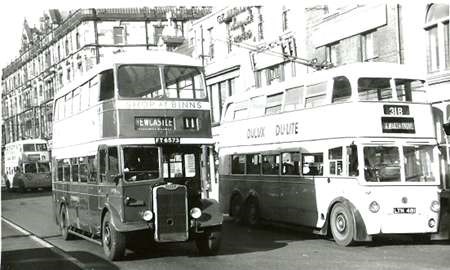
A rare photograph of Tynemouth Guy Arab III FT 6573 No 173 in the Fleet with Pickering H56R body leaving The Haymarket, Newcastle for the coast. Its blind has not been reset for the return journey. The date is probably mid 50s when shot and mid morning judging by the long shadow cast on the MCCW, BUT 9641T No.481 corporation trolley being overtaken and about to leave the stop on its journey to Polwarth Drive, Gosforth.

Ray Jackson


04/12/20 – 12:37

The bus would have turned right coming out of the old Haymarket Bus Station, then left round the back of the South African War Memorial onto Northumberland Street.
It’s now a few yards further on, and on Barras Bridge heading towards The Great North Road. It will stay in the outside lane, as just a few hundred yards further on, it will turn right into Jesmond Road, heading towards Jesmond, then the Coast Road.
This was the short lived revised, cream top livery, which was only around for a couple of years, so not every vehicle in the fleet had it. In 1958, the red top version was introduce, and the MCW Orion bodied Leyland PD3/4’s were the first to receive it.

Ronnie Hoye


Quick links to the  -  Comments Page  -  Contact Page  -  Home Page


All rights to the design and layout of this website are reserved     

Old Bus Photos from Saturday 25th April 2009 to Wednesday 3rd January 2024