Copyright Ian Wild
Sheffield Corporation
1966
Bedford VAS1
Craven B22F
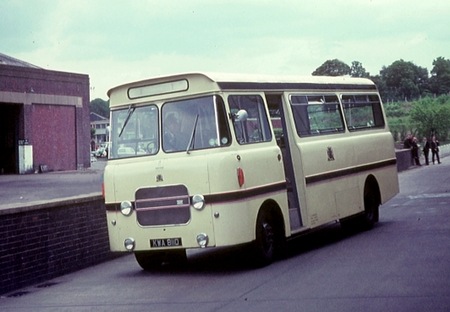
‘Mini-bus opens new field for city firm’ – says the Sheffield Telegraph newspaper in January 1966. Sheffield Transport had agreed to buy a prototype of a new design of a small bus developed by Cravens Ltd, a Company which had built a number of single and double deck bodies for Sheffield before and after the second world war. This new design would enable the Company to produce a range of different capacity buses with up to 33 seats. So far as I am aware, it remained unique. It was certainly the only Bedford bus to be operated by Sheffield.
The bus was originally used by the Transport Committee and for private hire but it later it did migrate on to normal service. I remember it especially on the circuitous route 44 to Bakewell via Ladybower and Bamford which wasn’t noted for a lot of patronage. I’m sure it must have been adapted later for one man operation as I remember the 44 being an early OMO conversion.
However here is the bus outside East Bank Garage on 19 June 1966 (it must have been nearly new) on the occasion of a tour of Sheffield by the Leeds and District Transport News.
The bus was renumbered 1 in April 1967 and was sold to the local King Edward VII Grammar School in 1973 – presumably at the expiry of its first seven year certificate of fitness.
An interesting might have been.
Photograph and Copy contributed by Ian Wild
04/07/12 – 05:20
Looks ungainly now and I fear it did then as well. Looks as if it ought to have a wheelchair lift in the back (needs it with that step!). The test here is whether it felt like a van with seats or a coachbuilt….coach. Small buses/coaches are fine, if that is what they are, and don’t shake themselves (and their passengers) to bits.
Joe
04/07/12 – 05:21
Ian, your final paragraph stuns me. I left KES in the summer of 1971 and kept in touch, through two members of staff in particular, who were mentors and very important to me with my professional development. …..and yet I wasn’t aware of this. I am a professional musician and retired music teacher – so one was the Head of Music. The other was an incredible guy who was also an MOT approved driving instructor, and advanced motorist, drove part-time for the real SUT and was a qualified fitter. Alan Finch got me through both the initial MOT and then the advanced driving tests first time and instilled in me a love of, and pride in, driving well and safely. Presumably he was instrumental in this purchase – but it seems to have passed me by. Sadly Alan died a couple of years ago.
Bearing in mind it was built at the same time that Cravens opened their Neepsend Coachworks and supplied a number of Atlanteans (PDR1/2) to Sheffield, it always puzzled me that No 11 was built by "Cravens" Do we assume it was Cravens Homaloy – the unit that built commercial vehicle bodies and trailers?
David Oldfield
04/07/12 – 05:22
Seem to recall that the local enthusiasts used to call this vehicle the"Cabbage Wagon"
Stephen Bloomfield
04/07/12 – 05:24
Ian is quite right about most of the operational details. However, it was never converted for OMO use.
A short time before it was withdrawn, I travelled home from work to on Weedon Street in the East End. On this particular occasion the Bedford/Craven 22 seater duplicated a Leyland Leopard/Burlingham 41 seater OMO saloon. Opting for the trip on 22, I was astonished that the vehicle was crew operated! Not a very economical bus for service!
Keith Beeden
04/07/12 – 08:37
Last time I saw it, was in ‘79 and was owned by Greenthorpes garage at Darnall, incidentally 500 yards from where it was built!
It was painted light turquoise blue with a darker blue band, and was named "Georgie Porgie"!
Shame it wasn’t preserved as it was the last bus ever built by Cravens of Sheffield, but the last owners’ extortionate asking price resulted in no buyers and it eventually went for scrap.
Chris Morley
05/07/12 – 07:07
Can’t put a date to this recollection but I remember seeing this bus parked on the drive of a house in Barnburgh, a small village about 18 miles from Sheffield.
Whether this was before or after Chris saw it at Darnall I can’t say.
Andrew Charles
06/07/12 – 07:17
I took slides of no 1 working service 190, Alsing Road to Darnall (terminated in Britannia Road) an also screened up for service 44.
The body was built at the old Cravens works in Staniforth Road and adverts showed it as being a Cravens Homaloy body.
Stephen Bloomfield
10/07/12 – 06:49
I hesitate to argue with the mighty Keith Beeden, but it was definitely converted for OMO latterly, certainly by 1972. I travelled on it on the 44 at that stage. It was fitted up, as most Sheffield OMO buses were, for a TIM ticket machine- but not a powered one. I believe it only had a 12v electrical system whereas all other buses had the 24v necessary to drive a TIM power unit. I think its duty included trips on the 190, referred to above, before and after the couple of round trips on the 44 which were the entire M-F service on that route. It wasn’t used at weekends. There is an unconfirmed story that STD had an option on a second such bus which would have been used to provide Edale with a rail replacement bus service when BR applied to withdraw the Hope Valley local trains in 1966. When it was found that the replacement buses would cost more than retaining the trains, BR decided not to proceed with this plan and No1 remained unique.
Phil Drake
02/08/12 – 07:30
In reply to Phil Drake I appreciate his statement that the Sheffield Bedford number 1 was indeed OMO converted. Possibly my journey was taken when the equipment was not serviceable?
I am humbled to have the term great applied! My interest in Sheffield matters is over some 75 years
Keith Beeden
02/08/12 – 07:32
Bedford VAS1. How many of these were built? Astons Coaches Marton had a Reading DRY 7877C (re-registered for some reason), Bodied one ex Davis Leicestershire who had two. How many Reading bodied ones were built?
David Aston
Typo on the registration I think, four numbers, probably a 7 too many.
20/12/15 – 08:30
The body is by Craven Homalloy Ltd, they also bodied a Leyland 90 for Standard Triumph at Coventry it was KWK 505F (pics on Flickr) it survives as a caravan in Cambridgeshire
John Wakefield
15/07/20 – 06:42
Have just been reading a Sheffield history website. The reason that I was unaware of its sale to King Edward VII was because it wasn’t. It was sold to King Ecgbert School some five miles away on the Derbyshire border – between Dore (service 50) and Totley (service 45).
David Oldfield
28/01/21 – 06:35
David, the website information is WRONG. This bus definitely went to King Edward VII Broomhill in the early 1970’s, I was there! It was looked after by Alan Finch who is mentioned above, assisted by a number of pupils. Possibly after your time Mr Finch set up a car workshop in the sheds on the Glossop Road boundary, next to the notorious outdoor toilets, and taught car maintenance as a subsidiary subject. If I remember rightly the car Mr Finch used for the driving lessons was a light blue Austin A60. The bus was repainted in the original Blue and Cream livery. The KES crest was added under the rear window, hand painted by a pupil who was good at art. A big leather car seat was added at the front left in what was originally luggage space, comfortable for a second teacher on trips out. Years later I did see the bus at Volvo Village and recognised it straight away.
Sam Wood
28/01/21 – 13:26
Sam. It is the sort of thing that Alan would do! [I left in the summer of 1971.] As I said, he got me through the basic MOT and then the advanced (IAM) driving tests in the "School Car". Everything that you said is correct apart from one thing. The School Car was a 1956 Series II Morris Cowley, refitted with a 1500 engine to make it into an Oxford, with massive "L"s on the sides as well as front and aft. The workshop was indeed by the "Backs". He drove an A110 Westminster and his wife a Wolseley 1500 (in the same colours as the school car). Lunchtime Roadsafety lessons were also part of the package and no one drove on the road until they could handle a car on Norton Airfield. Alan also used to regale us with stories of his holiday time exploits as a driver for SUT.
David Oldfield
07/08/21 – 05:24
David, Sorry for the late reply – I don’t look at this site very often. Thank you for the confirmations and corrections. I remember Alan Finch’s Westminster – we did a lot of work on that in the school’s workshop. We had a lot of trips in the Bus, always amused by the number of people at bus stops who put their hands out – no destination or route number but it was cream and blue and they wanted to get on! The furthest I remember going was to Jodrell Bank via Blue John cavern – the Mam Tor road was still open then. Somewhere I have a photo of the Bus taken from the Blue John entrance. The Bus was a tight fit through the school gate on Glossop Road, fortunately the head stones had already been removed which did help. I don’t remember the bus suffering any damage. I’d guess Alan Finch gave the teachers some tuition before they were let loose – it was quite a bit bigger than a normal minibus. At the time we were told the bus had been built for the Transport Department Band, but this doesn’t seem to be correct. I had doubts about this at the time, it did have about the right number of seats but apart from the space at front left there was no luggage space or boot, they would have needed a van for the instruments. Happy memories!
Sam Wood
16/08/21 – 05:45
Sam. Like many local authorities, Sheffield had a special vehicle for the use of the Transport Committee and other local dignatries. This was 900, the 1958 Roe Dalesman AEC Reliance MU3RV. A bit of an indulgence, it was also available for private hire when not on its intended duties and latterly was used on the Derbyshire B & C routes. The poor councillors must have had a bit of a shock and a tremendous come down when they found out that the replacement, eight years later, was a Bedford VAS1 with weird bus bodywork – No 1.
David Oldfield