Old Bus Photos

Stratford Blue – Leyland Tiger Cub – 2745 AC – 44
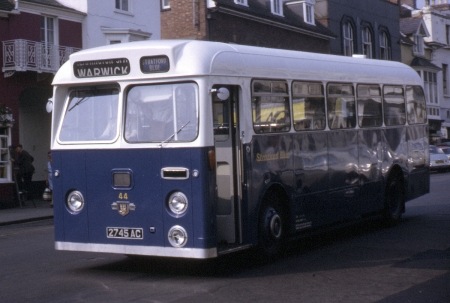
Stratford Blue - Leyland Tiger Cub -2745 AC - 44
Copyright Roger Cox

Stratford-upon-Avon Blue Motors Ltd
1959
Leyland Tiger Cub PSUC1/1
Willowbrook B45F

In his comment upon Michael Bishop’s posting of the Isle of Man Road Services Leyland Tiger Cub with a Willowbrook DP41F, Ian Wild refers to the very similar Stratford Blue Leyland PSUC1/1 Tiger Cubs. Pictured in August 1970, this is No.44, 2745 AC, the one with the Willowbrook B45F body – the other four had DP41 seating configuration – and, I think, it is our first picture on the site of a Stratford Blue bus. The early history of the company is rather complicated, but by 1931 it was operating as a Balfour Beatty group business with second hand vehicles, as Balfour Beatty refused to finance new purchases. In 1935 the BET group assumed control, with management passing to BMMO, a situation that continued until the BET sold out to NBC in 1969. NBC set about absorbing its newly acquired smaller operators into the bigger neighbouring companies. From 1st January 1971, Midland Red assumed full control of Stratford Blue, and buses were progressively repainted into the BMMO overall red livery.
Here is a link to read the full history of Stratford Blue.

Photograph and Copy contributed by Roger Cox


15/07/12 – 08:08

What a beautiful glossy finish. You don’t see that very often – and you rarely saw it in NBC days. It seems strange to me that some operators manage to keep this sort of finish and others can’t. It can’t simply be the difference between whether vehicles are hand or machine washed.

David Oldfield


15/07/12 – 12:44

On that point, David, when I was with Tynemouth and Wakefields, prior to NBC all Northern group buses were hand painted, this involved several coats of primer and paint followed by a final coat of varnish, the drawback was cost and the fact that the whole process took about 10 days, these days much of what you see is just stuck on graphics. cost effective, but no where near as good a finish.

Ronnie Hoye


15/07/12 – 12:44

A very nice photo of a small’ish concern who always took a pride in their vehicles and ploughed their own furrow, in spite of being a BMMO subsidiary for some 40-odd years. They were great advocates of Tilling-Stevens B10’s before the war and I recall visiting an aunt around 1949-50 and seeing these strange-sounding antiques. I didn’t fully appreciate them, truth be told.
Later, they were equally keen Leyland users, of which the above is a good example. Peter Gould’s website contains a potted history, taken from the book "Stratford-upon-Avon Blue Motor Services Remembered", by David Harvey. 

Chris Hebbron


16/07/12 – 06:28

I can’t help thinking that the picture gives a good impression of how Samuel Ledgard’s fleet would have looked if they had taken similar vehicles.

Chris Barker


16/07/12 – 06:29

It certainly does look in remarkably good fettle for an 11 year old bus – one could easily believe that the photo was taken to mark its first day in service.
As Chris states, despite being under the wing of Midland Red, they went their own way – especially regarding vehicle policy. Their BET Federation style PS1’s and Tiger Cubs, and the Northern Counties rebodied PS2’s were more reminiscent of Yorkshire Traction – a company about as far removed from Stratford Blue as I can imagine.
I’ve heard it said that the BET Group retained some smaller outfits such as Stratford Blue, Hebble and Mexborough & Swinton in order to allow junior managers to gain experience and prove themselves on a small scale before being let loose with a larger company.

John Stringer


16/07/12 – 12:18

You’re right in what you say, John, whenever United ‘Tilling Group’ took over a company everything was changed to a standard procedure, where as Northern General ‘BET’ allowed companies to retain their name, different livery, and a certain amount of independence, in some cases this even went as far as vehicle spec, take the PD3’s for example ‘livery apart’ although outwardly the Orion bodied examples all looked the same, but the Percy Main vehicles were totally different from the rest inside, and the Sunderland District ones were Burlingham bodied. This all changed with NBC, the ‘Corporate Image Brigade’ stepped in, the names went one by one, and some splendid liveries were cast aside to be replaced by drab poppy red or vomit green dependant on where you live

Ronnie Hoye


16/07/12 – 18:20

Only one word to say about the photo – stunning, absolutely stunning! That’s three, but who’s counting. As others have said, a beautiful livery – strange how something as basic as blue and cream can look beautiful, but it did – immaculately presented on a classic design. In addition ‘Stratford-upon-Avon Blue Motors’ has such a wonderful ring from a more elegant age.
And Ronnie, I agree with every word you say about Northern Group liveries. I was sad when Gateshead adopted green and cream in 1964 thereby making them look the same as Tyneside; I may have been in a minority in loving the old maroon/brown and cream but I thought it was really smart and it was distinctive.
In mentioning the end of separate liveries with inception of NBC you might also have mentioned the revolting yellow which got slapped all over buses based in Tyne and Wear soon afterwards; strange how Newcastle Corporation’s yellow and cream looked really smart and yet Tyne and Wear’s didn’t seem to look good on anything!

Alan Hall


17/07/12 – 06:55

Another well-kept vehicle in a small fleet despite, as others have said, being a division of Midland Red for so many years. Looking closely at the picture reminds me that Stratford Blue were among a very small number of (usually small) operators who used the service number box to display the name.

Pete Davies


17/07/12 – 06:56

I may be mistaken, but I think Stratford Blue were wound up after pay/conditions were brought into line with BMMO – there was a strike about this issue. Why the company couldn’t have been allowed to continue with staff on an equal footing with the parent escapes me, but then around this time NBC was intent on wrapping-up its smaller operations – were there administrative costs, such as posting of accounts, involved in running subsidiary companies?
Whatever, it was a shame to have lost a "blue company" – although NBC’s (lack of!) policy on corporate blue liveries would have seen to that in due course anyway. Red "Statford Blue"?: reminds me of when Western National was split by NBC and Bob Montgomery had those members of his new North Devon operation – trading as Red Bus [sic] – which were still in Leaf Green lettered as "This is a RED BUS" (as opposed to the "RED BUS" fleetnames on the red members of the fleet). "This is still a STRATFORD BLUE bus" (on Poppy Red vehicles) doesn’t have the same ring though. Although with NBCs policy of shortening fleetnames – Cheltenham District/Cheltenham, Bath Services/Bath, Maidstone & District/Maidstone (on coaches), Mansfield District/Mansfield – red "Stratford" buses wouldn’t have been so silly.
Back to the bus though – the whole thing’s just right isn’t it? livery, vehicle design/proportions . . . and a nice linen destination blind – class.
But does anybody know why Stratford Blue was "allowed" to pursue a Leyland-based vehicle buying policy? One assumes that the Directors were all senior BMMO officers, so why didn’t they insist on purchase of BMMO products? Was it because the Leyland purchases by Stratford Blue provided a bench-mark against which BMMO products could be judged, as I’ve read? – but then they weren’t being operated over comparable routes and BMMO operated Leyland vehicles in its own fleet anyway; or was it because BMMO couldn’t meet its own requirements from internal production and Stratford Blue had, of necessity, to look elsewhere?

Philip Rushworth


17/07/12 – 06:57

Alan, I prefer not to think about the NBC version of T&W yellow, and the PTE went on a very expensive experiment with various layouts of Newcastle Corporation’s original livery only to end up with something not a million miles from where they started, in fact I would be surprised if most of the population of Newcastle knew the difference.

Ronnie Hoye


17/07/12 – 08:19

…..but just be thankful that you didn’t end up with something like South Yorkshire’s "Coffee and cream"! Even when the coffee was strengthened, it wasn’t a patch on Sheffield’s cream with blue livery and it only became vaguely bearable with the eventual addition a red.

David Oldfield


17/07/12 – 12:41

Yes, the right combination/shade of blue and white/cream do make a very attractive buss. My Western Travel post shows a dual-purpose Gloucester Bristol RELH6L in similar guise, although their bog-standard all-over blue with thin white stripe between decks looked uninspiring.

Chris Hebbron


17/07/12 – 12:41

Chris B – how right you are with the Ledgard comparison – in fact there was once an edition of an Ian Allan publication which featured a Stratford PD2 and I for one had to glance again quickly, thinking that it was a Ledgard view. I can’t just recall whether it was a "Buses Illustrated" or one of the annuals.

Chris Youhill


28/07/12 – 08:36

A lovely picture but it would be a mistake to think this is representative of how Stratford Blue buses looked in their later years – what it does show is No. 44 fresh from the paint shop in the blue and white livery that replaced the earlier blue and cream from 1969 onwards. In their later years the Tiger Cubs were unreliable, unloved and often unkempt, and consideration was given to replacing them with used buses from elsewhere, but it never happened. There were 14 Tiger Cubs in the fleet, with Willowbrook, Park Royal and Marshall bodies. They all passed to Midland Red on 1 January 1971 but were withdrawn by May, despite two of them having been repainted red – mostly replaced by the newly delivered Ford R192s. As to Stratford Blue’s quasi-autonomous existence the answer probably lay with BET headquarters rather than with Midland Red, but it has never been fully explained and probably never will be. Although Stratford Blue bought Leylands almost exclusively from 1948 to 197 (82 in total), Midland Red bought more in 1952/53 alone, with their 100 LD8-class Titan PD2s. Final comment on this photo is that Warwick was rarely seen as a destination on a Stratford Blue bus – the hourly 90A from Stratford to Leamington passed through the town, but very few journeys finished there. This was most likely a schools journey.

Bob Telfer


28/12/12 – 13:48
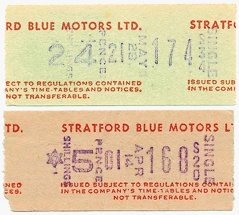
Stratford Blue

Just to say Kineton depot of Stratford Blue used white ticket rolls as did Stratford unless on local service then we had to change to pink.

Bill Floyd


29/12/12 – 18:13

I may be imagining this, but there looks to me to be a conductor on board who is in the process of winding the destination blind – this would explain the ‘unlikely’ destination and the fact that it appears badly set. The ‘PAYE’ sign doesn’t look to be illuminated.

David Call


20/07/14 – 07:15

Just to say Leyland Cub fleet number 44 reg no 2745 AC finished its days in the brook through bridge on Kineton to Radway Rd driver they say lost control DD number 31 turned over on Bourdon Hill towards Stratford this was a converted SD.

Bill Floyd
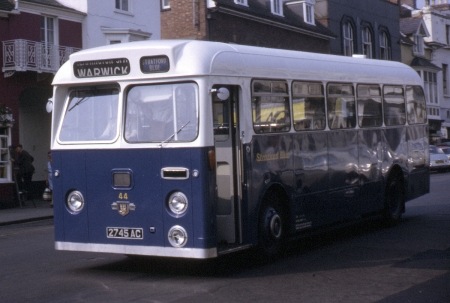

2745 AC_lr Vehicle reminder shot for this posting


09/06/17 – 06:27

I am trying to find out when Stratford Blue re-livered/painted their Leyland PD double deckers and included the newer Stratford Blue logo.
I believe that originally the mudguards were black and at this time were re-painted blue, also the roof colour changed.
I think it was in the early 1960’s but can’t find anything definite about it in the various books published on SB.
Hope that you can help or point me in the right direction please.

Paul Meers


Quick links to the  -  Comments Page  -  Contact Page  -  Home Page
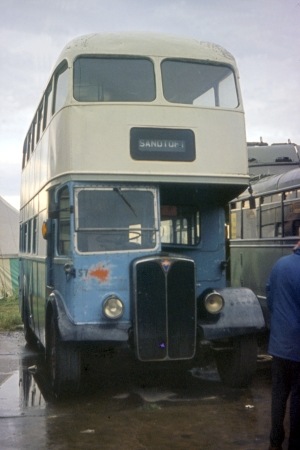


Hanson – AEC/Hanson Regent – TVH 497 – 361

Hanson - AEC/Hanson Regent - TVH 497 - 361                     Copyright Eric Bawden

Hanson
1950
AEC/Hanson Regent
Roe H37/28F

Here we have a picture I took at Sandtoft around 1972/3.
This bus started life in 1950 with Hanson of Huddersfield as an AEC Regal III 9621E with a Duple C33F body, registration EVH 805 fleet number 295. To ‘modernise it’ in 1954 Hanson had Plaxton remove the front bulkhead and build a Venturer style full front on it. It was then renumbered 326.

Hanson - AEC/Hanson Regent - TVH 497 - 361

In 1961 Hansons’ rebuilt the chassis and had a new Roe H37/28F body fitted, re-registered it as TVH 497 and gave it fleet number of 361. Numerically it was the seventh rebuild in the series, the fourth double decker and the first front entrance decker. It passed to Huddersfield Corporation with the stage carriage operations of Hansons’ on 1st October 1969.
Thornes of Bubwith acquired it in October 1970 as their no. 57. Although listed as being withdrawn and scrapped in Thornes own lists in May 1972, it was eventually acquired for preservation.
It is seen in the above colour shot in as acquired condition and what appears to be ex Aachen 22, a 1956 Henschell trolleybus with Ludewig body along side it. As this trolleybus is kept at the Sandtoft Transport Centre one must assume 361’s destination blind is telling the truth! I’m afraid I didn’t keep records of the pictures I took in those days so have to rely on detective work to place and date them.
Sadly 361’s career as a preserved bus didn’t last very long, I believe it suffered a catastrophic engine failure and was sold for scrap.

Photograph and Copy contributed by Eric Bawden


13/07/12 – 09:08

Thanks for posting. I have in my "bought" collection a view of VVH 348 which, by that time, had migrated to the Porthcawl Omnibus Company.

Pete Davies


13/07/12 – 17:12

Pete, That would be 368 when with Hanson, rebuilt in 1962 from 1949 Roe H31/25R bodied Regent III 285, ECX 414.

Eric Bawden


14/07/12 – 07:39

Unfortunately I don’t believe 361 suffered any catastrophic failure at all, but was just sold. It was kept here where I live in Greenfield, less than five minutes walk from where I now live, along with various other vehicles including my own. It just disappeared one day and I was annoyed about it at the time and even more so now, as it is a genuine Saddleworth bus which would have appeared frequently on the Oldham service which ran past Greenfield station.
The shame is that, had it survived at Thorne’s, even out of use, a bit longer it might have joined their fleet of splendidly-restored vehicles.

David Beilby


14/07/12 – 11:23

I was always under the impression that a conrod came through the engine block and that is why it was scrapped. It did get repainted in an approximation of Hanson livery but the shade of red was far too dark, almost maroon. There are some photos about of it in these colours. The correct shade was a Dulux colour called Wexham Red.
I did know the owner at one time but it is many, many years since I lost contact with him.

Eric Bawden


18/06/17 – 07:02

I bought 361 from Thornes and moved it initially to Sandtoft. It was then subsequently moved to Huddersfield goods yard where it was repainted into Wexham Red. The bus subsequently moved to a mill yard in Greenfield where it received the engine from Morecambe 57.
361 attended some rallies in the mid seventies and visited Shildon for the anniversary in 1975 (?).
The bus was sold in serviceable condition when I got married in 1976.

Bill Roberts


Quick links to the  -  Comments Page  -  Contact Page  -  Home Page


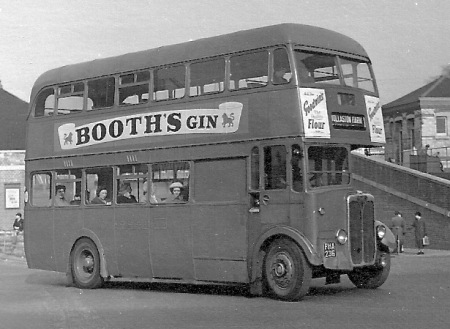
Midland Red – SOS FEDD – FHA 236 – 236 – 2254

Midland Red - SOS FEDD - FHA 236 - 236 - 2254
Photograph by ‘unknown’ if you took this photo please go to the copyright page.

Midland Red (Birmingham & Midland Omnibus Co)
1939
SOS FEDD
Brush H30/26F

Midland Red FHA 236 (2254, formerly 236) was one of their unique pre-war, front-entrance, SOS FEDD double-deckers. They were built in large numbers between 1933 until 1939 with bodies by Carlyle (1), Short Bros, Metro-Cammell and finally Brush, each batch having gradual improvements and modifications. Like their SON single-deck sisters, they were extensively rebuilt by Hooton Aero & Engineering (and others?) in the 1940s to extend their lives. This example is seen at Stourbridge busFHA 236._ffjpg station, probably in the late 1950s. Note the position of the fuel cap, which fed the tank positioned beneath the driver’s seat. This postcard is uncredited so if anyone knows who took it, please let us know.

Photograph and Copy contributed by Paul Haywood


10/07/12 – 18:28

It’s interesting how this forward entrance layout, used extensively pre-war by Barton and London Country area as well as Midland Red died out in the post-war period only to find popularity again in the early 1960’s. The reasons cited for the adoption of forward entrances in the sixties were greater safety by giving the driver a better view of the entrance and easing the conductor’s workload as a result particularly on 30ft long higher capacity vehicles.

Philip Halstead


11/07/12 – 08:05

Looking at this, and at the single decker posted a few days ago, without looking at the caption, the radiator grille looks remarkably AEC, at first glance. Then, you study it and see it isn’t!

Pete Davies


11/07/12 – 08:06

Dare I say, that surely must be one of the most awkward looking designs imaginable. What strange proportions giving it a very "tall" appearance and the design around the cab is very unhappy. Even the radiator looks partly buried by the flat, featureless front.
Thank goodness this was only a blip in inspiration before coming up with many superb designs not long afterwards!
I hope this doesn’t upset anyone but beauty really is in the eye of the beholder..this poor bus needed help!

Richard Leaman


11/07/12 – 12:38

You’re absolutely right, Richard, on both the points you make: first, I agree with you that the overall design just doesn’t work. The whole of the cab area is untidy; the staircase gives the impression that the front offside passenger window has just been blocked off. The ‘tall’ appearance is possibly due to the angle of the photo, but you’re right about the radiator, the location of the front registration plate exaggerates the problem, and the livery doesn’t help either.
However, as you also remark, beauty is in the eye of the beholder; unlike many correspondents, I always thought the (much later, of course), Orion looked balanced and business like, (especially on M&D’s Guys), but at the time, the message I was being taught was that appearance is secondary to operational performance any way. An ugly duckling that was economical and reliable was preferable to a good looker that wasn’t.
The choice of entrance location, (Philip’s comment), is worth an entire separate article of its own. For urban working, there was a lot to be said, (before H&S concerns), for open platforms – quick, convenient for passengers, and, provided the driver was using his mirrors as he should, tolerably safe. Doors were less draughty for inter-urban use, but manually operated doors, especially rear doors such as Lodekkas had, were a drag for the conductor otherwise and were usually left open. In moving to front entrances, I think some operators – e.g Southdown with its Queen Marys – were motivated partly just by a desire to demonstrate their modernity; officially, the conductor remained responsible for giving the ‘go’ bell however busy. Personally, I never understood why operators chose rear or centre entrances on underfloor single deckers intended for stage carriage work.

Roy Burke


11/07/12 – 18:43

Although it wasn’t my favourite, I agree with Roy that the Orion – in the right livery – could still look good. [M & D, Sheffield and St Helens being three examples.] …..but ideally have a good looking, attractive vehicle that is also reliable and economic – in that order.
Am I the only one [ducks low to avoid flying missiles] that wasn’t over impressed with looks of BMMO buses? I have a thing about balanced designs and BMMO were, to say the least, quirky and original – and early Ds (1 – 5 especially) always seemed to be a cross between Clement Freud and Eyor; mournful and unhappy. […..or is now a good time to leave the country?]

David Oldfield


11/07/12 – 18:44

While the body, as a whole, is not unattractive, the detail is very deleterious to the overall effect. Although I’m no lover of sliding windows, the arrangement of these is bizarre. It’s also mean upstairs, in such a smoking era! The driving cab windows are so small as to be useless to a driver looking out, and the front/rear side ones are non-standard lengths! At least both headlamps are the same height!
I wonder if these FHA’s had the same entrances as the earlier EHA’s, whereby the (wooden?) doors were inset and there were two steps to climb before going through said doors. I recall the latter when I was based at RAF Stafford in 1956-58. My abiding memory of BMMO at this time was the sole bus (usually a D7), which ran through the Sunday night/Monday morning from Stafford railway station the RAF Stafford. This service must have broken records for overloading, with folk standing downstairs and upstairs and sometimes three to a seat! Bends were taken very gingerly, but with no guarantee that the vehicle would right itself then! If the bus wasn’t waiting, we’d take one of the pre-war Rolls-Royce taxis which held about 7-8 and were more than capable of 70mph, even at 20+ years old and God knows how many miles on the clock! When these beauties were replaced by Vauxhall Wyverns, my last journey from camp to station involved a driver who remained in top gear for the whole journey into town, slipping the clutch with expertise when crawling through traffic – such consummate abuse! But I digress!

Chris Hebbron


11/07/12 – 18:45

This vehicle remained in service until 1960 and was one of the final 6 withdrawn in December 1960. Two sister FEDD’s – 2120 and 2247 – continued as staff and training buses, I wonder how many miles they covered in their lifetime? I vividly remember as a youngster going ‘long distance’ with my parents to visit a cousin in Halesowen (from my home of Birmingham) and the route traversed the infamous ‘Mucklows Hill’. This was used for testing new buses and the FEDD’s were the staple diet on this route along Hagley Road and the climb-returning to Brum-was in first gear for about a mile, I can still hear the howl of the poor K type engine to this day!

Nigel Edwards


12/07/12 – 07:56

The use of forward entrance double deckers in the East Midlands before World War 2 was not confined to Barton. Midland General/Mansfield District (on AEC Regents) and Trent (AEC Regents and Daimler COG5s) were users of this entrance layout for double deckers as well. Trent also had a batch of FEDDs with MCCW bodies. After the War Barton continued with forward entrance double deckers with its Leyland PD1s with Duple bodies while MGO/MDT and Trent switched to rear entrance bodies on double deckers.

Michael Elliott


12/07/12 – 11:17

David, you speak as an enthusiast, and from that standpoint, your views, (appearance, reliability and economy in that order), are the appropriate ones and few enthusiasts would disagree with you. However, expressing your order of preference in M&D’s Traffic Department would have caused major head shaking; doing so in front of the Traffic Manager, Stanley Smith, would have been to risk a reaction of life-threatening proportions! Similarly, I don’t think your views would have been appreciated by the Chatham Detailer who’d had to send out a Guy Arab at ten o’clock at night to replace a broken down Atlantean – a not altogether unknown occurrence.

Roy Burke


12/07/12 – 12:05

I was going to say the same as Michael regarding East Midlands area use of front entrance double deckers. Just to add that Trent had quite a lot of their Weymann bodied front entrance vehicles rebodied with Willowbrook rear entrance open platform bodies after the war. I can also remember travelling from Alfreton to Nottingham on a front entrance Midland General Regent about 1952. They had big single piece manually operated sliding doors. Barton’s Duple PD1s however had power operated bi-parting doors – with a set of conductor or passenger operated open/close buttons on the inside, and I seem to think an external open button.

Stephen Ford


12/07/12 – 19:24

Roy, speaking as an enthusiast, I was saying "Why not have something good looking". Only the reliable and economic (in that order) were meant to be juxtaposed – ideally they should be good looking as well.

David Oldfield


12/07/12 – 19:24

In common with David Oldfield Midland Red buses sadly leave me cold. They may have been innovative but their looks were not for the purist with the possible exception of the C5 motor way coaches. No give me an AEC preferably with Roe bodywork any day!

Chris Hough


12/07/12 – 19:25

How interesting to get the operator`s viewpoint in these posts. Roy`s comments about his M and D experiences of management attitudes just makes me realise that operators had a totally different approach. It was all about profit and loss, with a dash of "public service" thrown in.
You have the best of both worlds, Roy, as you have enthusiasm, and a knowledge of the practical issues!

John Whitaker


13/07/12 – 06:01

Chris H., that’s music to my ears (AEC/Roe).

David Oldfield


13/07/12 – 06:0213/07/12 – 06:02

Fascinating isn’t it how attitudes and priorities change. These days it is all about appearances, image, reputation and less about genuine customer service. Maybe years ago it really did not matter what a bus looked or rode like as long as it arrived at 11.38am on the dot. The even more strange thing is that very many operators combined good looking vehicles WITH service as it is well documented on this website. It is a rather rare find today though!

Richard Leaman


13/07/12 – 09:16

I must agree with David and Chris about BMMO. All my enthusiast life, I have failed to interest myself in anything Midland Red. Something about their ugliness, narrow cabs, and "totally unlike anything elseness"
Perhaps the later examples were more pleasing to look at, but something was missing for me!
It was the same when SOS buses were in other fleets such as Trent, no appeal whatsoever, and I lived on one of the BMMO routes for the last year or so of their existence too!
However, if people ARE interested, who am I to criticise them. To repeat the current idiom of this site, "Beauty really is in the eyes of the beholder"

John Whitaker


13/07/12 – 17:08

Your meaning, David, was really quite clear, and I was, perhaps, being a bit pedantic in taking you up on it. You’re absolutely right; while reliability and economy are obviously vital factors, there was, (still is), no reason why the vehicle couldn’t also be pleasing to the eye. Hence, I’d agree with you totally about AEC/Roe – a great combination that fulfilled all three requirements.
My observations were just based on personal experience. Since I was supposed to be learning about bus company management, I always tried to understand, (and acquire), a ‘management’ view about the fleet rather than an ‘enthusiast’ view. Since, also, the then Traffic Manager was very well known as a man not to mince words, I couldn’t help, as I wrote my comment, getting a mental picture of his reaction, (which would have been voluble and scathing), to the idea that operational effectiveness should in any way be compromised by considerations of what he might well have described dismissively as ‘prettiness’.
My operational training in the Medway Towns altered my opinion of Leyland, a maker who until then I’d almost revered, especially in comparison with Guy, a maker who I’d hardly come across and had never thought about much. Guys every time!
I mentioned the Orion only because that’s what we had and they were very satisfactory in service. On balance, given a totally free hand, I’d probably have stuck with (6LW-engined) Arabs, but with the Park Royal bodies that East Kent had and which were still occasionally seen at Maidstone. Not the AEC/Roe combination that you’d have chosen, David, but if I’d been a Traffic Manager, I’d have been happy.

Roy Burke


14/07/12 – 07:24

AEC/Roe was one of my favourite combinations too, David, but not quite as nice as highbridge Bristol K/ECW!
There are many other "classic" combination favourites, and it would be nice to hear what they all are.
I`m quite fond of the whole range of utility bodies too, especially Daimler CWA6/Duple (shell back dome, of course) I dare not mention the famous phrase about beauty yet again!

John Whitaker


14/07/12 – 07:25

My first encounter with Midland Red buses came when, as an ATC cadet, I went on a week’s summer camp at Shawbury, near Shrewsbury, in 1957. With memories of the Picture Post "eyes" set each side of the front destination display on London buses at that time, I always thought that the curiously miserable, droopy expression of the D5 similarly deserved a teardrop on each side of the destination box. The crude radiator slots of the tin front didn’t impress me much either. The D7 was a bit less eccentric in appearance, but the set back front wheels of the D9, apparently intended to improve engine bay access, always looked a bit odd and unbalanced to me. At least the D9 and the contemporary S14 had a decently designed radiator shape instead of the primitive slots of previous types.
The early FEDD buses up to about 1938 had the unbelievably old fashioned radiator inherited from the ON type, and this was set off centre to the nearside, with the nearside of the cab positioned in line with the offside of the radiator. The result looked decidedly antiquated, and compared poorly with contemporary AEC, Daimler and Leyland models. The introduction in 1939 of the "AEC" lookalike radiator, as shown in the picture of FHA 236, though still offset, did improve matters somewhat, but the curious disparity in the spacing of lower and upper deck window bays makes the body look untidy. Probably another reason why Midland Red failed to enthuse many of we transport aficionados was the boring, unrelieved, overall red bus livery, though the black embellishment of the coaches showed what could be done with a bit more imagination.

Roger Cox


14/07/12 – 10:52

John. If you mean KSW/ECW, I agree with you. The only thing that spoiled Sheffield’s 1957 B/C Fleet PD2s was the tin front. The four bay body was far better than the five bay on the K – but Lowestoft’s rare five bays on Regent IIs were rather special.

David Oldfield

PS: Roy. Glad we’ve not fallen out – and still agree!


Quick links to the  -  Comments Page  -  Contact Page  -  Home Page


All rights to the design and layout of this website are reserved     

Old Bus Photos from Saturday 25th April 2009 to Wednesday 3rd January 2024