Old Bus Photos

Pennine – Leyland Royal Tiger – MTC 757 & MTD 235
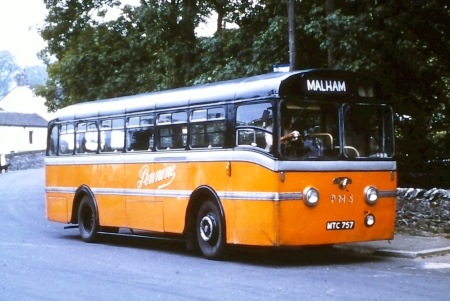
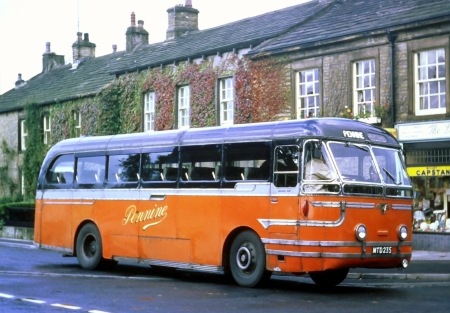
Pennine - Leyland Royal Tiger - MTC 757

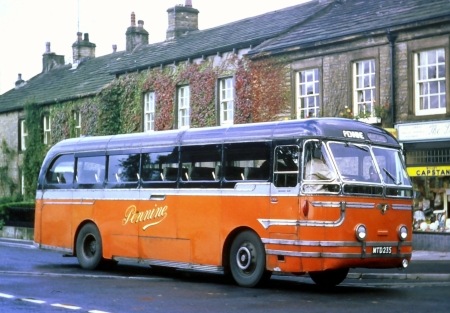
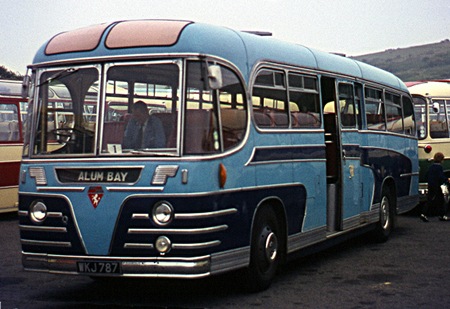
Pennine - Leyland Royal Tiger - MTD 235
Both photographs by ‘unknown’ if you took this photo please go to the copyright page.

Pennine Motor Services  
MTC 757 MTD 235
1950 1952
Leyland Royal Tiger PSU1/13 Leyland Royal Tiger PSU1/15
Brush B44F Leyland C41C

There has been some discussion on another posting about the former Leyland demonstrators, MTC 757 and MTD 235, the latter being still with Pennine and mentioned in the new PSV Circle listing on preserved buses. I have "bought" slides of these two, and I know when and where they were taken, but I’ve no idea of the photographers. MTC 757, the bus version, is seen in Malham in June 1964. MTD 235 is seen in Gargrave in September 1967. MTC 757 had a Brush bus body, while MTD 235 is quite clearly Leyland’s own. ‘The Dalesman Cafe’ on the right of the lower shot was still thriving when I was last in Gargrave a few months ago!

Photograph and Copy contributed by Pete Davies


05/08/12 – 12:31

Wouldn’t you put the dates of these two the other way round? The bus looks remarkably modern and simple for 1950- even the peaked front dome (or is that a trick of the light?) Could it be a rebuild? On the other hand the Leyland (export?) body looks a bit 1940’s Detroit at the front, especially that chrome "dribble".

Joe


05/08/12 – 14:11

Joe, it’s definitely a trick of the light – MTC 757 did not have a peaked dome, and was a very neat looking bus for the time. It was built in 1950, and acquired by Pennine in 1951. They withdrew it in 1967 and it is believed to have been scrapped.
MTD 235 was the prototype for the Leyland Royal Tiger coach body, and as originally built it did not have the multi-windowed ‘lantern’ type windscreen arrangement seen here and familiar on all the production examples, though it must have been modified very early on, as all the photos I’ve seen of it with Pennine show it as it is here. I must rack my brain (quite difficult nowadays) and try to remember which book I have that shows it in its original form and report back. Don’t hold your breath !

John Stringer


05/08/12 – 14:34

I had – please note the past tense! – black and whites of both these vehicles, and taken at Lancaster Bus Station. MTC most certainly did not have a peaked front dome. I have a copy of the Pennine history by Donald Binns in collaboration with the operator, which has a photo of her on page 49. The caption includes "It was scrapped in August 1967 after 16 years service and with 825,000 miles on the clock".

Pete Davies


05/08/12 – 14:35

The dates given in the posting would seem to be correct. MTC 757 was a Royal Tiger PSU1/13 with Brush B44F body built as a demonstrator in 1950, and bought by Simpson of Gargrave t/a Pennine in 1952. Brush ceased building psv bodies in 1952. MTD 235 was also a Leyland demonstrator, and it carried the standard Leyland 41 seat coach body for this model, though the chrome trim was adapted to meet customer choice, and some examples did not have the "swept under" front panelwork. This body continued to be available up to the time that Leyland closed its coachbuilding facilities in 1954. The PSU1/13 version of the Royal Tiger had the horizontal O.600 engine coupled with a four speed synchromesh gearbox and vacuum brakes.

Roger Cox


05/08/12 – 15:06

MTD 235 is still owned by Pennine and is kept at Barnoldswick and is worked on when time permits.

Philip Carlton


06/08/12 – 07:27

The Brush body was a nice design and must have been one of the very earliest on an underfloor engined chassis (apart from BMMO). Quite different to those supplied to Yorkshire Traction/Woollen. Presumably it was 7ft 6in wide?

Chris Barker


06/08/12 – 08:34

Chris, MTC and MTD were both to the usual 8ft width for underfloor engined vehicles of the time, so far as I am aware.

Pete Davies


11/08/12 – 07:23

Think 8′ was standard width for these underfloors. Although they still existed quite recently as a heavy engineering and railway manufacturer, Brush effectively became Willowbrook in bus terms. [Not sure who bought whom.] The next Royal Tigers for Tracky were Willowbrook – but built by the same men in the same factory.

David Oldfield


11/08/12 – 12:07

Several Royal Tigers were built to 7ft 6in width, it was offered by Leyland as an option. Hebble and Devon General had some Willowbrook bodied examples.
Brush are still very much in business, in Loughborough adjacent to the railway station. It was just their bus building activities which they disposed of in 1952. All production was then transferred to Willowbrook including some double deck Daimlers for Derby which were in build at the time and Brush designs disappeared almost immediately.

Chris Barker


12/08/12 – 07:16

Willowbrook existed in Loughborough from 1931, totally independent of Brush. They occupied the retail site now known as Willowbrook Park.
Brush voluntarily quit the bus body building enterprise in 1952, but locals tell me that their designs were passed to Willowbrook.
As Chris says, Brush are still in business, but they are a mere shadow of what they once were, and are no longer the town`s biggest employer. Once upon a time, they were the second largest tramcar builder in the UK, and that was just part of their total business!
What about Pennine though! Still in business, and they have seen it all and survived it all, and still continue as a small independent. I remember them well from my courting days, with wife to be living past Settle, on the Pennine route!
Good old Happy Days are getting even happier!

John Whitaker


12/08/12 – 07:18

I thought Pennine only had a garage in Skipton, but from Philip’s comment above, and from looking at their current timetable showing some early morning services starting in Barnsoldswick, I realise they have a garage there as well. Does anyone know how many vehicles are accommodated there; presumably only 4 or 5?

Dave Towers


28/08/12 – 14:29

The Pennine garage at Barnoldswick was acquired with the business of Ezra Laycock Ltd in 1972. As an ex-Laycock employee I ought to be able to confidently tell you the depot’s capacity – I can’t quite do that, but I think that the answer is five, although in Laycock days vehicles were parked outside as well. According to the timetable three buses start and finish at Barnoldswick, so that is presumably how many operational buses are kept at the depot. I did have it in my head that MTD 235 had been moved to Skipton, but I may have imagined that bit.
As far as I am aware Pennine also continues to use the small depot at Settle, capacity two vehicles.

David Call


29/08/12 – 07:26

I notice that Pete Davies has mentioned (on the Pennine LWY 702 posting) that MTD 235 is indeed now resident at the Skipton depot.

David Call


29/08/12 – 18:59

All is explained, at last. The section about MTC 757 & MTD 235 appears under a total of four headings – Brush (bodybuilder), Leyland (bodybuilder), Pennine (operator), and Leyland Royal Tiger. Only under the heading of Leyland Royal Tiger is there a section devoted to Pennine’s LWY 702, and it is at the foot of that section where Pete Davies has mentioned that MTD 235 is now at Skipton depot.
I would not expect LWY 702 to be mentioned under Brush, of course, but I am surprised that it does not at least get a mention under Pennine (operator). As to whether it should appear under Leyland (bodybuilder) or even Leyland (chassis builder), I suppose you will have to draw a line somewhere regarding what gets included and what doesn’t, there were an awful lot of Leyland buses manufactured. In passing perhaps I could mention that I noticed that under the heading of Leyland Royal Tiger Cub, only one of the three sections actually relates to an example of that model. The other two refer to the infinitely more common Leyland Tiger Cub.
Should I trawl through the other headings checking for similar errors/anomalies? It would beat counting sheep, I suppose.

David Call


30/08/12 – 06:56

The comments engendered by entries to this Forum frequently range far and wide, often well beyond the strict confines of the original submission. We have all had at least one reprimand, not, be it noted, from our webmaster, for straying from the initial subject, but that is entirely within the spirit of this site. The wealth of interest, information and detail that emerges thereby is invaluable. I think that we should go on regarding ourselves as a bus enthusiasts’ equivalent of Dr. Johnson’s Literary Club, with free ranging discussion. Cross referencing every point made in the "comment" columns would be a nightmarish task. Let us just be very grateful for this splendid site.

Roger Cox


30/08/12 – 11:47

Agreed, Roger. It’s worth remembering, too, that, although not as good as cross-referencing, there is a search facility on the website which I’ve found useful a couple of times.

Chris Hebbron


31/08/12 – 07:24

I think most of us form a loose group of cyber friends with a common purpose. I think that overrides any jobsworth tendency to pedantry – and that comes from one of the world’s biggest pedants!

David Oldfield


31/08/12 – 07:25

Contrary to what I stated above, it seems that the section devoted to LWY702 actually appears under all the headings I mentioned – I hadn’t realised that many of the headings lead to multiple pages. It does not help, of course, that my search engine (google) only picks up words and phrases which are contained in the first of those multiple pages – not the second and subsequent.

David Call


11/05/14 – 11:14

On the Pennine (operator) pages, Chris Wright and Orla Nutting comment on the forthcoming closure of the company.
There has been some confusion about MTD 235. Some sources say she’s at Barnoldswick (spoken locally as Barlick) and some (including me, based on reports I’ve had) say she’s at Skipton. To a degree, both are right and both are wrong! On withdrawal, she spent MANY years gathering dust at Barnoldswick garage. About 2 years ago, she was moved to head office with a view to start of restoration. The inspection was duly undertaken and it was found to be [I quote] ‘a massive job’ which would divert too many staff hours, so she’s back at Barnoldswick, apparently with one of the Leopards new to Ezra Laycock.
I suspect that a number of readers will be concerned about the future of MTD maybe she should could go either to the Leyland Museum or to the one in St Helens if the family don’t keep her.

Pete Davies


12/05/14 – 08:37

The ex-Laycock Leyland Leopard reputedly stored at Barnoldswick depot can only be OWY 197K, since that was the only Leopard ever owned by Laycock’s.
An interesting point is that throughout the few months of its time with Laycock’s, and into Pennine ownership, it carried the incorrect registration OWY 179K.

David Call


13/05/14 – 06:34

Thank you, David, for your comments about the Leopard. In the Donald Binns book about Pennine, there are two photographs showing her with OWY 197K, but the listings in the book show both registrations! She is shown in the book as being stored at Ingleton, but that is clearly out of date if my information from company staff the other day is correct.

Pete Davies


23/05/14 – 07:51

Pete. I paid my respects to Pennine on the last day 16th may I Actually wrote to Maurice Simpson wishing him well for the future and how sad it was Pennine Motors was closing down. I suggested MTD 235 should be restored in memory of his father and the company and what his plans are for the vehicle.
Work was carried out on the brakes and other bits and pieces the chief engineer tells me, however she is to be towed back to Skipton in the coming weeks but what the future is it is not clear as yet.

Mark Mc Alister


25/05/14 – 10:33

Thanks, Mark, for your update.
Before I retired, I worked in the passenger transport team of Southampton City Council, dealing with the local operators over aspects of their services. The national concession scheme was just coming into use. My managers commented on several occasions that the regulations said that the level of reimbursement must be strictly neutral, in that the operator must be no better off and no worse off through taking part in the scheme.
The reports I have read in various places all suggest that North Yorkshire County Council have a different view.

Pete Davies


26/05/14 – 09:28

The point made by Pete Davies was first specified in the Ridley 1985 Transport Act when each local authority had the power to determine a concessionary fare scheme. This led to wide variations throughout the country, and some authorities, of course, chose not to offer any meaningful scheme at all, which was one of the reasons why the Labour government, in reality, John Prescott, decided to ensure that mandatory schemes were available everywhere from 2001. This was followed up in 2007 by a national scheme for England. The Welsh and Scottish administrations pursued their own policies. This new scheme maintained the requirement that "Travel Concession Authorities are required by law to reimburse bus operators for carrying concessionary passengers, on the principle that the operators are "no better off and no worse off" by taking part in concessionary travel schemes. The aim is not to subsidise bus operators, but to pay for any increased costs that they have incurred". The legislation goes on to say, "The national bus concession in England is available at any time on a Saturday, Sunday or bank holiday, and from 9.30am to 11pm on any other day. TCAs are able to offer concessionary travel outside these hours on a discretionary basis". I understand that North Yorkshire allows the passes to be used from 9am until 6am the following morning, which is entirely lawful under the clause stated above.

Roger Cox


26/05/14 – 09:29

The situation in respect of the depot premises is as follows.
Skipton: To let at £40,000 p.a. or might sell
Barnoldswick: Sale agreed
Ingleton: Sale agreed
Settle: For sale (‘Guide price’ £75,000) or might let
As Mark McA says, the future for MTD 235 is not clear – it looks even less clear now. We can only hope that it will be, as suggested by Pete, donated to one of the established museums.

David Call


26/05/14 – 14:01

Quite right, Roger, but it’s the amount of reimbursement that seems to have upset matters in this case.

Pete Davies


21/02/16 – 15:44

Re MTD 235 – can anybody give me an update on this coach’s current condition and location please?

Howard Piltz


21/03/16 – 15:54

It appears to have been offered for sale on Ebay in 2014 but the highest bid, just over £2K, didn’t meet the reserve price. Since then it has been off the radar.

Mike Morton


23/03/16 – 05:42

"Just over £2K", Mike? That’s just silly, given the nature of the beast. I’d have expected another ‘0’ on the figure . . .

Pete Davies


23/03/16 – 17:10

Pete
That’s the reality of Bus Preservation lots of effort/money but nothing like the financial return of vintage cars.

Roger Burdett


23/03/16 – 17:14

Sadly Pete, the generation of enthusiasts that remember and appreciate this era of classic vehicle are getting on in years and fewer in number, and probably feel that it is a bit late in the day to start getting involved in such a substantial and expensive restoration. The majority of active preservationists nowadays are more into the vehicles of their youth – such as Nationals, Olympians and Metrobuses, and even more recent types than those.
I attended the open day at the Dewsbury Bus Museum the other week and thought I’d sample a few rides on the free bus service into Dewsbury and back. I rode on the superb recently restored West Riding PD2 and then the West Riding PS2 but was surprised to note that though plenty people were photographing them, there were relatively few that chose to ride on them, whereas the Olympians, RELL, Leopard and even the virtually new Arriva Enviro Whateveritis were packed out with excited punters.
Time moves on, and so will we, and I fear for the long term future of many of our favourite classic buses.

John Stringer


24/03/16 – 05:56

Re MTD 235. It did not meet reserve on eBay in 2014 (highest bid £2250) so presumably its still with Simpson (t/s Pennine Coaches) Skipton.

John Wakefield


24/05/16 – 08:58

MTD 235 once again on Ebay.

Dave Philpot


30/05/17 – 06:42

MTD 235 has been sold on in Yorkshire.

Phil Clark


22/11/17 – 07:37

I can report that restoration of ex-Pennine Royal Tiger MTD 235 is continuing with the mechanics receiving a thorough overall and work commencing on the body. It is hoped that it will make a return to the road one day soon, keeping fingers crossed!

Phil Clark


23/11/17 – 07:09

Wonderful news!

Pete Davies


23/11/17 – 07:10

Good news indeed Phil-thanks for the report.

Stuart Emmett


23/09/18 – 06:14

I am currently restoring the ex-Pennine Leyland Royal Tiger MTD 235 – has anyone got a destination blind for this or any Pennine posters or notices or timetables that were displayed in their buses in the 1950s, 1960s or 1970s? I will be pleased of any help or copies of anything that will add to the restoration. Thank you, you can contact me through this website.

Phil Clark


05/11/18 – 13:38

The only blind I have seen also covers 1972, 1983 and 1986 changes and includes the former routes of Laycock, Skipton and the ex Ribble locals and Burnley etc.
1950’s’/1960’s when MTD was in main service then the range was small. Therefore would suggest only needs to include Malham, Tosside, Morecambe, Lancaster, Ingleton, Gargrave, Settle, Skipton, and Contract.
On further materials-assume, you already will have the Donald Binns 2000 book called Pennine Motor Services that includes many timetables.
Hope this helps and that your worthwhile project continues on. Any ideas when it might be completed?

Stuart Emmett

MTD 235_lr Vehicle reminder shot for this posting


18/11/18 – 09:26

I’m trying to locate the Leyland Royal Tiger MTD 235 mentioned in your website. My dad is a retired bus driver and it’s his favourite bus. I’m trying to arrange just to see it really.

Steven Davies


27/01/19 – 07:41

Thanks for your info on MTD 235 destination names that will be useful, at the moment it has no blind gear as this must have been removed some time ago, so I am trying to find replacement blind gear (if anyone has some!). I haven’t found that book on Pennine but I hope I’ll find it some day. I have found some old Pennine excursion flyers which I hope to make use of. Restoration continues albeit slowly as I’m finding much of the rear end wood frame has decayed or is missing and this is not my favourite job! I am part way through rewiring the coach as much of the original is in a very poor state. I think it will be a while yet before it is finished, but if anyone has any memorabilia, old Pennine notices, posters or unpublished photographs I will be pleased to know!

Phillip Clark


28/01/19 – 07:39

Pennine book available right now suggest be quick www.abebooks.co.uk/

Stuart Emmett


29/07/22 – 05:56

Hello Phillip – wondering how the preservation of MTD 235 is progressing please.

Stuart Emmett


Quick links to the  -  Comments Page  -  Contact Page  -  Home Page


Moss Tours – Beadle Rochester – WKJ 787

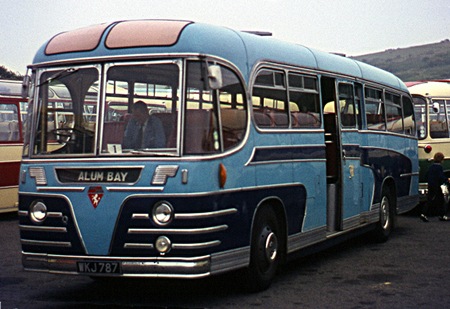
Moss Tours - Beadle Rochester - WKJ 787
Copyright Roger Cox

Moss Tours Isle of White
1955
Beadle Rochester
Beadle C41C

This picture of WKJ 787, a Beadle Rochester C41C coach was taken in 1970 at Alum Bay, Isle of Wight. The Rochester was an integral design from the Dartford based coachbuilder, and was powered by the Rootes TS3 3 cylinder horizontally opposed piston two stroke engine, very similar to the pre war Sulzer ZG9. (The wartime Junkers Jumo aero engine operated on related principles but differed in several design aspects.) The TS3 was designed initially at the Humber works of the Rootes group, and production was undertaken at the former Tilling Stevens (hence "TS") factory in Maidstone that Rootes acquired in the autumn of 1950. Two stroke engines have a power stroke on every rotation of the crankshaft, and have to have some form of pressure charging for induction. On the TS3 (and on contemporary Foden two strokes) this was achieved by a Roots (no commercial relation to Rootes) supercharger driven by the engine, which absorbed some of the power output.  The engine had a capacity of 3.26 litres and developed 105 bhp at 2400 rpm. The very distinctive exhaust note akin to a Gatling Gun in full cry earned these engine the sobriquet of "Knockers". A four cylinder 4.35 litres version was developed giving 200 bhp at 2600 rpm, and 14 prototypes ran 1.2 million miles very successfully, but this programme came to a halt with the Chrysler takeover of Rootes in 1967. Chrysler had entered into joint agreements with fellow American engineers Cummins for commercial vehicle engine supplies, and the exceptionally promising TS4 was an embarrassment to these arrangements. As it turned out, the Cummins V6 and V8 engines were a disaster. The TS3 was subsequently cancelled as well, and Chrysler turned to Perkins for the supply of smaller engines. Yet another promising British engineering achievement foundered upon corporate ignorance and myopia. //www.commer.org.nz/
The Rochester in the picture began life in 1955 as a Beadle demonstrator, and was later acquired by Moss Tours on the Isle of Wight. It was bought by a church group in the 1990s, and then thankfully sold on into preservation. To my eye, the body design is quite well proportioned, making due allowances for the ample application of chrome at the front. A recent view of this Rochester may be found here:- www.flickr.com/

Photograph and Copy contributed by Roger Cox


03/08/12 – 07:57

To my mind this is pretty much what a centre entrance Weymann Fanfare would have looked like. I’ve never seen one, so was that an option or were they all front entrance?

Ronnie Hoye


03/08/12 – 07:58

Whereas there were front entrance Rochesters there were never centre entrance Fanfares. They are suspiciously similar but I believe Weymann were on the market first and, if you ignore the Fanfare front end, the rest can be seen as pure Beadle – despite similarities. I still find it incredible, after all these years, that Beadle "got away with" the Rochester as did Duple (or was it Roe?) with the Elizabethan and the Dalesman.
This vehicle made a guest appearance at last year’s Hemel Running Day. Handsome beast, whatever.

David Oldfield


03/08/12 – 07:59

Yorkshire Woollen had a batch registered CHD 375-390 new in 1957 and these were C41F.They were all withdrawn in 1967.

Philip Carlton


03/08/12 – 08:12

I’ve seen this several times, in ISLAND QUEEN guise. Moss still exists as an operator on the Isle of Wight, as part of Southern Vectis, whose fleet has been renumbered in the last few weeks as part of an exercise involving the whole of "Go South Coast".

Pete Davies


03/08/12 – 10:56

What a lovely picture. I can see the Fanfare similarities but it smacks of Yeates in some ways too.

Les Dickinson


03/08/12 – 17:20

The TS3 was an amazing engine; a real success story in a difficult area of internal combustion technology.
General Motors also produced the Detroit Diesel with a Roots blower, as early as 1938. It was used in some British tanks, but never used in the UK other than this, to my knowledge.
Chrysler made a stupid decision to scrap development (which included plans, jigs and engines) of the TS4, which was virtually ready to go. A couple of engines survived under wraps and here is the wonderful sound of a TS4 running: www.youtube.com/ 

Chris Hebbron


03/08/12 – 17:21

Yes, Les, the somewhat ornate decoration does suggest the designer had a look at some Yeates products and liked what he saw. I’ve always had the idea that the Yeates decoration was overdone, on the basis of "There’s a bit here that’s still blank. Let’s decorate it!" It must have increased the body weight, surely?

Pete Davies


03/08/12 – 17:21

Southdown had 25 Rochesters the first five of which had centre entrances but the windscreens and the first body bay were quite different being more akin to the bodies fitted to Southdown’s Tiger Cubs which were being delivered around that time. The remaining twenty were standard front entrance 41 seat models which were used extensively on express services. I drove later Commer Avengers fitted with this engine which could be quite lively if revs were kept up which makes me think I would love to have tried the four cylinder version it could have had great potential another chance missed.

Diesel Dave


03/08/12 – 17:40

WKJ 787_2_lr

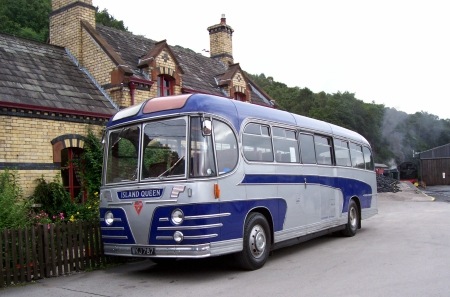
I have been through my archives and attached is a picture you may want to add to the current discussion. Island Queen is owned by Roger Burdett and in 2008 I was a passenger on it to Scotland via the Kirkby Stephen Rally. The day before we went to the Lakeside and Hatherwaite Railway where I took this picture. Besides the obvious change in livery the vehicle has lost one of the orange front skylights.

Ken Jones


04/08/12 – 07:45

Thanks for that link to the TS4, Chris. That sound takes me right back to the days when the Southdown Commers could be seen (and decidedly heard) sprinting along the A22 and A23 south of Croydon. The cancellation of the TS4 and discontinuation of the TS3 should be added to the sadly substantial list of corporate follies that has denuded the UK economy of much of its engineering expertise.

Roger Cox


04/08/12 – 07:46

How did it perform, Ken, and was the engine noise subdued inside?

Chris Hebbron


04/08/12 – 07:47

I couldn’t have put it better myself Pete, this is better for being a little less cluttered I think.

Les Dickinson


04/08/12 – 11:41

Reference question above from Chris Hebbron – I thought it performed well – Scotland and back with no problems – and as a passenger it gave a nice ride. It was however noisy depending where you sat, so choice of seat is very important on this vehicle as I soon discovered.

Ken Jones


04/08/12 – 17:20

The TS4 was discontinued as a result of the Rootes takeover by Chrysler who introduced the V6 in the Dodge KP Series. This engine was seriously fast outpacing the TS3 and according to my father (who used the TS4 in development on the road). Unfortunately it was an erratic engine throwing belts and of course saw its reputation totally screwed by its lack of reliability in Daimler Roadliners.
Island Queen is a delight to drive and ok for noise if you sit in the front half. It is likely to be out and about in the second half of 2013

Roger Burdett


04/08/12 – 20:46

I’m sure that the initial engine in the Roadmaster was a Cummins ‘small-V’ one, which proved troublesome to the point where it was replaced by a Perkins engine and finally a Leyland unit, none of which produced a fully acceptable solution. I’ve seen it mentioned that it was originally a marine unit and suffered from problems of responsiveness, not a problem in a marine setting. Other contemporary Cummins engines were pretty good, but the one fitted was suitably very compact.
The chassis appears also to have been prone to flexing, causing body problems.
The TS4 never really came out of R&D and into volume production, to my knowledge.
Whatever the shortcomings of the early Leyland Nationals, they acquitted themselves well in comparison with the Roadliner. Thx, Ken, for the passenger experience pointers.

Chris Hebbron


07/08/12 – 07:14

I have had a ride on this vehicle, and got the impression that the engine noise was amplified by the entrance stairwell, which is presumably right next to the engine. This suggested that a front-entrance one would probably be more refined.

Peter Williamson


13/08/12 – 08:49

Here is a link to a picture of a Rochester with a front entrance body. The pillar at the rear of the front curved corner glass has had to be repositioned from that of the centre entrance design in order to accommodate the door. This one, KPR 688, was apparently one of three Rochesters bought new by Bere Regis and District in 1957. www.flickr.com/photos/

Roger Cox


15/10/12 – 17:06

The other surviving Rochester, 8 GMK, is likely to be a couple of years before it appears on the rally scene as there are a couple of others in the queue before it gets started.
There is a lot of work to do to it, including a large dent in the rear dome and some chassis work. Plus I need to get the ‘K’ and the VAS finished first. There are quite a few shots of it at this link.

Charlie Lemon


06/05/13 – 08:19

I travelled many hundreds of miles on the Yorkshire Woollen Rochesters and always enjoyed riding on them. However, while 105 bhp is impressive on paper, my recollection is that they had no worthwhile torque whatsoever, which made hill climbing a slow and tedious business, even with a driver who knew to keep the revs up (they were the only coaches at the time fitted with a rev counter). With someone who tried to drive them like a Gardner, things became hopeless as below a certain RPM the engine switched to four stroke which halved the power.
As far as noise is concerned, I do not recall them being any worse than, say, a Leyland inside but the ones I knew had front entrances and I always sat at the front. Outside was a different matter. I used to deliver papers early in the morning and remember a brace of Rochesters heading for Blackpool in the morning stillness as they blasted their way out of Cleckheaton. They were audible for about 3 miles. Heaven only knows what a TS4 would have sounded like.

Bob Hunter


29/10/13 – 07:17

The resemblance between the Weymann Fanfare and the Beadle Rochester, which was highlighted earlier in this thread, is also mentioned in John Senior’s "The Weymann Story Part 2 1942-1966".
Apparently at a time when Weymann was highly profitable there was a disagreement between the managing director, DJA (Jack) Davies, and the owners, United Molasses, about what to do with the profits. The row became acrimonious and Davies was forced to leave. He went to Beadle in March 1955, and the Rochester appeared the following year.

Peter Williamson


06/11/13 – 16:08

On YouTube under the heading ‘QUANTOCK CLASSIC BUS DAY 2011 Part3’ a short journey aboard WKJ 787 is included in the video. The Rochester footage begins at 5.54 and lasts until 8.09, followed by a very brief ‘encore’ from 9.20 – 9.56. Sound effects from the little Commer TS3 engine are as one would expect – growly, raucous and gorgeous. It’s definitely worth watching/listening to if you like 2-stroke diesels – just make sure the neighbours are out before you turn up the volume!

Brendan Smith


07/11/13 – 07:15

Brendan: My word- I’d forgotten what it was like. An Atco with hyperdrive…. and what a driver!

Joe


WKJ 787_lr Vehicle reminder shot for this posting


04/02/14 – 07:41

Does anyone have any information about WKO 136 ? apparently a demonstrator.

Dominic


Quick links to the  -  Comments Page  -  Contact Page  -  Home Page


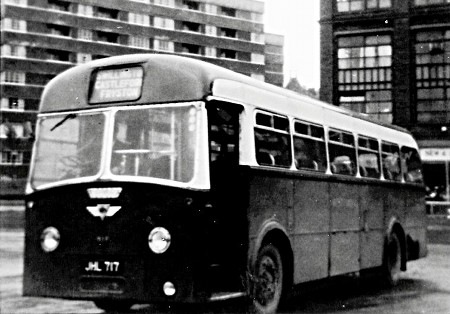
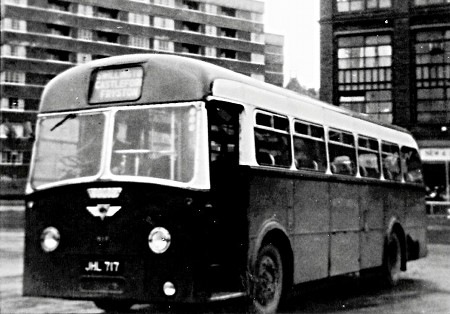
West Riding – AEC Reliance – JHL 717 – 817

West Riding - AEC Reliance - JHL 717 - 817
Copyright Chris Hough

West Riding Automobile
1956
AEC Reliance
Roe B44F

In the nineteen fifties West Riding bought very few batches of saloons They were used on a selection of routes. Seen in Leeds bus station is a Roe bodied AEC Reliance fleet number 817 registration JHL 717 which dates from 1956. It is on the "back roads route" from Leeds to Castleford via Swillington and Fryston. West Riding did not always bother with route numbers as is evident from this shot The bus certainly shows the effect of road grime on paintwork as it stands in Leeds bus station in 1967.

Photograph and Copy contributed by Chris Hough


01/08/12 – 07:19

Odd design- front not very Roe? It may well have picked that spray up that day on that back roads route- could be off the fields or clay slurry from mining. Note the single mini-wiper and the gloop around its perimeter, the state of the wheels/tyres and (possibly) the wet muck behind the rear wheels. It got better when the windows were covered too- that’s where the idea for the all-over adverts came from.
Nearly on thread: West Riding’s successors, Arriva, have just managed to provide a new batch of deckers with facing fore and aft seats over the rear wheels. Now where do the local yobbery put their muddy feet/boots? Arriva are now providing notices to try to stop people dirtying their clothes on muddy seats. Come back practical designers… conductors… inspectors!!

Joe


01/08/12 – 08:53

Actually, very Roe, Joe. For a time in the early fifties, this droopy windscreen was a feature of Roe saloons – and distinguished them from their Park Royal cousins built on the same frames. I like your theory about the origins of contra-vision adverts, though!

David Oldfield


01/08/12 – 11:59

As we Geordies would say "wor bairns hacky mucky" rough translation "the baby is in need of a wash"

Ronnie Hoye


01/08/12 – 12:01

What a dismal scene! Obviously a grotty day, when some photographers would leave the camera at home because of a) the weather and b) the resulting dirty appearance of the vehicle. There are some photographers of buses who capture only "pristine" views but there is a real world out there and it often happens that the cleaners can’t keep pace with the weather. It may just happen that the photographer is on holiday and wants to record the local transport. I know that doesn’t apply in this case, but what’s the photographer supposed to do, come back next year and hope the same bus is still in service?
Very atmospheric, and the black and white print enhances that. Thanks for sharing.
Interesting comment from Joe regarding back to back seating over the rear wheels. I first noticed this with Bolton Corporation, but the idea still persists. The original idea was to have greater seating capacity. The inward facing arrangement seems to me to be far better. Clearly, a candidate for the "nice idea, but . . ." file!

Pete Davies


01/08/12 – 15:38

While "facing seats" are not by any means ideal the abuse of them on both buses and trains is absolutely abominable. Its almost certain that, as you walk past any stationary bus, if you look inside you will see passengers with their filthy footwear planted on the opposite seat – and not just placed there either – there will be plenty of "scrubbing" in every direction just to plant more filth and to cause as much wear to the material as possible. It might be thought that those responsible would just be the yobs of Society, but not a bit of it – the culprits are just as likely to be smartly dressed businessmen or secretarial young ladies. It is a despicable and costly habit, of which the perpetrators are fully aware and, apart from the burden placed on transport operators, the ruination of decent peoples hard earned nice clothing is scandalous. In summary the phrase "Blow you Jack I’m alright" springs to mind, and in reality there can be no cure for it – its sadly just another sign of "Today."

Chris Youhill


01/08/12 – 17:37

You’re dead right, Joe and Chris. However, it seems to be a universal problem. I remember once risking my life by photographing a couple of youths on a German train with their feet on the seat directly under a large and unambiguous"Halten Sie Füße weg von den Sitzen"(or similar) sign and graphic image. Needless to say, they just laughed at me, but (who knows) maybe the memory of the occasion may just hit home to one of them in years to come? Staff, particularly on railways, rarely bother to challenge the offenders as they prefer a quiet life, and who can blame them? However, one can sometimes come unstuck by making big assumptions – like the time I worked myself into a Victor Meldrew Harumph on seeing a lady with outstretched legs onto the opposite seat in a first class carriage. I was on the brink of saying something when I thankfully noticed that she had removed her shoes and placed a newspaper on the seat to rest her stockinged feet! Phew! Nearly an "I’ll get my coat……." moment!

Paul Haywood


02/08/12 – 07:12

Would, the would be perpetrators on arriving home put their muddy /dirty shoes on their own furniture thus defiling their property, I think not.

David Henighan


02/08/12 – 07:13

Sometimes a bit of sarcasm works wonders, when I was at Armstrong Galley one of our drivers had a notice in his coach ‘if the floor is full please don’t hesitate to use the litter bin’ strangely enough it seemed to work

Ronnie Hoye


02/08/12 – 07:13

I acknowledge your knowledge, David. I was thinking of exclusive Roe users like Doncaster, but at that time they were still on half cabs! Underfloor came much later.

Joe


02/08/12 – 07:14

I thoroughly agree with Joe regarding back to back seating over rear wheel arches, they seem to be obligatory with modern day low floor buses. I witnessed one of Stagecoach leather coach seated Scania/ALX 400’s when only days old being so treated despite various notices asking that it not be done.
When I was a driver I would wherever possible make a point of loudly asking for all feet to be taken off all seats it seemed popular with most passengers except the thoughtless culprits, as Chris says another sign of "today" I’m glad that I retired 9 years ago.

Diesel Dave


02/08/12 – 07:15

I wholeheartedly agree about the comments made about yobs (and non yobs) putting their feet on the back to back seats, who knows what they could have stood in? A few years ago I went for a lengthy trip on the Yorkshire Coastliner service between Leeds and Scarborough and felt the need to contact the company about some matter or other, I honestly can’t remember what it was now. Anyway, I took the opportunity to mention that this seating arrangement was not ideal for such a long journey and that people sat on the back seat tended to use the facing seat as a footrest. Coastliner’s suggestion was that I should have had a word with the perpetrators!

Dave Towers


02/08/12 – 11:18

Dave Towers received a somewhat pathetic and "resigned" reply from Coastliner – did they also include a list of A & E departments along the route where Dave could receive attention to his injuries after the quite likely "smack in t’ mouth" which could result from "having a word."
I share Diesel Dave’s sentiments and I am glad that I retired eleven years ago – the level of appalling conduct by too many passengers is now beyond a joke – and I loved the career to a passion – so I can well understand how most drivers who are doing the job "just for a living" must feel.

Chris Youhill


02/08/12 – 11:20

Joe. This comes down to personal experience – if you had never come across the droopy screens then you would assume they did not exist, or were an aberration. I happen to be a Roe fan/"expert" – but presumably, with Doncaster connections, so are you. I’ve been caught out in the past myself.

David Oldfield


02/08/12 – 17:12

Tough attitude of passengers both young and old can be yobbish but to a degree the companies are also at fault. In Leeds the interior of vehicles are often filthy with old newspapers, tickets etc on buses just out of the depot. Minor vandalism such as graffiti is left in situ so Joe Public see an unloved uncared for bus that they think hmm the company don’t care why should I. I am old enough to remember buses smelling of disinfectant on leaving the depot not last nights takeaway!

Chris Hough


02/08/12 – 17:13

I seem to remember being told that the reason for the demise of inward facing seats over wheelarches, in favour of back to back ones, was an ‘elfen safety’ issue. It was reckoned that passengers could fall off these seats too easily when the bus cornered (yes, they did actually sometimes!).
I agree entirely with all the above sentiments regarding inconsiderate, yobbish behaviour on buses these days, and as someone who still has to drive buses for a living (albeit part-time now, after nearly 40 years full-time) for a major operator, it is heartening to know that at least a few of you sympathise with the hopeless situation we find ourselves in.
All too often, present day bus drivers are criticised for being uncaring and disinterested, and held totally to blame for the state of the industry today. Physically we may have it easier with our automatic gearboxes, power-steering and computerised ticket machines – no more grappling with crash boxes, heavy steering or snipping away at piles of Willebrew tickets etc. – but the job is much more stressful, frustrating and demoralising in a host of different ways that the PSV drivers and conductors of yesteryear could never envisage.
Passengers often complain that the "bus driver should have done something" when there has been yobbish, unsocial behaviour taking place but, as Chris rightly implies, one is certainly putting oneself at risk of abuse – at the very least of the foul verbal kind, and quite possibly of the violent physical kind – if one intervenes. It’s just not worth it.
The companies pay lip service to their official intolerance of this kind of behaviour, but otherwise just ignore the issue – probably for fear of appearing too authoritarian. Even yobs are fare-paying passengers so we must not upset them too much.

John Stringer


03/08/12 – 07:55

I remember these buses coming through Dewsbury on the joint West Riding/Yorkshire Woollen service 3 to Cullingworth. I believe one is being prepared at the Dewsbury Bus Museum.

Philip Carlton


09/08/12 – 09:30

If I may climb back over the seats to the subject of Roe Underfloor Designs of the 50’s…. checking with Peter Gould’s list, I see that Doncaster actually bought a single centre entrance Regal IV in 1951…it must have been a sort of Festival of Britain experimental fling, because they also bought the two 8ft double deckers- Regent III and CVD6- which they sold on as two wide (for the streets or the washer- the jury is out) and then the two all-Leyland PD2’s which were the last non-Roe deckers ever bought and, trolley-bodied, lasted nearly 20 years: the next year, I see they bought nothing! Anyway… the party was clearly over and they reverted to half cab Regal IIIs in 1953, which were more typical of this traditional fleet. But… my point is that I have found a pic of 21 and it doesn’t have droopy windscreens… angled two piece, it seems…… so the droopy screens came later…

Joe


11/08/12 – 07:27

Pontypridd U.D.C. had three 1957 Guy Arab LUF’s with Roe rear-entrance bodies and ‘droopy’ windscreens – try this link:- www.sct61.org.uk/  Lancashire United Transport had some Atkinson PM746H’s with Roe bodies with similar fronts also, see:- www.flickr.com/photos/

John Stringer


11/08/12 – 09:20

I’ll throw another one at you Joe. You mentioned square screens on Regal IVs – just like Sheffield’s 12 – 14. The droopies were only on Reliances (and contemporary underfloors) which would make them 1953 onwards – but still from "the early fifties".

David Oldfield


12/08/12 – 07:21

As Manuel said… I learn… I learn. Curious that the "square" underfloor body designs look better or more modern…like that Pennine Royal Tiger.

Joe


16/11/12 – 09:04

John mentions (02/08/12) the yobbish attitude of passengers sadly this attitude to other peoples property is prevalent in all walks of life. I work in the NHS and we have a constant problem with mindless vandalism to furniture in particular. I once asked a culprit if he would do the same to his own property and was met with a torrent of four letter words and told I pay your effin wages so shut it.

Chris Hough


Vehicle reminder shot for this posting


04/07/14 – 07:41

You get a fine from Merseyrail Electrics if you put your feet on their seats. There are signs up warning about it and they seem to work. Not that I use their trains very often.

Geoff Kerr


Quick links to the  -  Comments Page  -  Contact Page  -  Home Page


All rights to the design and layout of this website are reserved     

Old Bus Photos from Saturday 25th April 2009 to Wednesday 3rd January 2024