Old Bus Photos

Hants & Dorset – Bristol Lodekka – GRU 978D – 1547
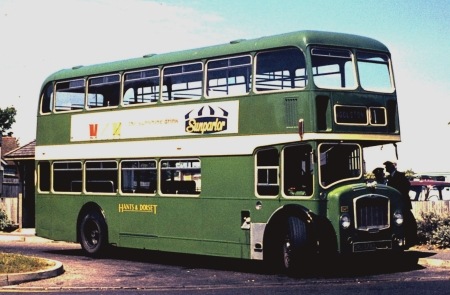
Hants & Dorset - Bristol Lodekka - GRU 978D - 1547
Copyright Pete Davies

Hants & Dorset Motor Services 
1966
Bristol Lodekka FLF6B
ECW H38/32F

In case readers were thinking the bulk of my photographs are of operators in the Midlands and North of England, here is something to balance matters. GRU978D was a Bristol FLF6B in the Hants & Dorset fleet. She is seen on the sunny morning of 29 May 1970, and is at Hamble Square, ready to return to Woolston on the 81.
I believe she went to the USA when withdrawn.

Photograph and Copy contributed by Pete Davies

A full list of Bristol codes can be seen here.


14/08/12 – 06:51

As a young enthusiast on the south coast, Hants and Dorset was my nearest Tilling operator, often seen at Fareham, and Southampton. In those days, I sometimes felt that Tilling companies (BTC, then THC) were all "much the same". That was before the impact of NBC – then we really knew what "all the same" meant! Here in the south, I reflect that it was possible to distinguish between the green Tilling companies (Hants and Dorset, Southern/Western National, Bristol Omnibus) or red ones (Wilts and Dorset, Thames Valley) by little idiosyncrasies as fleet number application (plates or transfers), the obvious registration letters used, and even destination indicator styles. Although the screen layout was an evolving national policy, somehow the style of the text differed between these operators – or was it just my imagination!? Several of these fleets also contained a number of vehicles unique to themselves. At Hants and Dorset, there were all-Leyland PD2s (highbridge), some NCME-bodied Regents (diverted from Western SMT), and H&D’s own open-top rebuilds with full-fronts. I think these bodies started on some pre-war Bristol Ks, and were transferred successively over a few years to some war-time Ks, and finally to some post-war Ks. These bodies, I believe, were rebuilt by H&D’s works from the original Brush bodies supplied pre-war (as ordinary half-cab double-deckers). So the FLF in the picture would have been "standard viewing" at the time, but brings great pleasure now. Incidentally, the name Hants and Dorset has disappeared, but the company became owned by Wilts and Dorset after privatisation (a reversal of the NBC era, when H&D controlled W&D!). But under modern W&D control, the H&D subsidiary is now called "Damory Coaches". While in Weymouth last week, I photographed two Olympians – but they weren’t sailing – just waiting near the King’s Statue on the seafront for their return journey on their Olympic charter. Much too modern for this site, but they did look proud in the sunshine.

Michael Hampton


14/08/12 – 11:37

Have no history whatsoever with Hants & Dorset, but always preferred the Bristol engine. H & D had some of the rare (late) Leyland engined FLFs. I only learned recently that this option was put on the list after the Bristol engine was removed from it.
Looking at this picture though, it shows the perfect proportions of the FLF body. Balance and symmetry are always the basis of a good design.

David Oldfield


14/08/12 – 11:39

Rob Sly has an excellent website listing preserved Bristol Lodekka buses, VR, LH and RE. This bus did go to USA and was red in 2011 which is the last update – full details at //bcv.robsly.com/

Ken Jones


15/08/12 – 07:55

As far as I’m aware, one of the main reasons Northern bought Routemasters was United’s introduction of this type of Loddeka onto the routes they operated jointly. Northerns RD Park Royal PD2’s were getting a bit long in the tooth, and although the PDR1 Atlantean had been in service with Northern for a couple of years it was decided to go for the Routemaster instead. Being a BET company, Northern never had any of these, but that all changed with the formation of NBC, when for reasons best known to the powers that be, long established fleets were shuffled around like decks of cards. I cant remember the exact number, but at Percy Main we had some Daimler Fleetlines transferred to United in exchange for Loddeka’s, but they only stayed a matter of a few weeks and were replaced by the AEC Renowns that came from East Yorkshire, the Bristol’s going on to other depots. I remember one or two drivers being caught out by the gearbox, where it wasn’t possible to go into neutral from fifth without going through forth. Digressing back to fleet reshuffles, some depots got buses from as far afield East Kent and Maidstone and District, make sense of that if you can.

Ronnie Hoye


15/08/12 – 07:56

On the fringes (in two respects) to what Michael H said about name changes, I notice that neighbour Wilts & Dorset are re-naming their Bournemouth and Poole operation ‘MORE’! Bizarre!

Chris Hebbron


15/08/12 – 07:57

Can’t help but agree with you David, on the ‘just right’ proportions of the FLF. Handsome machines from any angle. Hants & Dorset did indeed have some FLFs with Leyland (0.600) engines, as did Wilts & Dorset. Interestingly, both fleets also specified semi-auto gearboxes to mate up with them. I could never understand however, why H&D had to change it’s livery from green to red under NBC ownership. Surely it can’t have been to differentiate between the H&D and Provincial (green) fleets. A similar fate befell West Riding Auto up here in the ‘Olympic Medal County’ of Yorkshire, where WR’s green fleet went red under NBC. Strangely, this meant that its fleet livery was then the same as associate company Yorkshire Woollen District, which retained its red. Maybe someone could explain?!

Brendan Smith


15/08/12 – 11:30

Chris H, there are rumblings that the name SALISBURY REDS is being extended from just the company’s activities in that City to Romsey and other routes as well, while MORE is being extended from Bournemouth and Poole to include Lymington. It’s being said that the W&D name will vanish (again) from bus sides, though I understand that it will remain as the legal lettering.

Brendan, going on from that, the history of Wilts & Dorset to 1972 includes a reference to the green to red transition of Hants & Dorset. It has nothing to do with trying to distinguish from Provincial. When the joint management of H&D/W&D were told that the W&D name was to be dropped, they were so disgusted by the dropping of such a highly respected name they decided "We’re going red".

Pete Davies


15/08/12 – 11:31

No logic in the halls of NBC Brendan. Maroon East Midland became leaf green.

David Oldfield


15/08/12 – 14:55

Wasn’t NBC policy a poor attempt at LT/Greenline… Country services to be green, urban services red? If I recall, a lot of the "used" Wulfrunian replacements at WR had arrived in green… and I think stayed that way…?? Anyway, privatised WR went back to green, if not the same one…. Of course, WR had once been part red anyway!

Joe


19/08/12 – 07:52

This must be the smartest design of all ECW double decker Bristols

Jim Hepburn


19/08/12 – 07:54

David, I seem to remember that East Midland (maroon) absorbed Mansfield District (green), is that when East Midland went green?

Vernon Ford


19/08/12 – 08:30

That’s very true, Vernon – but it’s no excuse! [I read recently a theory that NBC went green for rural and red for urban – but that doesn’t explain Hants & Dorset going from green to red!] …..and of course the blues (East Yorkshire and Midland General) had to go red.
None of this would have been half so bad if Tilling Red, Green and Cream had been retained. Visually – and on quality – they were better than Leaf Green and Poppy Red which faded within the year.

David Oldfield


19/08/12 – 12:00

I seem to recall reading somewhere that certain bus companies which had their origins in tramways, and which had not set up a separate company later to operate buses, were therefore statutory companies (i.e. set up by Acts of Parliament). The Acts specified in very minute detail the activities of the operator and in some cases this could even specify the livery that would be used (though obviously not in the majority of cases as many tramway operators changed their liveries). I believe Mansfield District was such a case, and the green livery on the bus fleet could only be changed by another Act of Parliament, which would have been too much hassle, so when East Midland took them over it was easier to adopt a green livery for the entire fleet. Has anyone else heard of this?

John Stringer


19/08/12 – 15:05

This may be right- I think, John S, that tramways regulations were why West Riding ran a red fleet on the old tram routes, and there might be some obscure connection with the centre entrances?

Joe


20/08/12 – 07:59

John, regarding your comments on statutory companies and Acts Of Parliament, I seem to recall reading something similar about Provincial surviving as a fleet in its own right for a similar reason, after acquisition by NBC. Even though Provincial came under Hants & Dorset administrative control, the fleetname and green livery were retained, whereas Wilts & Dorset, a larger NBC subsidiary, was swept away altogether under NBC ‘rationalisation’. If the above is correct, was another Act of Parliament actually passed when NBC was privatised? If it wasn’t, on a mischievous note, wouldn’t it be nice to inform First Group that Provincial’s fleetname and livery must be reinstated….?

Brendan Smith


20/08/12 – 08:00

Joe, am I right in thinking that West Riding trams were red and buses green? (why the difference? – a subsidiary company operated the buses to start with?? [time to consult bookshelf!]) and this difference perpetuated on the Wakefield-Leeds tram-replacement buses because those services operated "jointly" with the Rothwell-Leeds services of LCT. Red WR buses could carry local passengers, green buses could not. I think the distinction was ended after LCT bought out Wallace Arnold’s Kippax & District (also Farsley Omnibus Co) operations: a coordination agreement (see V4 of John Soper’s/LTHS’s excellent history of LCT et al) was subsequently entered into in respect of the Leeds-Garforth corridor, which allowed (green) WR buses to carry local passengers – so the retention of red buses on the "track" was pointless, although as there were still WR services that couldn’t pick up in Leeds I suppose WR could have painted Leeds-Garforth buses in red as well. Whatever, with all these (in many cases poorly advertised) restricted carrying arrangements – which varied from town to town – in force is it any wonder that passengers deserted the bus?


I’m going to stick my neck out here and say that this red "urban"/green "rural" NBC livery theory is a load of tosh – Alder Valley (a new company) went red – and it’s territory can hardly be described as urban – as did East Yorkshire (ditto, country-wise) when it changed colour. Cumberland, Ribble, West Yorkshire, Eastern Counties, East Kent (and the previously-mentioned Hants & Dorset) – all with large rural areas stayed/went red. I remember reading, many years ago when the privatisation BA livery was introduced, that even office furniture down to desk tidies was changed: the logic being that corporate means the same throughout, down to the last item. I’ve read that NBC (and their design consultants!) wanted to go "poppy red all over" but that that the managers of green fleets put forward a strong-enough case for that colour to be retained. The blue fleets weren’t so lucky, in the long run: no standard blue was decided on and the choice of colour was left down to the Regional Chairman: Stratford Blue had gone by this time; Midland General was told to go red, after a period in which it painted it’s buses in NBC-style "Balfour Beatty" blue; EYMS and Sunderland District were allowed to stay (their own) blue by the Regional Chairman ([sic] I think, as NBC seemed to have a habit of changing Regional boundaries around this time), but Sunderland District was then absorbed by Northern – and that just left EYMS with a non-standard indigo livery, which then succumbed . . . except for plucky little Jones. Now I’ve heard that when the directors of Jones sold out to NBC they insisted that the the Jones identity AND blue be preserved for ten years – would that fit in with when the Jones identity disappeared under MAP? Wholly-urban Provincial and (OK, this is pushing it) Bristol Joint Services and "Bath Services" stayed green, and indeed, Cheltenham District went green. Red "urban". green "rural"? – seems like a London-centric fixation.

Philip Rushworth


20/08/12 – 09:06

Nah, Philip. My body’s down south but my heart’s still in the north.

David Oldfield


20/08/12 – 11:40

Nay Philip, I haven’t a clue. West Riding buses were green except the red ones on the old tram routes- Leeds and, I think, Ossett. These had centre entrances and, I think, double staircases (like trams?!) An early example of route branding, but can anyone confirm the fundamental reason? Was it passenger co-ordination, or tramway legislation? After all, Yorks Woollen latterly ran into Leeds in red….
I still think that deep in the NBC head office was the belief that buses were born either green or red, and green ones ran in leafy suburbs. The fact that this didn’t work across the country was only realised later….

Joe


20/08/12 – 13:56

Just a small point arising from Philip Rushworth’s comment on Alder Valley. When Aldershot and District was, in effect, taken over by Thames Valley – one of the best BET companies being swallowed up by one of the worst BTC ones – to form Alder Valley in January 1972, the livery initially adopted was maroon, on the rather tenuous pretext that this was the colour formed by mixing TV red and A&D green. London Country Bus Services next door already used a green livery, so that, when the dead hand of Freddy Wood’s standardisation came to be applied, the maroon became red.

Roger Cox


20/08/12 – 13:58

Brendan, When the Barbie livery was introduced, along with the dropping of the local fleetnames, I wrote to the local branch of First to suggest the very same thing in respect of Provincial. The then MD wrote back to say they had considered this, but weren’t worried. From that, I guess the disposal of certain fleetnames may have been written into the 1985 Act, but I must admit I’ve never read it.

Pete Davies


21/08/12 – 07:34

As well as Bristol staying green so did Crosville who were a very urban operator in the north of their territory.

Chris Hough


21/08/12 – 08:32

Yes Chris, but outside Bristol and Liverpool/Wirral they were both very rural.

David Oldfield


21/08/12 – 20:29

We can surely add Eastern National and United Counties to the list of the NBC "Greens" with much urban mileage.

Roger Cox


24/08/12 – 08:26

Joe
The fundamental reason, was I think, that red buses on "the track" (Leeds-Wakefield) were joint/coordinated with LCT buses on Leeds-Rothwell (both having been jointly-worked/coordinated tram services) and could pick-up within the LCT area. The significance of this distinction ended when green WR buses on the Leeds-Garforth corridor were also allowed to pick-up within the LCT boundary following a co-ordination agreement with LCT on that corridor.

Philip Rushworth


04/02/13 – 06:59

Further to the query regarding the survival of Gosport & Fareham under NBC, I well remember Peter Hunt, then General Manager at H&D/G&F telling me that, as G&F was a Statutory Company, an Act of Parliament would be necessary to extinguish it. At that time (around 1977) the estimated legal costs of such an Act was £30,000, which was not considered justified. In any case, Peter Hunt said in a public meeting at which I was present "I think small is beautiful" he thought the efficiency benefits of small-unit cohesion far outweighed any possible advantage from scrapping it. Would that the current crop of industry managers had his wisdom!

David Jones


04/02/13 – 09:58

It’s statutory status probably stemmed from its creation as a tram company. I would have thought, though, that the name could merely have been discontinued and/or the company made moribund. It looks as if the small is beautiful, and a certain affection for this quirky organisation by Peter Hunt and well-loved by locals and enthusiasts alike, won the day! And hooray for that! Shame it never happened to equally loved and respected Samuel Ledgard.

Chris Hebbron


25/06/13 – 07:40

Here’s one for Lodekka enthusiasts… I once boarded a Hants & Dorset FS which featured something I’ve never ever seen on any other Lodekka – it had an opening top vent in the nearside rear lower bulkhead window. I know this to be true, but can anyone shed any light on this particular vehicle?

Colin Plucknett


25/06/13 – 11:45

Coincidence can be a funny thing. I’m travelling at present but have a number of models with me to show to/sell to a friend. One is a Corgi Lodekka FS being Hants and Dorset 1512, CEL 860C. This is modelled with a top opening light in the nearside front bulkhead window so I presume that all that batch, at least, had them.

Phil Blinkhorn


25/06/13 – 11:47

Colin both West Yorkshire and Crosville also had an opening window on the front lowerdeck window on their FS Lodekkas.

Chris Hough


28/06/13 – 07:22

Thanks very much Phil and Chris for your interesting replies – however, the window I am thinking of is one of the pair in the rear downstairs. I have since turned up one half-shot from a book and you can just see what I mean. It really is a rare thing – and at least it proves I’m not going mad!!! Any further ideas chaps?

Colin Plucknett


13/12/13 – 16:55

In case anyone is curious, the last H&D FLF 1577, LLJ  443F, is preserved and appears annually at the King Alfred Running day in Winchester, on 1st January. Free rides all day on part of the 47 road, all welcome.

Alex Geisler

GRU 978D Vehicle reminder shot for this posting


13/02/14 – 17:01

When Hants and Dorset was split up into smaller units Wilts and Dorset was one of the resulting companies.
To rename buses from Hants and Dorset to Wilts and Dorset the simple expedient of printing some stickers that read "WIL" and placing them over the "HAN" of Hants and Dorset was used.

David R


Quick links to the  -  Comments Page  -  Contact Page  -  Home Page
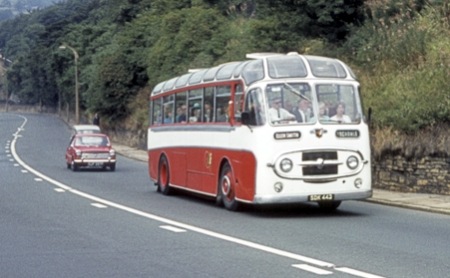


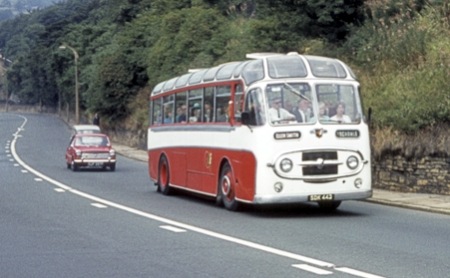
Ellen Smith’s Tours – Leyland Worldmaster – SDK 442

Ellen Smith’s Tours – Leyland Worldmaster – SDK 442
Copyright John Stringer

Ellen Smith’s Tours (Rochdale)
1958
Leyland Royal Tiger Worldmaster
Plaxton Consort Mk.II C41C

In the mid 1950’s Leyland abandoned their heavyweight underfloor-engined Royal Tiger model in favour of the very much lighter Tiger Cub. Most export customers however required something rather more substantial, so the opportunity was taken to revamp the old Royal Tiger into a longer and even heavier duty chassis to meet their needs. So was born the Royal Tiger Worldmaster. Where the old model had only a manual gearbox option, the new one had only Pneumo-Cyclic transmission as standard.
It, along with its integral equivalent the Olympic II, went on to be – undoubtedly in my mind – the most successful model Leyland ever built.
Some home market customers still looked towards something with more clout than the Tiger Cub, and a 30ft. version to suit home market requirements was introduced – the RT3/1 bus and RT3/2 coach.
Glasgow bought a large batch of the bus version in 1956, and my own local operator – Halifax Corporation – took nine in 1958, but here climbing Bradford Road out of Stump Cross near my then home is SDK 442, a 1958 Plaxton Consort-bodied RT3/2 coach of Ellen Smith’s Tours, of Rochdale.
One of two with Smith’s, it was later rebodied with a Plaxton Panorama Elite body – surviving until the company eventually sold out, and now preserved.

Photograph and Copy contributed by John Stringer


10/08/12 – 07:13

Very nice, John! I have read somewhere – but can’t lay my hands on it at present – that the "leaping tiger" logo of the Royal Tiger was based on the Ellen Smith logo which, in turn, had been inspired by a picture on a card such as used to be included in cigarette packets.

Pete Davies


10/08/12 – 07:14

A superb vehicle owned by a superb operator which offered a quality friendly service of excursions and tours from my childhood home town of Rochdale. Every other Saturday during the rugby season I would travel on an Ellen Smiths coach to Rochdale Hornets away games. Each coach had a dedicated driver who took pride in the appearance of his own vehicle. While SDK 442 was around at that time we usually travelled by one of the later Harrington Cavalier bodied 36ft Leopards but I did travel on SDK after it was rebodied.
I believe Ellen Smiths had dispensation from Leyland to use their ‘pouncing tiger’ badge as it’s fleet logo which can just be seen on the photo on the side of the coach. Perhaps someone can confirm or otherwise.

Philip Halstead


Further to my earlier post, I have found my source and can answer Philip thus, and I quote from Eric Ogden’s history of the operator, page 9:
"The striking Leaping Tiger crest applied to the sides of the coaches, first in a triangle and then in a circle, appeared in the 1930s on the Leyland Tigers. It is said that the first hand-painted image was copied from a cigarette card. This skilful freehand painting was carried out by Jack Mills who was trained as a professional painter. The design was used by Leyland as the badge for the Royal Tiger coach from 1949. The same design was used as the sign for the Royal Tiger pub in Leyland."
I hope this helps!

Pete Davies


10/08/12 – 10:47

Is this the Tiger in question www.flickr.com/photos/

John Darwent


10/08/12 – 13:47

Yes, John D, that is the tiger. It always faces "forward" on the side of the vehicle. That on the Leyland badge goes to the viewer’s right which suggests to me that they used the one from the offside of an Ellen Smith coach.

Pete Davies


Yes that’s the Tiger logo and thanks for clarifying the tie up with the Leyland badge.
To conclude the Ellen Smiths story, Harry Smith sold out to Rossendale Transport on retirement and the new owners ran the business as a separate entity for some years. The red and white livery and name were retained. I left the area shortly after and am not sure if the name still survives.

Philip Halstead


11/08/12 – 07:35

Mention of Harry Smith reminded me when I drove for Stanley Gath Coaches of Dewsbury. We frequently went on hire to Ellen Smith. We were given a reporting time by Harry who was quite pedantic about this time. If we were due to report say at 8 a.m. he told us we were not to arrive before the stated time or else. As we had come via the M62 we often had to sit and wait just up the road and then arrive as if we had come nonstop. I was always interested in the withdrawn vehicles that were dumped at the back of the garage.

Philip Carlton


12/08/12 – 07:23

Just a point to ponder. Was there something in the water in Rochdale. Not one, not two but three top notch operators. Yelloway, Ellen Smith and the Corporation.

David Oldfield


12/08/12 – 14:43

David, probably a matter of what wasn’t in the water. The stuff down here in Hampshire is nothing like the real stuff off the Pennines!

Pete Davies


12/08/12 – 17:38

It’s that Legionella bacteria what gives Pennines water its bite!

Chris Hebbron


13/08/12 – 08:44

Did Legionella give rise to one of Harrington’s biggest mistakes?

David Oldfield


13/08/12 – 08:45

The Ellen Smith name still survives. The coaches are now all black with an orange and white tigers head and large stylised tiger stripes. The tiger theme is used in marketing with their loyalty card and a range of excursions. There is a picture on Flickr of one of their coaches at: www.flickr.com/photos/ 

David Slater


13/08/12 – 11:29

…..and the Ellen Smith Flickr group has pictures of this vehicle with it’s Elite body (as a museum exhibit) and also of ODK, rebodied in the sixties as a Panorama, in service.

David Oldfield


14/08/12 – 06:47

Nice one, David O!
Was Ellen Smith the name of the woman who started up the company, or what is the origin of this name?

Chris Hebbron


15/08/12 – 08:04

Yes, Mrs Smith’s first name was Ellen and she seems to have founded this element of the family’s interests.

Pete Davies


10/10/12 – 13:30

Philip, just read your comments about the late Harry Smith.
You mention Stanley Gath. You might remember Stanley invited a group of Ellen Smith drivers to a "Yorkshire Coach Drivers" social evening in Ravensthorpe near Dewsbury (1966). We hired a coach from a Mr. Norman Fletcher (Harry would’t let us have one) and drove across to Ravensthorpe and as I remember we had a very enjoyable night.
The outcome of this though was that for the next four years we at Ellen Smith decided to hold our own "Lancashire Coach Drivers" social evening at the end of the season. All due to Stanley Gaths hospitality in the first place.

Douglas Neal


25/10/12 – 07:10

Harry did not sell out he died Eric sold to Rossendale

Smiths Driver


11/09/13 – 08:30

My name is Helen Morris and Eric Smith was my grandad. Its great to see that people are still interested in Ellen Smith. To answer some of your questions:
1. the company was founded by Eric’s grandmother Ellen Smith using money from taking in washing/sewing.
2. Originally the company owned trucks that delivered goods during the week and could be converted for passengers at the weekend.
3. Eric worked for the family business for most of his life up to the late 90’s when he retired due to ill health, specifically lung cancer. He died in October 2000.
4. I was always told that the tigers were hand painted on by my uncle Jack Mills based on a picture on a cigarette pack.
I hope this helps.

Helen Morris


12/09/13 – 08:30

Thank you Helen, for adding to the information we hold. Do you have a photo of any older company buses that you think we’d like to see?

Chris Hebbron


25/09/13 – 18:23

Chris, here’s one of Ellen Smith’s early vehicles:- www.flickr.com/photos/ There are more if you follow through on Ellen 137’s photostream.

David Williamson


04/11/13 – 16:55

Having worked for the Accountants of Ellen Smiths the books were always spot on and Eric and Harry were controlled by I think it was Margery !! I have in my possession the original cast iron company seal of Ellen Smith (Tours) Limited which was being discarded when the Company was taken over. If anyone wants this piece of history please let me know through the site.

P Curran


05/11/13 – 10:17

I would suggest the Manchester Museum of Transport would be a good home for the seal. They even have an Ellen Smith’s coach – the one above no less with its later body! I can help arrange if necessary.

David Beilby


06/04/14 – 08:17

Two points, the Halifax Worldmasters were incredibly slow vehicles, all the more surprising given the engine size. I would prefer to wait 5 minutes extra and catch the Hebble and still be in Northowram quicker than a Worldmaster. Also they had awful tin can Weymann bodies, so I really hated them!
Second, does anyone know why Ripponden & District (coaches) and Ellen Smith both had the same, or similar, logo’s of the Tiger?

John


SDK 442_lr Vehicle reminder shot for this posting


01/06/16 – 12:09

I remember both these coaches parked up at the side of the office back in the mid 70s. They were in a far sorrier state. I played in them quite a few times. There were always feral cats giving birth to kittens. As I got older, early teens I was paid by the drivers to clean the coaches when they came back. Good happy years they used to take me everywhere.
So glad to see them in lovely working condition. Thanks for reminding me.

Vincent Tolan


Quick links to the  -  Comments Page  -  Contact Page  -  Home Page


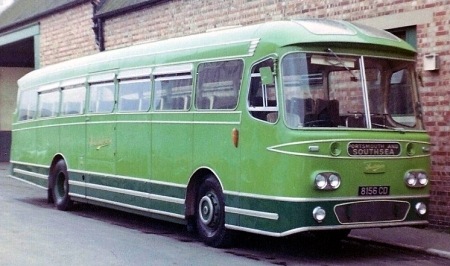
Southdown – Leyland Leopard – 8156 CD – 1156

Southdown - Leyland Leopard - 8156 CD - 1156
Photograph by ‘unknown’ if you took this photo please go to the copyright page.

Southdown Motor Services
1962
Leyland Leopard PSU3/3RT
Weymann C49F

A few weeks ago this photograph arrived in my inbox with no senders name no e-mail address and not a word of comment. Well as it is a good colour shot of a very nice vehicle and from a southern operator which I would like more of to make the site more balanced I decided to post it.
Checking into the information embedded in the jpg file it states that the shot was taken at the Southdown depot on Hyde Park Road, Portsmouth. Having just been for a drive down Hyde Park Road courtesy of Google street view I don’t think it is there anymore. The Southdown fleet unfortunately did not enter into my spotting days, way out of my area, so only know what most people have read. Anyway I still think it was worth posting, thanks for the shot Mr Anon.

Photograph Mr Anon – Copy Peter


07/08/12 – 14:44

Sorry if I offend anyone, but to me this just doesn’t look right. For my money the fanfare was a classic, but this looks as if one has been been decapitated and repaired in a hurry with whatever could be found lying around, from this angle the back window and the trim under the side ones look very Harrington like, and the end result is neither one thing or another, perhaps a bit more of the darker shade of green above and below the windows and also in the trim on the front may have made a difference. No doubt someone will shoot me down in flames, but that’s just my opinion.

Ronnie Hoye


07/08/12 – 17:40

Was this body style unique to Southdown? Never mind about the shape, just look at the livery – it oozes quality!

Ian Wild


07/08/12 – 17:49

Southdown operated 20 of these PSU3/3RT Leopards with Weymann ‘Castillion’ bodywork. They were delivered in 1962/3. The first 5 were as illustrated, and the final 15 had longer side windows, which improved the appearance somewhat. Not as pretty as the Harrington Cavalier or Grenadier though!

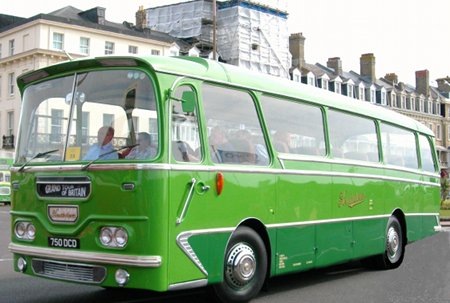
750 DCD_lr

Here is a shot of this superbly restored Harrington bodied example. The bodywork is a short ‘Grenadier’ as opposed to the earlier Cavalier.
This example was delivered in 1964, and was fitted with 28 seats in 2+1 configuration for Southdown’s Coach Cruises.

Roy Nicholson


08/08/12 – 07:23

I have to agree with Ronnie. It doesn’t look right. I have it on one side of my screen as I type this, together with a view of XUF141 taken at Wisley. XUF141 is, clearly, one of the shorter Leopards with Weymann body (Fanfare?) but, to me, this shows definite traces of Harrington. Hybrid, anyone???

Pete Davies


08/08/12 – 07:24

This is a Grenadier 3110 with a Cavalier front.

Philip Lamb


08/08/12 – 07:25

I see Ronnie’s point of view but the design does have some character and certainly looks a solid job. It seems to me that the front line bus body builders never seemed to quite hit it off when moving to building coaches. They always ended up with a dual-purpose look about them, like a ‘flashy’ bus. The Weymann Fanfare was an exception but does anyone remember those unhappy efforts East Lancs made at building coaches for Accrington and Widnes. At least they had the good grace to stick to buses after that!

Philip Halstead


08/08/12 – 07:26

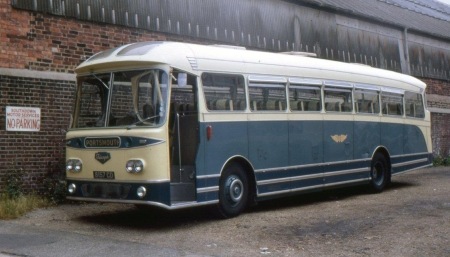
8157 CD_lr

Although the photo of 1156 was not my submission, I thought you might like sight of 1157, another of the same batch, but this time in the livery of Southdown subsidiary Triumph Coaches.
I took the photo in July 1967, on the parking area adjacent to Southdown’s Hyde Park Road, Portsmouth premises.

Bob Gell


08/08/12 – 07:27

Ronnie,
Yes, you’ve guessed – I like it. Beauty is in the eye of the beholder – which is why I guess Southdown purchased them . . . unless Weymann offered a cheaper "look-a-like-Harrington-style" than Harrington could offer. Those windscreens look identical to those on Bradford’s 256-270/286-300 batches of MCW-bodied Atlanteans (and "Manchester"-style bodies elsewhere?). Anyway, I prefer the smooth roof-line of the "Castllian" to the stepped roof-line of the Harrington offering, which . . .
Roy
Has a Cavalier front panel . . . why? Why not just produce a short Grenadier, full stop?? Did Southdown request this bastardisation, and why??? Perhaps because it looks better . . .

Philip Rushworth


08/08/12 – 08:46

Philip,
All of Southdown’s Grenadier’s had Cavalier front panels, so I suspect it was a matter of standardisation. Southdown were renowned for specifying follow on batches in similar body styles to previous batches……….Probably to disguise the age of older vehicles before the days of ‘Paddy plates’

Roy Nicholson


08/08/12 – 08:47

First an apology for the fact that the photo arrived without the text, at the time I was having a self inflicted problem connecting the two.
In answer to the comments made yes these vehicles were unique to Southdown and the second batch of 15 No’s 1160-1174 with the longer side windows did look infinitely better sleeker and more elegant (a personal view I know) this batch also lacked the perspex lights in the front dome which tidied up the looks.

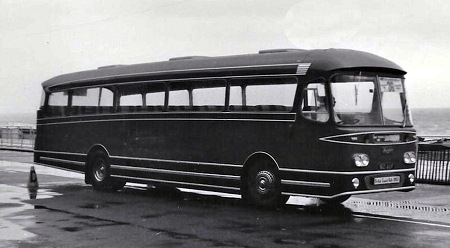
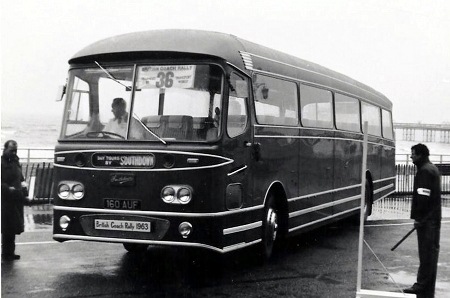
160 AUF_1

160 AUF_2

160 AUF_3

Here are some B/W photos of 1160 at a very wet 1963 Brighton coach rally, this particular vehicle was also on the Weymann stand at the 1962 Earls Court show.
Regarding Hyde Park Road the name was changed in the early 70’s to Winston Churchill Avenue and the depot name changed at the same time

Diesel Dave


08/08/12 – 15:08

A lovely batch of photos for me to enjoy, especially the Triumph one, which bring back Southsea memories. Certainly the later ones with fewer windows look sleeker.

Chris Hebbron


09/08/12 – 07:13

Are there any photos of the Accrington or Widnes coaches mentioned above?

Jim Hepburn


09/08/12 – 07:14

Apologies to Pete Davies for being picky but XUF 141 No 1141 like all Southdown’s Fanfares was on a Tiger Cub chassis. As Philip says the Castillians look a solid job and indeed they were just that and very pleasant coaches to drive, I drove for Southdown from 1969-91 at Eastbourne depot where at different times we had No’s 1160/61/62/65 all of which were among the six with only 45 seats which were low backed and leather covered in two tone green the rest were 49 seaters, 1156-59 the short window batch had high backed moquette covered similar to the Fanfares so were not as light and airy inside. These coaches looked and drove very much better than the following batches of Plaxton bodies.

Diesel Dave


09/08/12 – 07:14

Following the demise of Southdown’s favoured coachbuilder Beadle, the company switched allegiance to Weymann acquiring 35 Fanfare-bodied Leyland Tiger Cubs, bringing it more into line with contemporary BET preferences. The arrival, however, of the more powerful L2 Leopard and the availability of Harrington’s Cavalier prompted Southdown to renew its ageing coach cruise fleet with a batch of 43 vehicles of this combination in 1961/62, supplemented by a pair of Cavalier-bodied PSU3/3RT 36-footers. The same year saw the arrival of the initial five Castillians (clearly a relative of the Fanfare), also on PSU3/3RT chassis, of which three were allocated to Triumph, entered service the same year. These five coaches are sometimes wrongly described as 36ft-long Fanfares. That particular animal was never built, and if it had have been, would have looked quite different. A Fanfare stretched to 34ft and heightened to 11ft 9in was built on an LHD Worldmaster chassis in 1956 as an export demonstrator. No orders were received and the sole example, given the name Arcadian, was exported to Spain. What is more interesting about this coach is that it featured three ‘panoramic’ side windows with no ventilators — two years before the arrival of Plaxton’s Panorama! The Castillian, on the other hand, in both short- and long-window form was in the main a new design. It only found favour with Southdown probably as a follow on to its Fanfare fleet, The 15 long-window Castillians, which I agree make for a better looking coach, were also improved by their lack of ventilators, and would have looked even better in Triumph colours . . .

Philip Lamb


09/08/12 – 11:19

No offence taken, Dave! I’ve amended my records. Southdown is a foreign fleet to me . . .

Pete Davies


09/08/12 – 18:17

Granted the later version with the larger windows does look better, but it still looks like a racehorse designed by a committee. Harrington? yes – Weymann? yes but not a hybrid of the two.

Ronnie Hoye


09/08/12 – 18:18

Jim,
You’ll find a Widnes example at www.flickr.com/photos/

Mike Grant


11/08/12 – 07:09

Been away for a while, hence my silence. Back to quality over appearance – which is why Southdown probably bought them. I agree, generally, with others. I am a Fanfare fan and think the later long windowed Castillians work better.
Shortly after, Weymanns closed down and all production went to Birmingham and the newly formed MCW. Now the Topaz really was a visual dog. The later "Metropolitan" coaches were a little better – but only available on Fords and Bedfords. Some were sub-contracted to Strachans. Am I right in thinking that Starchans also produced some Orions? On sub-contract?

David Oldfield


11/08/12 – 12:02

Nice to see you’re back, David, and that you remain concentrated on the quality/performance/appearance theme. Keep watching, ‘cos your sharp and informed observations, (especially about AEC), are always worth reading.
It may be that quality influenced Southdown, but with due respect to Weymann, I can’t think that could have been a determining factor in a comparison with, say, Harrington. Nor, I suspect, would price, because although price was important, Southdown depreciated their fleet over 12 years, which minimised the effect of small price differences. Availability may have ben a factor, but it may just have been a matter of preference – beauty in the eye of the beholder again. Southdown’s choice of Queen Mary double-deckers, which many enthusiasts admire greatly, was not all that popular elsewhere. It was largely a matter of consistent overall fleet image as perceived by top management.
I found Diesel Dave’s driving experiences interesting, too. I never drove a Southdown Plaxton – only a Castillian, which, (you may like this, David), I didn’t think was a patch on M&D’s Reliances.

Roy Burke


12/08/12 – 07:13

Thanks for your kind comments Roy but, including yourself, I am by no means the only expert on this forum. There are no doubt many others who could claim that laurel. Your observations are equally on target.
A few observations. The Cavalier was a big improvement on its predecessor, possibly, therefore a holding pattern before the arrival of the Cavalier. ….. also, were they comparing metal frames on the Weymann bodies with composite on the Harrington? Finally, the rear end of the Castillian still looks like a rip off of the Cavalier – so which did, indeed, come first?

David Oldfield


19/03/13 – 07:20

Sometime in the early 1970s Hyde Park Road in Portsmouth was remodelled with some of it being renamed Winston Churchill Avenue. I was working at Yelloway at the time and, through our joint operator Associated Motorways (of which Southdown was a member), we were asked to include an extra note in the timetable for the Rochdale-Portsmouth/Southsea service for a couple of seasons which read something like ‘Winston Churchill Avenue Coach Station was previously known as Hyde Park Road Coach Station’. I called there once when passing through on holiday and I have a vague recollection of the coach station building standing all alone in quite a wide open space of redevelopment.

David Slater


19/03/13 – 11:46

You’re quite right, David, but calling it a coach station was stretching the imagination! It was a nondescript depot building with a storage yard and lots of bombsite land around it on which to park all the vehicles. The depot was not mentioned on blinds, merely ‘PORTSMOUTH – HYDE PARK ROAD’. Summertime, Southdown/Triumph coaches were stored there ready for the seafront tours.

Chris Hebbron


21/03/13 – 10:55

I can well imagine the poor state of the property Chris! Regarding the location. A comment on Flickr from ‘PD3’, a person who has taken lots of photos of Southdown vehicles including some Harrington Cavaliers parked around the Hyde Park Road garage, reads ‘The [Ibis] Hotel would have been next door to where the depot was, the land now has a building used by Portsmouth University upon it’.
Some of his photos at Hyde Park Road, which feature buildings in the background, include: //www.flickr.com/photos/one  
Without realising it, I already had a photo on Flickr of the timetable for the Summer 1973 joint Yelloway/Associated Motorways Rochdale-Portsmouth/Southsea service which features the statement ‘Winston Churchill Avenue Coach Station was previously known as Hyde Park Road Coach Station’ //www.flickr.com/photos/two

David Slater


02/02/14 – 16:21

With regard to Chris Hebbron’s comment about Southdown/Triumph coaches being parked at Hyde Park Rd ready for Excursions, that is not really correct as the Triumph fleet was permanently based there, including the 3 Weymann-bodied Leopards. Had you visited on a Saturday/Sunday you would have found very few coaches there as they were either in the North (mainly) of England having worked Forces leave services on Friday evening, returning overnight on Sunday. While away from Portsmouth, they worked on the Saturday for local operators, so that fore example a coach working to Leeds on Friday would then be ‘on hire’ to West Yorkshire and work from Leeds to Scarborough or perhaps Morecambe on the Saturday.

Paul Statham


8156 CD_lr Vehicle reminder shot for this posting


31/08/17 – 05:00

One thing one has to admit about the Harrington bodies was that they remained rattle free long after others had deteriorated. 1750, shown above, was most famous for being ‘The Albion Car’, piloted by Bert ‘Crasher’ Mills for the Brighton football team.
Having renamed Hyde Park Road in the early ’70s, I well remember an indignant patriot sending in a complaint to Southdown House in Brighton. All that could be squeezed into the destination box was ‘Portsmouth W C’hill Ave’ and our complainant was incensed that our wartime leader had been reduced to ‘W C’hill’.

Nick Turner


Quick links to the  -  Comments Page  -  Contact Page  -  Home Page


All rights to the design and layout of this website are reserved     

Old Bus Photos from Saturday 25th April 2009 to Wednesday 3rd January 2024