Old Bus Photos

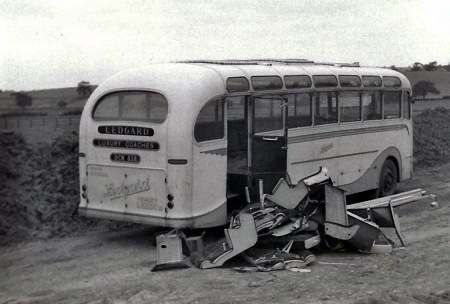
Samuel Ledgard – Guy LUF – DCN 838
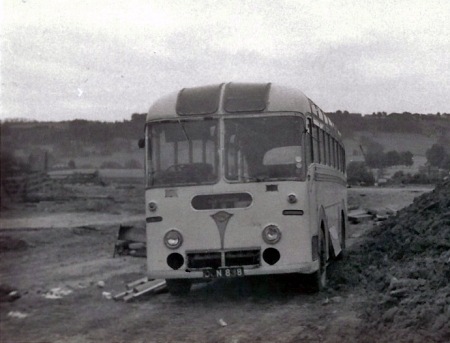
Samuel Ledgard - Guy LUF - DCN 838
All three shots from the Stephen Howarth collection

Samuel Ledgard
1954
Guy Arab LUF
Picktree C35F

DCN 838 was new to Samuel Ledgard in 1963, it was one of 35 second hand vehicles added to the fleet in an attempt at some sort of standardisation, in order to reduce stocking a wide range of spare parts.
It was new to Northern General Transport in 1954 as their 1538. A Guy Arab LUF – Chassis No LUF 72189 it had a Picktree C35F body.
It passed to West Yorkshire Road Car Company on 14th October 1967, upon the takeover of Ledgards by that company. It was never operated by WYRCC.
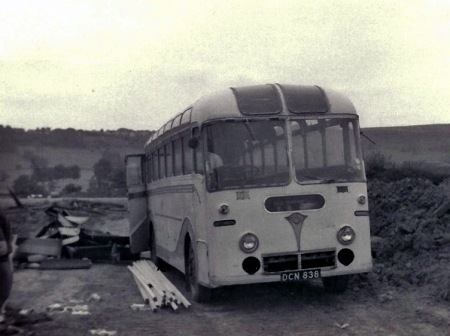
Samuel Ledgard - Guy LUF - DCN 838

Samuel Ledgard - Guy LUF - DCN 838

The three pictures show it in a sorry state in July 1968 being used as a Site Office with William Press at Leathley, not far from its home ground.

Photographs and Copy contributed by Stephen Howarth

———

19/08/12 – 12:05

If my records are correct, Northern had 13 of these, they were fitted with Gardner 6HLW engines, and you’ve said they were built by Picktree coachworks, which was more or less next door to Northern’s Chester Le Street depot. They were designed by Doug Pargeter who had previously been with Northern Coachbuilders. I don’t know of any others of this type, so they may well have been unique to Northern General. Unlike most of the coach fleet which were predominantly cream, these were all red, but looked very smart and were always well turned out. They were built mainly for continental work, and the off side emergency door was designed to allow easy access to to vehicle whilst it was being used in Europe. I’m not aware of any survivors

Ronnie Hoye

———

20/08/12 – 07:53

It seems that Picktree Coachworks was founded on 6th September 1947. The coach building side of the business tailed off in the mid 1950s – possibly these Guys were the last Picktree bodies of all – and its latter day activities consisted of the sale of motor vehicles. It closed down in November 1996, being fully wound up in April 1998. As far as I can gather, the bulk of Picktree’s output went to Northern General, who also had some curious Picktree bodied AEC Regals known as "kipper boxes" whose chassis incorporated components from older machines. It is certainly probable that the Guy LUF coaches carried over much of the design expertise from Northern Coachbuilders, and they were generally considered to be high quality vehicles. We certainly need Chris Y to give us his valuable insight into their life with Samuel Ledgard.

Roger Cox

———

20/08/12 – 07:54

What a sad end for a fine coach These were my favourite Ledgard coaches. They had well appointed interiors complete with aircraft style drop down tables in the seat backs. I had a number of trips on various members of the batch and they were a very smooth riding machine with a very melodious transmission.

Chris Hough

———

20/08/12 – 07:55

Just as a footnote to my previous comments. I don’t know when it closed, but Northern had a booking office in Pilgrim Street Newcastle which was just round the corner from Worswick St Bus Station. As a youngster I remember that in the centre of the window they had a model of one of these on display in a glass case. I don’t have a clue what scale it was, but to a boy of about 8 or 10 it looked huge, I wonder what happened to it?

Ronnie Hoye

———

20/08/12 – 11:46

What very sad but inevitable pictures Stephen, and so close to the operating area of these fine vehicles too. I am somewhat puzzled though by the theory that they were purchased with "standardisation" in mind, and with respect I don’t think that this was the case. Rather, I think they will have been snapped up as an absolute bargain in mid life highly luxurious coaches on well proven and reliable chassis, and from an operator with high maintenance standards too. There is no doubt at all that they were in superb order when they arrived, and they gave impeccable service. I was a devotee of the old Ledgard original livery of dark blue, cream and black for coaches, and the "DCN"s looked majestic and dignified so painted. The final ivory and pale blue colours were just "not them" and didn’t suit their traditional and individual styling at all I’m afraid.
We had eight of them, DCN 831/4/5/6/7/8/9/40, and DCN 832 was bought from Wood’s of Pollington for spares only. DCN 831 was at Otley from Day One and was a joy to drive – Chris Hough so rightly says that they were smooth riding (exceptionally so) and the transmission was quietly melodious – in fact these coaches simply oozed refined quality. I was once sent to the Morley Street stand in Bradford to work a half day excursion to Bridlington (such outings were legion in those happy days) where the manager, Mr. Tom Kent, was supervising the loading. Any prospective passengers viewing the chrome and glitter of the opposition companies were quietly informed with a gesture to 831 and "Nice seats here." By departure time the Guy was full and off we went – all without exception commented on what a lovely vehicle to travel in, and were very impressed by the Gardner’s competent and swift ascent of the notorious Garrowby Hill twixt York and Bridlington.
Returning briefly to the "standardisation" theory, I wonder if this perhaps arose from the purchase in 1963 -5 of the thirty four London RTs and five RTLs – certainly standardisation was the aim there, and they formed by far the largest class of identical vehicles in the Company’s history – sadly our "swan song" in view of the impending doom of October 14th 1967.

Chris Youhill

———

20/08/12 – 11:47
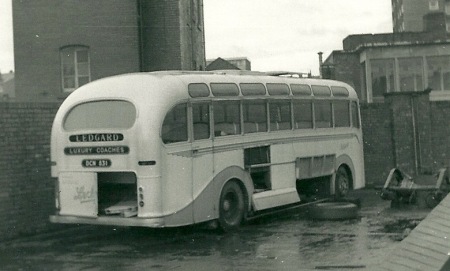
DCN 831_lr

I have been having another look through a box of pictures and came across this one. It is of similar coach DCN 831, again in a state of disrepair, hope it does not upset you too much seeing it this way Chris.

Stephen Howarth

———

20/08/12 – 14:05

Well Stephen, the entire saga of the demise of Samuel Ledgard upsets me but we just have to put up with it I suppose. The almost unreal proceedings in the week leading up to Saturday 14th October 1967 are still a sore point with enthusiasts and passengers, the latter never having had a truly satisfactory and reliable service since that date. DCN 831, in your latest picture of the near deserted roof of Armley Depot, was of course the vehicle which was always allocated to Otley Depot and, yes, I suppose I am still sad but there we are – the whole nature of the bus industry has altered out of all recognition and that’s that isn’t it ??

Chris Youhill

———

20/08/12 – 14:09

Sad to see this view of DCN 831, Stephen, as it captures its early demise on the Armley depot roof in June 1967, just a few months after it received a full repaint. This premature scrapping was because of badly decayed body pillars discovered during the repair of two accident-damage off-side panels (one of them seen missing in this picture?). I was fortunate enough to photograph it at Otley when freshly repainted two months earlier – see this link www.sct61.org.uk/

Paul Haywood


Quick links to the  -  Comments Page  -  Contact Page  -  Home Page
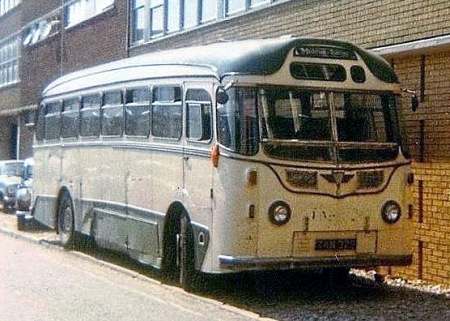


Maidstone & District – AEC Reliance – TKM 329 – C329

Maidstone & District - AEC Reliance - TKM 329 - C329
Copyright Chris Hough

Maidstone & District Motor Services Ltd
1954
AEC Reliance  MU3RV
Harrington C37C

A recent posting led to a discussion about the relative importance in a PSV of economy, reliability and good looks, and I picked this vehicle as an example that in my opinion embraces all three qualities. Beauty is in the eye of the beholder and my personal preferences may not be shared by others, but the lines of these coaches always seemed to me to be well-balanced and elegant in an understated way, if, perhaps, a trifle old-fashioned. The styling of the roofline around the destination indicator was a treatment popular with many coach builders and operators for front-engined vehicles, but by the mid-1950s, the effect had become a bit dated. Very appealing, nevertheless, and the epitome of high quality and pedigree.
Sadly, C329 doesn’t look its best in the photo – absolutely no criticism of Chris’s camera work, but following withdrawal it’s become scruffy and the sun’s angle casts a shadow that exaggerates the front windscreen divisions. Also, the ‘moustache’ beading may seem fussy, but it was almost an M&D trademark. I’d be grateful for other correspondents’ views on C329’s attractiveness or otherwise.
[This link will show C328, in rather smarter condition.]
M&D were substantial Harrington customers for many years and they had almost 50 vehicles of this design in their extensive, (I’d say excessive), coach fleet. By the time I joined, they had been withdrawn from front line express duties, however, and were kept mainly to provide summer capacity. Like every underfloor-engined AEC I ever drove, their road manners were impeccable. Even the prospect of a spell at the wheel was a pleasure to look forward to. They were also both economical and very reliable.
Inside, these coaches were not, perhaps, as light and airy as some of their contemporaries, but there was no sense of claustrophobia. On the contrary, they conveyed an atmosphere of relaxation, reinforced by the wonderfully comfortable seats and by their extraordinary quietness. Their main drawback, (only drawback as far as I’m concerned), was the centre entrance, which made it uneconomic to convert them to other uses.

Photo by Chris Hough. Many thanks for his kind permission to use it.

Copy contributed by Roy Burke

A full list of Reliance codes can be seen here.


17/08/12 – 07:22

6 of this batch were acquired by Yorkshire Woollen where they were nicknamed Gunboats by the crews.TKM 304/26/347/348/9/5O were numbered 435-440. They were purchased to replace a similar number of Commer/Beadles. Another member of the batch was purchased by Hebble Motor Services at Halifax to replace an ex Red Line Reliance that was a fire victim. After YWD they went on to an operator called Davies of Ferryhill County Durham except for 436 that was broken up by YWD after a bad accident.

Philip Carlton


17/08/12 – 07:23

As a northern boy I didn’t get to see the inside. My personal view of the outside is of a fine looking coach. Perhaps one-too-many windows/panels. One less, but slightly longer would have enhanced the appearance, and the roofline over the front is not enhanced by the application of the livery. In my opinion the cream area should have followed the outline of the roof – then- almost perfection. No doubt others will say tosh, but that’s my thought.

Les Dickinson


17/08/12 – 10:26

The box for the fleetname over the destination and service number boxes doesn’t help the outline. Either omit the fleetname or omit the service number box and have the destination and fleetname side by side. Then use another BET operator’s style of livery (Ribble or Southdown) and it would make quite a lot of difference. As we are, it seems a feeble attempt at imitating the Silver Star front dome.

Pete Davies


17/08/12 – 12:32

As a Kentishman I have to say I can’t see anything wrong with the livery or layout of the destination!
Shame to see this looking so scruffy though – I remember these coaches featuring on the cover of M&D’s tours brochures which were captioned "Over the hills and far away".
The Silver Star "headboard" was an abomination on this design and ruined an otherwise graceful look.
All these things are of course subjective…

Andrew Goodwin


17/08/12 – 12:33

Roy is right about the state of the coach and very kind about my photograph! The coach was parked in a back street in Preston and was certainly not in the M&D fleet! Like a number of fifties coaches these seem to be built like the proverbial brick Outhouse!

Chris Hough


17/08/12 – 16:29

I have to disagree with Andrew on this one – I thought that the Silver Star Wayfarer Mark 2s were vastly improved by their headboards, unlike that operator’s all-Leyland Royal Tigers and Burlingham Seagull which really did look atrocious. Preservationists seem to agree with me as both MMR 552 and 553 are still with us, and the owner of "553" once told me that there was a waiting list of people who wanted to buy the coach from him at any reasonable price. If I ever win the jackpot in the lottery I will outbid them all!

Neville Mercer


There is a posting of them both together coming shortly. Watch this space as they say.

Peter


18/08/12 – 07:40

In my opinion, which doesn’t count for much…I think that destination information on the front of bus/coaches should always be upright so that reflections are reduced and they become easier for those of us whose sight is not 20/20 to read at a glance. Obviously that would not tie in very well with the design of this coach, but I must admit that the picture of it in the link is very smart and clean…

Norman Long


20/08/12 – 08:05

Funny: until this very moment I’ve looked at photographs of these vehicles and thought "M&D coach, nice": but all of a sudden the affinity with some nasty little Gurney-Nutting(?) bodied Commers(?) has struck me, and now I just find them hideous. Why? The "pinched-in front", the way the front dome just seems to push the already squeezed-in front down, giving a sort of hump-backed appearance to the whole thing – and there are too many windows, which (on their own) I could live with. Ugh. In full M&D rig and in the context of when they were built it might have been a different story . . .

Philip Rushworth


20/08/12 – 09:08

Philip, nice to see there are people who can call "the Emperor’s new clothes" in the face of popular opinion.
M & D vehicles were just magnificently turned out, but I never rated these Harringtons. They got it very right with the Cavalier/Grenadier but the Bedford/Ford versions were hideous and the Legionnaire not much better. Balanced design again – you either have or you don’t.

David Oldfield


20/08/12 – 14:02

I’ve held back until now on commenting about these Harrington bodies, but seeing that Philip Rushworth and David Oldfield have entered less than rhapsodic views about them, I will say that I always thought them to be incredibly ugly vehicles. Just compare the styling with other contemporary designs using curved corner glasses at the front – the classic ECW LS coach, for example. Harrington did very much better with the Cavalier.

Roger Cox


24/08/12 – 08:36

Who’d build coach bodies – it’s a fickle market isn’t it? driven by fashion, rather than by loyalty. Burlingham got it right with the "original" Seagull then missed the "zeitgeist" with subsequent offerings; as did Harrington with the Cavalier/Grenadier; Duple seemed to judge the market right for many years until gradually loosing the plot and fading away in the 80s(?); and Plaxton seems have picked up from the mid-1960s with the introduction of the Panorama. However, history seems to suggest the Plaxton’s days are numbered, and that they are due to misjudge the market and enter decline (look what happened to Leyland et. al.) . . . but there aren’t any more British coach builders to take their place!

Philip Rushworth


24/08/12 – 12:24

You’re so right Philip. Duple lost the plot and went bust at the end of the ’80s – when Plaxton bought their intellectual rights. Duple’s is a very sad story inexorably linked with a certain Mr Ford who had previously fallen out with Plaxton and moved over to Duple – hence the vague similarity between the Panorama Elite and the Dominant.

David Oldfield


24/08/12 – 12:25

Seems I’m in a small minority in liking this design. At the risk of losing whatever tiny credibility I might ever have had in these pages, however, I remain unrepentant.

Roy Burke


24/08/12 – 15:43

You’re still welcome and entirely entitled to your own opinions, Roy. There are times when – in my professional, musical life – I differ from my colleagues. Grown ups accept each other, regardless (and I think most of us are grown up on this forum).

David Oldfield


11/02/13 – 13:27

You’re not alone Roy, I like the Wayfarer 2 style as well. I don’t think it was as nice as the later Wayfarer 4 but for an early 1950s body, I think it was quite stylish. It did make an attempt to get away from just being a box, which is so easy on an underfloor flat front single decker. I think Harrington bodies were all of real quality and generally well styled (with as always the obligatory exception). They were certainly better looking than many of the competitors’ efforts.

Gordon Mackley


14/06/13 – 07:31

The Reliance Harrington C37C don’t remember them even though grew up with M & D but can say I was on one just last week don’t remember batch but sure worked all over the M & D patch ended its days think in Bexhill can say a very impressive coach so as they say watch this space soon be out of hiding.

Paul


TKM 329_lr Vehicle reminder shot for this posting


08/06/15 – 16:08

Maidstone and District’s Wayfarer 2 bodies came on three different types of chassis and they were each very different. The most numerous (in terms of both vehicles and photos) were the AEC Reliances. The Leyland Royal Tiger versions had central entrances like the AECs and might have been expected to be the same but in fact had vertical rather than sloping window pillars. The Commer Contender versions were of a completely different configuration, having front entrances. Interestingly the centre entrance coaches had front offside emergency exits and the front entrance Contenders centre ones!

Gordon Mackley


Quick links to the  -  Comments Page  -  Contact Page  -  Home Page


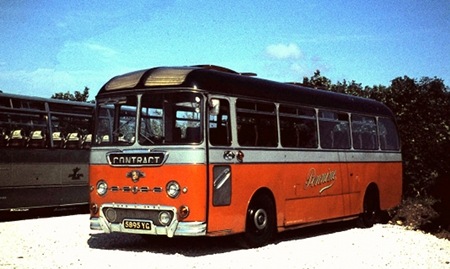
Pennine Motor Services – Leyland Leopard – 5895 YG

Pennine Motor Services - Leyland Leopard - 5895 YG
Copyright Pete Davies

Pennine Motor Services
1962
Leyland Leopard
Duple DP41F

Here is a photo of 5895 YG, Leyland Leopard with Duple body, in the fleet of Pennine Motor Services, then in Gargrave. I took the photo in Morecambe in June 1970. Note the SALOPIA vehicle alongside.
This vehicle was the last of four of this style, the other three being on Tiger Cubs UWX 277, 6108 WU and 9712 WX, so close inspection shows subtle changes over the years. The next new addition was 240 CWY, which Roger Cox posted elsewhere on the site a while ago.

Photograph and Copy contributed by Pete Davies


15/08/12 – 08:06

Herewith the conundrum as to what constitutes a C or a DP. Yelloway thought they were too bus like and only bought one batch but most things, including the entrance door, make this look more like a C than a DP. The same thing befell the Sheffield Transport Leopard/Burlinghams which were DP because they were based on a modified bus design rather than the Seagull – but they were really just as much coaches as their Weymann Fanfare and ECW contemporaries.

David Oldfield


15/08/12 – 11:34

Interesting point, David. From an operational point of view, the issue of whether a vehicle was a C or a DP generally depended on three factors: use, seating and livery. As OMO became more prevalent, provincial operators realised that front entrances enabled relatively easy and cheaper downgrading, especially if the eventual fate of new vehicles was considered when they were bought.
As for external appearance, a sensitive compromise was needed: too bus like, and passengers might feel they were being offered second best if they expected a coach; too coach like could mean problems displaying stage carriage destinations later in life.

Roy Burke


15/08/12 – 11:55

I’m not sure if it was still known as the ‘Donnington’ by this time but it definitely improved with age (like we do!) When it was first introduced, it had too many shallow side windows, perhaps a throwback to the old ‘Roadmaster’ design. This one, with just five deeper side windows is a great improvement and looks very nice. Yelloways were of the original design which would explain why they didn’t like them!

Chris Barker


15/08/12 – 14:47

The screen and front dome of the Donnington were shared with contemporary Willowbrook Viscount (cf Devon General). [Interesting how Duple recycled two Willowbrook names – Viceroy and Viscount.]

David Oldfield


15/08/12 – 14:48

The five bay version was known as the Donington 2 and was used by, among others, MacBraynes. I produced a resin kit of it in fact!
The design was built by the Duple Midland operation and was effectively superseded by the Britannia, which was very popular and shared the same front grille mouldings.

Andrew Goodwin


16/08/12 – 07:33

The correct spelling is Donington with one "n" – the body was named after the Donington Park motor-racing circuit close to the Duple Midland works in Loughborough. Donnington with "two ns" is in Shropshire.
As you say this version of the Donington (actually its third incarnation since the first prototype was built in 1956 – the first version was built from 1957-58 and lacked the "chain" motif in the front panel) is by far the most attractive due to the deeper windows.
I’m left a bit confused by the comment that "the Donington was replaced by the Britannia". The Britannia design was first introduced in 1956 and the last were produced in 1962, the same year in which the Donington was deleted from the Duple catalogue. Both models were replaced for the 1963 season by a choice of either the (Hendon built) Commodore or (Blackpool built) Commander. Dual purpose options then became the preserve of the Willowbrook subsidiary and were built to "BET standard" design.

Neville Mercer


16/08/12 – 14:24

Yes Neville, I assumed that the draughtsmen who wrote "Donington" on the drawings knew what they were doing!
I didn’t actually say it was replaced by the Britannia but my choice of words was perhaps unfortunate. What I meant to convey was the relative popularity of the Britannia as against the Donington leaving the latter with fewer sales.
As you will no doubt tell us there were at least three versions of the Britannia as well!
Reference the comment above about Willowbrook model names being recycled, Park Royal also did this with the name Royalist though the second version was anything but successful, not helped by being initially built on a second-string chassis rather than a front line player.

Andrew Goodwin


17/08/12 – 07:07

You’re quite right, Andrew, there were several versions of the Britannia. The original version, brought to market in 1956 to replace the Elizabethan, had a curved waist-rail and introduced the "chain motif" to the Duple range. All of this first version had front entrances, but were offered alongside the Britannic which had a central entrance and retained more of the styling of the Elizabethan. The Britannic was quietly dropped from the catalogue in 1957 and few were sold.
The second version of the Britannia formed part of a new range of designs exhibited at the 1958 CMS at Earls Court and shared many components with the new version of the Super Vega built on Bedford SB chassis. Basically similar bodies (but at that stage nameless) were also offered on Ford and Commer chassis. As far as I can tell from my own records the Mk II Britannia was only available with a front entrance at first, but from 1960 onwards a new central entrance design with a much more curved profile at the front end was also offered. The most famous of these were probably the examples operated by Samuelsons in London and St Helens Corporation.
There were minor detail changes to both front and central entrance versions in 1961, but you really have to look hard to see the difference – a tiny destination blind incorporated into the front bumper is the most visible clue.
By 1962 orders for both Britannias and for the Donington had reduced to a trickle due to competitive pressure from the much more stylish offerings from Plaxton and Harrington. Duple realised that it was losing its share of the heavyweight coach market, dumped the Britannia, Donington, Willowbrook Viking and Viscount, and the entire sadly bastardised Burlingham range from the catalogue, and replaced the lot with the Commander (with vertical window pillars) and the short-lived Commodore (with a "Bella" style raked back pillar towards the rear).
Sorry to go on, but as you might have noticed I have a thing about pre-1965 coach designs!

Neville Mercer


17/08/12 – 07:08

David and Roy have a valid point. Shortly after I joined Armstrong Galley ‘the coaching division of T&W PTE’ we took delivery of 15 Leyland Leopards GBB 985/999N fleet numbers 85/99 – 86/95 were 53 seaters with DP doors, but still had the comfort and overall look of a coach, and 96/99 were 45 seaters with coach doors, However, 85 was a totally different animal, it was in actual fact the first Alexander ‘T’ type ‘rumour has it that one or two of the Scottish bus group companies weren’t too pleased about it going to T&W’ but back to the plot, the vehicle itself was first class, but with the best will in the world it was a bus with coach seats. A/G did quite a lot of hire work for National Travel,and a fair amount of contract work, so 85 was always first choice for that, it was later transferred to the stage carriage fleet, and I think it was sold on after that

Ronnie Hoye

Sorry, should have said that the 14 coaches were Duple bodied


17/08/12 – 07:11

Externally all forms of the Donington look like buses to me, except when dolled up with Britannia/Vega trim, as here //sct61.org.uk/  It’s amazing what a few bits of metal and an association of ideas can do!

Peter Williamson


21/08/12 – 07:41

Castle Donington (one n in the middle!). The village has long suffered having people mis-spell its name, just as many folk think it is in Derbyshire because of the postal address, but it is in Leicestershire.
The Duple Donington body. Duple purchased the business of Nudd Brothers and Lockyer in 1952, renaming it Duple (Midland) Motor Bodies. Nudd’s premises were a hanger on the former Castle Donington airfield, now East Midlands Airport. Nudd had experience of metal framed bodywork, hence the Duple interest and the name of the design of the Duple metal framed body. The technology of the time may have resulted in the rather angular design and the small windows used at first.

Mr Anon


01/08/14 – 16:29

I found the comment on ‘DP’ v ‘C’ interesting, as I’ve never been quite sure where the difference lay, and there are clearly several ‘grey areas’. One of my main questions is how the Ribble PDR1 ‘White Lady’ Atlanteans justify the designation ‘coach’, at least among enthusiasts. The roughly contemporary Leopards with BET-style bodies by Marshall and MCW are always referred to as ‘DP’, though in terms of comfort, style or usage there was little to distinguish them from the Altlanteans; if anything the Leopards were marginally more coach-like internally and ventured further afield. But both types were effectively buses fitted with headrest seats and luggage racks, and consequently had the claustrophobic feel of being packed with a lot of stuff that they were not really designed for. Both were mainly used on relatively short inter-urban express services, at least one of which (the X43 Manchester-Skipton) was actually a stage carriage route at its country end. Doses it really just boil down to the double-deckers’ almost all-ivory livery, compared with rather more red on the saloons? But then in NBC days the Atlanteans (by then well past their unimpressive best) were given service bus livery, while the Leopards got the DP treatment! Was it just that the Atlanteans hijacked the justified ‘C’ designation of their upmarket cousins, the ‘Gay Hostesses’? And as for the earlier generation of Titan ‘White Ladies’ — though admittedly I’m too young to remember very much about them — how could anything lowbridge ever really be called a coach, however much chrome you put on the outside?

Keith


15/10/19 – 05:48

This coach finished it’s day parked along the workshop at Berresford Motors Limited in the role of mess room. I believe it was still in situ when the business was sold to PMT.

Leekensian


Quick links to the  -  Comments Page  -  Contact Page  -  Home Page


All rights to the design and layout of this website are reserved     

Old Bus Photos from Saturday 25th April 2009 to Wednesday 3rd January 2024