Old Bus Photos

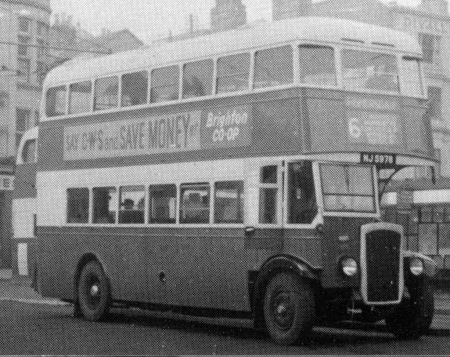
Brighton, Hove & District – Dennis Lance II – NJ 5978 – 6315
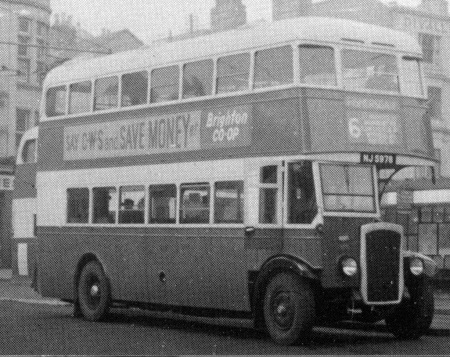
Brighton, Hove & District - Dennis Lance II - NJ5978 - 6315
Copyright R A Mills

Brighton, Hove & District
1935
Dennis Lance II
Tilling H30/26R

Not a big user of the marque, Thomas Tilling, nevertheless, for Brighton town services, bought four Dennis Darts, then two Dennis Aces between 1932 and 1934.
In 1935, they then bought six Dennis Lance II’s, adding Tilling bodywork in the style of their 80 London STL cousins. Here is 6315, standing, driver’s door ajar, at Brighton Station, not long after the war. It is blinded for Fishersgate (Portslade).
Unlike its London cousins, it shows no trace of body sag! The radiator has the style of those fitted to the sweet little Dennis Darts of the early 1930’s and not the ‘Dutch Roof’ design, thick or thin, that had DENNIS across the radiator centre. This one has a small DENNIS plate below the radiator cap. Although it has the archaic triple window front upstairs, the larger BH&D blind box suits this front more than the ‘pinched’ LT style did. One change is that the rear upstairs emergency exit does not have twin windows that its London cousins possessed. All six were withdrawn in 1949.

Photograph and Copy contributed by Chris Hebbron


27/08/12 – 20:07

As at 3.35pm on Monday, I find nobody has yet had a comment published about this. Surely, you’ve not left us all speechless, Mr Hebbron??? (More likely, of course, that Peter hasn’t had chance to post the comments made already.)
I’ve seen a few buses with the triple front windscreen arrangement, and they seem to have been London types for the most part, with a few CIE vehicles as makeweight. I can understand that the London ones may have fallen under the influence of the Metropolitan Police, but what about CIE? Did they simply like the design and stick with it for many years?

Pete Davies


27/08/12 – 20:11

Chris. Many thanks for the super photo of a BH&D Dennis Lance. It was news to me that they had any Lances, which were very uncommon in Tilling controlled fleets, as I can only think of the 1936 pair at Southern Vectis, with the later radiator. Perhaps this was due to Dennis persevering with the 4 cyl. notion of a double deck chassis, which most had, I believe, in petrol and/or 04 (Lanova ?) form.

Dennis had supplied the Tilling group with substantial numbers of petrol engined Lancet 1 single deckers, and the standard small bus was the Ace, but with the advent of Bristols in the group,Dennis were keen to protect this business. Consequently, trial batches of Lancet 2s , with 04, or 5LW engines, were supplied, but as far as I can see, the only fleet to take any real number was Caledonian. What engines did these Lances have, and when did BH&D start to convert their AECs to oil engines?
Indeed, when were their first Bristol Gs or Ks delivered?
The Lances lasted well, did n`t they, especially as they were not so different from the London collection (DL class) which were all gone by about 1937, albeit a year or two older.
More detail of the Brighton fleet up to 1950 would make delightful reading!
The Lances of the later 1930s, as supplied to Walsall, and Merthyr, had very compact cabs because of their short 4 cyl. engines, theoretically enabling more effective use of passenger space, a bit like the Daimler COG5/40 concept. Fascinating stuff!

John Whitaker


27/08/12 – 20:16

These Brighton, Hove and District Lances were numbered 6311 to 6316, registrations NJ 5974 to 5979. The bus in the picture would appear to be 6315, NJ 5978. The pre war Lance never used the heavy style of radiator of the Lancet I, but the version used on these BH&D Lances appears to have been a slight variation upon the usual contemporary pattern which had a tapering grille set within a parallel sided frame, the bottom edge of which formed a shallow "V". Other Lance IIs, notably those of Aldershot and District, used the high set oval radiator of the Lancet II (and later III) which resulted in a decidedly restricted view from the cab. The Tilling bodies on three of the BH&D Lances, 6311/4/6, were rebuilt by Portsmouth Aviation in 1947, which made their withdrawal just two years later seem rather a profligate decision. I cannot establish if these Lances were powered by the 6.1 litre 100 bhp 6 cylinder ohv petrol engine or the 6.5 litre 85 bhp sixteen valve 4 cylinder O4 diesel, though, in view of the severe gradients in parts of the Brighton area, the petrol version would have been more likely.

Roger Cox


28/08/12 – 18:01

I don’t think that the three-window design would have been anything to do with the Metropolitan Police regulations. It’s notable that the LGOC effectively abandoned three windows around 1930 and all their Regents and Renowns had two windows, whereas Tilling and many of the independents continued to have three windows.
I suspect that it had more to do with the need on buses without roller blinds for a large opening window for the conductor to lean out of to change the destination boards. By the time the Tilling STLs came out I suspect it was just a styling hangover.

Michael Wadman


30/08/12 – 11:49

It is good that BH&D has been given an airing thanks to Chris H. 6315 was one of a batch of six Dennis Lances that were operated by BH&D and were the last petrol-engined double decker buses to join the fleet. They were converted to diesel as follows: – 6312, 6313, 6315, 6316 received Gardner 5LW engines between 1942 and 1946 and 6311,6314 were fitted with AEC 7.7 engines and radiators. When withdrawn in 1949, they were all sold to Westcliff-on -Sea Motor Services Ltd for further service. I do hope we will see more BH&D buses on this web site soon.

Richard Fieldhouse


31/08/12 – 07:29

The three window design for the upper deck was also used on pre war trolleybuses in Huddersfield Indeed a batch of Park Royal Sunbeams of 1949 also had this styling.

Chris Hough


31/08/12 – 07:30

Thx, Richard, for the additional info.
If the condition of these vehicles is as good as seen in the photo, plus diesel engines, I’m not surprised that they were sold on for further service, Richard. Wonder when they finally went for scrap?
Strange that they were re-engined with two types of engine. The fitting of AEC radiators to 6311 and 6314 was an unusual move. I wonder if changing petrol engines for diesels was a common action in the war. I’m not aware that it was.

Chris Hebbron


31/08/12 – 09:42

I was surprised to learn about the Gardner 5LW engine changes in the war period as I believe these were in very short supply and tightly regulated by the Ministry of War Supply. The Daimler Company had only a limited supply of 5LW engines for their production of the CWG5 model in 1943. I can only assume BH&D may have had a few 5LW engines in stock. I have no knowledge about the Dennis Lance operation in Westcliff but I believe the AEC engined Dennis Lances were converted to open top, so possibly ran for some time into the mid-fifties. However another related war time matter that has always been hard to understand is how BH&D could store 7 new AEC 661T/Weymann trolleybuses from 1940 to 1946 when other towns and cities were in desperate need for trolleybuses. Brighton Corporation AEC 661T/Weymann trolleybuses were loaned to Newcastle during the war.

Richard Fieldhouse


04/09/12 – 08:44

Another operator of buses with three windows at the front of the upper deck was Luton Corporation, who operated some pre-war Daimler COG’s with Willowbrook lowbridge bodywork thus fitted. A picture appears on this very site! (see Luton Corporation). A brief look at a fleet book I have reveals Luton operated several Daimlers of CH6, CP6 (petrol), and COG5 (diesel) types, all with Willowbrook L26/26R bodies. These had the lowbridge gangway on both nearside and offside, and were new from c.1933 to 1938, most surviving into post-war years, being withdrawn c.1948-1953. I believe the use of the double lowbridge gangway was originally used to avoid the patent payment to Leyland for their 1927 design, but I think that this was cleared by c.1933/34, so it’s continued use after that date must be operator preference / standardisation. Presumably the three-window upstairs layout suited the two-gangway/central seating block layout inside.

Michael Hampton


18/04/13 – 07:05

Just to keep the record straight the SIX Southern Vectis Dennis ‘Lance’ double deckers delivered in 1935 had Gardner 5LW diesel engines from new.

Patrick Hall


30/07/13 – 15:37

The six Lances [600-605] ADL 500-505 for Southern Vectis were delivered in 1936 with 600/1 arriving 29/5/36 and 602-5 arriving -/6/36.
They had a hard life with SV especially during the war years but still managed to give 17 years service [600/2/4] or 18 years [601/3/5], so the last ones were still in use as spare buses when the first Lodekkas arrived!
Apparently [604] survived with a Showman in Gloucester until November 1965.
Any further news/photos of them welcome.

Vectis83


31/07/13 – 07:51

Here, at least, are a couple of photos of them:
Here’s a photo, behind the T-S, of 500 in pre-war livery (and large SV lettering) – See (scroll): //tinyurl.com/klbxrz7
Here’s a late photo of 504 – See (scroll down): //tinyurl.com/oe358ku

Chris Hebbron


31/01/14 – 10:12

First of all a correction to a commonly made mistake – the company to which the BH&D Lances went was Westcliff-on-Sea Motor Services NOT WestcliffE …
Of the six Lances one, NJ 5976 was converted to open top (I think by Westcliff, not by BH&D) and used on the Southend sea front services. The others were used mainly(possibly entirely) on contract work. One later finished up as a store at Southend depot. Several later acquired AEC radiators. None received Eastern Nation fleet numbers in July 1954, so they must all have gone by then. I think (but cannot check, as I cannot locate my copy) the recent history of Westcliff has a photo of one with that company.

Brian Pask

Thanks Brian I have corrected the spelling of Westcliff.


02/05/14 – 17:55

Further to my query posted above in August 2012, about how BH&D could store their new AEC661T/Weymann trolleybuses throughout the period 1939 to 1945, perhaps some correspondence from the LPTB to the BH&D Tilling Group may put some light on the matter. Michael Dryhurst has written a most interesting "What if–" article in "Classic Bus" no.130 April/May 2014 on these stored BH&D trolleybuses. It would seem the LPTB would have liked to purchase these BH&D trolleybuses in 1944 for use on their 654 Crystal Palace to Sutton route to relieve serious vehicle shortages due to serious war damage to Bexleyheath and West Ham depots.

Richard Fieldhouse


03/05/14 – 07:19

Richard highlights one of the most intriguing episodes of WW2 transport history here. Why were these vehicles stored throughout the war when there were chronic shortages all over the country?
I too have seen the article in "Classic Bus", which is a fascinating "what if" scenario, especially as the B.H.and D. 661Ts had coasting and run back brakes, making them eminently suitable for LPTB.
Perhaps the answer lies in their Crompton Parkinson equipments, totally non standard as far as London trolleybuses were concerned, but thanks, Richard, for bringing up this point.

John Whitaker


03/05/14 – 07:20

I’ve just found out that Westcliff-on-Sea took delivery of three Dennis Lances in 1931 (JN960/1/2), so there was a logic in their taking the BH&D ones. Incidentally, these also finished up with AEC radiators.
Interesting about LPTB’s bid to buy BH&D’s trolleys. Obviously LPTB got by with their shortage in the end, since the only trolleys they ever borrowed were some Bournemouth ones earlier in the war to cover a shortage overcome by acquiring the South Africa-destined trolleys in the end.

Chris Hebbron

NJ 5978_lr Vehicle reminder shot for this posting


19/01/15 – 07:25

On 31/01/14, Brian Pask mentioned that the six Lances went to Westcliff-on-Sea, five to contract work. Here’s a photo of Brian’s, showing NJ 5979 doing this work. The front blind area has changed and the front has also been modified to achieve double windows upstairs. The cab windscreen’s also been altered to allow for the AEC radiator. It’s not an improvement on an otherwise fairly streamlined original front. www.sct61.org.uk/wmnj5979

Chris Hebbron


Quick links to the  -  Comments Page  -  Contact Page  -  Home Page
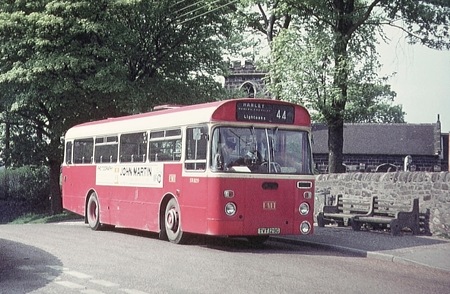


PMT – Leyland Leopard – TVT 129G – SN1129

PMT - Leyland Leopard - TVT 129G - SN1129
Copyright Ian Wild

Potteries Motor Traction
1968
Leyland Leopard PSU4A/4R
Marshall B43F

A pleasant Sunday afternoon scene in May 1970 outside the church at the Bagnall terminus of service 44 from Hanley shows one of Milton Depots pair of short Leopards. This batch of 20 buses was a welcome relief after the 48 Daimler Roadliner buses delivered in the previous three years. These short length Leopards were ultra reliable machines and ideal for the rural services operated by Cheadle, Longton, Newcastle and Milton Depots where they replaced early AEC Reliances.

Photograph and Copy contributed by Ian Wild


24/08/12 – 08:19

Nice shot!
"This batch of 20 buses was a welcome relief after the 48 Daimler Roadliners . . ." All I have read about the Roadliners indicates that the term ‘unmitigated disaster’ is too mild. How could Daimler have got it so wrong?

Pete Davies


24/08/12 – 08:20

Said in three simple words – ultra reliable machines. Never was convinced that Volvo were that much batter than AEC but Leyland suffered from association with British Leyland (Motor Corporation). I have great respect and affection for the Leopard, AN68 and Tiger. They may not have been as flash or quick as the Volvos but they plodded on – you trusted them to keep going.

David Oldfield


24/08/12 – 12:19

A pair of these are preserved namely 1127 – TVT 127G and 1128 – TVT 128G

Chris Hough


24/08/12 – 12:20

Pete. Everyone got it wrong apart from Bristol with rear engined buses – Daimler got more wrong than anyone else, especially choice of engine. As a "coach" man, my top three are ZF Reliance, RE and Leopard. I preferred the Leyland engined RE and, significantly, PMT turned to the RE – albeit late in the RE’s lifespan.

David Oldfield


25/08/12 – 07:40

David,
Ta! I had an idea that most of the problem was the choice of engine.

Pete Davies


25/08/12 – 07:42

David, you can add Seddon to the list of rear engined design failures. No doubt because of his debt of gratitude to Robert Seddon in the early years of his engineering career, Geoff Hilditch, in his writings, is quite kind about the shortcomings of the Pennine RU, but it was undoubtedly a severe disappointment to those who tried hard to encourage competition with British Leyland. The only really satisfactory Seddon psv design was the Pennine VII, which proved to be a sound and reliable performer.

Roger Cox


25/08/12 – 07:42

TVT 127G_lr

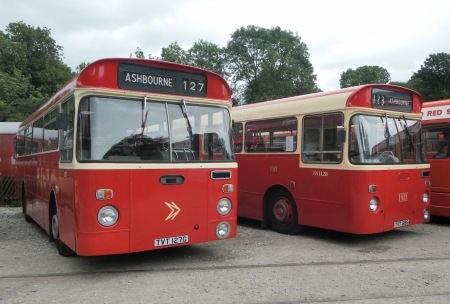
Re Chris Hough’s posting of 24/08/12 12:19 about the two preserved PMT Leopards 1127 & 1128, here is a photo I took of them both at the Wirksworth Bus Rally at the Ecclesbourne Valley Railway on 1st July this year.

Eric Bawden


25/08/12 – 08:53

As always, seeing sisters side by side highlights the detail differences. In this case, the indicator displays, the "company" logo versus the NBC one on the front, the little ventilator under the windscreen . . . And this is just from a look at the bus front!

Pete Davies


25/08/12 – 10:54

Pete. There was another problem that everyone except Bristol had, as well. Heavy engines overhanging the rear axle causing bodies, and chassis, to flex (and sometimes break). Ingenious use of the Lodekka drop axle enabled Bristol to shorten the overhang on the RE and thus reduce the stresses on both chassis and body. The Seddon RU mentioned by Roger was, as much as anything, meant to be an RE clone to help RE operators out who were suffering delivery delays (a "British Leyland" problem with all their brands at the time). Crosville bought hordes of the things and were stung. The Ward Dalesman GRX was a further unsuccessful attempt. The Seddon Pennine VII, on the other hand was a "Leopard with Gardner engine" that "British Leyland" refused to supply to the Scottish Bus Group.

David Oldfield


25/08/12 – 12:27

And we all know what happened to British Leyland over their perceptions of what the customer wanted and what they were prepared to supply: among other things, we got foreign trucks and buses, and cars with traditional boot lids (even on cars with the hatchback shape) when other car makers were introducing hatchbacks, etc!

Pete Davies


27/08/12 – 07:53

A common consensus is the generally uselessness of early rear engined saloons Interestingly some operators managed to make the beast work. Preston made the Panther work as did Hull equally Leeds 150 Swifts had a normal lifespan. While others quickly sold them off as to fault prone or too costly to maintain.
I suppose that fashion also played a part whereby if undertaking A was getting rid of the things undertaking B down the road would do as well.
To my mind this meant that Leyland could pour money into the National and not further develop the other chassis particularly the Bristol RE which was streets ahead of anything similar from the Leyland empire.

Chris Hough


28/08/12 – 14:35

These Leopards were awful (my opinion) it was all down to the cab layout the windscreen was about 6 feet away so you had to stand up to wipe the screen also had a low driving position. The only good thing was they were warm in the winter. we operated them on the Newcastle – Market Drayton service (64) and the other problem was they did not have a AEC Badge on the front.

Michael Crofts


28/08/12 – 17:55

Well, Michael, I will agree with you wholeheartedly on the matter of AEC, but have to say that Devon General’s similar AH505 Reliances – ie with Marshall bodies – had similarly huge cabs with the screen miles away. So you can blame Leyland for the low driving position, which they rectified on Leopards after 1969, but Marshall are to blame for your trek to clean the screen!
[I assume you were after an AEC chassis and engine behind the badge? I knew a coach operator in High Wycombe (Bucks) who ran a Reliance with a Bedford engine…..!]

David Oldfield


28/08/12 – 17:56

All Leylands had that problem, Michael!

Eric Bawden


29/08/12 – 07:23

Just noticed another difference, on the two preserved examples (1127/8). 1127 has sliding vents behind driver’s signalling window, 1128 doesn’t.

David Oldfield


29/08/12 – 12:20

We had three similar Leopard PSU4/Marshalls to this at Halifax. 358-360 (NHE 8-10F) came to Calderdale J.O.C. from Yorkshire Traction as part of the Todmorden takeover arrangements. Nice enough looking buses, they too suffered from the faraway windscreens and very low driving position. They had the original style of large Pneumocyclic gearchange pedestal which got completely in the way, and to get in and out of the cab seat required the skills of a contortionist. With the seat wound up high enough to see forward and reach the pedals one’s knees were rubbing against the underside of the steering wheel, and one’s left leg had a struggle to fit around the gearchange pedestal. They were extremely uncomfortable and inconvenient buses to drive.
Despite the relative indestructability of the earlier Leopard chassis, I am told that the build quality of the Marshall bodies left a lot to be desired. Despite the apparent similarity of the BET-style bodies built by various bodybuilders, it would seem that some were a lot better than others, and that the Met.Cam/Weymann version was generally the most durable.
Despite this, 360 was badly damaged in a collision and sold to a Barnsley breaker, but later it turned up in Malta rebuilt and magnificently presented by one of the island’s most enthusiastic bus owners.

John Stringer


19/01/13 – 06:12

Having owned a Marshall bodied short Ribble Leopard for almost 15 years I find it hard to believe that they were such poor service vehicles. I must admit there is a certain amount of dexterity required to become seated in the drivers seat, but once seated I have not yet found any problem with the driving position. Surely windscreens on most half cabs and other 1960’s vehicles are a similar distance away? Whilst I have not driven this particular bus fully laden, the steering could be entertaining, I find it a pleasure to drive.

John Davis


20/04/13 – 07:17

Re- remarks on variations with 127/128, yes there’s lots more inside and out, we have a boot but no doors, 127 has a disabled chair lift! 127 has 2 roof vents, 128 has 1, coach seating in 127, service seats in 128. The luggage racks differ, as do cabs, as 128 was altered along with destination box layout by previous owner. I cannot explain, or took the time to find out why all this happened, as owner/secretary of ‘TVT 128G group’ what I can say is that 128 has served us well over the 13 years we have owned her, no major repairs other than a radiator leak/broken jubilee clip/1 leaf spring but she’s a good runner.

Keith Broomhall


TVT 129G_lr Vehicle reminder shot for this posting


20/07/15 – 06:49

Enjoyed a couple of laps around Oulton Park yesterday aboard TVT 128G, one sighting lap and one ‘fast’ lap! Wouldn’t have been half as much fun on a modern bus.

Wayne Hope


Quick links to the  -  Comments Page  -  Contact Page  -  Home Page


Belle Vue Coaches – Leyland Royal Tiger – LOE 300

Belle Vue Coaches - Leyland Royal Tiger - LOE 300
Copyright Pete Davies

Belle Vue Coaches
1951
Leyland Royal Tiger PSU1/15
Duple Roadmaster ????

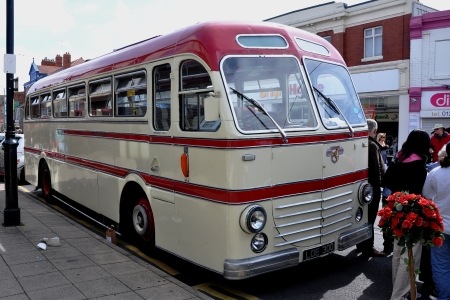
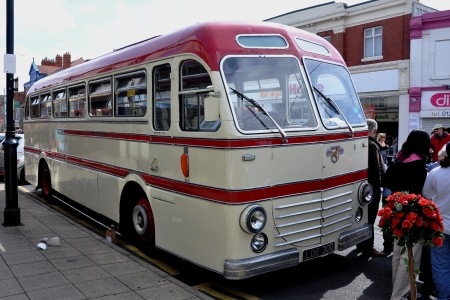
As most people visiting this site will know, Dinky made far more examples of the model Duple Roadmaster than Duple ever managed to make of the real thing. Most of the real ones went to Standerwick and, so far as I am aware, there are no survivors from that batch. There area few others about, however, and I captured this one, LOE 300 on Royal Tiger PSU1/15 chassis, during the Fleetwood Tram Sunday event on 15 July. The PSV Circle volume on preserved buses shows her to have started life in 1951 with Jackson of Castle Bromwich. She’s now in the care of Walsh (Belle Vue Coaches) in the Manchester area and may or may not show RSK 615 as the registration. "Not" in this view! I’m sure someone out there can answer this, but I’ve only ever seen the Roadmaster on a Royal Tiger chassis. Were they ever fitted to other makes?

Photograph and Copy contributed by Pete Davies


21/08/12 – 16:29

RSK 615 isn’t assigned to any vehicle at present.

Roger Broughton


21/08/12 – 16:30

To clarify the note above, she shows Belle Vue Coaches on the back panel, but PSVC shows her as with Walsh.

Pete Davies


21/08/12 – 16:31

KWO 37 Guy Arab UF  – on this site, Pete.

David Oldfield


21/08/12 – 20:31

David, Thank you for that. I can see some resemblance, but my experience of the body design – Standerwick and Dinky Toys, of course, plus this one – shows several differences. Is it, perhaps, a Mk1 and a Mk2, or other modification, in the way the Seagulls had variations and "Mk" numbers during their production?

Pete Davies


21/08/12 – 20:32

SK is a Caithness (Inverness) registration mark, so if that’s the original number, could it have started life with the SMT group ‘Highland Scottish’ as it later became?

Ronnie Hoye


21/08/12 – 20:33

I saw this lovely machine at the Leyland event, but how much nicer would it look if repainted into the dark blue with a red roof livery it wore while with its main owner, South Notts of Gotham, who bought it from Jackson at a fairly early stage in its working career? Did any other Roadmasters survive to the present day?

Neville Mercer


21/08/12 – 20:34

Two of these coaches survive. The other is MAL 310, a South Notts PSU1/11 new in 1951. South Notts also owned LOE 300 for a time.

Philip Lamb


22/08/12 – 06:10

Livery makes such a difference, Pete – as does the fact that the Guy is photographed in black and white and the Leyland is, literally, in glorious colour. Lighter shades tend to flatter – which is no doubt why large operators of this era used "reverse" livery for coaches.

David Oldfield


22/08/12 – 06:11

The registration number RSK 615 is almost certainly an age related DVLA allocation thus inferring that the LOE 300 registration has or may have been lost at some stage. If it is being driven wearing LOE 300 then hopefully the number has been regained replacing the age related one.

Richard Leaman


22/08/12 – 06:11

I wonder how many of these Jackson of Castle Bromich had, because South Notts purchased two of them, LOE 300 and LOE 900, both in 1957. As Neville says, South Notts were the main operator, having obtained around thirteen years service out of them. Together with their own MAL 310 purchased new and MRR 974 with Leyland bus body, it was quite an impressive fleet of Royal Tigers for a small independent!

Chris Barker


22/08/12 – 10:23

Pete. If you scrutinise the two photographs carefully for differences:
(i) Livery (ii) Mouldings (iii) Position of emergency door (central on Guy) partly causing (iv) different windows (pairs on Leyland put two singles in middle of Guy) Drop ventilators on Guy and Hoppers on Leyland.
Mouldings include front panel on Leyland for spare wheel.
Question for everyone. Hoppers? How common was this in 1950.
Still the same body, though. Similar difference could be seen on other bodies, including later Duples – in particular between bodies on different chassis.

David Oldfield


22/08/12 – 11:08

Thank you, David.

Pete Davies


22/08/12 – 14:47

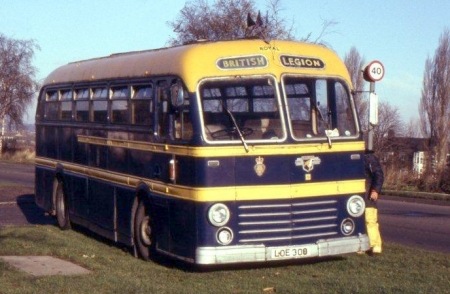
As Chris B says, LOE300 spent approx 13 years with South Notts; it then passed to the British Legion (later Royal British Legion) at Gotham who kept it for many more years.

LOE 300_lr_2

My photo shows it on Queens Drive, Nottingham in 1988/9, towards the end of its time with them.
How nice to see it preserved and active again.

Bob Gell


23/08/12 – 07:13

Good bit of parking or pioneering low-step access for the old lads?! More seriously, I thought the (unavoidably) off-centre Leyland badge had been added as a restoration trimming, but apparently not.

Joe


23/08/12 – 07:14

Now that’s a classy livery, well suited to the beading. Presumably this was is South Notts colours?

Paul Haywood


23/08/12 – 07:15

Another unique point about the South Notts trio of Roadmasters is that the one they bought new, MAL 310 was 7ft 6in wide, whereas these two were 8ft wide.

Chris Barker


23/08/12 – 10:48

Regarding MAL 310 being a 7ft 6in wide vehicle (and a bus rather than a coach) – this probably has to do with the routes it was planned for. I don’t ever remember seeing single deckers on the Nottingham – Gotham – Loughborough main line service. Single deckers operated the Nottingham – Kegworth village service with quite a few narrow roads and tight bends. Most were short workings to Barton in Fabis or Thrumpton, and the others included or omitted West Leake and/or Kingston on Soar according to market day, the state of the moon, and whether there was an R in the month – a typical rural bus service of the 50s. From memory, I think it was previously run with conductor operated half-cabs.

Stephen Ford


23/08/12 – 10:48

There’s a nice colour shot of LOE 300 in South Notts livery in Malcolm Keeley’s excellent book "Midland Red Days". I didn’t know about it’s time with the British Legion, so thanks for that photograph – she looks rather nice in blue and yellow!
Also thanks to Philip Lamb for reminding me that MAL still exists. My personal favourite livery on this type was that of Bamber Bridge MS who had two of them in red and black, one a narrow 7 ft 6 in, the other an 8ft wide version. It’s about time a diecast manufacturer tackled this one again – it’s been a long time since the 1/72 scale Dinky Toy and there are lots of good liveries available even though it was a comparatively rare prototype.

Neville Mercer


23/08/12 – 14:19

Some interesting thoughts from Stephen. There was an oddity reported on the BBC news channel several weeks ago about a market day service in the Milton Keynes area. It operates only on the FIFTH Tuesday in the month, so maybe three or four times a year. Why, the reporter was asking, not EVERY Tuesday?
In the Nottingham and Gotham area, I’d be surprised if the mischief makers among the local bus fans did not spend time amending the signs to BARTON IS FAB . . . And Thrumpton, that’s where the fire brigade in the children’s television show was based, wasn’t it?

Pete Davies


24/08/12 – 08:15

There’s also a train that goes only one way (I believe from Stockport to Stalybridge) and doesn’t return. I think that is only when there’s a Q in the month as well!

David Oldfield


24/08/12 – 08:15

Alan Townsin’s Duple book confirms that the Guy had a later version of the Roadmaster body than LOE 300, after what he calls "some tidying up". The hopper windows were standard on the early models, later reverting to the more usual full-drop type seen on the Guy. Red & White Group were the biggest Roadmaster customer, the parent company taking 1 Leyland and 14 Guys, with a further 7 Guys for the United Welsh fleet.

Peter Williamson


24/08/12 – 08:32

South Notts own Royal Tiger/Duple Roadmaster (fleet number 42, MAL 310) had 45 seats. This was one more than the Royal Tiger with the Leyland bus body (fleet number 45, MRR 974) that seated 44 due to the emergency exit being in the rear wall of the body. The Royal Tiger badge was fixed in the centre of the front panels on 42, rather than offset to the nearside as with 63 (LOE 900) and 64 (LOE 300). Numbers 63 & 64 both seated 41 passengers. Sorry, Neville – South Notts painted the roof maroon on their buses.

Michael Elliott


24/08/12 – 12:29

Michael, I lived in Nottingham for several years and can assure you that South Notts COACHES used to have a red roof. You’re thinking of their double-decker buses which did indeed carry maroon as their top colour. The red roof on coaches seems to have been abandoned on new vehicles or repaints after about 1960, but the maroon roof on ‘deckers continued until the time of the NCT take-over.

Neville Mercer


25/08/12 – 07:26

Thanks Neville for your info on South Notts coach livery pre circa 1960. I’m a ‘native’ of Nottingham and we moved to Clifton in 1953 (when I was three) so over the years I’ve been very familiar with South Notts buses.
Certainly South Notts double deckers had maroon tops and wings and initially also had cream lower deck window surrounds but, from my memory, this was soon dropped and blue window surrounds with a cream cant rail and waist rail (depending on whether the vehicle concerned had a waist rail) adopted instead.
My memories of South Notts single deck buses (principally the Royal Tiger bus, known as ‘the coffin’) is that these had maroon tops also. I have to say that these are memories from age nine/ten when I started to take a ‘more informed view’ on buses. On the question of the ‘Roadmasters’ my memories are of them with maroon tops, as are my memories of the Bedford OBs and the Leyland PS1/Duple ‘A’ type, which latterly became a snow plough. Later coaches, such as the Bedford SBs and VAMs had a livery incorporating two shades of blue.
By the way keep up the good work with the ‘Independents’ series of books. I look forward to treating myself to a copy of the North Wales volume.

Michael Elliott


25/08/12 – 10:56

Thanks for the kind words, Michael. On the South Notts front you’ve made me doubt myself enough to look through a few picture books to check the coach livery. As well as the previously mentioned shot of LOE 300 in Malcolm Keeley’s book (definitely a bright red top!) I’ve also found two shots of South Notts OB/Duple Vistas with the red roof. It’s a pity that they didn’t continue with this livery variation into the 1960s/70s – by the time I lived in Nottingham the coaches were all-over blue which did them no favours.

Neville Mercer


26/08/12 – 07:40

During 1934 both Barton and South Notts, as associated companies, introduced maroon roofs wings to all their vehicles as a form of corporate identity. Barton having held a 50% share in South Notts since 1929. Maroon was replaced by a light shade of blue on single deckers during 1961 and with the repainting of 117 in 1986 to celebrate 60 years of operation the maroon was dropped, but retaining indigo and cream as the original livery. This was so well received it was decided to standardize this on their double deckers and several were so treated.
Royal Tiger No.42 MAL 310 was a dual purpose vehicle, not a bus and was used on private hire and often hired to Barton for their express services. The two ex Jackson Royal Tigers in fact stood in Barton’s Chilwell garage yard for several months and at least one (No.64 LOE 300) ran in service with South Notts in Jackson’s green/grey livery.

Alan Oxley


11/10/12 – 07:22

I was surprised to read in Neville Mercer’s post (above) that of the two Roadmasters with Bamber Bridge Motor Service one was 7’6" wide and the other 8′, since they were both from the same batch (of three?) new to Scout Motor Services, and it has always been my understanding that the entire batch were 7’6". Any more bids?

David Call


17/01/15 – 06:17

This bus is part of our vintage collection at BelleVue Manchester Ltd.
Any questions you may have I can forward on to The Walsh Bros.
Kenny Walsh is the maintenance Director at BelleVue and he is one half of the Walsh Bros who perform restorations on a variety of classics.

Donna Thompson


01/06/15 – 07:22

The South Notts Worldmasters had maroon tops. I went on one to Dudley Zoo on a school trip – my first solo outing. It was similar to Barton’s maroon as there had always been connections between the two companies. They often did the Saturday services to Gotham and Thrumpton etc from Huntingdon St bus station as well as private hire and duplicates. P54 Malcolm Keeley – Midland Red Days does indeed show LOE 300 with a maroon roof exactly the same as the two South Notts Leyland buses behind. This is probably a Saturday with the Leyland PDs doing a short working to Gotham and the regular service to Loughborough (18-30 departures?). The Thrumpton bus would turn off before Gotham and was usually lightly loaded. Alan Oxley’s South Notts book (1985) is one of my cherished possessions and I would highly recommend it if you can get hold of a copy.
Oxford Diecast models intend to make a 1/76th scale model of a Worldmaster in Belle Vue Coaches livery-this one? More details will emerge.

David O’Brien


02/06/15 – 07:06

David, hate to be pedantic but these are Duple ROADmasters, not Worldmasters. Worldmaster was a brand-name used by Leyland for export versions of their Royal Tiger chassis. Also, while I accept that most South Notts vehicles had maroon roof trim, nobody has addressed the issue of bright red being shown in various published photographs detailed above. I’m aware of the "false colour" which many early types of slide film produced (as is anybody who has bought a book about Ribble!) but the examples given are beyond that. If the colours in the photo’s mentioned are wrong then I suspect that they were altered during production of the books in question. Anybody got any thoughts?

Neville Mercer


03/06/15 – 06:21

That is a valid point, Neville. Not only did different makes of colour film, slide and negative, give greatly varying results, often exacerbated by sloppy laboratory processing, but we now exist in an age of Photoshop and similar computer programs that allow image modification to a degree way beyond the old darkroom techniques. I confess to using the modern methods to get a reasonable result from my elderly slides, and I very much doubt if most published pictures are truly accurate in colour rendition. One does try to get it right, but, perhaps, our increasingly high mileage memories are probably not the best judges of the original liveries. One would really need a paint chart to match the most important colours of the original scheme for a true result.

Roger Cox


03/06/15 – 06:22

To answer my own query (11/10/12) it would appear that the three Scout Roadmasters were a mixture of 7’6" and 8’0". BLOTW has DRN 355 as 7’6" and DRN 356/7 as 8’0", but the Peter Gould fleetlist gives DRN 357 as 7’6". All the available evidence indicates that the Peter Gould version is correct, if this is the case then the two which went to BBMS were indeed one of each width.
In respect of three Leyland-bodied PD2s new to Scout at much the same time (DRN 364-6), Peter Gould has the first two as 8’0" wide and the third as 7’6". BLOTW gives them all as 8’0", but given the mixture of Roadmaster widths I suppose it’s quite possible that the PD2s were mixed width also.

David Call


28/10/15 – 07:13

Yes, colour films of the era each had their own characteristics: principally, Kodachrome (perhaps the most widely-used colour films at the time) produced vivid representations of reds. Other films were more subdued (and perhaps more realistic). Maroon appearing as bright red: I can believe it!

Allen


28/03/16 – 17:16

"SK" was indeed a Caithness CC registration originally, but with so few registrations issued by this authority, registration marks BSK to YSK were allocated by DVLA to various VROs throughout UK for "age-related" re-registrations between 3/90 and 3/92.

Andy


LOE 300_lr Vehicle reminder shot for this posting


23/08/20 – 05:26

LOE 300 was sold in 11/18 to James Baile of Nassington. His mother runs a wedding and conference venue Prebendal Manor, Nassington, pics of it appear on their FB page, it was being used as an office in April this year! https://www.facebook.com/  so not sure what his plans are for it. It won’t do it much good if left outside!

John Wakefield


Quick links to the  -  Comments Page  -  Contact Page  -  Home Page


All rights to the design and layout of this website are reserved     

Old Bus Photos from Saturday 25th April 2009 to Wednesday 3rd January 2024