Old Bus Photos

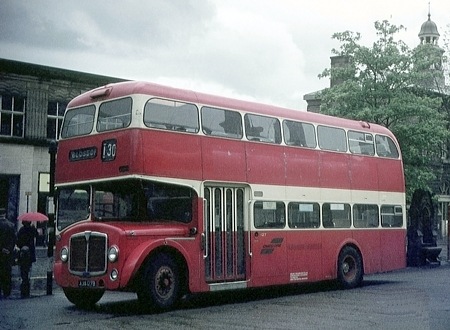
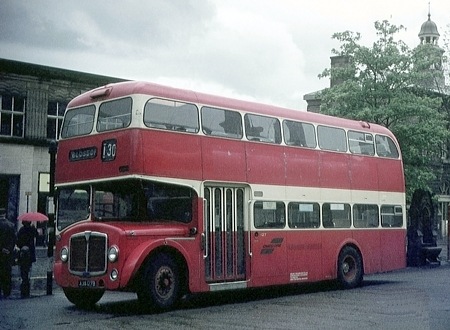
Sheffield Corporation – AEC Regent V – 365 EWE – 1365
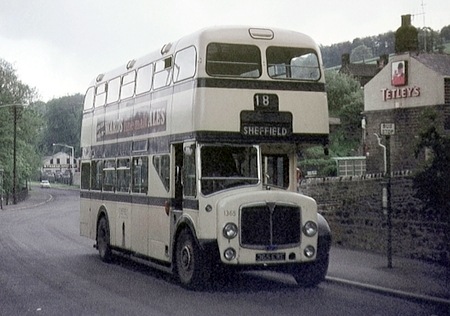
Sheffield Corporation - AEC Regent V - 365 EWE - 1365
Copyright Ian Wild

Sheffield Corporation
1963
AEC Regent V 2D2RA
Park Royal H38/32F

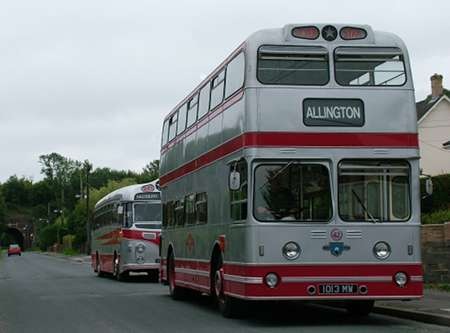
After several years of deliveries of rear engined double deckers, Sheffield bought batches of forward entrance for all three fleets in 1963 and 1964. This bus was from the first batch and is seen in May 1967 at the Oughtibridge terminus of service 18. Although four years old by this time, the bus appears to be in its original coat of paint with red lining below the lower blue band and the gold front fleet number.
Brian commented recently on Sheffield Bridgemaster 525 that it was used on the service 7 to Stannington, I think it more likely that the bus(es) he recalls was one of these not dissimilar looking vehicles which were regular performers on that service.

Photograph and Copy contributed by Ian Wild

A full list of Regent V codes can be seen here.

———

03/09/12 – 06:14

Strange how companies ‘borrow – steal?’ design ideas from each other, I would be hard pushed to spot the difference between some Alexander and MCW bodies, and to me the upper deck on this vehicle could have come straight out of the Orion stable rather than Park Royal

Ronnie Hoye

———

03/09/12 – 07:50

These were essentially Herries buses for the north of the city – including the bit of the West Riding which would become part of the city after the 1974 Local Government Act became law. The 18 was the Oughtibridge route (on the main Manchester via Flouch Inn corridor) but a favourite haunt for the park Royal regent Vs was the 91/98 Grenoside/Ecclesfield Circular. I thought that 64 – 73 with Weymann bodies were better looking but apparently they suffered from being amongst the last bodies completed at Addlestone and the quality of finish was not up to traditional Weymann standards. Pity, though. These were delivered to East Bank in August 1963 and spent their formative years on the 28/43 group of Herdings routes.

Ian, there is an extant picture of 525 (in Charles Halls’ book) on the 70 to Wombwell – so she did creep north of the city centre.

David Oldfield

———

04/09/12 – 06:44

Could it also be a BET Standard? BET "asked" PRV to change the original Bridgemaster from Classic PRV style and construction to steel framed "Box on Wheels" that it became. That is when PRV began to look more and more like the Orion.

David Oldfield

———

04/09/12 – 08:34

A pair of identical Regents ended up with Hebble when the Sheffield C fleet was disbanded in 1970. They always stood out by virtue of their Sheffield style indicators they were then passed to Yorkshire Woollen when Hebble disappeared a year later.

Chris Hough

———

05/09/12 – 06:50

That was 1150/1151 – and they were joined by some 1962 Atlanteans and the infamous ECW/PD2s.

David Oldfield

———

05/09/12 – 06:51

And after that, the two of them left Yorkshire for good, ending up with KMB in Hong Kong. They were rebodied with MetSec bodywork, and ended their days in a scrapyard, in the Chinese version of Barnsley!

Dave Careless

———

05/09/12 – 08:35

PRV and Roe both seemed to take a liking to those rather obvious ventilation extractors on the upper deck around this period – the fact that they weren’t more widely adopted might hint at their usefulness. To me, for some reason (familiarity perhaps?), two fog/spot lights have never looked right on a half-cab: I can only think of AEC fitting two fogs/spots, but did Leyland? – I’m sure I’ve never seen a Daimler or Guy with two. Whatever, to me this bus has a brutal purposefulness about it – a classic in terms of both design and livery.

Philip Rushworth

———

05/09/12 – 08:36

It’s only my opinion, but my vote for the best looking half cabs ever would go to the Park Royals of about the mid to late 50’s. Southdown had them, Newcastle had both high and low bridge versions on AEC Regent V chassis, Northern General Group had them on Guy Arab IV’s, and a later batch of PD2’s with rear doors. To be fair the Leeds Roe bodied Regent V’s were also a handsome beast, but I prefer the PR’s

Ronnie Hoye

———

05/09/12 – 08:37

Can you give us any details please, David, of how and when BET ‘asked’ PRV to alter their design and construction?

Roy Burke

———

06/09/12 – 06:48

Sorry, Ronnie, but my vote always goes to Roe. I will agree with you after that – and don’t forget the COMS Regents with similar PRV bodies.
Roy. Regret that I cannot give documentary details – I do not own the book that contained the information. (It was a paperback about significant prototypes vehicles.) Briefly: Crossley were allocated the task of developing the Bridgemaster and they were also producing a clone of Ronnie’s favourite PRV body at the time. Apart from being extremely attractive, it had, I believe aluminium construction – like the Routemaster. ACV were anxious to attract BET orders, but BET wanted a simple steel-framed construction with single skinned domes – in other words an Orion clone. This was around 1958, when Crossley finally closed down, and production moved to PRV in London. This resulted in the dreadful box-like front-end design of the Bridgemaster (even though initially the rear dome was the same as "standard") and the same single skinned interior panels (again like early lightweight Orions). I believe there is also passing reference in "The Blue Triangle" (Alan Townsin).

David Oldfield

———

06/09/12 – 07:19

With respect to the intake of the 1964/56 series of AEC Regent V/Park Royal vehicles I can add a little information on their purchase.
From the early sixties, Sheffield Transport Dept favoured the rear engined double decker, giving up to 78 seats. The general Manager C.T Humpidge, the successor to R.C.Moore from 1961, did favour the traditional front engine design. When the Sheffield Joint Omnibus Committee needed replacement vehicles, Mr Humpidge suggested that the AEC Regent/PRV version would be a cheaper option than the Atlantean or Fleetline.

Keith Beeden

———

07/09/12 – 07:33

Whilst I agree with David about the aesthetics and quality of traditional Roe body work, I do come down on the side of Ronnie in respect of the Park Royal double deck design of the mid 1950s. The PRV bodied Guy Arab IVs of Southdown – the body style with the deeper windows than the East Kent contemporaries – were, to my eye, the most handsome front engined ‘deckers of all time.

Roger Cox

———

07/09/12 – 07:34

Mention of C.T.Humpidge reminded me that after retiring from Sheffield Corporation he became The Reverend C.T.Humpidge. There cannot be many bus managers that have done that.

Philip Carlton

———

07/09/12 – 07:34

Philip’s "brutal purposefulness" description is very good because it really homes in on how Park Royal’s Orion clone differs from the Orion itself. Here’s an Orion for comparison www.old-bus-photos.co.uk/ The front tapers inwards in both an upward and forward direction (something that was taken to horrible extremes on tin-front Leylands), and in this case, though not always, is less perpendicular. Not nearly as brutal, is it?

Peter Williamson

———

08/09/12 – 07:11

Couldn’t agree more, Peter.

David Oldfield

———

08/09/12 – 07:12

Mr. J.P. Senior, former General Manager at Burnley, Colne and Nelson, then Assistant GM at Ribble became vicar of Heddon-on-the-Wall, Northumberland.

Eric Bawden

———

08/09/12 – 07:12

I’ve just discovered that the Park Royal site www.prv.org.uk/  has recently been updated with a large number of images, which are worth taking a look at. Many of them are rear-end views, which is very useful given the variety of rear domes that Park Royal used during this period, which tended to either accentuate or mitigate the box-on-wheels effect.

Peter Williamson

———

08/09/12 – 07:14

It is the front end perpendicularity (assuming there is such a word!) that I always found distasteful – whether on these, Bridgemasters or indeed front entrance Lodekkas (plus, of course, the original housebrick style Atlanteans). They all looked ungainly, as though they were about to trip over their front wheels and fall flat on their faces in the road! I’ll also earn some flak by saying that I liked the Orion, especially exposed radiator types. Well, having gone so far I may as well wreck what remaining credibility I have by saying I also liked the shape of the Leyland National – though I fully understand its innumerable mechanical shortcomings. Both it and the Orion dared to look like honest to goodness buses instead of space-age adaptations.

Stephen Ford

———

08/09/12 – 07:15

Philip, pictured elsewhere on this site is a 1959 Roe bodied PD3 Tin front, that also has two fog/spots. I certainly cant remember any other half cabs with more than one, even the twin headlight Green Line RMC’s only had one fog, so it may well be that the practice of fitting two was unique to Sheffield. However, since about 1982 I think, current legislation only allows front fog/spot lights to be fitted in pairs

Ronnie Hoye

———

09/09/12 – 07:32

The industrial smogs down the Sheffield river valleys could be pretty thick: to get people home in the evening perhaps you needed one for the kerb and one for the white line- or for the conductor walking down the middle of the road!

Joe

———

09/09/12 – 07:33

I’ve had a look round some of my photos to see whether two foglamps was unusual on half-cabs and I’ve noticed four trends:
No foglights – quite a lot of operators didn’t fit foglights at all. Most of the South Wales operators come into that category, but so do Manchester and Salford.
One foglight – some operators had a single foglight and didn’t modify the buses. Halifax is an example of this. Rhondda’s Regent Vs had a single one to the end although I did find one that had none.
Later fitment of second foglight – Oldham’s tin-front PD2s and exposed-radiator PD3s originally only had a single foglight but were later modified with a second one. The PD3s were so done at their 7-year CoF in 1971.
Always two – some operators always had two, or fitted the second at an early date. Southdown’s Queen Marys had two. Stockport’s fleet of PD2s and PD3s all had two, from the 1958 Crossley-bodied examples onwards. South Yorkshire is another surprising example – even their Bond-bodied PD2s had two. Rotherham’s 1965 Daimler CVG6s had two as well.

David Beilby

———

12/09/12 – 06:58

I recall these Regents at the small Bridge Street bus station, working services 91/98 to Grenoside as stated, also the 73 and 80 to High Green. They were the last front-engined buses in the Sheffield fleets.
The reference to smog reminds me that some operators had "fog on route" on their blinds. Oldham and Manchester were two, maybe others.

Geoff Kerr

———

23/11/12 – 16:04

The sound these wonderful buses made was my all-time favourite- with the possible exception of the Bristol RE.These were Sheffield’s only semi-automatic Regents and sounded very different to the other Regents in the fleet. 3150/1, as they were numbered after 1968, were the C fleet pair mentioned above. They were, I understand, bought for the 85 to Gainsborough, but by the time I reached Sheffield in 1969 they were used on city services such as the 150/151 to Shiregreen. This pair had overhead luggage racks downstairs! Hebble, who by January 1970 were in absolutely desperate straits vehicle-wise, grabbed them eagerly when the C fleet passed into NBC ownership on 1 Jan 1970.

Phil Drake

———

23/11/12 – 16:54

I seem to remember that the parcel racks in 1150/1 were of netting rather than having a solid base, quite unusual for a double decker.

Ian Wild

———

05/12/12 – 07:28

I always found the second B fleet batch slightly superior to the initial one at this time of year. Those 1368-1377 368-377HWE had fan heaters which didn’t stop when the bus did.

On the subject of Sheffields Half cab fog lights, I only ever remember the 31 forward entrance AEC half cabs having twin fog lamps in their service days, all other half cabs would have just a nearside one.
It was only when the PD3’s in particular were relegated to the ancillary fleet that the second offside ones appeared.
With the exception of the initial Alexander bodied Atlantean 369 all other Sheffield buses received after 1960 would all have twin fog lights
A shot of of ex-Sheffield PD3 909 on SCT61 when 23 with Stevensons fleet still only had the nearside one.
The pre-service shot of 461 at Crossgates only had the one.

Andrew

———
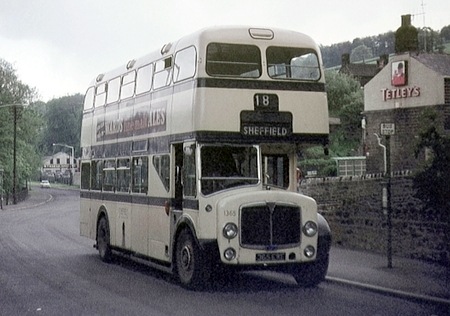
365 EWE_lr Vehicle reminder shot for this posting

———

23/12/12 – 17:05

To pick up on Phil’s contribution (23/XI/12) 1150-1/3150-1 were purchased for service 85 Sheffield-Retford-Gainsborough but, according to Alan Hinton’s Omnibus Society pamphlet about this route "neither racks nor vehicles were popular . . . and they rarely reached Retford [sic]". Partial double-decking of the route had started on 25/VIII/58, those through journeys which were double decked (the frequency was hourly between Sheffield-Retford, but only two-hourly between Retford Gainsborough) required a change to a single-decker at Retford. Initially PD2/Roe 1156-61 were allocated, being fitted with high-backed seats and platform doors. Then around 1960 it appears that "some Roe-bodied AEC Regent Vs from the B fleet were tried . . . but like most AECs they were not popular on this route" – why? In 1962 Leyland Atlantean/Weymann 1163-65 were purchased for the service, having high-backed seats and a "special upper-deck [sic] luggage compartment to accommodate . . . fishing baskets" (why on the upper deck? – to minimise smells??). In 1966 A-fleet Leyland Atlantean/Neepsend of the batch 348-60 took over double-deck operations – presumably C-fleet vehicles worked "A" services to balance the mileage. Until 17/III/68 the service was operated by Townhead Street garage and an outstation at the EMMS garage in Retford: on that date Townhead Street garage closed and Greenland Road garage assumed responsibility for workings using the 1962 C-fleet Atlanteans, now renumbered 3163-5. Single-deck operations were, from 1960, entrusted to the Burlingham and Weymann Fanfare bodied Leyland Leopards, but latterly became the preserve of A-fleet AEC/PRV Swifts – some of which had their seating capacity reduced to provide extra luggage accommodation for the role. Alan Hilton’s pamphlet really is a most fascinating history of this route.

Philip Rushworth


Quick links to the  -  Comments Page  -  Contact Page  -  Home Page
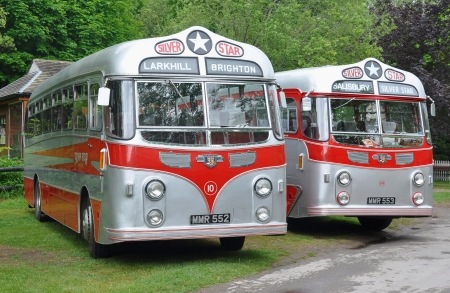


Silver Star – Leyland Tiger Cub – MMR 552/3 – 10/26

Silver Star – Leyland Tiger Cub – MMR 552/3 – 10/26
Copyright Pete Davies

Silver Star Motor Services
1956
Leyland Tiger Cub PSUC1/2
Harrington C41C

Here is a view of MMR552 and 553 fleet numbers 10 and 26, Tiger Cubs with Harrington coach bodies from the dear departed fleet of Silver Star, Porton, near Salisbury. I have seen and photographed both of them on a number of occasions, but this sighting at the "Harrington Gathering" at Amberley on 3rd June was my first of them together. They may be twins, but they are most certainly not identical twins.

Photograph and Copy contributed by Pete Davies


31/08/12 – 07:37

My late friend Walter Martin bought two identical Bedford YRQ/Plaxton Panorama Elite III in 1972/3 which were instantly identifiable by several small differences in livery and application – just like these two splendid vehicles.

David Oldfield


31/08/12 – 12:34

This picture has made my day! From the age of 9 I grew up in Sale in Cheshire and the Silver Star vehicle(s) doing the forces leave service to Manchester spent their lay-over at the premises of Pride of Sale, often venturing out "on hire" on local excursions. They also sometimes appeared "doubly on hire" to North Western for use on the North Wales and Yorkshire Coast services.
Sadly my personal experience of their fine fleet was short-lived as they sold out to W&D less than a year after I moved to Sale. A brief pleasure, but still vivid in my memory. It’s good to see the pair together again in a recent shot.

Neville Mercer


31/08/12 – 14:29

I’m glad you found the view interesting, Neville. One of the Atlanteans, 1013MW, survives as well, but I don’t know of any of the other vehicles from the fleet.
The idea of reaching destination and then running ‘on hire’ to the local operator caught me out on several occasions. The one which sticks out most clearly is a Red & White MW coach which had arrived in Morecambe on a tour and was acting as a PD3 on the L6 Heysham to Lancaster service, on hire to Ribble. Must have been a surprise for the crew to draw that!

Pete Davies


31/08/12 – 16:05

I know the feeling Pete – Ribble would seize anything on a busy day. I was always amazed by some of the oddities that would turn up at Lower Mosley Street on X60 duplicates. As I mentioned in my article (on this site) about LMS these included vehicles from East Kent and East Yorkshire which had been commandeered by Ribble staff at the Blackpool end. I also witnessed the arrival of a 36ft Yelloway Reliance/Cavalier on an X60 extra in the summer of 1966 – presumably it had operated a duplicate on their own Blackpool services and then been free for the day for other remunerative work. It also, of course, had the advantage of being able to show both Manchester and Blackpool on its destination blind, but I bet that the Allen family made them pay the top rate for the hire!

Neville Mercer


01/09/12 – 08:06

I well remember during busy summer periods working for Southdown at Eastbourne in the 1970’s and 80’s it was a case of anything goes especially with coaches that were staying on a weeks tour on days when they were not out or coaches that were on day trips, on entering the garage the drivers were asked " what time are you leaving" if it was late enough for the coach to be used that afternoon he was asked to please see nothing was left on the luggage racks as the coach would be used, this of course was in NBC days. The favourite tour coaches used belonged to Eastern Scottish which were at different times Bristol LH’s Leyland Leopards and on one occasion a Seddon Pennine VII. another favourite was Western Welsh nearly always a Leopard but among other companies featured was a Crosville Bedford VAM. My fondest memory of these is of taking a school party from Eastbourne to Lewes on one of M&D’s superb AEC Reliance/Harrington Grenadiers a totally blissful afternoon, the different companies vehicles driven when on express services however is a story on it,s own.

Diesel Dave


01/09/12 – 10:51

An interesting posting, and I was most amused to read the appreciative comments of some correspondents about these vehicles. I agree with them. Apart from the Leyland chassis and the different treatment around the destination indicators, however, these coaches are pretty well the same design as my recent M&D AEC posting that received rather less fulsome responses. Maybe I’m thick, but I just don’t understand that. I also agree with Diesel Dave about the M&D Grenadiers; superb describes them absolutely.

Roy Burke


02/09/12 – 15:35

No, Roy, you’re not thick! It’s taken me a while to work it out, but I think the reason for the difference of opinion about the appearance of the Maidstone vehicle versus this pair is the indicator display.
These two have a modified version of what many regard as the typical Harrington front dome of the period, with two wide indicator displays. That on the Maidstone looks to be much more of a bus indicator, far more concentrated in the middle of the dome, and I’m sure the more usual style would have made it more attractive to many of our readers. A different way of applying the livery, with a lighter top, might have helped, too. I don’t suppose Southdown would have objected if their neighbour (and associate BET company) had used the Southdown style.

Pete Davies


03/09/12 – 07:54

Off subject, Neville, but I lived in Ashton-on-Mersey in the late ’70s.

David Oldfield


04/09/12 – 08:43

We missed each other by a few years, David. I moved to Nottingham when I was 19 (mid-1972) and from there to the USA for a six year spell from 1974. I blame the introduction of the NBC corporate liveries. Emigration became the only sensible option!

Neville Mercer


05/09/12 – 06:54

I can understand that, Neville. Glad you came back, though.

David Oldfield


05/09/12 – 08:40

I’m with Pete here: I’m still not a big fan of the design, but the overall styling/livery/destination display works much better (and its "polished-up", which might help!). For me the significant differences are: the fog/spot lights and associated moulding, which when combined with the "pointy" dome tend to accentuate the vertical aspect and narrow the front; and the absence of the above-windows moulding present on the M&D vehicle (which seems to be a throw-back to the 1930’s).

Philip Rushworth


06/09/12 – 06:51

I stand by my comments on the M&D Reliance, but as I’ve said before, in the right livery an Orion can look good. This just emphasises how important livery and its application is and reinforces all the comments on this forum about kids in paintbox liveries that we suffer today with current operators. Two identical vehicles can look SO different in different colours.

David Oldfield


07/09/12 – 07:25

I agree David – but I think the converse is true as well. Many colour schemes look well on some vehicle designs but not on others. A good livery is one that is sufficiently robust (and perhaps adaptable) to be applied to different types. Even some of the big groups seem to be recognising this. For example, I dreaded the appearance of "splash it all over" washed out green when Arriva took over Cross Country Trains – but they didn’t, thank goodness!

Stephen Ford


07/09/12 – 07:25

Well, David, we could have a long discussion about the effect of livery and detailed design differences on a vehicle’s ultimate attractiveness. However – maybe I don’t possess a ‘true’ enthusiast’s appreciation of these things – but to me a basically sound and well-balanced design is not somehow transformed, Jekyll and Hyde-like, into hideous ugliness because of such elements. I can understand how one treatment might appeal more than another, but the underlying balance and elegance of Harringtons’ design on these Silver Star coaches, (‘splendid’ was your own adjective), remains apparent in the M&D vehicles, dated destination indicator screens notwithstanding. I returned to the link showing one in Hebble livery, but that exercise has served only to reinforce my view. We can only agree, perhaps, to differ – and Philip, I guess, would be with you rather than me – on this.
‘Two other points in my final comment on this issue. First, Peter’s observations. I agree that M&D’s destination screen treatment is rather ‘bus’ like. Most of their express services were short distance, on which many passengers would buy their tickets from local agents just before travel. A large, instantly readable destination screen thus made operational sense. I’m not sure I follow his point about Southdown livery, however; after more than a year with that company, I never quite understood what their express livery was, and judging by the inconsistency with which it, (and even whether a vehicle should display a scripted or capital lettered name), was applied, I’m not entirely sure that they did either.
Secondly, while there is no rule that says correspondents must like this Harrington design, I find both the Silver Star and M&D versions infinitely cleaner and better balanced than the Duple coachwork on the recent Black & White posting. While looking at Hebble vehicles, moreover,I came across a Bellhouse Hartwell Landmaster of about the same date as the M&D vehicles. Now for real ugliness…….’

Roy Burke


08/09/12 – 07:05

There you go, Roy. I agree with you on your latter points.

David Oldfield


08/09/12 – 07:05

We’re back to this ‘beholder’ business again and the matter of comparisons, one with another! I don’t find the BHS vehicle THAT ugly, but this Barton monstrosity is another matter: SEE: www.modelbuszone.co.uk

Chris Hebbron


08/09/12 – 07:06

Mention of the Bellhouse and Hartwell coaches reminded me of a comment my friend the late Donald Ingham who had been a driver of these beasts told me. The drivers referred to them as Brabs this being a reference to the giant seaplane the Brabazan that flew in the 1950s. One of these coaches was sold to a old persons home in Derbyshire and had its rear end modified to take wheel chairs and eventually was sold for preservation to a group of drivers at YWD Frost Hill depot. Alas this was an abortive venture and I recently heard that it had passed to Ensign for their heritage fleet but it would appear to be too far gone. .

Philip Carlton


09/09/12 – 07:20

Wow, Chris, what a beauty! (Pardon the irony). What is it? There’s some script below the radiator grille, but I can’t make out what it says. (not ‘Bristol’, surely?). Could it be the builder’s name – I’d have wanted to remain anonymous if I’d had anything to do with it. More details from someone, please. I’m intrigued.
Philip’s remark about the Bellhouse Hartwell coaches’ nickname was amusing, too. Very appropriate. I read elsewhere that they were also nicknamed ‘Sabrinas’, for fairly obvious reasons.

Roy Burke


09/09/12 – 07:20

Reference to Chris H’s link, Barton’s 657 was certainly no oil-painting, and the normally attractive livery was applied in a rather fussy way. I remember it as one of those quirky members of the Barton fleet – an in-house rebody of, if I remember its sound correctly, a half-cab Leyland TS? In the early/mid 50s it often worked on the route 10, Nottingham – Long Eaton – Kegworth – Loughborough. There were a few similar rebodies, plus the much more attractive style just visible behind, but I think there were only one or two of this particular design.

Stephen Ford


09/09/12 – 07:21

Small point, Philip, but if I don’t mention it someone else surely will. The Bristol Brabazon was a large landplane, powered by eight Bristol Centaurus piston engines mounted in pairs driving contra rotating airscrews. The huge contemporary flying boat was the Saunders Roe Princess which had ten Bristol Proteus turbo props. Both were misconceived for the post war air transport scene.

Roger Cox


10/09/12 – 07:08

As originally built, MMR 553 also featured the "V" shape front trim but fairly early on presumably had a bit of an accident and for most of the time with Silver Star appeared as we see it today.

Nick Webster


10/09/12 – 07:09

If you’re looking for ugly in house re bodies, you need look no further that the Tynesider and Wearsider of Northern General. I think one of them is still around somewhere in the North West area ‘Liverpool?’ but I’m not sure which one it is

Ronnie Hoye


10/09/12 – 07:09

You see the safe path I tread to avoid controversy with body designs! I thought, Roy, that the writing said ‘Daimler’, but could be mistaken. And thanks, Stephen, for your thoughts on the body’s origin.

Chris Hebbron


10/09/12 – 07:10

I believe the Sabrinas were SUT.

David Oldfield


11/09/12 – 06:49

I realise that we have taken something of a diversion but the excellent picture of the Barton BTS1 made me wonder, whilst the body was built in Barton’s own workshops and rightly ascribed to them, I wonder how many components were bought in, such as front wings, front dome and windscreen frames etc. I may be wrong but I can’t imagine all of these being produced by Barton, or any other operators who built their own bodywork. One thing is certain though, these were sound vehicles which gave Bartons good service. They must have been considerably better than some of the offerings from the myriad of post war British coachbuilders.

Chris Barker


12/09/12 – 06:54

Discussion on styling should also take into account changing fashion- less so with buses than coaches- as well as functionality. I think the Bridgemaster/Renown expressed a fashion for the square rather than curves, seen in buildings of that era. Liveries/trim were lightened and simplified in the 60’s. Curves were very thirties/forties and in the case of Barton, the "diner" look became a caricature. Then there is the "classic" look like the Leyland/Leyland PD2, and most ECW output, which could seem boring- but the style had to last 10/20 years. Now today… the Optare Spectra already looks dated and those areas of purposeless blind glazing in other, later designs… why?
A CVG6/Roe* takes a lot of beating….(insert your own preference here)*

Joe


28/07/14 – 07:33

Just come across the site and was taken aback to see the Silver Star Leylands. I was stationed in Tidworth 61-62 and used to travel up most weekends to Manchester using Silver Star. The drivers name was Vic I believe.

Richard Hill


28/07/14 – 10:23

Glad about your surprise delight, Richard!
Companies like Silver Star must have started to feel the pinch once the last National Servicemen finished their service in 1962 and their places were taken by civilians, who mainly lived locally. Strangely enough, I always found it better to go home by train, with reasonably-priced Forces Return tickets. We still had an extensive rail network then, too!

Chris Hebbron


28/07/14 – 11:49

I have some very happy memories indeed of outstanding small operators that I encountered and used during National Service 1954/5/6.
First was the highly individual Green Bus Service (Rugeley and Uttoxeter) Ltd – M.A. & C.J. Whieldon – what an exotic an assorted fleet they had.
Then, at Yatesbury, troop transport was provided by the wonderful R & W Febry – "Sodbury Queen" radio luxury coaches – a very smart and proud Firm indeed, and still I believe in haulage in a very big way.
Later, at Patrington, East Yorkshire the contrast was fascinating – the magnificent East Yorkshire Motor Services with a glorious fleet, and the tiny Connor and Graham of Easington (Spurn Point) who provided reliable and most useful services almost into the North Sea !! In 1955/6 they had a very elderly conductress called Sally and, many years later after De-mob, I went on an official enthusiasts tour of the area, including being greeted by one of the proprietors. Near the depot at Easington I said to him "I don’t suppose dear old Sally is still around now ??" With a mischievous smile he told me to knock on the door of the second nearby cottage – the door was answered by the good lady herself and I was invited into the original "chocolate box" country cottage and made very welcome – "I’m always glad to see mi’RAF lads" said Sally followed by this classic "Of course I’m not on the buses now yer’ know." Bless her, she must have been close to receiving HM’s telegram !!

Chris Youhill


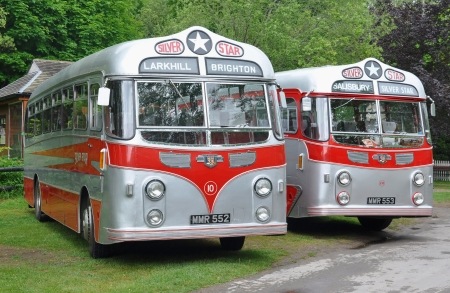
MMR 552_lr Vehicle reminder shot for this posting


25/08/14 – 07:26

Is there any record of the sold Silver Star Leyland Atlantic’s that went to Bristol Bus Company for use on the WSM routes.

Ray Kite


26/08/14 – 06:47

1013 MW

The ex Silver Star Atlantean 1013 MW is in active preservation, as seen here on a re-creation of Silver Star operations around Salisbury Plain in August 2009. This bus saw service with Super Coaches of Upminster and Beresfords of Cheddleton, following its withdrawal from service with Bristol Omnibus.

Petras409


Quick links to the  -  Comments Page  -  Contact Page  -  Home Page


North Western – AEC Renown – AJA 127B – 127

North Western - AEC Renown - AJA 127B - 127
Copyright Ian Wild

North Western Road Car
1964
AEC Renown 3B3RA
Park Royal H42/30F

This former North Western bus still in its original livery but with SELNEC (Cheshire) fleetnames is at the Norfolk Arms terminus in Glossop in May 1972 not long after North Western was split between SELNEC, Trent and Crosville. This was one of the second batch of these buses bought by North Western in this case with forced ventilation evidenced by the lack of opening windows. I wonder how effective this was in dispersing the cigarette smog more or less standard on the upper decks of buses in those days. I pass this location from time to time and wonder at how there could have been a busy bus terminus at such a busy location.

Photograph and Copy contributed by Ian Wild

A full list of Renown codes can be seen here.

———

28/08/12 – 15:17

The Norfolk Arms was busy and similar to the LPTB Hounslow trolleys, the traffic signals were controlled by the driver when ready to depart. I think it was mounted on the pole just by the driver’s cab in the picture. This turned the High St W and E, Victoria St and Norfolk St lights to red and then the bus would sweep out. I have it on good authority this led to at least one conductor being left behind. The old North Westerns from Glossop had a few characters.

Mike Franks

———

28/08/12 – 18:03

I felt bereft, as a student in Manchester, missing my AECs from STD, SUT and the local coach operators. Luckily North Western plied down the Wilmslow and Palatine Roads in student land. It might have been a Fleetline or a Loline but my day was always made when one of these Renowns turned up to take me home.
These PRV bodies have, unfairly in my opinion, been called ugly. Compared with Bridgemasters – especially the forward entrance version – these were positively beautiful, and in their own right were better looking than many contemporaries.

David Oldfield

———

28/08/12 – 18:04

When NBC was set up many fleets were shuffled around like decks of cards, and Northern General was no exception. At Percy Main ‘Tynemouth and Wakefields’ we had a number of Daimler Fleetlines sent off to different areas and got all sorts in return, among the number were six Renown’s that came from East Yorkshire’s fleet. I was in the minority but I quite liked them, especially if you got one on the likes of the 306 or 308 where you had some long gaps between stops, but they could be hard work on some of the town service routes that stopped at every other lamp post.

Ronnie Hoye

———

29/08/12 – 07:59

I have to agree with David that this version of the Park Royal body, combined with North Western’s style of applying the livery, is FAR better than the version on the Bridgemaster or on Southampton’s Regents and PD2As. Those things were little better than shoe boxes with windows. It’s not far off the style Oxford had on their …CWL Regents, and it really was quite good!

Pete Davies

———

29/08/12 – 08:00

I agree with David that the Park Royal Renowns were a big improvement on the Bridgemaster but I wouldn’t go as far as to say they were beautiful. The only Renowns that can justify that accolade in my opinion were the East Lancs bodied versions operated by Leigh Corporation. There were both rear and forward entrance versions in a wonderful blue and cream livery. Fortunately one of the forward entrance vehicles is still with us at Boyle Street museum in Manchester.

Philip Halstead

———

29/08/12 – 08:02

Wearing my driver’s hat, I can imagine a Fleetlines’s attraction for stop start over a manual AEC – much as I personally prefer the latter. Significantly, the North Western Renowns had been "downgraded" from long trunk routes, only to be reinstated by Crosville when they had taken over the Cheshire operations. They claimed they were better out on the open road and could maintain "a head of steam"!

David Oldfield

———

29/08/12 – 10:17

Philip. I did say compared with the Bridgemaster. I would definitely agree with you about the Leigh buses. I used them on the Warrington service when I was doing my post-graduate teacher training at Padgate in the mid ’70s. One or two were still in blue and cream but orange and white was the order of the day. [For new vehicles, I think SELNEC/GMT orange and white was actually quite good even though it did spoil older vehicles in "better" municipal colours.]

David Oldfield

———

29/08/12 – 12:24

As I’ve already said I quite liked the Renown’s, but by the time they came to us most of the routes for which they would have been ideally suited had either gone over to, or were in the process of being changed to OPO, as for them having "a head of steam" they could clip on a bit, and unlike the PD3’s, where after a prolonged spell of stop start braking where the brakes become a tad warm and tend to fade, you could guarantee the Renown’s would stop when asked to.

Ronnie Hoye

———

29/08/12 – 12:24

East Lancs also bodied Renowns for Leicester in both front and rear entrance versions on of the front entrance ones regularly appeared on the rally circuit 190 DBC 190C. My own favourite Renowns were the ones owned by East Yorks in their traditional livery complete with modified upper deck window pillars to negotiate Beverly Bar.

Chris Hough

———

29/08/12 – 12:26

Regarding the beautiful East Lancs-bodied Leigh Renowns, Philip Halstead mentions there is a forward entrance example preserved at the Manchester Museum.
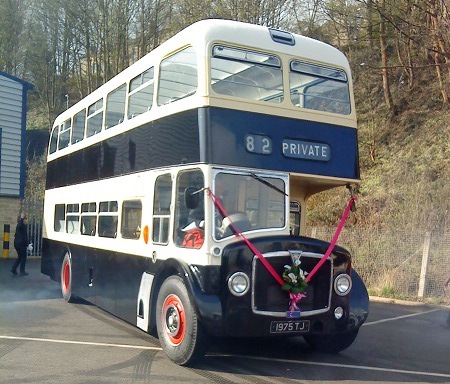
Their rear entrance Renowns were always great favourites of mine ever since I saw the front and rear view photographs of one of them in Buses Illustrated when new. In 1976 I bought 28 (1975 TJ) for preservation from GMPTE, but in the 1980’s sold it and it then passed through several subsequent owners – maintaining a very low profile in the process. Only last week I learned that it been acquired by Tony Blackman for continued preservation, and who knows…..maybe operation in his Yorkshire Heritage Buses wedding hire fleet, though I do hope that it doesn’t turn black and white in the process. The beautiful azure blue and cream Leigh livery would be very much in demand by would-be happy couples I would imagine – it would match the bridesmaids’ dresses and floral arrangements !

John Stringer

———

30/08/12 – 06:49

1975 TJ_lr

Leigh 28 at Luddenden Foot, it has been working hard this summer for Yorkshire Heritage Buses. This shot was on her first day in service and as can be seen it is in black & white John.

Geoff S

———

30/08/12 – 07:09

AJA 129B_lr

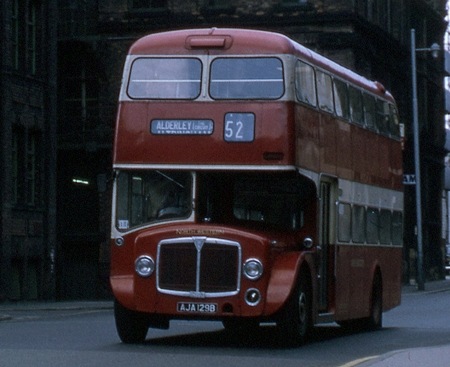
Here is a picture of fellow Renown AJA 129B in Manchester, en route to Alderley in true North Western days. I have to admit that personally I much preferred the North Western Loline IIIs to the Renowns in both appearance and performance, but it would be nice to be able to detect something of the variety and individuality of the psv designs of those times in the present day crop of tediously indistinguishable bus types.

Roger Cox

———

31/08/12 – 07:33

Thanks Geoff S. for sending the photo. I hadn’t realised its restoration had advanced so far, I may well then have seen it at a distance and mistaken it for the ex-Southampton Regent V. As for the livery……….I’ll say no more.

John Stringer

———

31/08/12 – 09:35

Black marks for the new livery, then, John?

David Oldfield

———

31/08/12 – 09:45

Is black a good colour for a wedding or do they do funerals as well.

Spencer

———

So where have you been for the past year and a bit? Have you forgot how to send emails?

Peter

———

31/08/12 – 12:28

It’s a dual-purpose vehicle, Spencer; white for weddings; black for funerals!

Chris Hebbron

———

31/08/12 – 12:29

Tony Blackman’s "new" livery is in fact that of Lockey of West Auckland, and presumably was prompted by his acquisition of a full-fronted Regent V/Park Royal which (although new to East Kent) had been operated by that famous County Durham independent. That particular vehicle also carries Lockeys titles while the rest of the heritage fleet don’t. We all have a lot to thank Tony for – in my personal case for an unforgettable ride through the Mersey Tunnel on his ex-Halifax Regent III. What a pity that his revived Halifax JOC no longer operates stage services in the original glorious livery!

Neville Mercer

———

31/08/12 – 12:30

I suppose so David, but the thought of how it could have looked in its proper livery leaves me feeling blue.

John Stringer

———

31/08/12 – 12:32

The black and cream livery used by Yorkshire heritage buses is derived from the colours on a former East Kent AEC Regent V which is in the livery of its last owner Lockey of St Helens Auckland I saw the ex Darlington Guy saloon in the livery recently and it looked very good indeed. Better in a livery than a scrap yard!

Chris Hough

———

02/09/12 – 07:10

The trouble with Bridgemasters and lowheight Renowns was that there was no inward tapering at the front, creating a profile that was squat and square. That’s why the Beverley Bar treatment is such an improvement – it adds a much-needed bit of shape. Don’t forget Northern Counties www.flickr.com/

Peter Williamson

———

03/10/12 – 06:07

I used to drive these Renowns, 127b, & 129b, in the 60s at the North Western Altrincham Depot , a nice drive but a bit on the ‘Bouncy’ side!!

Roger Williams

———

AJA 127B_lr Vehicle reminder shot for this posting

———

13/11/12 – 08:44

I was a summer guard with NWRCC at Glossop Garage between 1960 and 1962. It was the guard that operated the lights at the Norfolk Arms terminus and you had to be mighty quick to get back to the platform, clutching Setright and money bag to grasp the platform pole before the driver moved off. Bristol K5G’s were OK but a PD2 was fast off the mark and you held on like grim death for the swing round. Those were the days – swinging loads on the old 125 to Manchester and overloads on the 85 to Buxton on summer days. It was a great company with great mates at Glossop depot. Public service at its best!

Roger Chadwick

———

13/11/12 – 12:57

Roger, be thankful it was a PD2 and not a trolleybus or you’d have been left standing.

Ronnie Hoye

———

23/11/12 – 10:03

Roger, Myself and two colleagues have been researching the North Western driver and conductor duties. Would you have kept any information when you worked at Glossop in the 60’s

Keith Hampton

———

22/01/13 – 06:33

Roger, Being one of the Two colleagues that Keith refers to can you supply any names of staff at all.
All part of an on going, and growing, North Western project of ours.

John Dixon


Quick links to the  -  Comments Page  -  Contact Page  -  Home Page


All rights to the design and layout of this website are reserved     

Old Bus Photos from Saturday 25th April 2009 to Wednesday 3rd January 2024