Old Bus Photos

Wallace Arnold Tours – Leyland Tiger – LNW 262
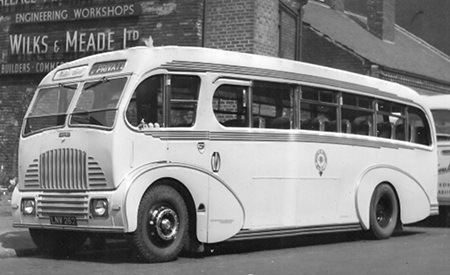
Wallace Arnold Tours - Leyland Tiger - LNW 262
Photograph by ‘unknown’ if you took this photo please go to the copyright page.

Wallace Arnold Tours Ltd
1947/1950
Leyland Tiger PS1
Burlingham FC33F

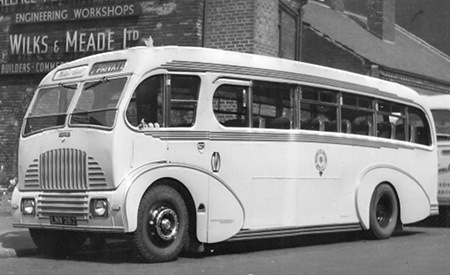
This photograph is yet another from my dusty collection, taken by an unknown photographer. It shows Wallace Arnold LNW 262, one of a large batch of Leyland PS1s purchase in the immediate post-war years to get a head start on the newly-emerging leisure and coaching market. It was bought in 1947 with a Burlingham C33F half-cab body. In 1950, following the trend towards "modernisation", it reappeared as an FC33F.
At the time, WA were constantly swapping bodies and rebodying chassis to create an up-to-date image at the lowest cost, so I’m not sure if this was a completely new body or simply a rebuilt front end. If it was a new body, what happened to its 3-year old original body?
It was withdrawn in 1957 and saw further service with Wilsons of Hunwick, Prospect of Ferryhill, McClean of Govan and finally to Austins of Stafford in 1963 where it seems to have joined its sister LNW 263.
The only sure thing about this photo is the location – the WA depot and workshops, Chadwick Street, Leeds.

Photograph and Copy contributed by Paul Haywood

———

30/09/12 – 10:44

I’m sorry, but I’ve always preferred the half-cab version of this body. It just looks better. This "grinning" style looks to have been taken as the inspiration for those ‘smiley’ characters which appear on the forum sections of some websites. Was this style of front end some form of inspiration for that variant of the Seagull which appeared on Bedford SB coaches?

Pete Davies

———

30/09/12 – 12:19

If that’s a conversion it’s been done very neatly!
Interesting to note the sign in the background, as Wilks and Meade were coachbuilders themselves!

David Beilby

———

30/09/12 – 12:20

I cant argue with that, Pete. Just one point, some of Northern’s Beadle re-bodies didn’t have a bulkhead behind the driver, but its hard to tell if this one does or not, it may only be a half one, in which case the object of the exercise may have been to leave the passengers feeling less cut off from the driver, that said, I still don’t like it.

Ronnie Hoye

———

30/09/12 – 12:21

My opinion of these sacrilegious "facelifts" intended to deceive the customers in some way is unprintable on a refined Forum like this one. Samuel Ledgard bought a batch of eight most handsome PS1 Tigers with Duple "porch entrance" bodies in 1948. During the madness years of the 1950s these beautiful coaches were subjected to this indignity by the Samlesbury Engineering Company – the first to be treated, LUB 675, was the worst – with small rectangular windscreens with level lower edges – absolutely awful.
Also, in the marketing "spin" frenzy, operators appeared completely oblivious to the maintenance difficulties and to the misting of windscreens which came with these "improvements."

Chris Youhill

———

02/10/12 – 15:28

Wilkes and Meade were a Leeds firm who were bought by Wallace Arnold. They were then set to work on the convoluted post war bodying, re-bodying and partial re-bodying programme (putting full fronts on half cabs). They built many new coaches in the late forties – some for outside customers, and also some buses for Sheffield Corporation. They were finally integrated into Wallace Arnold’s maintenance division and the name disappeared into obscurity.

David Oldfield

———

02/10/12 – 15:30

David B, Wilkes and Meade were actually part of the Wallace Arnold empire so may have had a hand in the rebuilding. It was bought to provide body building/repair facilities for the coach fleet

Chris Hough

———

02/10/12 – 15:32

This looks like a completely new body to me. The trim above and below the windows, and around the wheel arches, belong to the same style of body as the front end, not to the half-cab style. If it is a conversion then it’s a wholesale update, not just a front-end job. Incidentally the trim above and below the windows was carried forward to the Seagull.

Peter Williamson

———

02/10/12 – 15:34

Notwithstanding the impracticalities of full-fronted designs that Chris mentions, but just accepting that it was just the ‘done thing’ at the time, I rather liked the Burlingham ‘SunSaloon’. The grille was a touch flashy and garish I know – so were very many other coach builders’ features in the early fifties – but I always thought that these were very neatly shaped at the front, just as their half cabs had been. Whilst most of us are traditionalists and would much more prefer halfcabs, I think one can understand why coachbuilders turned to full-fronts and full-front rebuilds in the circumstances of the time – it’s just that so many made a dog’s breakfast of the job.

John Stringer

———

02/10/12 – 15:35

This was a new body, a Burlingham Sun Saloon built in 1950. The original body was transferred to a prewar Leyland or AEC as part of the modernisation programme. Wilks & Meade supplied WA with a total of 40 bodies on new and recon chassis in the period 1946-1950, as well as carrying out a good deal of refurbishment and rebuilding work for the operator. A small number of bodied were also built by Wilks & Meade for other concerns. Quite why this coach was at Wilks & Meade’s premises is not clear, one supposes it had been receiving some attention to its body.

Philip Lamb

———

03/10/12 – 06:16

Excellent observations, gentlemen, thank you.
Philip, the Wilks & Meade sign was attached to the side of WA’s workshop/office/canteen building and the Wilks & Meade workshop was further up Chadwick Street. WA’s large depot had entrances from Chadwick Street and the parallel Sayner Road, so this coach was probably parked awaiting duty or mechanical attention.
When WA moved to Donisthorpe Street as a (long-term) temporary measure, prior to the completion of their Tour Terminal, depot and workshops in Gelderd Road, this whole site was taken over by Wallace Arnold Sales & Service, a Vauxhall main dealership – and is now owned by Evans Halshaw. You can still see the footprint of the old depot on Google.
In my time with WA (mid 60s) there was only one chap still employed from the Wilks & Meades days, a very fine man called Jack Lye, who was obviously much used for body repairs etc. I can still see him walking up the street carrying long lengths of beading to be cut, drilled and applied to some accident damaged coach.

Paul Haywood

———

03/10/12 – 10:38
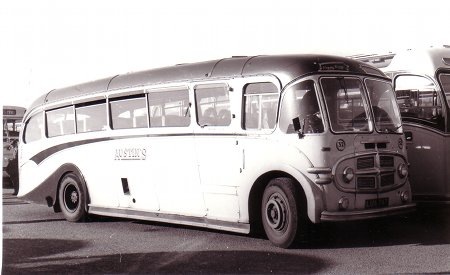
LUA 747_lr

Austin of Woodseaves collected quite a large fleet of Tigers which had started life with Wallace Arnold. If you think the Burlingham Sunsaloon body was an abomination, perhaps you should compare it with this one. LUA 747 started life with a Duple "A type" half-cab body, but was modified with a full-front by their in house bodybuilder Wilks and Meade as shown here. Wilks and Meade produced quite a few similar conversions, all of them using the distinctive tin-front and unmistakable "propeller in an oval" design more usually associated with Plaxtons. Odd that Plaxton should allow this – does anybody know why? (copyright unknown)

Neville Mercer

———

03/10/12 – 17:50

Looks to me as if a complete Plaxton Consort front up to and including the cab window, not just the grille, has been skilfully grafted on. Presumably this was supplied by Plaxton. Makes for an interesting combination!

Philip Lamb

———

04/10/12 – 07:29

Thurgood also produced some bodies (usually on Bedford SB chassis) in the late 1950s/early 1960s which used an almost identical "Plaxton Venturer" front. I also seem to recall that Dodd of Troon (AA Motor Services) had a Foden PVSC6 with a very similar full front rebuild, although this may have originally been bodied, as a half-cab, by Burlingham. My copy of the Foden chassis list is out on loan at the moment, so I can’t check this. Are there no old-time Plaxton employees on this website who might clarify the reason for all these Venturer lookalikes?

Neville Mercer

———

04/10/12 – 07:30

Is the result of the grafting known as a "Duplax"?

Phil Blinkhorn

———

06/10/12 – 07:24

The fitting of the new front end end was done in 1954. From 1952 WA began ordering coach bodies from Plaxton, Plaxton would have been keen to retain their business. Although the work is described as Wilks and Meade to Plaxton design, most, if not all the components must have been supplied by Plaxton. Wilkes and Meade had previously done similar conversions to Yeates design at the same time as Yeates had converted some of WA’s coaches themselves-was this an exercise in keeping Wilks and Meades workshop occupied between car related jobs?

David Hick

———

11/10/12 – 16:04

As mentioned, Wallace Arnold’s rebodying and rebuilding programme in the late 40s/early 50s was complex, and is documented in PSV Circle publications. In fact the featured coach, LNW 262, was one of four in a chain of body changes.
(1) LNW 262, as has been mentioned, was a 1947 Leyland PS1 with Burlingham half cab C33F body, which it carried till winter 1952/3.
(2) HUA 904, a 1939 Leyland TS8 then received the half cab Burlingham body from LNW 262.
(3) APT 464, formerley Wilkinson’s of Sedgefield, was fitted with the 1939 Duple C32F from HUA 904 by Comberhill Motors (dealer).
(4) NUA 753 was a 1950 Leyland PS2/3/Burlingham FC33F whose body was then transferred to LNW 262 to produce the coach depicted. Its chassis then went to Plaxtons for a new Venturer FC35F8 body.

David Williamson

———

12/10/12 – 08:12

David, many thanks for the comprehensive body juggling information. As mentioned in other threads and discussions, WA were very money conscious and never failed to spot a bargain when one arose, and they must have calculated that these complex activities were worthwhile. The strange thing is, I doubt if Mr & Mrs Tourist would have been too bothered about touring in a half-cab or a full-front as long as the seats were comfy and the price was right.

Paul Haywood

———

13/10/12 – 06:33

Interesting point, Paul. It is well known that as soon as underfloor engined coaches made their appearance, halfcabs were considered dead in the water. Despite the regulated environment there was still real competition in the coaching world, and operators could not bear to see a rival operator with more up-to-date stock than they had. And yet, as you say, this may actually have had very little to do with their customers. My family only used coaches for excursions, but I’m quite sure my parents never noticed which of the Albions used by our local operator had full fronts and which were halfcabs. I did of course, but then at the age of 8 I was already a bus freak!

Peter Williamson

———
LNW 262_lr Vehicle reminder shot for this posting

———

16/12/12 – 07:37

Regarding Jack Lye from Wilks and Meads (03/10/12 above), there was a George Lye who used to work occasionally in the WA Gelderd Road bodyshop when he was well into his eighties. He loved the job, and was ex Wilks and Meads – could they be the same man? I was at WA 1978 to the end in 2005.

Jon Hartley

———

16/12/12 – 08:38

Jon – George it was! Thanks for that memory jog. Pleased to learn that he was still involved with WA so late on. Every time I pass the Gelderd Road "wasteland" I can’t believe how such a comparatively modern hive of activity could have disappeared so quickly. As you were there to the "bitter end", you must share those sentiments. How are the mighty fallen!

Paul Haywood


Quick links to the  -  Comments Page  -  Contact Page  -  Home Page


Leicester City Transport – Leyland Titan PD3 – TBC 164 – 164

Leicester Corporation - Leyland Titan PD3 - TBC 164 - 164                     Copyright Chris Hebbron

Leicester City Transport
1958
Leyland Titan PD3/1
Willowbrook H41/33R

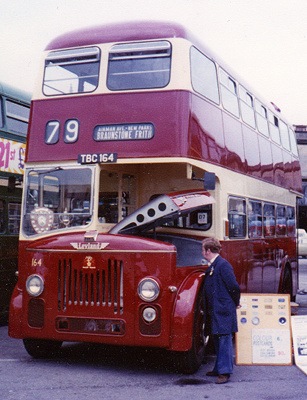
LCT bought an eclectic mix of chassis and bodywork for its fleet over the decades, but settled on just three (164-166) tin-fronted Leyland Titan PD3/1’s, with attractive Willowbrook bodywork, in 1958. 165 and 166 were withdrawn in 1972 and 1975 respectively, with 164 being withdrawn in 1974. It’s seen here, looking remarkably chipper, aged 19, at the Bristol Bus Show, in 1977.

Photograph and Copy contributed by Chris Hebbron


29/09/12 – 07:43

And would the gent who looks as if he’s volunteering to become lunch be Mr Hebbron, by any chance?

Pete Davies


29/09/12 – 07:44

This bus is currently under restoration on a farm outside Leicester.

Philip Lamb


29/09/12 – 12:15

I thought it was at Snibston Discovery Park in Coalville, fully restored ages ago, along with a 6 wheel Renown and the 1911 Leicester City Transport Leyland tower wagon used up to the end of LCT Tramways in 1949. The latter is the oldest preserved Leyland lorry.

If the photo is 1974, Chris, and the figure looking in is not you, then it would be Clive; (sorry Clive, but I cannot remember your second name!). He was the regular Leicester Museums staff member who drove the exhibits to various shows when they were stationed at the Corporation Road Pumping Station Museum in Leicester. Probably still does, from Snibston. Other LCT buses are restored, or under restoration, by the Leicester Transport heritage Trust, including tram 36.

John Whitaker


29/09/12 – 18:03

Handsome bus, dignified livery. By the time I went up to university in 1984 the bus fleet had been standardised on MCW Metropolitans and Dennis Domintors with a few Metro-Scanias thrown in: but the fleet still sported the dignified cream and maroon-banded livery, some services were conductor-worked, and tickets dispensed from Ultimates and Solomatics . . . not for long though, the red/white/grey Leicester CityBus identity was adopted as part of the Leicester CityCouncil corporate identity (that’s right chaps, paint your buses the same colour as your refuse waggons so that passengers get the message), and Wayfarer machines came in. Most LCT services (except those worked jointly with Midland Red/Fox?) were cross-city and, I think until a route revision round about the time I went up, used different numbers depending on direction of travel. Leicester, like Trent, used to place front number plates at ‘tween decks level – any suggestions as to why? was this just a midlands foible, or did any other operators adopt this practice? Willowbrook seemed to have a respectable business amongst major operators for both single and double-deck business around this time, but then in the 1970s seemed to concentrate on the lightweight market: I suppose the introduction of the Leyland National killed-off the BET standard business, but why didn’t it continue to chase the double-deck market? And why did Duple buy Willowbrook and then divest itself of the business? Why did it keep the Willowbrook identity when Burlingham and Nudd Brothers & Lockyer became Duple (Northern) and Duple (Midland) – in fact, why wasn’t Willowbrook amalgamated with Duple (Midland)? Anyway, back to the bus: did Leicester pay extra for the Leyland badge? which would explain why not all tin-fronts sported this feature, but not why Leyland didn’t think it worth advertising itself on its products; and why, when the tin-front was adopted for wider use, did Leyland not modify the grill to eliminate the space for the BMMO badge? – surely the costs of re-tooling would have been miniscule when compared to production volumes. So many questions! Hopefully some answers will be forthcoming, in the meantime I’m going to scroll up and drool over the bus a bit more . . .

Philip Rushworth


30/09/12 – 07:57

Number plates between decks was not just a midlands foible Philip as Southdown did up until I think the late fifties when they moved them to below the cab windscreen for some reason although for obvious reasons the double deck coach No 700 with full front Northern Counties body always had it’s plate below the radiator grill.
I think the livery on the PD3 in the photo was far better than the later predominately cream version and the red/white/grey is best forgotten and the Midland Red front although not very stylish was infinitely superior to the St Helens front which was such an ugly brute which never suited any bodywork.

Diesel Dave


30/09/12 – 07:58

Philip Willowbrook did build some VRs and Atlanteans in the seventies principally for the Northern General companies sadly they were not a patch on this example Leicester’s last rear entrance bus an East Lancs bodied PD3 ran in 1982.
Why Leyland kept the tin front design until the early sixties without getting rid of the space for the BMMO badge I cannot say but Edinburgh fitted a version of it to all its Titans finally building a fibre glass version themselves.
The bodies built by Willowbrook were somewhat ersatz copies of ECW (the VR) and MCW products.

Chris Hough


30/09/12 – 10:40

If you go to your web page and type in AFT53 you’ll find a picture of Tynemouth 223 being used as a training bus, it was one of 5 Willowbrook bodied PD2/12’s delivered to Percy Main in 1957. AFT 49/53 – 219/223. The original livery layout was mostly red with cream center band and roof, later on the roof became red ‘I thought they looked best in that livery’ and about 1968 this updated version of the first post war layout was adopted. As far as I know these were the only ones of this type in the NGT group. Northern were never fans of tin fronts, in fact I think the Routemasters were the only ones that came close to that description

Ronnie Hoye


30/09/12 – 12:04

The tin front design question is an interesting one, as the Leyland grille design changed slightly over the years and I see nothing sacrosanct about the part with the space for the BMMO badge.
This photograph also makes clear why Orion bodies (in particular) on tin-front chassis, tapered in so much at the front. This was to match the width of the standard tin-front which was clearly to suit 7′-6" chassis. Willowbrook opted to maintain more body width to the front resulting in a mini dash panel to the offside of the tin front.

David Beilby


02/10/12 – 14:46

Diesel Dave comments on the ugliness of the St Helens front. I’m making the rash assumption here that St Helens Corporation thought it rather pretty!

Pete Davies


02/10/12 – 14:54

The figure is not me, Pete/John and the photo was taken in 1977, so may or may not be Clive. I was worried, myself, about the wisdom of examining the mechanicals in the bowels of the monster, so I kept well clear. One can never be too careful!

Chris Hebbron


03/10/12 – 06:00

Thanks for clarifying! It looks as if that lid could stand duty as a guillotine.

Pete Davies


03/10/12 – 06:01

The later Leyland concealed radiator design was known as the St Helens front, because St Helens was the first operator to take delivery. The design was pure Leyland — a reverse of the situation re the original Leyland tin front, which was developed to match contemporary Midland Red styling.

Philip Lamb


03/10/12 – 06:02

David, the tin front wasn’t designed to suit a 7ft 6in chassis. The original design, as we all know, was for BMMO and the order was for 100 8ft wide PD2s with Leyland bodies. Again, as we know, the standard Leyland 8ft wide body was a widening of the original 7ft 6in wide body.
For some reason Leyland widened all but the the front of the 8ft body. This didn’t cause any design problem with the traditional layout of radiator and front scuttle panel and, as the BMMO requirement for a tin front was expected to be only for them, the tin front was designed to blend with the body.
Whilst the tin front was eventually offered on both 7ft 6in and 8ft chassis, the BMMO order was the only one, in either width, to specify Leyland body work.
Liverpool adopted the tin front and its 1954 delivery of PD2/20s (8ft wide with bodies by Alexander) did not have the narrowing and the tin front on these vehicles was the full width of the bus – as were tin fronts on bodies by other builders for a range of operators using the 8ft wide chassis.
Doug Jack’s "The Leyland Bus" has a range of pictures showing a variety of 8 ft wide tin front PD2s without any narrowing of the body, some with full width tin fronts, some with the 7ft 6in version on 8ft wide bodies.
The question is why 8ft wide Orion bodies narrowed as they did to use the 7ft 6in version of the tin front.
The Edinburgh Holmes designed tin front replacement was unutterably ugly. As for the St Helens front, it was designed to give better visibility and Leyland saw it as being akin to the design on the current Vista lorry cab (which they shared with Dodge), thus giving a form of "house style".

Phil Blinkhorn


03/10/12 – 10:12

One of the attractions of this site is the wide scope of observations from correspondents with differing interests. With my ‘operational’ background, my reaction at the illustration was, as others have commented, of a smart vehicle in attractive livery, but I wondered about the destination display. The route numbers are large and very readable, which was fine for locals who knew where they were going, but the actual destination box itself isn’t too helpful for passengers who needed to check their intended destination, and is out of proportion with the numerical display. The positioning of the number plates is distracting, and doesn’t make things easier for them.

Roy Burke


04/10/12 – 07:22

Philip,
A reference in "Local Transport in St Helens 1879-1974" by TB Maund and MJ Ashton says "St Helens commissioned an unusual asymmetrical front which was subsequently used elsewhere and known as the ‘St Helens front’ ".
As a passenger on St Helens Corporation and Crosville to school from 1961-68, I always assumed that St Helens Titans had fibreglass fronts because Fibreglass Ltd (a subsidiary of Pilkington Brothers) were based in St Helens.
Thus, some Corporation spending was kept within the boundary and kept some local people in employment. This is something long-lost in our economy, much to the delight of Volvo, Scania etc.

Dave Farrier


04/10/12 – 13:35

On the subject of highly placed registration plates it may have been a geographical thing as both Trent and Barton also place them over the cab on double deckers.

Chris Hough


11/02/14 – 07:00

I worked for LCT for 5 years, and my understanding of the positioning of the number plates was that the body fitters were sick to death of having to refit them after minor shunts. So the chief engineer of the day, early 1960s, decreed that the damned things be removed to a higher place of safety. Presumably, other operators took the same view and for the same reason. A minor shunt, that maybe just dented the bottom of the grille, could be ignored until the next repaint, whereas damaged or missing number plates had to be attended to immediately or the vehicle was out of service until fixed.

Rob Haywood


11/08/14 – 07:16

The man looking at 164 is NOT Clive. It’s not me either but I did drive this to rallies when working for Leicester Museums and Clive Stevens worked for me. He still volunteers at Abbey Pumping Station Museum. We also drove the 1939 Renown, once all the way to Brighton.

Bob Bracegirdle


Vehicle reminder shot for this posting


02/11/14 – 15:24

As an ex. LCT employee, 1956-61, I can confirm that the positioning of the front number plate between decks came about long before tin fronts – pre WW.II in fact. It was positioned there so that reconditioned radiators could be swapped between buses without the necessity to swap number plates.

Paul Banbury


Quick links to the  -  Comments Page  -  Contact Page  -  Home Page


North Western – Leyland Tiger Cub – FDB 586 – 586A

North Western - Leyland Tiger Cub - FDB 586 - 586A
Stephen Howarth collection

North Western Road Car Co
1955
Leyland Tiger Cub PCUC1/1
Weymann B44F

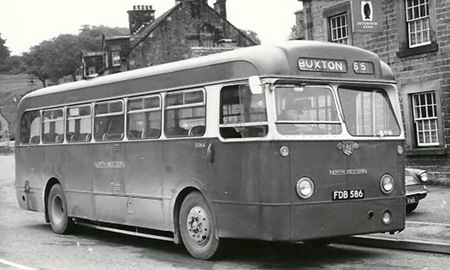
FDB 586 a Leyland Tiger Cub was new to North Western RCC in 1955.
It was converted, along with the rest of the batch to OMO in 1958/9, as denoted by the ‘A’ suffix after the fleet number.
586 is shown here (in rather a grubby state) working the 1 hour 36 minute duration Service 65 from Ashbourne to Buxton. The picture was taken outside the Devonshire Arms Hotel in the picturesque Derbyshire village of Hartington, a view which has changed little over the years. There was still over 50 minutes to go before it reaches the end of the journey in Buxton Market Place.
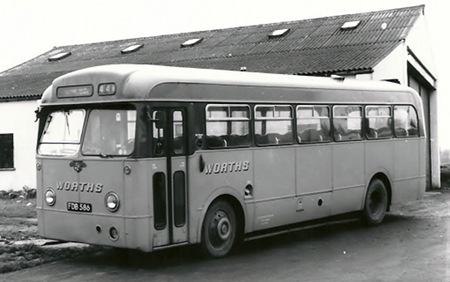
It was withdrawn in 1968, and passed to Worth’s Motor Service Enstone, Oxfordshire.

Worths - Leyland Tiger Cub - FDB 586 - 586A
Stephen Howarth collection

Taken from their website “Worth’s were established in 1922 in the village of Enstone by Thomas (Dickie) Edmund Worth who started, like a lot of Bus and Coach Companies of that time by repairing motor bikes, bicycles and lawn mowers. He later progressed to running Ford Model T taxis’, and then on to Char-a-Bancs running day trips to the coast.”
This year the company will be celebrating 90 years in business and continues to be run by the Worth family with the motto still being well known as:- "For a rattling good ride".
There website can be found at www.worthscoaches.co.uk
FDB 586 is shown here outside the Garage in Enstone.

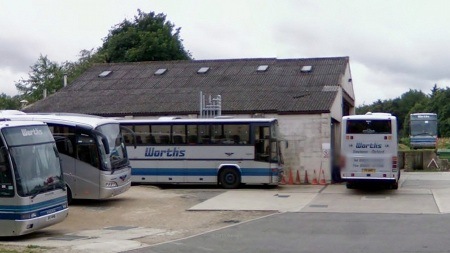
Worths Motor Services Garage
Stephen Howarth collection

I have included a modern day picture of the premises, and as can be seen the garage building, unlike the fleet, has altered little.

Photographs and Copy contributed by Stephen Howarth

———

25/09/12 – 16:45

Purely from the "observer" point of view, Worth’s has always struck me as being one of the better operators. Others, of course, may feel or know otherwise! As for North Western, what can one say other than "R.I.P."?

Pete Davies

———

25/09/12 – 18:57

Pete: yes and yes.

David Oldfield

———

26/09/12 – 07:07

The No. 65 doesn’t look overburdened with passengers does it? And to think, until the late 50s this route was paralleled by a railway line, whose stations, on the whole, were nowhere near the villages they purported to serve!

Stephen Ford


Quick links to the  -  Comments Page  -  Contact Page  -  Home Page


All rights to the design and layout of this website are reserved     

Old Bus Photos from Saturday 25th April 2009 to Wednesday 3rd January 2024