Old Bus Photos

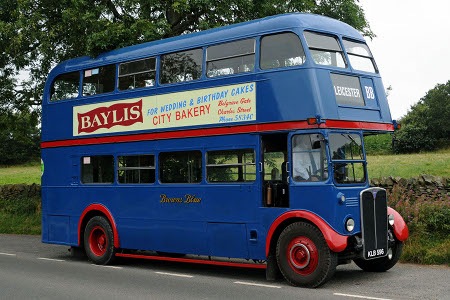
Browns Blue Bus – AEC Regent III RT – KLB 596

Brown's Blue Bus - AEC Regent RT - KLB 596
Copyright Mike Greenwood

Browns Blue Bus Service
1950
AEC Regent III RT RT3/3
Saunders H56R originally now Weymann

I was interested to read about Victor’s visit to Leicester in 1958 to see the ex-LT Daimlers in service with Browns Blue. A good friend of mine, Mick Gamble, has just completed writing a comprehensive history of the Browns Blue Company. This is now at print and is due to be released in mid-October. Mick has worked on the project for over two years and has travelled many a mile in interviewing members of the Brown family along with form Browns Blue drivers, conductors and engineering staff. The book will be hard back containing 232 pages, over 200 photos and a complete fleet list.
Mick has produced the book to coincide with the 50th anniversary of the take-over of the company by Midland Red in March 1963.
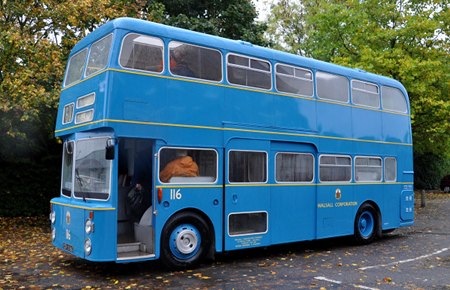
Chris Barker noted that Browns Blue also operated nine ex-London Transport RTs and whilst all nine found new owners following withdrawal by Browns Blue, sadly none made it into preservation. So Mick has done the next best thing and has purchased KLB 596 transforming it into a replica of HLW 160 which was the only non-roof box RT that Browns Blue operated. Mick has had authentic adverts produced and a replica 19 metre long destination blind!

Photograph and Copy contributed by Mike Greenwood


21/10/12 – 10:41

Nice!!!

Pete Davies


22/10/12 – 17:04

This vehicle looks magnificent in Brown’s Blue livery, and would look even more so if parked next to the RTW preserved in Stevenson of Spath’s yellow and black colour scheme. Bring them both up to Manchester sometime please, my range is more limited these days! Well done to all involved in this project, independents are severely under-represented in the ranks of preserved vehicles.

Neville Mercer


27/01/13 – 07:59

We had this bus for our wedding transport in July 2006. It was in traditional London Transport red. Our wedding was in Winchester and the bus was hired for the day with a clippie from somewhere in Hampshire.

Sam Covill


Quick links to the  -  Comments Page  -  Contact Page  -  Home Page


S H M D – Daimler Fleetline – ELG 40F – 40

S H M D - Daimler Fleetline - ELG 40F - 40
Copyright Ian Wild

Stalybridge, Hyde, Mossley and Dukinfield
1968
Daimler Fleetline CRG6LX
Northern Counties H41/27D

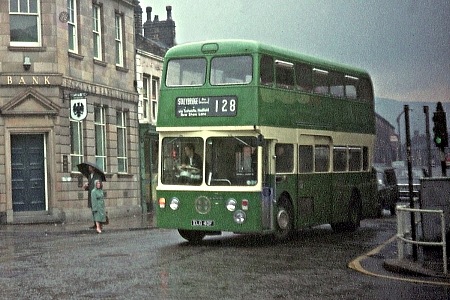
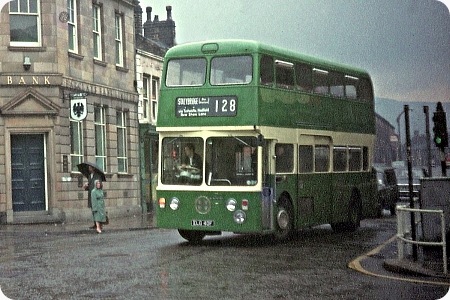
It’s August 1968 and a wet day in Glossop. One of SHMD Board’s recently delivered Walsall inspired short dual entrance Fleetlines is about to turn at the traffic lights outside the Norfolk Arms on a 127 to Stalybridge. North Western’s Glossop Depot is further up the road behind the Fleetline. These buses looked quite elegant in this livery but were totally unsuited to the SELNEC orange and white applied after the PTE takeover. Note the Rotavent ventilators in the side windows in lieu of sliding top lights, these were very much in vogue at the time.

Photograph and Copy contributed by Ian Wild

A full list of Daimler codes can be seen here.

———

19/10/12 – 06:34

The introduction of the V shaped lower deck windscreen changed a plain and fairly dull NCME design into something much more attractive compared to the full sized vehicle of previous deliveries.
Why SHMD went to a smaller vehicle when every operator around it – even Stockport – had gone for something bigger is a question I can’t answer.
The narrow front door wasn’t particularly well liked but the vehicles performed reasonably well in service and I agree, the SELNEC scheme ruined the overall look.

Phil Blinkhorn

———

19/10/12 – 11:12

It’s an odd combination, with folding front door and a sliding one amidships. I have a bought view of a "C" suffix unit from this fleet, and it has only a cream stripe below the upper windows – above the indicator display. This looks far better.

Pete Davies

———

19/10/12 – 12:44

This was a strange vehicle design contrived by the innovative Edgeley Cox at Walsall where a large fleet of this type was operated. Was there some relationship between the managements at SHMD and Walsall to cause SHMD to choose these vehicles? I have always rationalised the concept in my mind on the basis that the narrow front door would be used as the entrance if the bus was working one man but could be kept closed and the centre door used conventionally for entry and exit if a conductor was on board just like a normal forward entrance front engined decker. Anybody know if this is right?
It is interesting that SHMD also had a history of innovation with the centre entrance Daimlers and of course the solitary double deck Atkinson in the mid-fifties. I understand these were inspired by a GM who had been at Blackpool, the spiritual home of centre entrance double deckers.
All this adds up to show what powers the municipal GM’s seemed to have in those glory days in including individual quirks into new vehicle specifications.

Philip Halstead

———

19/10/12 – 14:43

Philip is correct about the idea behind the door usage.
I’m not aware of any direct link between SHMD and Walsall and it would be interesting to see the minutes relating to the decision to purchase the vehicles. Presumably these are archived by Tameside MBC if any one has access.

Phil Blinkhorn

———

19/10/12 – 16:48

Were Walsall heavily into short Fleetlines? I remember seeing one/some with no front cantilever. I can’t remember how/where the driver sat!
I am often in these congested days puzzled as to why passenger numbers fall and bus sizes rise….

Joe

———

19/10/12 – 17:34

Walsall had 99 short Fleetlines. The first was only 25′ 7" with no front overhang and an entrance behind the driver’s position pretty much the layout adopted by forward entrance front engined vehicles.
The next 29 were of the same layout but were 27′ 6" with a front overhang. All of the above had wrap around windscreens on both decks.
The next 69 were 28′ 6" long and were identical in looks to the SHMD vehicles. A comprehensive set of photos can be found by searching Walsall Fleetlines on Flickr. The last supposed Fleetline, actually the unique Daimler CRC6-36, went to to the other extreme with a 36′ length and two staircases.

Phil Blinkhorn

———

20/10/12 – 06:21

Thanks Phil for confirming my theory on the entrance/exit concept. I always feel that Edgeley Cox was to the bus world what Oliver Bullied was to railways. Both were great innovators and must have been strong personalities in that they got their employers to adopt large numbers of very unusual vehicles (locos in Bullied’s case) where a more standard solution would have almost certainly made more commercial sense. Sorry to digress into the world of flanged wheels on this site but the parallel has always struck me.

Philip Halstead

———

20/10/12 – 15:03
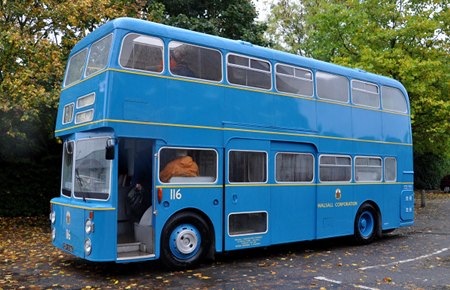
XDH 516G

XDH 516G_cab

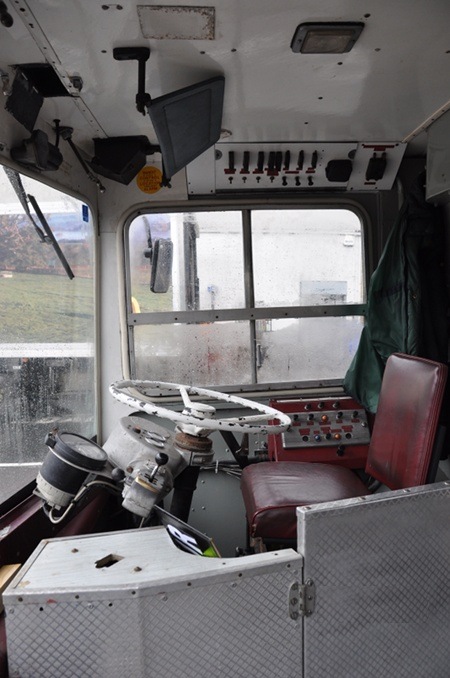
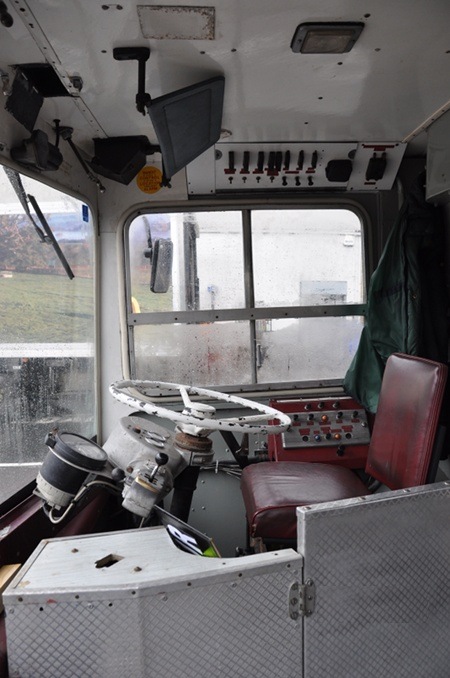
Since the current posting has mentioned the Walsall short Fleetlines buses I thought you may like to see a couple of shots taken of the preserved Walsall vehicle, which is part of the Wythall collection it was used in 2010 to celebrate the end of trolleybuses in Walsall by following most of their former routes.

Ken Jones

———

20/11/12 – 05:28

I’m not "into" buses but came across the article on S.H.M.D. Fleetlines, the last six of which seemed to be used a lot on 2-man services like the 125 in the ’70s. Were these buses sent to Glossop after the P.T.E. absorbed the North-Western operation there, to replace the Renowns on conductor-operated routes, while the earlier,’conventional’, 56XX Fleetlines were cascaded out of the area to depots like Leigh-perhaps to replace A.E.C.s there in a similar role? Does anyone know if the ‘preserved’ S.H.M.D. Fleetline that was being kept at Mossley (I think) still exists?

John Hardman

———

20/11/12 – 11:33

On the last point, I can confirm that Fleetline number 28 is still there, along with PD2 number 5.

David Beilby


Quick links to the  -  Comments Page  -  Contact Page  -  Home Page


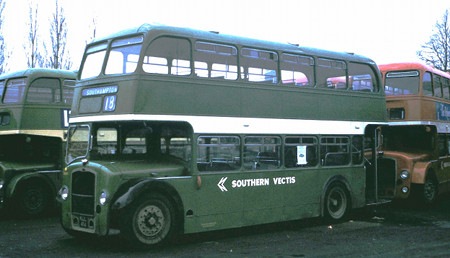
Southern Vectis – Bristol Lodekka – KDL 414 – 518

Southern Vectis - Bristol LD6G - KDL 414 - 518
Copyright Pete Davies

Southern Vectis Omnibus Company
1954
Bristol Lodekka LD6G
ECW LD57R

KDL 414 is a Bristol LD6G with the usual ECW H60R body, still in Tilling green, but with NBC fleetname and the white stripe. She was one of ten which were borrowed at the time, and has gained a Hants & Dorset fleet number (3493) instead of her "real" one. She is in the yard of Southampton depot on a dull lunchtime in March 1974.

Photograph and Copy contributed by Pete Davies

A full list of Bristol codes can be seen here.


16/10/12 – 16:57

A lovely photo of an icon in design which does speak well for the quality of the Bristol and ECW product at 20 years of age. Just a little puzzled at the seating capacity which was normally 58 seats in this first tranche of 1954 Lodekkas. The 1955 build saw seating increase to 60 seats but some operators still preferred 58 seats.

Richard Fieldhouse

Info from 1963 OBF 3 South Central

Peter


16/10/12 – 16:57

One of the early LDs with long radiator grille, as used up to 1955. The red bus behind has the same type of grille. However, it was not unknown for the long and short grilles to be exchanged during overhaul.

Geoff Kerr


16/10/12 – 17:30

KDL 401_lr

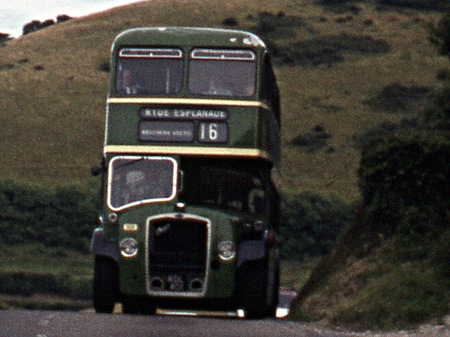
Here is another shot of one of these Southern Vectis early LD6G Lodekkas. KDL 401, SV fleet no.505, delivered in March 1954, is shown at St. Boniface Down on 28 August 1967. According to Bus Lists on the Web, this bus and its fellow no.518 above originally had ECW bodywork with a capacity of H33/21R. It is possible that this was increased later, as others within the same batch had H33/25R seating accommodation.

Roger Cox


17/10/12 – 08:46

I very much preferred the original long radiator grilles, as shown on the SV buses, to the later shorter ones which, in my opinion, ruined the look of the vehicles.
The reason for the 58 seat capacity is interesting. It arose because the inward facing seats were for two people instead of the normal three – due to the enormous intrusive differential housings, these being to go along with the original intention to have twin propshafts and diff’s to achieve the low height with the "highbridge" upper saloon. The first thirteen production models which West Yorkshire had (DX3-13) suffered from this lower saloon gangway handicap even though the transmission had already been revised to one propshaft and differential.

Chris Youhill


17/10/12 – 08:46

Nice to see a long grille version of the Lodekka, (always the DX in my mind) – relatively rare. ECW were really consistent in producing restrained and well-balanced designs. In view of Phil Blinkhorn’s contribution to the Ugly Bus Page and the majority response to the recent Queen Mary posting, however, perhaps it’s fortunate that they never produced a full-fronted version of the Lodekka!

Roy Burke


17/10/12 – 08:47

The seating arrangement when these 10 were with Hants & Dorset is noted in the PSVC listing (PK782) as H33/27R. I submitted this for consideration after reading the recent comments about a West Yorkshire MW regarding vehicles with the traditional livery but carrying NBC ’embellishments’.

Pete Davies


07/11/12 – 15:27

The early batches of SVOC Lodekkas were fitted with luggage racks in place of the longitudinal seats on one or both sides at the rear of the saloon, giving a total capacity of 54, 56 or 57 seats. The racks were installed for railway replacement purposes as the Island’s rail network was being run down. They were subsequently removed as more holiday makers came by car, seating capacity reverting to 60. Long radiators and split rear window – the real classic every time!

Trevor


Quick links to the  -  Comments Page  -  Contact Page  -  Home Page


All rights to the design and layout of this website are reserved     

Old Bus Photos from Saturday 25th April 2009 to Wednesday 3rd January 2024