Old Bus Photos

Lancaster City Transport – Seddon RU – TBU 598G – 598
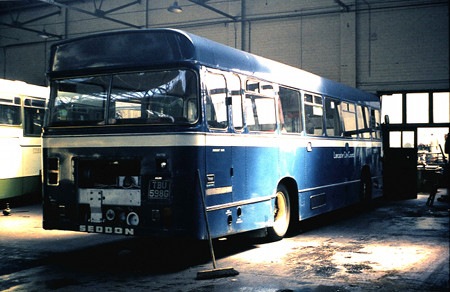
Lancaster Corporation - Seddon RU - TBU 598G - 598 

Lancaster City Transport
1969
Seddon RU
Pennine B??F

Much has been written, on this website and elsewhere, about the Seddon Pennine. Most of such text is not complimentary. Southampton City Transport had several, with bids for their Gardner engines being far higher than bids for the complete vehicle when they were withdrawn.
TBU 598G was the demonstrator, which Lancaster acquired via Midland Red after that operator had taken over Green Bus of Rugeley. The wife of one of my office colleagues could not get out of her mind the thought that Rugelli [as she pronounced it] was in Wales so, whenever they went from Winchester to York, she would ask "Why are we going via Wales?" I digress!
It is clear that 598, to give her the Lancaster nomenclature, is in no condition for service in this view inside Heysham Road garage on 20 May 1975. Note the missing door for the engine compartment, and the cleaner’s broom, which is having a rest.

Photograph and Copy contributed by Pete Davies


28/10/12 – 10:14

Perhaps the broom was propping the body up!
I had a ride from Huddersfield to Stocksmoor on it (the bus, not the broom) when it was on demonstration to Huddersfield Corporation.

Eric Bawden


28/10/12 – 11:40

An apropriate time of the year to be talking about the broom.

Ken Jones


28/10/12 – 11:41

Glad you clarified the means of transport Eric, given the time of year!!! As far as the RU goes, I had a connection with these as I sold some internal panelling to Seddon Pennine for the Crosville order which meant a good deal of shuttling between Crane Wharf Chester and Oldham. I worked for Huntley Boorne and Stevens of Reading and they, apart from making tin boxes for Huntley and Palmers – of which they were an offshoot, had a product range of decorative PVC finishes laminated to a variety of metals. Most ECW bodies from around 1967 had some interior panels in this material (as was the "wood" finish to the glove box on some Mk 3 Ford Cortinas and the "wood" embellishment on the side of the Mini Countryman) and Crosville wanted certain interior panels on their RUs to match as the material was easy to clean and impervious to tobacco.

There were great expectations for the RU. Those with Seddon Pennine (or to be exact Pennine Coachcraft) bodies fared worse than those from other bodybuilders though mechanical problems far outweighed those of the bodywork.

Phil Blinkhorn


28/10/12 – 17:05

Indeed, Ken. My mother in law still rides hers, at 92!

Pete Davies


29/10/12 – 07:14

What!!??
Pete, are you saying your 92 year old mother in law still has a 1969 Seddon Pennine RU?

Eric Bawden


29/10/12 – 11:03

No, Eric! Just a broom.

Pete Davies


29/10/12 – 11:03

Seddon seemed to drop the ‘Pennine Coachcraft’ name sometime in the late ’60s/early ’70s. Morecambe & Heysham AEC Swifts 1-7 (new in 1967) arrived with ‘Pennine Coachcraft’ bodies, but the bodies on Seddon RUs 11-6 (new c1972/3) were known as simply ‘Seddon’, as were those on similar-vintage Lancaster Leopards 116-21.

David Call


The history of Pennine Coachcraft is, as far as I can make out from published information and my own records, as follows:
Seddon was producing its own cabs and later bodies for trucks and vans from the 1940s and throughout the 1950s.
It started to build bus bodies in penny numbers in the late 1940s and this grew during the 1950s, most going for export.
Pennine Coachcraft was registered as a company in 1960 and, for accounting and management purposes, was treated as a separate company in the group, though sharing Seddon’s truck and bus chassis site, building commercial vehicle cabs and bodies and bus/coach bodies.
From 1966 Seddon simplified its type names. Bus/coach production was based on chassis known as Seddon Pennines of various marques, of which the RU was just one. So a Seddon Pennine RU bodied by Pennine Coachcraft would be a Seddon Pennine RU/Pennine whilst one bodied by Plaxton would be a Seddon Pennine RU/Plaxton. Other chassis were bodied, for instance, an AEC Swift would become an AEC/Pennine.
When the RU was launched it was originally marketed as the Seddon Pennine RU/Pennine and certainly the Crosville order was couched in those terms but as orders came in for the type and other bodybuilders were specified, Seddon decided that the Pennine name would be linked only to the bus and coach chassis so sometime in the period 1970-1972 the Pennine Coachcraft badging was replaced by Seddon though the legal entity was maintained and Huntley Boorne and Stevens were still invoicing Pennine Coachcraft when I left in June 1971.

Phil Blinkhorn


31/10/12 – 14:47

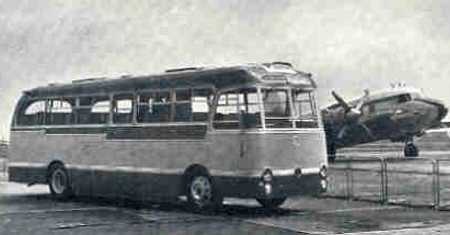
The Seddon Pennine RU was a grave disappointment to a bus operating industry utterly fed up with the take it or leave it attitude of the Stokes era British Leyland. Operators hoped that the RU would become a real challenger to the dubious Panther/Swift offerings, and become a vehicle comparable with the superb Bristol RE, which Leyland was determined to kill off to enhance the market prospects of the National. Unfortunately, the RU had serious design deficiencies, particularly the exceedingly short prop shaft between the gearbox output and the rear axle, which led to regular failures. Unlike all its other contemporary competitors, the RE took the drive forward to the gearbox set ahead of the rear axle, and then back again to the differential. Actually, this principle had been pioneered some years earlier by a tiny firm in New Addington, Croydon, called Motor Traction, which produced the Rutland Clipper in the mid 1950s. This had a Perkins R6 mounted vertically in line at the rear, and the drive was taken forward to an amidships mounted transfer gearbox that drove the prop shaft back to the rear axle. Only two were made, both with Whitson bodies, but, lacking a camera back in the days of my long gone impoverished youth (the youth is long gone, not the impoverishment), I have no pictures, though I remember seeing one about the Croydon area quite regularly at the time. There is currently a picture of the Clipper at this site:- www.ebay.co.uk/  but it may not be around for much longer.

Roger Cox


31/10/12 – 17:38

The "take it or leave it" attitude Roger mentions led to the demise of Leyland’s trucks as well as their buses. Hauliers noticed that certain European manufacturers were producing lorry cabs with sleeping accommodation, but the BL attitude was that "British truck drivers don’t sleep in their cabs" and didn’t respond. My brother in law is a retired long-distance truck driver. Guess what makes he would normally be expected to drive, and sleep aboard, from about the mid 1970s . . . They weren’t UK-built!

Pete Davies


01/11/12 – 07:05
Rutland Clipper_lr

I have endeavoured to copy the Rutland Clipper advert, and I attach it here. It isn’t very good, but it is possibly better than nothing. Pictures of this very rare machine are equally rare.

Roger Cox


01/11/12 – 10:03

It looks as if the photo was taken at Northolt airfield. Whilst London Airport (Heathrow) was active at the time of the photo Northolt was the "home" of the BEA Viking and one is in the background. BEA eventually closed its Northolt base in 1954

Phil Blinkhorn


01/11/12 – 11:29

I assume, Phil, that this was unrelated to RAF Northolt, or did they share or the RAF take over later?

Chris Hebbron


01/11/12 – 16:50

I believe Northolt is still a joint civil and RAF field.

David Oldfield


01/11/12 – 16:50

When London Airport (Heathrow) opened in May 1946 it was just a collection of runways, prefabs and tents. BOAC and other airlines moved in.
BEA was formed out of BOAC in January 1946 and was initially based at Croydon. With there being little room at the new London Airport and Croydon being seen as too restricted for expansion, the airline moved its base to Northolt in March 1946.
In 1950 BEA operated the world’s first turboprop service with one of the Viscount prototypes from Northolt to Paris Le Bourget.
Alitalia, Aer Lingus, SAS and Swissair all used Northolt before moving to Heathrow.
In 1952 Northolt was the busiest airport in Europe with over 50,000 movements
In April 1950 BEA operated its first service from what is now Heathrow and over the next four years gradually transferred its services there, the last routes at Northolt being domestic flights with DC3s and Vikings. The last BEA flight out of Northolt was a DC3 in October 1954.
Northolt was opened in May 1915 and the RFC/RAF has operated from there ever since, making it the RAF station with the longest continuous use. It was a fighter base in WW2 and fighters appeared again in 2012 as part of the exclusion patrol arrangements for the Olympics.
Currently the airfield houses RAF communications aircraft and helicopters as well as a range of admin sections. It also has civilian traffic again as a number of business flights operate to/from there.

Phil Blinkhorn


02/11/12 – 07:26

Thx, Phil – very interesting.

Chris Hebbron


26/11/12 – 08:34

In 1975, when the photo was taken the undertaking’s title was "Lancaster City Council Transport Department. The change took place after the Lancaster and Morecambe & Heysham fleets amalgamated in 1974.

Jim Davies


11/12/12 – 11:38
TBU 598G_02

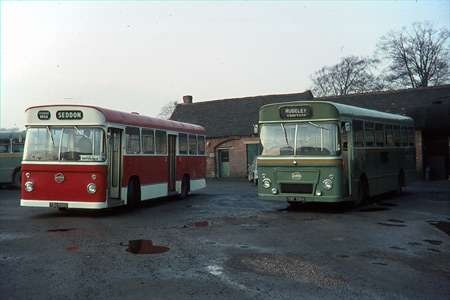
Here’s a view of the bus while it was still a demonstrator for Seddon, at the Rugeley premises of Green Bus on 20 December 1970. Alongside it is one of the operator’s pair of Seddon Pennine 4 buses (20, YRF 136H) bought the previous year.

Alan Murray-Rust


10/04/15 – 10:51

Although 598 is a demonstrator vehicle, as far as I’m aware, Morecambe & Heysham as then was, took delivery of all of 11-16 prior to the arrival of 598. They all worked the route past my home at the time, & I travelled on all of them regularly, along with the M&H Swifts. Once Lancaster took over the running of both fleets, they were all living on borrowed time, as Lancaster pursued an all Leopard/Atlantean policy – the whole fleet became common user, & there were probably understandable doubts as to the abilities of the Swifts & Seddons to climb some of Lancaster’s stiff gradients, especially on the slog up to Moor Hospital. For the same reason, whenever a M&H double decker was used on the joint University U1-U3 service, the vehicle was always one of the 5 Leylands (87-91), & never a Regent.

Andy Richmond


10/04/15 – 16:59

Andy,
Thank you for your thoughts. I had moved south by the time of Local Government Reorganisation in 1974, and was only "visiting" when I took this photo. According to the PSVC listings, TBU came with quite a history. New in March 1969, she passed to Green Bus in May 1971, then to Midland Red in November 1973. They sold her to Ensign and Lancaster bought her from Ensign in October 1974. She entered service in Lancaster in March 1975. PSVC shows her as having been withdrawn in March 1977, passing via a couple of dealers to Northern Ireland.

Pete Davies


13/06/16 – 05:52

When the U1 – H3 services started Morecambe regularly used one of the Regent V with Massey bodies numbers 82-86. The route ran past my parents house so I often saw them.
Incidentally 84 from this batch was the only M&H bus at that time to have platform doors supposedly for safety when used on school services !!!

Keith Wardle


13/06/16 – 11:02

Thank you, Keith! Being a resident of the maroon and cream territory next door, I saw the green and creams only at irregular intervals and this particular one even more rarely. If this particular Regent had platform doors. It seemed so out of place when none of the others did!

Pete Davies


13/06/16 – 11:03

Like Andy R, I can only remember Morecambe & Heysham using PD2s on the University services, the PD2s being of course Morecambe’s front line dds at the time. I’ll happily be outvoted, though, if anyone else has recollections from the period.
As for Regent V no. 84, I don’t recall it being used on school services, particularly, in fact the only time I remember it having a regular run was when, for a few years, it worked the White Lund Corner to Overton service, which had a vehicle requirement of one bus. In later years, however, it may have done the afternoon Morecambe Grammar School to Bolton-le-Sands extra, but I’m not sure. Does anyone know if platform doors were fitted from new? The answer to this question was probably contained in Lancaster’s 1978 jubilee booklet, a copy of which I no longer possess.
As to the ex-M&H Swifts being capable of climbing Lancaster’s hills, I think the Swifts would have had a power/weight ratio at least equal to that of Lancaster’s Tiger Cubs, and with the RUs it would definitely have been superior, the Tiger Cubs having been standard fare on the Moor Hospital service for several years. Size would have probably been a greater consideration, I can’t now remember whether anything bigger than 30′ ever ran to Moor Hospital (or Williamson Park).

David Call


13/06/16 – 13:03

David, to answer your query about platform doors on Morecambe & Heysham 84 – YES. According to the PSVC listing, 81 to 83 and 85, 86 were H56R when delivered. 84 was H56RD.

Pete Davies


14/06/16 – 06:01

The quote about 84 being ordered with doors for schools services was made by a member of the transport committee when the buses were delivered and was reported in the Morecambe Visitor. I never saw it used on such services although it might have prevented me and my mates leaping off the open platform several yards before the stop. None of us suffered any accidents from this daft behaviour.

Keith Wardle


27/06/16 – 11:09

TBU 598G finished its’ days with Ardglass GAA carrying players to matches. It is seen here parked in Ardglass at the side of the Ulsterbus sub-depot there. This photo was taken shortly after its’ arrival – I am not sure that happened to it subsequently but would guess it was scrapped.
www.flickr.com/photos/  (The photo is my own and is watermarked as such)

Bill Headley


28/06/16 – 06:24

Bill, Thanks for your comment. 598 is noted in the PSVC fleetlist as having arrived with Mulhall, Ardglas, in 2/78 and as having gone to Kidds (dealer), Maze, by 9/80. Your guess about what happened after that is almost certainly correct!

Pete Davies
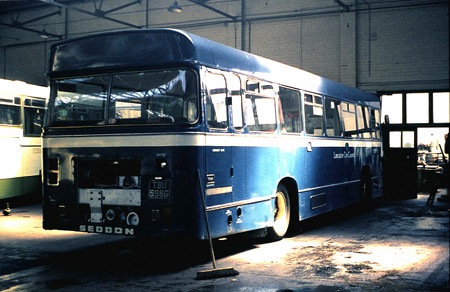

TBU 985G_lr Vehicle reminder shot for this posting


23/06/17 – 06:50

I drove her at Whieldons and always found her a great little motor, it was a popular bus and was very reliable, other a diff problem in 1971 which took a couple of weeks to arrive, but considering that TBU had been passed around many firms and had worked extremely hard, perhaps understandable. Its problems started at Midland Red Tamworth, when it was expected to be driven without having the water topped up, not the best idea perhaps!!! This was the first RU, what a shame it wasn’t saved.

Bryan Yates


Quick links to the  -  Comments Page  -  Contact Page  -  Home Page


CIE – Leyland Atlantean – 353 IK – D353

CIE - Leyland Atlantean - 353 IK - D353
Copyright Paul Haywood

CIE (Coras Iompair Eireann)
1970
Leyland Atlantean PDR1A/1
CIE/MSL H43/31D

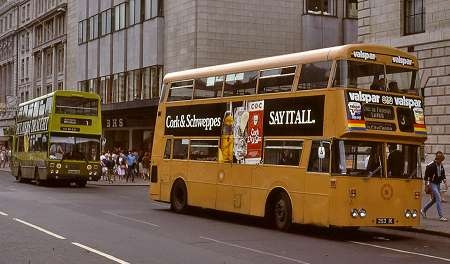
Ireland’s national transport authority – CIE – came late to the rear-engine bus scene. Although they had been wooed by Leyland from an early date (and even trying a Guy Wulfrunian), the first buses from an initial order for 341 Atlantean PDR1/1′s did not enter service until late 1966, known as the ‘D’ type. Subsequent batches brought the total number of PDR1’s to an amazing 602 by 1974, followed by a further 238 AN68/1’s by 1977.
To reduce costs and to give work to CIE staff, all the chassis came in knocked-down form for local assembly and, because CIE were unimpressed with the box-like shape of early Atlanteans, they were fitted with these unusual CIE/Metal Sections bodies. The first 218 were fitted with a front-entrance 78-seat body but the remainder had 74-seat dual-entrance bodies in the certain expectation of one-person operation which, because of local union objections, never materialised until 1986, by which time many of the early examples had been withdrawn.
Leyland’s notoriously unreliable vehicle performance, spares availability and after-sales service during the 1970s finally exhausted CIE’s patience, and many Atlanteans (and Leopards) had to be re-engined by DAF and GM. In a desperate attempt to break away from their reliance on British supplies, and to create a totally home-grown bus industry, CIE came up with the unique German-designed, GM-engined Bombardier buses in the early 1980s which were built in Shannon – but that’s another story.
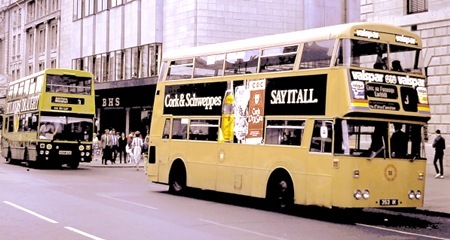
This photo of D353 shows one of the 1970 batch of PDR1A/1’s on Dublin’s O’Connell Street in 1984, two years before CIE decided to split its bus and train divisions into separate companies (Irish Bus, Dublin Bus and Irish Rail). It is seen wearing the thankfully short-lived tan livery which replaced the smarter blue and cream scheme, before giving way to a smart two-tone green as seen on the Bombardier in the photograph.

Photograph and Copy contributed by Paul Haywood


26/10/12 – 07:37

A cast iron contender for the Ugly Bus page.

Phil Blinkhorn


26/10/12 – 10:11

Exactly my reaction, too, Phil! Looks like CIE’s experience with Atlanteans mirrored M&D’s experience, also.

Roy Burke


26/10/12 – 10:12

Yes, Phil, but how high would it be in the ratings, bearing in mind what ugly ducklings are on that page already?
Too new for this site, but I have a view of one of the tan-liveried ones (Van Hool/McArdle body) on parade in Southampton for "Committee Inspection", alongside the usual East Lancs product in July 1975.
I was under the impression that CIE had a green and cream livery – the one with the flying snail logo – before the tan, and then they went to the blue and cream one which I’ve seen at Duxford a couple of times, before going to two-tone green. Liverpool and Birmingham respectively spring to mind, but whose livery inspired the tan? More important, how far adrift from reality is my memory?

Pete Davies


26/10/12 – 10:20

Amazing Phil – I read that bit about CIE/Metal Sections bodies, but I didn’t realise the metal sections were cast iron!

Stephen Ford


26/10/12 – 14:26

Pete,
The double decker liveries were: pre war and into the late 1940s mid green with three white bands
Late 1940s to 1961 the green was much darker and the bands were painted light green.
From the 1961 the colour scheme was gradually changed across the fleet to a blue and cream one reminiscent of Birmingham’s, including the sandy coloured roof, though this feature was deleted on repainting. The first Atlanteans appeared in that scheme before the adoption of the scheme shown above, which was not applied to front engined double deckers.

Phil Blinkhorn


26/10/12 – 17:27

Baffling, isn’t how in Dublin the buses were ever Black and Tan? This body had the bookends look with sloping front and back- a precursor of the Olympic "Routemaster"? Works no better…. but then a sort of nod to Liverpool with the peak. The side window frames slope one way, and the upper front deck the other. The strong (that’s the answer) green now looks good, as did the original green- with those Gaelic bus stop signs.The old CIE logo was (also?) a circle of segments (if you follow). If you want to see lots of buses (no wonder the fleet is huge) go to Dublin: the only way to get around is the bus.
Off topic but still Leyland: what were those two Titans tantalisingly in the background in the Antiques Roadshow last Sunday? Beautiful greeny/goldy livery on one, despite what I just said….

Joe


27/10/12 – 06:23

Thanks, Phil.

Pete Davies


27/10/12 – 06:25

The titans were a Massey bodied PD2 late of Birkenhead in blue and cream and the other one with an MCW body once belonged to Wallasey.

Phil Blinkhorn


27/10/12 – 06:27

Sorry, Joe, I cant give you a definite answer as I didn’t see the programme. However, it came from Port Sunlight so the most likely answer is that the blue one would have been either one of the two preserved Leyland’s from Birkenhead Corporation fleet. Both are Massey bodied, BG 9225 is a 1946 Titan PD1/A and FBG 910 is a 1958 PD2/40. I don’t know where the green/gold vehicle would be from, unless of course it was both of them and one had been given a repaint for some special event and will be returned to its correct livery at a later date

Ronnie Hoye


27/10/12 – 09:36

Joe, you’re right about the strange choice of liveries used by CIE over the years. The original green was logical enough considering their history, but to go black and tan for the buses (and – don’t forget – the railways) always seemed perverse considering the baggage that those colours carried. You say the only way to get around Dublin is by bus, but don’t forget their two superb tram lines and the extensive Dublin Area Rapid Transit railway which have transformed the city’s transport network in recent years.

Paul Haywood


03/01/13 – 13:02

As an Irish person (and transport photographer) I feel I have to correct comments made here. We never had a black and tan bus livery anywhere in Ireland. The buttermilk tan livery, as shown in the picture at the top of this page, replaced a livery known as monstral blue and cream, which looked very similar to black and white, the blue was very dark and the cream was very light! Then of course when C.I.E was spilt in 1987 the Atlanteans took on red and white Bus Eireann livery or Dublin Bus Green, depending on which of the 2 companies they were working for.
As I can’t post links here check out my flickr page, under the name irishmanufan, in the collections fotopic rescue and rallies and preserved buses to see pictures of Irish Atleanteans in monstral blue and cream, butter milk tan and Dublin Bus Green. 2 are standard D’s (PDR1) and one is an AN68.

Linda

Just include the url if you want to post a link. Irishmanufan


03/01/13 – 15:29

Fair point, Linda, but "black and tan" has been a description long used for this CIE livery (and particularly for the railways of this period) by many enthusiasts both British and Irish, rightly or wrongly. As you will know better than me, the shade of "tan" on the bus illustrated here varied considerably between batches and overhauls and some were distinctly darker (and more "tan") than shown here. The point of the postings is to say "good riddance" to this livery, regardless of how it’s described, when we consider the more attractive liveries that were used before and since this period.

Paul Haywood


03/01/13 – 15:30

The blue CIE livery was in some ways a copy of the Birmingham livery and was applied in similar manner. No operator would dare to run buses in the Republic in black and tan!

Chris Hough


04/01/13 – 14:07

I’m still baffled. If you were going to use "buttermilk tan", it is hardly tactful to team it with "Guinness black" wheels. The original West Yorkshire Metro livery was, if I recall, Buttermilk (lighter than this) with a gentle (emerald) green- and red wheels? That would have done the trick.
Fortunately, caramac clearly didn’t last long: could have been worse: pink & blue with fuzzy bits.

Joe


08/02/13 – 06:40

This livery was NEVER described as Black & Tan on C.I.E buses…The correct livery was Middle Buff made by British Paints Ltd and its reference no. is BS 350…I know this as Liam Dunne, no less told me when I did stand work with him at the Commercial Motor Show in Earls Court in 1974 and later at the NEC in 1978..Liam was C.M.E of C.I.E Road Services and later M.D of Van Hool McArdle in Spa Rd Dublin.. Hope this helps..

David O’Connor


14/04/13 – 08:02

Well I never heard the original D class Atlanteans described as ugly before. They were a significant advance on other bodies back in 1966.

tarabuses


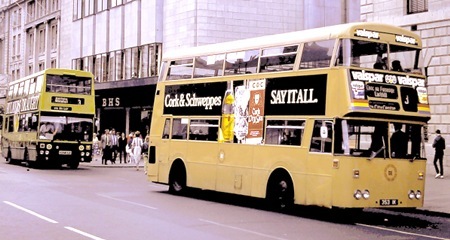
353 IK_lr Vehicle reminder shot for this posting


18/10/13 – 18:35

353 IK_2

I’ve just bought a new scanner and got a far better scan of the CIE Dublin Atlantean. This shows a more accurate "tan" which may or may not settle the "black and tan" controversy.

Paul Haywood


Quick links to the  -  Comments Page  -  Contact Page  -  Home Page


Halifax Corporation – AEC Regal III – BCP 544 – 258

Halifax Corporation - AEC Regal III - BCP 544 - 258
Copyright Roger Cox

Halifax Corporation Transport and Joint Omnibus Committee
1949
AEC Regal III
Roe B32R

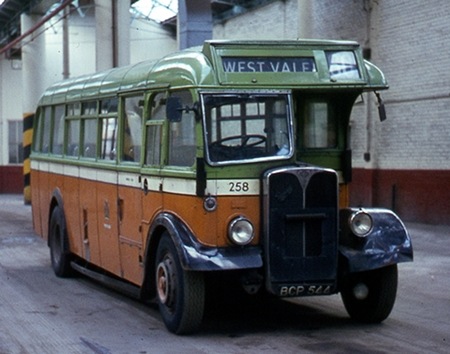
Halifax buses seemed to undergo a curious renumbering merry go round from time to time, as if fleet numbers were somehow on ration. The number 258 was a case in point. Here is another Regal III of the 1949 batch, BCP 544, which, like its fellow AJX 848 also on this site, was rebuilt from B32R to B33F in 1953/4. It originally joined the ‘B’ Joint Committee fleet as number 269, but in October 1964 it was transferred to the ‘A’ Corporation fleet as number 99. In the following month it was transferred back again to the ‘B’ fleet with the number 268, but it was then renumbered again as 258, which is the number it carries in this picture. This Regal was the only remaining example of its type when I joined Halifax Passenger Transport as a Traffic Clerk towards the end of 1964, and I drove it from time to time when training for my PSV licence in early 1965. Despite its sixteen years of service, it was a delightful and characterful bus to drive, and carried its age very lightly.

Photograph and Copy contributed by Roger Cox


24/10/12 – 07:58

One thing that has always intrigued me with exposed radiators is the variety of ways people find for keeping them warm. This one’s ‘appendage’ looks quite professional, certainly far better than a bit of old newspaper!

Pete Davies


24/10/12 – 11:15

I was going to refer to these over another recent posting. They seem to suggest that AEC and Leyland engines ran "cold" but did Daimlers D’s ever have them? – because they ran hot, it seems, judging by the supplementary air intake, otherwise known as leaving the bonnet side open and resting on the mudguard. Am I anywhere near, Engineers?

Joe


24/10/12 – 11:30

That’s an interesting observation, Pete. I can’t make out the exact nature of the blind on this vehicle, but, as you say, there were many different approaches. I’ve always been fascinated, for example, with East Yorkshire, which seemed to like placing an aluminium sheet over part of the exposed radiator, although, for reasons I’ve not understood, the actual treatment varied between vehicles, even ones of the same batch. Did the engineers know the fleet so well that they could tailor blinds individually, since although you could raise or lower a flexible blind, an aluminium sheet was a fixed feature?

Roy Burke


24/10/12 – 12:47

What a marvellous sight to see this morning as I land on the OBP Homepage bleary-eyed !
How lucky you were Roger to have driven this delightful bus. Around this time I was still at school, and this last remaining Regal was sometimes used to transport us the relatively short distance to Woodside Swimming Baths if the more usual Nimbus was unavailable. Our local Bus Club hired it in 1965 for a memorable visit to Bolton, Bury and Rochdale Corporations – on which it performed admirably. It was almost regarded as a mascot by the local enthusiasts.
Not long afterwards it was sold to local building contractor Pickles for staff transport. HPT repainted the lower panels cream before sale, and it pottered around the locality in an increasing state of decrepitude until finally scrapped.
Unfortunately, the framework modifications involved in moving the entrance to the front – cutting out a large piece when there was already a weakness due to the emergency door being directly opposite, and cutting into the front bulkhead to allow for one-man-operation, severely compromised its structural integrity.
The uncanny thing about your photo is that aside from the fact that 258 was scrapped forty-odd years ago, it could have been taken this morning. Parked in what is nowadays referred to as 7-Bay at Skircoat Garage, the building is exactly the same – even to having the same shades of paint on the wall, though today it is maybe peeling a bit more.

John Stringer


24/10/12 – 17:48

There was always a timelessness about the old Skircoat Garage, wasn’t there, John. One would have been only mildly surprised to chance across a tram or two, such was the period feel to the place. I wrote to Geoff Hilditch a few years back to send him copies of my small store of Halifax bus pictures, and he very kindly replied in a long letter. One of the things he told me was that the Skircoat depot, along with Elmwood, is facing demolition in the near future. Another piece of treasured transport history seems to be about to vanish.
Joe’s comment about hot running engines is interesting. Gardners were always cool runners, which proved to be a bit of a problem when bus heaters became generally adopted. The vast majority of wartime Daimlers had the AEC 7.7 engine, as did the bulk of utility Bristols. Any cooling problems must have been caused by the installation design. Daimler’s own CD6 8.6 litre engine proved to be highly variable in quality between individual examples, the best being satisfactory, but the worst were as bad as the contemporary Crossley HOE7.
Installations were probably made to cater for a worst case scenario.

Roger Cox


Leeds exposed radiator buses had both an aluminium plate and a roll down blind attached to it. There were two distinct designs the AEC version covered the radiator from the bottom to just over half way The one used on Titans and Crossleys was around 2-3 feet deep and was positioned mid radiator. These were generally fitted around this time of year and were removed in March/April.

Chris Hough


24/10/12 – 17:49

One of this batch came to Rochdale when I lived there in the early 1960’s to operate for the Social Services Department. If I remember correctly it was fitted with a wheelchair lift. I regret I cannot remember the number of the vehicle but it was painted in Rochdale Corporation’s then new livery of cream with a single blue band. It was a case of what might have been as Rochdale was of course a staunch AEC user but never actually had any post-war single deck half cabs.

Philip Halstead


25/10/12 – 07:14

Isn’t it interesting how some postings generate a lot of comment, sometimes veering off at tangents from tangents from tangents, while other postings generate very little? It’s all part of the fun of taking part in the world of the forum!

Pete Davies


25/10/12 – 07:47

You’ve noticed that as well, Pete.

David Oldfield


25/10/12 – 12:02

Of course it’s unrelated to interest or enthusiasm, for there would be plenty of silent admirers, even with quiet posts. What always intrigues me are the posts which run their course, go silent for ages, then spring into life again! And by some queer quirk, I sometimes find the whole thread passed me by the first time round!

Chris Hebbron


25/10/12 – 12:01

The Regal that went to Rochdale was BCP 543 and it was given the fleet number 500. It said "Welfare Service" in the destination box.

David Beilby


25/10/12 – 12:03

Geoffrey Hilditch is alive and well. I met him the other week on one of his visits to Wigan. He still drives from Torquay and back.
He said how much he enjoyed his time at Halifax and wondered if today’s bus managers feel the same, with all the financial pressures.
I didn’t know about the garages though – they are still there!

Geoff Kerr


25/10/12 – 16:03

I agree with John and Roger – Skircoat Garage has hardly changed over the intervening years. Enjoy it while you can – word is that the site has been sold to ASDA and the depot will be demolished in the near future

Ian Wild


26/10/12 – 07:34

Hope ASDA realise that they’re going to have ghosts of AEC Regals amongst their frozen ready-meals!

Stephen Ford


26/10/12 – 07:35

Ian. How sad to think that a useful building providing work, skills, training and local employment has to die to build yet another Temple to the £1 bottle of milk. If I lived there I would never step foot inside the place but, just last weekend I bought a new camera from Curry’s/PC World built on the site of the former Winterstoke Road Garage of Bristol Omnibus Company..but not without thought.

Richard Leaman


26/10/12 – 14:16

The same thing happened to the Newcastle Corporation central works at Byker which employed dozens of people with all manor of skills, as well as being a garage they could virtually build a vehicle from scratch. Now it’s a retail park where you can buy all manor of goods, mostly produced in China. I think it comes under the definition of progress.

Ronnie Hoye


27/01/13 – 16:58

rad_blind

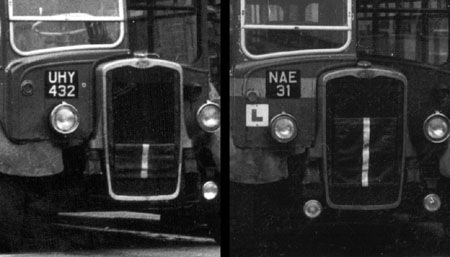
Reverting to the comments about radiator blinds/mufflers, one company that was very organised in this respect was Bristol. Their blinds had a white stripe down the middle. At various points on the system – the one I happen to recall was at Bath Bus Station – there was a miniature display of a radiator with blind. This would be set to show the desired blind setting for the day, to match temperature. The white stripe on the blind meant that an inspector could spot from a distance that the driver had set his own blind correctly. The attached view shows buses with two of what appear to have been four different settings. You can just make out in the left hand view the clips to which the upper part of the blind would be attached. It would be interesting to know whether the setting was determined by head office or locally. I can imagine there being considerable temperature variation on the same day between the coast at Weston and the high ridge of the southern Cotswolds.

Alan Murray-Rust


01/06/13 – 15:30

I’m a Bristolian and spent several years working for BOC but never knew that! Remember Winterstoke of course and was quite shocked when I saw it had gone.

Geoff Kerr


03/10/16 – 08:15

Geoff….I pass the site where Winterstoke Road Bus Garage was located just about every day and the line up of retail warehouses is just a terrible replacement for that superb garage. In my mind I see lines of K, L and KSW parked up with a few of those new fangled Lodekka’s! Once upon a long time ago I spent many an hour with my old friend Clive checking fleet numbers and spotting favourites from the safety of the grassed areas just inside the front walls. I do remember the radiator setting sign also mentioned….it is a good 40 plus years ago but have an idea there was one on the back wall of the old Marlborough Street Bus Station..in the garage/parking area…I remember seeing it/them many times and think one might be preserved at the BVBG garage. I will have a look on the next open day.

Richard Leaman


Quick links to the  -  Comments Page  -  Contact Page  -  Home Page


All rights to the design and layout of this website are reserved     

Old Bus Photos from Saturday 25th April 2009 to Wednesday 3rd January 2024