Copyright John Kaye
H W Hunter and Sons
1951/2
Leyland Titan PD2/12
Leyland H32/28RD
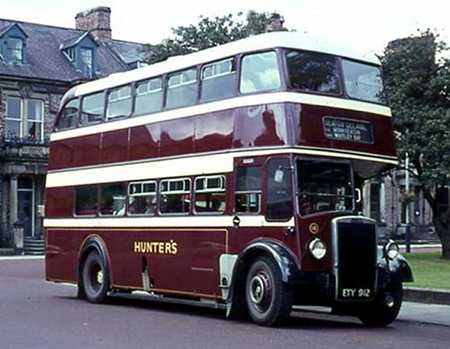
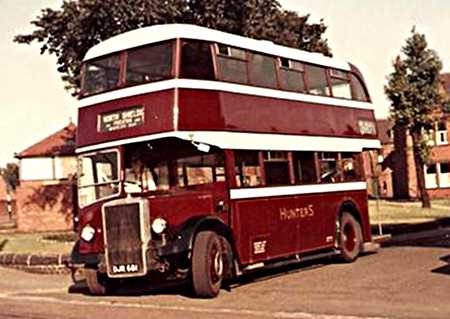
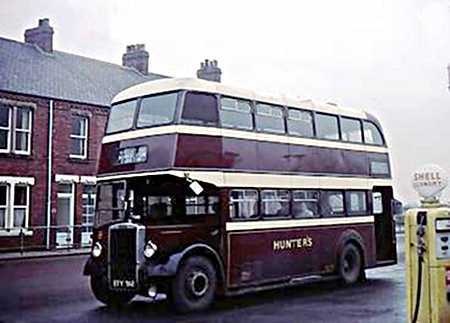
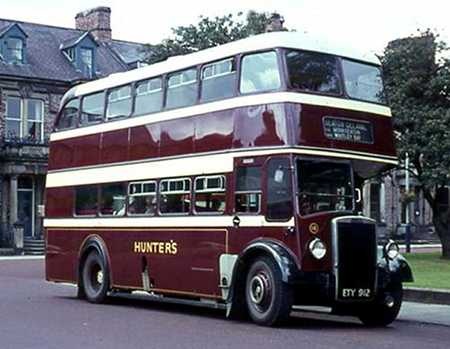
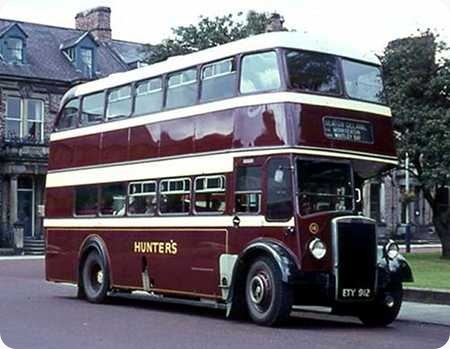
Standing at it’s terminus in Northumberland Square North Shields, this is one of two Leyland Titans (DJR 681 being the other) from the small independent of H W Hunter and Sons who were based in the Northumberland mining village of Seaton Delaval. The one in the shot above had a closed platform, I’m not sure if doors were fitted, whereas the other Titan DJR 681 was the more common open platform type.
At the same time they had the Titans I’m pretty sure they also had two Leyland single deckers, but I can only trace JR 6600. That started life in 1937 with a Burlingham B35F, but was rebodied by ROE in 1954 as a B39C. Hunters had one route that ran from Seaton Delaval to North Shields via Holywell, Earsdon, Monkseaton, Whitley Bay and Preston Village. From Monday to Saturday it was an hourly service, but rather strangely it was every half hour on Sundays. As well as the service vehicles they also had coaches but I don’t know the exact number, but to the best of my knowledge I don’t think the fleet ever exceeded about twelve vehicles in total. The appearance of this one is nothing special by Hunters standards, they were always immaculately turned out and meticulously maintained, when running, they didn’t tick over, they purred.
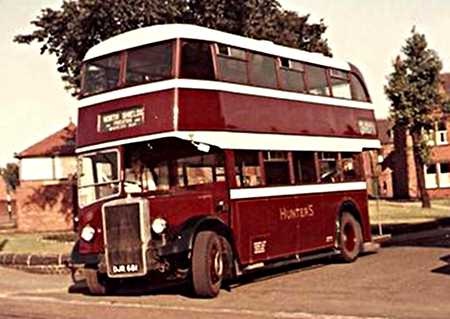
DJR 681 – Photograph by ‘unknown’ if you took this photo please go to the copyright page.
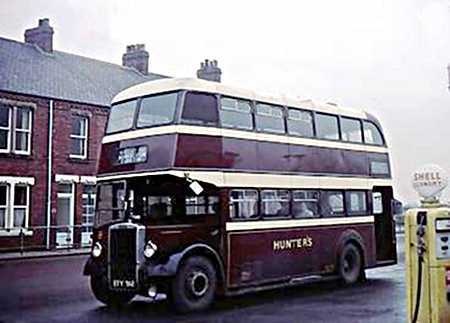
ETY 912 – Photograph by ‘unknown’ if you took this photo please go to the copyright page.
DJR 681 was about 1948/9 vintage and was defiantly all Leyland, so presumably it was a H30/26R Titan PD2/1 (Edit from a Michael Elliott comment 03/12 it was a PD2/3). The registration for ETY 912 dates it at about 1951/2, it could be an all Leyland as well, but if you compare the two photos there are several differences so I cant say for certain that it is. The window surrounds are rounded off in the corners and have an altogether much softer line about them and the slide vents are totally different. As you can see the platform was enclosed on ETY 912 but I can’t quite make out if doors were fitted.
Photograph and Copy contributed by Ronnie Hoye
02/12/12 – 11:10
ETY 912 is an example of the definitive Leyland Farington body which was the the refinement of Colin Bailey’s 1930s design that had already been updated as exemplified by DJR 681.
The Farington first appeared in 1948 but wasn’t greeted with great enthusiasm so Leyland went away, thought again and produced a classic design.
Phil Blinkhorn
02/12/12 – 11:11
It’s unfortunate, Ronnie, that you don’t know who built the body on ETY. If someone else had posted the views, with the same uncertainty, I’d have suggested seeking your opinion! Leyland were still building bus bodies when ETY was built – I have gathered from other sources over the years that they stopped in about 1953 or 1954, so it could just be a very late one, with updated details. On the other hand, it could be a clone from Alexander or "Psalmsbury": someone will tell us.
Pete Davies
02/12/12 – 11:15
A bit of digging shows that ETY 912 is a PD2/12 with 27ft 6in length fitted with synchromesh gear box and vacuum brakes.
DJR 681 was delivered, according to "The Leyland Bus" in which it is pictured, in 1950. Unfortunately the caption doesn’t state the sub type.
Phil Blinkhorn
02/12/12 – 12:01
Among the original quartet of lady drivers at West Yorkshire’s Harrogate depot was a girl called Eileen Hunter who had a North Eastern accent – it might be my imagination, its around forty years ago, but I seem to recall hearing that she was some family relation of Hunter’s of Seaton Delaval. I wonder if anyone knows ??
Chris Youhill
02/12/12 – 14:16
It’s interesting, Chris, that you describe the young lady’s accent as North Eastern. I don’t know how true this is, but I have been told that a true "Geordie" is someone who hails from Newcastle Upon Tyne, while others are not "Geordies". Someone from Gateshead, for example, is just someone from Gateshead . . .
Pete Davies
02/12/12 – 16:20
Lets not go down that road, Pete, Newcastle was in the County of Northumberland, whilst Gateshead was in Co. Durham, and its a bit like a true cockney being born within the sound of Bow Bells. However, amongst the older generation, people from Seaton Delaval have a very pronounced Northumbrian accent and they roll the letter ‘R’.
Ronnie Hoye
02/12/12 – 17:05
Okay, Ronnie. "R" as in Retreat, then!
A Londoner by birth, but definitely not Cockney !!!!
Pete Davies
03/12/12 – 08:04
Looking at these glorious photos of the two Hunter’s PD2’s and their Leyland bodies, that on ETY having the characteristic Leyland taper to the front bay of what was to me the ultimate front engine rear entrance body style. I was in raptures over the superb livery of both buses and the obvious care and attention that must have been given to them. Their traditional (outside of this site that is an unacceptable word) style and appearance make todays garish and seemingly uncoordinated liveries of the big groups look even more as though, as was said of the camel, they were designed by a committee.
Diesel Dave
03/12/12 – 08:06
DJR 681 was a Leyland Titan PD2/3, new in 1950 with a Leyland H30/26R body. It was built to the then permitted maximum dimensions for a two axle double deck bus of 26 feet long by 8 feet wide (the PD2/1 was 26 feet long by 7 feet 6 inches wide).
During 1950 the Construction and Use regulations changed and the maximum length for a two axle double deck bus increased to 27 feet with the option of 7 feet 6 inch or 8 feet widths. The designations for the Titan incorporating these changes were PD2/10 (7’6" wide) or PD2/12 (8’0" wide). Triple servo vacuum brakes were fitted but it was around this time that Leyland was experiencing problems with its synchromesh gearbox and many PD2s were fitted with the constant mesh gearbox as used in the PD1.
Michael Elliott
03/12/12 – 08:08
A true Geordie is someone from the North East but north of the River Tyne. Back to ETY 912, this is definitely a Leyland body but from the design which was the last flowering of the classic Leyland body before Leyland pulled out of the bodybuilding business around 1954. A very attractive final development with inset rubber mounted windows that could have no doubt taken Leyland into the 1960’s if they had not stopped production. It always seemed a strange decision to me to quit while you are well ahead of the game with such a quality design with a strong market following. I did read somewhere that the decision was made because at that time Leyland needed the body shop floor space for lorry production.
Philip Halstead
03/12/12 – 10:41
Diesel Dave – Oh how I agree wholeheartedly with you – most of today’s totally meaningless and expensive "liveries" go totally un-noticed by the travelling public and its incomprehensible that the "marketing" fraternity have managed to gain such a stranglehold on common sense – and the railway companies are no better either !!
Michael – I know just what you mean about the PD2 and PD3 "synchromesh" gearboxes having wrestled many a time with their unpredictable "rubbery clunking" – a sad comparison with the "Swiss watch precision" of the glorious PD1 (yes, I’m unashamedly biased as a lover and admirer of the PD1).
Philip – Yes indeed the 27’0" x 8’0" final version of the Leyland body was indeed "the last flowering" and Mr. Samuel Ledgard must have felt a real glow of pride when, less than two months before he died, the arrival of PNW 91/2/3 took our operating area by storm.
Chris Youhill
03/12/12 – 13:59
Philip, the reason Leyland stopped bus body building was to concentrate on the production of lorry cabs which were quicker to build than a bus body and thus generated faster cash flow for the company which could both invoice for bus chassis as soon as they were complete and finish trucks more quickly.
In my view it was a great loss to the industry.
Phil Blinkhorn
03/12/12 – 14:00
Having spoken to a couple of my former colleagues who ‘like me’ can remember ETY, I still cant say for certain whether or not it had doors. However, the general opinion seems to be that it did, but rather than the conventional 2×2 powered concertina type, they were similar to the two piece manually operated folding version fitted to some of the early Lodekka’s
Ronnie Hoye
04/12/12 – 07:12
Leyland probably did need greater capacity for lorry cab production, but I have heard that part of the reason for the cessation of bus bodybuilding was strained industrial relations, bus construction involving more inter craft disputes than cab work.
Roger Cox
04/12/12 – 07:13
My favourite Sheffield PD2s were the OWBs with this sort of Leyland bodywork – a true classis despite its slightly anachronistic five bay layout. For many years it was proclaimed as the ultimate Farington but some years ago more knowledgeable folk than I pointed out that, whatever it may be called, it isn’t a Farington. Nonetheless, as Phil said, a great loss to the industry when Leyland gave up on bodywork – especially of this calibre.
David Oldfield
04/12/12 – 08:14
I imagine this is the type you mean, David: www.flickr.com/
Very handsome.
Chris Hebbron
04/12/12 – 09:14
Certainly is, Chris. Thanks for that. It is the publicity shot made by Leyland, pre-delivery, and is in the experimental green livery which lasted less than 18 months. These were the only buses delivered in green – the whole batch – but many buses and trams were repainted in green (some with darker green bands). There was such an outcry that they were all repainted into cream and blue as soon as possible – the Leylands into the Farington/Roe scheme with more blue than usual. [The Roe Regent IIIs and Roberts trams, also delivered in 1952, were cream and blue.] There is a story, unsubstantiated, that there was so much green paint left over that lamp standards in Sheffield were painted green for many years. [That they were so painted is fact.]
David Oldfield
04/12/12 – 11:35
Good story, David, and these stories are often true. Interchangibility is one of the advantages of being a municipal enterprise, although the reverse situation wouldn’t have worked – Striped cream/blue lamp standards; I think not!
Chris Hebbron
04/12/12 – 11:37
Roger, there were some disputes as there were at many body builders at the time. Doug Jack, in "The Leyland Bus" states that the decision was to increase space for cab construction and, I understand, years ago when he when he was Director of BL Heritage he always maintained that demarcation disputes were not critical to the decision.
With the de-nationalisation of road haulage under the Tories in 1954, the Leyland and AEC truck building received large numbers of orders and pressure for short delivery.
Apart from the necessity of meeting those orders, bus body building was slowing at the same time as was Leyland’s commitment to what was a slow and more complex process, compared to truck cab building.
No new coach design had emerged since 1950 and the single deck underfloor body of 1951 on the Royal Tiger had not been a success, so much so that the prototype/demonstrator Tiger Cubs of 1952 were bodied by Saunders Roe and Weymann, the integral Olympian had not been bodied in house and neither were the experimental Lowloaders, the contracts going to Saunders Roe and MCW.
Colin Bailey’s classic double decker body had been refined but there is no evidence of a replacement being moved any further than a few sketches.
As a company, Leyland was more interested in engine, drive train and chassis development and no doubt the faster cash flow generated by truck building helped fund the development of the Atlantean and more refined truck and bus gearboxes.
David, the use of the Farington name has long been a matter of debate. The 1948 refinement of Colin Bailey’s design brought in rounded window pan corners, flush glazing on rubber inserts and a number of other refinements, including the elimination of the external belt rails and mouldings below the windows, giving a much plainer and more modern look. This was called the Farington to distinguish it from the immediate post war version of the body which remained on the catalogue.
Production was very limited, partly due to a backlog of orders for the original post war model and partly because reaction to the body was unenthusiastic.
Manchester received some of the last in 1951/2 (3265-3299) which had sliding ventilators in some bays, separately mounted to the rest of the glazing, the lower glazing resembling the shape of the tins a famous brand of processed fish.
That, plus the substitution of metal interior finish for Leyland’s and Manchester’s previous wooden interiors and not least that the ventilators and some panels rattled soon after delivery, gained them the epithet of "Salmon Cans" .
The next incarnation appeared at the 1950 Commercial Motor Show with an example for Leicester based on the newly permitted 27ft vehicle length. This formed the basis of all future Leyland double deck bodies. The rounded windows pans and rubber inserts were retained but the flush mounting, which had received much criticism, was replace by a mounting slightly recessed which found greater favour with the industry and added to the looks of the design.
Double skinning of the roof, all side panels and all metal interior finish completed the changes. This was the true Farington and the Hunter’s bus above exemplifies the breed which most have agreed over the years is a classic.
There was one last version as supplied to amongst others, Manchester, BMMO, Plymouth and the final vehicles which went to Trent. Minor interior changes were made but the the most visible external change was the reduction in depth of the rear upper deck emergency exit windows. These were not officially Faringtons as the name seems to have been dropped from 1952.
Regarding your comment on the "anachronistic" five bay layout, there are proponents on both sides of the debate in both the professional and enthusiast camps.
Six bay construction certainly was anachronistic but the arguments for five bay have more than a degree of sense.
My most detailed information and knowledge comes from three operators, Manchester, Stockport and North Western.
Manchester never bought four bay designs for its traditional double deckers. The reasons I was given many years ago was that five bays gave more rigidity, replacement of glass and damaged body panels was cheaper and one engineer told me that the thinking in the Department was that five bay vehicles looked more "balanced" (tell that to fans of the London RT!). Certainly MCTD went out of their way with their Northern Counties orders to avoid that company’s standard four bay product.
North Western, having had just one batch of four bay Weymann bodied PD2s, quickly returned to five bays with its next PD2 order and Stockport, which could have ordered a five bay version of the Crossley built Park Royal design for its 1958 PD2 deliveries, decided on the standard four bay design but quickly reverted to suppliers offering five bays for all future deliveries.
Phil Blinkhorn
04/12/12 – 15:41
Chris, I’m sure those who visited Hillsborough on a Saturday afternoon would have been happy to see blue and cream striped lamp standards in that part of Sheffield
Andrew
05/12/12 – 07:20
Good point, Andrew!
Chris Hebbron
05/12/12 – 08:05
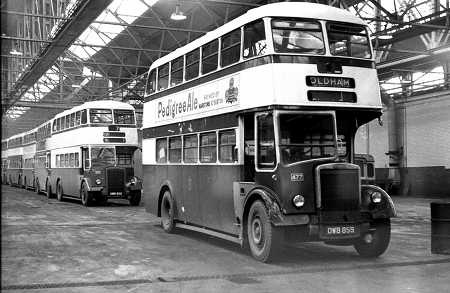
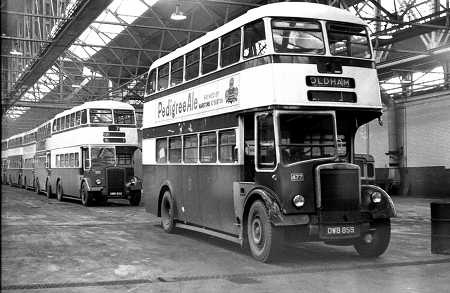
Continuing the deviation onto Sheffield’s OWB-series PD2/10s, four of these were bought by Oldham Corporation. I thought these looked particularly splendid in their crimson and white colour scheme as seen on 477 at the front. Two of them were repainted (actually in the early days of SELNEC) into the later pommard and cream and still looked good as seen on 475 in the background. This is the vehicle seen in green in the official Leyland photograph linked to earlier and therefore carried four very different liveries in its life.
Taken on 14th February 1970 I can readily identify all the buses in the row behind 475 and what a good rally contingent they would make. The first is an earlier ex-Sheffield PD2/1, almost certainly Oldham’s 465 (LWE 110). Next is the sole remaining PD1/3 246 (DBU 246), then PD2/3 342 (EBU 872) identifiable by its vestigial offside number blind, the last one to retain this. Both of these had Roe bodies. Last and just visible is ex-Bolton PD2/4 472 (DBN 330), meaning that all three principal styles of post-war Leyland DD body are represented in this line-up.
David Beilby
05/12/12 – 09:14
Andrew,
with OWLS as the decorative finial, no doubt!!!
Pete Davies
05/12/12 – 09:16
Another memory jogged by David B’s Oldham photo. How many Leyland bodies had sliding cab doors? I’d forgotten about that on 656-667 and I’m sure no other Sheffield Leyland bodies had sliding cab doors.
David Oldfield
05/12/12 – 11:04
Pity WL was not a Sheffield mark eh Pete?
David Oldfield
05/12/12 – 11:58
David, The mark which was really required in Sheffield was LS, then any number ending in 0 in front of WLS reversed, if that could have been reached would have been cherished.
Andrew
05/12/12 – 12:00
500 London RTWs had sliding cab doors but, other than the Sheffield PD2s I can’t bring any too mind.
Phil Blinkhorn
05/12/12 – 13:54
Certainly would, Andrew – and we all know how much support the OWLS need…..
David Oldfield
05/12/12 – 17:35
I cant say that I’ve ever seen one of this type with a sliding cab door. The first to have them in the NGT Group were the Weymann bodied GUY Arab 111’s of 1952, they were also the first 8ft wide vehicles, but the first Orion bodied PD2’s delivered to both Newcastle Corporation and Sunderland District both had hinge mounted doors.
Ronnie Hoye
06/12/12 – 07:04
Yorkshire Woollen Guy Arab 1 fleet number 483 was new in 1943 with a Massey utility body was rebodied in 1948 with a Brush body. This bus had a sliding cab door. It has never been explained why this bus gained this body when the rest of the wartime Guys were rebodied by Roe.
Philip Carlton
07/12/12 – 06:50
Strange how fallible the memory is isn’t it? I well remember travelling on the two Hunter’s double deckers [I lived in Preston Village] but can’t remember the door arrangement.
The original comment about the Sunday service is not so very surprising when you know that Whitley was a very popular holiday resort in those days, both in and out of season. The buses and trains were well used at the weekends.
I too am sure Hunters had single deckers at the time but sadly do not remember any details.
John Thompson
10/12/12 – 08:00
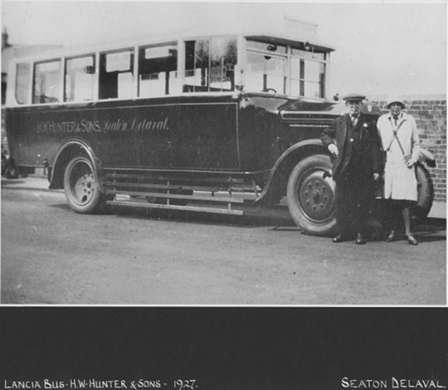
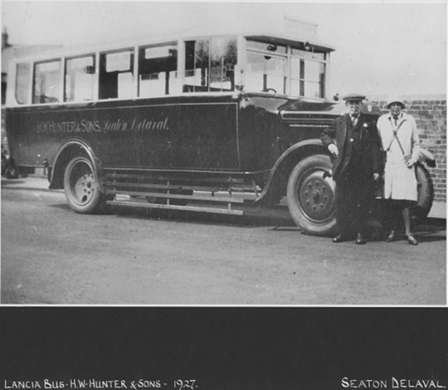
I thought you may find this interesting. Apart from the information on the front the only addition on the back is a Northumberland County Council Archives stamp. Hunters were established in 1926 so the picture was taken the following year, it gives no information as to who the two people actually are, but its not unlikely that its H W Hunter himself standing next to his first bus?
Ronnie Hoye
09/01/13 – 10:35
I am certain that ETY 912 did not have doors, and I am certain that there was another single-decker identical to JR 6600.
It was quite common in the area in the 1950s for bus services to be more frequent at the weekend. United service 40, for example, from Blyth to Whitley Bay via Seaton Delaval was every two hours Monday to Friday and every hour Saturday and Sunday. In mining settlements like Seaton Delaval the men would walk or cycle to work in the colliery Monday to Friday, and women would be at home or walk to the Co-op for shopping. Saturdays and Sundays were the days for travelling further afield to visit relatives, go to the cinema, hospital visiting and the like. Hunter’s coped with the extra weekend work by employing part-time staff who worked for NCB during the week. Sometimes on a Saturday the garage would be empty as all four buses and four coaches would be out on the road. Monday to Friday only one or two of the buses would be out.
Paul Robson
07/07/13 – 13:57
I used to travel regularly on Hunter’s bus when I lived in Preston Village. It was the only bus to actually run down Front Street.
I can confirm that ETY 912 did not have doors.
The weekday service was every hour from North Shields to Seaton Delaval (departing Northumberland Square at -45 each hour), but for most of the day there was an additional bus between Delaval and Whitley Bay giving a half-hourly service on that part of the route.
The half-hourly through service from Shields ran on Saturdays and Sundays, but I seem to remember on Sundays it only started in the middle of the day. I remember being told the more frequent service was to serve visitors to Preston Hospital.
Hunter’s used hand-written Bell Punch tickets which seemed very odd.
Percy Trimmer
20/05/14 – 10:37
Some months ago someone asked if was connection between Hunters of Tantobie in Durham and that of Hunters of Seaton Delaval Northumberland.
Available on ebay is a photo of a Hunters coach of Seaton Delaval showing Flint Hill. I took it that Flint Hill is Durham not Northumberland. Unless the information with ebay photo is incorrect. Anyone know the answer, separate companies?
A photo appears on Leylandleopard ebay listing showing OUP 425D a Vam to Hunters of Seaton Delaval.
Alan Coulson
20/05/14 – 16:29
The vehicle depicted in the photo advertised on eBay is OPT 425D, a Strachans bodied Bedford VAM new to Hunter’s of Tantobie in August 1966. It certainly isn’t depicted in Hunter’s of Seaton Delaval livery, so it would appear that the photograph seller simply assumed the wrong operator. www.ebay.co.uk/itm/Hunters-Seaton-Delaval
David Call
21/05/14 – 08:11
David Call. Thank you for your reply. Sorry about incorrect registration detail.
Alan Coulson
 Vehicle reminder shot for this posting
13/11/21 – 06:19
Pete Davies (02/12/12): ETY 912 had a Leyland body, and, according to BLOTW, was new in 12/51. The last traditional Leyland bodies (i.e. not including those built at Workington many years later) were on PD2s for Trent, the last of which entered service in 1/55. Leyland stopped taking orders a couple of years or so earlier, but ETY 912 easily made the cut.
The bodies built by Alexander and Samlesbury under contract to Leyland were, with one exception I believe, on PD1 chassis, and dated from 1946-8.
David Call