Bolton Corporation – Crossley SD 42/7 – DBN 978 – 8
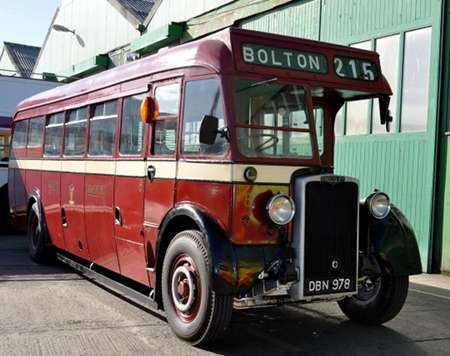
Copyright Ken Jones
Bolton Corporation
1949
Crossley SD42/7
Crossley B32R
DBN 978 is listed as one of only eighteen Crossley single deck half cabs that survive. It is a SD42/7 with Crossley B32R body dating from 1949 and preserved in original condition as Bolton Transport number 8. It was transferred to Bolton Corporation Welfare Department, and is now privately preserved c/o The Tameside Transport Collection 2005. A picture of it prior to preservation taken in 1966 can be found at this link. The above picture was taken in September 2010 when it was present at the Rigby Road depot Open Day in Blackpool.
Photograph and Copy contributed by Ken Jones
28/12/12 – 06:47
I wonder why Crossley bothered with the step up in the window line on this model. The strengthening Manchester wanted for the suspended platform on its post war standard required the step up in the upper deck window line only, the lower deck step up was purely cosmetic – so why follow the idea through on a single decker?
This is a lovely example which I well remember seeing in service.
Phil Blinkhorn
28/12/12 – 06:48
An excellent view of a lovely machine! I’ve seen her on several occasions, including on her native territory in my "black and white print" days of the early 1960’s. The odd thing is that, apart from rally appearances, views I’ve seen of her in Bolton are all round the depot area behind the office at 147 Bradshawgate. Did she not move much?
A bought slide, from the Omnicolour collection suggests – incorrectly, I think – that she was a SELNEC vehicle when that photo was taken and comments she would have looked rather odd in orange. Of course, if she was with the Welfare Department, she wouldn’t have passed to SELNEC – or would she???
Pete Davies
28/12/12 – 09:52
Bolton withdrew the bus in 1962 and it passed to the Welfare Department. As with other Councils, the Transport Department looked after the vehicle mechanically and provided garaging (some even provided drivers) but the asset was owned by the Council’s Welfare Department and was not included in the stock passed to SELNEC though they may well have looked after and housed the vehicle under contract.
Phil Blinkhorn
28/12/12 – 11:03
Thanks, Phil. Another incorrect caption to join the list!
Pete Davies
28/12/12 – 11:52
DBN 978 was bought by the Crossley Omnibus Society in the summer of 1969. We had a frantic two weeks repainting it and then took it for its first trip out to the Grand Transport Extravaganza that year. Whilst in preservation it was kept at first in Carlton Street, alongside the Bolton (and later SELNEC) garage in Shiffnal Street, in almost exactly the same place it had been parked as a welfare bus.
I think this is where some of the confusion has come from. It was no longer owned by Bolton or SELNEC, just parked there. It moved up to the society accommodation in Greenfield on 19th September 1971 under tow due to an engine problem which after removing the engine turned out to require a replacement core plug at a cost of about 2p!
It was bought by the current owner in 1974 and restored to rear-entrance the following year (from memory). It is unusual in having air brakes.
David Beilby
28/12/12 – 13:43
Thank you, David, for giving the assorted dates. The slide I have is dated May 1970, so it is well into the preservation era. I’ll let the operator of Omnicolour know for future reference.
Pete Davies
29/12/12 – 07:01
Thanks for the fascinating information, gentlemen.
When was it converted to front entrance? Was it for its Welfare Department service or was it an early o-m-o conversion? Good to see it back in original condition.
Frankly, considering the comparatively small number of single-deck Crossleys put into service, I’m pleasantly surprised to learn that no fewer than eighteen still survive.
I’ve always had a soft spot for them, and I’d love to see an all-Crossley Rally somewhere someday (or have I already missed them?)!
Paul Haywood
29/12/12 – 09:08
Peter Gould’s fleet lists show that 6 and 7 of the same batch were converted in 1954 and 1955 respectively yet omit a date for 5 and 8. Can’t confirm if this is an oversight or if the conversion was done after withdrawal in 1962 but the conversion looks identical to 6 and 7 rather than one done specifically for the needs of the Welfare Department.
Phil Blinkhorn
29/12/12 – 14:05
I used to see these buses around 1961 as Pete Davies says always parked behind the Bradshawgate offices and I am pretty sure they were front entrance omo by then. Bolton’s need for single deckers was quite small and the few routes they operated were infrequent services to the north of the town so I suppose these buses spent long periods on layover. I don’t ever recall seeing one on the move.
Philip Halstead
30/12/12 – 07:17
I used to think that all had been converted to front-entrance but this was not so. 5 remained rear-entrance and I have a photograph of it in Cowley’s yard in Salford, still with rear entrance.
6 and 7 were full one-man conversions and featured an angled cab side window for the driver to collect fares.
8 was converted later and no doubt used a lot of the principles adopted for 6 and 7. However, there was no fare collection on a Welfare Bus so the angled window wasn’t needed. In fact it would have caused a problem on this bus as it was fitted with a heater in this role (I don’t believe they had them before) and the pipes went up in a box enclosure in the corner where the angled window would have been. The heater was above the bulkhead window – pre-dating the Leyland National physics-defying arrangement by some years!
Another difference was the blind display. Instead of a destination plus three-track number blind, there was just a single destination. This had a blind which if I recall correctly had just a single display "Welfare". Inside of course the bus was completely different, with longitudinal seating and a tail lift at the rear.
David Beilby
30/12/12 – 08:51
Thanks for that info David. Interesting that they didn’t need a ramp or chair lift as many Welfare Departments specified when converting buses from the Transport Department
Phil Blinkhorn
30/12/12 – 09:45
The tail lift was a chair lift – sorry if I gave the wrong impression.
David Beilby
30/12/12 – 17:27
Ah, my error in interpretation.
Phil Blinkhorn
23/01/2013 06:54:16
I travelled on this bus on what was billed as its first day of service boarding it at the top of Halliwell Road and travelling up to Smithills Dean CE School It was my favourite ‘though No 6 was reputed to be faster!
James Wood
29/01/13 – 15:28
I have owned DBN 978 partly from 1971 as a Crossley Omnibus Society member and wholly in August 1974 onwards. The bus is presently taxed and insured. Just waiting to refit the overhauled starter motor.
The bus has been operated more or less trouble free since 1997 when the engine was rebuilt. The only major event was a broken offside leafspring in 1997. Due to personal circumstances it has been laid up for the past 2 years until now. The starter was found to have become coated with rust in this period hence the overhaul. Next rally will be in April to Dukinfield.
Ralph Oakes-Garnett
Almost forgot! The bus can be viewed at Tameside Transport Collection at Roaches, Mossley where it is kept. Just off the A635 if you come from Manchester a road off to the right just before the Saddleworth/Yorkshire border. If you pass the sign you missed it! The bus has been a regular rally attender for years including European destinations of Noordwijk aan Zee and Amsterdam.
11/08/13 – 19:53
Here it is in its latest guise. Don’t ask me why. Perhaps Ralph will explain in due course. //sct61.org.uk/bn8c
Peter Williamson
12/08/13 – 07:23
That’s most odd. Why paint a post war vehicle in a wartime livery of an operator it never ran for and, assuming the scheme is meant to represent Manchester, use the wrong shade for the relief colour which was far nearer the white used for the 1960s Mancunians than the near cream used. Sorry if anyone gets upset but, unless this has been painted for TV or a film – and we all know just how accurate producers insist vehicles must be (!) – this is a waste of paint.
Phil Blinkhorn
12/08/13 – 19:21
I think, Phil, that for somebody who has run the vehicle for everyone’s benefit in Bolton livery for forty years, rebuilt it from front-entrance at his own expense and even taken it abroad, it’s really only for Ralph (the owner) to decide whether it’s a waste of paint.
What other vehicle could represent the wartime Manchester single-deck streamlined livery? I’ve never seen a vehicle in that livery!
(Incidentally I always understood that the streamlined livery used a shade more like white than cream.)
David Beilby
13/08/13 – 06:26
David, of course the owner can do as he wishes – but: the body design is nothing like anything Manchester ever operated; the chassis and engine are totally different to the pre-war Mancunian and we agree the relief colour is wrong so, therefore, I’m at a loss to understand the point.
I know from my interest in aviation just how misleading incorrect representations can be. Years down the line arguments ensue over the validity of markings and the actual provenance of a a type painted as something else. Just how long will it be before a photo appears in the press where it will be stated that the bus IS what it isn’t? In years to come how many times will those trying to research, from a standpoint of little knowledge be misled? At least the registration is a dead giveaway.
Heritage schemes are one thing but, in my book, this is "passing off" to what purpose?
Phil Blinkhorn
13/08/13 – 06:28
It sounds like a dramatic role for this bus to me. I can see the turbans on the Ladies’ heads, the pinnies, the caps and the suits and trilbies….
Joe
13/08/13 – 17:55
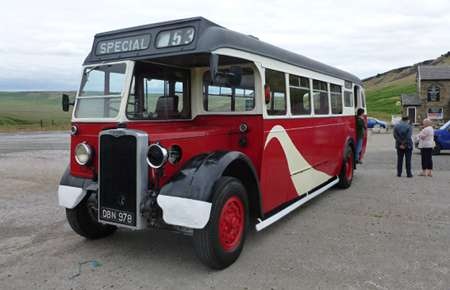
This is the ex Bolton Crossley which was repainted for a wartime event in Saddleworth recently. Photograph taken at Carriage House Inn Marsden Yorks. 10.08.13.
I painted this bus for the wartime event and also to give those who have never seen the Streamline Livery which was last seen 63 years ago including me to experience it. For those that remember it they must be around 70 and over. If I wait for the owner of the one existing bus which carried the Streamline Livery then they will be mostly dead! I do not see this other bus which incidentally is also a Crossley being finished in the next 10 years. I like the livery and obviously it was modified to depict the wartime version. In respect of the shade of the relief colour it was white BUT when varnish was applied became creamy. I would also point out that as a one parent family of a 9 year old it was a marathon task getting the bus finished in time for the event and therefore large parts are in primer. As for the body this is basically the post war version of the Streamline design and Manchester were contemplating ordering some Crossley single deckers post war but as the requirement changed was not proceeded with and then of course Mr Neale took over.
I new it would be controversial but it would be nice to see the positive side to this. As my old friend David points out I have done and spent a lot of time and money on this bus and having been through great personal trauma in the past three years I felt it was time for something different. To me it shows just how vibrant the Manchester colours were compared to some of the drab municipal schemes around at the time.
I also need to point out that post war buses were painted in the Streamline scheme i.e. 2890 to around 2850. Finally I do intend to repaint back to Bolton colours in a couple of years before that I intend to give the bus the non wartime version. Owning preserved buses should be fun and sometimes give a glimpse of the might have beens!
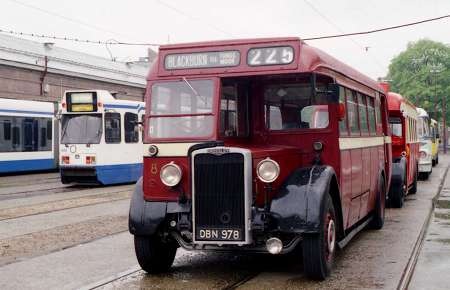
Here is another shot of the ex Bolton Crossley in its original livery taken by myself at Remise Lekstraat Amsterdam on 4th May 2004.
Ralph Oakes-Garnett
14/08/13 – 10:21
Well said. Owners must be allowed to determine how they want to present their vehicle. I too strongly favour historical accuracy thus I inwardly squirm when, for instance, I see what ‘Wheels’ have done to the ex-Stockport Corporation PD2 fleet #40 but it’s their bus, it’s their right and the good thing is that it remains preserved. It can be returned to it’s true colours another time if someone has the inclination, time and money.
Orla Nutting
14/08/13 – 10:23
Ralph, thank you for all the background on this great bus, especially concerning its present livery. It looks good; obviously you’ve put in lots of hard work and TLC over the years.
I am only sorry that you do not see the point, Phil.
Peter Stobart
14/08/13 – 11:13
Peter, as I said previously, owners can do as they wish. I fully get the point that a vehicle still in existence is better than none at all. I can understand – to a point – painting a vehicle from one fleet in the colours of another for which it never operated if the vehicle it represents was as near as possible identical, especially if there is some solid historical reason and its is made plain that it is not the original.
I’ve read Ralph’s explanation but still can’t get my head round how something a good way removed from reality has obviously had such care and effort put into it by an obviously dedicated owner. The "what if" idea presupposes either an extension of WW2 with Crossley able to lavish materials on a far from utility vehicle or that Crossley had fully designed and had for sale the SD42 and body pre-war.
I remember the furore some years ago when one of the model bus companies put a 30ft Tiger Cub with standard BET bodywork on the market in Midland red black and red colours. It never happened so why bother?
Phil Blinkhorn
14/08/13 – 13:19
One of the basic rules about the preservation of old buildings, especially "listed" ones is that any alterations for modern use should be capable of being reversed- for example an old Georgian chapel may have a building within a building constructed to provide offices, housing etc and ensure the building is used, but be capable of reverting to the original- and be seen as such. Seems to me that this could apply to historic vehicles, too.
Joe
14/08/13 – 18:49
This is really a tale of 2 Crossleys Bolton 8 and Manchester 129. I have painted the bus in a wartime version for the Saddleworth event and later the 1938 version of Streamline livery.
If you want to see the Streamline livery for real the choice is a) do as I have done. b) Wait until Manchester 129 is fully restored in around 10 years.
I was not prepared to wait that long and in another 10 years most people that remembered the livery sadly will not be around to see it. I have a copy in my possession of a Manchester Corporation official engineering drawing of the proposed post war single deck Crossley dated October 1946. I am not sure how well it will copy onto this site but I will try. Richard Finch the owner of 129 the Streamline Crossley Mancunian has the original and it was he and my son that helped in the painting of number 8.
Also out of interest over the years I have modified my bus to make it run better i.e. the intake and air filter(s) as it now has 3 not original but I am only doing what other Crossley owners did to try and get the optimum performance out of the engine. I must say that correct timing of these buses is paramount as a little fraction out is the difference between running very smoothly and loss of power with smoke! Interesting to relate over the years this bus has acquired a number of parts from pre-war Mancunians particularly the fan assembly. It is often said that every Crossley is different which is largely true I can say. So we presently have a lively bus that runs cool if anything and delivers 14 mpg and even 20mpg on long relatively flat runs as per trip to the Potteries Rally in May. A bus that climbs the 1 in 5 out of my village in 2nd gear and does not boil.
If I had stuck to the original specification then there were a number of inherent problems with running hot not least the air intake being treated to a diet of hot air from the sump. So what you have is not exactly original but a good bus, a heavy bus!
I intend to run the bus in Manchester colours for around 2 years. Not a waste of paint it looks stunning and I often think it is the Manchester bus it always wanted to be! There are many Manchester parts that I incorporated into the rebuild between 1974 and 1976 when the bulkhead was restored and the door put back to the rear. Also at this time the the back doors were removed and built across and the remains of the rear chairlift removed. Manchester PD1 post war Streamliner at Bingly Autospares provided 3 window pans as they were the same pattern.
Out of interest my father was originally an upholsterer before the war but after became a guard and then driver at Hyde Road Depot at a time when apart from 70 the Leyland Tiger every other bus was a Crossley some 300 on site. The trips around the depot in the fifties left a lasting impression. Both sides of my family at some time or other worked ay Crossley Motors at Gorton or Crossley Brothers. I was born in Ancoats in Crossley House owned by Crossley’s. So yes I like Crossley buses but Manchester’s the most. I never wanted more than one bus but if 2150 is ever for sale I would snap it up straight away. I was a few years ago part owner of 2558 a Streamline double decker but sadly it was too far gone to restore. For those visiting our depot at Mossley the bulkhead survives as does the engine at GMTS Museum.
Ralph Oakes-Garnett
15/08/13 – 07:09
Ralph has taken the trouble to explain at length, more than once, his thinking as regards the livery in which he is currently presenting his bus and his future plans for it. I fail to see, Phil, why you seem unable to accept this.
Many organisations – I’m thinking, for example, of the North Yorks Moors Railway in this part of the world – organise an annual ‘Wartime Weekend’. At these events people are encouraged to dress up in wartime garb, uniforms etc. The people who do so are often too young to remember the Vietnam War, never mind World War II, but they enter into the spirit of the occasion. Try to think of what Ralph’s done in a similar light. There are photos on this site, and elsewhere on the internet, of his bus in Bolton livery, and very fine it looks, so I think everyone can be confident that Ralph will continue to lavish every care upon it in the future. It seems to me that, if he was prepared to spend time and money painting it in a livery which, although not perhaps historically accurate for that bus, ‘looked the part’ for a special event, then he deserves nothing but praise rather than opprobrium.
With luck, any youngsters visiting the Saddleworth event will have acquired an interest, not only in the war and the sacrifices made by our parents’ generation, but also in Ralph’s bus and any others which may have been present. They are unlikely to have been bothered about historical accuracy but might just have been inspired to take an interest in bus preservation when we’re all long gone.
Alan Hall
15/08/13 – 12:03
Alan, I’ve also explained my position. There’s a massive difference between people dressing up for a day in WW2 uniforms and painting a vehicle in a non-accurate way.
The Crossley may well inspire someone to take an interest in PSVs but it’s the lack of interest in historical accuracy that bothers me.
In 1963, at the start of our A level course, an inspirational history teacher made a statement which, with the amount of disinformation on the internet, is truer than ever 50 years later, it went something like this:
"Lads, you’ll find this course will throw up contradictions and different views of what actually happened. The victors write history, the others have a different view. Your job when it comes to the A level paper is to put down what you have learnt. If you don’t know, don’t make it up. There are no marks for you writing your own version of history".
Get the point?
Decades of trying to research airline and bus operator histories, of working in aviation archives and in helping establish a major UK aviation museum, have opened many contradictions some which remain unresolved after decades.
Ralph’s beautiful but inaccurate representation can only help muddy waters in the future. I know it’s considered anal to insist on detailed accuracy and we all make errors from poor knowledge or bad memory but this colour scheme on this vehicle makes no sense to me. I’ve said my piece and I’ll leave it there.
Phil Blinkhorn
15/08/13 – 14:58
I have not been reading the OBP pages so much recently because of other interests so I have been catching up on recent threads and this one concerns me. I’m not able to quote historical accuracy in the finest detail but I do like old buses and coaches. I also like those who are enthusiasts and I respect their knowledge. Everyone has different ideas on how to do things but one simple goal of most owners of old vehicles is to look after them.
As I see it, Mr. Oakes-Garnett has owned and cared for this bus for forty years or so…a significant proportion of most of our lifetimes. Clearly he has a great affinity to it and that means for it to be still here, he must have lavished care, skill, time and vast sums of money to keep it on the road. Above he has set out clearly and in very generous detail why he wanted to change the colour scheme, his reasons and his personal thoughts about why he did it. He also indicates that he intends to put it back to just how it was before..in the way that HE did many decades ago. Then it will be back in splendid originality and "historical accuracy" will be maintained.
Meanwhile, just as if he had once sold it to "XYZ TOURS of SPUDBURY on SEA", it has been repainted. He could have chosen to do it like "XYZ" and painted it pink with yellow spots but he decided to do something that embraces history and adds to the story of DBN 978. He has done it well, with care and respect..and because his son likes it….and that brings me to why I post this contribution, always remember that preserving something involves the item whether it is a bus or a 1958 washing machine but most of all includes the ideas, thoughts, skills and feelings of those doing it. Historical accuracy has an important place..but kindness, friendship and understanding are even more important so Ralph..I say Good Work! DBN could not and never will be in better hands!
Richard Leaman
15/08/13 – 17:35
Richard I congratulate you on your posting and would give you 12 out of 10.
Ralph is to be commended in all he has done!
Peter Stobart
16/08/13 – 06:24
Thanks for that Richard. I just wonder how many critics on theses sites actually own or support a preserved bus? As I have said before the hobby should be fun and the latest incarnation of the bus has attracted a lot of interest locally about the second world war and also the different colours of buses in the Manchester area. My son has also learned a lot during this exercise including helping to make a headlamp mask and all the reasons why wartime markings were applied and the difficulties involved in moving around in the blackout. Most of his schoolmates in Diggle were at the wartime weekend and were frantically waving at us as we passed by.
Finally I have said it twice and I will say it again.
You would have to be around 70 years old to remember the Streamline livery as it finished in 1950. There is only one genuine prewar Manchester bus still around that wore the livery. That bus is DNF 204 Manchester 129 a Crossley Mancunian. This bus is kept at Roaches Mossley along with my bus. The owner Richard Finch is doing an excellent job in restoring it but is very much a perfectionist and progress is happening but not at a fast rate. Richard is often distracted by work on other buses including mine. I also have to say 129 was in a disgusting state when it was found around 1965 abandoned in a hedge. Today it has been reframed throughout and the cab totally rebuilt. There is still a long way to go with the limited means available. I can not see it restored fully for many years yet and Richard agrees. So if I had not taken the time to put a bus in this livery who else would? And is it fair to make everybody wait when already 63 years have passed since 1950. Richard thinks not because he helped me paint it. Now on the shade of white. The bus is still largely in primer due to limited time but I can tell you that it will be right. I was recently part owner of a doubledeck Streamline Crossley Mancunian CVR 760 Manchester 2558 and it was quite clear under the peeling paintwork what the shade of white was. The white becomes creamy when varnish is applied. Sadly by 1989 the bus was too far gone to restore at that time. Maybe these days we could have managed to restore it but unfortunately it had to be moved and disintegrated. The remains of said bus were sent to a number of locations we still have the bulkhead. This was another reason why I wished to paint my bus in Streamline livery.
I may at some time in the future have another paint scheme but for most part it will be in Bolton livery.
Finally I remember in 1977 at Brighton my dad and I had slogged away for months to get the bus ready to go on the London Brighton Commercial Run. There were many trials and tribulations at this time and both of us were very green and ignorant but as they say ignorance is bliss. On leaving Brighton a pedantist came up to us and said this bus is in the wrong shade of maroon. I said well if you are offering to paint it you are welcome!
Ralph Oakes-Garnett
16/08/13 – 09:36
Well said, Ralph! Did that nitpicker at Brighton 36 years ago ever take up your offer to allow him the honour of painting it in the maroon of his choice? I bet not.
All this livery business aside, I find these postwar all-Crossleys the handsomest of all single-deckers of their era. Everything looks no-nonsense and purposeful. From your comments on DBN 978’s performance it must be in pretty good mechanical shape too. What is the UW? Would it be about six-and-half tons? Do any 5-speed Crossley coaches survive? I’ve read that the very high overdrive ratio (I seem to remember 0.656:1) was chosen to achieve the best possible improvement in fuel consumption.
Ian Thompson
17/08/13 – 06:27
Thanks for that Ian.
As far as I am aware non survive but I have in my possession a five speed Crossley box. They were crash boxes and unfortunately for myself they were fixed amidships attached to a banjo piece. I had looked at fitting it but not practical. It is a large gearbox same size as my synchro box. I do however have the benefit of my bus having a coach diff from new. It is 5.2:1 whereas the standard was 6.6. Presumably this was fitted because the bus worked Pennine area routes to Darwen, Blackburn and Affeteside for most of it’s life.
Anon
21/08/13 – 06:59
Ralph,
Well over 40 years ago a Manchester ‘Streamliner’ single deck Crossley was parked up at in the yard at Plumtree railway station near Nottingham. At that time Plumtree station was home to several preserved buses and trolleybuses. The bus in question was in a parlous state; it was devoid of windows and internal fittings, the radiator top tank was full of concrete and the steering wheel had lost its rim with just the hub and spokes remaining. The identity of the bus wasn’t known and after a while it was towed away for preservation in the Manchester area, we were told. I wonder if this bus was Manchester 129, which you have mentioned in your recent posting?
Michael Elliott
01/09/13 – 13:59
Michael.
Yes the said bus is 129 and has had a lot of work done on it. However it is rarely seen by the public at large. It is kept at our depot Tameside Transport Collection in Mossley. We are there most weekends including this one but Saturday only as we are taking 3 buses to Heaton Park on the Sunday.
Ralph Oakes-Garnett
19/08/14 – 14:09
I am not a contributor to this site, just a casual visitor, so a bit ignorant. Hence my question. How were they able to use a half cab vehicle for one man operation?
Martin Robinson
20/08/14 – 18:11
Just to clarify the above question. Using a half cab for one man operation must have meant that the driver was constantly twisting around to tend the customers, surely? Did he end up with serious back problems or did he have a special swivelling seat? Wasn’t there money constantly being dropped? It appears an impossible process. Can someone explain?
Martin Robinson
21/08/14 – 06:20
The adaptation of half cab buses for OMO (no PC complications back then) was adopted in several fleets, Brighton Corporation being the first to try it with double deckers. I don’t know if swivelling seats were ever fitted, but bearing in mind that the driver would sit with his legs on each side of the steering column, and then considering the space constraints in a half cab, especially with a conventional gear lever to the left of the seat, any rotational movement would have been so limited as to be almost useless. The Brighton PD2s had the nearside bulkhead window angled forward to give passenger access to the driver over rear part of the the engine bonnet, and this form of modification seems to have been pretty much the standard elsewhere. According to a correspondent on the following site, half cab OMO conversions were also tried in Darwen, Southport, Southend, Aberdeen, East Kent, City of Oxford and Eastern National. I don’t know how accurate this list is, no doubt our OBP experts will clarify (and some of our OBP regulars have posted comments on this SCT page so, hopefully, more information may be forthcoming), but he omits Bolton, and also Doncaster. www.sct61.org.uk/bg26
The reference to East Kent also puzzles me. In 1956/7 this operator rebuilt 26 of its 1947 Dennis Lancet III rear entrance saloons with new full fronts, revised cab layouts and forward entrances for OMO work, and they ran successfully in this form for another ten years, being twenty years old when finally withdrawn. However, these were very different from simple half cab conversions. I am not aware of any other East Kent examples.
Roger Cox
21/08/14 – 06:21
With most of these OMO conversions the front nearside bulkhead (that is the bit to the left as you enter the bus that faces onto the bonnet), and the rear half of the driver’s nearside cab window were usually cut back and a new angled window put in to create a bigger ‘hole’ for the driver and passengers to communicate through, and to provide room for a ledge to which the ticket and change machines could be awkwardly mounted.
I believe some did have a swivelling seat, but most didn’t, and yes it must have been ergonomically diabolical – especially if the driver was already suffering from middle aged aches and pains.
My local operator Halifax Joint Omnibus Committee had a number of AEC Regal III single deckers converted in this way back in the early 1950’s. To add insult to injury the doors were manually operated by means of a substantial pivoting metal rod that was attached to the top edge of its leading section, and then passed across the top of the entrance and into the space in the canopy above the bonnet and under the roof space. The end of it then emerged in the cab high up above the driver’s head. At every stop the poor driver, already aching from the constantly twisting around, then had to raise his left arm right up above his head and nearly pull his shoulder out as he heaved away to operate the doors. The arrangement was not popular, and wouldn’t be allowed today.
Yet it wasn’t just confined to single deckers back in the 1950’s. A small number of operators experimented with a similar arrangement on halfcab double deckers when DD.OMO was first permitted in the late 1960’s. Brighton Corporation comes to mind for one.
John Stringer
21/08/14 – 10:54
Roger, the list of 8 fleets which I provided related specifically to double deck OPO. I did quite a bit of research, but never came across Bolton or Doncaster, so I would be interested to know more about this myself. I also believe that Accrington and Stockport gave serious consideration to adapting their newest Titans to the appropriate configuration, but took the idea no further. Stockport’s few front entrance vehicles represented just a tiny percentage of the fleet. As regards East Kent, there was an article in ‘Classic Bus’ some time ago which showed a Regent V operating on, I think, service 10, and being used as a single-manned vehicle. Overall, my understanding is that it was only Brighton who pursued the idea of double deck half cab OPO for any substantial length of time. The situation with single deckers would have, I’m sure, been quite different. John Stringer mentions Halifax’s Regals; my home town fleet in Lancaster also converted some Regals and I would imagine that overall numerous companies would have used half cab single deckers one-manned. Crosville actually rebuilt a good number of its Bristol Ls with front entrances for this purpose. Just consider also the Bristol SC, often used for more lightly trafficked routes. Whilst not a half cab, the door was positioned behind the driver, who would therefore be subjected to similar ergonomics!
Dave Towers
21/08/14 – 12:41
I seem to remember that Burnley, Colne, and Nelson had OMO single deck half cabs.
Stephen Howarth
21/08/14 – 17:47
Stockport had intended to run its front entrance PD3s as OMO vehicles on certain routes and they were delivered with both angled bulkhead windows and stair gates so that they could operate as single deckers, well after double deck OMO was allowed – another facet of Stockport being traditional! Union opposition and then the advent of SELNEC ended all thoughts of front engined OMO.
Phil Blinkhorn
22/08/14 – 06:39
Stockport had intended to run its front entrance PD3s as OMO vehicles on certain routes and they were delivered with both angled bulkhead windows and stair gates so that they could operate as single deckers, well after double deck OMO was allowed – another facet of Stockport being traditional! Union opposition and then the advent of SELNEC ended all thoughts of front engined OMO.
Phil Blinkhorn
22/08/14 – 18:08
Blackburn Transport were still operating Darwen PD2s OMO on Darwen depot local services as late as 1979-1980 – whilst crew-operating early Atlanteans from Blackburn depot! Some of the Darwen local services used narrow back streets, which may have been unsuitable for Atlanteans,although the Bristol REs managed to get round them. As I have mentioned before, after something of a moratorium on OMO conversions from about 1976 to 1979 by many public sector operators, there was some sort of national agreement in 1979 and OMO conversions started again in earnest, resulting in several operators having to return older types of vehicle to OMO, which had earlier been consigned back to crew work.
Michael Keeley
23/08/14 – 06:22
Just another thought about Bolton being a possible addition to the list of operators using half cab double deckers as OPO buses. This would seem less likely given that by the time double deck OPO was permitted by law in 1966, Bolton had some 70 Atlanteans in their fleet.
Dave Towers
23/08/14 – 16:25
Dave, I’m pretty sure Bolton never used half-cab DDs OMO. Most of their later front-engined buses were full fronted PD3s anyway but I don’t think these were either. (On that note though, I suppose in theory a full front, front engined bus would be marginally more easy to operate OMO than a half cab).
Michael Keeley
24/08/14 – 06:48
Northern General converted a Leyland Titan PD3 for use on ‘One Man Operated’ duties by moving the cab back behind the front axle – in effect making the PD3 normal control. With the cab then directly opposite the front entrance/exit doors, it was suitable for ‘pay as you enter’ operation. If memory serves correctly, Northern also updated the braking system, and a Routemaster fluid flywheel and semi-automatic gearbox replaced the Titan’s manual transmission. Other Routemaster parts used included the radiator, adapted front wings and a widened version of the Routemaster bonnet. Although this experimental vehicle (known as The Tynesider) may have looked a little odd, to me it had a certain charm. No doubt it would have been more reliable, simpler to maintain and cheaper to operate than the rear-engined ‘deckers on offer at the time, which was presumably the purpose of the exercise. I personally felt it a shame such an ingeniously simple design could not have been approved for ‘new bus grant’. If it had, maybe we would have seen the Leyland Titan PD4 as a viable option to the Atlantean. Presumably pleased with The Tynesider, Northern followed it up by converting one of its Routemasters to similar layout (The Wearsider), and full marks must surely be given to the Company for their bold attempt at designing such a practical, straightforward ‘PAYE’ double-decker.
Brendan Smith
24/08/14 – 18:41
Brendan, I don’t know if you saw it, but I had a posting of ‘Tynesider’ featured on the Ugly bus page on this site. As far as I’m aware, its still around somewhere in the Liverpool area.
Ronnie Hoye
25/08/14 – 07:28
Thanks for the link to the photo Ronnie. I had looked under the Northern General and Tyneside headings to see if The Tynesider was included, but never thought to look under the ugly bus page – probably because I didn’t think it looked too bad for a prototype! I’m pleased to hear that this unique vehicle is still around after all this time, and I’m sure we all wish it well.
Brendan Smith
26/08/14 – 06:51
Brendan, more news about Tynesider. I’ve just come back from the Seaburn vintage and historic vehicle rally, apparently, about four years ago the person in Liverpool who owned Tynesider became short of funds, so it was sold to a dealer for scrap. However, as luck would have it, he realised what he had bought and he contacted a group of enthusiasts here in the North East. He offered them the vehicle for the price he paid for it, and agreed to keep it until the money was found and arrangements could be made to bring it back home. It is now back in this part of the world and restoration work is well under way, and it is hoped to have it on the rally cercuit some time next year. As for Wearsider, it looks as if it has been scrapped.
Ronnie Hoye
27/08/14 – 05:48
Thanks for the info Ronnie. While it is sad to hear that The Wearsider Routemaster may well have bitten the dust, it’s lovely to know that at least The Tynesider is now in preservation. I’m sure many people would not see this vehicle as the prettiest or most handsome thing on wheels, but at least it has a distinctive character, a trait that is sadly lacking in most of today’s sterile "me too" designs. I’m no fan of Boris Johnson’s NTFL (New Toy For London), but at least you know what it is from a distance!
Brendan Smith
27/08/14 – 07:13
I agree wholeheartedly with your last sentence there Brendan, and dare I venture the further comment that the same can be said of the NTFL perpetrator ??
Chris Youhill
29/08/14 – 14:00
The vexed question of accurate liveries continues to divide the enthusiast fraternity.
I don’t own a vehicle but respect and admire those who do.
If a slightly non standard hue is used there may be many reasons for this and it should not detract from the joy of having the vehicle survive. Three examples spring to mind one is the ex London RLH beautifully painted in Ledgard livery now they did run this type of bus but not this particular example, but it serves as a powerful reminder of a very popular company. Again Yorkshire Heritage services who use vintage buses as wedding transport paint many of their buses in a black and cream livery since this is what the punters want and they are a commercial enterprise. Again I would rather see them in this guise than in a scrap yard. Finally the Wensleydale Bus Company run a service in the Dale which was West Yorkshire and United territory with a Lincs Road Car MW in green again not accurate but I would sooner have a ride in it than pass up the opportunity due to the "wrong" colour scheme.
Chris Hough
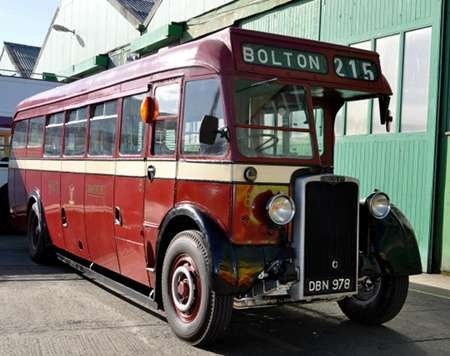 Vehicle reminder shot for this posting
15/07/19 – 07:01
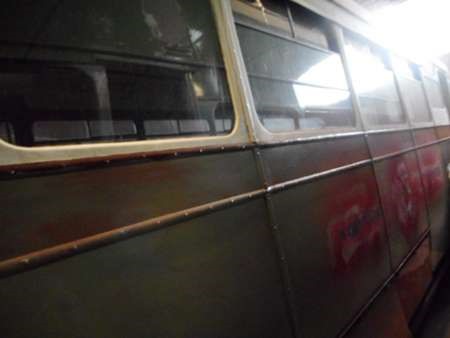
Ralph Oakes-Garnett has today posted a picture of his Bolton bus, on a Facebook group, and it shows it in partial undercoat in preparation to return it to full Bolton livery.
It is 2 years since he was struck down by illness, and he says it is slow progress.
I am sure he won’t mind me sharing the image with you.
Stephen Howarth
Quick links to the - Comments Page - Contact Page - Home Page