Copyright Alan Murray-Rust
Liverpool City Transport
1954
AEC Regent III 9613S
Saunders-Roe H32/26R
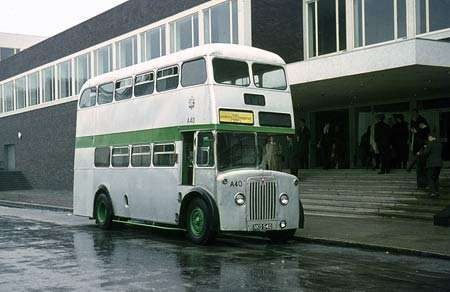
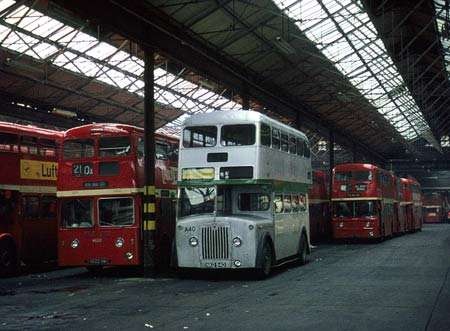
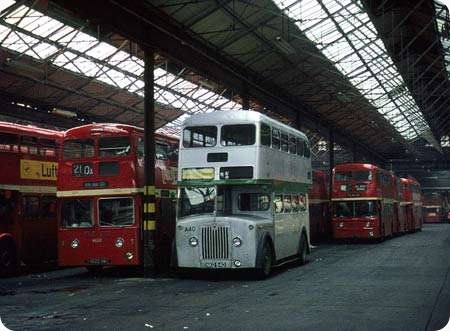
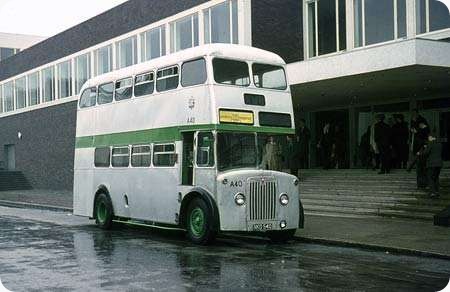
Liverpool City Transport’s A40 can reasonably be stated to be a unique bus. As far as I can make out, it was one of just two double-deck buses for the UK market with bodies built as a Saunders-Roe product (the other being its twin, A39), and to make it unique it carries one of the small number of unpainted bodies ordered by Liverpool with the intention of using them on limited stop services. 40 were originally envisaged, but the idea was dropped and in the end only 18 appeared as such. These bodies are not painted silver, but the panels have a textured natural aluminium finish. It’s not clear whether this in practice reduced maintenance or repaint costs, but all of them retained the unpainted finish to the end of LCT days at least. Because of the texture to the finish, it would not have been possible simply to paint over the original panels, so to change livery would have required a complete repanelling. Despite the tin front, this is indeed a Regent III, one of the large batch of 100 delivered between 1953 and 1955 during the tram replacement programme. Apart from the two from Saunders-Roe, the remainder were either built by Crossley or finished by Liverpool on Crossley frames.
Horne and Maund’s epic treatise on Liverpool’s Transport doesn’t give any reason for the two bodies being ordered from Saunders Roe. Doing some investigation into Saunders-Roe, I did discover that following the takeover of Crossley by AEC, a number of design staff transferred to Saro. In view of Liverpool’s close relationship with Crossley, I wonder whether there was some sort of insider dealing going on. Interestingly, the Saro bodies, being of all-aluminium construction were about one ton lighter than the Crossley ones, and additionally had 2 extra top deck seats, both of which might have been considered significant advantages. The reduced weight should have led to fuel economies, but the main factor could have been first cost of the aluminium structure.
In the course of my investigations I also put to rest a misapprehension about Saunders (of RT fame) and Saro (of the Tiger Cubs). I had always been led to understand that the two were separate organisations. In practice Saunders, Saunders Engineering and Shipbuilding (SEAS) and Saunders-Roe (Saro) were simply successive marketing names for the bus building operations of the Saunders-Roe group at Beaumaris.
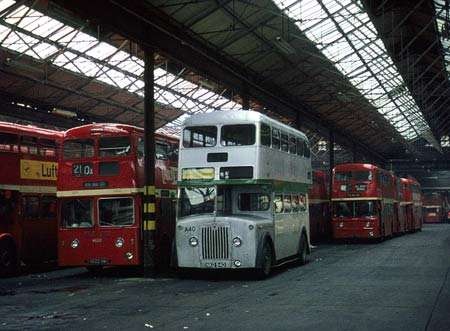
What was A40 doing in Manchester’s Hyde Road Garage? The answer is that the Liverpool University Public Transport Society (LUPTS) had organised a trolleybus tour of the Manchester and Ashton system on 12 June 1966, and this was the vehicle selected to ferry the Liverpool contingent to and from Manchester. The bus was certainly made to show what it could do along the open spaces of the East Lancs Road.
Copyright Alan Murray-Rust
This second view is a fuller shot of the bus showing better detail of the Saro body, waiting to start from the University Students’ Union in Liverpool. As can been seen, it was normal British summer weather, but remarkably the rain had ceased by the time we arrived in Manchester (!) for the main tour, and at one point the sun even tried to come out.
Photograph and Copy contributed by Alan Murray-Rust
30/12/12 – 08:54
Well, A40 certainly stands out against the red and cream residents!
I, too, have often wondered where Saunders, Saunders Roe and Saro fitted together. I presume there is no connection with the rather more popular Roe of Crossgates, Leeds!
Pete Davies
30/12/12 – 08:55
Alan. Even allowing for your self-correction in paragraph two, there were many deckers from Beaumaris. The 250 RTs were preceded by OKM 317 which was operated by Dodd’s of Troon and used as a test bed for the said RTs. Devon General, like many others, had a programme of rebuilding after the war. DR705 (ETT 995) used the chassis of a 1937 AEC Regent with parts from a 1938 Regal with a new (1953) Saunders-Roe body. Don’t know how many, if any, more Saunders-Roe bodies emerged in this programme. It was certainly a extensive one but most of the new bodies were by Weymann and extended to 1954. They were known locally as "Light sixes". Were there any more? Over to you out there…..
David Oldfield
South Wales Transport had a number of Regent Vs which were unpainted. I well remember them in their first year in service when on a visit to South Wales though my main memory from that trip is a ride on the Swansea and Mumbles Railway or Tramway – both terms were used – with two double decker trams coupled together, something I hadn’t seen in Blackpool.
I seem to remember the Regents were repainted so presumably their panels were to a different finish.
I was never a fan of the Liverpool Crossley or Saro bodies to this design, I thought, and still do, that they are visually utilitarian.
Regarding the South Wales Regents, the following is reproduced from Commercial Motor:
"Since 1958 our company has been experimenting with non-painted buses to ascertain whether there was any advantage in operating buses of this type.
Altogether, we had 13 such vehicles, six were acquired in 1958 and a further seven in 1959. It would seem, however, from the records that while the unpainted vehicles offered certain advantages there were disadvantages which in relation to costs of maintenance, showed that over the experimental period there was very little to choose between the painted and unpainted vehicles.
For instance, the unpainted vehicles have received considerably more than normal cleaning to maintain an acceptable appearance. The cost of which almost cancelled out the saving made in the non-painting of the exterior.
The unpainted vehicles, when requiring body repairs after accidents, did offer certain advantages, severe damage, which necessitated the complete replacement of a panel was facilitated when no painting was required. However, there were disadvantages in this respect too, minor dents and scratches which could be filled and painted on an orthodox finish, invariably necessitated the changing of the panel, as the effect of even the most highly skilled panel beating was still visible.
There being little to choose on actual cost, the final decision evolved over the appearance of the vehicles and it was felt that the painted bus was considerably more attractive, so it’s back to the redskins for us."
Phil Blinkhorn
30/12/12 – 09:49
No, Pete. They had no connection with Charles H Roe of Leeds. They were, however, connected with Avro (however it was spelt – I’m sure Phil Blinkhorn will correct me) who were aircraft builders, hence the aluminium construction. [Slightly off piste: London Transport and Park Royal were involved in war time aircraft production. This led to their aluminium expertise when designing and building the Routemaster.]
David Oldfield
30/12/12 – 12:07
Avro (AV Roe & Co), the Manchester- based aircraft manufacturer, was founded by Alliot Verdon Roe. Later ejected from his own company by bankers, he took an interest in Saunders of Cowes in the Isle of Wight – a flying boat builder – which then became Saunders-Roe.
On the subject of double-decker buses, have we all forgotten the Leyland PDR Lowloader? One of the two prototypes had Saunders-Roe bodywork. Then there were the vehicles built under contract from MCW in the 1960s.
Neville Mercer
30/12/12 – 13:42
Well yes, to my shame, Neville, I had forgotten the Atlantean/Lowloader but tell me, I’m intrigued, about the MCW sub-contracts.
David Oldfield
While Charles Roe s had no connection with A V Roe.
Leeds was home to a shadow factory in world war 2 that produced over 700 examples of the world famous Lancaster bomber. The factory was next to what is now Leeds-Bradford Airport and was heavily camouflaged to the extent it had the roof grassed over and live sheep on top!
One other operator who tried unpainted aluminium for the fleet was Edinburgh who had a small batch of MCW bodied Leyland Titans these were soon painted and no more were purchased in this format
Chris Hough
30/12/12 – 13:45
Thank you, David O. I didn’t think there was a connection, but one never knows!
Pete Davies
30/12/12 – 17:29
Been travelling all day so missed much of the above until now. I’ve never got to the bottom of just why Leyland went to Saunders Roe for the body for the Lowloader. In 1953 they were still building bodies though the thought may have been that they wanted continuity and the writing was on the wall for their own plant.
Given that, why didn’t they go to MCW or, closer to home, Northern Counties?
Perhaps they wanted to keep things as quiet as possible for a while and chose SARO for its remote location, relatively few customer visitors and in the knowledge that the order would receive detailed and deep attention from a company at the time looking to increase its business.
Phil Blinkhorn
31/12/12 – 07:14
Can’t help noticing the body on A40 has a very strong resemblance to the Northern Counties 4-bay bodies on tin-front PD2’s operated by Lytham St Annes and Oldham.
Philip Halstead
31/12/12 – 07:16
Some musings on Phil’s comment on the Crossley bodies of the same batch of Regents. Personally, I always felt that the 8ft wide bodies on the first batch of Regents (A757-806) were not unattractive. The body was not enhanced by the addition of the first Liverpool-style tin front. The final version of the Crossley body, and particularly the final version of the tin front, were distinctly retrograde.
What is undeniable is that the final livery of overall green with just the central window surrounds in cream was a recipe for making any manufacturer’s body look utilitarian. Even the early two-band livery didn’t do a great deal, so that even the Leyland bodies – one of my favourites – was made to look pedestrian in comparison with some other operators (e.g. the one across the water). My view on this earlier livery may well be influenced by the fact that the relatively few vehicles still carrying it when I became familiar with the fleet would already be some years out of paint shop, and that version of the green was notorious in not meeting old age gracefully. The very last vehicle to retain that style, the evaluation Atlantean E2, was reckoned to have no two panels of exactly the same shade of green towards the end. It was a real patchwork.
Alan Murray-Rust
31/12/12 – 11:29
Now the A. V. Roe part of the equation has been settled, what about the Saunders part? There was a Saunders Eng & Shipbuilding at Cowes Isle of Wight which merged in 1948, with Avro, but Cowes is a long way from Beaumaris. The 300 Saunders RTs were delivered from 11/48 until 2/51. M&D had a batch of Saunders-bodied K6As (DH204-243, JKM 901-940 delivered in 1948 which had a Weymann-look about them. Where were these built?
Then there was a 1942 K5G (DH445 GKR 741) which had a Saunders body built in June 1950. This was definitely based on the RT body behind the bulkhead, even to the interior trim and top rear emergency exit. Was this body tucked into the RT production run or an experimental body using Rivaloy construction?
Also, the AA AEC Regent III (OKM 317) built in 1951 as a prototype for future production, though apparently registered to M&D in 1951 but not used by them but as a demonstrator, but was it for AEC or Saro?
Further, M&D also had a Saro semi-chassiless bus in 1953 (SO68 RKE 540) with Gardner engine, but I don’t know who supplied the gearbox and other running units. It appears to have been still-born because I can’t find any similar vehicles ever being built. All the vehicles mentioned (and all the Tiger Cubs for Ribble, etc) seemed to have full service lives, so it seems odd that this manufacturer had a relatively short flirtation with buses.
Over to you gentlemen to explain this lot!!
Ray Stringer (no relation to John)
31/12/12 – 12:51
There is a book in existence "Saunders Roe Ltd, Builders of the World’s Lightest Buses" by Gerald Truran published by Bryngold Books (Wales). Not sure if it is still in print as it isn’t listed on their current web page. This was written by a former employee.
All Saunders Roe buses were, as far as I’m aware, built on Anglesey.
The company itself started as S E Saunders boat builders. The Wikipedia page is reasonably accurate and worth a read as a starter – //en.wikipedia.org/
Phil Blinkhorn
31/12/12 – 12:52
We all ought to go away and look at Wikepedia about Avro and Saunders Roe. It otherwise needs a complete article. These companies- and others- seemed to survive by doing a bit of this and a bit of that- often innovative- and occasionally a Helicopter or a bus would come good. They merged and unmerged and reorganised like primitive life forms. AV Roe himself seems to be a consistent element. The thing that doesn’t seem to have appeared here and put me right if I’m wrong is that one factory was built next door to Crossleys and when AEC took over Crossley, a number jumped ship and so bus expertise was acquired: so was the Lowloader related to the Crossley chassisless bus? And then the riveted aluminium buses for export…. you can get an idea of our manufacturing problems-these were flexible companies with eggs in many baskets…. like Tatra?
Joe
31/12/12 – 17:22
Joe, Crossley’s factory was at Errwood Rd Stockport, Cheshire. SARO’s was at Beaumaris on Anglesey so those who moved to SARO had to move house.
I’m not aware of any linkage between the chassis/engine/drive train used by the Lowloader and anything Crossley. As far as I know, only the body was SARO and the assumed linkage on the Wikipedia page could well be speculative.
I’m not aware that anything other than bodies were produced by SARO
Phil Blinkhorn
31/12/12 – 17:23
There is a connection between Crossley Motors and AVRO. From 1920 to 1928 A V Roe and Company Limited was owned by Crossley Motors and it was at the end of this period that A V Roe left the firm he had founded. He sold his minority share holding in AVRO to J D Siddeley, of Armstrong – Siddeley, the company Crossley had sold its majority share holding to. Armstrong – Siddeley’s aircraft interests became Hawker-Siddeley (of Hurricane fame) and AVRO was a separate subsidiary of this organisation. A V Roe used the proceeds from the sale of his AVRO shares to buy a controlling interest in Saunders Aircraft of Cowes, which was renamed Saunders-Roe. Saunders-Roe had a factory at Beaumaris, which became the base for their bus body building activities using at various times Saunders Engineering and Shipyard (SEAS) and SARO.
Michael Elliott
31/12/12 – 17:28
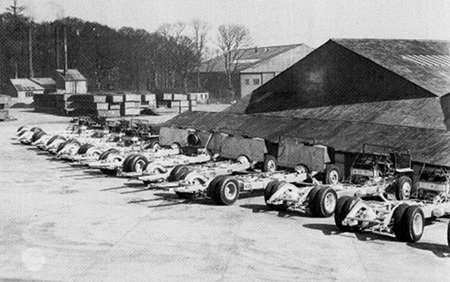
Copyright Saunders
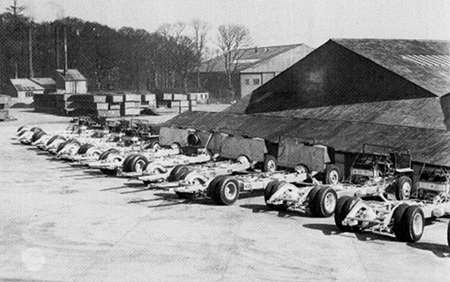
Here’s a photo of Saunders Ship. & Eng. yard at Beaumaris, in 1949, with bus bodying in full swing!. The chassis without platform extension are those of RT’s. The four chassis with extensions, in the centre of photo, are those AEC Regal III’s."
Chris Hebbron
01/01/13 – 07:19
Yes I misspoke Phil… I was confusing Crossley taking over the Avro works in 1920. But Wikipedia does say that after AEC the design staff from Crossley went to Saro, hence the Lowloader had Crossley connections! That could make sense?
Joe
01/01/13 – 07:20
Phil: I’ve looked at the Bryngold website and the Saro book is listed about two thirds of the way down the list of titles on the right of the page; this opens a separate page relating to the book, and there is no suggestion that it is unavailable. Knowing Gerald Truran’s voluminous knowledge of all things Welsh in the bus world, he may well clarify the reason for Saro working on the Lowloader project. My own guess would be that Leyland were looking to build on the experience Saro had with chassisless aluminium construction with the Tiger Cubs, which were definitely not failures.
Incidentally, the Bryngold page has a picture of the bodyshop with an undeniable Bristol half-cab (without much body structure) which set me wondering until I saw Ray Stringer’s comment above referring to the M&D batch, which I had been unaware of.
Alan Murray-Rust
01/01/13 – 09:53
Joe, That could be but it’s a bit tenuous as Crossley’s staff who moved and worked on the Lowloader would have had little, if anything, to do with the Bridgemaster development as work on the Lowloader design at SARO commenced in 1951 and Crossley’s involvement with the Bridgemaster was from 1953/4.
Alan, Thanks for the info. When I went into their site yesterday the page obviously didn’t load properly as the sidebar was missing. Could you expand on your comment re chassisless construction and Tiger Cubs as the Cub had a chassis?
Phil Blinkhorn
01/01/13 – 11:21
Phil: My comment on the Saro Tiger Cubs was something that was sitting in the back of my mind rather than based on something definitive. I’ve done some checking up in my limited library, and two things have become clear. Firstly, the Saro Tiger Cubs were clearly conventional chassis, and secondly that the chronology does not support my guess, as the development work on the Lowloader (source: The Leyland Bus) predated the Cubs. Moral: engage brain before opening mouth! It’s interesting to see that one of the demonstrator Cubs – part of the Ribble order – had a Saro body. The Leyland Bus doesn’t comment on the choice of Saro, but both Tiger Cub and Lowloader were small engine vehicles, so the weight saving of an aluminium body would be a key factor. One wonders why they were not more widespread – was it higher first cost, operator conservatism or capacity at the Anglesey plant?
Alan Murray-Rust
01/01/13 – 11:43
Returning to Liverpool’s A40, it’s interesting that Liverpool specified a textured unpainted aluminium. This seems to have, whatever it looked like, a durability the South Wales Regents never attained.
In Gavin Booth’s Buses By Design there’s a picture of an ex-works South Wales Regent taken at Addlestone and the panels are very obviously smooth. He comments that the finish swiftly tarnished and the buses were all painted.
Phil Blinkhorn
02/01/13 – 07:23
Like Alan, I have always assumed that the reason for the choice of Saunders-Roe to body the first Lowloader prototype was weight-saving, given that the bus was to be used for demonstration and needed to impress with its performance. By the time the second Lowloader was built, MCW’s lightweight construction had been developed. Guy also used Saro for its Gardner 5HLW-powered Arab LUF demonstrator, perhaps for the same reason.
I have read that Saunders-Roe’s early departure from the bus body market was due to a policy decision by the company rather than any lack of customer interest.
Peter Williamson
02/01/13 – 09:00
I have always been given to believe that all operators of Saro buses spoke highly of their quality. They were an "off-shoot" of an existing business and presumably not core to it.
David Oldfield
03/01/13 – 06:38
Being involved with Liverpool A40 in the early part of its restoration, it certainly had (as was stated earlier) a good power to weight ratio being over a ton lighter than similar Crossley bodied Regents. Bodywork wise too it was much more solid than its Crossley steel framed counterparts. The only body restoration that has taken place in preservation on A40 has been a platform bearer! Notable when its parked next to a London RT is the RT style emergency window!
Rob
27/12/13 – 15:27
Great to see the old LCPT AEC A40 – these were known to school kids as "ghost buses". My cousin was a big bus fan, and used to be keep me clued up on fleet developments. A40 was well known – used to operate sometimes on our local route, service 61, Aigburth Vale to Seaforth. This would be around 1958-60?
Tony Howard
28/12/13 – 08:08
Correction to my comment 02/01/13 – 07:23. The Saro-bodied Guy Arab LUF demonstrator still exists and apparently has always had a 6HLW engine, much to my surprise.
Peter Williamson
28/12/13 – 08:37
Going back, again, to Peter’s post nearly a year ago, it was a policy decision to withdraw from the passenger market but there was a post-script. Saunders-Roe eventually became a Cammell-Laird possession – and therefore in common ownership with MCW. MCW, not for the first time since closing Weymann down, found itself short of capacity. It solved this by putting orders for Atlanteans for Devon General to Saunders-Roe.
David Oldfield
10/04/14 – 17:55
Picking up on the later MCW/Saunders-Roe connection, Brighton’s 1968 PD3s were also built at Beaumaris – there’s a picture of a couple under construction in a 1971 Brighton Corporation Transport fleet history published by a body called E.L.P.G Enterprises (Eastbourne Lion Preservation Group?) It also states that only 21 other bus bodies, apart from these, were built during the short-lived return to bus body building on Anglesey – "ten for the home market" I assume the DG Atlanteans David refers to "and eleven for overseas" – no idea what those were.
Michael Keeley
13/04/14 – 07:20
I’ve now unearthed my copy of the Bryngold book on Saro referred to above; answers to some of the above queries from that book are as follows:
a) 1968 Beaumaris home market production was 5 PD3s for Brighton and 10 Atlanteans for Devon General, as stated above. The other 11 vehicles were bodied under licence from the Superior Coach Company of America, on Bedford VAM chassis. The first was in the Demonstration Park at the 1968 Commercial Motor Show,no other details given; the other 10 were assembled on left hand drive VAMs and sent to the Middle East for use by an oil company. The final passenger carrying body produced at Beaumaris was a Superior body, on a Ford D series truck chassis, owner unknown.
b) Apparently Leyland approached Saro to build an all aluminium lightweight body for what became STF 90. No reason is given for Leyland approaching Saro. ULW is given as 6-17-3.
c) The first double deck bodies built at Beaumaris were rebodied TD3/4/5s for Southdown – AUF 660/1, BUF215/7/28/35, EUF 183/6/99, with features specified by Southdown.
d) Maidstone and Dist JKM 901-40 were built at Beaumaris in 1948, the last vehicles to the pre-war Short Bros design.
e) Maidstone GKR 741 was the first double deck Rivaloy body, resembling the RT body.
f) OKM 317 – is given as used by M&D as DH500, later to CB Law of Prestwick, and Dodds of Troon.
g) RKE540 Saro body and underframe – given as Gardner 5HLW engine,David Brown 5 speed gearbox, ULW 5-17-3.
h) Devon General ETT 995 was the only Saro Light Six – it is in preservation in the West Country.
I can thoroughly recommend the book, a fitting tribute to Saro, and to Gerald Truran, who researched it, but sadly passed away before it could be published.
Bob Gell
13/04/14 – 18:24
The Bedford VAM with the licences built body that appeared at the 1968 show was a right hand drive facsimile of an American school bus . MCW hoped to interest local authority education departments and independent operators but both markets were disinterested as it was cheaper to use non dedicated vehicles. Also, by any UK standard, the vehicle was spartan.
Phil Blinkhorn
15/04/14 – 10:59
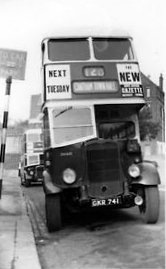
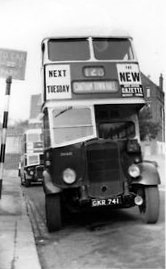
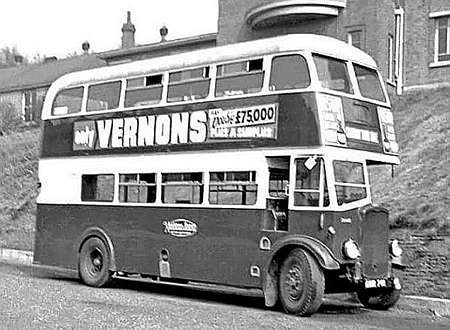
Here’s a frontal view of Maidstone & District Bristol K5G DH445 (GKR 741) from 1942, with a 1950 Saunders H56R ‘Rivaloy’ body (ex Chatham & District). Ray Stringer mentions that body was based on the RT body from behind the front bulkhead, even to the interior trim and top rear emergency exit and wondered if the body had ben tucked into the RT production run, or was an experimental body using Rivaloy construction? Bob Gell quoted that Maidstone GKR 741 was the first Rivaloy body, resembling the RT body.
Unfortunately, the view does not show the body behind the front bulkhead, but certainly does not reveal any RT resemblance at the front. What a shame they skimped on putting a PV radiator on it at re-bodying. Definitely a case of spoiling the ship for a ha-p’orth of tar!
Chris Hebbron
17/04/15 – 09:37
Liverpool’s A40 always had a mystique about it, more so than its companion A39, because it was unpainted. A40’s interior had a much more luxurious feel than the other 98 Regent IIIs in the batch and even A39, perhaps partly due to its moquette seats, something highly unusual for the Liverpool fleet. Good to know that the vehicle is preserved.
Mr Anon (lpl)
10/02/17 – 16:59
As a young lad who couldn’t wait to work for YTC (Yorkshire Traction) I well remember the company taking delivery of two dozen Saro Cubs GHE 2 to GHE 25 1002/1025 and were put into service immediately in Battleship Grey but with fleet numbers and Yorkshire Traction emblasened on the side. Evidently the paint shop workers at Saro were on strike and YTC were in the process of disposing of an old fleet of PS1’s so they went into service in grey but were later called in and painted in reverse livery where the main colour was Yorkshire Cream then later to Traction Red.
ELJ Tracky Lad
06/09/18 – 05:32
Reference the sliver bus in the above photo. These buses were used on route 510 limited stop. We called them slice bullets because they were fast and had good heaters. I felt like a king when I drove this bus on route from Liverpool central to Prescot.
Many a person got on the bus but they tried to get off nearl killing them selves when the driver had to stop at the traffic lights.
I passed my Psv on a crash box, the instructor used to take out the window behind the driver and shout at you get off the brake, feather the clutch and so on that why most of us are now deaf.
Mike Grant
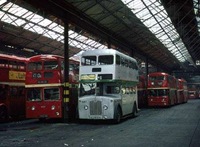 Vehicle reminder shot for this posting
31/12/20 – 06:35
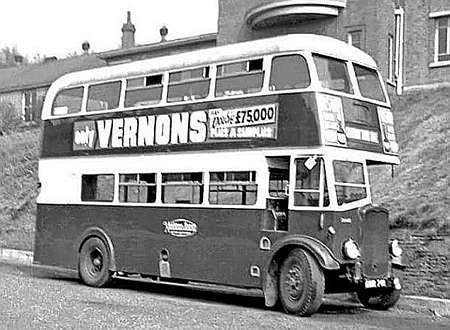
This picture (not mine) exemplifies how similar this one-off body was to the RT body.
Ray Stringer