Old Bus Photos

Leeds City Transport – AEC Regent V – XUM 894 – 894
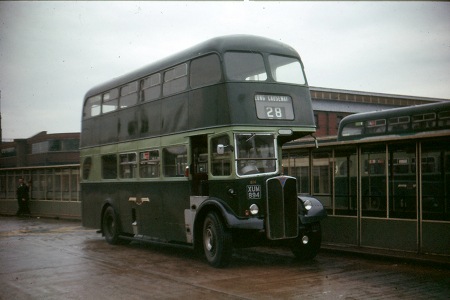
Leeds City transport AEC Regent V

Leeds City transport
1957
AEC Regent V
Roe H60R

Yet another example of a Regent V with a Regent III radiator. If I remember Leeds city Transport buses were nearly all semi automatic or had clutch less gearboxes of some description probable to help them off to quick start from the bus stops.


894 is the last of a huge batch which were ordered as tram replacements. The next batch numerically were fitted with 8′ wide bodies.

Terry Malloy


The last batches of post-war LCT buses to have full three pedal "clutch and gearbox" transmission were the Crossleys, the Leyland PD1s, the sixty Leyland PD2s (NNW batch), the six "standee" single deckers (2 Guy, 3 AEC Reliance and 3 Leyland Tiger Cub) – so rather more than is generally realised !!

Chris Youhill


Hi everyone,
I meant to post this link a while ago, finally got around to it.
www.britishpathe.com/record.php?id=39972
It shows the first delivery of these vehicles to Torre Road Depot.

Terry Malloy


I think the reason for preferring clutchless transmissions, in common with several other municipal operators, was the need to retrain large numbers of tram drivers in a very short time. Far fewer people owned cars in those days, and many of those tram drivers would never have driven a motor vehicle.
What about the PD2/11s (UUA batches)? I know some of them were specials with pneumo-cyclic transmission, but I didn’t think they all were.

Peter Williamson


The last manual gearbox double deckers were the sixty "NNW" Leyland PD2s. All subsequent double deck vehicles being semi automatic of one kind or another. Thereafter all AECs and Daimlers were either three pedal pre-selector or two pedal "monocontrol." All Leylands were two pedal pneumo-cyclic with the exception of the batch of ten "RNW"s (301 -310) which were three pedal pre-selector, and were the only ones made other than the London Transport RTLs and RTWs. Passionately wishing to drive one of the latter, I booked a piece of teatime overtime out of Bramley and persuaded a bemused but helpful shift foreman to let me take 307, one of the only two remaining at the time – a great experience !!

Chris Youhill


31/07/12 – 05:43

The clutch you are referring to was a gear changing pedal (NOT A CLUTCH) they were known as preselctors, I used to love to drive them brings back memories going up Churwell Hill in the old girls, (52/53 Morley)

Roger Hopper


07/11/12 – 16:47

Snivelling out of Bramley Chris? You’re very lucky one of the PD1s wasn’t compulsory for you! When we had these at Torre Road Garage (301 – 310) we used to complain bitterly that they wouldn’t "Pull" up hills. Scott Hall Road 69 & 70 routes used to see old Hunslet MK3s flying past us. The regular Bramley drivers (used to PD1s & PD2s used to use a form of "double declutching" on these and other preselector buses – preselecting neutral between gears. Don’t know if this helped or not. Perhaps the Bramley mechanics knew how to tune them up properly as I never heard of any complaints about lack of power when the Bramley drivers got hold of them.

Bill Midgley


08/11/12 – 07:16

Most interesting memories Bill, thank you, and I had forgotten or was never aware that the "RTL"s had been at Torre Road. On that one joyous occasion that I drove 307 I found it went very well – unless I was mesmerised by the wonderful concerto of gurglings, compressed air hissings and tick over wobblings so as not to notice, and of course there were virtually no real hills on that particular piece of work, the entire outward journey from Bramley in the west to Barnbow Factory in the east being "private." The Bramley practice you mention of "double de-clutching" is completely unorthodox, baffling, and quite un-necessary, and surely can have no advantage at all – in fact it entirely defeats the object of faultless gear changes for which the system was invented !!

Chris Youhill


08/11/12 – 11:12

Ah, but it must have been harder to fiddle a CVD or CWD like. The gearchange was not an H-gate but a quadrant, so the neutral position was not between the gears. Having said that, the sheer driver-crippling vindictiveness of the change pedal has entered the annals of bus folk-lore!

Stephen Ford


10/11/12 – 10:20

Chris, these buses were new to Torre Road Garage and serviced the 69 Moortown and 70 Primley Park via Scott Hall Road services. The crews were on the TRG Rota – the precursor to getting a "Regular" on a main route.
At TRG, these were :- Dewsbury Road – Moortown – Middleton, Morley – Meanwood, East End Park Circular (included Moortown-Whitkirk & Leeds – Bradford), Lawnswood – Beeston, Half Mile Lane & Compton Road – Horsforth. Nearly everyone wanted to get onto Lawnswood because it had the best duty sheets – usually two "dinnertimes" in a late week. I worked out of TRG from 1958 – 1960 and had a "Regular" on Dewsbury Road before I went off to Headingley. When I first started, I was the youngest conductor on LCT being eighteen and two weeks! Ah! Those were the days – or maybe not!

Bill Midgley


06/01/15 – 05:42

Here’s a Pathe News clip of one of the Monocontrol Regent V’s being driven by a one-legged driver. //www.britishpathe.com/video/monocontrol-bus-aka-revolutionary-bus/query/leeds+buses

Chris Hebbron


07/01/15 – 06:26

Chris the one legged driver was John Rafferty the long time chairman of the council transport committee. The film was shot at Torre Road depot.

Chris Hough


08/01/15 – 06:43

Breath-holding shots of Alderman Rafferty climbing unaided into this Roe half-cab using his one leg and his crutch.

Joe


Quick links to the  -  Comments Page  -  Contact Page  -  Home Page
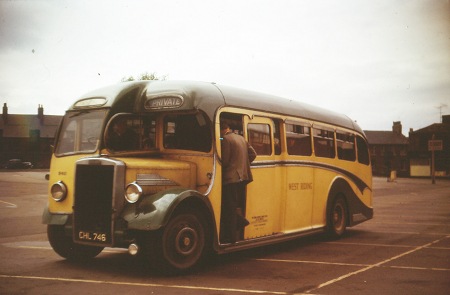


West Riding – Leyland Tiger PS2/3 – CHL 746 – 340

West Riding Leyland Tiger PS2/3

West Riding Automobile
1950
Leyland Tiger PS2/3
Longford C33F

This bus was originally owned by J Bullock & sons which merged with West Riding in 1950 this was after a failed attempt of West Riding to sell out to the British Transport Commission.
There is another photo of a similar preserved bus all be it 2 years younger and with a Roe body here.


Quick links to the  -  Comments Page  -  Contact Page  -  Home Page
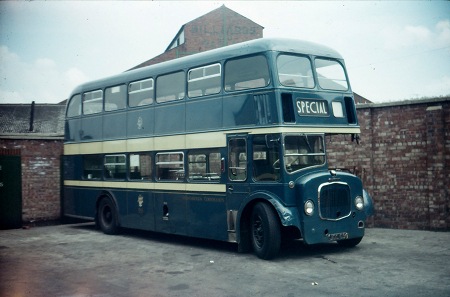


Middlesbrough Corporation – Dennis Loline I – JDC 599 – 99

Middlesbrough Corporation - Dennis Loline I - JDC 599 - 99

Middlesbrough Corporation
1958
Dennis Loline 1
Northern Counties H36/31RD

Photo taken on a trip to the Transporter bridge which I walked across the top of I presume it is still there or did they really sell it to the Red Indians. This bus is actually a preservation vehicle loads of information here. I seem to remember at the time a rumour that the Loline was actually a Bristol Lodekka built by Dennis not sure how true it was, if any body knows leave a comment.


My Group now own and have preserved this Dennis Loline Mk1. The Loline was in fact a licence built Bristol Lodekka, they of course could only be sold to state owned undertakings and Dennis wanted a bus to rejuvenate their sales in the Municipal market. Northern Counties built a one off body for this bus which was exhibited at Earls Court Commercial Vehicle Show in October 1958 before entering service with Middlesbrough Corporation on 5th November 1958.
In the photo above it is seen at Middlesbrough Corporations Parliament Road Depot towards the end of its life, when, because it was a backloader, and all the rest of the fleet were front loaders it only saw light service being used for transporting Councillors from the Councils planning committee on site visits etc. We rebuilt the bus between 1994 and 1998 and took it to Showbus at Duxford for its 40th anniversary where it won the class for "best preserved Dennis". It is now used extensively for running days and rallies, in fact it has now done over 120 events in the past ten years without any major trouble.

David Hunter


I rode on this magnificent vehicle at a Heart of the Pennines Rally back in the 1990s and was highly impressed by its performance on the hills around Halifax. Only Tony Blackman’s souped-up Regent III did better. Best wishes to those who preserve the Loline. Think you’re not quite right in describing the body as unique, though, Lancashire United had two very similar Loline Is. Sadly neither survived into preservation.

Neville Mercer


23/03/11 – 06:58

Barton’s Dennis Loline 111 861 XAL flt no 861 was the lowest British built decker at only 12’6" by NCME and was shown at the 1960 Commercial Motor Show.

Roger Broughton

My fault KC


23/03/11 – 18:35

Further to Roger and Nevilles posts There are shots of the Baton Loline and one of the LUT ones on www.sct61.org.uk. Barton vehicle has been in preservation for many years

Chris Hough


06/12/14 – 07:07

You are correct about ‘ Boro buses route numbers being letters. There were exceptions though, services from the Transporter Bridge were M1 & M2 which had same route for much of the way, splitting on Acklam Road although I cant remember the exact destinations, they were not far from the parting of the route. The other exceptions were the two routes,jointly operated by Stokton corp & M’bro corp Stokton used route numbers. To save face the route along Newport Rd was the O/0 the one via Acklam Rd was the 11/II. Hope this may be of of interest to you.

David Onions


06/12/14 – 08:51

I’ve always considered this bus in the "Borough" livery to be one of the most handsome and well proportioned vehicles I’ve had the pleasure to admire in a long long lifetime of enthusiasm.

Chris Youhill


16/04/15 – 06:43

Read somewhere that the Halifax Lolines were uniquely fitted with Leyland 600 engines. The vast majority were LX Gardner, though Oxford specified AV470’s in their Mk II chassis.

Paul Burgess


16/04/15 – 16:01

No, Paul, the Halifax Lolines had Gardner 6LX engines and five speed semi auto gearboxes.

Roger Cox


16/04/15 – 16:02

I can assure you Paul that the Halifax Lolines were fitted with the Gardner 6LX.

John Stringer


17/04/15 – 06:45

North Western took a batch of 15 Loline IIs in 1960, twelve of which had Leyland O.600 engines, the other three had Gardner 6LX.

Ian Wild


17/04/15 – 06:46

North Western had the Leyland O.600 engined Lolines.

Phil Blinkhorn


17/04/15 – 06:47

Do we know how much the Mk II chassis differed from the Mk I?

Chris Hebbron


17/04/15 – 09:28

The Loline Mk I was the original version with a rear entrance and a conventionally sprung rear axle. The Mk II had a forward entrance and air suspension for the rear axle, and it came on the scene in 1958, before the forward entrance versions of the Bristol Lodekka made their appearances.

Roger Cox


19/04/15 – 07:37

Luton also had two Lolines with Leyland O.600 engines. (Information from "British Double Deckers since 1942", A A Townsin, 1965, four shillings and sixpence and still very useful!).

Peter Williamson


20/04/15 – 07:12

Thx, Roger.

Chris Hebbron


12/12/15 – 07:51

Does anyone have a list of the corporation bus destinations/routes by letter? I used to live in Grove Hill, then Beechwood, so the C , D , Q and R were my routes. I was always fascinated about where all the others went. Especially the S and a very mysterious Belasis!!

Terry Begley


12/12/15 – 13:03

The 500 Group who own/preserve the Middlesbrough Loline will I am sure will be able to help you Terry.
Their Facebook group page is here https://m.facebook.com/500group/

Stephen Howarth


02/05/16 – 13:54

I’ve uploaded a ton of reference images I’d taken as part of my uni project to recreate a 3D model of this classic bus to feature in an animation.
When working on a 3D animation it is vital to gather as much high quality reference material as possible in order to study the subject. I was lucky enough to arrange a private visit of this bus with David (Group 500) who was kind enough to let me take lots of photos in order to capture as much detail as possible for my research.
Please feel free to check out some of these photos in my Flickr album www.flickr.com/gp/johnbriggs

Johnny


23/10/16 – 05:34

The M bus destinations referred to above in Middlesbrough were Lodore Grove and Levick Crescent. These were displayed as Lodore or Levick on the destination blind. The routes diverged on Acklam Road travelling south where it reached the eastern end of Levick Crescent. One version then travelled along the Crescent and terminated at the junction with Mandale Road, the other continued along Acklam Road until it reached Lodore Grove, slightly further south. Both versions were simply M, distinguished by the destination.

John Butler


24/10/16 – 07:15

Interesting photos, Johnny. I was intrigued by the longditudinal rear seats dividing into two sections with different levels, something I’ve never seen before.
If you put the animation online, let us know where we can find it, will you?

Chris Hebbron


Quick links to the  -  Comments Page  -  Contact Page  -  Home Page



All rights to the design and layout of this website are reserved     

Old Bus Photos from Saturday 25th April 2009 to Thursday 4th January 2024