Old Bus Photos

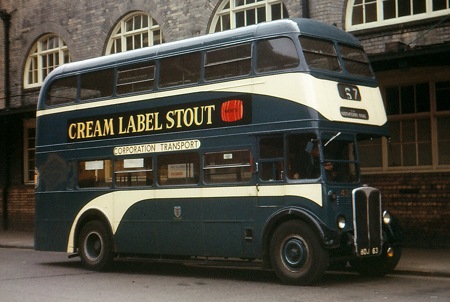
Hull Corporation – AEC Regent III RT – BDJ 63 – 143

Hull Corporation AEC Regent III RT Type

Kingston upon Hull Corporation Transport
1950
AEC Regent III RT
Park Royal H30/26R

KHCT had a large second hand batch of these RT types from 1962 to 1970 they were ex St. Helens Corporation, this bus was D63 in there fleet. There is a preserved St Helens RT type fleet no D67 and a good picture of it is here. There is also a picture here of ex fleet no D70 whilst in service with Norfolk’s of Nayland.

———


It’s amazing how a different livery and adverts can almost camouflage such an iconic vehicle as an RT. It looks superb in KHCT’s colours and the streamlined style suits it. It’s a shame, though, about the missing rear wheel spats and painted-over front wheel chrome rings to complete the idyll.
Thx for the post. AS for the advert, "What we want is Watneys" and ‘Red Barrel" keg bitter come to mind!

Chris Hebbron


Quick links to the  -  Comments Page  -  Contact Page  -  Home Page


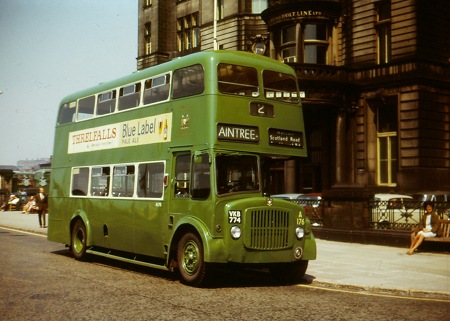
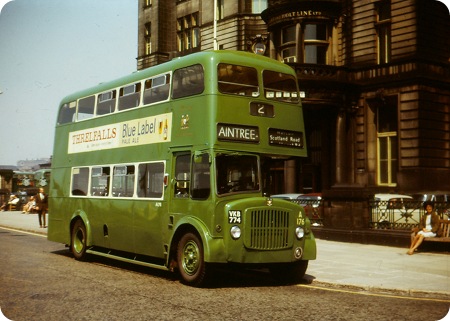
Liverpool City Transport – AEC Regent V – VKB 774 – A176

Liverpool corporation AEC Regent V

Liverpool City Transport
1957
AEC Regent V
Metro Cammell Weymann H33/29R

A unique radiator grill I think don’t know why as the standard grill looked much better than this tin look. I also think how much better the livery would have been if there was a nice cream band between the upper and lower deck, there was far too much green on Liverpool buses.


Glasgow Corporation also had this tin front on their Regent Vs

Anonymous


The original livery had a cream band right round the bus just above the lower deck windows, and a narrower, similar one below the upper deck windows; the green was also darker. The livery in this picture dates from about 1964 I think.

Anonymous


Some of Aberdeens Gardner engined AEC Regent Vs also sported this type of grille.

Chris Hough


This type of grille was very common in the 1950s on AEC Regents and on Leyland Titans. Known colloquially as a ‘tin front’ the style was common to Regent IIIs and Regent Vs in the Liverpool fleet, 292 of them in all (A1-A292) , and from memory around 300 Titan PD2s. Very common too on Midland Red and Glasgow Corporation ‘deckers.

Anonymous


17/02/11 – 07:08

The ‘City of Liverpool’ name was not added to the coat of arms till 1965.

Anonymous


15/04/15 – 10:43

I remember these well particularly running on routes 4 and 5 from South Castle Street to Woolton, and the 4b and 5b from the Pier Head to Penny Lane. On the 4 and 5 routes, they were able to get up to a fair old speed along the dual carriageways of Menlove Avenue between Penny Lane and Woolton. The 4b and 5b ‘belt’ routes ran out to Penny Lane via Wavertree and Smithdown Road respectively, then changed route number to run back to the city centre the other way, both quite heavily trafficked routes. The Penny Lane terminus was near the ‘shelter in the middle of a roundabout’ made famous in the song, also the terminus of the 99 to Lower Lane, the 42 to Edge Lane, the 71 to South Castle Street, the 77 into town and the 46 to Walton, on which I recall for a while seeing the two single deckers, SL175 and SL176.

Mr Anon


23/01/17 – 16:35

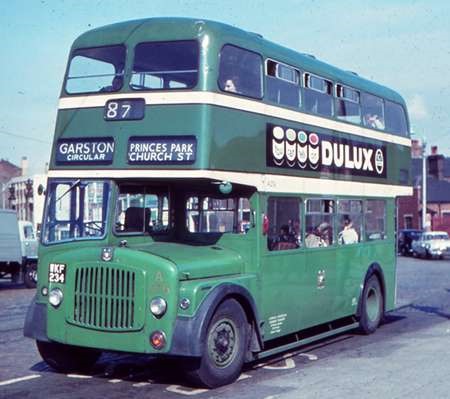
Not strictly about this bus, but the AEC Regent V D3RVs of Liverpool had one similarity to AEC Regent III 9613A A757-806 – the gearbox sound.
Although the A757 etc batch were described as 9613As they had synchromesh gearboxes, and the later batch A1-100 were 9613S. AEC Regent Vs A101-292 and Bridgemaster E3 all sounded the same.

Paul Mason


25/01/17 – 07:32
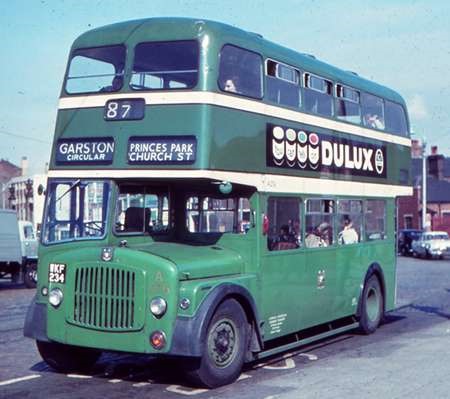
WKF 234

Herewith the original Liverpool livery on this type – taken at Pier Head on 5/7/1962. At this time the cream only around the windows (to make masking for spray painting quicker, I was told) was already well under way.
It always looked to me that the bottom half of the vehicles were repainted more often than above the lower deck windows.
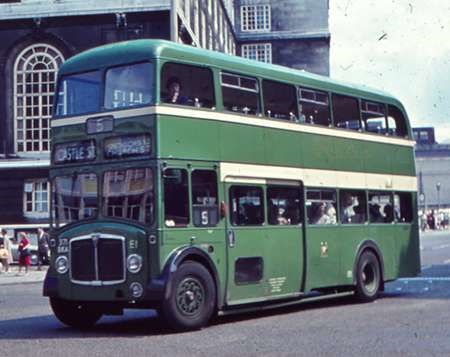
371 BKA

As an afterthought, I have also included the one and only 30fter AEC in the same livery taken at the Adelphi 26/6/1962.

Geoff Pullin


02/08/20 – 06:43

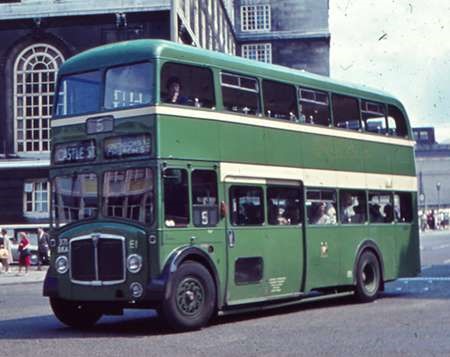
Where were the handles placed that wound the number and destination scrolls? I remember them as being under the top deck over the front right fender next to the driver’s cab. But on the photos this looks not to be the case.

Gary


03/08/20 – 06:29

I’m not sure about vehicle E1 in particular, but from what I can recall all Liverpool double decks till then had a very robust cast metal destination gear framework that was accessed by the conductor from the front bulkhead of the upper saloon and hinged out so the blinds could be adjusted and seen before being clanged back into place, usually before reaching the terminus.
The subject of changing destination blinds is fascinating in its own right! Even within the much standardised Tilling Group companies, there was no standard! It was surprisingly late in the production of the Lodekka that the double width step appeared in the front cowl instead of two widely spaced single foot holes. The first time was on the six prototype 30ft long vehicles in 1957 and then standardised in the Flat Floor series. Presumably this was to ease access for those companies that had conductor operated blinds. Bristol Tramways/Omnibus itself always used driver operated blinds with controls in the cab roof, so it would not have been imbued in its erstwhile motor constructional works designers as being an operational difficulty!

Geoff Pullin


04/08/20 – 06:38

Geoff’s comment reminded me that the PMT Atlanteans and Fleetlines 1959-1965 had a similar destination layout which the conductor changed from the top deck by hinging the unit towards him so that the destination could be set before pushing the unit back into the vertical position. These were the first double decks with separate main and via blinds.

Ian Wild


05/08/20 – 06:47

Similar on some of Trent’s vehicles. I remember heading into Nottingham with my parents one evening about 1956 (I’d be 7). Front seat upstairs on one of the pre-war Willowbrook re-bodied Regents. Conductor came upstairs, unlatched the display before my wondering eyes, turned to me and said, "Right – you wind that handle right to the end…"

Stephen Ford


20/08/20 – 05:33

Geoff Pullin comments about being unsure whether E1 had the hinged blind box of its predecessors. In fact this feature continued on the Atlanteans of the L500-L801 (at least) series which were delivered with the three-window layout. It was only with the introduction of OPO that the simplified layout with just number and terminal displays was incorporated, which could be operated from the driver’s seat.

Alan Murray-Rust


Quick links to the  -  Comments Page  -  Contact Page  -  Home Page


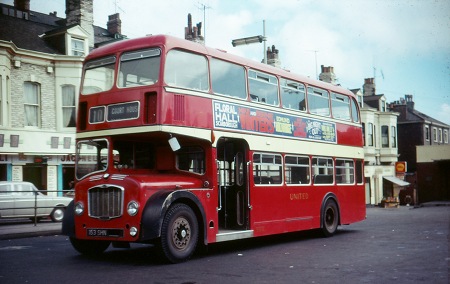
United Automobile – Bristol Lodekka FLF6B – 153 SHN – L153

United Bristol Lodekka

United Automobile Services
1964
Bristol Lodekka FLF6B
ECW H38/32F

I am not sure if the Lodekka actually had a version number i.e. I, II, III as the Regent III, V for example if any body knows please let me know. I did like these front entrance Lodekka’s, the three things I remember most is the low step to get on, how brightly light the interior was at night but best of all was the whine of the engine, being used to AEC and Leyland’s at home the Bristol or Gardner engines were very different.

A full list of Bristol codes can be seen here.

A full list of United codes can be seen here.

———

The best United engine noises of all were the final batch of Bristol FLF Lodekkas delivered between January and May 1968. These F-registered machines were fitted with Gardner engines and were the first non-Bristol engined buses in the fleet. A Bristol-type whine was accompanied by a very powerful growl as I remember – very impressive. Also, this final batch were even brighter inside than normal. The interior panelling was finished in all-over cream formica as opposed to the normal dark green which made them feel light, spacious and very modern. They were lovely vehicles to ride on!

Incidentally, you may like to know that I am the author of a book on United’s buses entitled ‘One And Two Halves To The Clock’, which is my own story of growing up as a lad in the 1960s in Redcar, North Yorkshire – a seaside town deep in United territory!

Colin Plucknett

———

Although Lodekkas did not have version numbers as such (ie: Series I, II, III etc), they were split into two broad types – namely LD and F-Series models. The original LD (Low-height Double-decker) series had a slightly sunken lower deck gangway, with the pairs of seats either side of it in effect raised above it. A longer version (LDL) made its debut in 1957, but only a handful were built. As the Lodekka developed over the years, a revised model was introduced. Known as the F (Flat floor) Series, this had as the name implied, a flat floor throughout the lower deck. It was available in four variants: FS (Flat floor, Standard/Short chassis); FL (Flat Floor, Long chassis); FSF and FLF (as for FS and FL, but with the second F denoting a forward entrance chassis). Interestingly, the Bristol BVW engine fitted to many a Lodekka from 1958 onwards did have version numbers. As the BVW evolved, engines became known as Series I, II and III, and could be identified by the serial number stamped on the engine plate. BVW1xxx denoted Series I, BVW2xxx were Series II, and BVWs numbered 3xxx/4xxx etc were Series III.

Brendan Smith

———

There was a final variation to the FLF series: the very impressive 31ft FLF6LX models, with semi-automatic gearboxes, as operated by Eastern National. Several of them started life with coach seating for the X10 Southend-London Victoria service. In their heyday, around 24 of the 40 plus that ENOC had were allocated to the long 151/251 working from Southend to North London (Wood Green): a 2hr 40min one way trip! Also, one or two were regularly featured on the "On the Buses" TV show.
As a Conductor, these were wonderful vehicles to work on, especially on the long haul routes. I also believe the Scottish Bus Group had some as well. They’re the only two operators I know that used them. Any others, anyone?

Mike Harper

———

05/06/11 – 14:28

Eastern National’s FLF coaches certainly were real stunners Mike, and the 31-footers were handsome machines in either bus or coach form. As you rightly say, several of ENOCs Wood Green FLF6LXs featured in ‘On the Buses’ and were to many of us the real stars of the show. (I wonder if Reg Varney and Doris Hare realised just how privileged they were to work alongside such venerable icons!). At least AEV811F and AVW399F took part in the series masquerading as buses of the Luxton & District Traction Company – and wasn’t it a quirk of fate that the ‘AVW’ registration was on a Gardner-powered bus? You are correct in saying that only ENOC and the Scottish Bus Group took delivery of 31-footers – sadly for some reason they didn’t find favour anywhere else.
Relating to the semi-automatic FLFs, I was fortunate enough to ride on Leyland 0.600 engined Hants & Dorset example when on holiday with friends in the 1970s. I had not realised the FLF had either feature until it started up and set off. The pronounced gear whine puzzled me, and it was only in later years I found out this was due to extra gearing in the transmission line. On manual gearbox Lodekkas the gearbox was mounted directly behind the engine, with the drive being taken downwards and slightly to the offside by the design of the gearbox. However, as the semi-auto ‘box was of a bulkier nature, this unit was mounted on the offside of the chassis. The drive was taken downwards and to the offside from the back of the flywheel to the gearbox, using a train of gears – hence the unusual whine emitted. It certainly added a certain character!

Brendan Smith


Quick links to the  -  Comments Page  -  Contact Page  -  Home Page


All rights to the design and layout of this website are reserved     

Old Bus Photos from Saturday 25th April 2009 to Thursday 4th January 2024