Old Bus Photos

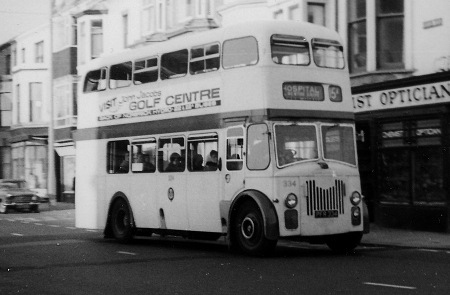
Hull Corporation – AEC Regent III – OKH 336 – 336
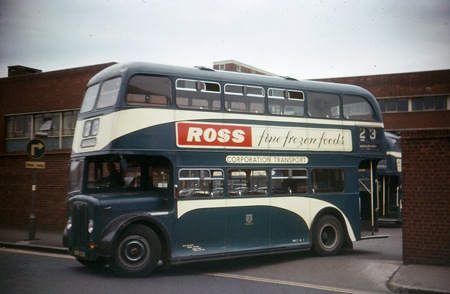
Hull Corporation AEC Regent III

Kingston upon Hull Corporation Transport
1953
AEC Regent III
Weymann "Auroa" H32/26R

Regent III I hear you shout, yes I thought it was a Daimler as well, until Paul Morfitt a K.H.C.T. expert pointed it out to me. K.H.C.T. bought 6 of these Regent IIIs with the Birmingham style tin front, they were apparently the last front engine/open platform buses bought brand new by them. Fleet number 337 is now fully preserved and should be out on the rally circuit next summer (2010) so keep your eye out for it. There is also a restored Bradford City Transport Regent III with a similar tin front it can be seen here.


04/04/13 – 06:28

The Weymann Aurora body is something of an enigma. The first one – also co-incidentally on an AEC Regent III with tin front – was built for Devon General and exhibited on the MCW stand at Earls Court in 1952 alongside the prototype Orion. An MCW sales brochure was produced, which was still being distributed two years later, but no more bodies of that type were ever built. In the meantime Weymann had been building this much more elegant design, which most people agree bears no resemblance to the prototype described in the brochure, and which could instead be traced back much more clearly to earlier Weymann bodies. It is almost as though Weymann simply thumbed its nose at the MCW design team and just carried on with their own design evolution as if nothing had happened.
To confuse matters still further, a brief article in a recent edition of Classic Bus magazine, describing the prototype (which is now preserved) as unique, it was answered by not one but two letters referring to production Auroras as "virtually identical" to the prototype – one of them referring to these Hull vehicles and the other I think to some Bristols for Maidstone and District. It seems that resemblance, like beauty, is in the eye of the beholder!

Peter Williamson


04/04/13 – 08:29

The Aurora is certainly an enigma – and a trap for those who only know half the story. I too have been puzzled by the lack of similarity between to prototype and production versions but the Weymann Story (in two volumes Senior/Venture) is very clear. The Aurora name was used for these modernised versions of the classic Weymann design (produced from 1953 to 1959). The MCCW Orion design was produced at Addlestone from about 1953 (the first being re-bodies of war time Guys for Maidstone & District). Interestingly, Addlestone were also building Aurora bodies on war time Bristols for M & D. What most people didn’t realise – me included – is that the Aurora name was then resurrected as the official and proper name for the forward entrance version on the Orion.

David Oldfield


04/04/13 – 11:03

Just remembered the Bournemouth trolleys which had the Aurora as late as 1962.

David Oldfield


04/04/13 – 11:04
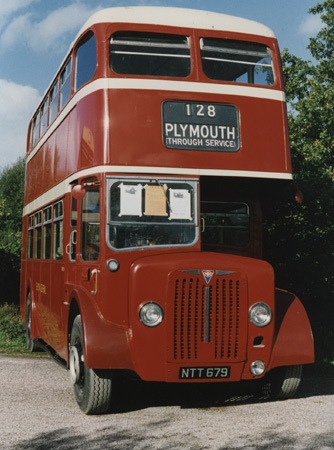
NTT 679

Here is a photo of the preserved one-off 1952 Aurora, Devon General NTT 679, taken at the Devon General Running Day at Newton Abbott in 1993.

John Stringer


04/04/13 – 15:49

The main difference between the prototype Aurora and the production model seems to be the move from pan window fixing to rubber mounting.
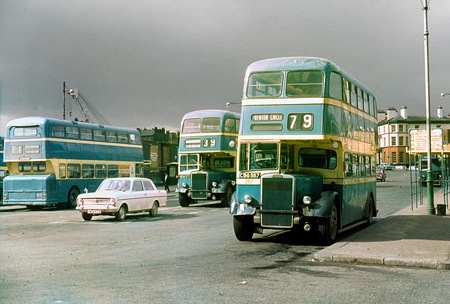
birkenhead titan

Here is an example of the production version as supplied to Birkenhead Corporation in 1954. Apart from being on an exposed radiator chassis, it differs from the Hull version in having a 5-bay body. The traditional Weymann drooping saloon window is much in evidence. Birkenhead dabbled with Weymann as a body supplier. The batch of 10 Auroras was not the whole of the CBG intake, the remaining 5 of the batch having locally-built Ashcroft bodies. The 1955 intake of 17 vehicles (10 PD2 and 7 Arab IV) saw half the PD2s bodied with the Orion style, and finally in 1964 came the one-off batch of 10 Fleetlines, again with Orion style, one of which appears on the left of the picture. (Originally delivered with the cream relief as window surrounds only, the appearance of the Fleetlines was much improved with the application of the standard livery on repaint, as seen here.)

Alan Murray-Rust


05/04/13 – 05:51

To me there are more differences than similarities. On the prototype, the dimensions of the windows – deep lower, shallow upper – are more like a production Orion than any other Aurora (and the deep lower deck windows were made much of in the sales brochure). On the production version, as Alan says, the traditional Weymann drooping bulkhead window is much in evidence, whereas on the prototype the top rail is straight and only the bottom curved, again just like most highbridge Weymann Orions. In fact the only similarities I can find (using other images) are in the front and rear domes and the rear emergency window.

Peter Williamson


23/04/13 – 07:50

My favourite bus, thin steering wheel and a smooth seat which you could slide off on exit from a roundabout and if it was a hot day and your cab door was open it could be interesting. A lot of drivers didn’t like them because you couldn’t see the pavement from the cab. I thought they were great, the exhaust would roar when you put your foot down.

box501


03/06/14 – 12:52

The Daimler and Guy Utilities of Maidstone and District were rebodied with a later form of five bay Weymann body derived from the pre and early post war design but with deeper windows upstairs. Only some Utility Bristol K6As had four bay ‘Aurora’ or five bay ‘Orion’ bodies. The only Orion bodied Guys which Maidstone and District had, were the Guy Arab IVs acquired or ordered by Chatham and District which were based on new post war chasses.

Gordon Mackley


Quick links to the  -  Comments Page  -  Contact Page  -  Home Page


Blackpool Corporation – Leyland Titan PD2/27 – PFR 334 – 334

Blackpool Corporation Leyland Titan
Photograph by ‘unknown’ if you took this photo please go to the copyright page.

Blackpool Corporation
1959
Leyland Titan PD2/27
Metro Cammell Weymann FH35/28R

Blackpool were really into the full frontal look I think it was to make them look like the trams that Blackpool is famous for. Before these normal looking full frontal Titans they had other versions which they classed as ‘streamlined’. The bodies were built by Burlingham a local body builder, I think they were bought out by the better know company called Duple.
There is a photo of a ‘streamlined’ Blackpool Leyland Titan here.

A full list of Titan codes can be seen here.


This photo is clearly of 334 (PFR 334), not 344. Good pic, though. 334 was one of a batch of 30 numbered 331-350. The 1960 abc British Bus Fleets No.6 (Lancashire), shows the seating as 61, reduced to 59 in the summer (for increased luggage space?). Burlingham were based in Blackpool and after the Duple takeover, the factory was known as Duple (Northern).

A Woods


Thanks for that, new glasses required I think, I have altered the heading so it is now correct.

Does your 1960 abc book have the above vehicle as a PD2/27 as my 1965 version because the website ‘Bus Lists on the Web’ has it has a PD2/40?

The 1965 abc British Bus Fleets No.6 lists a batch of 50 as the following:-
301 – 310 PD2/21
311 – 350 PD2/27

The ‘Bus Lists on the Web’ site as the same batch of 50 as the following:-
301 – 310 PD2/21
311 – 330 PD2/27
331 – 350 PD2/40

Can anyone solve this anomaly.

Peter


There is certainly plenty of odd information about these buses. I quote from two sources:
In "Blackpool’s Buses", by David Dougill, the fleet list shows 301-305 as PD2/21 with Burlingham bodies, while 306-310 had MCW bodies. 311-350 were PD2/27 with MCW bodies. "Trams and Buses Around Blackpool" by the well-know duo Steve Palmer and Brian Turner gives the same detail. The only difference between 311-330 and 331-350 is that the earlier numbers were delivered in 1958 and the later ones arrived in 1959.

Pete Davies


The PD2/40 was an exposed radiator variant of the breed I would suggest that Blackpool had no exposed radiator buses delivered post war. Early ones had full font bodies to a Blackpool design by Burlingham while later examples both fully fronted and half cab had variations on the Leyland Titan tin front Some of Blackpools PD3s had an asymmetrical full front due to the revised "St Helens front" of concealed radiator PD3s

Chris Hough


Chris, I’m no Blackpool expert but do I recall in the murky recesses of the mind that sometimes "exposed" radiators with smaller blocks were provided for certain full-front applications? Does that clarify – or muddy – the waters?

David Oldfield


This bus survived longer than most of its classmates as, along with 337, it was converted for use a Permanent Way staff bus in which guise they were numbered 434/7 (346 also worked for the Electrical Services department).
From my time at Blackpool I have a 1978 fleet list which shows these as PD2/27s which entered service on 25th and 26th March 1959 respectively.

David Beilby


Blackpool 334 was a PD2/27 as David Beilby confirms. To answer David Oldfield, Leyland supplied the ‘exposed radiator’ version of the Titan for full front designs where the front grille was part of the body design rather than being one of Leyland’s standard fronts. Examples are Ribble’s PD3’s with Burlingham and MCW bodies and the Southdown ‘Queen Mary’ Northern Counties bodied PD3’s. They were PD3/4 and PD3/5’s. As Blackpool used both the standard Leyland BMMO and St Helens style bonnets in their full fronts these Titans were the concealed front chassis types, PD2/21,PD2/27,PD3/1 and finally PD3A/1. The latter had the asymmetrical front windows with the nearside windscreen ‘drooping’ down to follow the shape of the St Helens style bonnet. This arrangement was also used on PD3A/2’s operated by Bolton Corporation with both East Lancs and MCW forward entrance bodies.

Philip Halstead


02/02/11 – 10:00

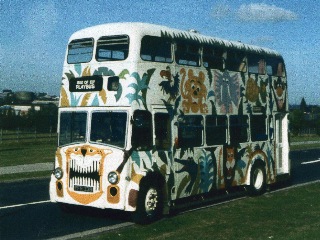
I was the last driver of PFR 339, one of the buses mentioned in the above article. It was being used as a play bus for the Wisbech area and survived in a working state until 1982. It used to move from one school to another in this area to provide a base for play schools in village where none existed.Playbus at colchester159 Gradually these village were able to form their own playgroups in accommodation of their own so PFR 339 worked at achieving it’s own demise. Eventually in 1982 it stayed in one school for a few years as a permanent base, but was eventually replaced by a more suitable form of accommodation. Clement Freud and his wife Jill were instrumental in setting it up in the first place.

Peter Thatcher


04/11/18 – 07:21

When I were a nipper as the saying goes me, my sister took a day trip to Blackpool. We went by Ribble X61, a DP Leyland Leopard out and a White Lady Atlantean (RRN reg) back to Liverpool.
We had a ride on a Balloon tram (two 1s, two 6d). We kept the ticket for years,it was a TIM issue. From the tram ticket we got the date 8th August, 1968.
Note the date. I spotted a BRAND NEW gleaming Leyland Titan PD3A, which could only have been LFR 538/9/40G when a week old. Sadly they were Blackpool’s last such buses but they gave good service unlike many mid-late 1960s back loader of which only the Routemaster had a long life
In my opinion the St Helens bonnet didn’t suit a full front, which Blackpool Corporation recognised by specifying half cabs for 381-399 and 500-540. The 1950s Leyland Titans would have looked better with a Ribble style grille, but I guess BCT wanted to be different! .

Paul Mason


Quick links to the  -  Comments Page  -  Contact Page  -  Home Page


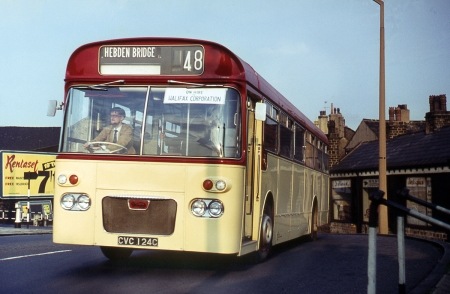
Demonstrator – Daimler Roadliner – CVC 124C

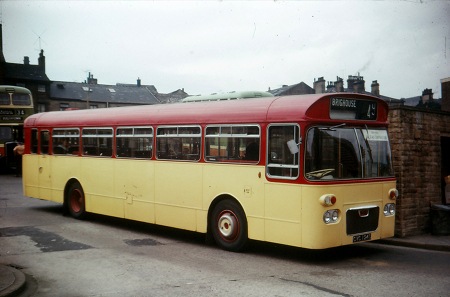
Halifax Corporation - Daimler Roadliner - CVC 124C

With – Halifax Corporation Transport and Joint Omnibus Committee
1965
Daimler Roadliner
Marshall B50F

I have listed this under Halifax Corporation has that is who the Roadliner was on loan to at the time the photo was taken. I went on this bus to Brighouse on the 49 route which was normally serviced by double deckers maybe the intention was to replace them with high capacity single deckers. Halifax didn’t buy any Roadliners or any similar single deckers so the route must of carried on being serviced by double deckers.
I have tried to research which operator the Roadliner finally ended up with but to no avail, if you know, let me know, leave a comment.


By 1975 this bus was with the Transport and Road Research Laboratory at Crowthorne Berks, and was used for "Guided Bus" experiments involving the bus being guided by a wire buried in the road.

Derek Lucas

———

It was the Daimler demonstrator, a deal was struck with Bob Crouch at Daimler to keep the bus in Halifax but it would be released back to Daimler when needed for demonstration purposes, it usually worked the 5/6 circulars and later had a green roof.
The Cummins VIM V6 engine was a poor unit and lead to the early demise of these buses.
In Halifax the poor roads lead to chassis body flexing and the long chassis severely restricted route availability, also with long routes such as 48/9 it meant too many unhappy passengers standing up.
Finally at this time – it had to have a Gardner 6LX – or it was out!

Christopher


08/03/11 – 15:44

I believe this bus was sold in the late 70’s through the Gov auction sales at the OSDD at Ruddington, Nottm., I was a fitter at the time, my apprentice and I had a drive around the perimeter, it still had the mountings for the experimental equipment and only about 4 seats were installed.

Roger Broughton


29/08/11 – 08:14

We had a number of batches with V6/V8 engines, with Plaxton Coach Bodies for express services, FAST/GOOD HILL EATERS, but required one driver-one coach, to keep them on the road.
The engine sound going through a urban area at 02.00 hrs. was out of this world!!!! Went back to LEOPARDS, after the 4th batch, that or buy a 2nd towing unit. [mind you all top management had Daimler cars by then, buy 9 get a free car?????]

Mike 9


29/08/11 – 16:31

Halifax Corporation - Daimler Roadliner - CVC 124C No2

Here is another picture of the Roadliner under evaluation in Halifax, taken, if my memory serves me correctly, near King Cross. Personally, I doubt that GGH seriously considered this vehicle as a contender for the Halifax bus orders. Knowing his fascination with all things in the bus world, I suspect that he wanted to try it out through curiosity alone.

Roger Cox


04/01/12 – 06:56

I well remember the Roadliner from my time with Eastbourne Corporation in the 1960’s. The demonstrator CVC 124C arrived in Churchdale Road depot one Sunday afternoon, I can’t remember when, it was not used in service only inspected and must have had an impression on Mr R R Davies the manager as one was ordered duly arriving in mid 1967 as No 86 (DHC 786E). I was the first driver to take it out on service as a additional bus on service 6, the seafront route, the first one man operated bus for the Corporation which I must say did not go down too well with the residents of the Meads section of the route. Two more similar vehicles arrived the following year as No’s 90/91 (EJK 890/91) all three having two door East Lancs bodies and fitted with the Metalastik suspension. As many others have commented they were very raucous both inside and out the suspension also I seem to remember chattered quite a lot but their performance was a revelation. I believe all three had to have new engines before they had covered 30,000 miles. I recall that when selecting 1st gear when stationary the N/S front corner dipped quite noticeably. My lasting memory of these buses is of stopping on the seafront to pick up passengers when the engine cut out for no obvious reason and would not restart I then noticed in the N/S mirror smoke coming from the engine bay upon investigation I found the main electrical control box and master switch had broken loose and was swinging on it’s cables with terminals shorting on the exhaust pipe after very carefully switching off the master switch I found the short circuit had burnt a hole in the exhaust pipe. Meanwhile orders had been placed for Leyland Panthers, I left the Corporation in 1969 and the Roadliners quite soon after, it has to be said the Panthers were only marginally better.

Diesel Dave


Quick links to the  -  Comments Page  -  Contact Page  -  Home Page


All rights to the design and layout of this website are reserved     

Old Bus Photos from Saturday 25th April 2009 to Thursday 4th January 2024